Available online on 15.09.2018 at http://jddtonline.info
Journal of Drug Delivery and Therapeutics
Open Access to Pharmaceutical and Medical Research© 2011-18, publisher and licensee JDDT, This is an Open Access article which permits unrestricted non-commercial use, provided the original work is properly cited
Open
Access
Research Article
INFLUENCE OF PROCESSING PARAMETERS ON RHEOLOGICAL
BEHAVIOR OF BENTONITE-BASED PICKERING EMULSION
Saida TOUZOUIRT
a*; Fetta KESSAL
b; Chanez BALAIDI
a; Dihia BOUKHALFA
aa
Département de chimie, Faculté des sciences, Université Mouloud Mammeri, Tizi-Ouzou, Algérie
b
Laboratoire de Pharmacie galénique et industrielle, Faculté de Medicine, Départment de pharmacie, Université Mouloud Mammeri, Tizi-Ouzou, Algérie
ABSTRACT
The aim of this work is to study the impact of processing parameters on the rheological properties of Pickering emulsions containing bentonite particles, CTAB, NaCl and soybean oil. Emulsification experiments were performed using mixing and homogenization at different speeds for 10 minutes. The effects of stirring speed and homogenization were investigated to determine the best conditions for producing a suitable Pickering emulsion for the intended application. In order to assess the influence of processing parameters on the Pickering emulsion rheological behavior average droplet size was measured and rheological tests were performed on all the emulsions samples. The rheological behavior of these emulsions is modeled by Casson's law. Results show that the stirring speed first decreases the average size of the droplets, and then an effect on the initial viscosity is observed. Increasing the stirring speed increases the values of the initial viscosity in contrast to the infinite viscosity which is influenced by the homogenization speed. On the other hand, these processing parameters significantly affect the values of the yield strength.
Keywords: stirring speed, Homogenization speed, rheological properties, Pickering emulsion.
Article Info:
Received 15 Aug, 2018; Review Completed 07 Sep 2018; Accepted 07 Sep 2018; Available online 15 Sep 2018Cite this article as:
Touzouirt S, Kessalf, Balaidic, Boukhalfa D, Influence of processing parameters on rheological behavior of
bentonite-based pickering emulsion, Journal of Drug Delivery and Therapeutics. 2018; 8(5):442-447
DOI:http://dx.doi.org/10.22270/jddt.v8i5.1903
*Address for Correspondence:
Saida Touzouirt, Département de chimie, Faculté des sciences, Université Mouloud Mammeri, Tizi-Ouzou, Algérie
INTRODUCTION
Pickering emulsions are stabilized by solid particles and are characterized by their high stability against coalescence. Many studies have been carried out on the influence of the emulsion composition but just a few of them were conducted to understand how processing parameters can influence droplet size and rheological properties. Therefore, the rheological study must be taken into consideration for process design.1
The rheological properties of emulsions depends on several physicochemical factors such as the viscosity of the internal phase, the fraction and the viscosity of the dispersant phase, particle size and size distribution, shear rate, nature and concentration of the surfactant and temperature. The factors influencing Pickering emulsion
stability have been identified. These include parameters such as oil phase composition, particle characteristics, emulsification technique, and storage conditions. However, the most important factors influence particles size but also the rheological behavior.2
Usually, in Pickering emulsions the increase of dispersed fraction allows formation of an interfacial network around droplets, effectively the solid particles accumulate in the form of a dense layer at the oil-water interface thus reducing the mean droplets size and increasing the stability of the system 1, 2, 5, 6,. This phenomenon is called Pickering stabilization; this should be achieved to protect emulsion from flocculation and coalescence.
The stability of the Pickering emulsions was determined by mean droplet size and rheological measurements. For this purpose, we took an emulsion that has previously been reported to be stable.7 We studied the effect of the processing parameters namely the stirring speed and the homogenization speed on the mean droplet size and the rheological behavior of this bentonite-based Pickering emulsion.
2. MATERIALS AND METHODS
2.1. Materials
Samples of treated and activated 3% sodium bentonite from the Hammam Boughrara were graciously supplied the Algerian Bentonite company (BENTAL). These samples were collected from Maghnia (North-West Algeria) deposits. The clay samples are composed mainly of 93% montmorillonite and 7% of illite with a specific surface area of 872 m2/g, a swelling index of 35
cm3/g, a plasticity index of 120%, a cation exchange capacity (CEC) of 0.91 meq/g, and an average particle size of 74m. 8-10
The cationic surfactant cetyltrimethylammonium bromide or CTAB (formula C19H42BrN with a molar mass of 364.45g/mol) is a BIOCHEM Chemopharma brand; and sodium chloride NaCl is branded (MERCK Eurolab, for analysis). The soybean oil is graciously supplied by the company CEVITAL (Algeria) and meets the specifications of the pharmacopoeia, its viscosity is 80 mPa.s at 20°C and its density falls in the range of 916 - 922 g.cm-311, 12.
2.2. Formulation processes
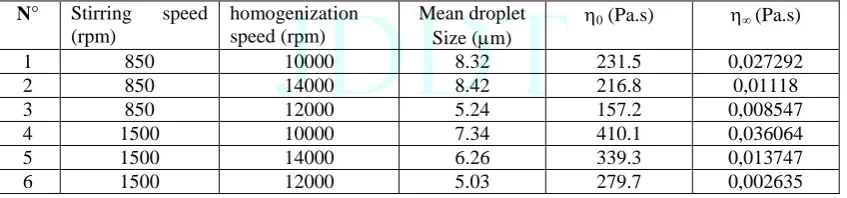
After wetting the bentonite in an adequate quantity of distilled water for 24 hours, the aqueous phase is prepared by mixing the bentonite suspension, the CTAB, and the NaCl with stirring for 1min30s using a Heidolph propeller stirrer type RZR1. The oily phase is then added drop wise while maintaining stirring at the same speed. The mixture is then homogenized for 10 minutes using the Ultra-Turrax homogenizer. The composition of the emulsions is given in Table 1. The emulsions were formulated at different agitation and homogenization rates according to Table 2.
Table 1: Composition of studied emulsions
Composition of emulsions
O / W ratio Bentonite (%) CTAB (%) NaCl (%)
30/70 7 0.02 0.015
Table 2: Operating conditions for emulsion formulation and characterization
N° Stirring speed (rpm)
homogenization speed (rpm)
Mean droplet Size (m)
0 (Pa.s) (Pa.s)
1 850 10000 8.32 231.5 0,027292
2 850 14000 8.42 216.8 0,01118
3 850 12000 5.24 157.2 0,008547
4 1500 10000 7.34 410.1 0,036064
5 1500 14000 6.26 339.3 0,013747
6 1500 12000 5.03 279.7 0,002635
2.3. Emulsions Characterization
2.3.1. Droplet size measurements
A light microscope of brand HERTEL and RESSUS OPTIC - KASSEL 55976 was used for droplet size determination driven by Optica image acquisition and processing software.
For each emulsion, different visual fields of gout are examined and about a hundred measurements were made to calculate the weighted droplet size average.
2.2.2. Rheological behavior
All rheological measurements were made using A HAAKE RheoStress 1 rheometer controlled by HAAK RheoWin Data software Manager.
The geometry used is parallel plate with a gap of 1.5 mm.
The tests were performed for 300s with a dot count of 30 for each emulsion. The temperature is kept constant at 20°C during all measurements.
3. RESULTS
3.1. Droplet size
A stable emulsion is an emulsion which has fine droplets. The latter is directly related to the stirring speed and texture of the emulsion.13
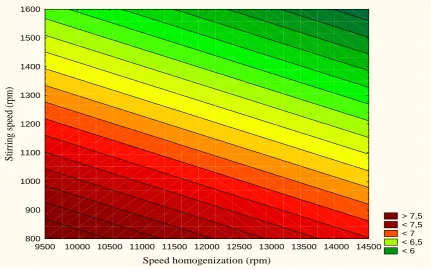
When comparing emulsions 1 versus 4 and 2 versus 5, increasing the stirring speed for the same homogenization speed (850 and 1500 rpm) lowers the average particle size from 8 to 7μm and from 8 to 6m respectively. For the homogenization speed of 12000 rpm the average size of the droplets remains to be the same (5μm). With a 40% lowering of the stirring speed (1500 rpm for the emulsion 6 and 850 rpm for the emulsion 3), the mean droplet size remains close to 5μm.
Figure 1 shows the influence of the torque stirring speed and homogenization speed on the mean droplet size. As can be seen from this figure, the smallest sizes are obtained with the highest speeds of stirring and homogenization. This can be explained by the fact that during the stirring the droplets are formed instantly and the size of the latter is directly related to the stirring speed applied, the homogenization refines the droplets already formed, there is breaking of drops which is facilitated by the surfactant which decreases the surface tension. Their size is thus reduced and depends on the speed applied.14
> 7,5 < 7,5 < 7 < 6,5 < 6 9500 10000 10500 11000 11500 12000 12500 13000 13500 14000 14500
Speed homogenization (rpm) 800
900 1000 1100 1200 1300 1400 1500 1600
Sti
rri
ng
s
peed
(rp
m)
Figure 1: Contour plot of droplet size (μm) according to stirring and homogenization speeds.
3.2. Rheological study
The shape of the rheograms illustrated in Figure No. 2 indicates that all emulsions exhibit the same rheological behavior which is rheofluidifying. We note that the curves can be fitted using the Casson's model (R2 = 0.9999).
Figure 2: Viscosity flow versus shear rate curve for the six formulations studied.
The Casson model is written as follows: 15
Where is the constancy of time; n the behavior index; is the shear rate; and are the respective viscosities with zero and infinite shear.
The viscosity at rest or zero shear viscosity ( ) is the parameter that defines the stability of the semi-solid product during its storage. Infinite viscosity or infinite shear viscosity ( ) describes the state of the product in use.
> 380 < 380 < 340 < 300 < 260 < 220 < 180 9500
10000 10500
11000 11500
12000 12500
13000 13500
14000 14500
Homogeneisation speed (rpm) 800
900 1000 1100 1200 1300 1400 1500 1600
Sti
rri
ng
s
peed
(rp
m)
Figure 3: Contour plot of the viscosity (Pa.s) at rest as a function of agitation and homogenization speeds
> 0,025 < 0,025 < 0,02 < 0,015 < 0,01 < 0,005 9500
10000 10500
11000 11500
12000 12500
13000 13500
14000 14500
Homogenization speed (rpm) 800
900 1000 1100 1200 1300 1400 1500 1600
Sti
rri
ng
s
peed
(rp
m)
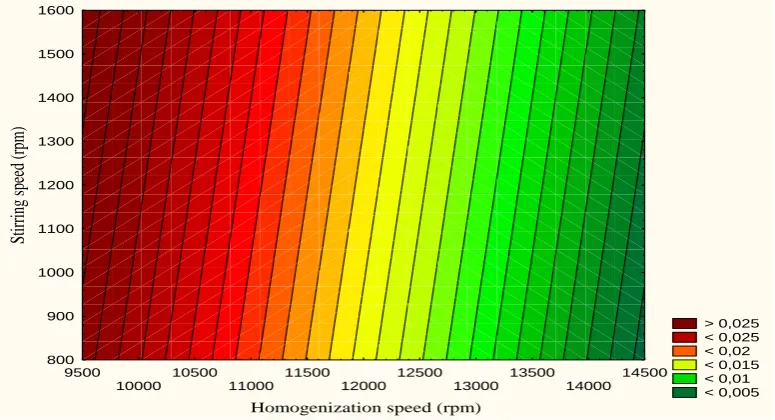
Figure 4: Contour plot of the viscosity (Pa.s) at infinity as a function of agitation and homogenization speeds.
For a homogenization speed of 12000 rpm, the viscosity at infinity is less than 0.01 Pa.s for the entire range of stirring speed studied.
By analyzing the rheogram of the stress as a function of the shear rate represented by Figure 5, we can see that both the stirring speed and the homogenization speed affect the yield stress of emulsions prepared.
The yield stress values of the studied emulsions vary between 18 and 42 Pa. The highest (42Pa) is given by emulsion 6 and the smallest one by emulsion 3. Both are formulated at the same stirring speed but at different homogenization speeds. In fact, for a stirring speed of 1500 rpm, the highest yield stress is given by the emulsion 6 which is homogenized at 12000 rpm. The reduction of 2000 rpm in the homogenization speed lowers the yield stress by approximately 43% (emulsion 4). Its increase of 2000tr/min also lowers the threshold stress but only by 24% (emulsion 5).
Furthermore, when the stirring speed is fixed at 850 rpm, the highest yield stress is given by the emulsion which is homogenized at 12,000 rpm. In this case, the reduction in the homogenization speed of 2000 rpm lowers the yield stress by approximately 42% (emulsion 1). Its increase of 2000tr/min also lowers the yield stress but only by 31% (emulsion 2).
The results of this study confirm that the homogenization speed affects the yield stress and thus the texture of the product. On the other hand, the most suitable speed in the case of our emulsion type (Pickering emulsion) is 12000 rpm.
4. DISCUSSION AND CONCLUSION
In this work, we have prepared a few Pickering emulsions stabilized by Algerian bentonite particles. Stirring and homogenization speeds were varied in order to study the effect of these parameters on particle size and rheological behavior of the formulated emulsions.
All emulsions exhibited shear thining non-Newtonian behaviour with yield stress. This rheological behavior can be correlated to the Casson model. The different rheological measurements revealed clearly the influence of process parameters, thereby the values of viscosity at rest and infinite, yield stress and mean droplet size are improved according to the studied speeds of agitation and homogenization.
Finally, several conclusions can be drawn for our bentonite-based Pickering emulsions :
- Regarding the size of the droplets which must be the finest, a high stirring speed is recommended. Increasing the homogenization rate beyond a certain value no longer decreases the size of the droplets. 16
- A high viscosity at rest also requires a high stirring speed (above 1200rpm).
- A great infinite viscosity requires a high homogenization speed.
In order to obtain a Pickering emulsion with a significant critical stress, the homogenization rate should be equal to at least 12000 rpm.
In order to choose the right conditions to formulate this type of emulsion, we must also take into account energetic aspects. The energy consumed during the homogenization step represents at least 80% of the total energy spent during the formulation of an emulsion. 17
Based on our investigations, the most favorable operating parameters for the formulation of a Pickering emulsion based on Algerian bentonite are as follows:
• stirring speed = 1500 rpm • homogenization rate = 12000 rpm
These values lead to emulsions with the following characteristics :
0 = 280 Pa.s; = 0.01Pa.s; c = 42Pa; and droplet size = 5m.
ACKNOWLEDGMENT
We gratefully acknowledge Pr. AHMED ZAÏD Toudert for their participation in writing of article.
We would like to thank Mr ANNARIS Hamid from the Faculty of Engineering Civil of Mouloud Mammeri University of Tizi-Ouzou who helped us to achieve the rheological tests.
REFERENCES
1. Stehl D, Hohl L, Schmidt M, Hübner J, Lehmann M, Kraume M, Schomäcker R and Klitzing R, Characteristics of Stable Pickering Emulsions under Process Conditions, Chemie Ingenieur Technik, 2016; 88(11):1806-1814.
2. Duffus L.J, Norton J.E, Smith P, Norton I.T and Spyropoulos F, A comparative study on the capacity of a range of food-grade particles to form stable O/W and W/O Pickering emulsions. Journal of Colloid and Interface Science, 2016;
473:9-21.
3. Paruta-Tuarez P, Fersadou H, Sadtler V, Marchal P, Choplin L, Baravian C and Castel C, Highly concentrated emulsions: 1. Average drop size determination by analysis of incoherent polarized steady light transport. Journal of Colloid and Interface Science, 2010; 346(1):136-142.
4. Ganley, W.J., P.T. Ryan, and J.S. van Duijneveldt,
Stabilisation of water-in-water emulsions by montmorillonite platelets. Journal of Colloid and Interface Science, 2017;
505:139-147.
5. Stiller S, Gers-Barlag H, Lergenmueller M, Pflücker F, Schulz J, Wittern K. P. and Daniels R, Investigation of the stability in emulsions stabilized with different surface modified titanium
dioxides. Colloids and Surfaces A: Physicochemical and Engineering Aspects, 2004; 232(2):261-267.
6. Frelichowska, J., M.-A. Bolzinger, and Y. Chevalier, Pickering emulsions with bare silica. Colloids and Surfaces A: Physicochemical and Engineering Aspects, 2009; 343(1– 3):70-74.
7. Touzouirt S, Limani C, Oukaci F, Ahmed Zaïd T and Nabiev M, Optimisation de la stabilité d'une émulsion de Pickering H/E à l'aide de la méthodologie des surfaces de réponses. The Canadian Journal of Chemical Engineering, 2017; 95 (1):77-82.
8. Barama S, Dupeyrat-Batiot C, Capron M, Bordes-Richard E and Bakhti-Mohammedi O, Catalytic properties of Rh, Ni, Pd and Ce supported on Al-pillared montmorillonites in dry reforming of methane. Catalysis Today, 2009; 141 (3–4):385-392.
9. Bouras, O., Propriétés absorbantes d’argiles pontées organophiles : synthèse et caractérisation. 2003, Université de Limoges: France.
modifiée par Fe(III), Al(III) et Cu(II). Revue des sciences de l'eau / Journal of Water Science., 2006; 19:23-31.
11. Rowe, R.C.e.a., Handbook of pharmaceutical excepients. 6 ed. 2009: Raymond C Rowe, Pharmaceutical Press and American Pharmacists Association.
12. British Pharmacopoeia. 2009, The Stationery Office on behalf of theMedicines and Healthcare products: London.
13. Bibette, J., Emulsion science : basic principles : an overview. Springer tracts in modern physics,. 2002, New York: Springer. ix, 140 p.
14. Trujillo-Cayado L. A, Alfaro M. C, García M.C and Muñoz J, Comparison of homogenization processes for the development of green O/W emulsions formulated with
N,N-dimethyldecanamide. Journal of Industrial and Engineering Chemistry, 2017; 46:54-61.
15. Couarraze, G. and J.-L. Grossiord, Initiation à la rhéologie. 3e éd. rev. et augm. ed. 2000, Paris: Technique et documentation. xii, 300 p.
16. Franco J.M, Raymundo A, Sousa I and Gallegos C, Influence of Processing Variables on the Rheological and Textural Properties of Lupin Protein-Stabilized Emulsions. Journal of Agricultural and Food Chemistry, 1998; 46(8):3109-3115. 17. Solano O.A.A., emulsions inverses tres concentrees Influence