INTRODUCTION
During the washing of coal for the removal – or bringing down to acceptable limits, of mineral matter (ash), sulphur, and other impurities, huge quantities of coal fines are generated, which, if not separated out, are carried away in the effluents and find their way into nearby river streams or other water bodies, thereby polluting the water. These coalfines, being of quite good quality with high vitrinite contents, are very valuable and can be gainful utilized for different purposes, e.g. blending with coals, making of briquettes, and soft coke etc. As such, beneficiation of these coal fines is of great industrial importance. One of the effective ways to retrieve these coal fines is via flocculation1-13 - a phenomenon defined, in most general terms, as the coagulation of finely divided particles, into greater mass. The process is thus related to fine particles, of colloidal dimensions, in suspension and is a process of bringing together – or agglomeration of, small particles in the form of ‘flocs’, often highly porous in nature, which settle under gravity, thereby giving rise to the clarification of the system. For
Biosciences, Biotechnology Research Asia Vol. 4(1), 259-266 (2007)
Studies on the effect of pH of slurry on zeta potential during
the flocculation of some Indian bituminous coals
ANIMAESH KUMAR MISHRA and D.P. PANDEY*
Department of Chemistry, Satish Chandra College, Ballia - 277 001 (India)
(Received: February 01, 2007; Accepted: May 06, 2007)
ABSTRACT
Experimental results of the study on the effect of variation of pH of slurry on zeta potential by the polymeric flocculants (HPAM, and Truefloc) during the flocculation of East Busseriya, Sudamdih and Singrauli coals of Jharia coalfields are reported. These results suggest that zeta potential greatly affects the flocculation behavior of coalfines as evidenced by higher settling rates at higher pH value. Zeta potential values are highly dependent on pH of the slurry and any change in pH alters the zeta potential value significantly. The highest zeta potential value is obtained in the pH, ranging between 6.0 and 7.0, which is also the range for maximum settling rate. The results of flocculation of coal particles have been explained on the basis of the ‘bridging mechanism’.
Key words: Slurry, zeta potential, flocculation, Indian Bituminous coals.
effecting flocculation, polymeric flocculants are now being effectively employed1-7, 10-13. Of late, Bioflocculants are also finding increasing use in flocculation 8-9 Thus; flocculation is an important part of coal beneficiation process.
Although good deal of work has been done on washing of coal, comparatively lesser and scanty work is repor ted in literature on the flocculation of coal fines, especially of Indian coals. The process of flocculation depends on several parameters, e.g. particle size, slurry concentration, pH of the medium, flocculant Dosage, agitation, viscosity, temperature, and zeta potential. Since Zeta potential plays an important role in governing the process of flocculation to a large extent, it is expedient to study the influence of this important parameter on flocculation of coals.
Indian bituminous coals, viz., East Busseriya, Sudamdih and Singrauli coals of Jharia coalfields.
MATERIAL AND METHODS
The influence of variation of pH of slurry on zeta potential during flocculation was studied by determining the zeta potential of different pH of slurry values. The pH of slurry was varied, due to which zeta potential changes and the other parameters, viz, Slurry concentration, particle size of coal, temperature of the medium, agitation were kept fixed. In this way, flocculation characteristics of the coals at different zeta potential values (Which is the function of pH of slurry) were investigated, using polymeric flocculants.
Selection and preparation of samples of coals The coals selected for this flocculation study were bituminous coals, namely East Busseriya, Sudamdih and Singrauli (all from Jharia coalfields).
Analysis of coals Samples of each of the above mentioned coals were individually prepared for flocculation tests. And for this the coal was
particles of size 36 BSS mesh. In a similar way, coal samples of all the coals in the particle size range 30 – 300 mesh were also prepared for other studies.
The samples of the coals were kept in water so as to prevent their oxidation. It was only at the time of slurry preparation that they were taken out of water and used as such.
Analysis of the Coal samples
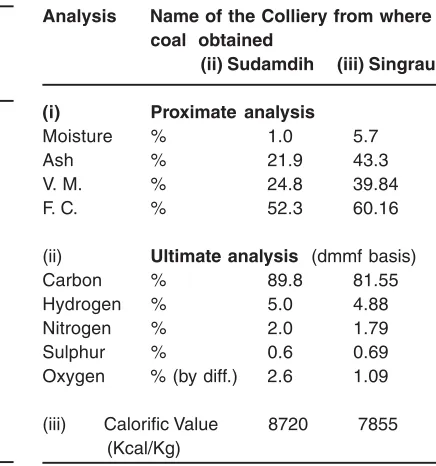
The Proximate and Ultimate analysis together with their calorific values are reported in Table 1 and 2.
Selection of Flocculants
The flocculants used in the present work were polymeric flocculants, namely, laboratory synthesised hydrolysed polyacrylamide (HPAM), and commercially available praestol and Truefloc flocculants.
Flocculation tests
For carrying out the flocculation tests, firstly a slurry of the coal was prepared and then settling rate determinations were made using the
Table -2: Proximate and Ultimate Analysis of Coals used for Flocculation Studies Analysis Name of the Colliery from where
coal obtained
(ii) Sudamdih (iii) Singrauli (i) Proximate analysis
Moisture % 1.0 5.7
Ash % 21.9 43.3
V. M. % 24.8 39.84
F. C. % 52.3 60.16
(ii) Ultimate analysis (dmmf basis)
Carbon % 89.8 81.55
Hydrogen % 5.0 4.88
Nitrogen % 2.0 1.79
Sulphur % 0.6 0.69
Oxygen % (by diff.) 2.6 1.09 (iii) Calorific Value 8720 7855 (Kcal/Kg)
Table - 1: Proximate and Ultimate analysis of Coal used for Flocculation Studies Analysis Name of the Colliery from where
coal obtained (i) East Busseriya (i) Proximate analysis
Moisture % 1.20
Ash % 16.00
V. M. % 24.20
F. C. % 59.60
(ii) Ultimate analysis (dmmf basis)
Carbon % 90.0
Hydrogen % 4.7
Nitrogen % 1.9
Sulphur % 0.7
Table - 3: Effect of Change of pH of Slurry on Zeta Potential during Flocculation of East Busseriya Coal with
HPAM, Praestol and Truefloc Flocculants.
pH of the Zeta Potential ( - mv) value as a result of Coal Slurry Flocculation with
HPAM Praestol Truefloc
2.0 - 23.0 20.0
2.5 22.0 -
-3.0 - - 21.0
3.5 - 26.0
-4.0 25.0 28.0 23.0
5.0 29.0 32.0 26.0
6.0 36.0 36.0 31.0
6.5 41.0 39.0 35.0
7.0 - - 31.0
7.5 33.0 37.0
-8.0 32.0 32.0 28.0
9.0 - 29.0 26.0
10.0 30.0 27.0 25.0
11.0 29.0 26.0 24.0
12.0 28.0 25.0 23.0
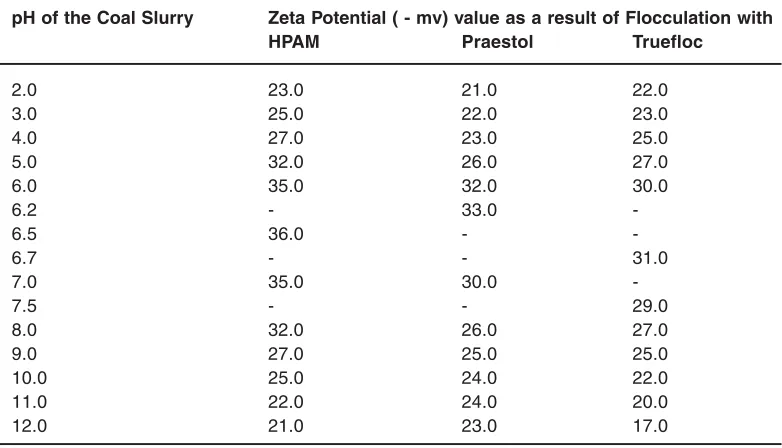
Table - 4: Effect of Change of pH of Slurry on Zeta Potential during Flocculation of Sudamdih Coal with HPAM, Praestol and Truefloc Flocculants.
pH of the Coal Slurry Zeta Potential ( - mv) value as a result of Flocculation with
HPAM Praestol Truefloc
2.0 23.0 21.0 22.0
3.0 25.0 22.0 23.0
4.0 27.0 23.0 25.0
5.0 32.0 26.0 27.0
6.0 35.0 32.0 30.0
6.2 - 33.0
-6.5 36.0 -
-6.7 - - 31.0
7.0 35.0 30.0
-7.5 - - 29.0
8.0 32.0 26.0 27.0
9.0 27.0 25.0 25.0
10.0 25.0 24.0 22.0
11.0 22.0 24.0 20.0
12.0 21.0 23.0 17.0
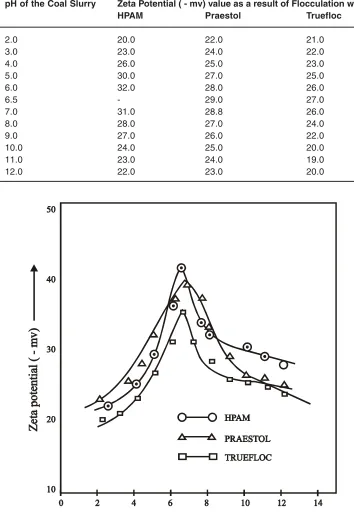
Table - 5: Effect of Change of pH of Slurry on Zeta Potential during Flocculation of Singrauli Coal with HPAM, Praestol and Truefloc Flocculants.
pH of the Coal Slurry Zeta Potential ( - mv) value as a result of Flocculation with
HPAM Praestol Truefloc
2.0 20.0 22.0 21.0
3.0 23.0 24.0 22.0
4.0 26.0 25.0 23.0
5.0 30.0 27.0 25.0
6.0 32.0 28.0 26.0
6.5 - 29.0 27.0
7.0 31.0 28.8 26.0
8.0 28.0 27.0 24.0
9.0 27.0 26.0 22.0
10.0 24.0 25.0 20.0
11.0 23.0 24.0 19.0
12.0 22.0 23.0 20.0
Fig. -2: Effect of pH of slurry on zeta potetial during flocculation of Sudamdih coal with
different flocculants
Fig. -3: Effect of pH of slurry on zeta potetial of Singrauli coal with different flocculants
flocculant solution of appropriate concentrations. The individual procedures are described below. i. Preparation of Slurry
Slurries of all the afore-mentioned coals were prepared for the flocculation tests. In the case of coal slurries, a weighed quantity (30 gms) of each of the powdered coal sample was transferred to a stoppered measuring cylinder of 500 ml capacity and the volume made up to the mark by the addition of distilled water. The coal water mixture was shaken vigorously by providing sepratetively end-to-end inversions to the cylinder, until the coal particles were thoroughly mixed and the system was homogenized. In case of fine coal particles, however, even the vigorous shaking was not found sufficient to wet the particles in comparison to coarser particles. Therefore, the solution was allowed to stand overnight in order to enable the finer particles also to wet completely. This slurry was eventually used for subsequent flocculation tests.
For all flocculation tests, the particle size of coals was 36 mesh and the concentration of slurry was kept 6%.
ii. Determination of Settling (or sedimentation) Rates
The settling rates were determined by adding the flocculants to the slurries and measuring the sedimentation rates of the flocculated particles. The optimum slurr y concentration and the concentration of flocculants were predetermined. Throughout the exper iments the slurr y concentration of 60 gm/litre was maintained and flocculant concentration of 0.1%.
The settling rate exper iments were performed in 500 ml stoppered measuring cylinder, having a centimeter scale pasted along its length up to the upper mark. For each individual settling rate experiment, freshly prepared polymer solutions and well-wet coal or vitrinite slurry, prepared in a manner described above, were used. To homogenize the slurry, it was shaken vigorously before mixing the polymer solution. After addicting the flocculant in predetermined dosage the cylinder was given 20-25 ent-to-end inversions. The cylinder containing the suspension was placed before a lamp to eliminate the particles and also to see the boundary clearly. The rate of fall of the boundary was measured against time using stopwatch having Mishra & Pandey, Biosci., Biotech. Res. Asia, Vol. 4(1), 259-266 (2007) 263
0 2 4 6 8 10 12 14
10 20 30 40 50
HPAM PRAESTOL TRUEFLOC
0 2 4 6 8 10 12 14
15 20 25 30 35
second till no further sedimentation was observed. Then a time verses distance settled curve was plotted, from which the settling rates were computed.
Measurement of Zeta Potential of Coals in Slurry The coal particles, including the finer ones in coal-water slurry, due to their microscopic size, form a colloidal system and such colloidal systems have a tremendous surface area of weight ratio. As a consequence of this, gravity is insignificant and surface forces rather control their behavior and zeta potential, as expected, plays a significant role in such colloidal systems. In Zeta potential determinations, measurement of the effect of electrostatic charge – a basis repulsive force, which is always counteracted by vander Waals forces, is made. The net result, i. e. attraction or repulsion depends on the relative magnitude of both. In a typical colloidal system, such as that of coal-water slurry, numerous counters and encounters occur between particles, as they move about by Brownlan motion and convection current. In other words, the outcome of these encounters or collisations between particles depends upon these attractive and repulsive forces between the colloids. While in case of an attractive force, the encounter will result in two particles remaining attached which then collide with third one and so on, until visible agglomerate forms and begins to settle, the net result in a case of repulsive force will, on the contrary, be the “near misses” as the two particles almost meet and are eventually repelled, as a consequence of which the system will remain stable, the colloids remaining discreet and in suspension. (a) Description of the Equipment
The zeta potential (ZP) of coal particles in slurry under different experimental conditions were measured using a zeta meter (Model ZM-77) procured from M/s. Zeta Meter Inc., New York, and U.S.A. The basic components of the zeta meter are a power unit and a microscope module. The former provides a precision regulated D.C. Voltage, which could be set anywhere from 0 to 300 volt (D.C.). The output voltage and current are measured on two precision (± 1%) meters. The power unit of this zeta meter was also equipped with an electric timer capable to measure time to a tenth of a second
addition to this, A.C. power for the microscope eliminator was also supplied from this unit. The microscope module is indeed a base for the microscope and the two eliminators. It also supports the mechanical stage, which allows precise positioning of the mirrored cell holder and the electrophoresis cell below the microscope.
The electrophoresis cell of zeta meter comprises a strip type platinum – iridium electrode and Molybdanum cylinder anode, the latter needing to be frequently cleared and more particularly when it turned from a metallic colour to blue black or black. (b) The Experimental Procedure and Computation of Zeta Potential
For computing the zeta potential values the Helmholtz-Smobichowski equation is employed which has direct relation between the zeta potential and electrophoretic mobility;
i.e.
ZP = 4πVT x EM DT
where EM = electrophoretic mobility at actual temperature and is given by the expression EM = 1600/ tV, t being time to transverse one full division and V the applied voltage.
VT = viscosity of the liquid in poise at temperature “T” DT = dielectric constant of the suspending liquid at temperature “T”,
4π = 12.57,
ZP = Voltage in electrostatic unit.
It is preferable to calculate ZP in “practical” millivolts instead of in electrostatic units. In such a case, the formula then becomes,
ZP = 113,000VT .EM (millivolts) DT .
At a given temperature the term 113,000VT is a constant such that the expression becomes
DTZP = CT. EM = CT 1600 t x V
The value of CT at different temperature is taken from the standard table.
RESULTS AND DISCUSSION
Since flocculation of coal depends largely on the surface properties of coal and the associated mineral matter i. e. ash, it was thought appropriate to study the surface characteristics of coal through the measurements of zeta potential, which also governs the adsorption of the polymer molecule on the solid coal particles.
The zeta potential values are highly dependent on the pH of the medium. Therefore,
the effect of pH of the coal slurry on zeta potential during flocculation with different flocculants was studied. The electrokinetic or zeta potential values of coal particles after flocculation were measured at different pH of coal slurries. The results are summarized in Table III, IV and V and represented graphically as plots of zeta potential value versus pH of coal slurry in Figs. 1, 2 and 3 respectively for East Busseriya, Sudamih and singrauli coals flocculated with HPAM, Praestol and Truefloc. A careful examination of these results leads to following observations
i) Zeta potential values are highly dependent on pH of the slurry and any change in pH alters the zeta potential value significantly. ii) The Zeta potential increases with increase
in pH up to a maximum at pH 6-7, beyond which any decrease in pH results in decrease in zeta potential. The highest zeta potential value is obtained in the pH, ranging between 6.0 and 7.0, which is also the range for maximum settling rate.
iii) The zeta potential value follows the order: East Busseriya > Sudamdih > Singrauli coal.
Also, the efficiency of the flocculants, in terms of zeta potential values, varies in the order: HPAM > Praestol > Truefloc, and holds true for all the coals studied.
The observation of highest zeta potential values in the pH range 6-7 can be explained that in this pH region the coal particles have maximum charge, which is why in this region maximum charge neutralization and bridging between flocculant molecule and coal particle takes place, causing maximum flocculation. Kumar et al14, while studying the electrokinetic characteristics of raw and beneficiated coal samples as also the tailings in the course of beneficiation of coals by froth flotation and oil agglomeration processes have also reported the dependence of zeta potential being in the pH range 6-7. Similarly Singh et al15 have also reported that in the pH range 6-7, the zeta potential values of Bhowrah coking coal is the highest and that in this region maximum flocculation takes place.
flocculation. On the basis of zeta potential measurements, Cambell and Sun16 have explained the adsorption behavior of coal particles during flocculation. Below or above the iso-eletric point (i.e. in the pH range 6-7 where zeta potential has been found to be highest) where the primary charge is zero and no double layer exists, the zeta potential of the coal particles will be reduced, due to which
rates would be lowered. The effect of zeta potential opposes the contact of the particles and causes their mutual repulsion and hence lowering in settling rates, as actually observed in the present work. It is thus seen that zeta potential plays a decisive role in modifying the surface characteristics of coal during their flocculation and also provides a clue to the mechanism of flocculation.
1. Tripathy,T, Karmakar , N.C. ,. Singh R.P., “Development of novel polymeric flocculant based on grafted sodium alginate for the treatment of coal mine wastewater”, J. Applied Polymer Science, 82, 375- 382, (1981)
2. Akers, R., Flocculation, Institute of Chemical Engineers, London, Eng., (1975).
3. Bratby, J., Coagulation and Flocculation, 1st edn., Uplands Press Ltd, Cr yodon, Cambridge, (1980).
4. Karmakar, N. C., Sastry, B. S. and Singh, R. P., Settling Characteristics of Coking and Non–Coking coal Fines, (ed. Srinivasan, K. S. V.), Allied Publishers, New Delhi, Vol. 2, pp. 1114–1117 (1998).
5. Hocking,, M.B., Klimchuk, K.A., Lowen, S., Polymeric flocculants and flocculation. JMS-Rev - Macromol. Chem. Phys. C, (1999). 6. Parekh, B.K. and Brauch, P.T., “Flotation of
Polymer Flocculated Coal Slurry” in Polymers in Mineral Processing, J. S. Lakskowski (Ed.), Canadian Institute of Metallurgy and Materials, (2000).
7. McGill, P,, and Flanagan, I.J., “The Twintec Advanced Dewatering System for the Solid-Liquid Separation of Coal Tailings”, in Polymers in Mineral Processing, J. S. Lakskowski (Ed.), Canadian Institute of Metallurgy and Materials, (2000).
8. Misra, M. Smith, RVV, Dubel, J., Chen, S. “Selective flocculation of fine coal with hydrophobic Mycobacterium phlei”, - J. Minerals & Metallurgical Processing, (1993) - csa.com
9. Vijayalakshmi, S.P., and Raichur, A.M.,
REFERENCES
“Bioflocculation of high-ash Indian coals using Paenibacillus polymyxa”. International Journal of Mineral Processing, 67(1-4), (2002).
10. Singh, G., and Gupta, R.K., “ Potential of polyacr ylamide-based flocculants for clarification of coal-washery liquid effluents”. Trans. IMM, Section C, Vol. 109 (Sept.-Dec. 2000).
11. Biggs, S., Habgood, M., G.J. Jameson, G.J., Y. -d. Yan. “ Aggregate structures formed via a bridging flocculation mechanism. Chemical Engineering Journal, 80(1-3), (2000). 12. Rulyov, N.N., et al, Application of
ultra-flocculation for improving fine coal concentrate dewatering, Coal Preparation, 26(1), (2006).
13. Ovenden, C., Xiao, H., “Flocculation behaviour and mechanisms of cationic inorganic microparticle/ polymer systems”. Colloids and Surfaces A: Physicochemical and Engineering Aspects, vol.197 no.2-3, (2002).
14. Kumar, J. D., Sengupta, S. K. and Bandopadhyay, P. J. Institution of Engineers (India), Mining & Metallurgy Divn., 64, 71 (1983).
15. Singh J., Tripathi, P.S.M. and Jha S. K. “Flocculation of Coal Fines vis-à-vis Their Recovery From Washery Waste Waters”, Paper communicated for presentation at the 2nd International Symposium on Beneficiation and Agglomeration, ISBA-86, R.R.L. Bhubaneshwar, December 17-19, (1986). 16. Campbell, A. L. and Sun, S. C. Transactions