An Exploration of Two ‘Modern Classrooms’: Elementary Science and Technology in the Shadows of Time, Standards, and Testing
Elizabeth Allison
University of South Alabama, USA M. Jenice Goldston
University of Alabama, USA
Abstract
This study explored two elementary teachers and their students’ perceptions of multiliteracies in science. The technological components of multiliteracies, including online communication tools, were of particular interest for this paper. The multiple case study included: two teachers and their students. One teacher taught a fourth grade classroom and the other a fifth grade classroom located in the same elementary school. Data collection included field observations, semi-structured teacher interviews, student focus groups, and semi-structured student interviews. Through extensive data analysis, we have constructed cases that represent the multiliteracies framework of a Modern Classroom defined by characteristics that include: 1) increasing and evolving access and use of technology, and 2) a lingering shroud of accountability to factors such as testing performance, state standards, and time limitations. Specifically, students voiced perceptions of technology as an effective tool for learning science and communicating in and out of the classroom. Teachers, though aware of the value of technology in science education, expressed concerns with logistical and pedagogical issues of implementation (e.g., grading online assignments and access to the internet). Teachers also noted time limitations and the breadth of standards as barriers to teaching science through inquiry. Whereas some students imagined the modern science classrooms as engaging with meaningful “projects,” other students demonstrated an enculturation to the common process of “schooling” involving reading then testing.
Key words: multiliteracies, student voice, elementary science education
Please address all correspondence to: Dr. Elizabeth Allison; 307 University Blvd, UCOM 3110, Mobile, Alabama, 36688-0002; [email protected]
Introduction
nature and uses of emerging, innovative technologies and communications in a global society with such diverse cultures that it broadens the term literacy, thus bringing the value of multimodalities in learning science to the forefront (New London Group, 2000). Multiliteracies as a lens for examining elementary science classrooms can provide meaningful insight into the complex interactions of contemporary science teaching, learning and communicating.
This study explored the presence of and participants’ perceptions of multiliteracies in two elementary science classrooms. In doing so, we paid particular attention to the often overlooked elementary students’ perspective or voice. We use the term, Modern Classroom, not in a general sense, but in terms of contextualizing the study’s elementary classrooms by two defining characteristics. First, a Modern Classroom is one with access to and integration of technological practices, including the use of mobile devices, the internet and computer software programs. Second, a Modern Classroom is one with an atmosphere wrought with a sense of accountability to, and resulting tension of, a variety of factors including testing pressures, state standards, and time limitations. Thus, this investigation is grounded in realities of the study’s participants who work and interact within the elementary classrooms. We use a multiliteracies framework to examine the participants’ meaning making of emerging classroom practices in teaching and learning science while attending to both teacher and student voices.
Background and Context
Multiliteracies
Multiliteracies emerged as a conceptual framework in 1994 when a small group of scholars met in New London to discuss a difficult question: “What constitutes appropriate literacy teaching in the context of the ever more critical factors of local diversity and global connectedness?” (Cope & Kalantzis, 2000, p. 3). This soon to be named New London Group understood the impact of “the changing world and the new demands being placed upon people as makers of meaning in changing workplaces, as citizens in changing public spaces and in the changing dimensions of our community lives—our lifeworlds” (Cope & Kalantzis, 2000, p. 4). Thus, the term “multiliteracies” was born. The “multi” in multiliteracies emerged from two views of literacy as “multiple.” First, innovations in technology as well as personal as social communications through the use of multimedia expand the boundaries of traditional literacy skills. Thus, literacy is viewed as multiple and encompasses modalities that include a variety of features: linguistic, visual, audio, gestural, and spatial (New London Group, 2000). The second “multi” descriptor of literacy refers to the increased cultural and linguistic diversity of society. Therefore, diversity of Modern Classrooms in science representing various cultures, languages, religions, and socioeconomic statuses lead to the need for, knowledge of, and implementation of multiliteracies in science education.
semiotic power, and the power to make and disseminate meanings” (Kress, 2003, p. 17). The “social change” referenced by Kress (2003) is not only in society at large, but in the microcosms of K-12 classrooms as well. As such, multiliteracies in science classrooms are value-laden through their embrace of an individual’s integration of creativity, independent thinking, collaboration, and views of diversity. In elementary science education, multiliteracies play an increasingly important role by enabling new ways for students to interact not only with science content and scientific practices, but also with each other, the teacher, and the larger global community. Though this work specifically addresses the technological aspects of multiliteracies in the classroom, to understand perspectives on how teaching and learning science is perceived by those in the science classroom, teacher and student voices must be honored and heard.
Incorporating the use of new technologies can assist in the planning science and utilizing multimodal instruction. For example, a classroom teacher found that an interactive white board (IWB) was useful when facilitating multiple means of communication in one lesson (or subsequent lessons) on evaporation, allowing for scaffolding in student learning (Gillen, Littleton, Twiner, Staarman & Mercer, 2007). However, it is imperative when preparing teachers to use multimodal instruction in their classrooms that the focus remains on student learning, rather than the novelty of “trying something new.” Anastopoulou, Sharples, and Baber (2011) assert that “through multimodal interactions, learners have the potential to engage with sensory and communicative modalities that are related to the subject matter to be learnt” (p. 267). The emphasis remains on the students, not the tools of instruction.
Student Voice
Student voice was a dominant agenda in educational research in the early 1990s (Brooker & MacDonald, 1999; Dahl, 1995; Lincoln, 1995: Oldfather, 1995; Wade, 1995), but lost momentum as the decade ended and research focuses shifted. This study revives an emphasis on student voice to examine their perceptions associated with multiliteracies, specifically technologies. As with earlier research, challenges arise when addressing student voice because of the associated issues of power and communication; yet failing to do so confines or even oppresses students in an educational system which is created and executed solely by the dominant adult culture (Cook-Sather, 2006; Kvale & Brinkmann, 2009; Parnell & Patsarika, 2011). Foucault (1980) states individuals are “always in the position of simultaneously undergoing and exercising […] power” (p. 98). Students are constantly negotiating their role in such power struggles, whether with the teacher, their peers, or any number of other interactions. Due to the lack of students’ input regarding previous curriculum and standards planning, analyzing the impact of multiliteracies on science learning from the perspective of elementary students gives invaluable insight into the thinking of the most important stakeholders in education—students.
Methods
The research question addressed in this paper is as follows: How do teachers and students perceive multiliteracies as they are enacted in the science classroom? In order to explore teachers’ and students’ perspectives on multiliteracies in science, a multiple case study approach was chosen as the overarching research method. Data were collected in two classrooms through observations, audio-taped teacher interviews, video-taped focus groups with small groups of students, and video-taped interviews with a purposefully selected group of 4th and 5th grade students. This ultimately created a multiple or “collective case study” which allowed for in-depth insight into the presence and perceptions of multiliteracies within and between each classroom (Baxter & Jack, 2008; Stake, 1995).
Setting and Participants
The study is bound in two Modern Classrooms: Ms. Tyson (5th grade) and Ms. Randall (4th grade) in Littleton Elementary School, part of the Morning City School District (pseudonyms are used for all participants). Littleton Elementary is a Title I eligible school with 29% of its 610 students receiving free or reduced lunch. The demographic breakdown is as follows: 2% Asian, 21% African-American, 10% Hispanic, and 66% Caucasian. With a total of 65 teachers, Littleton’s motto as stated on their webpage is “Littleton educates, respects, protects, and loves children.” Throughout the district there is a “Bring Your Own Device” policy, and from the observations, many students embraced the policy by bringing their own technology. Fourth grade students in Morning City Schools are assessed formally through state-mandated reading and math assessments as well as an additional district-mandated reading and math assessment. Fifth graders participate in state-mandated reading, math, and science assessments as well as district-mandated reading and math assessments.
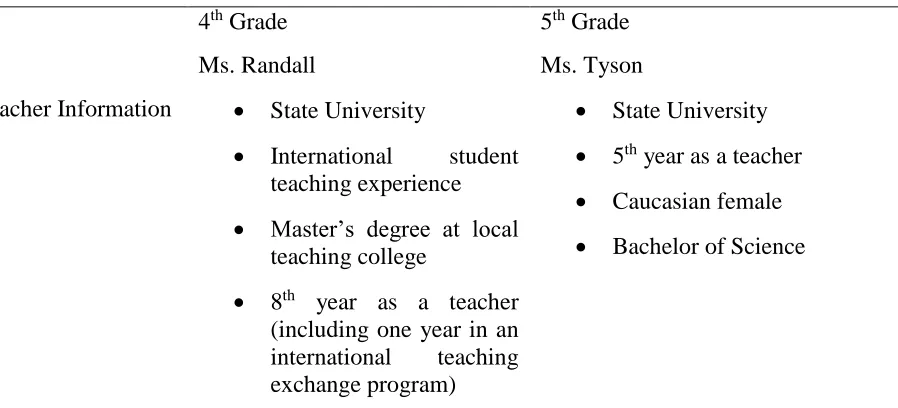
All 20 students of Ms. Tyson’s class chose to participate, though two chose not to be video-taped. Of the 21 students in Ms. Randall’s class, 16 chose to participate, but four chose not to be video-taped. Table 1 (below) provide additional background information pertaining to the study participants.
Table 1 Description of Study Participants 4th Grade
Ms. Randall
5th Grade Ms. Tyson Teacher Information State University
International student teaching experience Master’s degree at local
teaching college
8th year as a teacher (including one year in an international teaching exchange program)
Caucasian female Student
Demographics
21 students
16 participated (4 not videotaped)
1 African-American 1 Hispanic
2 multiracial 12 Caucasian
20 students
20 participated (2 not videotaped)
3 African-American 3 Hispanic
14 Caucasian
Data Collectionand Analysis
The data collection methods were chosen as a way to address the research question while allowing room for exploration of the emerging data (Stake, 1995). One component of data collection consisted of classroom observations over the course of five months. The purpose of classroom observations was to explore the presence and enactments of multiliteracies and student voices in science. Based on classroom observations, teacher and student interviews were conducted to investigate and bring to the forefront their perceptions of multiliteracies in science. Interviews and focus groups were also used to explore or clarify areas of interest noted during classroom observations such as specific instructional methods, tools used, and communication methods. While many interview and focus group questions emerged from data observed in the classroom, some questions were standard for each interview. For example, students were asked about their use of iPads and laptops in an ongoing project, as well as their perceptions of working independently versus working collaboratively in science. Student focus groups provided data on students’ social interactions while also allowing interaction with them on a more personal level as researchers prepared to choose individual students for in-depth interviews. Interview and focus group data were audio-recorded, video-recorded, and transcribed. Although videotaping student interviews is not a frequent practice, we believe that student voice is best captured and respected through a combination of visual and auditory data. Variables such as body language, tone, and volume are important components of accurately portraying student voice.
Artifacts (such as student work, texts, and other appropriate items) were photographed and carefully examined in order to further enhance the trustworthiness and richness of the overall data (Marshall & Rossman, 2011). Memo-writing and reflexive journaling were also utilized in order to “remain transparently grounded in the lives of those who constructed the data—the participants and researcher” (Mills, Bonner, & Francis, 2006, p. 11).
teaching and learning in order to document their implementation or lack thereof. At the conclusion of the study, a total of 30 observation hours were conducted in Ms. Tyson’s class, while a total of 20 hours were completed in Ms. Randall’s class. The difference in time spent in each classroom was due to disruptions of the scheduled science class meetings by school events. Every student from each class participated in a focus group. As such, each student was given an opportunity to voice their perceptions of multiliteracies. Four focus groups were conducted with four to five students from Ms. Randall’s class; while five focus groups were conducted with students from Ms. Tyson’s class. During the focus groups and observations, two students were chosen from each class for individual interviews—Kevin and Callie (5th grade students from Ms. Tyson’s class) and Gabriella and Aaron (4th grade students from Ms. Randall’s class). The students were selected through purposeful sampling to further examine student voice. The specific criteria for selecting individual students for this phase was determined during the first stages of data collection as categories arose and warranted further exploration. Although we chose students from varying ethnicities, ability levels, socio-economic statuses, and gender, as Stake (1995) notes, “balance and variety are important; [but] opportunity to learn is of primary importance” (p. 6). The students were chosen because they represented four very distinct voices. Kevin, an African-American male, was quiet during whole group instruction and stated that he lacked confidence in science and math. Callie, a Caucasian female, was identified as gifted. Though she was an enthusiastic participant in class, she was also humble, inquisitive, and patient with her classmates. Gabriella was described by Ms. Randall as a “perfectly average” student, though she was quite humorous and well-liked by her classmates. Aaron was inquisitive and frequently asked questions during class on a variety of subjects. During this period of data collection, observations focused on the individual students as opposed to the group/class. Three interviews were conducted with Callie and Kevin from Ms. Tyson’s class, while two interviews were conducted with Aaron and Gabriella from Ms. Randall’s class. The interviews delved into the students’ personal views of student voice and multiliteracies associated with science. Data collection concluded with teacher interviews that addressed areas associated with multiliteracies, specifically their use of technological tools and student collaboration in science. Interview and focus group questions were developed and modified as the study progressed in order to explore student and teacher perceptions of specific multiliteracies observed in classroom practices (Charmaz, 2006).
beginning with an overview of the technology practices within the school and the two classrooms.
Findings
The Bring Your Own Device policy at Littleton Elementary School underpins multiliteracies through communicative technology usage in Ms. Randall’s and Ms. Tyson’s science classrooms. The teachers’ classroom environments were equipped with a variety of popular technologies including overhead digital projectors, audio visual packages, digital tablets, several iPads, several laptops, and a shared grade laptop cart. Depending on the day, up to five students brought their own mobile device. Only one student in Ms. Tyson’s class did not have the internet at home, however Ms. Tyson informed us that her mother had internet on her mobile phone. The prevalence of technology (e.g., mobile devices, laptops, AV packages) created classroom environments whereby teachers and students utilized technology daily in a variety of ways in science that included engaging in queries, problem solving, communicating, and sharing information to name a few. As a result, teachers and students provided a variety of perceptions on the value and implementation of technology as a tool for teaching and learning. The findings that follow are presented as themes with supporting data in the form of teacher and student voices.
Students Speak Up: Technology as a Tool for Learning
A key feature of multiliteracies is the ability to decode and make meaning from a variety of media including traditional text, online text/webpages, video, images, and diagrams (Kress, 2003). Technology was used by all and in many different ways in both science classes. These included BrainPop (2015) videos and investigations, Science Court (Scholastic, 2015) activities, Schoology (2015) assignments, Google Drive (2015), and online research. The following themes reveal the participants’ perceptions of technologies used in learning science.
Humor, fun, and effective engagement for learning science through multimedia. BrainPop (2015) is an animated, online learning platform that utilizes short animated videos with interactive activities among other tools (e.g. printable handouts, short quizzes, and teacher resources). In each class, BrainPop videos were used as a tool for science instruction. Students from both classes were quite adamant that visuals, particularly videos, were a suitable alternative to traditional textbooks. They noted that videos such as BrainPop (2015) and Science Court (Scholastic, 2015) had characteristics of being quick, engaging, humorous, and valuable because, according to the students, they allow more time for “interactive” science activities. Chloe, a fourth grader in a focus group, explained why she liked BrainPop (2015) videos saying, “Those are nice because it’s the 21st century and nobody likes to read out of a textbook anymore.” The other students in her focus group agreed. Stephen held an additional view saying the videos were “funny” which led to students paying more attention to them.
Science Court (Scholastic, 2015) is a multimedia computer software program created to
“introduce core science topics and model scientific processes in the classroom—while fully engaging students with the humor of the Science Court” (Scholastic, 2015). The program, as it
Tyson’s science class), students described Science Court (2015) as a more engaging activity because of its humor. Two students discussing Science Court (2015), while often completing each other’s sentences, explained:
Asia: When you’re just reading out of a textbook, you’re kind of bored so you kind of… Sybil: Doze off.
Asia: Yeah, you doze off so you’re not really paying attention. So it [Science Court] makes it funny, but it’s still educational.
Asia continued:
I remember in books that are like educational. Those are like boring, you’re like okay I want to get on with this. But when you’re watching something on the screen, it’s more cartoony and funny. They [the characters] have funny voices. You kind of are like listening to what they say.
In this instance, humor had the ability to engage and promote thinking for the students, a common trend in educational research on teaching and learning (Torok, McMorris, & Lin, 2004).
The students not only described Science Court (Scholastic, 2015) as “fun” but they also believed it to be useful for learning. Harold connected the humor to learning by stating, “I think it’s really funny. Since it’s funny you get more into it so you learn more.” Sybil and Asia point out the difference between reading the science textbook and problem solving with Science Court
with Sybil stating, “In books, they’re just like the answer is blah, blah, blah. But on [Science
Court] here they help you get the answer” and Asia elaborating, “Yeah, you had to figure it out
and it makes you get more in depth.”
Digital technologies for learning tasks are preferred to traditional approaches. One platform frequently used in Ms. Randall’s classroom was Schoology (2015), an online “learning management system” with a wide variety of uses including course management, mobile learning, and communication. Sasha described Schoology (2015) as an “online place where [Ms. Randall] puts up assignments. We do the assignments and then we comment.” The assignments they refer to were typically done as homework, which Keon said, “was a lot better than having a sheet and having to read.” Other students contributed to the conversation on Schoology (2015). Jessie stated, “It’s kind of like Facebook for school.” Destiny agreed, “It’s like Facebook with your teacher.”
Also used in both classrooms was Google Drive (2015), a cloud-based file sharing and storing platform. Students were able to work on the same file from different devices at the same time, access files from different locations, and receive feedback and information from their teachers. The students of Ms. Randall’s class voiced that Google Drive (2015) was not only enjoyable but also more efficient than storing files on a hard drive.
Alex: I like Google Drive because it’s fun.
Alex: We can all be in different places working on it.
Chloe: And you don’t have to like write everything on a piece of paper. Tish: It has a research little box on it, so you don’t have to leave the tab.
Students expressed an ease of use with digital technologies and point out the advantages to using the digital technologies over using traditional paper and pencil approaches. In fact, they do not mention any negative points regarding the use of digital technologies with their science assignments. They seem to have an understanding of the basic uses of internet technology that allows them to navigate the completion of science tasks using these technologies seamlessly. Teachers Speak Out: Value vs. Implementation
Although technological tools and programs were used in each classroom, each teacher expressed concerns and issues when implementing this component of multiliteracies. For example, the use of the internet and mobile devices for school assignments at home was an area in which Ms. Randall felt tension. When asked about homework assignments on Schoology (2015), which were frequently assigned in her class, Ms. Randall admitted to struggling with assigning activities for homework that require technology because of the unequal access to technology. She stated,
I’m working on that. Everyone’s parent has a smart phone, so technically they should be able to do it at home. Alicia doesn’t have a computer, but she also only turns in her homework half of the time. So I can’t tell if she’s not doing it, or if she actually doesn’t have [access]. I’ve talked to her, “You know you and your mom can go to the library.” And they always have a week to do it. I mean, her mom has an iPhone. I do Schoology on an iPhone, so it can be done.
In her statement, it appears that Ms. Randall was trying to rationalize her use of technologies outside the classroom. For instance, although access to technology is not equal for the students in her classroom, she believes students should be able to access the internet for assignments in some fashion. She mentioned access again when describing her use of online applications:
For research stuff, I loved when we did technology in space, I loved that they were able to do some research. That was really our first experiment with Google Drive (2015) and that went really well. I don’t use it enough, but I have such a hard time because I know they use it at home. But I also know that not everyone’s technology at home is equal, so I have a hard time having them do things at home.
Technology as a key component of multiliteracies not only requires that students make meaning of (and create) information through multimedia but it also enables the use of multiple communication modes and avenues. This presents a unique dilemma for teachers as Ms. Randall points out, it is difficult to ensure that all students have access or the ability to use technologies outside of school.
I can’t imagine how much science is going to change in the classroom in five years. With the devices, that has changed so much this year. When I left, I only had one device. So now having four and having students bring their own devices has been really different...I will be excited about that.
When asked about what her classroom would be like if each student had a device, however, she was candid in her response. She was both excited about the possibility and aware that it would require adaptations to how she taught science:
It makes me kind of nervous. I have to wrap my head around how I want to manage that. You enter into a whole new world when you can bring your device in. The Google Drive, I have loved this year and it’s been fabulous. What I think I love is the group projects, because whenever they’re doing something…what’s great about it is that one person doesn’t have to sit at the computer with everyone standing around them. They can all be on a computer and they can all be sharing information. It’s been an easy way to share things with them like photographs that I’ve taken or videos or like we’re doing something and there’s a lot of different websites I just create a document and they can just click on it.
Google Drive (2015), according to Ms. Randall, gives students not only the ability to produce their findings but communicate ideas and share information with others inside and outside of the classroom. Using online tools such as Google Drive (2015) is a growing trend for multiliteracies development in classrooms (Denton, 2012). Its use is not without some concerns, however, as shown when Ms. Randall pondered the friction between the use of these tools and expected classroom practices. Such friction was seen in the following:
I haven’t given grades [on the Google Drive assignments]. I still haven’t figured out exactly how I want to use this. I really started using it after we came back from Christmas. So last week when we were out for so many days [because of snow], I wanted them to have some practice. So I made a five question division quiz. Some of them did it. Some didn’t, so I extended the due date. I could see this being really beneficial like putting it on here and having every kid bring in a laptop. But then you don’t have a printout for the parents. And I like having the paper test to be able to pull kids and talk about it. And I don’t want to assign a quiz to do at home when mom or dad could be helping. I just haven’t completely figured it out.
Ms. Randall was eager to implement technology in her class efficiently and effectively, although she admitted to still “figuring it out.” Despite having concerns, one of the major benefits she noted was the ease of collaboration with using online tools. This type of flexible collaboration, an important component of multiliteracies, is continuing to infiltrate science classrooms and elevate the already collaborative nature of inquiry-based learning.
regarding current science technologies, particularly with relevance and logistical issues as seen in her following comments:
I will admit that it gets kids more into things sometimes, but the whole process of going to get a laptop, turning it on, logging in, and getting the kids where they need to be just so they can type a paper every single time, takes a very long time. Now I think it’s very important that they know how to type a paper, but that’s just one example of course. We complain about that all the time. The IPads are so quick. You just get them and turn them on. If [only] we had quicker resources than going all the way down the hall and getting the laptop cart and making sure it’s plugged in. Logistically a lot of technology here is difficult [to get and use].
She continued, this time referring back to her personal experiences and priorities of learning: I would love for [computers] to replace textbooks and everything. I still think that they should have the textbooks here and maybe not have to lug the textbooks home. I still think they need to know how to do [use] a table of contents and dictionaries. You know, the ways that we’ve grown up in. But I think that’s all starting to be replaced, so they need to be kept up to date.
In her ideal situation, she would give each student an iPad and attachable keyboard. She believed it would alleviate some of these problems. Even with her admitted hesitations, she still noted that students benefited from using technology in classrooms because of its potential as an engaging alternative learning tool, “I think it gets them more excited about it. Definitely. I think it gives them another way to learn and another voice to hear besides mine.” In this instance, she used the term “voice” in such a way that it appears to refer to another source of authority or source of knowledge. While she recognizes classroom learning technologies as another resource of authority, she did not state that these technologies also serve as pathways for students to become producers and authorities of knowledge.
Ms. Tyson believed students are enthralled with the novelty of iPads, but remains unsure of whether or not students learned more through iPad use or traditional methods. She stated, “To be honest, I don’t think it necessarily is anything to do with [pause]. I don’t think just because it’s an iPad they’ve learned any more. I think it’s something new and exciting.” She identified iPads and computers as a quick resource tool for expanding and elaborating upon questions during lessons while stating earlier that it takes time to efficiently use them. She voiced,
I like the fact that if we have a question and we’re reading the textbook, it’s more difficult to find it. On the iPad we just have to type it in and we can figure it out. It’s an easy tool to use to research and further knowledge.
stated, “I think they know a lot more about technology than we do.” Students in focus groups confirmed her supposition stating that they were self-aware of their own skill and ability with technologies available to them.
Ms. Tyson saw technology as more of a tool for consuming information instead of creating it. Despite this, she captured a key point of multiliteracies as she reflected,
[Teaching today is] really hard because we’re teaching them to use a technology that’s probably going to be extinct in ten years, so you have to teach them skills that gets them used to new technologies. I think the most important thing to teach them is inquisitiveness. Not like I do [with] a new technology and getting intimidated by it, but wanting to put their hands all over it and wanting to touch it. I think it’s not even technology, it’s knowledge in general.
Ms. Tyson recognized that innovations in technology require new ways of thinking that are not only focused on the technology itself, but also the affordances allowed by the technology (Knobel & Lankshear, 2008, 2009; New London Group, 2000). This view is consistent with the knowledge building concept in which students are encouraged to be self-aware of their thinking, which creates a learning culture for the production of knowledge rather than its transmission and consumption (Scardamalia & Bereiter, 2006). Ms. Tyson’s words suggest that she values the importance of fostering and developing students’ creativity and inquisitiveness through the use of technology, although she personally continues to struggle with the adjusting to the prevalence of technology in classrooms.
Teaching Science in the Shadows of Time Limitations and Accountability
Ms. Randall, Ms. Tyson, and their students articulated the importance of technology integration in science, as well as the issues they face with such integration on a daily basis. Such concerns, too, exist in their perceptions of teaching science, particularly through inquiry. Ms. Tyson specifically revealed time limitations as a factor in her teaching practices:
I know a lot of [teaching science] is gearing toward teaching yourself now [student-center inquiry], but for me I think that’s very difficult. And I know it’s a little controversial, but I think it’s hard sometimes to teach yourself something you don’t understand. And if you don’t understand it, you have to go more into researching it and [to] understand and you get more behind, more and more behind on other things. [Inquiry] is great in an ideal world but when you’re in a time crunch it makes it a little difficult.
Although she did not use the term “inquiry,” the scenario she described of “teaching yourself” reflects the general premise of exploratory, inquiry-based learning in which students utilize scientific practices and process skills to describe, solve, and answer questions on their own (Goldston & Downey, 2013). Ms. Tyson’s statement revealed her struggle with the use of inquiry teaching practices, which may be due to her own struggles with learning that way, as well as her view of herself as constrained by traditional time limitation concerns.
Randall revealed a lack of opportunity for students to investigate questions tied to students’ interests:
As far as what they’re interested in, that’s the really hard part for me because I would love to have more time to just do what they’re interested in, but I have to make sure that I also get what’s in the course of study taught, so a lot of times if there is something that we’ve talked about that they’re really interested in I will encourage a kid to look it up and share information with us the next day or I will find some basic facts that answer those questions and share that.
Here, she acknowledged that students’ interests are sometimes peaked, but instead of exploring those interests in class like she would prefer, she asks that students explore them at home and then share the information with the class. She was aware of and committed to maintaining the integrity of the required course of study.
Time appeared to be a factor for Ms. Tyson with respect to teaching science, but other factors were also implied such as the demand to teach other disciplines during the main part of the day and leave science for the end. She stated the following with regards to planning science lessons:
I [plan] a week at a time. Science and social studies are so tough because it’s at the end of the day and those are the two that kind of get put on the back burner, especially social studies which is so sad. So that we have to be very, I don’t know the word for it. I have to change up the schedule a lot with science—be very flexible. Because sometimes we run out of time and I’ve spent more time on social studies than on science. Or sometimes they just get so off task at the end of the day and things take longer than I think they’re going to take.
Ms. Tyson added that she is also required to teach science and social studies in the afternoon because that is the designated time for fifth grade intervention. Essentially, students are pulled from her class for intervention services during science and social studies because they are not allowed to be removed from class during reading or math. Ms. Tyson’s need to prioritize certain subjects over others, particularly reading and math over science and social studies, is not an isolated occurrence as many elementary school teachers experience the same pressures (Griffith & Scharmann, 2008; Milner, Sondergeld, Demir, Johnson, & Czerniak, 2012). Perceived issues of time management and accountability to local and state curriculum mandates permeate these classrooms, causing teachers such as Ms. Tyson to struggle with finding time for teaching science regularly and effectively.
culture where “standardized testing measures whether its one-size content knowledge has fitted all (which it never can, and in fact measures the similarity of some students to the single set of assumptions about knowledge and thinking)” (Kalantzis & Cope, 2003, p. 24). In the following theme, it becomes apparent that the process of schooling is deeply ingrained in all participants of the process, including students.
Learning in the Shadows of Time Limitations and Accountability: Vision vs. Enculturation Teachers are not the only stakeholders that recognize the influence of external factors (i.e. time and standards) as restraints on teaching and learning science in meaningful ways to the participants. Students are surprisingly astute about forces that shape teaching in their classrooms and reveal wisdom about the effects on their own learning (Fielding, 2004). For instance, Harold, when asked what type of science lesson he would plan if given the chance responded that the class would read content first, take an exam, get a grade, and then do a project. The common teaching and learning algorithm of reading first—testing—obtaining a grade, framed Harold’s enculturated view of the instructional sequence and has already shaped his expectations. Simply put, he perpetuates what he has experienced, and places science learning through investigation at the end of his list after accountability policies have been met. Furthermore, he rationalized that learning through inquiry though “fun,” would take longer. Therefore, they would not learn as much if they did inquiry activities. Other students agreed, and one pointed out that with inquiry, “You learn a little bit more (depth), but not as much (breadth).” This comment parallels Ms. Tyson’s desire to teach fewer standards more in-depth instead of many concepts superficially. Roger, a fifth grader was asked if it would be useful for teachers to know student interests in science. He responded that it probably would not make a difference, though the Framework for K-12 Science Education (NRC, 2012) states that “personal interest, experience, and
enthusiasm—critical to children’s learning of science at school or in other settings—may also be linked to later educational and career choices” (p. 12). Kevin didn’t think that his teacher even knew of his interests. In discussing teaching and learning alternatives in science, one focus group shared that videos such as Brain Pop (2015) provide a “quick” alternative to lengthier textbook reading sessions that were frequently conducted in Ms. Tyson’s class.
Robbie: I like watching videos.
Kevin: Since I’m an auditory person, I can listen to the video.
Tyler: Well, I mean, we don’t have to read the text. I can just like watch something and understand it instead of going in my textbook and having to read and all that stuff.
Tyler’s comment adds a different dimension or an alternative to Ms. Tyson’s time concerns. Another group of students addressed this point.
Sarah Ann: I like videos, but I don’t want to just watch a long one. [I prefer] A short, fast one that gets to the point.
Callie: Like Brain Pop.
Sarah Ann: So they get the point, so then you could do [other things in] more interactive ways.
cover the same amount of content as textbook readings in less time and be more enjoyable to students today? From the standpoint of multiliteracies, as students become increasingly more “connected” through emerging technologies, the authenticity of such tools for transforming the methods of teaching and learning science are possible and perhaps inevitable.
Discussion and Conclusions
This discussion draws upon the findings derived from interpreting the words and events of the participants to elucidate how teachers and students perceive multiliteracies, particularly the use of multimedia and communicative technologies as they are enacted in the science classroom. The term Modern Classroom is used in this study to contextualize the two elementary classrooms through two characteristics. First, the Modern Classroom is wrought with a sense of increased accountability for teaching mandated standards, especially for math and reading (Griffith & Scharmann, 2008; Goldston, 2005; Milner, et al., 2012). Due to this, Ms. Tyson and Ms. Randall find that time to teach science is a constant concern in today’s classroom. Second, the Modern Classroom refers to the increased integration of technology in society, specifically mobile devices and the internet’s impact on today’s science classroom. Prensky (2001) argues, “Digital immigrant teachers” (or individuals that were introduced to technology later in life as opposed to growing up with such technology) “assume that learners are the same as they have always been, and that the same methods that worked for the teachers when they were students will work for the students now” (p. 4). The student voices, however stand in sharp contrast to such statements. Although both teachers admit that technology is becoming increasingly important in students’ lives, they each struggled and feel ineffective with how, when, what, and in what amount to incorporate technology effectively in their science classrooms.
Even holding so much uncertainly, the teachers did incorporate different types of technologies in teaching and learning science and their students utilized available technologies in different ways on a daily basis. Some teacher-facilitated activities required the use of the internet to research topics, while at other times, students took it upon themselves to use technology to look up information without teacher guidance. While both teachers admitted that the internet was indeed a quick, useful tool for this purpose, they recognized that the credibility of the sites is often unknown. Although there was not a 1:1 ratio of students to mobile devices in either classroom, students and teachers in both classrooms used laptops and mobile devices to teach and learn elementary science concepts. Dunleavy, Dexter, and Heinecke (2007) outline the “added value” with the use of multiple technologies including 1) “an enhanced ability to find and retrieve relevant information via the web, 2) an increased level of real-time formative assessment enabling individualized instruction, or 3) the creation of virtual communities that allow students to communicate inside and outside of the classroom” (p. 441). The first point stated by Dunleavy and colleagues was also emphasized by the teachers’ and the students’ in this study who saw quick access for information valuable to learning science. Point three involves the creation of virtual communities was also highlighted by the students through the ease of access in communication found when using Google Drive (2015) in and outside of the classroom.
If technologies do not work, teachers have to be prepared with a backup plan, which in a sense, means double planning. It appears that the development of multiliteracies in classrooms, particularly the use of digital technologies, can be challenging when infrastructure and logistical issues prove to be problematic for teachers trying to use innovative technologies. Furthermore, both teachers, when asked what professional development they would like in the future, stated that they want to see what effective, efficient integration of technology looks like in the classroom. Given the findings here on how teachers and students perceive multiliteracies in the science classroom, there lies an interesting tacit dissonance between the teachers’ views and the students’ views. The students in these classrooms expressed an ease of use with technological tools for learning science, other purposes in the classroom, and in their personal lives. Students voiced that they frequently helped their teachers and parents with technological practices and shared that cloud-based programs such as Google Drive (2015) were more efficient and effective for collaborative learning. Although the teachers value integrating technologies within their science classrooms, they seemed hesitant with new technologies within the context of multiliteracies, in part due to their novelty and also not knowing the ultimate outcome of their usage on students’ learning of science concepts. The students, as counterpoint, were already on board and fearless with using new technologies as a tool in learning science.
As stated, Ms. Tyson and Ms. Randall each struggled with some troublesome issues surrounding teaching science in the Modern Classroom, and the future of students’ learning science relies heavily on teachers’ abilities to address, challenge, and overcome these issues (Collins & Halverson, 2009). Though Ms. Randall and Ms. Tyson had not heard of “multiliteracies,” through their actions it was clear that they valued multiliteracies, student voice, and science. Given their very different teaching strategies and personal teaching philosophies, each one clearly provided an open atmosphere with experiences in their classrooms that supported multiliteracies. For example, Ms. Tyson incorporated collaborative and problem solving experiences as well as flexible, undirected use of technological tools, and Ms. Randall utilized interactive websites for student projects. These activities were not without some internal tensions. Ms. Tyson was bound by limited views of inquiry and multiliteracies, specifically effective technology implementation and cooperative learning due to perceived barriers of time, standards, and student maturity. Ms. Randall was more open to inquiry and multiliteracies (particularly collaborative learning and student-led investigations) but as also aware of her own hesitations and limitations including classroom management and device management.
Though each teacher shared concerns, they were open to the process of experimenting with and trying new strategies with technologies in their science classrooms. Such strategies include, for example, the use of Google Drive (2015) and Schoology (2015) for student collaboration in and out of the classroom. Given students’ perspectives, these strategies result in building learning communities where multiple voices are heard and individuals embrace active learning. Technology in this process is used to make learning more effective and efficient while maintaining the notion that hands-on, investigative activities are also essential to learning. Both teachers’ perceptions regarding student voices were similar with the belief that students’ perceptions were important and easily accommodated through varied learning activities.
struggled with the state standard of teaching science through inquiry citing time limitations, a long list of mandated content standards, and a lack of developmental appropriateness associated with cooperative learning as barriers for her. The perception that inquiry requires too much time is a common concern among elementary teachers (Goldston & Downey, 2013). Other common apprehensions included classroom management concerns, teachers’ discomfort with content knowledge, teachers’ perceived concern over the difficulty inquiry poses for students, and a general misunderstanding of the nature of science in classrooms (Colburn, 2008; Goldston & Downey, 2013; Hodson, 1988; Welch, Klopfer, Aikenhead, & Robinson, 1981; Pomeroy, 1993; Slotta, 2004). Ms. Tyson voiced concerns in utilizing collaborative learning, an integral feature of multiliteracies and teaching through inquiry approaches, as well as a lack of student maturity in dealing with cooperative approaches. In an analysis of factors that impact teacher use of cooperative learning, Abrami, Pousen, and Chambers (2004) found that “expectancy of success” tended to be the most prominent factor in teachers’ willingness to implement cooperative learning. They argue that, similar to Ms. Tyson, “teachers need to believe they have both the skill to implement cooperative learning successfully and a context that is amenable to effective cooperative learning use” (Abrami, Pousen, & Chambers, 2004, p. 211). Therefore, teachers need to believe they can make it happen, and that students will learn successfully.
With confidence in teaching through inquiry because of the experiences and resources with the “science kit” teaching of the Alabama Math Science and Technology Initiative (AMSTI) (2013), Ms. Randall admitted to feeling quite comfortable in a student-centered science classroom. AMSTI (2013) teachers receive several science “kits” throughout the year that include student supplies and instructional materials. In order for teachers to receive the AMSTI (2013) kits for their grade level, they must complete the required professional development with the kits. Professional development using inquiry and having the kits available may explain why she does not rely on a textbook to teach science.
Ms. Randall’s concerns, however, dealt directly with logistical and management issues when implementing technology. She was unsure of how to handle varying levels of internet access in students’ homes, online assessments, and managing multiple devices in the classroom. While already overwhelmed by the limitations of a “heavy set of standardized assessments,” Jacobs (2013) agrees that “implementing a pedagogy of multiliteracies…may be problematic,” particularly because “technology is often foremost in teachers’ discourse rather than the thinking or creative processes engendered by the technology” (p. 625).
Of course, classrooms do not exist in isolation from the larger educational community. National and local agendas often reinforce a school’s “normative, dominant, institutional cultural capital” (Robinson & Robinson, 2013). This is reflected when Ms. Tyson repeatedly noted time and an overloaded curriculum as influencing how she taught science as opposed to how she would prefer to teach it. Ms. Tyson identified the breadth of standards that needed to be taught in a single year as an issue in science education. If she could teach science as she wished, she would teach fewer topics across the disciplines but spend more time to go deeper thus giving her students a richer understanding of the content. Her words are reflective of the previous NSES standards (NRC, 1996) and those of the NGSS where less is more (NGSS Lead States, 2013).
since the implementation of NCLB are publicly documented (Milner, Sondergeld, Demir, Johnson, & Czerniak, 2012; Griffith & Scharmann, 2008; Goldston, 2005). This is also supported by research which concludes that teachers are influenced not only by national and state policy but also by their local administration (Milner et al., 2012). In the elementary educational landscape of competing disciplinary priorities, “at best science is a vestigial organ, at worst it has been excised from the curriculum body,” so in essence, it appears that science is often left behind (Goldston, 2005, p. 185). Other common apprehensions to teaching through inquiry, all of which were noted by Ms. Tyson and Ms. Randal, include classroom management concerns, teachers’ discomfort with content knowledge, teachers’ perceived concern over the difficulty inquiry poses for students, and a general misunderstanding of the nature of science in classrooms (Colburn, 2008; Goldston & Downey, 2013; Hodson, 1988; Welch, Klopfer, Aikenhead, & Robinson, 1981; Pomeroy, 1993; Slotta, 2004).
It is unclear whether the teachers explicitly told students that there are too many standards and not enough time to teach science through inquiry-based or problem solving approaches (though Ms. Tyson did explicitly say so in interviews) or if students inferred such ideas from other cues they experience in school. In either case, the students held the same perceived limitations as their teachers when describing the factors that determine how and what science is taught in their classroom. In fact, students’ voices defended the ways that science was taught by stating the limitation of standards and time. This is not surprising given that students and teachers are a part of the same institutional and testing culture (Segool, Carlson, Goforth, Von der Embse, & Barterian, 2013). It is interesting that the students recognized these limiting issues, and in some cases were more creative and open to alternative ways of thinking about teaching and learning science. Callie stated that if she was a teacher, she would let students “run wild” because then at least “you’re doing things. You’re still learning, but you’re doing it at your own pace and you’re finding things out by yourself.” Although several students believed the problem solving, student-centered learning to be time consuming and even impractical for teachers due to time issues, other students like Callie imagined a science class where students do the hands-on work and their voices are valued and heard despite the barriers of a test-driven educational climate.
From a researcher’s perspective, the students were open and eager to share their perceptions on learning science, multiliteracies, and student voice. Their metacognitive thinking was insightful and revealed itself when they described how they learn best and the importance of multiliteracies in their lives today and in the future. Students indicated that working collaboratively, freedom to make choices and mistakes, problem solving, and utilizing technology were useful not only in school but also in future employment. Furthermore, although most students explained that active learning was an enjoyable and effective way to learn science, students referred to lack of time and the breadth of standards as a barrier to incorporating such experiences in elementary classrooms. Students’ voices in this case mirrored their teachers’ perceptions, particularly those of Ms. Tyson, who frequently stated time as a constant issue in teaching science.
she believed her students enjoyed “popcorn reading” from their science textbook; however, her students stated that they found reading the textbook boring and ineffective when compared to other methods of learning. The students interviewed were mature beyond their years and were open when sharing their perceptions exhibiting impressive metacognitive awareness. It is common knowledge that effective teachers frequently search for and explore a variety of teaching strategies with the hopes of reaching their students. The students of this study were knowledgeable about what worked for them, and, if given the chance, they could assist their teachers in creating a classroom environment rich with multiliteracies that promote student engagement in the learning of science if only asked.
Because educational institutions are cultures, the roles, rules, discourse, expectations, and behaviors of teachers and students are defined as traditions and rituals within the culture, and those participating are enculturated into the ways of being, knowing, and doing within the culture. This is clearly seen in the words of the students who in a short few years have been enculturated into the schooling process. They know how teaching is carried out and defined, they are aware of the expectations for learning and behaving in school in its variable contexts, and they even know that assessment drives what happens in classrooms. Therefore, as one student pointed out, they read about science, take the test, and when that is taken care of first, then can enjoy learning science in more meaningful ways. Within the prescribed roles of teachers and students, there is a hierarchy of accountability that prioritizes what and how science is taught. Unfortunately, science and inquiry-based, student-centered approaches hold a low priority in the hierarchy (Griffith & Scharmann, 2008; Milner, Sondergeld, Demir, Johnson, & Czerniak, 2012). Not surprisingly, the hierarchy and its priorities set the stage for the perpetuation of the traditional roles of the teacher as authority and students as passive receivers of knowledge.
To break away from the status quo expectations of educational institutions, creative use of multiliteracies may provide opportunities to shift the roles of teachers and students back and forth to re-imagine a space for science learning that fosters a student’s voice in ways that deepen their learning. Innovative use of multiliteracies in the science classroom support the voices of students who see technologies as fingertip tools that engage them and enhance their learning of science quickly and efficiently. In other words, keeping multiliteracies as a framework for learning science positions teachers so they can “re-imagine the teaching of science for their future students and science for their students’ future” (Goldston, 2014). Student voices, as were evident in the two Modern Classrooms of this study, have the potential to serve as valuable resources when rethinking the teaching and learning practices of elementary science.
Implications
strategies and techniques, and c) professional development should encourage teachers to acknowledge the positive potential of technology in students’ lives (Blackwell et al., 2013).
Recently, a nonprofit initiative was established, “Leading the Digital Leap,” which is comprised of leaders from the Consortium for School Networking (CoSN), the National School Boards Association (NSBA), and the School Superintendents Association (AASA). This initiative highlights three important tenets that should be addressed when creating a digital or “tech-based” learning environment (Pierce, 2015, p. 2). The first two tenets, “Plan before purchasing” and “Replicate technology success,” speak directly to the needs and concerns described by Ms. Tyson and Ms. Randall (Pierce, 2015, p. 2). Resolving logistical issues and providing professional development are integral components. The third tenet, however, speaks to a well-established and larger concern, “Usher in a culture of change” (Pierce, 2015, p. 2). Technology used to be something separate that was taught to children—it was an add-on, or a novel way to teach science. In describing “new literacies,” Lankshear and Knobel (2006) view the world as being drastically different than it was in the past, requiring a new approach to literacy and meaning making. Although some educators still identify with the add-on mindset of literacy, this is the not one that connects classroom activity to societal reality.
Limitations
Although the qualitative approach to the study generated rich and meaningful data, the small number of participants and single setting is not intended to be generalizable. As Stake (1995) notes, “the real business of case study is particularization, not generalization” (p. 8). Teacher and student willingness to be honest and open during interviews and focus groups is always a possible limitation to reliable data. Furthermore, creating a personal, reciprocal relationship with the students required constant reflection and attention to the power relations which were present. Kvale and Brinkman (2009) reference Eder and Fingerson (2002) when they state that special attention must be given “to the power imbalance between the child and the adult, and the need for the interviewer to avoid being associated with the classroom teacher, as well as to refrain from conveying expectations that there is one right answer to a question” (p. 146). To assist in trustworthiness of data analysis, peer-debriefing was implemented periodically during all stages of data analysis. Member-checking was implemented with the teachers, however, due to time limitations, it was not conducted with the students.
References
Abrami, P., Poulson, C., & Chambers, B. (2004). Teacher motivation to implement an educational innovation: Factors differentiating users and non-users of cooperative learning.
Educational Psychology, 24(2), 201-216. doi:10.1080/0144341032000160146 Alabama
Math Science and Technology Initiative. (2013). AMSTI. Retrieved from www.amsti.org Anastopoulou, S., Sharples, M., & Baber, C. (2011). An evolution of multimodal interactions
with technology while learning science concepts. British Journal of Educational
Technology, 42(2), 266-290.
ATLAS.ti Scientific Software Development. (2011). Atlas.ti 6.2. Berlin: Germany.
Blackwell, C., Lauricella, A., Wartella, E., Robb, M., & Schomburg, R. (2013). Adoption and use of technology in early education: The interplay of extrinsic barriers and teacher attitudes. Computers & Education, 69, 310-319.
BrainPop (2015). BrainPop. Retrieved from www.brainpop.com
Brooker, R., & Macdonald, D. (1999). Did we hear you?: Issues of student voice in a curriculum innovation. Journal of Curriculum Studies, 31(1), 83-97.
Cervetti, G., Damico, J., Pearson, P. (2006). Multiple literacies, new literacies, and teacher education. Theory Into Practice, 45, 378-386.
Charmaz, K. (2006). Constructing grounded theory: A practical guide through qualitative
analysis. Thousand Oaks, CA: SAGE Publications, Inc.
Colburn, A. (2008). An inquiry primer. In E. Brunsell (Ed.), Readings in science methods K-8
(pp. 33-36). Arlington, VA: NSTA Press.
Collins, A., & Halverson, R. (2009). Rethinking education in the age of technology: The digital
revolution and schooling in America. New York, NY: Teachers College Press.
Cook-Sather, A. (2006). Sound, presence, and power: "student voice" in educational research and reform. Curriculum Inquiry, 36(4), 359-390.
Cope, B., & Kalantzis, M. (2000). In Cope, B. & Kalantzis, M. (Ed.), Multiliteracies: Literacy
learning and the design of social futures. New York, NY: Routledge.
Dahl, K. (1995). Challenges in understanding the learner's perspective. Theory into
Practice, 34(2), 124-130.
Denton, D. (2012). Enhancing instruction through constructivism, cooperative learning, and cloud computing. Tech Trends, 56(4), 34-41.
Dunleavy, M., Dexter, S., & Heinecket, W. (2007). What added value does a 1:1 student to laptop ratio bring to technology-supported teaching and learning? Journal of Computer
Assisted Learning, 23, 440-452.
Eder, D., & Fingerson, L. (2002). Interviewing children and adolescents. In J.F. Gubrium & J.A. Holstein (Ed.), Handbook of interview research (pp. 181-201). Thousand Oaks, CA: Sage. Fielding, M. (2004). "New wave' student voice and the renewal of civic society. London Review
of Education, 2(3), 197-217. doi:10.1080/1474846042000302834
Foucault, M. (1980). In Gordon C. (Ed.), Power/Knowledge: Selected interviews and other
writings 1972-1977. New York, NY: Pantheon Books.
Gee, J. P. (2000). New people in new worlds: Networks, the new capitalism and schools. In Cope, B., & Kalantzis, M. (Ed.), Multiliteracies: Literacy learning and the design of social
futures (pp. 43-68). New York, NY: Routledge.
Gillen, J., Littleton, K., Twiner, A., Staarman, J., & Mercer, N. (2007). Using the interactive whiteboard to resource continuity and support multimodal teaching in a primary science classroom. Journal of Computer Assisted Learning, 24(4), 348-158.
Goldston, M. J. (2005). Elementary science: Left behind. Journal of Science Teacher Education, 16(3), 185-187.
Goldston, M. J. (2014). NSTA president-elect position statement. Retrieved from www.nsta.org Goldston, M. J., & Downey, L. (2013). Your science classroom: Becoming and
Elementary/Middle school science teacher. Thousand Oaks: California: SAGE Publications.
Google (2015). Google Drive. Retrieved from www.google.com/drive/
Hodson, D. (1988). Toward a philosophically more valid science curriculum. Science Education, 72, 19-40.
Jacobs, G. (2013). Designing assessments. Journal of Adolescent & Adult Literacy, 56(8), 623-626.
Kalantzis, M. & Cope, W. (2003). Assessing multiliteracies and the new basics. Assessment in
Education Principles, Policy, and Practice, 10(1), 15-26.
Knobel, M. & Lankshear, C. (2006). Discussing new literacies. Language Arts, 84(1), 78-86. Knobel, M. & Lankshear, C. (2008). Remix: The art and craft of endless hybridization. Journal
of Adolescent & Adult Literacy, 52(1), 22-33.
Knobel, M., & Lankshear,C. (2009). Digital literacies: Wikis, digital literacies, and professional growth. Journal of Adolescent & Adult Literacy, 52(7), 631-634.
Kress, G. (2003). Literacy in the new media age. New York, NY: Routledge.
Kvale, S. & Brinkmann, S. (2009). Interviews: Learning the craft of qualitative research
interviewing. Thousand Oaks, CA: SAGE Publications, Inc.
Lincoln, Y. (1995). In search of students' voices. Theory into Practice, 34(2), 88-93.
Marshall, C., & Rossman, G. (2011). Designing qualitative research (5th ed.). Thousand Oaks, CA: SAGE.
Mills, J., Bonner, A., & Francis, K. (2006). Adopting a constructivist approach to grounded theory: Implications for research design. International Journal of Nursing Practice, 12, 8-13.
Milner, A., Sondergeld, T., Demir, A., Johnson, C., & Czerniak, C. (2012). Elementary teachers' beliefs about teaching science and classroom practice: An examination of pre/post NCLB testing in science. Journal of Science Teacher Education, 23, 111-132.
National Research Council. (1996). National Science Education Standards. Washington, DC: National Academy Press.
National Research Council. (2012). A framework for K-12 science education: Practices,
crosscutting concepts, and core ideas. Washington, DC: National Academies Press.
New London Group. (2000). A pedagogy of multiliteracies: Designing social futures. In Cope, B., & Kalantzis,M. (Ed.), Multiliteracies: Literacy learning and the design of social futures
(pp. 9-37). New York, NY: Routledge.
NGSS Lead States. (2013). Next generation science standards. Retrieved from www.nextgenscience.org
Oldfather, P. (1995). Introduction to the issue. Theory into Practice, 34(2), 86-87.
Parnell, R., & Patsarika, M. (2011). Young people's participation in school design: Exploring diversity and power in a UK government policy case-study. Children's Geographies, 9(3-4), 457-475. doi:10.1080/14733285.2011.590715
Pierce, M. (March 31st, 2015). 3 tips for implementing a tech-based learning environment. ESchool News.
Pomeroy, D. (1993). Implications of teachers' beliefs about the nature of science: Comparisons of scientists, secondary science teachers, and elementary teachers. Science Education, 77, 261-278.
Prensky, M. (2001). Digital natives, digital immigrants. On the Horizon, 9(5), 1-6.
Scardamalia, M. &. Bereiter,C. (2006). Knowledge building: Theory, pedagogy, and technology. In K. Sawyer (Ed.), Cambridge handbook of the learning sciences (pp. 97-118). New York, New York: Cambridge University Press.
Scholastic Inc. (2015). Science Court. Retrieved from www.tomsnyder.com Schoology (2015). Schoology. Retrieved from www.schoology.com
Segool, N., Carlson, J., Goforth, A., Von der Embse, N., & Barterian, J. (2013). Heightened test anxiety among young children: Elementary school students’ anxious responses to high-stakes testing. Psychology in the Schools, 50(5), 489-499.
Slotta, J. (2004). The web-based inquiry science environment (WISE): Scaffolding knowledge integration in the science classroom. In M. Linn, & E. B. Davis (Eds.), Internet
environments for science education (pp. 203-232). Hillsdale, NJ: Lawrence Erlbaum.
Stake, R. (1995). The art of case study research. Thousand Oaks, CA: Sage.
Torok, S. E., McMorris, R. F., & Lin, W. C. (2004). Is humor an appreciated teaching tool? Perceptions of professors’ teaching styles and use of humor. College Teaching, 52(1), 42-20.
Wade, R. (1995). Encouraging student initiative in a fourth-grade classroom. The Elementary
School Journal, 95(4), 339-354.
Warschauer, M., Knobel, M., & Stone, L. (2004). Technology and equity in schooling: Deconstructing the digital divide. Educational Policy, 18(4), 562-588.