Security and Law
Security and Law
Volume 12 Number 4 Article 7
12-2017
Evidence Verification Complications with Solid-State Drives
Evidence Verification Complications with Solid-State Drives
Ryne Teague
University of South Alabama, [email protected]
Michael Black
University of South Alabama, [email protected]
Follow this and additional works at: https://commons.erau.edu/jdfsl
Part of the Computer Law Commons, and the Information Security Commons
Recommended Citation Recommended Citation
Teague, Ryne and Black, Michael (2017) "Evidence Verification Complications with Solid-State Drives," Journal of Digital Forensics, Security and Law: Vol. 12 : No. 4 , Article 7.
DOI: https://doi.org/10.15394/jdfsl.2017.1445
Available at: https://commons.erau.edu/jdfsl/vol12/iss4/7
This Article is brought to you for free and open access by the Journals at Scholarly Commons. It has been
accepted for inclusion in Journal of Digital Forensics, Security and Law by an authorized administrator of Scholarly Commons. For more information, please contact [email protected].
Cover Page Footnote Cover Page Footnote None
EVIDENCE VERIFICATION COMPLICATIONS
WITH SOLID-STATE DRIVES
Ryne Teague, M.S. Michael Black, Ph.D. University of South Alabama
Mobile, AL 36688 251-460-6880
ABSTRACT
Solid-state drives operate on a combination of technologies that create a barrier between the physical data being written and the digital forensics investigator. This barrier prevents the application of evidence verification methods developed for magnetic disk drives because the barrier prevents the investigator from directly controlling and therefore verifying that the underlying physical data has not been manipulated. The purpose of this research is to identify a period of inactivity where the underlying physical data is not being manipulated by wear-leveling or garbage-collection routines such that evidence can be reliably verified with existing hashing algorithms. An experiment is conducted on Samsung drives. The limitation of this method is it does not enable the verification of deleted data and will be one size of solid-state drives. The results show that after an hour and a half, the solid-state drives examined will produce the same consistently until ten hours.
Keywords: SSD, verification, validation, chain of custody, solid-state drive
1.
INTRODUCTION
Methods for forensics and storage techniques have been developed around the physical design of magnetic hard drives and the idea of evidence verification [11[2]. Digital evidence altered during an investigation can be ruled inadmissible in a court of law. Hard disk drives and older forms of storage have proven techniques to prevent changes to data [1]131[4]. It is also possible to provide evidence that a hard disk drive has not been altered using a hashing program. With these methods, digital evidence can be presented in court with little question of their integrity [2] [3].
@ 2017 ADFSL
The design of solid-state drives has drastically changed from the design of hard disk drives and because of this, evidence verification procedures used for magnetic drives will need to be redesigned for use in solid-state drives [1]. A solid-state drive's storage medium has a limited number of writes before a section of the memory will fail, rendering the entire drive useless [1][2]. A component of the solid-state drive is the solid-state drive controller that holds firmware used to increase the lifespan of the drive [l]. The solid-state controller's introduction has led to a wider adoption of solid-state technology, but it
has also complicated standards for digital evidence in forensics investigations [l].
Previous evidence verification methods fail
due to certain firmware processes within the
solid-state drive controller. Users are not given the same level of control over solid-state drives
as they are hard disk drives [11[2]. The mechanism to prevent changes in HDDs works because of the lack of a solid-state controller equivalence inside HDDs drive [4].
The research goal and question were identified by searching for solutions to the problems from solid-state drives that forensic investigators face. The research goal is to explore periods of inactivity in solid-state
firmware processes, also known as
housekeeping algorithms, that affect evidence
verification. The research question is as follows. Can periods of inactivity be identified during which housekeeping algorithms of a
solid-state drive's controller does not affect the validation process done by digital forensics investigators using a court accepting hashing methodology?
2.
JVlETHOD
The goal of this research is to contribute to digital forensics knowledge base in the areas of solid-state drives and evidence verification by finding solutions without physically altering the solid-state drive. This experiment used the quantitative experimental research approach
where a problem had been identified, data was collected, and a hypothesis had been formulated and to be tested. The experiment
was designed to observe one condition which was the length of time between the solid-state
drive to reach a static state. The results were measured and stored using software and are relevant to the research goals.
The purpose of this study is to identify if there is a period of inactivity where the validation process used by a forensic
investigator is not being manipulated by wear-leveling or garbage-collection routines. The test has been conducted as a controlled experiment. A period of inactivity is defined as a time when the solid-state drive is not manipulating the underlying data. Inactivity is verified by hashing the drive and verifying the output. Based on Bell's experiment, any window of inactivity is most likely to be soon after the drive has been powered up therefore the test will only be repeated for two hours.
The researcher used four consumer-rated
solid-state drives with a capacity of one hundred and twenty gigabytes to one hundred
and twenty-eight gigabytes for this experiment. As stated before, Samsung controls most of the solid-state market. Therefore, all the solid-state
drives used were manufactured by Samsung varying in size between one hundred and
twenty and one hundred and twenty-eight
gigabytes.
An environment was necessary to create a
test bed to run consistent experiments on each
solid-state drive. The environment consisted of one desktop computer, the necessary input/output devices for the computer, and four solid-state drives. Each solid-state drive was connected to the experiment computer directly through a SATA port. The experiment computer was installed with Ubuntu Server 14.04.05 LTS operating system. After installation, the operating system was immediately patched with up-to-date software
packages. The only additional software installed were VIM, a simple text editor and parted, a command line tool used to partition drives. A Linux operating system was chosen over Windows because Windows modifies system volume information on drives utilizing NTFS file systems which may issue write commands to the experiment drives. No such requirement exists on the Ubuntu operating
The experiment began by connecting each solid-state drive tested to the experiment machine. The machine was then powered on and booted to the Ubuntu operating system. Each solid-state drive had both data and power cables disconnected and reconnected. This was done to remove the frozen status of the solid-state drives. Upon booting, an operating system issues an AT A Freeze command that prevents any security-related changes to the solid-state drives. Power cycling the test drives unfroze each drive and allowed the secure-erase command to operate properly.
Four terminals were opened to execute the experiment scripts on each of the test drives. Each terminal was set to a different directory where the experiment script was copied. Each experiment script was then started and passed the path to a solid-state drive and the location of a unique mount point as parameters. The syntax to run the script at the command line is the following:
. /main_ 1.sh <drive> <mountpoint>
The script began by issuing the secure-erase command erasing all contents the drive. The script then partitioned, formatted, and mounted the solid-state drives. By writing standard text files, the solid-state drives were then filled to ninety percent capacity, deleted to twenty-five percent capacity, and then filled to fifty-percent capacity. Upon completion of all file write and deletion, an MD5 hashing program was immediately executed for two hours on each solid-state drive.
It should be noted that the solid-state drives never reached one-hundred percent capacity. It was considered rare in a real-world scenario that a user's drive would ever reach maximum capacity. The deletion of data created slack space which should cause garbage-collection and wear-leveling to be triggered. The process of writing, deleting, and writing files again was intended to ensure
@ 2017 ADFSL
every available cell of the test drive to be written to at least once and to have cells that are marked for deletion. Together, these scripts created a scenario that would trigger garbage-collection and wear-leveling routines to activate.
In total, the experiment was conducted four times. In the first two experiments, the MD5 hashing program executed for two hours. In the last two runs the MD5 hashing program executed for ten hours. The time for one experiment was originally estimated to take between two to three hours for each solid-state drive, totaling between ten to fifteen hours for all. The actual time for completion of four tests executed on four drives concurrently took between twenty-seven to twenty-nine hours.
The detailed experiment steps are below. This experiment has eleven steps. Steps three through ten were implemented in scripts developed by the researcher. All scripts were run from the experimenter's machine .
1. Experimenter's machine was powered on with four solid-state drives connected plus an additional magnetic disk drive that hosts Ubuntu 14.04.05 lts operating system.
2. The experimenter disconnected the power and data cable from each solid-state drive from the machine and then reconnects both cables again.
3. Each solid-state drive was wiped by being sent a Secure-Erase AT A command which defaulted the drive to its original, out of the box state.
4. The script then paused until each drive completed the Secure-Erase.
5. Each solid-state drive was then formatted with the NTFS file system. 6. Each solid-state drive was logically
mounted to the experimenter's system. 7. Each solid-state drive was then written
to ninety percent capacity.
8. The drives were written with files ranging from one byte to thirty-two megabytes in size from /dev/urandom. 9. Each solid-state drive had randomly
selected files deleted until the drive reached twenty-five percent capacity. 10. The deletion operation was a normal
file-system deletion, like emptying the recycle bin of a windows operating system.
11. Each solid-state drive was then written to fifty percent capacity.
12. The drives were written with files
ranging from one byte to thirty-two megabytes in size from /dev/urandom. 13. A script was run from the researcher's
computer to produce an MD5 of the
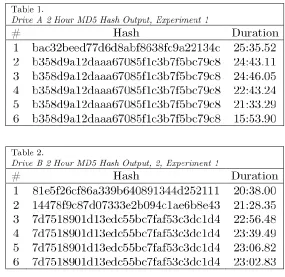
Table 1.
solid-state drive continuously for two hours. Each MD5 produced was stored on the computer for analysis along with the time taken to generate the MD5. 14. Data was analyzed to identify periods
of inactivity within the solid-state
drive's garbage-collection and wear-leveling processes.
3.RESULTS
The results are formatted in tables with the MD5 hash in the left column and the time taken to produce the MD5 hash in the right
column. The time is formatted as
minutes:seconds:milliseconds.
Drive A 2 Hour MD5 Hash Output, Experiment 1
#
Hash
Duration
1 bac32beed77d6d8abf8638fc9a22134c 25:35.52
2 b358d9a12daaa67085flc3b7f5bc79c8 24:43.11
3 b358d9a12daaa67085flc3b7f5bc79c8 24:46.05
4 b358d9a12daaa67085flc3b7f5bc79c8 22:43.24
5 b358d9a12daaa67085flc3b7f5bc79c8 21:33.29
6 b358d9a12daaa67085flc3b7f5bc79c8 15:53.90
Table 2.
Drive B 2 Hour MD5 Hash Outvut, 2, Exveriment 1
#
Hash
Duration
1 81e5f26cf86a339b640891344d252111
20:38.00
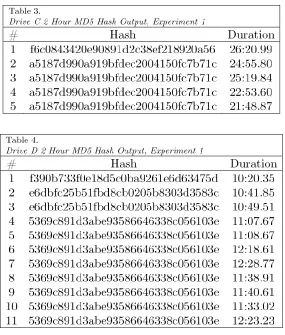
Table 3.
Drive C 2 Hour MD5 Hash Output, Experiment 1
#
Hash
Duration
1 f6c0843420e90891d2c38ef218920a56
26:20.99
2
a5187d990a919bfdec2004150fc7b71c
24:55.80
3
a5187d990a919bfdec2004150fc7b71c
25:19.84
4
a5187d990a919bfdec2004150fc7b71c
22:53.60
5 a5187d990a919bfdec2004150fc7b71c
21:48.87
Table 4.
Drive D 2 Hour MD5 Hash Output, Experiment 1
#
Hash
Duration
1 f390b733f0e18d5c0ba9261e6d63475d
10:20.35
2
e6dbfc25b51fbd8cb0205b8303d3583c
10:41.85
3
e6dbfc25b51fbd8cb0205b8303d3583c 10:49.51
4 5369c891d3abe93586646338c056103e 11:07.67
5 5369c891d3abe93586646338c056103e 11:08.67
6 5369c891d3abe93586646338c056103e 12:18.61
7
5369c891d3abe93586646338c056103e
12:28.77
8 5369c891d3abe93586646338c056103e 11:38.91
9 5369c891d3abe93586646338c056103
e
11:40.61
10 5369c891d3abe93586646338c056103e 11:33.02
11 5369c891d3abe93586646338c056103e 12:23.23
As shown from the first experiment's
results, the hash became consistent after the third consecutive hash. When the same hash is produced consecutively, the contents of the
drive are not being altered. These results imply
there are periods of inactivity in the solid-state
drive controller's housekeeping algorithms
during which validation processes are not
affected.
Except for one solid-state drive, each drive reached a state where the hashes were not
changing after the MD5 hash program
executed once. The experiment was repeated a
second time to validate the results of the first
experiment.
Table 5.
Drive A 2 Hour MD5 Hash Output, Experiment 2
#
Hash
Duration
1
856002a
e
8684fc21fl bf5c82
e
f568128
20:38.97
2 ed8e45e37d6a81aab0ac441e88187c45 22:47.51
3
ed8e45e37d6a81aab0ac441e88187c45 22:22.07
4 27764daaea24b2877db98f
e
d10225c95 22
:3
6
.
22
5 27764daaea24b2877db98f
e
d10225c95 22:02
.
87
6 27764daaea24b2877db98fed10225c95 21:47.60
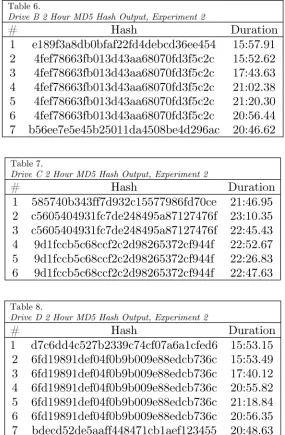
Table 6.
Drive B 2 Hour MD5 Hash Output, Experiment 2
#
Hash Duration1 e189f3a8db0bfaf22fd4debcd36ee454 15:57.91
2 4fef78663fb013d 43aa68070f d3f5c2c 15:52.62
3 4fef78663fb013d 43aa68070f d3f5c2c 17:43.63
4 4fef78663fb013d 43aa68070f d3f5c2c 21:02.38
5 4fef78663fb013d 43aa68070f d3f5c2c 21:20.30
6 4fef78663fb013d 43aa68070f d3f5c2c 20:56.44
7 b56ee7e5e45b25011da4508be4d296ac 20:46.62
Table 7.
Drive C 2 Hour MD5 Hash Output, Experiment 2
#
Hash Duration1 585 7 40b343ff7 d932cl 55 77986fd 70ce 21:46.95
2 c5605404931fc7de248495a87127476f 23:10.35
3 c5605404931fc7de248495a87127476f 22:45.43
4 9d 1 fee b5c68ccf2c2d982653 72cf944f 22:52.67
5 9d 1 fee b5c68ccf2c2d982653 72cf944f 22:26.83
6 9d 1 f cc b5c68ccf2c2d982653 72cf944f 22:47.63
Table 8.
Drive D 2 Hour MD5 Hash Output, Experiment 2
#
Hash Duration1 d7c6dd4c527b2339c74cf07a6alcfed6 15:53.15
2 6fdl 9891 def04f0b9b009e88edcb 736c 15:53.49
3 6fd19891def04f0b9b009e88edcb736c 17:40.12
4 6fd19891def04f0b9b009e88edcb736c 20:55.82
5 6fdl 9891 def04f0b9b009e88edcb 736c 21:18.84
6 6fdl 9891 def04f0b9b009e88edcb 736c 20:56.35
7 bdecd52de5aaff448471cblaef123455 20:48.63
In the second experiment, Drive A and Drive C produced a consistent hash after four hashing iterations. These results match the first experiment's results. However, the results for Drive B and Drive D were different from the results in the first experiment, and Drives A and C in the second experiment.
from these results that the wear-leveling and/or garbage-collection could still run after entering a state of inactivity. Additionally, Drive A and Drive C only produced a
consistent hash for three hashing iterations before the test ended. Drive B and Drive D had produced consistent consecutive hashes for longer but still allowed data to be altered at the end of the test. This may be an indication that Drive A and Drive C's wear-leveling and
or garbage-collection could also activate after a
period of inactivity. The last hash produced for Drive B and
⋮
⋮
⋮
⋮
⋮
⋮
⋮
⋮
⋮
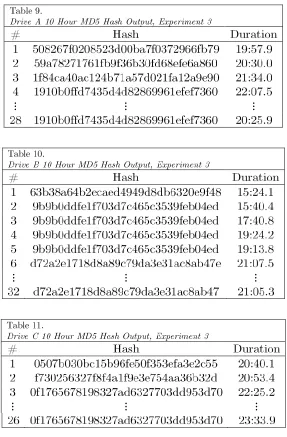
Additional data was gathered to examine
how often the hash changed for each drive. A
second set of tests was conducted the same as
the first tests, with the exception that the
MD5 hashing program would execute for an additional eight hours changing the total
execution time to ten hours.
Table 9.
Drive A 10 Hour MD5 Hash Output, Experiment 3
#
Hash Duration1 508267f0208523d00ba7f0372966fb79 19:57.9
2 59a 7827176 lfb9f36b30fd68efe6a860 20:30.0
3 lf84ca40ac124b71a57d021fa12a9e90 21:34.0
4 191ObOffd7435d 4d82869961 efef7360 22:07.5
28 191ObOffd7435d 4d8286996 lefef7360 20:25.9
Table 10.
Drive B 10 Hour MD5 Hash Output, Experiment 3
#
Hash Duration1 63b38a64b2ecaed4949d8db6320e9f48 15:24.1
2 9b9b0ddfelf703d 7 c465c3539feb04ed 15:40.4
3 9b9b0ddfelf703d 7 c465c3539feb04ed 17:40.8
4 9b9b0ddfelf703d 7 c465c3539feb04ed 19:24.2
5 9b9b0ddfelf703d 7 c465c3539feb04ed 19:13.8
6 d72a2e1718d8a89c79da3e31ac8ab47e 21:07.5
32 d72a2e1718d8a89c79da3e31ac8ab47 21:05.3
Table 11.
Drive C 10 Hour MD5 Hash Output, Experiment 3
#
Hash Duration1 0507b030bc15b96fe50f353efa3e2c55 20:40.1
2 f730256327f8f4alf9e3e754aa36b32d 20:53.4
3 0f1765678198327ad6327703dd953d70 22:25.2
26 0f1765678198327ad6327703dd953d70 23:33.9
⋮
⋮
⋮
⋮
⋮
⋮
⋮
⋮
⋮
⋮
⋮
⋮
⋮
⋮
⋮
Table 12.
Drive D 10 Hour MD5 Hash Output, Experiment 3
#
Hash Duration1 le2d732187a3ec427efcd3422felad7b 15:13.6 2 8cca98ccla5634b7f033682d5b8f3e6a 15:37.6 3 8cca98ccla5634b7f033682d5b8f3e6a 17:17.6 4 8cca98ccla5634b7f033682d5b8f3e6a 19:23.2 5 8cca98ccla5634b7f033682d5b8f3e6a 18:56.6 6 d8ff920d43933fe2aef94fa532de5a3a 20:56.7
30 d8ff920d43933fe2aef94fa532de5a3a 20:40.1
Table 13.
Drive A 10 Hour MD5 Hash Output, Experiment 4
#
Hash Duration1 6a5a93c167f797bd46a80de292fb324a 22:45.9 2 8db0034679607 dfa8514444f2a01 bfce 23:44.0
26 8db0034679607 dfa8514444f2a01 bfce 25:32.6
Table 14.
Drive B 10 Hour MD5 Hash Output Experiment 4
#
Hash Duration1 ee94482f39bca3f9244d9el 72bbccf7c 15:47.6 2 b3cc0f055a8b34 7 e6b42f cff2f70113e 15:48.0
28 b3cc0f055a8b34 7 e6b42fcff2f70113e 23:22.2
Table 15.
Drive C 10 Hour MD5 Hash Output, Experiment 4
#
Hash Duration1 f3bbdad1755465de46266fc33a92713a 12:23.1 2 95a054dae1826fa8e01bff9ed45f0aa5 11:55.8
49 95a054dae1826fa8e01bff9ed45f0aa5 14:52.9
Table 16.
Drive D 10 Hour MD5 Hash Output Experiment 4.
#
Hash Duration1 ff 49c215d6b597 dbb6fde20ce635335 7 15:42.2 2 7705414505849254d18e29d096f12980 15:49.9
4.
CONCLUSION
Based on the results seen in Table 8 through
Table 16, all solid-state drives tested produce a consistent hash when the experiment was
extended from two to ten hours. Additionally,
seven of the sixteen tests show an early period of consecutive, matching hashes may occur within minutes of the start of the analysis of the drives but change again within several
hashing iterations.
The research question is "can periods of
inactivity be identified during which housekeeping algorithms of a solid-State drive's
controller does not affect the validation process done by digital forensics investigators using a
court accepting hashing methodology?" The
data produced by the experiment above
provides a strong indication that given an amount of time equal to or greater than one
and a half hours, a solid-state drive will reach
a state in which multiple matching hashes are
generated and where the validation process for digital forensic investigators is not affected
using these solid-state drives and firmware versions.
These results have also produced data
about the aggressiveness of the garbage-collection and wear-leveling routines of
solid-state drives. The only variable changed during the experiments was the length of time the MD5 hashing program executed. However, the aggression and speed of the wear-leveling and garbage-collection routines are unpredictable in these experiments. Experiment three for Drive A showed the MD5 hashing program produced different hash five iterations in a row until reaching a state where consecutive matching hashes were produced, which only happened in one experiment. Drive A reached a state where
consecutive matching hashes were produced on
experiment three after one hour but reached the same state in experiment four after only twenty-two minutes. Additionally, Drive B
@ 2017 ADFSL
showed a short, early consecutive matching hashes state in experiment three, but not in experiment four.
The results indicate that there is a period of inactivity where the solid-state drive produces a consistent hash over a length of
time that could allow an investigator to image
the solid-state drive, verify the image, and
power off the solid-state drive before the hash
changes. However, allowing the drive to reach this period of inactivity before a forensic image is created causes data such as slack space to be
lost and changes the drive from its original acquisition state. Presently, that is not within
accepted forensic practices. New forensic practices should be reviewed to adopt this technique. If new chain of custody standards approved of this technique, investigators could
use this technique to obtain evidence from a
forensic copy that is close to the solid-state
drive's original state. Currently, evidence obtained from solid-state drives is usually deemed inadmissible because solid-state drives
are self-altering and self-corroding due to
wear-leveling routines and garbage-collection.
When this research began, the goal was to
investigate whether solid-state drives can reach a state that no longer interferes with the validation process used by forensic examiners. The research has identified a strong indication
to support this hypothesis. The experiment
wrote data mimicking a user's daily use in real environments, and then examined four solid-state drives produced by the industry's leading
producer of drives. The results of this experiment clearly show that a period of inactivity for garbage-collection and
wear-leveling routines was identified within the ten-hour window; however, this period of inactivity has not yet been proven to be permanent. Further research and analysis is needed on this subject before a method can be published that
allows forensic evidence to be examined and
presented in court without question.
[1]
[2]
[3]
[4]
REFERENCES
Bell, G. B., & Boddington, R. (2010). Solid State Drives: The Beginning of the End for Current Practice in Digital Forensic
Recovery? The Journal of Digital Forensics, Security and Law, 5(3), 1-20.
Burd, S. (2011). Systems architecture (6th ed.). Boston, Massachusetts: Cengage Course Technology.
Carrier, B. (2005). File System Forensic Analysis. Upper Saddle River, New Jersey:
Pearson Education.
Volonino, L., Anzaldua, R., & Godwin, J. (2007). Computer Forensics Principles and Practices. Upper Saddle River, New Jersey:
APPENDIX
Drive A
Model: SAMSUNG MZ7TD128HAFV-000L1 Serial Number: S14TNSAD602536
Firmware Revision: DXT04L0Q
Drive B
Model: Samsung SSD 750 EVO 120GB Serial Number: S33MNB0H949501E Firmware Revision: MAT01B6Q
Drive C
Model: SAMSUNG SSD 830 Series Serial Number: S0VUNY ABA0l 720 Firmware Revision: CXMOlBlQ
Drive D
Model: Samsung SSD 840 EVO 120GB Serial Number: S1D5NSAFB67977M Firmware Revision: EXT0CB6Q