ISSN: 2149-214X
www.jeseh.net
Evaluating
the
Gifted
Students’
Understanding Related to Plasma State
Using Plasma Experimental System and
Two-Tier Diagnostic Test
Saadet Deniz Korkmaz1, Bahadir Ayas2, Eren Can Aybek3, Suat Pat1
1Eskisehir Osmangazi University 2Anadolu University
3
Pamukkale University
To cite this article:
Korkmaz, S.D., Ayas, B., Aybek, E.C., & Pat, S. (2018). Evaluating the gifted students’
understanding related to plasma state using plasma experimental system and two-tier
diagnostic test.
Journal of Education in Science, Environment and Health (JESEH), 4
(1),
46-53.
DOI:10.21891/jeseh.387480
This article may be used for research, teaching, and private study purposes.
Any substantial or systematic reproduction, redistribution, reselling, loan, sub-licensing,
systematic supply, or distribution in any form to anyone is expressly forbidden.
Authors alone are responsible for the contents of their articles. The journal owns the
copyright of the articles.
Evaluating the Gifted Students’ Understanding Related to Plasma State
Using Plasma Experimental System and Two-Tier Diagnostic Test
Saadet Deniz Korkmaz, Bahadir Ayas, Eren Can Aybek, Suat Pat
Article Info
Abstract
Article History
Received: 11 May 2017
The purpose of this study was to investigate the effectiveness of the experimental system design related to plasma state on the gifted students’ understanding on the subject of the plasma state. To test the research hypothesis, one group pretest-posttest research model was carried out with 18 eighth-grade (4 girls and 14 boys) gifted students in mathematics and science, attending to a university-based after school program for gifted students. A two-tier achievement test (Plasma Achievement Test-PAT) consisting of 10 items used as a pretest and posttest. First tier of the test consists of multiple-choice items and the second tier consists of open-ended items. Students were asked to find the correct answer in the first tier and write the reasons (justifications) for their answers in the second tier. Pretest and posttest mean scores of first and second tier scores were compared with statistical analyzes. Also the students’ justifications for the second tier of the test was used to make content analyzes. From pretest to posttest an increase was found in open-ended tier scores. The difference between pretest and posttest wasn’t statistically significant for multiple-choice tier scores. From the findings it can be concluded that the experiment system was effective on the gifted middle school students’ understanding on the subject of the plasma state.
Accepted: 12 November 2017
Keywords
Teaching of plasma state Science education Gifted students
Introduction
The success in the physics courses depends on most variables such as teacher, the content of the course, availability of the devices for the laboratory experiments, an applicable schedule and open learning philosophy to meet the requirements of the students, making critical efforts to achieve the learning goals. The researches show that the experiments play an effective role in understanding the physical phenomena in physics and in our world (Psillos & Niedderer, 2002). The learning strategies containing the experiments ensure that the students associate the theory to the practice and gain an ability to do experiments and to think scientifically and aim their cognitive developments (Hofstein & Lunetta, 2004). The students must take an active role in all stages of the process to ensure that the experiments are considered as most important training tools in the physics course especially to teach difficult or abstract concepts. Any tools and equipment required by the experiments that are expected to be conducted in the scope of the physics course curriculum are in general accessible easily. But, if there are any technical or physical limitations, it is proposed that different techniques such as the demonstration experiments or simulations are used. It is highly difficult to realize the experiments related to plasma state of the matter, which constitutes the subject of this study, in a classroom environment due to the technical limitations and working at a high voltage.
The plasma defined the first time by Irwin Langmuir in as an ionized gas containing a free particle in 1928 constitutes more than 99% of the universe (Langmuir, 1928). Examples of the plasmas in the universe include sun, stars, solar winds, supernovas and nebulas. Examples of the plasmas in our earth include polar lights (Aurora), lightning, flash, fire, ionospheric region of the earth, magma layer of the earth and Van Allen belts.
Moreover, the plasmas are keys to understanding the behaviors of all structures from the plasmas filling the interstellar environment to the extra galactic jets dispersed from the disks encircling the black holes.
47 J. Educ. Sci Environ Health
manufactured. The plasma technologies are also used in many different applications in the chemical industry (e.g. gas mitigation, gas production, etc.), medical industry (e.g. plasma sterilization, plasma treatment, etc.), material industry (etc. coating, functionalization, etc.) and other most industries (Liebermann and Lichtenberg, 1994). Furthermore, examples of the plasmas produced in vitro include the neon advertisement lamps brought by the modern technology, Xenon headlights of vehicles and sodium vapor lamps (Contemporary Physics Education Project [CPEP], 2014; Elizer & Eliezer, 2001; Eskisehir Osmangazi University [ESOGU], 2014; Grill, 1993). Although the plasma application fields are highly broad, it is essential that the basics of the plasma physics are taught by the new generation scientists early as possible (O'Brien, Zhu, & Lopez, 2011). Recently, any various training practices led by universities for this purpose stand out. For example, the education programs and cooperation projects between the plasma laboratories such as the Princeton University, Plasma Physics Laboratory (PPPL) and Tokyo University, Institute of Frontier Sciences (Graduate School of Frontier Sciences) are started, and the scientists, who work on plasma, work with graduate and postgraduate students to teach the main properties of plasma and plasma technologies (Tillocher et al., 2015; Prager & Ono, 2014). It is seen that, although they are included in the high school curriculum, such education practices are limited to high school students. A limited number of students, which meet a high criteria, are admitted to a few plasma education programs that may also be utilized by high school students. For example, only the high school students from the New Jersey region admitted to the Saint Peter’s University, Center of Microplasma Science Technology (CMST), and these students then describe the plasma subject to their friends in their schools (CMST, 2016).
Plasma state, which takes up a large place both in the universe, where we live, and in our daily life, takes a place in the physics course curriculum of the secondary education of the Ministry of National Education in our country. It is aimed that the students adopt the principle “describing the general properties of the plasma by giving examples” on the plasma subject as the final subject the “Matter and Its Properties” unit, which is the second unit of the ninth-grade curriculum, and for which 12 course hours. Expression of the subject must be supported by the experiments to ensure that the students may gain any achievements on plasma like almost all physics subjects. The literature review shows that the experiments concerning plasma state are limited only to the plasma sphere, and knowledge and experience of the student on the plasma phenomena are highly limited for secondary education students.
We realized any studies, both with the secondary school students and with candidate science teachers by using the experiment system as a demonstration experiment concerning plasma state (Korkmaz, 2015; Korkmaz, Aybek, & Pat, 2015). These studies show that the basic properties of the plasma cannot be perceived very easily and the designed experiment system is effective in understanding the plasma subject. In these studies, that we also support with the discharge tube simulation as a plasma environment, it is determined that the students must understand and have an ability to apply dynamic, electrics, magnetism and modern atom theory for them to able to deceive the plasma and its basic properties. Such acquisitions are possible for secondary education students, for whom the physics course curriculum of the secondary education in Turkey, only, when they come to the twelfth-grade level. To the best of our knowledge, previously, no one has reported such a study included demonstration experiments concerning plasma state which is a state that exists widely in the universe and that is used to produce new products and generate energy today, conducted with gifted students. Therefore, the purpose of this study was to investigate the effectiveness of the experimental system design related to plasma state on the gifted students’ understanding on the subject of the plasma state.
Method
Study Group
Data Collection Tools
Plasma Achievement Test
The Plasma Achievement Test (PAT) developed in 2015 by the Korkmaz (2015) for the purpose of collecting data (Korkmaz, 2015; Korkmaz, Aybek, & Pat, 2015) is used as a pretest and posttest in the study. PAT is a test which consisting of 10 multiple-choice and 10 open-ended items to purpose of determining the knowledge level of the students on plasma. With the open-ended items in the test, the students are required to justify their answers to the multiple-choice items.
In the developing process of PAT a 20 item pilot test form was prepared. The pilot test was presented to two measurement and evaluation specialists, two physics teachers, one physical science specialist and one science teaching-specialist for expert opinion. In accordance with the opinions of the experts, necessary corrections were made in the test items and the final form of the test was given. Item analysis and reliability study of the PAT were carried out with 80 students studying in the two different high schools in Eskişehir in the 2014-2015 academic years. Item difficulty and item discrimination indices were calculated. The most appropriate 10 items were selected according to the item analysis results. The detailed validity and reliability study of PAT can be found in the Korkmaz (2015).
The maximum score that can be taken each tier was 100. Each open-ended item scored polytomously between 1-10 with a rubric developed to grading open-ended items, and each multiple-choice item is scored dichotomously as 0 or 10. Then, students’ test scores for each tier calculated separately by summarizing the item-scores.
In the scope of this study, PAT is applied to the eighth-grade EPGS students, and the reliability coefficient is calculated as .69 according to the split-half method for this group. It is expected that the reliability coefficient is higher in the achievement tests, whereas the students in the study group are selected according to the same identification test, which means the group was very homogenous, may be caused that the reliability coefficient is calculated lower than the expected (Turgut & Baykul, 2010).
Process
The study is conducted in the scope of the EPGS science course. The plasma achievement test is applied primarily to the study group as a pretest. A plasma demonstration experiment supported by the simulation is conducted one week after the plasma achievement test is applied.
The discharge tubes filled with the low pressure and various gasses (Ar, Neon, etc.) are used in the experiment system. The gas atoms are transformed to plasma state by using the low frequency (10 kHz) power supply and electrodeless discharge method (Korkmaz, 2015). The first phase of plasma state is the ionization of atoms. The ratio of the number of particles ionized in the tube to total number of particles is between 0.1% and 1%. The number of electrons is equal to the number of ions. Upon initiation of ionization, ions and electrons are forced to collide with non-ionized gas atoms and with each other. Electricity and heat conduction within the plasma are provided by electron due to their high speeds. Masses of the electrons with a high energy are highly less that the ions and ionized particles within the plasma. Because pressure of a gas with plasma generated is low, electrons cannot collide many times with particles having masses larger than electrons, and therefore cannot transfer energy to these particles. Therefore, the kinetic energies, thus temperatures of the electrons in the low pressure plasmas are always larger than the particles having larger masses than the electrons. As known, the kinetic energies of the particles in the microscopic medium are perceived as a temperature in the macroscopic medium. Because the number of electrons is less than the total number of particles; energies, namely temperatures of ions and neutral atoms are highly low, the temperature of the medium never rises at a sensible degree. In the literature, this method is called cold plasma.
The plasma generation method is explained during the demonstration experiment, and any differences between the plasma obtained from the experimental system and the plasmas observed in nature are examined. Upon the demonstration experiment, Neon Lights & Other Discharge Lamps simulation is monitored (Phet, 2014). The achievement test is applied again immediately after the demonstration experiment.
49 J. Educ. Sci Environ Health
Data Analysis
The answers of the students to the multiple-choice and open-ended items on the plasma achievement test are reviewed descriptively. The correct answers of the students in the multiple-choice items are multiplied by 10 to get a score range between 0 to 100. Thus, it is ensured that they may be compared to the open-ended items. Then, pretest and posttest scores are compared as follows:
1. Pretest multiple-choice scores and pretest open-ended scores; 2. Posttest multiple-choice scores and posttest open-ended scores; 3. Pretest multiple-choice scores and posttest multiple-choice scores; and 4. Pretest open-ended scores and posttest open-ended scores.
Because the research group consists of 18 students, a non-parametric Wilcoxon-Signed Rank Test is used for the paired comparisons. To interpret whether the test result is significant or not, the determined significance level .05 is divided by the number of comparisons (4 comparisons) by making the Bonferonni adjustment. Therefore, it is accepted that α is equal to .0125, and the significance of the statistical test results are interpreted according to this value.
Findings
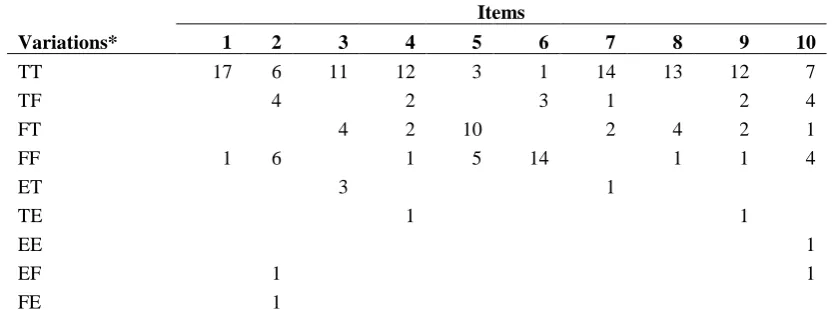
Distribution of correct, wrong and empty answers to the multiple-choice items in the pretest and posttest is given in Table 1:
Table 1. Variation of the correct, wrong and empty answers to the multiple-choice items
Variations*
Items
1 2 3 4 5 6 7 8 9 10
TT 17 6 11 12 3 1 14 13 12 7
TF 4 2 3 1 2 4
FT 4 2 10 2 4 2 1
FF 1 6 1 5 14 1 1 4
ET 3 1
TE 1 1
EE 1
EF 1 1
FE 1
*TT: Correct in the pretest and correct on the posttest; TF: Correct in the pretest and wrong on the posttest; FT: Wrong in the pretest and correct on the posttest; FF: Wrong in the pretest and wrong on the posttest; ET: Empty in the pretest and correct on the posttest; TE: Correct in the pretest and empty on the posttest; EE: Empty in the pretest and empty on the posttest; EF: Empty in the pretest and wrong on the posttest; FE: Wrong in the pretest and wrong on the posttest.
As reviewed in Table 1, it is seen that, although some of the students give correct answers to items 2, 4, 6, 9 and 10 in the pretest, they give wrong answers in the posttest, and give wrong answers to items 2, 5, 6 and 10 in both pretest and posttest. When the justifications of the students, who give wrong answers, are examined, it is seen that the students state that plasma never transmits heat. During the demonstration experiment, the students are allowed to touch the discharge tubes as a media created by plasma. The students may interpret that, the plasma samples used in the demonstration are not hot, plasma never transmits heat. Another reason is that students may have previous knowledge. In both cases, since the fluorescent lamps give light, the plasmas conduct electricity. Fluorescent lamps do not generate too much heat. The polar lights are formed by magnetism. The student’s previous knowledge about fluorescent tubes and polar lights lead him/her to the wrong answer. The similar situation is also observed in a plasma globe.
is a situation, when the ionized atoms, electrons, exited atoms, photons and neutral atoms exist together. In option A of 6th question, plasma is stated as “it is an exited gas state of the matter”. However, when the simulation that is shown to the students is reviewed, it is observed that the demonstration in the simulation may cause a misconception in the students, because atoms are excited as a result of an electron bombardment in lieu of ionization. Therefore, the students may think that plasma state is an excited state of atoms by being under the influence of the simulation, and thus select the option A which is a strong distractor. The answer “…plasma is an excited gas state, it emerges as a result of an electron bombardment.” given by a student to the respective open-ended item confirm this opinion. The statements of the students that “it is an excited gas” or “it happens as a result of excitation of gases” are also not deemed correct.
Distribution of numbers of the students, who leave unanswered and give wrong answers to the open-ended items (0 justification score) by pretest and posttest is given in Table 2.
Table 2. The number of the students, who leave empty and give wrong answers to the justification items in the pretest and posttest
Item Empty Wrong
Pretest Posttest Pretest Posttest
1 0 0 1 1
2 4 2 7 2
3 9 3 6 3
4 5 3 3 0
5 7 4 9 7
6 3 2 13 14
7 5 4 10 6
8 3 2 3 0
9 5 4 6 1
10 5 3 12 8
Average 4.6 2.7 6.7 4.2
In Table 2, it is seen that number of students who give empty and wrong answers were reduced compared to the pretest.
The pretest and posttest scores of the students for the multiple-choice and open-ended items on the Plasma Achievement test are given in Table 3.
Table 3. The descriptive findings for PBT pretest and posttest scores
Minimum Maximum Mean SD
Multiple-choice Pretest 40.00 80.00 63.38 13.34
Posttest 40.00 80.00 67.77 11.14
Open-ended (Justification)
Pretest 10.00 34.00 20.38 7.55
Posttest 16.00 68.00 37.83 16.82
In Table 3, it is seen that the pretest score average is 63.38 and the posttest score average is 67.77 for the multiple-choice items. Although an increase in the scores of the students is observed in the posttest, it is seen that the standard deviation of the group also reduces a little bit. When the scores of the open-ended items are reviewed, it is seen that the mean score of the students increased by approximately 17.5 points in the posttest. Standard deviation also has increased in the posttest. The cause of this increase in the standard deviation may be the facts that number of the students, who never state any justification in the pretest, are high and the pretest justification scores were low.
51 J. Educ. Sci Environ Health
Table 4. The results of the wilcoxon-signed rank test for the pretest multiple-choice – pretest open-ended and posttest multiple-choice – posttest open-ended items
Mean Rank Sum of Ranks N Median Negative Positiv
e
Negative Positiv e
Z p
Pretest MC 18 65 9.501 .002 171.001 .002 -3.725 .000
Pretest OE 18 18
Posttest MC 18 70 9.501 .002 171.001 .002 -3.724 .000 Posttest OE 18 36
1N = 18; 2N = 0; MC: Multiple-choice items; OE: Open-ended items.
It is determined that a significant difference between the pretest multiple-choice and open-ended mean scores in favor of the multiple-choice items (Z = -3.725, p < .0125). When the students’ answers are examined, it is seen that the students who give correct answers to the multiple-choice items in the pre-test, cannot justify their answers. According to the Table 4, there is also a significant difference between the posttest multiple-choice and open-ended mean scores in favor of the multiple-choice items (Z = -3.724, p < .0125). Namely, the students give correct answers to the multiple-choice items, but cannot justify their answers in the same manner.
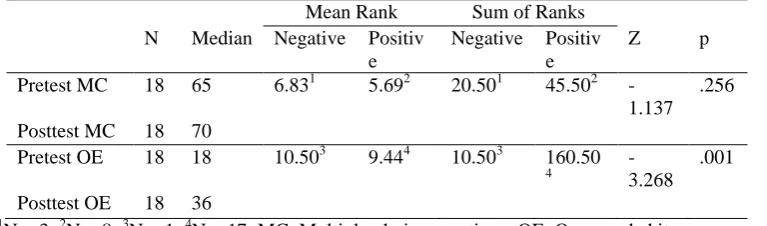
Wilcoxon-Signed Rank Test conducted to determine whether there is any significant difference between the pretest and posttest multiple-choice scores and between pretest and posttest open-ended scores. The results of the Wilcoxon signed rank test can be found in Table 5.
Table 5. Wilcoxon-signed rank test results for pretest – posttest multiple-choice and open-ended scores Mean Rank Sum of Ranks
N Median Negative Positiv e
Negative Positiv e
Z p
Pretest MC 18 65 6.831 5.692 20.501 45.502 -1.137
.256 Posttest MC 18 70
Pretest OE 18 18 10.503 9.444 10.503 160.50 4
-3.268
.001 Posttest OE 18 36
1
N = 3; 2N = 8; 3N = 1; 4N = 17; MC: Multiple-choice questions; OE: Open-ended items.
According to the Wilcoxon-Signed Rank Test, there is no significant difference between pretest and posttest multiple-choice scores (Z = -1.137, p > .0125). However, that there is a significant difference between pretest and posttest scores for open-ended items (Z = -3.268, p < .0125). Accordingly, it may be said that the students may justify the questions asked to them better in the posttest.
Conclusion
In this study that the plasma demonstration experiment is presented to the students, who continue to the EPGS, and the change in the knowledge levels of the students on plasma is examined. There is no significant increase is found from the pretest to the posttest according to multiple-choice items. In the open-ended tier, where the students justify their answers, it is determined that the students had given better justifications in the posttest, and accordingly, there is a significant increase in the mean score. In this scope, it may be said that the use of the experimental setup increases the knowledge level of the students significantly. Also in similar researches (Korkmaz, 2015; Korkmaz, Aybek, & Pat, 2015), the same finding is reported and this shows the significance of the experiment setup in learning the concepts especially such as plasma in the science education. Furthermore, it may be thought that use of the open-ended tests or two-tier tests such as PBT is more useful in the measurement and evaluation stages in the science course.
continue to the EPGS program, is 37.83. This may be arisen from the properties of the students, who continue to the EPGS program, and contents of the program, because an accelerated curriculum is submitted to the gifted students in the EPGS science and mathematics fields (Sak, 2013). In this scope, it may be said that that the preliminary knowledge level of the EPGS students is higher than one of the 9th grade students. Hence, when the pretest multiple-choice and open-ended tier scores of both student groups are compared, it is seen that the mean score of the EPGS students (63.38 in the multiple-choice tier, and 20.38 in the open-ended tier) is higher than the ones of the 9th grade students (25.4 in the multiple-choice tier, and 10.46 in the open-ended tier (Korkmaz, 2015)).
When the answers of the students to each question are reviewed, it is observed that they come to an incorrect conclusion, especially with the items related heat conduction of plasma and submit the experiment setup as a proof in their justifications. For example, a student states his/her justification that “If it transmits heat well, no energy saving may be obtained in fluorescent lamps, and the fluorescent lamps are more hot that the filament lamps. Furthermore, no heat conduction happens in our hands in the experimental setup and plasma globe, once we conduct.” for the second question. If the students reached such a conclusion as a result of the experiment, may be its main cause includes a plasma generation method in this system. Since the low pressure discharge tubes are used in the experiment system, the temperature of the medium never rises at a sensible degree. It is observed that the student shows, an excessive interest to the experimental setup and it may be supposed that the students, who contact the discharge tubes, concluded that the tubes never transmit heat, because the discharge tubes are not hot.
It is remarkable that the majority of the students give wrong answers at item 6 in both Pretest and Posttest. It is observed that the students tend to the wrong option A (distractor) in this item. The simulation shows the excitation of atoms as a result of an electron bombardment, not ionization stage. Therefore, maybe the students thought that plasma state is an excited state of atoms of being under the influence of the simulation, and thus chosen the option A.
Recommendations
As if a mediocre reliability coefficient obtained in the plasma achievement test used in the research may be arisen from homogeneity and small size of the group. Yet, the development of a new plasma achievement test shall be useful for the researchers, who intend to work on a similar subject. Furthermore, standardization of this test is useful to compare the results that may be obtained in future studies.
It is supposed that the plasma generation method used in the experimental system creates a perception in the students that plasma never transmits heat. To determine whether this perception of the students is caused really by the experiment setup or not, a qualitative research may be conducted together with up the students. This shall be a guide for both development of the experimental system and future developments of new achievement tests based on plasma state subject.
It is understood that the demonstration of the simulation after the experiment could cause a misconception in the students from this study group. Therefore, it can be examined in future studies whether the simulation causes any other misconceptions in similar groups. Furthermore, future researches could be conducted on with the updated simulation in accordance with the findings of this study.
Acknowledgments
This study was supported by the Eskisehir Osmangazi University Scientific Research Projects Committee (Project No: 201421027). The authors gratefully acknowledge the financial support from the organization.
References
Ayas, M. B., & Sak, U. (2014). Objective measure of scientific creativity: Psychometric validity of the Creative Scientific Ability Test. Thinking Skills and Creativity. 13, 195-205.
Center for Microplasma Science and Technology. (2016). Education and research. It was accessed on 05.04.2016 at https://www.saintpeters.edu/cmst/93-2/
53 J. Educ. Sci Environ Health
Elizer, S., Eliezer, Y. (2001). The Fourth State of Matter an Introduction to Plasma Science. İOP publishing. Eskisehir Osmangazi University [ESOGU]. (2014). Plasma science and technologies lab home page.
http://esoguplazma.ogu.edu.tr
Grill, A. (1994). Cold Plasma in Materials Technology: from fundamentals to applications. New York: IEEE Publishing.
Hofstein A., & Lunetta V.N. (2004). The Laboratory in science education: Foundations for thetwenty-First Century. Science Education. 88 (1). 28-54
Korkmaz, S.D. (2015). A new experimental system design related to the plasma state. Educational Research and Reviews. 10(17), 2501-2511.DOI: 10.5897/ERR2015.2452
Korkmaz, S. D., Aybek, E.C. & Pat, S. (2015). The Effect of New Experimental System Design Related to the Plasma State on Achievement of Candidate Elementary Science Teachers. Universal Journal of Educational Research. 3(10): 735-741. DOI: 10.13189/ujer.2015.031012
Langmuir, I. (1928). Oscillations in Ionized Gases. Proc. Nat. Acad. Sci. 14, 627.
Liebermann, M. A., & Lichtenberg A. J. (1994). Principles of plasma discharges and materials processing. John Wiley and sons Inc.
National Research Council [NRC] (2007). Plasma Science: Advancing Knowledge in the National Interest. Washington, DC: National Academy Press.
O’Brien, D.A., Zhu, W. & Lopez, J.L. (2011). Student Experiences with Plasma Phenomena. IEEE Transactions on Plasma Sciences, Vol. 39, No. 11, 2584-2585.
Prager, S. & Ono Y. (2014). A Tokyo / Princeton Educational Partnership in Plasma Physics. http://www.princeton.edu/international/doc/Prager_Ono-2014_15-PU_UTokyo-Proposal-PR.pdf
Psillos, D., & Niedderer, H. (2002). Issıues and Questions Regarding the effectiveness of Labwork in Teaching and Learning in the Science Laboratory, D. Psillos and H. Niedderer, Eds. Dordrecht: Kluwer, pp. 21-30. Sak, U. (2008). Test of the three-mathematical minds (M3) for the identification of mathematically gifted
students. Roeper Review. 31(1), 53-67.
Sak, U. (2013). Gifted people: Their properties, identification and education. Ankara: Vize Publishing House. Tillocher, T., Aubry, O., Boufendi, L., Pichard C., Lefaucheux, P. & Dussart, R. (2015). Engineering and
research education in Plasma technology. 43rd Annual SEFI Conference June 29 - July 2, 2015 Orléans, France.
Turgut, M.F., & Baykul, Y. (2010). Measurement and Evaluation in Education. Ankara: Pegem Akademi.
Author Information
Saadet Deniz Korkmaz Eskişehir Osmangazi University Odunpazarı, Eskişehir, Turkey Contact e-mail: [email protected]
Bahadir Ayas Anadolu University Tepebaşı, Eskişehir, Turkey
Eren Can Aybek Pamukkale University Pamukkale, Denizli, Turkey
Suat Pat