Geschke Center
Doctoral Dissertations Theses, Dissertations, Capstones and Projects
2017
Navigating Conflict in Inclusive Education:
Autoethnography from an Elementary School
Principal
Kimberly Christine Adams
University of San Francisco, [email protected]
Follow this and additional works at:http://repository.usfca.edu/diss
Part of theEducational Leadership Commons, and theSpecial Education and Teaching Commons
This Dissertation is brought to you for free and open access by the Theses, Dissertations, Capstones and Projects at USF Scholarship: a digital repository @ Gleeson Library | Geschke Center. It has been accepted for inclusion in Doctoral Dissertations by an authorized administrator of USF Scholarship: a digital repository @ Gleeson Library | Geschke Center. For more information, please [email protected].
Recommended Citation
Adams, Kimberly Christine, "Navigating Conflict in Inclusive Education: Autoethnography from an Elementary School Principal" (2017).Doctoral Dissertations. 350.
NAVIGATING CONFLICT IN INCLUSIVE EDUCATION:
AUTOETHNOGRAPHY FROM AN ELEMENTARY SCHOOL PRINCIPAL
A Dissertation Presented to
The Faculty of the School of Education Department of Organization and Leadership
In Partial Fulfillment
of the Requirements for the Degree Doctor of Education
by
Kimberly C. Adams San Francisco, CA
Autoethnography from an Elementary School Principal
Practitioners and researchers have interpreted and debated the concept of the least
restrictive environment creating the operational practices of mainstreaming and inclusion to adhere to the laws of the Individuals with Disabilities Education Act. Despite the laws to ensure equal access to general education classrooms, and the vast body of literature on
the technical implementation of inclusive practices, students with disabilities continue to be segregated and educated in a separate and unequal system of special education.
The purpose of this study was to better understand the competing tensions and conflict in inclusive education that elementary school principals navigate on a daily basis while making a school wide shift from providing special education supports and services
to inclusive education. This study intended to make explicit the competing tensions and conflicts principals must navigate from the institutional, district, school, and personal
levels in addressing the academic and social needs of students with disabilities. The main questions that guided this research were: a) What are the everyday conflicts that elementary school principals experience on a daily basis while transitioning
from providing special education services and supports to inclusive education? b) How do elementary school principals navigate the everyday conflicts that occur while
transitioning to inclusive education? A focused autoethnographic design, with the
Conflicts were found in the areas of roles and responsibilities; skills, knowledge,
and experience; time and resources; and placement. This study provided
recommendations to school leaders to address the identified everyday conflicts in
inclusive education.
In order for schools to become inclusive, school leaders must clearly
communicate the basic shifts required for inclusive education to happen, but must also
address the contradictions in the current educational system, and the individual ideologies
the Faculty of the School of Education in partial fulfillment of the requirements for the
degree of Doctor of Education. The content and research methodologies presented in this
work represent the work of the candidate alone.
Kimberly C. Adams__________________ May 18, 2017__
Candidate Date
Dissertation Committee
Dr. Darrick Smith ____________________ May 18, 2017__ Chairperson
Dr. Emily Nusbaum____________________ May 18, 2017__
my committee. Dr. Darrick Smith, Dr. Emily Nusbaum, and Dr. Danfeng Koon thank you for the advice and guidance you gave me. A special thank you to Dr. Smith for your role as chairperson, and for being a huge influence and inspiration throughout my
doctoral studies.
I would also like to acknowledge my parents, Dr. Susan Adams and Douglas Adams. Thank you for instilling in me the love of learning, and the appreciation of the strengths and differences in others. To my mom, thank you for being my thought partner and allowing me to talk through this dissertation with you at every step along the way.
To my partner, Lloyd Gilmore, thank you for believing in me, for always challenging me, and for making me laugh each and every day.
SIGNATURE PAGE……….….iv
ACKNOWLEDGEMENTS……….…v
CHAPTER 1 THE RESEARCH PROBLEM………..1
Statement of the Problem……….1
Background and Need for the Study………3
Purpose of the Study………6
Research Questions………..7
Conceptual Framework………7
Educational Significance……….9
Definition of Terms……….9
CHAPTER 2 REVIEW OF THE LITERATURE………...12
Introduction………12
LRE and the Continuum of Placements……….12
Discourses of and Attitudes Towards Inclusion………14
Principal’s Role in School Reform for Inclusive Schools……….17
CHAPTER 3 METHODOLOGY………....…..20
Restatement of the Purpose of the Study………....…...20
Research Design………...20
Research Participant and Setting...21
Background of the Researcher………...22
Background of the Site………...24
Data Collection………..25
Systematic Self-Observation……….26
Self-Reflection Field Journal………...27
Artifacts……….…27
Semi-Structured Interviews………...28
Data Analysis……….29
Trustworthiness and Credibility……….32
CHAPTER 4 FINDINGS………...33
Introduction………33
Introduction to Who? ...33
Who?...34
Introduction to What?!...41
What?!...42
Introduction to When and Where? ...46
Roles and Responsibilities………...54
Skills, Knowledge, and Experience………...56
Time and Resources………...57
Placement………...58
Research Question Two Discussion………...58
Resolving Conflict at Point of Open Contention………...…....59
Resolving Social and Organizational Contradictions………...…….60
Resolving Conflict within Ideology………...….…...63
Discussion Summary………...………..64
Implications………...…...…….65
Recommendations for the Profession………...………….66
Recommendations Regarding Time and Resources...66
Recommendations Regarding Roles and Responsibilities...68
Recommendations Regarding Skills, Knowledge, and Experiences...69
Recommendations Regarding Placement...70
Recommendations Regarding Ideology...71
Recommendations for Future Study………...…………...71
Concluding Thoughts………...………..72
REFERENCES………...………...74
APPENDIX A: INTERVIEW PROTOCOL………...………..80
CHAPTER 1
THE RESEARCH PROBLEM
Statement of the Problem
How many students would we label and place if we had to look students squarely in the eye and say to them, “You are labeled and placed in this special classroom because of the choices we have made. We have constructed a world, a society, schools, and classrooms in which you do not fit; and, under the circumstances this seems like the best option.” Most likely, the answer is very few. (Gallagher, 2001, p. 651).
Elementary school principals today are more than their representations of school-building managers, purveyors of student discipline, and bearers of bad news. The modern school principal is in a complex position required to meet the needs of students, families, teachers, staff, and the school district, while upholding state and federal laws and policies. Principals not only run the building and support the management of student behavior, but also act as instructional coaches, supervisors, inspirational leaders,
community figureheads, finance officers, transformational leaders, teachers, social justice leaders, and often middle managers who translate policies from district offices or state and federal mandates to the classrooms (Rousmaniere, 2013).
disabilities are often excluded from classrooms with high academic expectations and social environments with non-disabled peers.
In the United States, students with disabilities represented about 13% of public school students during the 2013-2014 school year (National Center for Education
Statistics, 2016). During that same year, 14% of students with disabilities spent less than 40% of the school day inside a general education classroom with nondisabled peers, 19.8% spent between 40% and 79% in a general education classroom, and 61.1% spent 80% or more time in the general education setting.
Several federal mandates have been passed over the last 40 years that seek to provide equal access to education for students with disabilities. The Individuals with Disabilities Education Act (IDEA) (Public Law No. 94-142), enacted by Congress in 1975 originally as the Education for all Handicapped Children Act (EHA), and most recently as the Individuals with Disabilities Education Improvement Act (IDEIA) of 2004, required states to provide a free and appropriate public education (FAPE) for all students with disabilities (U.S. Department of Education, 2016). The 1997 amendments of the IDEA mandated that all students with disabilities be educated and participate with nondisabled peers in the least restrictive environment (LRE) (U.S. Department of
Education, 2016).
with disabilities continue to be segregated and educated in a separate and unequal system of special education (Baglieri & Shapiro, 2012; Braddock & Parish, 2001).
Background and Need for the Study
Since the conception of public education in the United States, students with disabilities have been segregated and educated in separate and unequal systems (Baglieri & Shapiro, 2012; Braddock & Parish, 2001). The historical 1954 passing of the Brown v. Topeka Board of Education case declared, “separate educational facilities are inherently
unequal” (Administrative Office of the U.S Courts, 2016). Although this case addressed the segregation of African American students in the United States public schools, it also opened the door for advocacy for students with disabilities. Disability advocates used this case to set the precedent for other court decisions that impacted special education in the United States, leading to the 1975 passing of Public Law No. 94-142.
The “Statement of Findings and Purpose” section of P. L. 94-142 recognized that students with disabilities represented more than eight million students in the United States, they were not having their educational needs met, and many of them were
excluded entirely from the public school system. The intended purpose of the law was to ensure all students with disabilities received a free appropriate public education (FAPE) with special education and related services to meet their unique needs and ensure their rights (Public Law 94-142, 1975).
environment since its conception in the IDEA. While this policy intended to rectify the exclusion and segregation of students with disabilities (Thomas & Rapport, 1998), the concept of LRE is inherently unsound (Taylor, 2001; 2004; Lipsky & Gartner, 1996; Hasazi, Johnston, Liggett, & Schattman, 1994). The LRE concept leaves room for interpretation, which has led to controversy around the “appropriate” environment or placement for students with disabilities. The amendments to the IDEA further
complicated this debate by adding that students have a “continuum of placement” options ranging from least restrictive to more restrictive. These provisions allowed the continued segregation of students with disabilities into separate or special day classrooms, and the continued debate on what it means to be an inclusive school or implement inclusive practices.
Inclusion has been and continues to be a controversial issue in education. School principals are in a complex position of navigating the interpretations of inclusive
education of the many stakeholders they partner with on a day-to-day basis. As school leaders and middle managers, principals are required to articulate and carry out their school’s vision that supports the learning of all students while translating policies from district offices or state and federal mandates to the classrooms. Research shows that strong principal leadership is required to support school restructuring to achieve inclusive schools (Bai & Martin, 2015; Barnett & Monda-Amaya, 1998; Riehl, 2000; Waldron, McLeskey, & Redd, 2011).
Waldron, McLeskey, & Redd, 2011). While Causton and Theoharis (2014) emphasize, “setting a bold, clear vision of full inclusion” (p. 4) much of the research fails to address the varied interpretations of inclusion in the school vision, or provides a description of inclusion that includes exclusion. Research on reform initiatives recognize that schools “embody a complex array of understandings, beliefs, and values that find legitimacy through their acceptance by the broader public and that are encoded in school structures, cultures, and routine practices” (Riehl, 2000, p. 60).
Some urban school districts have recognized the importance of identifying the inequities in school structures, cultures, and practices and have charged school leaders with the role of social justice leader. As social justice leaders, school principals must identify systems of systemic oppression in their current sites and district in order to address inequitable barriers that students face (Personal communication, Administrative meeting, 2016). This task requires school principals to have knowledge of systemic or institutional oppression and be able to identify laws, customs, beliefs, or practices that produce inequities based on one’s social group or identity.
Anderson (1990) argues,
Anderson makes clear that more research is needed that addresses the invisible forms of control in schools and school districts. Without examining these issues, underprivileged clients, such as students with disabilities, will continue to lack inclusive and equal education.
The development of inclusive schools will rely on principals to address the competing beliefs and values regarding students with disabilities that are enacted through the varied discourses of inclusive practices and the underlying institutional identities of students with disabilities. This will first require identifying the competing tensions and conflicts that school leaders encounter on a daily basis, something the literature on inclusive practices and whole school reform have yet to identify. Explicitly identifying conflict in inclusive education will advance the conversations around inclusion, and ultimately lead to productive change for students with disabilities.
Purpose of the Study
Research Questions
The main questions that guided this research were:
1. What are the everyday conflicts that elementary school principals experience on a daily basis while transitioning from providing special education services and supports to
inclusive education?
2. How do elementary school principals navigate the everyday conflicts that occur while transitioning to inclusive education?
Conceptual Framework
In order for school leaders to be able to articulate a clear vision that supports the learning of all students in an inclusive environment, principals must have a clear
understanding of the institutionalized practices that perpetuate the status quo, as well as the actions that address the marginalization of students based on difference. A critical constructivist approach to educational administration was used to better understand the competing tensions principals face in supporting students with disabilities. This
framework provides a mediation model, showed in figure 1, for the study of legitimation (Anderson, 1990). This model recognizes the competing beliefs and practices in
organizations and administrators’ unique position that requires them to continuously navigate conflict and construct meaning.
stakeholders, and (c) mediation as the cognitive task of resolving (or perhaps dissolving) contradictions within the structures of one’s own ideology” (Anderson, 1990, pp. 46-47).
Figure 1. Mediation Model.
The first definition describes conflicts that are at a point of open contention and requires mediation by intervening between conflicting parties or viewpoints. An example of this could be a disagreement between teacher and parent. The second definition
requires the principal to “resolve conflicts of interest at a symbolic level by interpreting the various segments of the organization to each other and the school to the community” (Anderson, 1990, p. 47) and is often done through the analysis of organizational practices and structures. The third definition focuses on how a principal dissolves “contradictions between the fundamental and operative levels of ideology” (Anderson, 1990, p. 51) and is best studied through close narrative analysis of a principal’s inner dialogue.
Educational Significance
This research added to the body of knowledge on inclusive education and whole school reform. Traditionally, inclusive education has focused on the technical
implementation of classroom practices while whole school reform has emphasized the importance of setting a clear vision for inclusion. This research identified institutional conditions that create barriers to inclusive education as well as the beliefs and values of school employees that contribute to the underlying institutional identities of students with disabilities and lead to practices of segregation and marginalization. This research also added to the body of work on educational administration by providing a detailed account of the day-to-day experiences of a school principal. This account allows for a critical reflection about the role of the school principal and provides next steps in addressing the invisible forms of control in schools that impact the education of students with
disabilities.
Definition of Terms
Free Appropriate Public Education (FAPE):“Special education and related services
that (a) have been provided at public expense, under public supervision and direction, and
without charge, (b) meet the standards of the State educational agency, (c) include an
appropriate preschool, elementary, or secondary school education in the State involved,
and (d) are provided in conformity with the individualized education program” (20 USCS
§ 1401).
the annual state educational standards test. It is the preferred way of describing its synonym, ‘regular education’” (Webster, 2015).
Inclusive Education: “Inclusive education is based on the simple idea that every child and family is valued equally and deserves the same opportunities and experiences. Inclusive education is about children with disabilities- whether the disability is mild or severe, hidden or obvious- participating in everyday activities, just like they would if their disability were not present” (PBS, 2017).
Individualized Education Program (IEP): “Written annual education plan for a student eligible for a disability classification. This document outlines placement, services, accommodations, and modifications necessary to meet the student’s individualized needs in the least restrictive environment” (Rapp & Arndt, 2012, p. 27).
Least Restrictive Environment (LRE): Provision of the IDEA that states “to the maximum extent appropriate, children with disabilities, including children in public or private institutions or other care facilities, are to be educated with children who are not disabled, and special classes, separate schooling, or other removal of children with disabilities from the regular educational environment occurs only when the nature or severity of the disability of a child is such that education in the regular classes with the use of supplementary aids and services cannot be achieved satisfactorily” (20 USCS § 1412(a)(5)).
One-to-one aide: A paraprofessional assigned to support one student.
Resource Specialist Program (RSP) Teacher: A special education teacher who provides services to students with disabilities who are educated in the general education classroom for 51% or more of the day.
Special Day Class (SDC): A more restrictive setting, and multi-grade classroom,
provided to students with disabilities whose IEP states the need for more than 51% of the day in a separate setting.
Special Education Teacher (Special Ed, or Sped Teacher): A teacher who provides specially designed instruction to meet the unique needs of a child with a disability. This includes special education teachers of special day classrooms or resource specialist programs.
CHAPTER 2
REVIEW OF THE LITERATURE
Introduction
This review of the literature will begin with an understanding of the concept of the least restrictive environment (LRE) and the continuum of placements described in the IDEA. Then, a discussion on the discourses of inclusion, and multiple stakeholder attitudes towards inclusion, will be provided. The numerous discourses and stakeholders demonstrate a varied interpretation of the concept of LRE as well as the very purpose of education. The review of the literature will conclude with the understanding of the complex role of the school principal in school reform and the creation of inclusive schools.
LRE and the Continuum of Placements
P.L. 94-142, the Education for all Handicapped Children Act (EHA) of 1975, later reauthorized as the Individuals with Disabilities Education Act (IDEA) and most recently the Individuals with Disabilities Education Improvement Act (IDEIA) was the first legislation in the United States that intended to protect the rights of students with disabilities. This federal legislation required states to provide a free and appropriate public education (FAPE) to students with disabilities, and the 1997 amendments
Since its conception, policymakers, researchers, and practitioners have interpreted the concept of the LRE. The body of literature on the principle of the LRE often
describes the historical context and development of the LRE concept and its many flaws that contribute to varied interpretations that influence the implementation of inclusive practices and hinder the creation of inclusive schools.
Thomas and Rapport (1998) provide an analysis of the different court decisions that laid the groundwork for the concept of the LRE. They conclude that “federal statutes do not require public school districts to educate every child in the regular classroom” and that placing every child in the general education setting first and providing supplementary aides and services would delay the appropriate program for those students with higher needs. They however state that failing to place students in the least restrictive
environment, or general education setting, based on claims of cost, disruption, or
inconvenience would also violate the IDEA. Their report identifies the debate regarding implementation of the loosely defined concept of the LRE. Taylor’s (1988) critical analysis of the principle of the least restrictive environment on the other hand highlights the pitfalls of the concept.
Taylor provides seven conceptual and philosophical flaws of the LRE principle. One key pitfall of the LRE principle he suggests is that it legitimates restrictive
for its time” (p. 227), Taylor posits a need to find new concepts to guide the education of students with disabilities that includes total integration.
The notion of total integration is one that has not yet been realized in most schools in the United States. In fact, there have been varying approaches to inclusive practices. Hasazi, Johnston, Liggett, and Schattman (1994) conducted a qualitative policy study of the LRE provision of the IDEA to investigate the interpretations and implementation of the LRE provision. Their study identified the “factors and conditions that contributed to the varying approaches to implementation of LRE policy across states and local school districts” (Hasazi, et. al., 1994, p. 492). The findings showed six factors had the largest influence on implementation of LRE policy: finance, organization,
advocacy, implementers, knowledge and values, and state and local context. Their study also concluded that the leadership at each site was crucial to the implementation of inclusive practices and how the leadership interpreted LRE determined “how, or even whether, much would be accomplished beyond the status quo” (Hasazi, et. al., 1994, p. 509).
The literature on the principle of LRE makes clear that the meaning of the LRE is up for debate. This debate has led to varying interpretations of LRE and factors that influence its implementation, thus leading to multiple approaches to inclusive practices and a myriad of discourses of inclusion.
Discourses of and Attitudes Towards Inclusion
legal lens often focuses on the interpretations of LRE, as previously discussed, the intent of the law, and providing supplementary supports and services (Hasazi, et. al., 1994; Kluth, Villa, & Thousand, 2001; Taylor, 2001; Taylor, 2004). The focus on
supplementary supports and services has emphasized the technical aspects of inclusive practices. Research from the technical lens provides instructions or recipes to follow with ingredients for classroom teachers such as differentiated instruction and cooperative learning (Ainscow, 2000; Ainscow, Howes, Farrell, & Frankham, 2003; Kilanowski-Press, Foote, & Rinaldo, 2010; Kurth, Lyon, & Shogren, 2015; McGregor & Vogelsberg, 1998). The philosophical lens looks at inclusion as a moral right and declares that all students be educated in the general education setting (Baglieri & Knopf, 2004; Biklen, 2010; Causton-Theoharis & Theoharis, 2009; Connor, Gabel, Gallagher, & Morton, 2008; Hehir, 2002; Lipsky & Gartner, 1996; Nusbaum, 2013; Skrtic, 1991). The vast body of literature on inclusive education can usually be categorized into one of the three lenses, however different school stakeholders also take varying positions regarding inclusive education. Winzer (2000) asserts, “Inclusion means different things to different people, and no one interpretation matches the needs of all stakeholders in the process” (p. 7).
to educate students with disabilities, however the study also reported that teachers with fewer years of experience teaching reported more positive attitudes towards inclusion. Teachers’ attitudes were also related to the types of disability and their attitudes were more positive towards students with physical disabilities and sensory impairments.
Another review of the literature on teachers’ attitudes towards inclusion by Avramidis and Norwich (2002) reported similar findings. A meta-analysis of American classroom teachers reported 65 percent of teachers agreed with the idea of inclusive education, however only 40 percent believed inclusion was a realistic goal (p. 133). Additional attitude studies reported on in the review of the literature suggested in America, “general educators have not developed an empathetic understanding of disabling conditions, nor do they appear to be supportive of the placement of special needs learners in their regular classrooms” (p. 133). Similar to the findings of de Boer, Piji, and Minnaert, Avramidis and Norwich (2002) found that placement of students in the general education classroom varied by the nature of the students’ disabilities and teachers were more willing to serve students with mild disabilities, physical, or sensory impairments than they were to accept students with more severe learning or behavioral needs (p. 142).
educated in the general education setting. Other parents showed mixed thoughts regarding inclusion and noted that self-contained classrooms allowed for academic improvement that would not have happened in a large general education setting, thus allowing their children to be educated in the general education setting in the future. Still other parents felt that inclusion did not provide students the support they needed to be successful, and that segregated classrooms were “a safe haven from an unwelcoming general education system” (Connor & Ferri, 2007, p. 67). The public discourse on
inclusive education revealed a variety of parental views about inclusive education and the appropriate place for their children to be educated.
The varied discourses of inclusive education as well as the wide-ranging attitudes of multiple stakeholders towards inclusion put school principals in a complex position in which they are required to navigate and make meaning of on a daily basis.
Principal’s Role in School Reform for Inclusive Schools
The research on educational leadership and inclusive education consists of studies on the attitudes of principals on inclusion (Barnett & Monda-Amaya, 1998; Praisner, 2003; Salisbury, 2006), the knowledge and skills of principals in regards to special education or inclusive practices (Bai & Martin, 2015; Protz, 2005), and the role of the principal in school reform for inclusion (Black & Simon, 2014; Causton & Theoharis, 2014; Cobb, 2014; DeMatthews, 2015; Hoppey & McLeskey, 2013; Parker, 2016; Riehl, 2000; Waldron, McLeskey, & Redd, 2011).
matters (Cobb, 2014). Cobb (2014) provides a meta-analysis of 19 peer-reviewed studies that focus on how school principals envision and act to foster inclusive school
communities. He identified three domains of the school principals’ work regarding inclusion that included: program delivery, staff collaboration, and parental engagement, as well as seven roles that principals perform: visionary, partner, coach, conflict resolver, advocate, interpreter, organizer. His review also revealed that school principals face a number of challenges that include: “fostering collaboration where perspectives diverge, establishing a cohesive school vision of inclusion and practice that offers differentiated learning experiences, and reducing situations involving litigation and teacher attrition” (p. 213).
In conclusion, the modern school principal is placed in an intricate position between legal mandates and multiple stakeholders. The school principal must act as interpreter to translate legal policies into school and classroom procedures and practices. The school principal must also partner with the multiple stakeholders in the school
community. These stakeholders often hold competing views of inclusive education based on their roles in the education system that requires the school principal to act as conflict resolver. The principal, as visionary, must then make meaning of the multiple
perspectives, beliefs, and values and articulate a vision for inclusion that acts as a road map to guide all community members. From there, the principal must advocate for resources and organize systems and structures that are in alignment with the school vision while providing ongoing coaching and support to keep everyone on track.
CHAPTER 3
METHODOLOGY
Restatement of the Purpose of the Study
The purpose of this study was to better understand the competing tensions and conflict within inclusive education that elementary school principals navigate on a daily basis while making a school wide shift from providing special education supports and services to inclusive education. This study intended to make explicit the competing tensions principals must navigate from the institutional, district, school, and personal levels in addressing the academic and social needs of students with disabilities.
The main questions that guided this research were:
1. What are the everyday conflicts within inclusive education that elementary school principals experience on a daily basis?
2. How do elementary school principals navigate the everyday conflicts in the competing discourses of inclusive education?
Research Design
(2011) describe autoethnography as, “an approach to research and writing that seeks to describe and systematically analyze (graphy) personal experience (auto) in order to understand cultural experience (ethno)” (p. 1). Autoethnography best addresses the research problem because it provides insight into the meaning making and decision making processes of the school principal and provides a rich account of the conflict a principal must address or mediate on a daily basis.
The underlying philosophy of this research is critical constructivism. A
constructivist orientation assumes that meaning is made through social interactions and norms while critical research not only interprets the world in which one lives and works, but also addresses issues of who has power, how it is negotiated, and what societal structures reinforce it (Merrian, 2009). This research addresses issues of power by examining the competing beliefs and values regarding students with disabilities that are enacted through the varied discourses of inclusive education and the underlying
institutional identities of students with disabilities.
Anderson (1990) suggests, “Accounts are urgently needed that describe how administrators attempt to manage the meaning of their organizations and who benefits from the resulting social constructions” (p. 51). The use of autoethnography in this study provided an account that details the mediation of social, organizational, and ideological contradictions regarding discourses of inclusive education.
Research Participant and Setting
elementary school is located in an urban public school district on the west coast of the United States. This school serves students in kindergarten through fifth grade. Typical class size in grades kindergarten through third grade was 22 students, and 33 students in grades four and five. The school also has two special day classrooms with a capacity of 10 students each. One special day classroom served students with IEPs in kindergarten through second grade and the other served students with IEPs in third through fifth grades.
Throughout the study, the number of enrolled students fluctuated within ten students, however the school had an average enrollment of 515 students. The race and ethnicity of students according to Illuminate Education, the school district utilized data system, was 41.55% Asian, 28.35% White, 11.26% two or more races, 9.13% Hispanic, 5.83% unknown, 3.11% Filipino, and 0.78% Black or African American. 31.46% of students were considered English language learners, 33.59% were socio-economically
disadvantaged, and 13.0% of students received special education services and had an IEP.
Background of the Researcher
I began my formal career in education in 2005 and obtained my first full time teaching assignment in the fall of 2007. As an elementary school teacher, I found
pleasure in working with students with disabilities, and creating a classroom environment that appreciated difference and communicated the fact that each member of the
classrooms were included in the general education classroom, as well as other academic and social benefits for all students, further strengthened my interests in working with students with disabilities.
In the summer of 2013, after six years of classroom teaching experience, I was in a major head-on car collision that resulted in extensive physical therapy. Although this was not the first time I had been in an incident that required physical therapy, it was the most serious accident I had experienced. In addition to the physical injuries, I was also diagnosed with posttraumatic stress syndrome and noticed a significant difference in brain function. After seven months of therapy I decided to go back to school and enrolled in a doctoral program. This decision was made in part because of my physical inabilities and the physical demands of classroom teaching, as well as my desire to work on my brain function, and to do more with the life that I was given.
After seven years of classroom teaching I became an Instructional Reform Facilitator, or instructional coach, that worked in a low performing school with a predominately African American student population. Seeing the inequities within the school district only furthered my desire to address the issues that contributed to the marginalization of certain student populations. The following year I obtained a full time position as an elementary school principal, at a different school that served over 500 students. I currently remain the principal of that elementary school and am serving my second year in the position.
began the family tradition of being an educator. My mom holds a Ph.D. in Psychology and is a tenured professor on the east coast of the United States.
I believe my family and my experiences growing up contributed to my desire to become an educator. I have lived in six different parts of the United States and abroad, exposing me to a wide range of cultural norms. The frequent moves to locations with very different norms made me an outsider throughout my schooling. My life experiences not only instilled in me the value of education, but also taught me the importance of every human individual, and gave me the desire to work towards building a more inclusive society.
Background of the Site
When I was first hired as principal of the site, I was given background from the Assistant Superintendent and Director about the school. They had told me the current 2014-2015 school year was the first year a third through fifth grade Special Day Class was added to the site, and the kindergarten through second grade Special Day Class had been added just one year before. They informed me of the challenges the school was having with the addition of the new classrooms and the increase of students with IEPs, but assured me that my background and knowledge around special education would be an asset to the school.
Shortly after being hired, I also had to opportunity to visit the school on two separate occasions at the end of the 2014-2015 school year. During my visits I had noticed desks in the hallways, just outside of several classrooms, and saw
addressed this issue by informing staff of fire code issues and removed all furniture from the hallways.
In the last few days of the 2014-2015 school year, and over the summer, I was informed that the third through fifth grade Special Day Classroom teacher, and both of the RSP teachers would not be returning to the site. This left me with three open special education positions to fill, and the only remaining member of the special education team was the kindergarten through second grade Special Day Classroom teacher. I was given minimal information, regarding the special education program at the site and the students with IEPs, however the change in personnel made it possible to change some of the structures and ways supports were provided to students from the start of my appointment as principal.
In my first year as principal, I began making shifts from providing special education services and supports to a more inclusive education. Although the school district communicated the directive of inclusive education, the decision to move towards more inclusive education stemmed mostly from my individual equity lens and ideological commitment, and was more of a move away from some of the problematic practices I had observed rather than towards a model of inclusive education.
Data Collection
Data collection began on January 3, 2017 and continued until March 24, 2017. Data collection took place on days that aligned with the school district work calendar. Data was collected through systematic self-observations, self-reflections, document analysis or artifacts, and semi-structured interviews. Primary data consisted of
External data was collected through artifacts such as published district materials and websites, emails from varying stakeholders, and meeting notes. The external data provided contextual information and complemented the primary data. Secondary data was collected through semi-structured interviews with an additional two elementary school principals. This information was used to determine if the findings from the primary data were unique to one school site, or if other elementary school principals had similar experiences at their schools.
Systematic Self-Observation
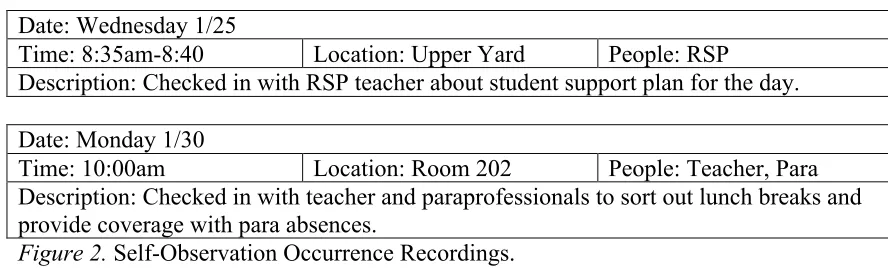
Self-observational data record actual behaviors, thoughts, and emotions as they occur in their natural contexts (Chang, 2008). Self-observational data were collected each day though occurrence recordings. Any time that I engaged in work that related to special education or students with disabilities, I made an occurrence recording. The data that were recorded included the time of interaction, people involved, location, and a brief description of the activity. Examples of systematic self-observation occurrence
recordings are shown in the figure below. Date: Wednesday 1/25
Time: 8:35am-8:40 Location: Upper Yard People: RSP
Description: Checked in with RSP teacher about student support plan for the day.
Date: Monday 1/30
Time: 10:00am Location: Room 202 People: Teacher, Para Description: Checked in with teacher and paraprofessionals to sort out lunch breaks and provide coverage with para absences.
Figure 2. Self-Observation Occurrence Recordings.
that included the tasks I engaged in, the people I interacted with, and where these took place.
Self-Reflection Field Journal
A field journal was also used to record self-reflective data. One narrative entry was recorded in the field journal at the end of each workday and provided the opportunity to record feelings, thoughts, and reactions in response to the daily events. The average length of the entries was roughly one spiral notebook page long. The field journal entries were written as a stream of consciousness that described how I felt at the end of each day and included private inner feelings about the day’s events and how they were in
alignment or not with my personal philosophies. The use of self-reflection field journal entries provided another perspective of the daily activities in which I engaged. This data was important because it showed my struggle with ideological contradictions regarding inclusive education. The process of writing a journal entry at the end of each day also led to new ideas or next steps that I could take or implement in the future. The process also served as a way of analyzing my own professional practice as principal.
Artifacts
Data included a variety of artifacts from district publications and websites, emails from multiple stakeholders, and meeting notes. They were collected as they were
challenges of implementing inclusive practices. Notes from these meetings were recorded and provided additional information from other elementary school principals about the challenges of transitioning to inclusive education. As the principal, I took part in IEP meetings as well. Although notes were taken as part of my role as principal, they were not used in data analysis. The information in IEP meetings remained confidential, however participation in the IEP meetings did contribute to the thoughts and feelings I had that were recorded in daily self-reflection field journal entries.
Semi-Structured Interviews
Semi-structured interviews took place between two additional elementary school principals and myself. Both interviews took place on March 21, 2017. Initial data analysis was conducted before the interviews in order to create an interview protocol. The data from the two interviews were used to determine if the findings from the primary data were unique to my own site and leadership practices, or if other elementary school principals had similar experiences regarding the conflict in inclusive education. The first interview took place in person and was audio recorded to allow the interview to feel more relaxed and take on a conversational feel. The second interview took place thirty minutes after the completion of the first interview and was over the phone due to the time
constraints of the principal. This interview was also audio recorded. The audio
disabilities, and a variety of leadership experiences that relate to inclusive education. The complete interview protocol can be seen in Appendix A.
Data Analysis
Collected data sets consisted of systematic self-observation occurrence recordings, daily self-reflection field journal entries, audio recordings from the semi-structured interviews with two additional participants, and artifacts that included documents from: district websites and publications, emails from multiple stakeholders, and meeting notes. Data were labeled and logged as a set as they were collected.
reporting positive experiences with the supports the teacher is using in the classroom for her son.
Once each occurrence recording was sorted into categories of conflict, or no conflict, I began to look for groupings of related topic or issue that led to conflict. Four different themes emerged from the data and were: roles and responsibilities; skills, knowledge, and experiences; time and resources; and placement. Each occurrence recording was then labeled by theme. Next, I used the transcribed audio recordings from the semi-structured interviews to determine if the other principals experienced similar themes relating to conflict. I added and labeled the conflict they described and grouped it with the other occurrence recordings.
Data that were grouped under the theme of roles and responsibilities included any situation where a community member questioned what was within his or her job
responsibilities or the job duties of another community member, or had a difference of opinion about what someone should be doing. The theme of skills, knowledge, and experiences included situations where community members made statements or
performed actions that demonstrated a judgment was made about the quality of work of one’s self or another. Time and resources included all references made to time, including scheduling of events, and resources included funding, supplies, and personnel needed or wanted by another. The theme of placement included the physical location of different members of the community as well as conversations or discussions about the continuum of placement options.
were labeled as roles and responsibilities were used to write the vignette “Who?”, those labeled as skills, knowledge, and experiences were used in “What?!”, and the ones labeled time and resources, and placement were used to create “When and Where”. The occurrence recordings served as events that would take place in the narrative findings in chapter four.
After compiling a list of events that would be included in each vignette, I used the self-reflection field journal entries to provide more contexts to the events. The field journal entries detailed personal thoughts and feelings about the events of the day as well as information about how I responded to the daily events. This data was compiled along with the events from the occurrence recordings and was then used to write the
autoethnographic findings.
After writing the findings in chapter four, I then shifted my focus to address the second research question, on how principals navigate or respond to the everyday conflicts. To address this question, I used Anderson’s (1990) mediation model. This model was used because it addressed conflict that occurred, “a) at the point of open contention, (b) as day-to-day meaning management among organizational stakeholders, and (c) as the cognitive task of resolving (or perhaps dissolving) contradictions within the structures of one’s own ideology” (Anderson, 1990, pp. 46-47).
through the self-reflection field journal entries and identified times where I described conflict between the leadership decisions I made and my own ideology. This information was added to the autoethnographic findings to provide additional context.
Trustworthiness and Credibility
In autoethnographic research, reliability is judged through the reader. Ellis, Adams & Bochner (2011) describe reliability in an autoethnography as the narrator’s credibility. If the narrative account provides factual evidence it will be more reliable than one that takes “literary license to the point that the story is better viewed as fiction than a truthful account” (p. 10). Credibility is also judged by the reader’s ability to put the provided story to use and to feel that it seemed real.
CHAPTER 4
FINDINGS
Introduction
To the average school principal, conflict is a common occurrence. School principals spend the majority of their time problem solving, handling a variety of conflicts, and constantly putting out fires. When a principal encounters a conflict there are always basic questions that are asked. These questions include: Who was involved?; What happened?; When did this take place?; and Where were you?. I used these basic
questions, as inspiration for the titles of the vignettes in the findings, and to depict the major conflicts that an elementary school principal encounters on a daily basis. The following three stories: ”Who?”, “What?!”, and “When and Where?” each highlight the themes regarding the conflict that was encounter and navigated on a daily basis: roles and responsibilities; skills, knowledge, and experiences; time and resources; and placement.
Introduction to Who?
The following vignette highlights the conflicts around roles and responsibilities. The narrative story depicts one main event that occurs because of the leadership decisions I made in order to provide coverage to students when different community members were absent, and the varying perspectives regarding the roles and responsibilities of different community members. This main event is of particular importance because it
Who?
“I’m a bit disappointed”, I said with a stern voice. “I know that everyone is stressed out, but it is never okay to be acting the way that I have seen some of you act lately.” I paused for a minute to allow what I was saying to sink in, and to model appropriate wait time. It was true, I did not like how some of the staff had been acting, and I felt a staff meeting was an appropriate time and place to clarify expectations, even if my message was only intended for a small few. I stood tall and spoke with authority. “We treat everyone in this building, students, each other, workers, with respect and dignity at all times, even if we don’t feel we are being respected.” The room was silent and all eyes were on me.
Bzz, bzz, bzz. Bzz, bzz, bzz, bzz. Ugh, the familiar sound and soft vibrations on my wrist informed me of my current reality. I was not in the library delivering the perfect speech on teacher and staff expectations, but rather in the comfort of my Tempur-Pedic. The warmth and stability of my bed was a stark contrast from the reality of my job. I raised my wrist to avoid having to lift my head from the pillow, and pushed the one button on my fitness tracker to silence my alarm. As I tried to comprehend where I was, a small smirk appeared on my face. Although it had not actually happened, the vivid realness and details of my dream brought a smile to my face.
I roll to my side, grab my cell phone, and begin my morning ritual. First, I sync my fitness tracker to find out how well I slept. Time asleep: 7hr 26min, sleep quality: 0 times awake, 9 times restless, 10min awake/restless. The data give me comfort that I had
message-absence creation, parent posting to the listserv, junk mail, PTA president. I
open the email with the absence notice to confirm it’s for today. I immediately begin thinking about how stressed the teacher will be, and which para I can pull, to cover the missing one-to-one aide, as I forward the message to the secretary. On to the weather. Now: feels like 48. Hourly: 51, 53, 54, 57, 58. Precipitation: 20%, 30%, 35%, 25%.
The chance of rain was high enough to note I would need to keep an eye on it throughout the day. Clock. I turn off my two back-up alarms before they sound, hop out of bed, and head to the shower. I shake my head as if to confirm I’m awake, still in shock by how real my dream had seemed.
As I arrive into the office, I check the whiteboard to see if anyone else had called in sick. Custodian-out. I unlock my office door, put down my bag, take out my lunch, computer, and notebook, and hang my bag on the back of the door. I plug in my laptop, sign on, and check to see if I have any new emails. Only one. I look at the sender and know immediately that it is a message that can wait, a continuation of the drama that began a week ago between a gen. ed. and special ed. teacher. I close my email, pull up my para schedules, and print a few extra copies. As I walk to the whiteboard in the main office again, I see the print out of all staff absences, which jobs have been filled with subs, and which ones will most likely remain open for the day. Four paras out and one sub.
paras in the workroom. “Good morning. We have four paras out today and only one sub so I need you in another room. You will be taking Ms. M’s schedule for the day.” I hand her a copy of the schedules I had printed out. She looks at me with wide eyes and cocked head. It was a look that was telling me what I already knew, that she didn’t want to be in that room.
“If I’m going to be in that room then I need to meet with you and the student so we can be clear on what the expectations are. I have no problem calling the police or going home if she isn’t going to behave like a student her age.”
I keep calm and with a smile on my face say, “Sure, we can quickly review expectations at the start of the day.” Setting clear expectations are a good thing I think, after all it was what I was so proudly doing in my dream last night. If reviewing behavioral norms was all I needed to do to keep the peace then I was okay with that.
“Okay great. I will meet you both right after morning announcements.” I finish walking to the end of the hall, unlock the front door, and turn down the side hallway to unlock the other doors before returning to the office. My secretary comes to me with shrugged shoulders, arms crossed, and head turned away. In a mousey voice she says, “There’s poop on the bathroom seat. I can handle dead mice, but I am not good with poop.”
and not realize what is left on the seat, which brings me to question if anyone was mad at me enough to do it on purpose. “No one can be that frustrated with anything I’ve done”, I think, “to want to leave poop on the toilet seat!” I had wiped up urine before, but this was a first. Part of me wanted to take a picture so that I could make signs of what the bathroom should and shouldn’t look like after using it. I took a glove out of the first aid kit, grabbed a wad of toilet paper and wiped the poop into the toilet. After sanitizing the seat and washing my hands I emerge from the bathroom. “Crisis averted!” I declare as I walk back into my office.
I sit at my desk, open my laptop, and get ready to read through all my emails when a teacher comes to the door. “Do you have a minute?” she asks.
“Sure, come on in.”
“Can I close this?” she points to the door and begins to shut it. “Of course.”
The teacher seems almost out of breath and exhausted from telling me what she is dealing with. I look at her and say, “I know it can be hard managing adults, I will check in with Ms. Z. Until then I think it is fine that you have her doing that.”
“Okay, thank you. I just don’t want to stress so much about this when I have so much else going on in my room.”
“Not a problem.”
She turns towards the door and heads back out. A stream of teachers trickles in for the day, and they begin congregating in front of my office door near the daily bulletin and sign-in. I keep my eyes peeled for any other teachers I need to check in with
regarding the para absences. Another teacher approaches, walks up to my desk and begins speaking. “I just wanted to let you know that Ms. Z was in the workroom almost all day yesterday. I was in there a few times throughout the day and she was there every time copying four full books. Shouldn’t she be doing something else?”
I look at her with a questioning face and say, “Hum, thank you for letting me know. I will be sure to look into it.” She walks out and two minutes later an RSP teacher pops her head into my office.
building as I wait by the flagpole to confirm every class has a teacher for the day. I enter the building and head upstairs to meet Ms. T and Juliette so we can do our quick check in. Ms. T is standing by the door waiting for me. “The class is outside doing P.E. do you want to come down so we can all check in?”
“P.E.? They don’t usually do that today. Okay,” she says with questioning uncertainty. As we get down the stairs I notice the class is lining up already coming into the building. It must have been just a quick lap to get extra energy out before starting the day. I approach the teacher. “Could I check in with Juliette quickly?” I ask. “Ms. M is absent so Ms. T will be in your room today and she would like to review expectations before starting.”
“Suuure,” the enthusiasm in her voice and exaggerated smile tell me the student is already having a difficult start to the day. I walk up to Juliette and whisper, “Good morning. How are you today?”
“I’m FINE!” she screams. “I didn’t do anything!”
In an agitated and rapid voice she responds, “Be respectful, calm body, no hitting. Okay bye,” and heads out the door.
“She is not going to act like that today or I am leaving,” Ms. T declares.
I walk out the door and ask Juliette if she could try that again, this time showing me that she can do it in a respectful manner. She turns around, heads back into the office, and sits down again in the chair. I prompt her to use a slow calm voice and give a
sentence frame of “Ms. T, I know that I can be…”
“Ms. T, I know that I can be respectful, use a calm voice, and not hit anyone. Okay? Thank you.” She stands up, heads out the door, and begins walking upstairs to her classroom.
“I can not believe students can just walk out of the principal’s office without being excused around here. Is that the expectation you have for them, because I need to know that she is going to be respectful and that was not respectful? I would like her to be excused first before going up to class.” Ms. T looks at me with disgust, as she shakes her head no.
I walk upstairs to see if Juliette made it back to class, Ms. T following behind. I get up to the room and ask Ms. T to wait outside by the door. I am tempted to send Ms. T back to her regularly assigned schedule, but decide not to. Juliette is putting her
“May I go to class now?” she asks. I look over at Ms. T, but realize she is contemplating having her go back down to the office to try it. I quickly respond, “Yes you may. Thank you very much Juliette.” Already frustrated by the power struggle I was witnessing, and second-guessing my decision to pull this para in the first place, I feel myself losing patience. I look up at Ms. T, smile, watch her walk into the classroom, and head back downstairs to my office.
I unlock the door, sit down at my desk, and reach for my first sip of coffee. Feeling frustrated and disappointed in myself, I give myself a minute to reflect on what I could have done differently. “Why do the adults in the building need to create so much drama?” I wondered. Perhaps we need to review staff expectations, roles, and
responsibilities in a staff meeting? I stand up, walk out to the secretaries, and ask, “Could you please put in a work order to change the lock on the staff bathroom door? I would like one where you need a key to enter. I’m tired of cleaning up everyone’s fecal matter.”
Introduction to What?!
What?!
Bzz, bzz, bzz. Bzz, bzz, bzz, bzz. The 6am alarm sounds again. With squinting eyes, open just enough to see the screen of my phone without being blinded from the light, I collect my morning data. Time asleep: 7hr 18min, sleep quality: 1 time awake, 15 times restless, 23min awake/restless. 9 Emails: auto-confirm@amazon, junk mail,
parent, teacher, listserv, listserv, work-order confirmation, IT, junk mail. Weather: Now:
partly cloudy, feels like 54. Clock. Off, off.
“Go ahead and pass to your classes, learn something new, and have fun!” The students make their way into the building. I pull out my cell phone, check my calendar, and confirm what I have on the agenda for today. The big meeting with HR and my potential new RSP was just an hour away. As I walk to the office I see an unfamiliar person sitting in a chair across from the secretaries. I approach her, “Hello, are you Jocelyn?” I ask.
“Hi, yes.”
“I’m the Principal. Nice to meet you.”
“Nice to meet you too. I know I’m really early. I just wanted to be sure I got here and could figure out where I’m going. I’m also very excited about this!”
“I’m very excited you are here as well. I need to run, but I’ll be right back. Maybe we can check in before everyone else gets here.” I turn and walk back out to the hallway to begin my rounds.
at our site this year, and give her a heads up about how everyone is feeling at the moment. “Jocelyn, okay, do you want to come in?”
“Okay,” She stands up, assembles her cane, and waits for directions.
“We are just going to go to the left,” I say. “Would you like me to lead you?” “Yes,” she holds out her elbow for me to guide her into my office.
“There is a chair right behind you.”
She feels behind her, takes a seat, and disassembles her cane. I pull up another chair and sit across from her.
“Welcome! As you know, HR wants all of us to meet so we can figure out if it would be a good fit. Could you tell me more about where you have worked and what you were doing?”
I ask the question partly to find out more about what had happened to her, and why she was being placed halfway though the year. All I had been told from the Special Ed. Department was that she was hired by another site at the start of the year, but was pulled from the position, and had been back at the site she had done her student teaching. When my Special Education Supervisor heard HR was looking for a site to take her, she immediately called me about it. She knew not only was I was short handed, but also that I was an advocate for students with disabilities and would be very welcoming and willing to accommodate her as well.
months ago. Since the new hire had more seniority than one that I hired last year, she got bumped. My other RSP is very close with her. She is not very happy that we lost her, and now we are getting someone to replace her. I just want you to know that because emotions are high right now and it is nothing against you.”
“Oh, it’s okay. I’m just so happy that I will be able to do what I went to school for and what I was hired to do.”
“Great. HR should be coming in just a minute. Let me go see if he’s here.” I open the door, peek my head out, and see him at the desk signing in. “Perfect timing!” I say. “I was just meeting with Jocelyn to give her a little more information about the site and what we would be having her do. Come on in.” I pull up a few more chairs so my two RSP teachers can join us as well. I begin to fill HR in on everything I had been discussing with Jocelyn, when the two RSP teachers walk in. “Great, now that everyone is here, I can go over what I had in mind. Ms. Jocelyn was telling me that she did a lot of work with students using Leveled Literacy Intervention. I think it would be great if she continues with that. After looking at your schedules, I think she would be able to lighten your case load quite a bit, and the students would be getting more of the support they need.”
“So this is a done deal then?!” the RSP asks with frustration, as she crosses her arms, and sits back in her chair.
The same RSP responds, “We have a very small office space and there isn’t any room for another person. Are you saying she would be there and her aide, and another person who is coming to supervise her?”
HR responds, “The additional person would only be coming to support for the first week. To see that everything is going smoothly and Jocelyn has the
accommodations she needs.”
“The office is small,” the other RSP confirms, “and when we both have groups of students in there it is very difficult.”
I think to myself, “Well, if you were both providing services in the least restrictive environment, like the schedules say, then we wouldn’t be having this issue”, but respond,
“I hear your concerns about space. We all know that space is a huge problem around here, but I’m sure I can come up with a solution that works for everyone. Do you have any other concerns? If not, then I know how busy you are so I’m going to dismiss the both of you.”
They stand up and walk out of the room. Once the door closes, HR looks at me with a surprised look on his face. I’m shocked by the hostility projected at Jocelyn, but not surprised. “Does anyone else see the irony in this?” I wonder. “Isn’t the whole point of special education to provide additional support so people can become
independent and join society in a productive manner? Isn’t this the exact moment we are
hoping for? Why would special education teachers not want this to happen?!”
“Everyone is a bit upset about what has happened here with allocations and
Jocelyn’s official start date. Why don’t we take a tour of the school? I can show you the RSP office,” I say with a smile. “Perhaps it’s best you leave your things in here today.”
Introduction to When and Where?
This final vignette highlights the themes of time and resources, and placement. This story depicts several situations that focus on the time and resources that are needed to provide services and supports for students with disabilities in the least restrictive environment. It also shows how different situations and attitudes result in the change of placement for students with disabilities.
When and Where?
Bzz, bzz, bzz. Bzz, bzz, bzz, bzz. Time asleep: 7hr 44min, sleep quality: 3 times awake, 13 times restless, 28min awake/restless. 8 Emails: parent-URGENT new
schedule, auto-update@amazon, psychologist-IEP confirmation, calendar invite, teacher,
junk email, music schedule update, absence creation. Weather: Now: scattered showers,
feels like 52, precipitation: 60%, 65%, 70%, 85%. Clock. Off, off.
I pull up the email with the URGENT subject line and begin reading. I notice that the parent had emailed the message to the classroom teacher, the RSP, and myself so I need to reply all before anyone else complicates things. Re URGENT: Hello, I am happy to discuss your concerns. Do you have time to come in and meet with me this afternoon?
Thank you. I know better than to address any concerns by email, and since I didn’t quite
proper accommodations for her, I am also dealing with a lot of parents that are upset
their children aren’t getting the services in their IEPs, since I’m down an RSP now. This
would never have happened if my concerns regarding allocations were taken seriously in
the first place. Please let me know if you have any update on when Jocelyn will be
returning to our site. Thank you. It wasn’t common of me to reach out to my Assistant
Superintendent, or to be so blunt regarding my concerns, but this was something that I was furious about, and I wanted to be sure I was getting my point across. I hit send. Swoosh.
My first meeting begins at 8:10, the official start to teachers’ contractual workday. My Special Education Supervisor arrives half an hour early, partly because parking is easier, and partly so I can fill her in on some things happening at the site. I give her some updates: a parent wants change of placement into the SDC classroom, another parent submitted a request for independent educational evaluation because her
child didn’t qualify for services, I recently received a parent request for records, we
brainstorm ideas around what the parent is hoping to achieve.