Geschke Center
Doctoral Dissertations Theses, Dissertations, Capstones and Projects
4-2018
Exploring the Relationship Between Students'
Perceptions of the Jesuit Charism and Students'
Moral Judgement
Scott Swenson
University of San Francisco, [email protected]
Follow this and additional works at:https://repository.usfca.edu/diss
Part of theEducational Administration and Supervision Commons
This Dissertation is brought to you for free and open access by the Theses, Dissertations, Capstones and Projects at USF Scholarship: a digital repository @ Gleeson Library | Geschke Center. It has been accepted for inclusion in Doctoral Dissertations by an authorized administrator of USF Scholarship: a digital repository @ Gleeson Library | Geschke Center. For more information, please [email protected].
Recommended Citation
Swenson, Scott, "Exploring the Relationship Between Students' Perceptions of the Jesuit Charism and Students' Moral Judgement" (2018).Doctoral Dissertations. 453.
EXPLORING THE RELATIONSHIP BETWEEN STUDENTS’ PERCEPTIONS OF THE JESUIT CHARISM AND STUDENTS’ MORAL JUDGEMENT
A Dissertation Presented to
The Faculty of the School of Education Department of Leadership Studies Catholic Educational Leadership Program
In Partial Fulfillment
of the Requirements for the Degree Doctor of Education
By Scott Swenson
ii ABSTRACT
Jesuit education has long focused on developing leaders of conscience,
competence, and compassion. There is a gap in the literature examining if aspects of the
Jesuit charism influence moral development. The Ignatian Identity Survey (IGNIS), and
the Defining Issues Test – 2 (DIT-2), were administered to seniors at an all-male Jesuit
high school. The IGNIS was used to explore students’ perceptions of five aspects of the
Jesuit charism: 1) Openness to growth and educational excellence (OGEE), 2) Religious
education and formation (REF), 3) Collaboration (COL), 4) Faith and justice (F&J), and
5) Active Reflection (AR). The DIT-2 was used to determine students’ moral
development and the ways in which they made moral decisions. SPSS was used to
statistically determine if correlations between students’ perceptions and their moral
development existed. This study found that students generally perceive OGEE, F&J, and
AR as being present in campus life, while REF and COL were less perceived. It also
found that the participants were highly developed morally, comparing favorably to
students in graduate school. Additionally, two aspects of the Jesuit charism, REF and
AR, had weak positive correlations with students’ moral development, while the other
iii
This dissertation, written under the direction of the candidate’s dissertation committee
and approved by the members of the committee, has been presented to and accepted by
the Faculty of the School of Education in partial fulfillment of the requirements for the
degree of Doctor of Education. The content and research methodologies presented in this
work represent the work of the candidate alone.
Scott Swenson May 9, 2018
Candidate
Dissertation Committee
Michael Duffy, EdD May 9, 2018
Chairperson
Jane Bleasdale , PhD May 9, 2018
iv
ACKNOWLEDGEMENTS
First, I would like to extend my gratitude to the Jesuit priests who live and work
at Bellarmine College Preparatory, for their generosity, their humor, and most
importantly, for their unwavering example of servant leadership. They helped to form
me when I attended Bellarmine as a student, and they continue to form me as a teacher
and leader.
I want to thank my first advisor in the ICEL program, Dr. Doreen Jones. Doreen
was, and continues to be, an example of what a Catholic educator should aim to be. She
shares he exuberant love with all who enter her presence, and her optimism and support
kept me going on more than a few occasions. My second advisor, Dr. Michael Duffy,
was kind enough to serve as my dissertation chair, and I could not be more thankful for
him walking this journey with me. For me, he serves as an example of what thoughtful,
caring leadership can be in Catholic education, and gives me something to strive for in
my own teaching and administrative practice.
I want to thank my parents, Gary and Laura Swenson, for their unconditional love
and support. Making them proud has been a driving force for me and I am so happy they
could share in celebrating this accomplishment.
Finally, and most importantly, I want to thank my wife, Amy Swenson. She
supported me through the seven years it took me to complete the program at USF and the
multiple “dissertation crises” I experienced. She kept me grounded and helped me dream
big. She gave me two beautiful children and did the important work of parenting while I
spent hours away at class and more hours writing. She did this with grace, humor, and
v
TABLE OF CONTENTS
ABSTRACT ... ii
SIGNATURE PAGE ... iii
ACKNOWLEDGEMENTS ... iv
CHAPTER I: THE RESEARCH PROBLEM ...1
Statement of the Problem ...1
Background and Need for the Study ...6
Purpose of the Study ...9
Conceptual Framework ...9
Research Questions ...11
Limitations ...11
Significance...12
Definition of Terms...13
CHAPTER II: REVIEW OF LITERATURE ...16
Overview ...16
Saint Ignatius ...16
School Culture and Climate ...17
Jesuit Charism ...23
Moral Development ...38
Historical Perspectives ...38
Contemporary Perspectives ...42
CHAPTER III: METHODOLOGY ...53
Restatement of the Purpose of the Study ...53
Research Design...53
Population ...54
Sample...56
Researcher Background ...58
Instrumentation ...59
Validity ...62
Ethical Concerns ...64
Limitations ...65
Data Collection ...66
Data Analysis ...68
Research Question One ...68
Research Question Two ...70
Research Question Three ...73
CHAPTER IV: RESULTS ...75
Restatement of the Purpose ...75
Sample Demographics ...75
Research Question One ...80
Research Question Two ...88
vi
CHAPTER V: CONCLUSIONS, IMPLICATIONS, AND RECOMMENDATIONS ...99
Summary of Study ...99
Conclusions and Implications ...102
Demographics ...102
Research Question One ...103
Research Question Two ...106
Research Question Three ...107
Recommendations ...109
Future Research ...109
Future Practice ...111
Closing Remarks ...113
REFERENCES ...115
APPENDICES ...125
Appendix A: Letter soliciting permission to use Bellarmine College Preparatory as data collection site and use BCP students as respondents ...126
Appendix B: Letter to parents allowing for “opt-out” of study ...128
Appendix C: IGNIS survey instrument...132
vii List of Tables
Table 1: Schematic outline of the relationship between the Ignatian
world-view and the characteristics of Jesuit education ...25
Table 2: Moral Development Affective Skills ...49
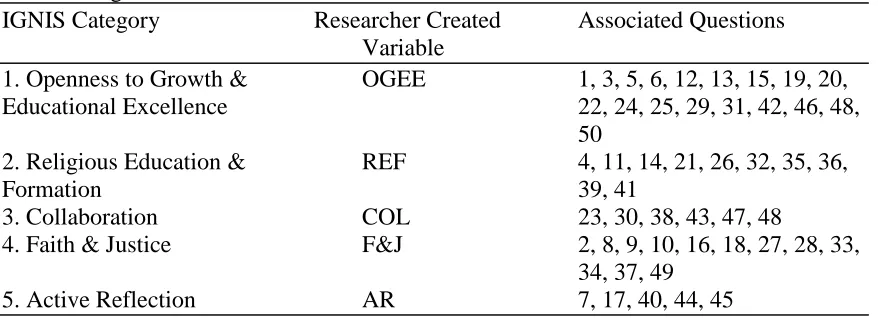
Table 3: IGNIS categories and related questions ...60
Table 4: Validity Criteria for DIT ...63
Table 5: IGNIS categories and researcher created variables ...70
Table 6: Developmental Indices for DIT-2 ...71
Table 7: GPA for survey respondents and total school population ...79
Table 8: Mean scores for the researcher created variables ...81
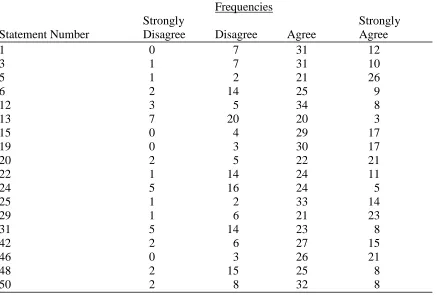
Table 9: Response frequency for the OGEE variable ...82
Table 10: Response frequency for the REF variable ...83
Table 11: Response frequency for the COL variable ...83
Table 12: Response frequency for the F&J variable ...84
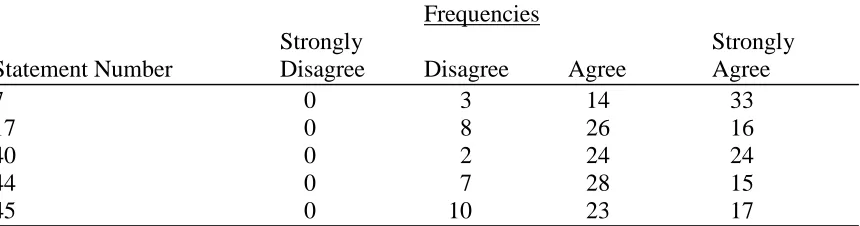
Table 13: Response frequency for the AR variable ...84
Table 14: Mean scores for the researcher created variables by ethnicity ...86
Table 15: Mean scores for the researcher created variables by religion ...87
Table 16: mean scores for the four moral staging variables for the sample and DIT-2 norms...90
Table 17: Mean scores for the four moral staging variables by ethnicity ...92
Table 18: Mean scores for the four moral staging variables by religion ...93
Table 19: Mean scores for the four moral staging variables by Christian or Non-Christian ...94
Table 20: Mean scores for the four moral staging variables by Religious or Non-Religious ...94
viii List of Figures
Figure 1: Ethnic background of the IGNIS respondent sample and the total
School population ...76 Figure 2: Percentage of IGNIS respondents identifying as Christian and
1 CHAPTER I
THE RESEARCH PROBLEM
Statement of the Problem
The function exercised by the school in society has no substitute; it is the most important institution that society has so far developed to respond to the right of each individual to an education and, therefore, to full personal development; it is one of the decisive elements in the structuring and the life of society itself. In today’s world, social interchange and mass media grow in importance (and their influence is sometimes harmful or counter-productive); the cultural milieu continues to expand; preparation for professional life is becoming ever more complex, more varied, and more specialized. The family, on its own, is less and less able to confront all of these serious problems; the presence of the school, then, becomes more and more necessary (Sacred Congregation for Catholic Education, 1982, ¶12)
The Catholic Church has long been involved in education and views it as a
fundamental human right (Paul VI, 1965 a; Sacred Congregation for Catholic Education,
1982). Moreover, the Church believes the primary focus of this education should be on
developing the moral conscience of the student so they may positively contribute to the
society in which they exist (Paul VI, 1965 a; Sacred Congregation for Catholic
Education, 1977, 1982, 1997; 2009; United States Conference of Catholic Bishops,
2005). The Catholic Church recognizes three interconnected agents of moral education:
the family, the society, and the Church (Paul VI, 1965 a). As discussed numerous times
by the Sacred Congregation for Catholic Education (1977, 1997, 2009), the Church
accomplishes this moral education through the inculcation of the Gospel message and
instruction in the faith. Father James Heft, SM (2000), explains this as a religious
transformational process illuminating the two principal goals of Catholic education:
2
within Catholic education that the relationship between faith and reason is brought to
light, as the search for truth is carried out.
The Society of Jesus has been rooted in the apostolate of education since it
opened its first school for lay students in 1548, in Messina, Sicily (O’Malley, 2000).
Quickly, the Society recognized that through schools they could reach a great number of
people and in instruct them in the ways of the Lord (Boston College Jesuit Community,
1994). The expressed mission of Jesuit schools is to form young men and women for and
with others (Arrupe, 1973). To accomplish this the Church uses the principle of
inculturation and applies it to the training provided in their schools. The thirty-fourth
General Congregation of the Society of Jesus (1995) decreed that “the process of
inculturating the gospel of Jesus Christ within human culture is a form of incarnation of
the Word of God in all the diversity of human experience, in which the Word of God
comes to take up a dwelling place in the human family” (p. 12). The Congregation
(1995) further stated,
[O]ur service of the Christian faith must never disrupt the best impulses of the culture in which we work, nor can it be an alien imposition from outside. It is directed toward working in such a way that the line of development springing from the heart of a culture leads it to the Kingdom. (p. 15)
It is the aim of the Society to use education in this way. They seek to do this while
maintaining high academic standards and to do so within a dynamic school culture.
Sergiovanni (2009) tells us that school culture is a powerful influencer of thought and
behavior, and successful schools have strong culture aligned with a vision. Key for this
to happen is a shared value system, a collective ideology which define and create norms
3
values which give rise to an identity, which is what a school stands for, and this is often
informed by a particular charism.
As described by the International Commission on the Apostolate of Jesuit
Education (ICAJE), the Jesuit pedagogical approach to accomplishing this has five
aspects: context, experience, reflection, action, and evaluation. (ICAJE, 1986, 1993).
The ICAJE was originally established in 1980. The Society of Jesus had a meeting on
secondary education that year and ICAJE was formed to continue the work and
discussion began at this meeting. Specifically, this group meets every year and serves the
following purposes:
1) To help the Secretariat coordinate the regions, 2) to communicate to the Jesuit Conference, Provincials, and especially to Province Delegates for Secondary Education, the results of ICAJE meetings, and to suggest ways in which the recommendations can be implemented, 3) To be in communication with one another and with the Secretariat for Education in the Curia, so that greater information and a sense of unity and networking can be accomplished, 4) To communicate to the Secretariat the concerns, challenges and accomplishments of the Jesuit schools in the world, 5) To contribute to the current challenge for Jesuit Schools to become a global network in our current context, and 6) To contribute to the renewal of the Apostolate of Jesuit Education. (Society of Jesus, 2016)
Documents produced by this commission have been critical to the establishment and
functioning of Jesuit schools around the world (Society of Jesus, 2016). Korth (1993)
adds that this paradigm effectively communicates the Ignatian worldview and values
through a system that was based on the Spiritual Exercises of Saint Ignatius of Loyola.
Crabtree, DeFeo, and Quan (2012) explain Ignatian pedagogy not just in terms of a way
for learning to occur, but a “formational and transformational process, a way of
proceeding toward the full development of the human being” (p. 106).
The pedagogical aspect of context speaks to the environment in which teaching
4
but also the personal environment of each student. Tobin (2012) explains four levels of
context: 1) the larger social context, 2) the current ecclesial context, 3) the institutional
context, and 4) the individual classroom context. These four levels are distinct but
interrelated. It is important that faculty members know and understand all aspects of the
reality that impact their students. Boryczka and Petrino (2012) describe context as
involving the “navigation of the terrain between the personal lives of teachers and
students and the political world, which includes their socioeconomic status, religion, race,
culture, and sexual orientation, all of which affect how teachers teach, students learn, and
vice versa” (p. 78). In this way, understanding and creating the context allows for
authentic relationships between the teacher and the learner to develop (Crabtree, DeFeo,
& Quan, 2012; ICAJE, 1986, 1993; Korth, 1993).
For Ignatius, experience meant “to taste something internally” (ICAJE, 1993, p.
14). Within the pedagogical paradigm, the concept of experience speaks to any activity
engaged in by the student, direct or vicarious, and memories and understandings of past
experiences. Direct experiences are those where the student has an authentic experience
which is fully engaging, such as discussions, field trips, service opportunities, simulations
and role playing. Vicarious experiences are those where learning comes through the
experiences of another, such as reading or lecture. The experience is necessary to
provide for the student an opportunity to internalize a feeling and join that with their
intellectual understanding, which will ultimately lead them to action (Crabtree, DeFeo, &
Quan, 2012; ICAJE, 1993; Korth 1993). Crabtree, DeFeo, and Quan (2012) add that
“Ignatian pedagogy requires the student to encounter truth directly so he or she may
5
The aspect of reflection refers to the time allotted for thoughtful reconsideration
of the experience to understand it more fully. Korth (1993) states that “[r]eflection is a
formative and liberating process that forms the conscience of learners in such a manner
that they are led to move beyond knowing to undertake action” (p. 282). It is through this
process that meaning making occurs for the student within human experience. They
come to understand more clearly the truth which they are studying, and how that truth
affects them and their relationships with others and the world (ICAJE, 1993; Korth,
1993). Boryczka and Petrino (2012) describe this aspect of the pedagogical paradigm as
an exercise in consciousness-raising, which involves aspects of sharing, analyzing, and
abstracting meaning from shared experiences.
Action refers to internal growth based on the experience and reflection as well as
outward action. This involves two steps: 1) interiorized choices and 2) choices externally
manifested. Interiorized choices may take the form of a changed attitude, point of
reference, or predisposition. Through this the student is choosing to make the truth their
own. Once this occurs, these newly interiorized values and understandings will compel
the student to action, that is, to do something that is consistent with their new
understandings. It is in this way that students begin to live out the Jesuit call to be
persons for and with others (Crabtree, DeFeo, & Quan, 2012; ICAJE, 1993; Korth, 1993).
The final aspect, evaluation, refers to assessing the changes experienced by the
students, both intellectually, and attitudinally. This process assists students in their
assessment of how their own attitudes, understandings, and openness to the subject matter
has changed throughout the course of study (Crabtree, DeFeo, & Quan, 2012). This
6
judgement of the student is being properly developed as they begin to align their lives
with Gospel values and the example of Jesus (ICAJE, 1993).
There is currently a gap in the research examining if the specific Jesuit charism
has any influence on moral development. There is an opportunity to explore the
relationships between the principles of the Jesuit approach to education and students’
moral development.
Background and Need
The Ignatian pedagogical approach is informed and animated by the Jesuit
charism as it seeks to form men and women who are conscientious, competent, and
compassionate. These are referred to as the three C’s and they constitute the mission of
Jesuit education (ICAJE, 1993; Secretariat for Education, 2015).
It is a mission rooted in the belief that a new world community of justice, love and peace needs educated persons of competence, conscience and compassion, men and women who are ready to embrace and promote all that is fully human, who are committed to working for the freedom and dignity of all peoples, and who are willing to do so in cooperation with others equally dedicated to the reform of society and its structures. (ICAJE, 1993, p. 6)
Essentially, the mission is to create individuals who live by a moral code.
The conscience is an individual’s ability to discern the goodness of their actions.
As Cardinal John Henry Newman (1875) described it as a loyal obedience to the divine
voice inside us. A person’s conscience is that private space where they can be alone with
God and listen to God’s voice. Conscience illuminates the truth that is realized through
the love of God, and through the love of their neighbor, which compels them to search for
truth and solution to all humankind’s problems (Paul VI, 1965 b) A person of conscience
7
seek to see reality as God does. This includes all the beauty of creation, but also the
suffering and injustice. This individual should be motivated to be a change agent in the
world to bring about the Kingdom of Heaven (Nedumattam, 2014; Secretariat for
Education, 2015).
Jesuit education has long been keenly aware of the need for academic excellence,
and has stressed it in their schools since the founding of the school in Messina (ICAJE,
1986). Competence is traditional academic excellence, leading to knowledge of the
world and the skills to change it. The competent person is capable of understanding
multiple contexts and can use them to transform reality. This transformation is not
possible working alone, so the competent student understands that their work will require
interacting with others, and their education should provide them with the necessary skill
set to accomplish these relationships (del Pozo, 2014; Secretariat for Education, 2015).
The compassionate person evolves away from charity to feelings of solidarity and
justice. This is a prerequisite for positive action, and the ability to recognize human
dignity is crucial. Similar to the obedience commanded by the conscience, compassion
should fuel contributions to changing unjust societal structures and systems. (McVerry,
2014; Secretariat for Education, 2015). Pope Francis (2013) speaks of developing
magnanimity, which is the ability to walk with Jesus and be attentive to what He tells our
heart. It is in listening to these words that we will feel compassion, which will lead to
action. If an individual is to be formed in the three C’s, that individual will have sound
moral judgement and will make just decisions, in thought and action, based on the
8
Moral judgement is connected to an individual’s moral stage or level. Lawrence
Kohlberg developed the theory and explanation of these moral stages. The moral stages
are split into three levels: preconventional, conventional, and postconventional. Each of
these levels have two stages of moral development in them, meaning there are six stages
in total. Stages one is the punishment-and-obedience orientation. Here the child
interprets the goodness or badness of actions based on the consequence of punishment.
The child will do that which avoids punishment and defers to the authority. In stage two,
the instrumental-relativist orientation, the child interprets the good as that which is fair,
reciprocal, and equal. In stage three, the interpersonal concordance orientation, good
behavior is that which pleases or helps others. This stage is often referred to as the good
boy/nice girl stage. Stage four sees the child turn toward the law and order orientation.
Here the good is interpreted as that which maintains the social order and shows respect
for authority. The social-contract legalistic orientation is stage five and there is an
awareness of personal values and opinions. The legal point of view takes precedence, but
the law is seen as something that can be changed. Stage six is the
universal-ethical-principle orientation and is the highest stage of moral development. Individuals are
concerned with abstract, ethical principles, such as justice, equality, and human rights
(Kohlberg, 1966, 1973, 1975).
As the Jesuit charism animates the school mission of forming moral leaders, the
relationship between the charism and moral judgement is an interesting one. Two
questions come to mind when pondering this relationship: 1) are Jesuit schools
successfully fulfilling their mission of forming moral leaders, and 2) is there something
9
successfully fulfilled. To do this, studies are needed that examine possible relationships
between the two constructs.
Purpose of the Study
The purpose of this study is to explore the relationship between secondary
students’ perceptions of the principles of the Jesuit charism and Ignatian identity, and
students’ moral judgement. By exploring these relationships, we may gain a more
complete understanding of what Jesuit education is accomplishing, and how. Having this
data will illuminate areas of strength and areas for improvement for schools regarding
their Ignatian identity and how strongly students perceive the principles of the Jesuit
charism. Ideally, schools will be able to make curricular and programmatic decisions to
best affect the student’s moral development and judgement.
Conceptual Framework
This study will rely on the charism of the Society of Jesus as a conceptual
framework. It is this charism that directly influences the culture of the school.
Sergiovanni (2009) explains school culture as a compass to steer members of the
community in the same direction while providing a set of norms to govern behavior and
interactions. Nine principles make up the charism and provide this compass for school
communities: 1) ad majorem Dei gloriam, 2) magis, 3) cura personalis, 4) finding God in
all things, 5) faith, 6) justice, 7) prayer, 8) being a person for and with others, and 9)
being a contemplative in action (Jesuit Vocations, 2016).
Ad majorem Dei gloriam is a Latin phrase meaning “for the greater glory of
God.” This is the Jesuit motto and seeks to inform the discernment process individuals
10
God more, should be made (Dulles, 1997, 2007; Geger, 2012; ICAJE 1986, 1993).
Magis is a Latin phrase meaning “more.” This refers to the desire to excel and to develop
a magnanimous spirit (Dulles, 2007; Geger, 2012; ICAJE 1986). Another Latin phrase
meaning “the care of the person” is cura personalis. This describes the care each person
in the community deserves and should be afforded. Every member of the community is
recognized as a unique gift from God with specific gifts they bring to the community and
specific challenges which require attention from the community (Alphonso, 2007;
ICAJE, 1986, 1993; Korth, 1993; Mitchell, 1988). The fourth aspect of the charism is an
emphasis on finding God in all things and this permeates the worldview and spirituality
of the Jesuits. Ignatius believed if individuals see God in everything, they will take care
of all God’s creation (Fink, 2001; ICAJE 1986). Faith is another aspect which is highly
important. Cultivating a strong faith, particularly a faith that does justice, is of utmost
importance (ICAJE, 1986, 1993). This leads to a commitment to justice which is
emphasized throughout Jesuit education and is intrinsically linked to faith. This justice
seeks to live out the Catholic Church’s preferential option for the poor. Avoiding
speaking simple platitudes about justice, there is a call to action, a call to live out justice
(Arrupe, 1973; Geger, 2012; ICAJE, 1986, 1993; McVerry, 2014).
The Jesuit charism emphasizes prayer as well as an opportunity to commune with
God. The individuals educated within the Jesuit context should have rich interior lives
and a healthy and loving relationship with God (ICAJE, 1986, 1993). Another aspect of
the charism is that schools seek to create men and women for and with others. This is
another articulation of living out justice. This is a call to accompany the poor and those
11
understanding that can be used to better serve those in need (Arrupe, 1973; ICAJE, 1986,
1993). The final aspect concerns the ability to reflect and is referred to as being a
contemplative in action. Being a contemplative in action requires the ability to withdraw
from society and spend time in reflection. These times of reflection are an opportunity
for reflective discernment, which is the ability to judge well the options in front of you in
light of the Gospel truth (ICAJE, 1986, 1993; McVerry, 2014; Nedumattam, 2014).
Research Questions
This study will address the following research questions:
1. To what extent do students perceive each of the nine principles of the Jesuit charism
and Ignatian identity on campus?
2. What level/stage of moral development are the students?
3. What are the relationships between each of the principles of the Jesuit charism and
Ignatian identity, and the students’ moral level/stage?
Limitations
Delimitations
This study will be conducted in one Jesuit, Catholic school. The school was
selected as it is the place of employment for the researcher. This limits the population for
the study to approximately one thousand, six hundred respondents, from which a sample
of approximately one hundred students will be drawn. The researcher also will only
collect data on aspects of the Jesuit charism, as outlined by the JSN survey, as they
pertain to school culture, and will do so using an online survey tool, Qualtrics.
Additionally, the researcher will use the Defining Issues Test, a questionnaire to gauge
12
Limitations
The findings of this study may not be generalizable to other Catholic, Jesuit
schools, due to its small and specific sample. The demographics of the school itself, as
well as the larger community in which it is located, is ethnically, racially, and
socioeconomically diverse. Additionally, the student population is all male. The
findings of this study will only be generalizable to other institutions which share similarly
diverse student populations, which are also single sex institutions. It is conceivable that a
number of students with test anxiety may hurry through the survey, or be unable to focus
during the survey, due to the resemblance to high-stakes test taking procedures. The
choice of using an online survey tool also requires access to computers and the internet,
as well as some basic computer skills. Some students may not be familiar enough with
the technology to successfully complete the survey. Additionally, due to the nature of the
content of the survey, some students may be led to believe that there are correct answers
to the questions and will try to guess those instead of completing the survey as instructed.
Surveys also rely on self-report from the respondents.
Significance
This study will contribute to the fields and bodies of research concerning Jesuit
education and moral judgement. The study will illuminate relationships between the
principles of the Jesuit charism and students’ moral judgement. This study will provide
the author with data which will be used to determine effectiveness of specific programs in
13
real data, to programs to strengthen their effectiveness and their ability to reach more
students. As the Jesuit Schools Network (JSN) continues to strive to maintain the Jesuit
character and identity of member schools, specific information about the impact the
charism is having on the student populations will be useful.
Definition of Terms
The following terms have been operationalized for this study:
Ad Majorem Dei Gloriam: A Latin phrase meaning “for the greater glory of God.”
This is the motto of the Society of Jesus. Saint Ignatius of
Loyola stressed seeking ways to offer God more glory
(Traub, 2008).
Apostolate: In this Roman Catholic context, this refers to any
evangelistic activity or work, such as education.
Contemplative in Action: This speaks to the nature of being a Jesuit. Jesuits seek to
take time each day to retreat from society, turning their
focus inward for reflection and prayer, then returning to
doing the hard work in which they are engaged.
Charism: In educational contexts, the charism refers to those aspects
which are hallmarks of a specific approach to teaching and
learning.
Cura Personalis: A Latin phrase meaning “care of the person.” This is a
belief that each individual in the community should be
recognized as the unique gift from God, with their own
14
Faith: In the Roman Catholic context this refers to the total belief
in God and an adherence to Church dogma and Catholic
Social Teaching.
Finding God in All Things: A way of proceeding for Jesuits and Ignatian spirituality
summed up in a single phrase. It invites a person to search
for and find God in every circumstance of life (Traub,
2008).
Inculturation: A theological concept which states that the Gospel message
needs to be presented to a culture in terms that culture will
understand. Ideally culture and the Gospel mutually
interact (Traub, 2008).
Jesuit: A member of the Society of Jesus. It may also mean
pertaining to the Society of Jesus (Traub, 2008).
Jesuit Schools Network: The network of all Jesuit secondary schools in North
America.
Justice: A desire for equity and inclusion of all groups in society.
In the Jesuit context, this is deeply informed by faith and
the example given to us by Jesus Christ.
Magis: A Latin phrase meaning “the more.” Jesuits are highly
interested in growth and seeking ways to better themselves
and their communities. By seeking “the more” they are
able to glorify God. This suggests a spirit of generous
15 Men and Women For
and With Others: A motto for the Society of Jesus and has become a defining
characteristic of Jesuit education. Jesuit education wants to
create leaders who are willing to serve others and be there
for those in need.
Moral Development: Refers to the emergence, change, and understanding of
morality from infancy to adulthood.
Moral Judgement: The process one uses to determine what is right and just.
Prayer: Opportunities and experiences to commune with, and
encounter God. Many different aspects of life provide us
opportunities to engage in prayer. This also refers to the
inward focus of Jesuits as they engage in their daily prayer,
or Examen.
Society of Jesus: A Catholic religious order founded by Saint Ignatius of
Loyola in 1540. This order takes an additional vow of
complete obedience to the Pope. Members are commonly
16 CHAPTER II
Review of Literature
Overview
This review of literature will seek to accomplish two goals: 1) identify the core
values and beliefs that make up the charism and identity of the Society of Jesus, and 2)
explore the historical and contemporary perspectives of moral development and moral
judgement. In order to identify the core values which create the Jesuit charism and
identity, Ignatian spirituality will also be discussed, and is central to the charism. The
historical and contemporary perspectives of moral development and moral judgement
will be viewed in their relationship to Lawrence Kohlberg, with pre-Kohlberg research
and theories comprising the historical perspectives. Kohlberg’s work and that which
came after he began his research will comprise the contemporary perspectives. A
particular focus is placed on Kohlberg because the researcher will be using the Defining
Issues Test 2 (DIT-2) in the data collection, which is a survey instrument to collect data
on an individual’s moral development based on Kohlberg’s theory.
Saint Ignatius
Saint Ignatius of Loyola was born and given the name Iñigo in 1491. He would
later call himself Ignatius. He was one of thirteen children born to a house of minor
nobility in the border between Spain and France. Ignatius grew up dreaming of making a
name for himself in battle as a knight. It was in Pamplona that his life would take a
dramatic turn. While defending the town from the French, he was hit in the legs by a
cannonball. One leg was shattered and the other injured badly. When Pamplona fell, the
17
Loyola. It was there that Ignatius convalesced for nine months, confined to a bed for
most of that time. He was given two books to read during this time, one on the life of
Jesus, and one on the lives of the saints. He read both numerous times and began
imagining himself as a heroic follower of Christ (Gallagher, 2008; Hansen, 2008; Porter,
2017).
It was then that Ignatius determined a new path for himself and set out as a
Pilgrim to Jerusalem, to walk the streets of the Holy Land. His transformation into a
pilgrim occurred at the monastery at Montserrat before the statue of the black Madonna,
where he traded his sword and fine clothing for a tunic, walking staff, and water-gourd.
Ignatius would then spend eleven months at Manresa, where he experimented with forms
of prayer, meditation, and contemplation. He kept a journal of notes on these experiences
which would eventually become the Spiritual Exercises, a tool used in the formation of
Jesuit spirituality (Gallagher, 2008; Hansen, 2008; Porter, 2017).
At the age of thirty-three Ignatius returned to grammar school to learn Latin,
which set him on an educational journey which ultimately led to the University of Paris.
It was here Ignatius earned a Master’s degree, and more importantly, met a group of men
that would become his companions and the first Jesuits. These companions were
ordained priests in 1537 in Venice, Italy, and soon after decided to create a new religious
order. Ignatius presented this proposal to Pope Paul III, who confirmed the Company, or
Society, of Jesus in 1540.
School Culture and Climate
The first and major purpose of a school is to develop and grow a culture that
18
“the character of a school as it reflects deep patterns of values, beliefs, and traditions that
have been formed over the course of history” (p. 7). Barth (2002) adds that the pattern of
norms, attitudes, behaviors, ceremonies, and myths also contribute to the culture of an
institution, which make up the core of the place. Hoy, Tarter, and Kottkamp (1991)
suggests that while culture is comprised of the values and norms, viewed through an
anthropological lens, the climate is comprised of the behaviors present in the institution
and is often viewed through a psychological lens. Freiberg and Stein (1999) offer that it
is the climate that that acts as the heart of the school and becomes the reason people are
drawn to the community. Sergiovanni (2009) states that the culture of an institution is
comprised of the shared system of values that influence how individuals within the
community understand the world, while climate describes the atmosphere that is created
by how members view the institution.
Among the early researchers of school climate, Tagiuri and Litwin (1968)
discussed four elements influencing the climate of an institution: 1) physical dimension,
2) social dimension, 3) organizational dimension, and 4) cultural dimension. The
physical dimension is made up of the physical space the institution inhabits. This
includes the size and number of buildings, and the way they are maintained. This also
applies to the resources available to the institution. The social dimension applies to the
various forms of diversity present at the school, including racial and gender diversity, as
well as various socio-economic statuses. The social dimension also includes the morale
of the constituents at the school, including students, teachers, and administrators. The
19
the leadership is organized. The cultural dimension includes the shared values, beliefs
and norms of the institution.
Barth (2002) states that “[A] school’s culture has far more influence on life and
learning in the schoolhouse than the president of the country, the state department of
education, the superintendent, the school board, or even the principal, teachers, and
parents can ever have” (p. 6). The culture and climate of an institution will have a
positive effect on the learning that takes place if the culture and climate are positive,
while a negative culture and climate will have a negative impact. (Freiberg, 1998;
Noonan, 2004). The successful school will have a positive culture and climate, and this
is linked to the quality of the relationships on campus. It is within the relationships that
various groups will cooperate to move the institution forward (Bryk & Schneider, 2002).
Hoy and Hoy (2003) discuss these various relationships in four types of climates: 1)
open, 2) engaged, 3) disengaged, and 4) closed. In open climates the relationships are
based on cooperation and respect among all stakeholders at the school. An engaged
climate is characterized by professional teachers operating at a high performing level,
with an ineffectual leadership team or principal. A disengaged climate has an open and
supportive administrative leadership team, but the teachers are disinclined to work
cooperatively with one another or with the leadership. In a closed climate there is
essentially no cooperation. Teachers and administrators simply perform tasks with no
real investment in the institution. “Strong school cultures have better motivated teachers.
Highly motivated teachers have greater success in terms of student performance and
20
In an explicitly Catholic setting, Cook and Simonds (2011) state that “Catholic
schools should set a new course for the future by making relationship building the
distinctive purpose of all their schools” (p. 322). Cook and Simonds (2011) develop a
framework for understanding the relationships necessary for a successful school
community. This framework includes the following five relationships: 1) a relationship
with self, 2) a relationship with God, 3) a relationship with others, 4) a relationship with
the local and world community, and 5) a relationship with creation. The relationship with
self begins with an invitation for self-exploration within a supportive environment
designed to draw out an individual’s unique gifts and talents. The aim of the school
should be to help students develop completely in heart, body, and spirit, all dimensions of
the self. As the self is developing, an emphasis is placed on the second relationship, a
relationship with God. Religious formation in the Catholic faith requires a school to try
to bring the individual into a greater understanding of God, which necessitates an
exploration of Jesus Christ. As students develop a deeper understanding of Jesus and His
style of embracing “the other,” of loving “the other,” this example becomes the model for
developing the third type of relationship, a relationship with others. This relationship,
based on Christ’s loving approach, is exemplified for students by the teachers, and the
individual care they show their students. It is through this care that teachers encourage
students to reach out to others within the school community, practicing the same care
shown to them by their teachers. Once a culture of relationships within the school
community develops, the students can look beyond the campus and begin developing the
fourth relationship, a relationship with the local, and global, community, based on the
21
curriculum of the school with how world cultures and religions are encountered, and how
service learning opportunities are used. Again, Christ’s example is used to encourage the
students to go and make a difference in the world. The fifth relationship is with creation.
Educators in Catholic schools need to stress the ways in which we are called to care for
the environment. The ways in which societies, businesses, corporations, and individuals
interact with the environment, both good and bad, should be discussed within the
curricular context of the school, and students should be encouraged to think about the
ways in which they can lessen their own negative impact on the planet.
Again, within the Catholic context, Cook (1998) discusses how schools can work
to create a positive culture, or “way of life,” for the school as it is the single most
important thing a school can do.
Evidence suggests that how students feel about God and the Church upon graduation has less to do with religion class than it does with how the school operates as a whole. It might be said that the informal curriculum is the pre-evangelization necessary before religious instruction can take root. For Catholic school students, the school culture, or way of life, speaks louder than religious instruction. Those who reject or feel rejected by the culture will most likely reject the message. What this means is that a positive, caring, supportive school
environment is the prerequisite for religious instruction to take hold. If this is indeed the case, it places a premium on a school’s culture, or way of life, in the faith development of students (Cook, 1998, p. 138).
To create this positive Catholic culture a school needs to: 1) identify and integrate core
values, 2) develop and display a school symbol system, 3) communicate core values
through word choice, slogans, and stories, and 4) revitalize traditions and rituals. Core
values are those ideals that provide meaning to a community. They are what the
community aspires to be. There are many sources for these values, but common ones
include Church documents, Catholic Social Teaching, and a charism or a religious order.
22
Schools with strong cultures typically have a strong symbol system as well. These
symbols communicate with the community, both on campus and off campus. Cook
(1998) states “[m]any school symbols represent aspects of its culture: logos, emblems,
coats-of-arms, seals, class rings, school colors, mascots, campus landmarks, etc. (p. 141).
This can also be aspects of the physical plant, such as a specific building, or a particular
shrine. Often it is through these symbols that relationships with the community may be
strengthened, as with the case of alumni of the institution who feel a fondness for a
landmark on campus. The school can also use word choice, slogans, and stories to
communicate their values and help create a positive culture. In the Catholic setting, the
school should aim to use words that align them with the greater mission of the Church or
a grounding in the Gospel. Slogans should also communicate that which makes the
school unique, and speak to the Catholic nature of the school. Finally, stories can be used
to convey important lessons about the core values. They provide an opportunity to
illustrate what is important to the community with an individual’s lived experience,
which resonates with others in the community (Cook, 1998; 2004).
Summary School Culture and Climate
The literature clearly describes an institution’s culture and climate as being the
single largest influence on the total student experience. The culture and climate of a
school are comprised of the shared values, expected norms, attitudes, and stories of the
institution. Relationships are highlighted as a particularly strong way to influence culture
and climate within schools, and effective leaders work diligently at cultivating
23
relationships should be the primary focus for the leadership and can be used to
demonstrate the Gospel message.
Jesuit Charism
In 1548, the Society of Jesus opened its first school for the laity in Messina,
Sicily. It is in this place that the Society of Jesus began to understand the social and
cultural impact it could have on the communities in which it lived and served. The
Jesuits began opening schools all over the world to spread the Catholic faith and train
students to become tomorrow’s civic leaders (O’Malley, 2000). It was in these schools
that Ignatian spirituality was shared with the laity. It is this spirituality that lead to a
distinct Ignatian identity developing in these schools which influenced the distinct Jesuit
charism, which is still evident today at all Jesuit schools around the globe.
David Lonsdale (2000) describes the spirituality that Ignatius offers as one which
emphasizes “discovering and responding to the presence and action of God in the
circumstances of everyday life” (p. 191). Lonsdale (2000) continues to discuss the
flexibility of the spiritual approach of Ignatius as having wide appeal to Christian
communities for three reasons. The first reason is that Ignatius made no distinction
between the laity and the religious in how they approach their personal relationship with
God. Every individual will experience God in their unique circumstances, and neither
experience, lay or clergy, is inherently more holy than the other. Secondly, it stimulates a
close, personal relationship with the person of Jesus, as a relatable person, similar to
ourselves. Thirdly, it helps people develop the capacity to see God in all things in their
24
Father James Martin, S.J. (2010) echoes Lonsdale assertion that Ignatian
spirituality helps people experience God in their daily lives stating “[t]he way of Ignatius
means there is nothing in our lives that is not part of our spiritual lives” (p. 27). Martin
(2010) goes on to discuss four phrases that describe Ignatian spirituality particularly well:
1) finding God in all things, 2) contemplatives in action, 3) incarnational spirituality, and
4) freedom and detachment. Martin explains that finding God in all things is developing
the understanding that nothing has to be hidden away from our spiritual dimension.
Everything in our lives can be brought out into the open before the light of God, and, in
fact, should be. Being a contemplative in action is developing the willingness to “see the
world as your monastery” (p. 8). Many people do not have the time or the ability to join
a monastery to devote themselves completely to contemplation and prayer, however,
people can develop a contemplative stance toward the world, and understand their actions
as a type of prayer. Ignatian spirituality is incarnational. God became human, or
incarnate, in the real person of Jesus, and today, we can find God in all of the real things
in our lives. This spirituality is about the real world and recognizing God’s closeness to
us. Finally, this spirituality focuses on seeking freedom and detachment. Ignatius
stressed not being tied down by the unimportant things in life, or becoming too consumed
by particular aspects of life. When we can be detached from those things that can act as
shackles, we will experience the freedom to know happiness.
Ignatian spirituality encourages individuals to see the world in a specific way. It
is precisely this world-view that impacts and shapes the Jesuit approach to education. In
1982 ICAJE met and over the next four years this commission worked to determine the
25
Table 1 shows the relationship between the Ignatian world-view, informed by Ignatian
spirituality, and the characteristics of Jesuit education (ICAJE, 1986). As one would
expect, many of the characteristics of Jesuit education are strongly aligned with aspects
of the Jesuit charism.
Table 1
Schematic outline of the relationship between the Ignatian world-view and the characteristics of Jesuit education.
Ignatian world-view Jesuit education…
1. For Ignatius, God is Creator and Lord, Supreme Goodness, the only one Reality That is absolute;
all other reality comes from God - is an apostolic instrument. and has value only insofar as it leads us
to God.
This God is present in our lives, - includes a religious dimension that “laboring for us” in all things; that permeates the entire education.
He can be discovered through - is world affirming.
faith in all natural and human events, - promotes dialogue between faith in history as a whole, and culture
and most especially in the lived - assists in the total formation of experience of each individual person. each individual within the human
community.
2. Each man or woman is personally - insists on individual care and known and loved by God. This love concern for each person. invites a response which, to be au-
thentically human, must be an ex- pression of radical freedom.
Therefore, in order to respond to the love of God, each person is called to
be: - encourages life-long openness to
- free to give of oneself, while growth. accepting responsibility for
and the consequences of one’s action: free to be
faithful; - emphasizes activity on the part of - free to work in faith toward the student.
26 the freedom to respond to God’s love is not automatic. Aided and strengthened by the redeeming love of God, we are engaged in an ongoing struggle to re- cognize and work against the obstacles that block freedom, including the effects of sinfulness, while developing the capacities that are necessary for the exercise of true freedom.
a. This freedom requires a genuine - encourages a realistic knowledge, knowledge, love and acceptance love and acceptance of self. of self joined to a determination
to be freed from any excessive attachment to wealth, fame, health, power, or even life itself.
b. True freedom also requires a - provides a realistic knowledge of realistic knowledge of the various the world in which we live. forces present in the surrounding
world and includes freedom from distorted perceptions of reality, warped values, rigid attitudes or surrender to narrow ideologies.
c. To work toward this true freedom, - is value-oriented. one must learn to recognize and
deal with the influences that can promote or limit freedom: the movements within one’s own heart: past experiences of all types; interactions with other people; the dynamics of history, social structures and culture.
4. The world view of Ignatius is centered - proposes Christ as the model of on the historical person of Jesus. He is human life.
the model for human life because of his total response to the Father’s love, in the service of others.
He shares our human condition - provides adequate pastoral care. and invites us to follow him, under the
standard of the cross, in loving response to the Father.
He is alive in our midst, and - celebrates faith in personal and remains the Man for others in service community prayer, worship and
of God. service.
5. A loving and free response to God’s -is preparation for active life love cannot be merely speculative or commitment.
27 speculative principles must lead to
decisive action: “love is shown in deeds”.
Ignatius asks for the total and - serves the faith that does justice. active commitment of men and women
who, to imitate and be more like Christ, will put their ideals into practice.
In the real world of ideas, social - seeks to form “men and women for movements, the family, business, others”.
political and legal structures, and religious - manifests a particular concern for
activities. the poor.
6 For Ignatius, the response to the call - is an apostolic instrument, in of Christ is in and through the Roman service of the church as it serves Catholic Church, the instrument through human society.
which Christ is sacramentally present in the world. Mary the Mother of Jesus is the model of this response.
Ignatius and his first companions - prepares students for active all were ordained as priests and they put participation in the church and the the Society of Jesus at the service of the local community, for the service of Vicar of Christ, “to go to any place others.
whatsoever where he judges it expedient to send them for the greater glory of God and the good of souls”.
7. Repeatedly, Ignatius insisted on the - pursues excellence in its work of “magis” – the more. His constant concern formation.
was for greater service of God through a closer following of Christ, and that concern flowed into all the apostolic work of the
first companions. The concrete response - witnesses to excellence. to God must be “of greater value”.
8. As Ignatius came to know the love of God - stresses collaboration. Revealed through Christ and began to
respond by giving himself to the service - relies on spirit of community of the Kingdom of God he shared his among teaching staff,
experience and attracted companions administrators, Jesuit community, who became “friends in the Lord”, in the governing boards, and benefactors. service of others.
The strength of a community - takes place within a structure that working in service of the Kingdom is promotes community.
greater than that of any individual or group of individuals.
9. For Ignatius and for his companions, - adapts means and methods in order decisions were made of the basis of an to achieve its purposes most
ongoing process of individual and effectively.
28
in a context of prayer. Through prayerful common vision and common goals. reflection on the results of their activities,
the companions reviewed past decisions - assists in providing the professional and made adaptations in their methods, training and ongoing formation that in a constant search for greater service to is needed, especially for teachers. God (“magis”).
From ICAJE, 1986
Demonstrating how this world-view and these characteristics affect students at
Jesuit schools, The JSN created a profile of graduating students. The document describes
a graduating senior from a Jesuit high school in five general categories: 1) open to
growth, 2) intellectually competent, 3) religious, 4) loving, and 5) committed to doing
justice. The first category, open to growth, points to the growth already experienced by
the individual, but also to their willingness to continue to develop, emotionally,
intellectually, socially, and religiously. The graduating senior will also be intellectually
competent. This assumes mastery of the academic requirements of the school, in addition
to developing the habits of intellectual inquiry and a desire to be a life-long learner. At
the time of their graduation, the individual will have an understanding of the teachings of
the Catholic Church, been introduced to Ignatian spirituality, and have been exposed to
other faith traditions. The graduate will also be moving toward the ability to have close
relationships with others that are not self-centered and growing in their capacity to love
another person. Finally, the graduate will be ready to live in a global society as a person
for and with others (JSN, 2015).
As the focus remains on the experiences of students, the Jesuit charism and
distinct identity begins to emerge, as influenced by Ignatian spirituality, and the Jesuit
commitment to education. Nine principles are singled out as major aspects of this
29
things, 5) faith, 6) justice, 7) prayer, 8) being a person for and with others, and 9) being a
contemplative in action (Jesuit Vocations, 2016).
Ad majorem Dei gloriam (AMDG) is a Latin phrase meaning ‘for the greater
glory of God’. This is the unofficial motto of the Jesuits and was central to Ignatius’
approach to his life and relationship with God. Ignatius was not concerned with the best,
or the most, or the greatest, but instead focused on ‘the greater.’ Barton Geger, S.J.
(2012) explains that “AMDG is a specific criterion for making decisions in the service of
God. We can phrase it like this: ‘When discerning between two or more good options, all
else being equal, choose that which serves the more universal good, i.e., that which
makes the widest impact” (p. 18).
Magis is a Latin word meaning ‘the more’. This is the essential idea to Ignatius’
devotion to AMDG. “The magis means doing the more, the greater, for God. When you
work, give your all. When you make plans, plan boldly. And when you dream, dream
big” (Martin, 2010, p. 369). Avery Dulles (2007) states “[i]t signifies the desire to excel,
to seek ever more (magis). What we have done and are currently doing is never enough”
(p. 1). This however, needs to be tempered, lest we reduce the magis to simply equate to
excellence. Geger (2012) discusses what magis is not, or should not be, to better
understand what it is. Geger states that magis should not be equated simply to generosity
or giving more than you currently are, nor should it necessarily imply excellence or
quality. “Even though ‘generosity’ and ‘excellence’ are poor definitions of the magis,
authentic applications of the magis often include acts that are generous and excellent”
(Geger, 2012, p. 25). Additionally, magis should not always be the harder or riskier
30
generously and lovingly and still not serve the magis, if the more universal good is not
being served. This is not to condemn great acts of love, which are at the heart of
Christian gospel, but to distinguish magis as something else. ICAJE (1986) discussed
this is the context of schools and linked magis and excellence with the needs of a
particular location and circumstance.
To seek the magis, therefore, is to provide the type and level of education for the type and age-group of students that best responds to the needs of the region in which the school is located. ‘More’ does not imply
comparison with others or measurement of progress against an absolute standard; rather is it the
fullest possible development of each person’s individual capacities at each stage of life, joined to the willingness to continue this development
throughout life and the motivation to use those developed gifts for others (p. 21).
Cura personalis is a Latin phrase meaning ‘care of the person.’ Ignatius paid
particular attention to the individual in the Constitutions of the Society of Jesus.
Alphonso (2007) explains that even as Ignatius sets forth a principle, universal in nature,
he calls for the care and concern of the individual, acknowledgement of their conditions
and circumstances, in the application of the principle. In the Ratio Studiorum, the
curriculum and pedagogical guide written by Ignatius, he begins with rules for the
provincial, who is in charge of all Jesuits in a given area, or province. Ignatius takes care
to inform the provincials to pay special attention to the gifts and talents of those studying
in their provinces and to do what they can to utilize those talents, while being respectful
of what is being asked of them (Loyola, 1599/1970). While this speaks to the governance
and care for those within the Society of Jesus, in Jesuit education this speaks to how
individuals should acknowledge each other, and recognize the talents, gifts, needs, and
31
about Jesuit education being student-centered. He states that the educational process
should be adaptive, as much as possible, to the individual’s abilities, needs, and interests.
ICAJE (1986) formalized this approach to Jesuit education stating that the curriculum
should be centered on the individual student, not on material to be covered, and that the
individual be allowed to accomplish objectives at their own pace. Faculty and staff act as
more than just guides along the academic journey of the student, but take a real interest in
the individual student to gain a deeper understanding of them intellectually, spiritually,
and emotionally. This is done to help the individual develop self-confidence as they
become active members of the larger society. This allows the faculty and staff to
accompany the student in their lives, through joys and sorrows, to develop a true
relationship. Robert Mitchell S.J. (1988) and Sharon Korth (1993) echo these sentiments
about the student centeredness of Jesuit education, with Korth also acknowledging that it
is in relationships built on trust and respect, that student and teacher can become
companions in learning.
Finding God in all things is a central idea in Jesuit spirituality, and was written
about extensively by Ignatius. Avery Dulles, S.J. (1997) and Peter Fink, S.J. (2001)
discuss Ignatius’ Spiritual Exercises and the way Ignatius spoke about finding God in all
creation: plants, animals, and other human beings. Ignatius believed that God dwelled in
all creation and was therefore offering up Himself in love and seeks to embrace us in
love. God is also present in all human experience, whether those experiences by joyous
or marked by sadness. Martin (2010) adds that this is due to seeing the world in an
incarnational way. This means that God is found in all real things, real people, and real
32
[w]hat Ignatius proposes as the touchstone of Jesuit formation is an asceticism that focuses a young Jesuit on the ability to be present to another reality, to hold in acceptance and a kind of awe the reality as he finds it, and out of this orientation to be sensitive to how God speaks to him through that other reality. Moreover, this kind of formation was not something to be done only within the novitiate (the first stage of a Jesuit’s formation). Rather it was to be inculcated as an abiding apostolic process that helped the Jesuit to become a man who could find God in all things, like studies, like other cultures, like people weighed down by sins, like art and music and science. The ramifications of this formation directive are wide and rich, suggesting an important key not only to the personal
religious event of finding God in all things but to the apostolic mind-set of expecting to find God in all people, places, and events (p. 72).
ICAJE (1986) places this spiritual approach into the educational setting. Since God is
everywhere and in everything, everything is worthy of study and academic inquiry. The
schools should create a sense of wonder for God’s creation and instill a desire to learn
about and explore that creation.
Jesuit schools are intrinsically about the propagation of the Catholic faith
tradition. It is precisely for this reason that the Provincial Assistants for Secondary and
Pre-Secondary Education of the Society of Jesus (2015) selected faith and faith formation
as a standard benchmark for Jesuit schools. Faith and faith formation should integrate
faith, culture, and life. Students should, throughout their course of study, be invited to
experience faith as a gift from God. Faith was chosen as a standard because of its
centrality to the mission of the Society of Jesus. Similarly, The Jesuit Conference (2007)
discussed the distinguishing criteria of Jesuit schools and lists service of faith at the top.
All Jesuit missions should strive to serve faith while bringing to fruition the Kingdom of
God. Peter-Hans Kolvenbach (2001) explains the service of faith as the bringing of the
countercultural gift of Jesus Chris to the world. ICAJE (1986) focused on what this