Sebastian Scherr*
Philip Baugut
1 Department of Communication Studies and Media Research, LMU Munich,
Germany
2 Institut für Kommunikationswissenschaft und Medienforschung,
Ludwig-Maximilians-Universität München,
Germany
*Corresponding author: Sebastian Scherr
[email protected]L Department of Communication Studies and Media Research, LMU Munich Ludwig-Maximilians-Universität München, Oettingenstr, 67 80538 München, Germany.
Tel: +49 89 2180-9453
Citation: Scherr S, Baugut P. Does an Active Journalistic Role Conception Rectify Questionable Reporting Practices? Answers from a Representative Survey of Journalists in Germany. Global Media Journal. 2017, 15:28.
Does an Active Journalistic Role
Conception Rectify Questionable
Reporting Practices?
Answers from a Representative Survey of Journalists in Germany Cases like Snowden and WikiLeaks emblematize the crucial debate about the appropriate means to enable the public access to important political information [1]. There are several journalistic reporting practices that may contribute to political transparency; however, they can be regarded questionable from an ethical point of view. For example, journalists have to decide whether it is acceptable to claim to be someone else, to badge or harass sources, to pay for information, or to use confidential government documents without permission [2,3]. Does the end justify the means? Answers on the ethical dilemma between promoting transparency and being a watchdog on the one hand, and problematic means to achieve those functions on the other hand can be one factor potentially shaping news coverage [BLINDED FOR PEER REVIEW].
This may be one of the reasons why large national surveys of journalists usually contain questions about the acceptability of different reporting practices [2,4,5] While there is no lack of descriptive findings on the acceptance of those reporting practices
[2], research on how individual characteristics of journalists drive their attitudes to utilize such questionable reporting practices is scarce.
Generally, journalism research is interested in both rather professional individual characteristics like role perceptions and rather non-professional characteristics like age, political leanings etc. [6-8]. Especially the concept of journalistic roles has received much attention [7,9,10]. While journalists’ role perceptions are theoretically and empirically well-researched, there is a lack of research investigating how professional goals and their perceived achievement are related to ethical considerations like attitudes toward questionable reporting practices.
Another crucial individual characteristic are the political leanings of journalists which are object to often controversial discussions about news bias and the democratic functions of the media [11-14]. While there are a lot of descriptive findings on how journalists position themselves on a left-right-scale [15-17], the studies regularly do not illustrate in how far political attitudes of journalists are meaningful for professional attitudes like ethical
Does an Active Journalistic Role Conception
Rectify Questionable Reporting Practices?
Answers from a Representative Survey of
Journalists in Germany
Received: March 24, 2017;Accepted:April 01, 2017;Published: April 01, 2017
Abstract
views which finally can affect the topic, focus or style of media coverage.
In this paper, we theoretically and empirically discuss in how far the perceived role achievement and political leanings of journalists are important variables when it comes to explain the acceptance of questionable reporting practices. We will do so, by reanalyzing data from a cross-sectional survey that is representative for German journalists.
Attitudes towards reporting practices and its
causes
Revealing confidential sources, paying for secret information, claiming to be someone else, using personal documents without permission, or getting employed to gain inside information – whether journalists think of these methods as acceptable especially varies from country to country, except in the case of revealing confidential sources [3,5,18]. For example, while only 12 percent of the German journalists say it may be acceptable to badger or harass news sources, more than half of the surveyed American journalists showed that attitude [18].
The Worlds of Journalism Project [19] documents country differences with regard to the dimensions relativism (i.e., meaning of values regardless of situation and context) and idealism (which refers to consequences in the responses to ethical dilemmas). Concerning idealism, a large majority of journalists in the US, Germany, and Switzerland agrees that questionable practices of reporting should be avoided in any case, even if this means not getting the story. Contrary to that, for example in Israel, only a minority of journalists agrees with this point [19]. Put in more general terms, Western journalists are deemed to be less supportive of questionable reporting practices than journalists in developmental or transitional environments, probably because journalists in those countries justify controversial reporting practices by their individual contribution to social change. While it is well documented that ideological and cultural factors have an impact on ethical orientations [19] and that they can change over time [20], the question in how far individual characteristics affect their acceptance of different journalistic reporting practices has been widely neglected so far. However, there are three important exceptions:
The first exception, considering the impact of political leanings, is the study of Weaver et al. [21] on the American journalist. In 1992, conservative journalists were less likely to tolerate questionable reporting practices, whereas the authors did not find a statistically significant correlation in 2002. Nevertheless, these findings have not been discussed more thoroughly with regard to their theoretical grounds and consequences. Another exception, considering the impact of journalistic roles on their research and reporting practices, is a specific finding in a study by Weaver et al. [21] namely that journalists who preferred an adversarial or interpretative function more strongly justified controversial reporting practices, which was less so for journalists ascribing themselves a more passive disseminator function. Nevertheless, these findings may be especially true for the
U.S.-American context, and their theoretical implications are not yet fully explored. Third, [BLINDED FOR PEER REVIEW] found that the perceived achievement of an active role increases the acceptance of questionable reporting practices. While there is a large body of research on journalistic role perceptions, the question and consequences of in how far journalists feel able to achieve their goals still deserves more attention.
Linking perceived role achievement with the
acceptance of questionable reporting practices
The theory of cognitive dissonance suggests that discrepancies between beliefs and behaviors produce feelings of discomfort [22]. While this approach receives intensive attention in psychology, journalism studies mostly refer to it when it comes to explain the selection of news by the audience [23]. However, cognitive dissonance is also likely to occur, when journalists perceive a discrepancy between their professional role and goals on the one hand, and the achievement of it on the other hand. Role achievement seems to be an important predictor, as studies showed that journalists who perceive discrepancies between role ideals and daily practice are less satisfied with their job, more frustrated with work, cynical and less committed [24-27]. Nevertheless empirical evidence that contributes to a deeper understanding of these findings is still scarce.Given these findings, [BLINDED FOR PEER REVIEW] found empirical support for their hypothesis that the degree, to which journalists perceive the achievement of an active role, has an effect on their acceptance of questionable reporting practices. German journalists who perceived to have achieved less in their job were more likely to accept questionable journalistic reporting practices. The study pointed out that the acceptance of questionable reporting practices might serve as way to reduce cognitive dissonance in consequence of a perceived discrepancy between an active role and its fulfillment. Journalists who do not feel able to achieve their professional goals probably try to play an active role by (at least) justifying and utilizing questionable reporting practices [BLINDED FOR PEER REVIEW]. Given these theoretical considerations and empirical findings, we formulate the following hypothesis:
H1: The less journalists perceive to have achieved an active professional role, the more they accept questionable journalistic reporting practices.
Journalists’ political leanings and the acceptance
of questionable reporting practices
compared to more right or conservative journalists, left or liberal journalists should be more likely to justify questionable reporting practices.
Generally, a distinct motivation to change society and to stand up for the disadvantaged can be regarded as typical for more left or liberal attitudes [29-31]. It is therefore not surprising that research on the “The American Journalist” suggests that the more liberal the journalist, the more likely they are to embrace values that refer to an interpretative, adversarial and populist mobilization function [21]. In line with this finding, [BLINDED FOR PEER REVIEW] found that more left/liberal journalists tend to show professional attitudes representing a slightly more active role perception such as being an advocate for disadvantaged people. As rather left or liberal journalists tend to play an active role it is plausible to assume that these journalists are more likely to accept questionable reporting practices. Such methods include but are not limited to paying for information or to claim to be someone else, which serve as a way to gather important information that allow journalists to challenge the powers and to play an active role in society by promoting social change. Put differently, journalists who want to actively change society rather than being passive disseminators of information can be assumed to hold the ethical view that the end (i.e., social change) justifies the means (i.e., questionable reporting practices). Following this premise, the impact of the perceived role performance on the acceptance of questionable reporting practices might also be a function of journalists’ political leaning.
However, the effect of perceived role achievement on the acceptance of questionable reporting practices has not been explored more deeply; we still do not know for which journalists this relationship is especially true. In the following, we will point out that a journalist’s political leaning is an important variable when it comes to explain the acceptance of questionable reporting practices. So far, no research explored more in detail the explanatory power of political leaning of journalists for the association between the perception of having achieved an active professional role on the one hand and the acceptance of questionable journalistic reporting practices on the other hand. For instance, it might be the case that only journalists who hold extreme political world views more strongly accept questionable research practices. This could not have been detected in simple correlational analyses between these variables as presented by Henningham [28]. Therefore, we formulate the following research question:
RQ1: How does political leaning of journalists moderate the association between the perceived achievement of an active role and the acceptance of questionable reporting practices.
Method
Sample and procedure
Data from a representative cross-sectional survey of German journalists from 2005 (n=1536) were used in this study to test the hypotheses. The elaborate multistep sampling procedure to obtain a sample that is representative for the population
of German journalists has been described elsewhere [32]. The sample includes journalists from different media outlets (TV, newspaper, online news, magazines, radio, news agencies) with different circulation and publication frequency as well as journalists who were both working as staff or freelancer. Highest efforts in flexible scheduling of interviews and getting in touch with journalists yielded a remarkable response rate of 73%. In the final sample, 37% of the journalists were female. The mean age was 40.5 years (SD=9.2), 25% worked as freelancers (vs. 75% working as staff) for a media company and 22% worked for a public broadcasting company (vs. 78% working for a commercial media company). Since this study focuses on correlations between the variables of a more general aspect within journalism (i.e., research practices, political leaning of journalists), we regarded the dataset from 2005 as still valuable for important insights into journalism practice.
Measures
We used the dataset for our secondary data analysis presented here. The data includes questions about perceptions of having achieved important aspects of an active journalistic role, the acceptance of different journalistic reporting practices, and the journalists´ political leaning.
Acceptance of questionable journalistic reporting practices:
Nine statements about journalistic reporting practices were included in the survey. The acceptance of these statements (e.g., “Using confidential government documents without permission is…”) was measured on a five-point Likert like scale ranging from 1 “absolutely not acceptable” to 5 “totally acceptable”. Principal axes factor analysis with Promax rotation (KMO=0.865; Bartlett´s test p<0.001, 35% explained variance) yielded a two-factor solution, of which the first two-factor describes questionable journalistic reporting practices, while the second factor was a methodological artifact resulting from extreme or ambiguous question wording. Therefore, only the first factor was used for further analysis. As the six items of the first factor yielded sufficient reliability (Cronbach’s α=0.78) an index variable measuring the acceptance of questionable journalistic reporting practices was constructed (M=2.2; SD=0.7).
Perceived achievement of an active journalistic role: Journalists
were asked about personally relevant aspects of their professional role and to what degree they perceive themselves having achieved them. Principal axes factor analysis with Promax rotation (variance explained=35.22%; KMO=0.833; Bartlett´s test p<0.001) yielded in three distinct factors (politically active, provider of service information, explain reality), of which we focus on the first. Reliability analysis showed that the three items capturing the first factor on a 5-point Likert scale ranging from 1 “totally disagree” to 5 “totally agree” (e.g., “I achieved in my job being advocate for disadvantaged people“) showed only limited reliability (Cronbach’s α=0.63), but were transformed into an index variable based on theoretical considerations and appropriateness (M=3.4; SD=0.6).
Political leaning of journalists: Journalists were asked to indicate
[29]. The mean value (SD) for political orientation was 37.5 (15.8) indicating a positively skewed distribution to the political left.
Overview of Data Analysis
We tested a moderation model, in which we especially focus on the regions of significance as indicated by the Johnson-Neyman technique offered in the Process macro for SPSS [33]. The direct effect of perceived journalistic role achievement on the acceptance of questionable journalistic reporting practices was assessed to test for H1 and moreover, the effect was differentiated for individual political leanings (RQ1).
Due to the dropout effected by the survey structure or item non-response, the final sample size was n=960. The model is based on ordinary-least-squares regression, and to obtain bias-corrected 95% confidence intervals for the direct effect and its moderation, we used nonparametric bootstrapping (n=5000) as recommended by Preacher and Hayes [34]. This approach turned out to be superior to the Sobel test [35].
Results
Preliminary analyses
Journalists in the sample were more left-leaning (M=37.5;
SD=15.8; n=1500) with 95% of the participants indicating political leanings lower or equal to a value of 60 (a value of 100 would indicate an extreme leaning towards the political right). Moreover, political leaning towards the right/conservative was correlated with having achieved important aspects of an active journalistic role (r=0.069, p=0.033; Pearson´s r; p for a two-tailed test of significance). Descriptive statistics are depicted in Table 1.
Moderation analysis
The significant moderation model indicates that the political leaning of the surveyed journalists alters the effect of perceived achievement of an active journalistic role on the acceptance of questionable research practices of journalists (R2=0.02,
p=0.0006). While both the perception of less having achieved an active journalistic role (b=–.10, p=0.011), and political leanings left from the middle (b=–.005, p=0.002) significantly predicted the acceptance of questionable research practices, there was no significant interaction between these variables (b=0.0009,
p=0.668). Therefore, we accept H1.
With regard to answering our research question, we explored regions of significance, in which the influence of both an active
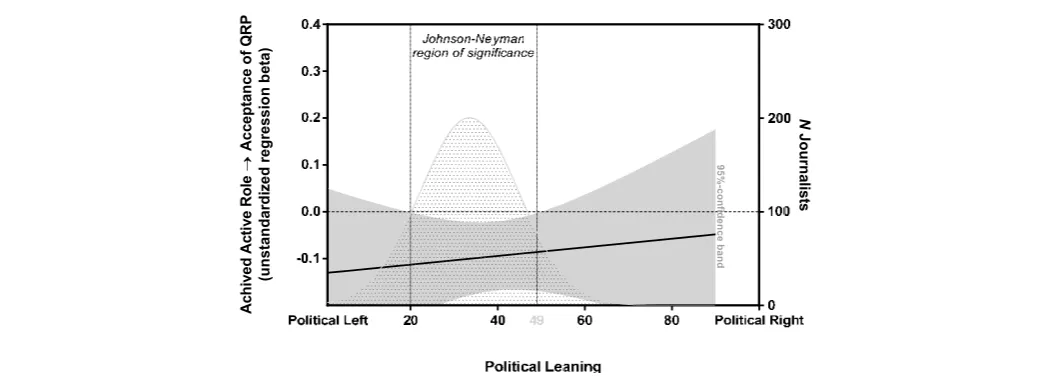
journalistic role significantly contributes to the acceptance of questionable research practices depending on the extremity of the journalists’ political leaning using the Johnson-Neyman technique. Analysis shows that only if the political leaning ranges between values of 20 and 49 (100 indicates political leaning to the right), journalists with the perception of not having achieved an active role will be more willing to accept questionable research practices. Interestingly, the hypothesized effect applies to about 65% of the surveyed journalists. Within this region of significance, the effect of the perception of less having achieved an active journalistic role on the acceptance of questionable research practices is significant and ranges between b=-0.11 and b=-0.09. This is indicative of a small effect only for journalists with political leanings positioned slightly left from the middle.
Figure 1 shows the effect of less having achieved an active
journalistic role on the acceptance of questionable research practices (left Y-axis) plotted against the journalists’ political leaning (X-axis) and indicates that this effect slightly decreases (i.e., is closer to the horizontal dotted zero-effect line) the more journalists have political leanings towards the right. The frequency distribution of the political leaning of the journalists in the sample is plotted against the right Y-axis with the corresponding distribution curve being depicted in the background. Figure 1 shows that the majority of German journalists falls into the Johnson-Neyman region of significance (left from the political middle position), where the non-achievement of an active journalistic role significantly increases the acceptance of questionable research practices.
Discussion
Journalists’ attitudes toward reporting practices are relevant because methods of newsgathering can have an impact on the amount of information accessible to the public. A journalist’s contribution to transparency, however, may sometimes require problematic reporting practices like claiming to be someone else or badging and harassing sources. In such cases, journalists have to decide whether the end justifies the means. Theoretically, it has been argued that the feeling of not having achieved an active role can lead to feelings of mental distress, a cognitive dissonance, which can be reduced by utilizing questionable reporting practices in order to play the pursued active role. Moreover, journalists’ political leanings are arguably related to the acceptance of questionable reporting practices, as they can be indicative of the journalists’ ambition to change society.
Variables 1 2 3
1. Political leaning −
2. Perceived achievement of an active journalistic role +.07* −
3. Acceptance of questionable reporting practices –.04 –.13*** −
M 37.5 3.4 2.2
SD 15.8 0.6 0.7
Note. Intercorrelations for German journalists (n=1536) are presented below the diagonal. Means and standard deviations are presented in the horizontal rows. For all scales, higher scores are indicative of a more right political leaning or a more extreme responding in the direction of the construct assessed. *p<0.05. **p<0.01. ***p<0.001.
Our findings show a relationship between the perception of not having achieved an active role and the acceptance of questionable reporting practices. Moreover, this relationship is only significant for journalists with a moderate tendency to the left. This difference between rather left and rather conservative journalists may be explained by the stronger emphasis leftish journalists put on the goal of changing society. Moreover, journalists tend to select their employer due to its political line that supposedly ensures the achievement of political and professional goals, and therefore offers an environment of congruence between personal political views and their employer’s political line [36]. The more journalist perceive not having achieved an active role the more they arguably try to reduce the corresponding cognitive dissonance [22] by accepting and utilizing questionable reporting practices.
Limitations
Methodologically, secondary data analyses always suffer from the questions that have been asked and those that are missing. This is an inevitable problem inherent to secondary data analysis and limits the conclusions that can be drawn [37]. For example, journalists were not asked whether and how often they really apply aggressive reporting practices. Moreover, as suggested by Henningham [28], we have no information on the importance of the story, for which certain research practices are adopted. Offering journalists a reference point for this (e.g., “given an important story [28] could produce new insights in future studies. Furthermore, one may ask in how far the results of a survey among German journalists can be transferred to other countries? Research has shown that measuring political leaning
on a left-right continuum can vary across countries [38], which can be traced back to underlying personal values, which differ between countries [39]. Hence, we conclude the results of this study are not representative for all journalistic cultures. However, we assume that our findings are especially relevant for North American journalism cultures since e.g., Hanitzsch et al. concluded that the German journalism culture is most similar to the US in terms of the institutional roles and ethical ideologies of journalists. Lastly, as the original study dates back to 2005, one could call the actuality of the presented results into question.
Conclusion
In times of increasing economic pressure on newsrooms, journalists seem to be confronted with the problem of not being able to achieve the role they want to play in society. This study carves out the moderating influence of political leaning, a variable that is arguably more than a private non-professional characteristic. While one can argue about the impact of journalists’ political leanings on the tendency of news coverage, the political leanings apparently matter as well in terms of the acceptance of questionable reporting practices. Claiming to be someone else, badging or harassing sources, or paying for information is arguably ethically problematic, although it may contribute to transparency at the same time, which is essential for a flourishing democracy.
It turned out that perceived role achievement is an important predictor of accepting questionable research methods, since journalists who do not feel able to achieve an active role are
Ac
hi
ve
d
A
ct
iv
e Ro
le
Ac
ce
pt
an
ce
o
f Q
RP
(unsta
ndard
iz
ed
re
gr
es
si
on
b
eta)
N
Jo
ur
na
lis
ts
95
%
-c
on
fid
en
ce
b
an
d
Figure 1 Effect of an achieved active journalistic role on the acceptance of questionable research practices (QRP) moderated by the political leaning of journalists in Germany (n = 960). Political leaning of journalists scaled from 1 "left" to 100 "right"; perceived achievement of an active journalistic role scaled from 1 "totally disagree" to 5 "totally agree"; acceptance of questionable reporting practices scaled from 1 "absolutely not acceptable" to 5 "totally acceptable".
more likely to accept questionable reporting practices. However, this relationship is only true for journalists having a moderate tendency to the left. Especially left/liberal journalists who can be characterized by a stronger pursuit of changing society may be trying to reduce mental distress by accepting or even utilizing questionable reporting practices. Especially in times of intrusion of economic pressures into newsrooms, it can be hard
References
1 Lynch L (2010) “We're going to crack the world open”: Wikileaks and the future of investigative reporting. Journalism Practice 4: 309-318. 2 Weaver DH, Willnat L (2012) The global journalist in the 21st century.
New York: Routledge.
3 Quandt T, Löffelholz M, Weaver DH, Hanitzsch T, Altmeppen KD (2006) American and German online journalists at the beginning of the 21st Century: A bi-national survey. Journalism Studies 7: 171-186. 4 Weischenberg S, Malik M, Scholl A (2006) Souffleure der
Mediengesellschaft: Report über die Journalisten in Deutschland. [Prompters in a mediated society: Report on journalists in Germany]. Konstanz: UVK.
5 Köcher R (1986) Bloodhounds or missionaries: Role definitions of German and British journalists. European Journal of Communication 1: 43-64.
6 Donsbach W (2008) Journalists’ role perception. In Donsbach W (ed.) The international encyclopedia of communication Malden, MA: Wiley, pp: 2605-2610.
7 Hanitzsch T (2007) Deconstructing journalism culture: Toward a universal theory. Communication Theory 17: 367-385.
8 Donsbach W, Patterson TE (2004) Political news journalists: Partisanship, professionalism, and political roles in five countries. In: Esser F, Pfetsch B (eds.) Comparing political communication. Theories, cases, and challenges Cambridge: University Press, pp: 251-270.
9 Mellado C, Márquez-Ramírez M, Mick J, Alonso OM, Olivera D (2016) Journalistic performance in Latin America: A comparative study of professional roles in news content. Journalism.
10 Mellado C, van Dalen A (2015) Between Rhetoric and Practice. Explaining the gap between role conception and performance in journalism. Journalism Studies 15: 859-878.
11 Groseclose T (2011) Left turn: How liberal media bias distorts the American mind. New York: St. Martins.
12 Kepplinger HM (2011) Journalismus als Beruf [Journalism as a profession]. Wiesbaden: VS Verlag für Sozialwissenschaften. 13 McChesney RW (2003) The problem of journalism: A political
economic contribution to an explanation of the crisis in contemporary US journalism. Journalism Studies 4: 299-329.
14 Patterson TE, Donsbach W (1996) News decisions: Journalists as partisan actors. Political Communication 13: 455-468.
15 van Dalen A, van Aelst P (2012) Political journalists: Covering politics in the democratic-corporatist media system. In: Weaver DH, Willnat L (eds.) The global journalist in the 21st century New York: Routledge, pp: 511-525.
16 van Dalen A (2012) The people behind the political headlines: A comparison of political journalists in Denmark, Germany, the United Kingdom and Spain. International Communication Gazette 74: 464-483.
17 Weaver DH, Wilhoit GC (1991) The American journalist: A portrait of U.S. news people and their work (2ndedn), Bloomington: Indiana University Press.
18 Weaver DH, Willnat L (2012) Journalists in the 21st century: Conclusions. In: Weaver DH, Willnat L (eds.) The global journalist in the 21st century. New York: Routledge, pp: 529-551.
19 Plaisance PL, Skewes EA, Hanitzsch T (2012) Ethical orientations of journalists around the globe: Implications from a cross-national survey. Communication Research 39: 641-661.
20 Brownlee BJ, Beam RA (2012) US journalists in the tumultuous early years of the 21st century. In: Weaver DH, Willnat L (eds.) The global journalist in the 21st century New York: Routledge, pp: 348-362. 21 Weaver DH, Beam RA, Brownlee BJ, Voakes PS, Wilhoit GC (2007)
The American journalist in the 21st century: U.S. news people at the dawn of a new millennium. Mahwah, NJ: Lawrence Erlbaum. 22 Festinger L (1957) A theory of cognitive dissonance. Stanford, CA:
University Press.
23 Donsbach W (2009) Cognitive dissonance theory -a roller coaster career: How communication research adapted the theory of cognitive dissonance. In: Hartmann T (ed.) Media Choice. A Theoretical and Empirical Overview Routledge: London, New York, pp. 128-148. 24 Scherr S, Baugut P (2016) The meaning of leaning: The impact
of journalists’ political leaning on active role perception and satisfaction with audiences and editorial policy. Journalism & Mass Communication Quarterly 93: 142-163.
25 Sigelman L (1973) Reporting the news: An organizational analysis. American Journal of Sociology 79: 132-151.
26 Stark RW (1962) Policy and the pros: An organizational analysis of a metropolitan newspaper. Berkeley Journal of Sociology 7: 11-31. 27 Pihl-Thingvad, S. (2015). Professional ideals and daily practice in
journalism. Journalism 16(3): 392-411.
28 Henningham J (1996) Australian journalists' professional and ethical values. Journalism & Mass Communication Quarterly 73: 206-218. 29 Hopmann DN, Elmelund-Praestekaer C, Levinsen K (2010) Journalism
students: Left-wing and politically motivated? Journalism 11: 661-674. 30 Lukes S (2003) Epilogue: The grand dichotomy of the twentieth century.
In: Ball T, Bellamy R (eds.) The Cambridge history of twentieth-century political thought Cambridge: University Press, pp: 602-662.
31 Schoenbach K, Stuerzebecher D, Schneider B (1994) Oberlehrer und Missionare?: Das Selbstverständnis deutscher Journalisten [Teachers or missionaries?: On the self-conception of German journalists]. Kölner Zeitschrift für Soziologie und Sozialpsychologie 34: 139-161. 32 Malik M (2011) Repräsentativität als Herausforderung für
Journalistenbefragungen in Deutschland [Representativity as a challenge for journalist surveys in Germany]. In: Jandura O, Quandt T, Vogelgesang J (eds.) Methoden der Journalismusforschung Wiesbaden: VS Verlag für Sozialwissenschaften, pp: 259-275. 33 Hayes AF (2013) An introduction to mediation, moderation, and
conditional process analysis: A regression-based approach. New York: Guilford.
34 Preacher KJ, Hayes AF (2008) Asymptotic and resampling strategies for assessing and comparing indirect effects in multiple mediator models. Behavior Research Methods 40: 879-891.
35 MacKinnon DP, Warsi G, Dwyer JH (1995) A simulation study of mediated effect measures. Multivariate Behavioral Research 30: 41-62. 36 Reinemann C, Baugut P (2014) Political journalists as communicators:
The impact of individual characteristics on their work. In: Reinemann C (ed.) Handbook of communication science: Political communication. Berlin: De Gruyter Mouton, pp: 325-348.
38 Thorisdottir H, Jost JT, Liviatan I, Shrout PE (2007) Psychological needs and values underlying left-right political orientation: Cross-national evidence from Eastern and Western Europe. Public Opinion Quarterly 71: 175-203.