SMALL AND MEDIUM ENTERPRISES USING SOFTWARE AS A SERVICE: EXPLORING THE DIFFERENT ROLES OF INTERMEDIARIES
Nagarajan Venkatachalam
Information Systems School Queensland University of Technology
Brisbane, Australia [email protected]
Erwin Fielt
Information Systems School Queensland University of Technology
Brisbane, Australia [email protected]
Michael Rosemann
Information Systems School Queensland University of Technology
Brisbane, Australia [email protected]
Shane Mathews
Business School
Queensland University of Technology Brisbane, Australia
ABSTRACT
Software as a Service (SaaS) can provide significant benefits to small and medium enterprises (SMEs) due to advantages like ease of access, 7*24 availability, and utility pricing. However, underlying the SaaS delivery model is often the assumption that SMEs will directly interact with the SaaS vendor and use a self-service approach. In practice, we see the rise of SaaS intermediaries who can support SMEs with sourcing and leveraging SaaS. This paper reports on the roles of intermediaries and how they support SMEs with using SaaS. We conducted an empirical study of two SaaS intermediaries and analysed their business models, in particular their value propositions. We identified orientation (technology or customer) and alignment (operational or strategic) as themes for understanding their roles. The contributions of this paper include: (1) the identification and description of SaaS intermediaries for SMEs based on an empirical study and (2) understanding the different roles of SaaS intermediaries, in particular a more basic role based on technology orientation and operational alignment and a more value adding role based on customer orientation and strategic alignment. We propose that SaaS intermediaries can address SaaS adoption and implementation challenges of SMEs by playing a basic role and can also aim to support SMEs in creating business value with SaaS based solutions by playing an added value role.
INTRODUCTION
Software as a Service (SaaS) is a software licensing and delivery model where the application or service is deployed from a centralised data centre across a network, providing access and use often on a recurring fee basis (Hoch et al. 2001). SaaS is projected to be a disruptive force at the heart of the operating principles of IT industry such as large capital software and infrastructure investments, centralized procurement and governance, and high service/software deployment cost ratios (Gartner 2012). SaaS makes professional and innovative software applications easily accessible at attractive prices. Some of the often cited benefits from SaaS are the reduction of the total cost of ownership, speed of deployment, reliability and risk mitigation through insulation from the continuous technology upgrades (Waters 2005). Small and Medium Enterprises (SMEs) are projected to be main beneficiaries of SaaS due to its utility pricing model with no or limited upfront capital investments and the ease of access with web browser access, 7 * 24 availability, 30 day free trials, direct subscription and automated upgrade cycles.
Though there are significant benefits to be realized from SaaS, SMEs face a set of challenges while sourcing and leveraging SaaS. For example, a study of SaaS sourcing related to German SMEs reported that there are challenges when integrating SaaS with other applications, there is loss of control over access to data and data migration complexities for SMEs (Haselmann et al. 2011). Further, an adoption study of SaaS explained that the SaaS model shifts all customization investments to the consumer side and the consumers are responsible for maintaining all customized components (Xin et al. 2008). The implications are that SMEs may need development and support skills, if they need to customize SaaS to fit into their environments. These findings are in line with past studies related to the use of IS by SMEs which highlight that resources and skills constraints prevent the full leveraging of benefits from new technologies (Scupola 2009; Palvia 2008; Poon et al. 1997). Though SaaS is described as an important technological and business model innovation that brings in new opportunities for small and medium enterprises (Hong et al. 2009), SMEs may encounter significant challenges in terms of leveraging the opportunities from SaaS.
Because of the self-service approach and the easy access to SaaS applications, there seems to be an implicit assumption that SMEs can directly use these applications. However, as discussed above, we foresee that SMEs are still faced with significant challenges when sourcing and leveraging SaaS. Traditionally, SMEs have used consultants and vendor support to overcome challenges associated with new technologies (Yap et al. 1992). SaaS applications are often provided by SaaS vendors that operate globally and are located abroad and that may only provide limited support to smaller customers (e.g. Salesforce). Therefore, we expect that SMEs will to some extent still rely on trusted providers that act as intermediaries between the SME as a local customer and the global SaaS vendor. This imputes our research question “What is the role of intermediaries for SMEs using SaaS?” Based on our review of existing IS literature on SMEs and SaaS, we observe that there is no study yet that examines the role of intermediaries for SMEs using SaaS. This research aims to bridge this gap with an explorative case study of two Australian SaaS intermediaries.
The remainder of this paper is organized as follows. We begin with a literature review of SaaS, SMEs and SaaS intermediaries. Then we explain the research design, which uses a multiple case study methodology. Next the cases are described and analysed based on a business model framework. Then the findings are presented through a discussion of the different roles of SaaS intermediaries. We conclude the paper with contributions, limitations and topics for future research.
LITERATURE REVIEW
related to SaaS intermediaries, including intermediaries in general and intermediaries in cloud ecosystems.
Small and Medium Enterprises
In Australia, small business is defined as an actively trading business with 0-19 employees; medium-sized businesses comprise 20-199 employees and large businesses as actively trading with 200 or more employees (ABS. 2012) SMEs contributed to 57% of private industry value added in addition to employing 4.8 million people during 2010-11 in Australia (ABS 2012). The characteristics of SME firms are classified in two major categories, namely, external environment oriented (customer and market) and internal environment oriented (management, human and financial resources) (Cocca et al. 2010). Traditionally, the uncertainty factors from the external environment are high for the SMEs as they normally are price takers and only have a limited customer and product base in which they operate (Storey 2000). In terms of the internal environment, empirical analysis of the role and significance of CEO, firm strategy and structure revealed that the relative growth and profitability of small firms correlated strongly with an innovative product-market position and a more aggressive and analytic mode of decision making guided by an explicitly codified strategy (Miller et al. 1986). However, compared with the large enterprises, SMEs have often implied and undocumented business strategies that are mostly focused on cost efficiencies (Ballantine et al. 1998; Hagmann et al. 1993).
Though the importance of SMEs and their economic contributions are well established, traditionally resource and capability limitations have restricted these firms from capitalizing the opportunities from IS/IT innovations (Mehrtens et al. 2001; Ramdani et al. 2009). Cost, lack of time, skills and knowledge are identified as uppermost barriers for SMEs’ adoption of new technologies (Heenetigala et al. 2009). Also, SME information technology expertise is limited in relation to the operationalization of implicit strategies (Ballantine et al. 1998; Levy et al. 2000). An e-commerce adoption study identified financial, technical and managerial resource constraints as the main barriers for SMEs (Lin et al. 2007). Lack of awareness of the potential of ICT into their business operations, the perception of unresolved security and privacy issues associated with the use of internet, high-set up costs and limited skills were also reported as barriers for SMEs’ adoption of e-business technologies (Taylor et al. 2004).
Software as a Service
SaaS is also discussed as an important technological and business model innovation that brings new opportunities for SMEs (Hong et al. 2009) and can help them to overcome traditional resource and capability constraints. SaaS can potentially address technology related challenges of SMEs as the SaaS delivery model shifts the development, deployment and maintenance of applications to SaaS vendors (Hong et al. 2009). The SaaS subscription model may overcome some of the financial barriers of SMEs in relation to IT. However, there will still be challenges associated with the use of SaaS by SMEs. A recent German study on the SaaS adoption by SMEs concluded that SaaS is not expected to be the revolution in business for SMEs in the near future but declared that SaaS is an important concept in the IS/IT architecture of these enterprises (Haselmann et al. 2011). Gartner (2012) observed that only a few SaaS applications have reached maturity and most SaaS applications still remain far away from mainstream adoption.
SaaS Intermediaries
Traditionally, intermediaries are conceived as part of the marketing channel between producers and consumers, with wholesalers, retailers and specialized intermediaries – such as finance firms, logistics firms and advertising agencies – as their main forms (Stern et al. 1996). Intermediaries bring customers and suppliers together and facilitate demand and supply activities. Intermediaries solve customers’ problems and, as a result, suppliers’ problems. Their position on the high ground between both groups enables them to create value and charge for it (Anderson et al. 2002). Intermediaries provide value-added services such as aggregation and distribution of products and product information, quality checks and warranties (Chircu et al. 2000). Intermediaries need to make choices with respect to their positioning in relation to the other actors in the business network. These role choices relate to aspects like functional scope (i.e., targeted business functions) and activity focus (i.e., supported business activities) (Fielt et al. 2008). Intermediaries can perform different roles, for example, they can perform basic market functions, provide management support for sourcing or serve as technology adapters (Dai et al. 2002).
The servitization of the software industry via SaaS and other cloud services results in services-oriented systems. Intermediaries can be seen as part of a value chain service system and as separate service systems themselves (Alt et al. 2010). Bardhan et al. (2010) outlined how services-oriented systems will act as a disruptive technological innovation and emphasized the different roles of service producers (e.g., Salesforce, Google), consumers (e.g., SME), service intermediaries (resellers) and service monitors (governments and standard bodies). Intermediaries have been discussed in the wider context of the cloud ecosystem. Recent literature identifies a number of generic roles as part of the cloud service ecosystem: application provider, (technical) platform provider, market platform, infrastructure provider, consultant, aggregator, integrator and consumer (Böhm et al. 2010). Leimeister et al. (2010) identified integrators, consultants and brokers as value adding participants within a cloud ecosystem. Overeem and Vreeken (2014) argue that while cloud providers focus on standardization, cloud brokers focus on customization for each customer and differentiate between configurator, assembler, trust builder and integrator roles for cloud brokers. However, to the best of our knowledge, there has been hardly any attention for SaaS intermediaries so far, in particular in relation to SMEs. The only other study addressing SaaS intermediaries focused on their internal, supply-side capabilities and concluded that business facing skills, customer development and process re-engineering capabilities will become more important (Overeem et al. 2014). While related, our study is more focussed on the external role of SaaS intermediaries in relation to their support for SME customers.
RESEARCH DESIGN
is the first empirical study of intermediaries for SMEs using SaaS. Therefore, we opted for an explorative research approach. We used a multiple case study design to investigate the role of SaaS intermediaries for SMEs using SaaS. The case study methodology is proposed as one of the best options for conducting explorative studies when there is scant prior research on the topic (Yin 1994). Also multiple case studies are preferred over the single case study due to the vulnerability of single case study and associated criticism with generalisation of the results as well as for extension of the existing theories (Benbasat et al. 1987; Yin 1994).
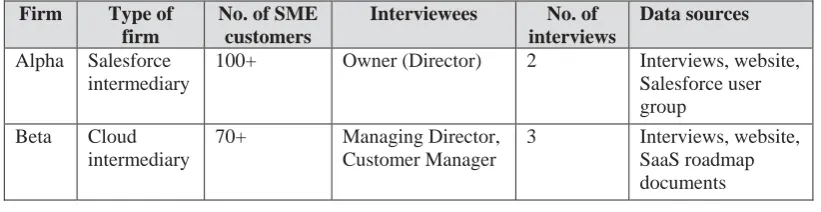
We selected two SaaS intermediaries, Alpha and Beta, based on (a) their focus on SME customers, (b) their support for market leading SaaS products, (c) their credentials in the market place, and (d) the availability of key stakeholders for the interviews and subsequent clarifications. Table 1 presents an overview of the two SaaS intermediary firms in this study. Semi-structured, face to face interviews were conducted with representatives from both firms. Two interviews were conducted with the owner of Alpha. Two interviews were conducted with the managing director and one interview with the customer manager of Beta. The duration of the interviews was between 60 to 90 minutes. The interview transcriptions were sent to participants to review for verification of their comments. Contact summary forms (Miles et al. 1984) were completed to record the first observations as well as capture main themes from these interviews. The same form was also used by the researcher to verify that all required data was collected. In addition to this, the information from both companies’ websites was used to gather additional data on partnerships and details of the services provided by these intermediaries. When required, specific clarifications were requested via emails and phone calls (for example, SaaS release documentations). The researcher also attended three local Salesforce user group meetings conducted by the owner of intermediary Alpha. This allowed the researcher to observe the interactions between SaaS intermediary Alpha and the SME SaaS customers in the Brisbane market. The NVivo qualitative data management tool was used for the coding and analysis of collected data through the open coding as well as descriptive, interpretive coding and analytical processes.
Firm Type of
firm
No. of SME customers
Interviewees No. of
interviews
Data sources
Alpha Salesforce intermediary
100+ Owner (Director) 2 Interviews, website,
Salesforce user group
Beta Cloud intermediary
70+ Managing Director,
Customer Manager
3 Interviews, website,
SaaS roadmap documents
Table 1. Overview of data collection at SaaS intermediaries.
elements, (7) performing of a number of Key Activities, (8) some activities are outsourced and some resources are acquired outside the enterprise via Key Partnerships, and (9) the business model elements result in the Cost Structure (Osterwalder et al. 2010).
CASE DESCRIPTIONS
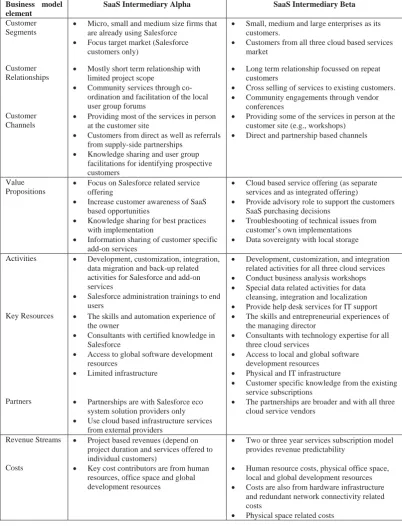
In this section, we describe both SaaS intermediaries in detail by means of their business model. We highlight some specific details in the text and provide a summarized overview of the business model elements in table 2.
SaaS Intermediary Alpha
SaaS intermediary Alpha is based in Brisbane and provides a selected set of Salesforce related services, in particular consulting, integration and support services, to SME customers that are part of the Salesforce ‘ecosystem.’ Their Salesforce based value propositions are based on increasing customer awareness of SaaS based opportunities and using best practices for implementation. The intermediary’s customers are SMEs customers are often firms that are moving from micro to small size. The firm operates project-based with short duration contracts for customer-specific requirements. The owner explained that “As an organisation, we are a small team, and we believe that large customers need a large team that can concentrate 100% on that customer. I would be winning in one hand but then at the detriment of the business as a whole. So, definitely looking for smaller, profitable shorter engagements rather than less profitable longer.” The firm had been in business for 3.5 years and serviced around 100+ SME customers so far.
The firm’s potential customers originate through referrals and call with specific requests like establishing a contact database. Project duration varies from 10 days for more straightforward configuration and getting Salesforce up and running, to longer engagements involving customization and development. The owner goes through requirement-gathering discussions with the prospects. As part of this process they increase the customer’s awareness regarding the opportunities with Salesforce CRM and associated service offerings. The owner of SaaS intermediary Alpha is also the facilitator of Brisbane Salesforce user group meetings where he and his team share the knowledge about best practices in using Salesforce. These knowledge sharing sessions cover a range of topics including Salesforce upgrade idiosyncrasies, question and answer sessions and demonstrations of complementary services that are part of Salesforce eco system. These forums and knowledge sharing sessions can also identify prospective customers for this intermediary.
The key resources of the firm are their authentic Salesforce expertise held in the matured age workforce and the provision of the local access to global knowledge for their SME customers. As stated by the owner: “Our unique selling point is our experience, our qualifications; we are certified. We definitely promote ourselves as being local to Brisbane.” The firm employs three certified Salesforce consultants with access to global resources via development centres abroad. This intermediary has established partnerships with other SaaS service providers of the Salesforce ecosystem, for example, Nimbus and RadianScore. These partnerships enable access to a wide range of Salesforce related knowledge and solutions that are relevant to their customers’ specific situations and are complementary to their own service offering.
SaaS Intermediary Beta
selection, (b) customization of standard SaaS applications to align with the customers’ specific environment situations, and (c) provide best fit solutions by combining a specific set of service options to match their customers’ process specific implementation. The managing director classified the potential customers into two categories by stating “I think, there is really two camps, the ones that go direct to internet and download and play with it, trial with it and they end up with silos of SaaS. They will have silo finance SaaS, silo procurement SaaS and ERP, then they need to this professional to come in to make all talk together. The other ones ask us give us a proposal for everything.” In 2013, this intermediary had a total of 79 customers out of which 67 belong to the SME category.
In terms of customer engagement, customer focussed consultants conduct a one day or two day workshops with all key stakeholders of their customer firm to get a complete understanding of the customers’ current position in the market place, their strategic goals and financial capabilities. The managing director stressed that they always start with the workshop: “Everything stems from the workshop. We always do the workshops with stakeholders before we implement anything.” The intermediary provides a ‘SaaS roadmap’ for their customers along with implementation options to choose after a structured analysis of the information collected in the workshops. The SaaS roadmap gives the options for the SME customers in terms of the choice of SaaS products, customized components with SaaS platform and/or off-the-shelf packages based on the customer’s specific needs.
Business model element
SaaS Intermediary Alpha SaaS Intermediary Beta
Customer Segments
x Micro, small and medium size firms that are already using Salesforce
x Focus target market (Salesforce customers only)
x Small, medium and large enterprises as its customers.
x Customers from all three cloud based services market
Customer Relationships
x Mostly short term relationship with limited project scope
x Community services through co-ordination and facilitation of the local user group forums
x Long term relationship focussed on repeat customers
x Cross selling of services to existing customers. x Community engagements through vendor
conferences Customer
Channels
x Providing most of the services in person at the customer site
x Customers from direct as well as referrals from supply-side partnerships
x Knowledge sharing and user group facilitations for identifying prospective customers
x Providing some of the services in person at the customer site (e.g., workshops)
x Direct and partnership based channels
Value Propositions
x Focus on Salesforce related service offering
x Increase customer awareness of SaaS based opportunities
x Knowledge sharing for best practices with implementation
x Information sharing of customer specific add-on services
x Cloud based service offering (as separate services and as integrated offering)
x Provide advisory role to support the customers SaaS purchasing decisions
x Troubleshooting of technical issues from customer’s own implementations x Data sovereignty with local storage
Activities x Development, customization, integration, data migration and back-up related activities for Salesforce and add-on services
x Salesforce administration trainings to end users
x Development, customization, and integration related activities for all three cloud services x Conduct business analysis workshops x Special data related activities for data cleansing, integration and localization x Provide help desk services for IT support Key Resources x The skills and automation experience of
the owner
x Consultants with certified knowledge in Salesforce
x Access to global software development resources
x Limited infrastructure
x The skills and entrepreneurial experiences of the managing director
x Consultants with technology expertise for all three cloud services
x Access to local and global software development resources
x Physical and IT infrastructure
x Customer specific knowledge from the existing service subscriptions
Partners x Partnerships are with Salesforce eco system solution providers only x Use cloud based infrastructure services
from external providers
x The partnerships are broader and with all three cloud service vendors
Revenue Streams x Project based revenues (depend on project duration and services offered to individual customers)
x Two or three year services subscription model provides revenue predictability
Costs x Key cost contributors are from human resources, office space and global development resources
x Human resource costs, physical office space, local and global development resources x Costs are also from hardware infrastructure
and redundant network connectivity related costs
x Physical space related costs
CASE ANALYSIS
The two case studies provide insights into how SaaS Intermediaries address SaaS opportunities and challenges for SMEs related to (1) increasing the awareness of SaaS based opportunities, (2), getting SaaS applications up and running, (3) integrating SaaS into new and existing business activities, (4) addressing the need for customization of standard SaaS offerings, and (5) leveraging new and innovative features available through automated upgrade cycles. To provide a deeper understanding of the role of the SaaS intermediaries, we analysed the business models of Alpha and Beta from an inside-out perspective (orientation) based on reasoning from activities, resources, partners and costs towards value proposition and customer elements and from an outside-in perspective (alignment) based on reasoning from customer elements, revenues and value proposition towards activities, resources, partners and cost.
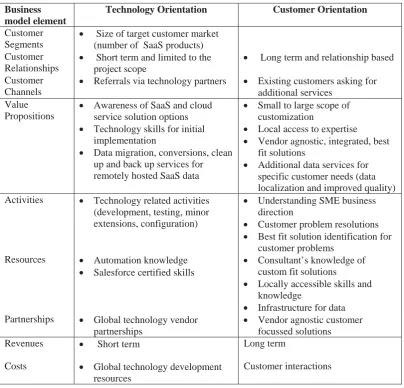
For orientation, the case analysis resulted in differentiating between technology and customer orientation. Technology orientation is related to the generic features of the vendor supplied SaaS offerings and getting the SaaS applications up and running in a straightforward way. Customer orientation is related to how intermediaries offer and deliver engagements that address the individual, customer-specific requirements for using SaaS. For alignment, the case analysis resulted in differentiating between operational and strategic alignment. Operational alignment relates to how intermediaries purposefully fit the vendor-offered SaaS solutions with the processes of the SMEs. Strategic alignment relates to how the intermediary’s scope of solutions and contractual arrangements go beyond the operational needs of their SME customers. Please note that we differentiate between technology and customer orientation and between operational and strategic alignment as perspectives for analytical purposes. In practice, SaaS intermediaries will be a mix of these perspectives, as also is the case for Alpha and Beta. However, on the whole, Beta demonstrates more customer orientation and strategic alignment than Alpha. This may be explained by the fact that Beta has more physical, technological and human resources and has global partnerships with service providers for all three cloud services (i.e., IaaS, PaaS, and SaaS).
Technology and Customer Orientation of SaaS
Both SaaS intermediaries demonstrate technology and customer orientation within their SME engagement process (Table 3). Technological orientation is related to the generic features of the SaaS offerings and getting the SaaS applications up and running in a straightforward way. Customer orientation is related to how intermediaries offer and deliver engagements that address the individual customer specific requirements using SaaS.
The technology orientation of the two SaaS intermediaries varies in terms of solutions offered to their customers. Intermediary Alpha offers only SaaS solutions that are based upon Salesforce and employs certified Salesforce consultants. The owner of Alpha stated that “We’re only interested in people that have already recognised that Salesforce is the platform of choice for them”. Intermediary Beta targets customer segments which are in need of all three types cloud-based services, namely IaaS, PaaS and SaaS. Beta offers technology solutions that are based upon multiple SaaS (Salesforce, Google) and other cloud services (IaaS and PaaS) vendors (Amazon & Cisco). Beta has technology integration expertise to integrate the different types of SaaS and SaaS-related infrastructure needs.
In the case of the intermediary Alpha, the owner educates the customer and increases the customer awareness of potential solutions from the Salesforce eco system that can enhance the customer’s value with SaaS use. The owner described an example related to a call from a prospect enquiring about setting up a contact database for their micro business. The owner identified the requirement as that micro SME could not track or keep any information related to the received emails during the conversation. He described it with, “An email comes in to an email inbox or an Outlook inbox. Well, it’s relying on somebody responding to it. How many did we get? We don’t know. How many were about, were genuine complaints as opposed to just an enquiry? Don’t know because there’s no analytics on that.” He subsequently elaborated about his proposed solution for this prospective customer during the site visit “but then, whilst there, I was talking about customer services. so well, how do you deal with issues and complaints and email enquiries, and things like that, and that’s why we think that customer services in the Service Cloud kicks in nicely.” In this example, the owner is proposing the ‘Service Cloud’ product of Salesforce as a solution to address an underlying problem related to managing customer relationships that goes beyond keeping track of their contacts and customers.
Business model element
Technology Orientation Customer Orientation
Customer Segments
x Size of target customer market (number of SaaS products) Customer
Relationships
x Short term and limited to the project scope
x Long term and relationship based
Customer Channels
x Referrals via technology partners x Existing customers asking for additional services
Value Propositions
x Awareness of SaaS and cloud service solution options x Technology skills for initial
implementation
x Data migration, conversions, clean up and back up services for remotely hosted SaaS data
x Small to large scope of customization
x Local access to expertise x Vendor agnostic, integrated, best
fit solutions
x Additional data services for specific customer needs (data localization and improved quality) Activities x Technology related activities
(development, testing, minor extensions, configuration)
x Understanding SME business direction
x Customer problem resolutions x Best fit solution identification for
customer problems Resources x Automation knowledge
x Salesforce certified skills
x Consultant’s knowledge of custom fit solutions
x Locally accessible skills and knowledge
x Infrastructure for data Partnerships x Global technology vendor
partnerships
x Vendor agnostic customer focussed solutions
Revenues x Short term Long term
Costs x Global technology development resources
Customer interactions
Table 3. Orientation of SaaS intermediaries.
Operational and Strategic Alignment of SaaS
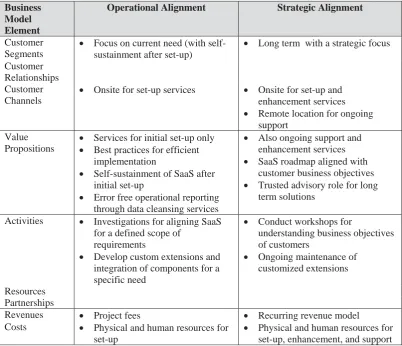
Both SaaS intermediaries demonstrate both operational and strategic alignment during the execution of their solutions for their customers (Table 4). Through operational alignment we explain how intermediaries implement the vendor-offered SaaS solutions as part of the SME’s processes. With strategic alignment, we explain how the intermediary’s scope of solutions and contractual arrangements go beyond the operational needs of their SME customers.
thoroughly and reports do not run correctly and then we go and investigate it to find that the field is numeric field and they have alpha characters in it. It is a very common issue; we sort of mandate that (i.e. data conversions)”. What tends to happen is that people try to do it themselves, and ends up very very messy. We say to them, you have to let us do that properly. Because rubbish in rubbish out”. These observations explain how intermediary Beta provides ongoing operational support to SMEs, when they start using SaaS.
For strategic alignment, the SaaS intermediaries go beyond the operational needs of their SME customers. Due to their connections within the Salesforce ecosystem, intermediary Alpha provides strategic value for their customers and prospects via the Salesforce user group. In these forums, the owner of Alpha shares knowledge about the important features of new releases from Salesforce (for example, the use of Chatter for collaboration or mobile features that are anticipated in the new release). He also organizes presentations by Salesforce platform vendors that are his supply-side partners. These partners explain the specific features offered via the Salesforce application exchange.
Business Model Element
Operational Alignment Strategic Alignment
Customer Segments
x Focus on current need (with self-sustainment after set-up)
x Long term with a strategic focus
Customer Relationships Customer Channels
x Onsite for set-up services x Onsite for set-up and enhancement services x Remote location for ongoing
support Value
Propositions
x Services for initial set-up only x Best practices for efficient
implementation
x Self-sustainment of SaaS after initial set-up
x Error free operational reporting through data cleansing services
x Also ongoing support and enhancement services x SaaS roadmap aligned with
customer business objectives x Trusted advisory role for long
term solutions
Activities x Investigations for aligning SaaS for a defined scope of
requirements
x Develop custom extensions and integration of components for a specific need
x Conduct workshops for
understanding business objectives of customers
x Ongoing maintenance of customized extensions
Resources Partnerships
Revenues x Project fees x Recurring revenue model
Costs x Physical and human resources for set-up
x Physical and human resources for set-up, enhancement, and support
Table 4. Alignment of SaaS intermediaries.
CASE DISCUSSION
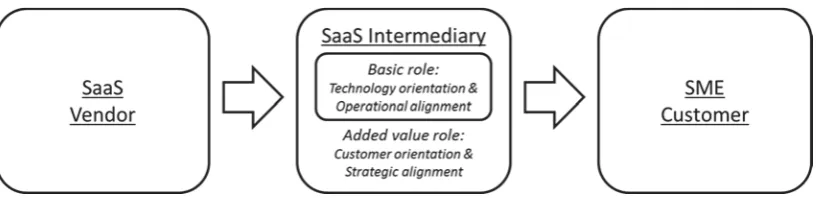
Figure 1. SaaS intermediaries: Basic and added value roles.
Basic role: Technology Orientation and Operational Alignment
The basic role of SaaS intermediaries is characterized by technology orientation and operational alignment. In this basic role, the intermediary supports the adoption and implementation of SaaS by SMEs. This means getting the SaaS application up and running in a straightforward way and making it part of the SME’s processes. Previous research of SaaS discusses the technology uncertainties of the SaaS market, data migration complexities and SaaS-specific skills required for basic configurations as some of technology challenges specific to getting a SaaS application operational in the SME environment (Haselmann et al. 2011; Xin et al. 2008).
SaaS intermediaries assist SMEs with technology and operational challenges originating from SaaS adoption and implementation. They conduct the requirements analysis, solution design and implementation activities for their SaaS customers. This includes the configuration of SaaS and may sometimes require intermediaries to educate the SME’s admin users to use the controls offered by SaaS vendors to make the application ready for all users in the SME. These activities enable a fully configured SaaS application ready for all users of SaaS within the particular SME’s operating environment. A basic role for an agreed scope of SaaS technology and operational activities comes mostly with short-term, project fees based contracts in the case of intermediary Alpha,
Data integrity, locality, data access and data segregation are identified as issues associated with the use compared in-house based data of traditional applications (Subashini et al. 2011). Both firms also offer specific data-related services through data migration, cleansing, integration, with other applications and back-up activities that aim to address the data-related challenges associated with SaaS use. The data related services have the potential to provide SMEs with cleaned up data, keeping the data in local infrastructure and error-free reporting benefits.
Added value role: Customer Orientation and Strategic Alignment
Intermediary Alpha has supply-side partnerships with other complementary service providers of Salesforce eco system, which enables them to increase the customer awareness of these SaaS extension options and offer an integrated value proposition from the network of Salesforce vendors. In case of intermediary Beta, supply-side partnerships are established with all three cloud service providers. By such offerings, Intermediaries enables the SME to overcome challenge of lack of awareness of how ICT can enhance their operations (Taylor and Murphy 2004). This results in the integrated value propositions through the full cloud service offerings that includes SaaS, PaaS and IaaS. Intermediary Beta delivers a SaaS road map with applications from a choice of vendors (Salesforce or Microsoft) as well as alternative implementation processes (customization or standard plug-ins) due to their extended engagement during the evaluation stage of their customers’ purchasing process.
While the SaaS model can overcome some of the problems and challenges of SMEs with IT, for example, the need for capital expenses related to hardware and software licenses (Waters 2005), it leaves other IT problems and challenges unaddressed, for example, the perception of unresolved security and privacy issues associated with the use of the internet (Taylor et al. 2004), and also introduces new SaaS related problems and challenges, for example, skills and knowledge required for customization needs (Xin et al. 2008) and data management in SaaS applications and the integration of SaaS with other applications (Haselmann et al. 2011). However, the SaaS model often focusses on the role of the SaaS vendor and does not address the role of the SaaS intermediary, in particular for SMEs. The basic role of SaaS intermediaries for SMEs can provide SMEs with easier access to software applications by addressing technology-related problems, for example, data cleaning data migration, application integration (Subashini et al. 2011), and operational challenges, for example, configure and implement SaaS within their operations (Haselmann et al. 2011). The added value role of SaaS intermediaries can support SMEs with creating business value by customer orientation (e.g. understand deep understanding of business needs of the customers, providing vendor agnostic solutions) and strategic alignment (e.g. a SaaS roadmap aligned with business strategy, awareness of new solutions). Overall, we argue that it is the combination of the SaaS model and SaaS intermediaries for SMEs that can provide SMEs with easier access to software applications and support SMEs in creating business value with IT.
Our identification of a basic role and value added role of SaaS intermediaries for SMEs is in line with the findings on internal, supply-side capabilities of Overeem and Vreeken (2014). Overeem and Vreeken conclude that business facing skills, customer development and process re-engineering capabilities will become more important and this is in line with our understanding of the value added role of SaaS intermediaries for SMEs. Looking more generally at cloud intermediaries, we see similarities between our differentiation between technology and customer orientation and the integrator and aggregator roles on the one hand and the consultant role on the other hand of Böhm et al. (2010). Our understanding of strategic alignment adds to the more operational perspective on cloud roles as provided by the value network of Böhm et al. (2010). More broadly, our research shows that even in the electronic world of SaaS and Cloud, which is often predicted to be disintermediated (Malone et al. 1987), there is still a need for intermediaries that solve customers’ problems and, as a result, suppliers’ problems (Anderson et al. 2002).
CONCLUSION
We identified different approaches for SaaS intermediaries with respect to their orientation (technology or customer) and alignment (operational or strategic). Technology orientation is related to the generic features of the vendor-supplied SaaS offerings and getting the SaaS applications up and running in a straightforward way. Customer orientation is related to how intermediaries offer and deliver engagements that address the individual, customer-specific requirements for using SaaS. Operational alignment relates to how intermediaries purposefully fit the vendor offered SaaS solutions with the processes of the SMEs. Strategic alignment relates to how the intermediary’s scope of solutions and contractual arrangements go beyond the operational needs of their SME customers.
We propose that SaaS intermediaries can address the SaaS adoption and implementation challenges of SMEs by playing a basic role based on technology orientation and operational alignment. SaaS intermediaries can also aim to support SMEs in creating business value with SaaS based solutions by playing an added value role based on customer orientation and strategic alignment. As far as we know, this is the first paper that describes SaaS intermediaries in more detail and also identifies the different roles that SaaS intermediaries can play. The contributions of this paper are: (1) the identification and description of SaaS intermediaries for SMEs based on an empirical study and (2) understanding the different roles of SaaS intermediaries, in particular a more basic role based on technology orientation and a more value adding role based on customer orientation and strategic alignment.
As this is an explorative study, there are a number of limitations that need to be taken into account. The empirical study has a limited number of intermediary cases and is only based on Australian intermediaries. Moreover, while the cases focussed on SaaS, one of the cases also included cloud offerings. This makes the cases slightly different and less comparable. We propose some directions for future research. Future research can gather data from the SaaS vendor’s perspective and SaaS SME consumers’ perspectives based upon their experiences with SaaS intermediaries to expand on the interactive nature of intermediary roles. Further, future research can also apply this SaaS-related intermediary knowledge to a cloud service intermediary context.
REFERENCES
ABS 2012. "Australian Small Business Key statistics and anlaysis," C. o. Australia (ed.), Department of Industry, Innovation, Science, Research and Tertiary Education.
Alt, R., Abramowicz, W., and Demirkan, H. 2010. "Service-orientation in electronic markets," Electronic Markets (20:3-4), pp 177-180.
Anderson, P., and Anderson, E. 2002. "The new e-commerce intermediaries," MIT Sloan Management Review (43:4), pp 53-62.
Ballantine, J., Levy, M., and Powell, P. 1998. "Evaluating information systems in small and medium-sized enterprises: Issues and evidence," European Journal of Information Systems (7:4), pp 241-251.
Bardhan, I., Demirkan, H., Kannan, P., Kauffman, R., and Sougstad, R. 2010. "An Interdisciplinary Perspective on IT Services Management and Service Science," Journal of Management Information Systems (26:4), pp 13-64.
Barros, A., and Dumas, M. 2006. "The Rise of Web Service Ecosystems," IT Professional (8:5), pp 31-37.
Benbasat, I., Goldstein, D. K., and Mead, M. 1987. "The Case Research Strategy in Studies of Information Systems," MIS Quarterly (11:3), pp 369-386.
Chesbrough, H., and Rosenbloom, R. S. 2002. "The role of the business model in capturing value from innovation: evidence from Xerox Corporation's technology spinǦoff companies," Industrial and Corporate Change (11:3), pp 529-555.
Chircu, A. M., and Kauffman, R. J. 2000. "Reintermediation strategies in business-to-business electronic commerce," International Journal of Electronic Commerce (4(4)), pp 7-42.
Clark, L., Desisto, R., Holincheck, J., White, A., Kyte, A., Sarner, A., Lheureux, B., Gassman, B., Klappich, C., and Kolsky, E. 2012. "Hype Cycle for Software as a Service," Gartner Research, ID:G00141122).
Cocca, P., and Alberti, M. 2010. "A framework to assess performance measurement systems in SMEs," International Journal of Productivity and Performance Management (59:2), pp 186-200. Dai, Q., and Kauffman, R. J. 2002. "Business models for internet-based B2B electronic markets,"
International Journal of Electronic Commerce (6), pp 41-72.
Dubey, A., and Wagle, D. 2007. "Delivering software as a service," The McKinsey Quarterly (6), pp 1-12.
Fielt, E. 2013. "Conceptualising Business Models: Definitions, Frameworks and Classifications," Journal of Business Models (1:1).
Fielt, E., Janssen, W., Faber, E., and Wagenaar, R. 2008. "Design TradeǦoffs for Electronic Intermediaries," Electronic Markets (18:4), pp 362-374.
Gartner 2012. "Agenda for Software as a Service, 2012," R. P. Desisto (ed.), Gartner, p. 7.
Gold, N., Mohan, A., Knight, C., and Munro, M. 2004. "Understanding service-oriented software," IEEE Software (21:2), pp 71-77.
Hagmann, C., and McCahon, C. S. 1993. "Strategic information systems and competitiveness: Are firms ready for an IST-driven competitive challenge?," Information & Management (25:4), pp 183-192.
Haselmann, T., and Vossen, G. 2011. "Software-as-a-Service in Small and Medium Enterprises: An Empirical Attitude Assessment," in Web Information System Engineering – WISE 2011, A. Bouguettaya, M. Hauswirth and L. Liu (eds.), Springer Berlin / Heidelberg, pp. 43-56.
Heenetigala, K., and Armstrong, A. 2009. "The Use of Internet Reporting for Small Business 23," Journal of business Systems, Governance and Ethics (4:4).
Hoch, F., Kerr, M., and Griffith, A. 2001. "Software as a service: Strategic backgrounder," Software & Information Industry Association (SIIA)).
Hong, C., Ke, Z., Ming Jun, Z., Wei, G., Jun Jie, C., and Xin Sheng, M. Year. "An End-to-End Methodology and Toolkit for Fine Granularity SaaS-ization," Cloud Computing, 2009. CLOUD '09. IEEE International Conference on2009, pp. 101-108.
Leimeister, S., Böhm, M., Riedl, C., and Krcmar, H. 2010. "The Business Perspective of Cloud Computing: Actors, Roles and Value Networks," in ECIS 2010 Proceedings, Paper 56.
Levy, M., and Powell, P. 2000. "Information systems strategy for small and medium sized enterprises: an organisational perspective," The Journal of Strategic Information Systems (9:1), pp 63-84. Lin, C., Huang, Y. A., and Tseng, S. W. 2007. "A study of planning and implementation stages in
electronic commerce adoption and evaluation: the case of Australian SMEs," Contemporary Management Research (3:1), pp 83-100.
McAfee, A. 2011. "What Every CEO Needs to Know About the Cloud-Cloud computing represents a genuine sea change in how organizations use IT. The time has come for companies to overcome their fears and embrace it," Harvard Business Review, pp 124-132.
Mehrtens, J., Cragg, P. B., and Mills, A. M. 2001. "A model of Internet adoption by SMEs," Information & Management (39:3), pp 165-176.
Miles, M. B., and Huberman, A. M. 1984. Qualitative data analysis: a sourcebook of new methods, Sage Publicaions: Beverly Hills, Calif.
Miller, D., and Toulouse, J.-M. 1986. "Strategy, Structure, CEO Personality and Performance in Small Firms," American Journal of Small Business (10:3) Winter86, pp 47-62.
Osterwalder, A., Pigneur, Y., and Clark, T. 2010. Business model generation: a handbook for visionaries, game changers, and challengers, John Wiley & Sons: Hoboken, NJ.
Overeem, G., and Vreeken, A. 2014. "IMPLICATIONS OF SAAS ON COMPETENCIES OF IT-BROKERAGES," in Twenty Second European Confererence on Information Systems: Tel Aviv Palvia, S. C. J. 2008. "Challenges for Small Enterprises in the Sourcing Life Cycle: Evidence from
Offshoring to India," Journal of Information Technology Case and Application Research (10:4), p 75.
Poon, S., and Swatman, P. M. C. 1997. "Small business use of the Internet," International Marketing Review (14:5), pp 385-402.
Ramdani, B., Kawalek, P., and Lorenzo, O. 2009. "Predicting SMEs' adoption of enterprise systems," Journal of Enterprise Information Management (22:1/2), pp 10-24.
Scuploa, S. 2009. "SMEs' e-commerce adoption: perspectives from Denmark and Australia," Journal of Enterprise Information Management (22:1/2), pp 152-166.
Stern, L. W., El-Ansary, A. I., and Coughlan, A. T. 1996. Marketing channels, (Prentice Hall Upper Saddle River, NJ.
Storey, D. J. 2000. Understanding the small business sector, Thomson Learning: London.
Subashini, S., and Kavitha, V. 2011. "A survey on security issues in service delivery models of cloud computing," Journal of Network and Computer Applications (34:1), pp 1-11.
Sushil, B., Leena, J., and Sandeep, J. 2010. "An Approach for Investigating Perspective of Cloud Software-as-a-Service (SaaS)," International Journal of Computer Applications (10:2), pp 44-47.
Taylor, M., and Murphy, A. 2004. "SMEs and e-business," Journal of Small Business and Enterprise Development (11:3), pp 280-289.
Waters, B. 2005. "Software as a service: A look at the customer benefits," Journal of Digital Asset Management (1:1), pp 32-39.
Xin, M., and Levina, N. Year. "Software-as-a service model: Elaborating client-side adoption factors," Proceedings of the 29th International Conference on Information Systems, Paris, France, 2008. Yap, C., Soh, C., and Raman, K. 1992. "Information systems success factors in small business," Omega
(20:5–6), pp 597-609.
Yin, R. K. 1994. Case study research: design and methods, (Second ed.) Sage: Thousand Oaks, CA.
ACKNOWLEDGEMENTS