© Penerbit UTHM DOI: https://doi.org/10.30880/ijie.2018.10.06.008
CAMP: Congestion Avoidance and Mitigation Protocol for
Wireless Body Area Networks
Muhammad Anwar
1*, Abdul Hanan Abdullah
1, Rd. Rohmat Saedudin
2, Farhan
Masud
1,3, Fasee Ullah
41
School of Computing, Faculty of Engineering,
Universiti Teknologi Malaysia, Johor Bahru 81310, Malaysia.
2
School of Industrial Engineering, Telkom University, 40257 Bandung, West Java, Indonesia.
3
Faculty of Life Sciences Business Management,
University of Veterinary and Animal Sciences, Shaykh Abdul Qadir Jilani Road, Lahore, Pakistan.
4
Department of Computer Science and Information Technology,
Sarhad University of Science and Information Technology, Peshawar, Pakistan.
Received 28 June 2018; accepted 5August 2018, available online 24 August 2018
1. Introduction
Word population of old age people is growing very fast. This is a leading threat to current health care systems which trends to lesser the health facilities in proportional to the population. As reported by US Bureau of Census, the number of aged population is expected to be twice in 2025 from 380 (in 1990) [1]. The aged people mostly fall to different chronic health issues which require steady healthcare. These people needs to stick with hospitals, if not, they may experience the life risk [2]. Researchers affirm that most diseases can be overcome if they could caught earlier [3]. So, there an intense requirement of an intelligent health system which serve the purpose of timely diagnosis of the diseases’.
To cope with these issues, scientists and technologists introduced Body Sensor Networks
Fig. 1: Types of BMS’ for BSN
Medical Database Server at Hospital Gateway
Physician Emergency
Immediate Family Memeber
Fig. 2: System Architecture of BSN
The BMSs used in BSNs are small in size and having limited resources such as memory, computational power and battery capacity as compared to the traditional sensors[7].The replacement or recharging the battery is not suitable for BSN especially in case of implanted BMS’. Reliability is the main requirement in healthcare applications. To enhance the reliability and lifetime of BSN, we have to consider various QoS aspects. Mostly, battery power is consumed in network communications. The optimization of the communication processes can improve the overall network lifetime of BSN [8].
To achieve efficiency in BSN communication, there are many design challenges like congestion, coexistence, interoperability, coverage area, body temperature, mobility, scalability, and data security [9].The congestion is one of the most challenging issue in BSNs. Congestion occurs when too much data is trying to pass through a BMS or link [10]. Fig. 3 shows the traffic flow and probability of congestion in BSNs. The congested BMS consumes too much energy and reduce the network life time of BSN
.
Congestion over utilizes the network resources. It also causes high number ofpacket drops which attempt to be retransmitted [10]. Therefore, congestion is one of the major problem in BSNs which causes high impact on the network resources. The problem can be controlled either by enhancing the capacity of BMS’ or adjusting the transmission rate.
Fig. 3:Traffic flow and congestion probability
This work is primarily focused to avoid the congestion to occur. However, if occurs, it should be mitigated. Congestion avoidance algorithms comprise two mechanisms: congestion detection and congestion avoidance mechanisms. The congestion detection mechanism predicts and detects congestion in the network. The congestion avoidance mechanism avoids congestion using the preventive methods [11]. Congestion detection mechanisms can be based on channel load or buffer occupancy. Channel load of a node can be used to detect congestion in the MAC layer. Controlling the channel load tackles the packet collisions but cannot affect the buffer occupancy. The algorithms which use buffer occupancy for congestion detection consider the efficient MAC algorithms to avoid collisions. Buffer occupancy of a node can show the degree of congestion on that node. If queue occupancy of a node is higher than a threshold, a congestion avoidance algorithm should be run to prevent congestion.
The congestion control algorithms consist of three mechanisms: congestion detection, congestion notification, and congestion mitigation which are further described as follows: 1) Congestion is detected in BSNs using channel load, ratio between packet interval time and packet service time, and buffer occupancy. 2) After congestion occurs, a mechanism needs to notify other nodes about the congestion event. 3) Congestion control mechanism attempts to mitigate congestion in the network. Congestion can be mitigated by either traffic resource control or by traffic control approaches[12].
proposed scheme carries out better results in terms of energy efficiency and network lifetime of BSNs.
The rest of the paper is structured as follows. Section-II review the existing related work. Section-III explain the proposed congestion control protocol for BSNs. Section-IV presents the results and comparison of proposed protocol with benchmark protocol and Section-V conclude the paper.
2.
Related Work
Several congestion control algorithms have been applied to BANs. Baek et al. in [13] proposed an adaptive rate control scheme named ARCS for congestion avoidance in WBAN. In order to avoid congestion in the network. This scheme uses the functionalities of both routing and MAC. ARCS scheme dynamically adjust transmission rate of each node, based on a prediction mechanism. This rate function consists of a congestion risk degree. The scheme do not have any congestion detection and notification mechanisms, which leads to lower amount of power consumption. This scheme is designed to avoid congestion in the network. However, if congestion occurs, this scheme do not have mechanism to mitigate the congestion.
Moghaddam et al., in [14] designed a congestion control protocol named NCCP for vital signs monitoring in biomedical sensor networks. This protocol categorizes vital signs of the human body and assign them bandwidth according to their priorities, based on weighted scheduling mechanism. Higher bandwidth is assigned to the patients who have high priority physiological signals. This protocol used queue occupancy of the nodes to detect congestion in the network. If congestion occurred, it is implicitly notified. However, this algorithm does not consider queue occupancy of the next hop nodes which h results in buffer overflow and higher number of retransmitted packets.
A packet size optimization algorithm (PSOS) for congestion control in pervasive healthcare monitoring was proposed by Yaakob et al., in [15]. This algorithm chooses the ideal size for the packets in several error conditions to overcome congestion, caused to lower packet retransmission and overhead. However, this algorithm does not consider energy consumption of the nodes. Moreover, this algorithm only provides congestion mitigation mechanism and does not have mechanism for congestion avoidance. For this reason, this algorithm ignores the maintaining of queue occupancy level which results in buffer overflow.
Misra et al. in [16] proposed congestion avoidance scheme named LACAS for healthcare WSNs. LACAS is based on learning automata. Each intermediate node adjusts the incoming rate using a learning machine, which controls congestion locally in each node. For input of the learning machine, the number of packets drop are considered. Congestion detection in this algorithm is based on packet inter-arrival rate and packet service time. Later, Gunasundari
et al. in [17] proposed an extended version of LACAS scheme named MLACAS. MLACAS is based on LACAS scheme with considering mobility of the nodes. Congestion is controlled in this scheme by the sending rate adjustment of the parent nodes. Congestion detection in this algorithm is based on packet inter-arrival rate and packet service time. Theseschemeshave high overhead due to the large number of control packets for learning machine. Moreover, these schemes only deals with congestion avoidance but there is no mechanism for congestion mitigation.
Bahalgardi at al in [18] proposed congestion alleviating protocol named Learning based Congestion Control Protocol (LCCP)for WBANs. This algorithm is based on learning automata approach, LCCP mitigates congestion using active queue management. According to data type, each packet is assigned priority i-e either high or low. Normal data packets are assigned low priority and critical data packets are assigned high priority, which have different queues in the nodes. Learning automata approach is used to adjust packet arrival rate in each node. Congestion detection in this protocol is based on the queue occupancy and packet loss rate. However, LCCP has high overhead due to the high number of control packets for learning automata.
Yaghmaee et al. in [19] introduced a Prioritization-based Congestion Mitigation Protocol (PCMP) for BSNs. This protocol categorized the patients’ vital signs into two groups: critical and normal based on their priority. PCMP calculates the ratio of the packet arrival rate to the packet burst time, and the traffic priority, the congestion index of each node based on the queue occupancy. The transmission rate of each node is adjusted according to the calculated index. Congestion notification is implicitly sent to the parent nodes. This algorithm provides QoS requirements for each patient, using patient prioritization. However, it does not take into consideration the priority of the sensors on each patient’s body.
Rezaee et al. [20]presented Healthcare Aware Optimized Congestion Avoidance and control algorithm (HOCA) in[20]. This algorithm works for both congestion avoidance and mitigation in BSNs. In the first step HOCA avoids congestion and if congestion still occurs, it is mitigated. In this algorithm congestion is avoided based on multipath routing. The traffic is categorized into sensitive traffic and non-sensitive traffic. Sensitive traffic is associated to the high priority data while non-sensitive traffic is associated to the normal data. In order to control the congestion in the network, this algorithm adjusts the packet sending rate of the nodes. In this algorithm congestion avoidance and mitigation is treated based on the data priority. However, this algorithm does not consider the priority of each sensor node located on the body for intra-BSN communications. Moreover, in this algorithm, exchange of the control packets the nodes rises the network overhead, which results in additional energy consumption.
along with routing decisions. Therefore our work is focused on congestion avoidance and mitigation. Our scheme make routing decisions based on congestion and number of hop counts to the BC. In this way, the BMS having congestion is not selected for next hop. This strategy helps to make the BSN more efficient in terms of network lifetime.
3.
The Proposed CAMP Protocol
In medical applications which require vital signs and physiological signals monitoring, the sensor nodes need to transmit information simultaneously, which leads to high data traffic in the nodes. Growing data traffic in the nodes increases the likelihood of congestion in the BANs. Congestion postpones packets transmission, which leads to undesirable situations for the patients because delay-sensitive packets cannot be delivered to the sink node within a predefined delay deadline. Furthermore, congestion causes packet loss which increases energy consumption of the nodes due to the more packet retransmissions. In these applications, congestion needs to be avoided as much as possible. If congestion occurs, congestion should be mitigated. The proposed protocol is primarily designed to avoid the congestion to occur. However, if it happens to occur, it is mitigated. For this purpose protocol uses 𝑄𝑄𝑄𝑄𝑄𝑄
and 𝑃𝑃𝑃𝑃𝑄𝑄 which are described as below:
Queue Occupancy Rate (𝑄𝑄𝑄𝑄𝑄𝑄)
The queue occupancy rate (𝑄𝑄𝑄𝑄𝑄𝑄) of a node presents the fraction of the queue has been occupied in the node. This rate is used for congestion detection. The queue occupancy rate of node j (𝑄𝑄𝑄𝑄𝑄𝑄𝑗𝑗) can be defined with the following equation:
𝑄𝑄𝑄𝑄𝑄𝑄𝑗𝑗 = 𝑄𝑄𝑄𝑄𝑄𝑄𝑄𝑄𝑄𝑄𝑄𝑄𝑗𝑗
𝑗𝑗
(1)
Where 𝑄𝑄𝑄𝑄𝑗𝑗 is queue occupancy of node J and 𝑄𝑄𝑄𝑄𝑄𝑄𝑄𝑄𝑗𝑗 is the maximum queue size which is fixed for all nodes. The 𝑄𝑄𝑄𝑄𝑄𝑄𝑗𝑗 is used for comparing with two thresholds which decides either to avoid or mitigate the congestion at a specific point in time.
Packet Sending Rate (𝑃𝑃𝑃𝑃𝑄𝑄)
The packet sending rate (𝑃𝑃𝑃𝑃𝑄𝑄) of each node is the rate at which node can send packets to the next hop. PSR of the node I can be defined as:
𝑃𝑃𝑃𝑃𝑄𝑄𝑖𝑖=�1.0− 𝑄𝑄𝑄𝑄𝑄𝑄𝑗𝑗�×𝑃𝑃𝑃𝑃𝑄𝑄(𝑚𝑚𝑄𝑄𝑄𝑄)𝑗𝑗
(2)
∀𝑗𝑗 ∈ 𝑛𝑛𝑛𝑛𝑄𝑄𝑛𝑛ℎ𝑜𝑜𝑜𝑜𝑜𝑜𝑜𝑜𝑛𝑛𝑜𝑜𝑜𝑜𝑛𝑛𝑖𝑖
Where 𝑄𝑄𝑄𝑄𝑄𝑄𝑗𝑗 is the queue occupancy rate of node j,
𝑃𝑃𝑃𝑃𝑄𝑄(𝑚𝑚𝑄𝑄𝑄𝑄)𝑗𝑗 is the maximum packet sending rate of node j.
The equation (2) implies that the packets sending rate of a node is computed by the available free queue size of the next hop node in WBAN. If 𝑃𝑃𝑃𝑃𝑄𝑄 of a node is adjusted higher than 𝑃𝑃𝑃𝑃𝑄𝑄(𝑚𝑚𝑄𝑄𝑄𝑄) of next node, the queue of next node will be overflowed and case the congestion to occur. Therefore, proper adjustment in 𝑃𝑃𝑃𝑃𝑄𝑄 according to the 𝑄𝑄𝑄𝑄𝑄𝑄 of next-hop will control the congestion in BSNs.
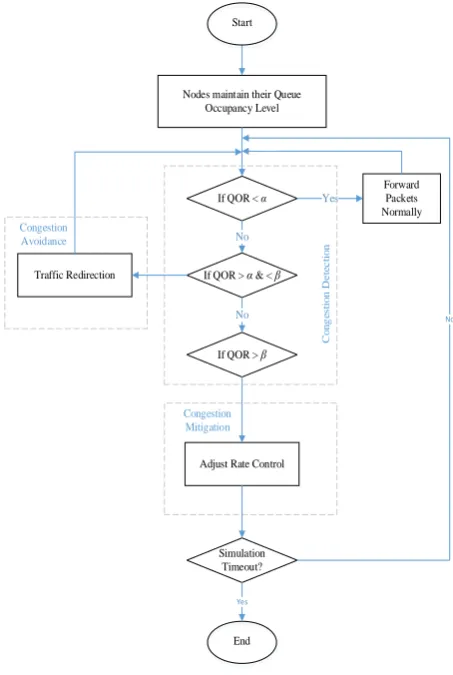
Nodes maintain their Queue Occupancy Level
Start
If QOR > α & < β
End If QOR < α
Forward Packets Normally
Yes
No
If QOR > β
No
Adjust Rate Control Congestion
Avoidance
Traffic Redirection
C
o
n
g
es
tio
n
D
e
te
c
tio
n
Congestion Mitigation
Simulation Timeout?
Yes
No
Fig. 4: Flow chart of proposed CAMP protocol
4.
Results and Discussion
For assessment of the proposed work, series of experiments were carried out in NS2 simulator. The results are compared with HOCA protocol [20] in BSNs. For simulation setup, 10 number of BMS’ and a BC are deployed on a single body. The simulation parameters are configured as stated in Table 1.
Table 1: Simulation Parameters
Parameter Value
Initial Energy 1 Joule
Traffic Constant Bit Rate (CBR)
Queue Length 100 Packets
Packet size 32 Bytes
Transmission Range 46cm Transmission Power 0.3mW
MAC Protocol IEEE 802.15.4
Network Interface WirelessPhy Simulation Time 120 seconds
The performance of the proposed protocol is evaluated in terms of throughput and network lifetime. The literature presents definition of network lifetime in two ways. It is a time period of network operations until the first node runs out of battery[21], [22]. Another definition describes network lifetime as the maximum duration of network operations till any of the nodes is active in the network and able to send data[23, 24]. This work uses the second definition to measure the maximum network lifespan of the proposed protocol.
Fig. 5 shows the analysis of network lifetime of the proposed protocol along with HOCA protocol. The proposed protocol performed well to avoid the congestion in the network. However, congestion is observed for a short period of time span. Subsequently, the proposed protocol prominently reduced the energy wastage of BMS’ and increased the network lifetime of BSN. The Fig. 5 shows that the network operation time for proposed protocol is 10000 Centiseconds (CS) whereas for HOCA protocol is 7500 CS. Therefore, the proposed protocol shows 33% enhancement in network lifetime as compared to the HOCA protocol.
Fig. 5: Analysis of Network Lifetime
In BSNs the primary purpose of BMS’ are to sense and
transmit data to BNC. The successful data transmission in
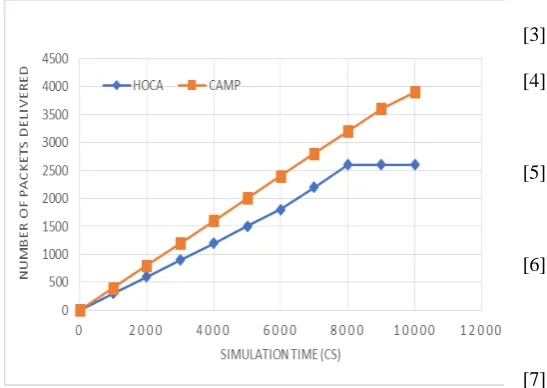
protocol performs better in achieving the throughput in the network as compared to HOCA protocol.
Fig. 6: Analysis of Network Throughput
Statistically, the proposed protocol successfully delivered 3900 packets while HOCA delivered 2600 packets. Therefore, the protocol achieved 49% better performance in terms of network throughput as compared to the HOCA protocol.
5.
Conclusion
Body Sensor Networks (BSN) is convenient and economical solution for healthcare applications. This research highlights the issues related to congestion in BSNs. In this paper, a congestion avoidance and mitigation protocol (CAMP) is proposed for BSN. The primary focus of this protocol is to avoid congestion in the network. This is achieved by constant monitoring of queue level of the BMS’. The traffic is redirected if queue occupancy level is greater than first threshold α. However, if queue occupancy level is reached to second threshold βand congestion is occurred, the proposed CAMP protocol mitigated the congestion by adjusting the rate control. Moreover, routing decision are performed based on hop counts and congestion level on the BMS. The experimental results indicate the proposed protocol performed better in terms of network lifetime and throughput in BSNs.
Furthermore, this work can be extended towards differentiated routing based on multiple routing zones to further improve the energy efficiency in BSNs.
References
[1] S. P. Keehan et al., “National Health Expenditure Projections, 2014−24: Spending Growth Faster Than Recent Trends,” Health Aff., vol. 34, no. 8, pp. 1407–1417, 2015.
[2] A. Nag, S. C. Mukhopadhyay, and J. Kosel, “Wearable Flexible Sensors: A Review,” IEEE Sens. J., vol. 17, no. 13, pp. 3949–3960, 2017. [3] N. C. I. NCI, “Cancer Detection and Diagnostics
Technologies for Global Health,” pp. 1–188, 2011. [4] B. Latré, B. Braem, I. Moerman, C. Blondia, and P.
Demeester, “A survey on wireless body area networks,” Wirel. Networks, vol. 17, no. 1, pp. 1– 18, 2011.
[5] M. Chen, S. Gonzalez, A. Vasilakos, H. Cao, and V. C. M. Leung, “Body area networks: A survey,”
Mob. Networks Appl., vol. 16, no. 2, pp. 171–193, 2011.
[6] M. Anwar, A. H. Abdullah, K. N. Qureshi, and A. H. Majid, “Wireless Body Area Networks for Healthcare Applications : An Overview,”
TELKOMNIKA, vol. 15, no. 3, pp. 1088–1095, 2017.
[7] G. K. Ragesh and K. Baskaran, “A survey on futuristic health care system: WBANs,” Procedia Eng., vol. 30, no. 2011, pp. 889–896, 2012.
[8] K. S. M. and A. J. Tanvir Ishtaique ul Huque, “Body Node Coordinator Placement Algorithms forWireless Body Area Networks,” IEEE INTERNET THINGS J., vol. 2, no. 11, pp. 94–102, 2015.
[9] D. M. Barakah and M. Ammad-uddin, “A Survey of Challenges and Applications of Wireless Body Area Network ( WBAN ) and Role of a Virtual Doctor Server in Existing Architecture,” no. February 2012, 2016.
[10] A. Ghaffari, “Congestion control mechanisms in wireless sensor networks: A survey,” J. Netw. Comput. Appl., vol. 52, pp. 101–115, 2015.
[11] A. Ahmed, K. A. Bakar, M. I. Channa, K. Haseeb, and A. W. Khan, “TERP: A Trust and Energy Aware Routing Protocol for Wireless Sensor Network,” IEEE Sens. J., vol. 15, no. 12, pp. 6962– 6972, 2015.
[12] C. Sergiou, P. Antoniou, and V. Vassiliou, “A Comprehensive Survey of Congestion Control Protocols in Wireless Sensor Networks,” IEEE Commun. Surv. Tutorials, vol. 16, no. 4, pp. 1839– 1859, 2014.
[13] Y. Baek, B. Lee, J. Li, Q. Shu, and C. Science, “An adptive rate control for congestion avaoidance in Wireless Body Area Networks,” pp. 1–4, 2009. [14] M. H. Yaghmaee Moghaddam and D. Adjeroh, “A
novel congestion control protocol for vital signs monitoring in wireless biomedical sensor networks,” IEEE Wirel. Commun. Netw. Conf. WCNC, no. February, 2010.
[16] V. Tiwari, S. Misra, and M. Obaidat, “Lacas: Learning automata-based congestion avoidance scheme for healthcare wireless sensor networks,”
IEEE J. Sel. Areas Commun., vol. 27, no. 4, pp. 466–479, 2009.
[17] R.Gunasundari, R.Arthi, and S.Priya, “An Efficient Congestion Avoidance Scheme For Mobile Healthcare Wireless Sensor Networks,” Int. J. Adv. Netw. Appl., vol. 2, no. 3, pp. 693–698, 2010. [18] N. F. Bahalgardi et al., “An Adaptive Congestion
Alleviating Protocol for Healthcare Applications in Wireless Body Sensor Networks : Learning Automata Approach,” vol. 26506, no. 1, 2012. [19] M. H. Yaghmaee, N. F. Bahalgardi, and D. Adjeroh,
“A prioritization based congestion control protocol for healthcare monitoring application in wireless sensor networks,” Wirel. Pers. Commun., vol. 72, no. 4, pp. 2605–2631, 2013.
[20] A. A. Rezaee, M. H. Yaghmaee, A. M. Rahmani, and A. H. Mohajerzadeh, “HOCA: Healthcare aware optimized congestion avoidance and control protocol for wireless sensor networks,” J. Netw. Comput. Appl., vol. 37, no. 1, pp. 216–228, 2014. [21] M. Effatparvar, M. Dehghan, and A. M. Rahmani,
“A comprehensive survey of energy-aware routing protocols in wireless body area sensor networks,” J. Med. Syst., 2016.
[22] Q. Nadeem, “A New Energy Efficient Protocol for Wireless Body Area Networks,” 2013.
[23] M. M. et al. Sahndhu, “BEC : A Novel Routing Protocol for Balanced Energy Consumption in Wireless Body Area Networks,” pp. 653–658, 2015. [24] WME W.M. Aiman, S.W.Ruslan, M.J.Che Soh,
Design of Low Power CMOS Bioamplifier in 250 nm and 90 nm Technology Node. International Journal of Integrated Engineering – Special Issue on ReSENT 2017, Vol. 9 No. 4(2017) pp. 109-113.. [25] Q. Nadeem, N. Javaid, S. N. Mohammad, M. Y.