ABSTRACT
Introduction: Nurse Educators are the main driving force in promoting the interest of nursing students to learn. The nursing education system needs to be updated and carried out research in the field of curriculum reform. Concept mapping is an innovative teaching method and can be reflected in meaningful learning.
Methodology: This study involved 109 nursing students from two nursing colleges in Kubang Kerian Nursing College (Kelantan) represent East Zone and Pulau Pinang Nursing College represent North Zone. The respondents were selected using simple random sampling. The descriptive values of items were expressed as means, standard deviations, frequencies and percentages. Results: The results of this analysis show that students receive good use of concept maps in teaching and learning. Overall mean their acceptance towards concept map is 3.44. The students' perception towards concept mapping among nursing students shows that positive-medium. Conclusion: Concept mapping is one method that aims to improve the meaningful learning among students. For this reason, nurse educators must think and reexamine the best method to teach and to empower nursing students to learning. It is because nowadays nurses need high critical thinking skills and a critical thinking disposition because everyday nurses encounter with multiple patients with the same health care needs. However, each patient responds to these needs differently.
Keywords: Perception, Nursing students, Concept mapping, Learning tool
MAPPINGAS A LEARNING TOOL
Rusnani Ab Latif
INTRODUCTION
Nurse educators need to equip themselves with knowledge and skills as well as new practices of teaching and learning that is relevant and active in parallel with the development and needs of the 21st century, thinking skills across all disciplines among students should be given priority. Nurse educators are the main driving force in promoting the interest of nursing students to learn. Educators might be successful in teaching the basics, but it does not mean the students will be able to analyze and evaluate what they are taught. There is a need to understand the complex processes involved in critical thinking. It is important to choose the best teaching approach to help the nursing students more easily understand the interest subject of nursing in depth, for example using concept mapping as a teaching and learning. It is extremely important for the nurse educator understand about learning skills practiced and its role among the students during learning process in their respective classes. An understanding of the student learning skills is important as predictor of academic achievement (Kannat Na Bangchang, 2015).
Nurses need critical thinking skills to perform their daily functions in practice. For nursing students, they can develop their critical thinking skills and give quality and safe care to their patients, alongside the concept mapping facilitate nursing students' critical thinking especially during done assessment of the patient regarding their disease and can determine the best and priority intervention in patient care to get a good evaluation of patient outcomes. Concept maps must be introduced to beginning level in nursing program because it is one method of teaching strategy to develop critical thinking. Different with lecture method, the students will passively absorb information (Dewey, 2008). In addition, lecture method also does not provide students with valuable skills in acquiring the information and retaining it (Udovic et al., 2002).
The nursing education system needs to be updated and carried out research in the field of curriculum reform. Concept mapping is an innovative teaching method and can be reflected in meaningful learning. Likewise, meaningful learning cannot be separated from critical thinking. Therefore, by using concept mapping in nursing education will produce nursing students who Kubang Kerian Nursing College, Kelantan, Malaysia
are more creative and critical thinking, to function effectively as a nurse in the clinical setting. By using concept mapping the nursing students will analyze first every problem that have by the patient and try to solve the problem by using appropriate decision making. This will develop the critical thinking and “think out of the box”. This will produce nurses with thinking in logical and new perspective that suitable with this modern era. Thus, the combined action of thinking skills and cognitive achievement will spur further catalyze and higher order thinking skills in students.
However, in Malaysia in nursing education context, the use of concept map analysis, as an assessment of diploma nursing college students has remained largely unexplored. Yet, limited nursing research has investigated in developing, validate and evaluate the lesson plan guideline protocol using concept mapping. Therefore, the researcher had implemented concept mapping as a learning tool and want to explore the students' perception towards using concept mapping as a learning tool.
Objective
To explore the students' perception towards using concept mapping as a learning tool.
LITERATURE REVIEW Concept Mapping
Concept mapping was originally developed by Novak in the 1980s, to document the way children learn science (Novak & Canas, 2006). Novak's work is based on the assimilation theory of cognitive by David Ausubel, who stressed the importance of prior knowledge in being able to learn new concepts (Ausubel, 1963). The most important single factor of influencing learning is what the learner already knows. They have demonstrated that concept maps are graphical tools for organizing and representing knowledge in networks of concepts and linking statements about a problem or subject (Mintzes, Wandersee & Novak, 2000). Schuster (2008) defined concept maps as “schematic devices for representing a set of concept meanings embedded in a framework of proposition as hierarchical graphical organizers that serve to demonstrate the understanding of relationships among concepts”.
Concept mapping is one method of teaching which encourage students to become independent learner, critical thinking and competent in their work. The
process of effective teaching and learning is determined by the teachers who are committed, dedicated and has a high teaching efficacy (Yusof et al., 2013). In other words, the effectiveness of teaching and learning depending on skills, attitude and the required methods in use by a nurse educator in delivering her lecture. By using concept mapping students will be able to analyze, synthesize, evaluate, and apply new concepts and knowledge by constructing the concept maps (Wheeler & Collins, 2003). Concept mapping fostered organization and critical thinking because it requires students to view the patient holistically and to construct relationships between patient problems, not just to copy information from a care planning book. Nurse educators will be able to easily identify missing or misunderstood concepts through the visual representation of concept mapping.
Concept mapping as teaching and learning strategies
In the process of delivering of learning, nurse educators have to cope with a variety of different groups of students, especially in terms of their acceptance of the learning abilities of teachers. In this situation, nurse educators need to be wise in choosing and determining the teaching and learning strategies accordingly. In other words, the nurse educators are responsible for determining the approach, selecting methods and techniques as well as set theory with the development of appropriate teaching and student abilities.
METHODOLOGY
This study involved 109 nursing students from two nursing colleges in Kubang Kerian Nursing College (Kelantan) represent East Zone and Pulau Pinang Nursing College represent North Zone. The respondents were selected using simple random sampling.
Data collection Steps:
· Before studies conducted, researcher provides information to teach assistant researcher how to implement uses concept map in teaching. Researcher prepares lesson plans and teaching notes using concept maps to help teacher's assistant researcher easy to understanding.
· During tutoring sessions, nurse educator was teaching the topic for two hours using concept mapping methods and given a scenario based on case studies.
· The students were provided a two-hour training class on the construction of concept maps.
· The students were taught how to construct a concept map during the orientation week of the semester.
· The students were asked to identify nursing diagnosis and nursing intervention and answer using concept mapping.
· After that the students tutoring sessions are asked to provide concept mapping notes as a response to their understanding of the topic in teaching. They were given 40 minutes to prepare it.
· The students were asked to prepare concept maps individually.
· The students’ concept mapping notes were evaluated by using rubric score that have been validated by expert panels. This rubric score was adapted from scoring criteria based on the Relational Scoring System (RSS) or scoring system for a conceptual network (McClure & Bell, 1990; McClure et al., 1999)
· The students were given the feedback regarding the concept maps that they developed. As a motivation for their hard try to develop concept maps, the prize was given to the students who got the high score mark can produce interesting and meaningful concept mapping notes with accurate and sufficiency of the content.
· On the next day, the students were given questionnaire on perceptions of the experiment group toward concept mapping based on four-point Likert scale, from 1= strongly disagree, 2=disagree 3=agree and to 4= strongly agree. The experimental groups were giving 15 minutes to answer that question. The total score was converted into percentages.
· This questionnaire adapted from study by Chei-Chang-Chiou (2008). The Cronbach Alpha coefficient of the instrument was 0.816 for the study sample. The instrument had high construct validity (with a part–whole correlation of 0.91) (Kerlinger, 1986).
Study ethics
Before carrying out this research project, an approval letter was being sent to Bahagian Pengurusan Latihan (BPL) under Institusi Latihan Kementerian Kesihatan Malaysia (ILKKM) and Directors of Nursing Colleges for consent. The researcher was explaining regarding the aim and procedure of study to the respondents. The researcher was also explained to the respondents that their answers were confidential and only used for the purpose of academic research. Written informed consent of all participants was being acquired.
RESULTS
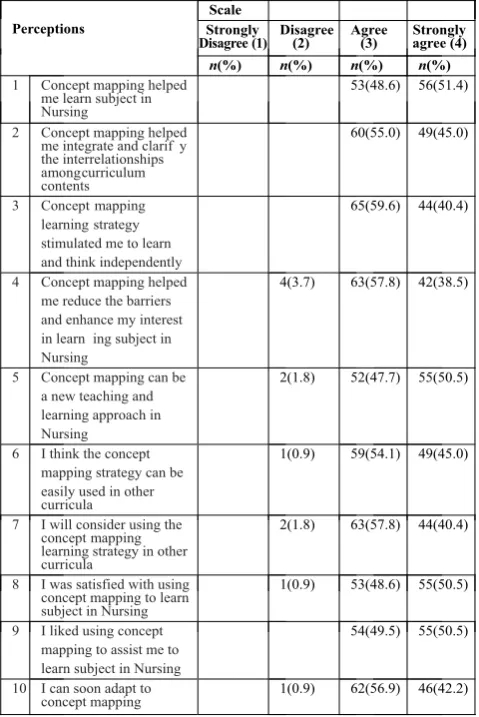
Table 1 reveals that 4-point Likert scale was used to frame the students' perceptions towards using concept mapping as a learning tool questionnaire. There have ten statements question was adapted from study by Chei-Chang-Chiou (2008). The total scores were converted into percentages. The results were discussed in percentages. Among 109 respondents, about 56(51.4%) of the respondents had strongly agree that concept mapping helped them to learn subject in nursing and 53(48. 6%) was agree.
respondents stated strongly agree was 55(50.5%), agree was 52(47.7%) and disagree was 2(1.8%).
There was 49(45.0%) of the respondents strongly agree the concept mapping strategy can be easily used in other curricula, 59(54.1%) was agree and only 1(0.9%) disagree. From 109 of the respondents, 44(40.4%) stated strongly agree, 63(57.8%) was agree and 2(1.8%) was disagree that they will consider using the concept mapping learning strategy in other curricula. About 55(50.5%), 53(48.6%) and 1(0.9%) of the respondents stated strongly agree, agree and disagree respectively and felt satisfied with using concept mapping to learn subject in nursing. All the respondents said strongly agree (50.5%) and agree (49.5%) and liked using concept mapping to assist me to learn subject in nursing. Regarding the statements can soon adapt to concept mapping, 46(42.2%) strongly agree, 62(56.9%) was agree and only 1(0.9%) was disagree.
Table 1: Perceptions of the experiment class toward concept mapping (n=109)
Perceptions
Scale Strongly
Disagree (1) Disagree(2) Agree(3) agree (4) Strongly
n(%) n(%) n(%) n(%) 1 Concept mapping helped
me learn subject in Nursing
53(48.6) 56(51.4)
2 Concept mapping helped me integrate and clarif y the interrelationships amongcurriculum contents
60(55.0) 49(45.0)
3 Concept mapping learning strategy stimulated me to learn and think independently
65(59.6) 44(40.4)
4 Concept mapping helped me reduce the barriers and enhance my interest in learn ing subject in Nursing
4(3.7) 63(57.8) 42(38.5)
5 Concept mapping can be a new teaching and learning approach in Nursing
2(1.8) 52(47.7) 55(50.5)
6 I think the concept mapping strategy can be easily used in other curricula
1(0.9) 59(54.1) 49(45.0)
7 I will consider using the concept mapping learning strategy in other curricula
2(1.8) 63(57.8) 44(40.4)
8 I was satisfied with using concept mapping to learn subject in Nursing
1(0.9) 53(48.6) 55(50.5)
9 I liked using concept mapping to assist me to learn subject in Nursing
54(49.5) 55(50.5)
10 I can soon adapt to
concept mapping 1(0.9) 62(56.9) 46(42.2)
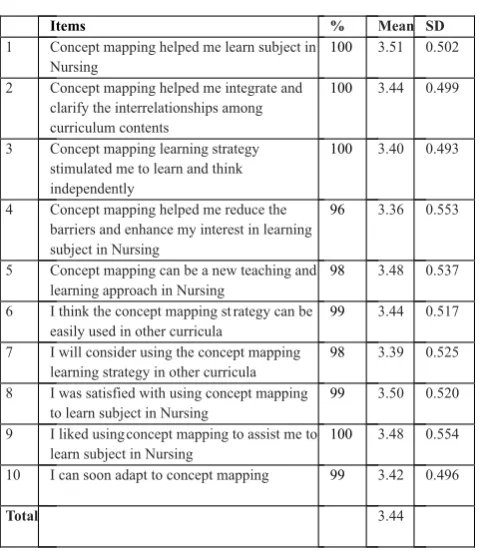
The summaries of perceptions of the experiment class toward concept mapping are displays in Table 2 The responses for each item were converted into 'agree' (answers of 'strongly agree' or 'agree') or 'disagree' (answers of 'strongly disagree' or 'disagree') and were converted into percentages. Questions 1-4 investigated whether the concept mapping strategy indeed improved learning. The data in Table 2 show that 100% of the students agreed that concept mapping helped them to learn subject in nursing, integrate and clarify the inter-relationships among curriculum content and also students indicated that concept mapping stimulated them to learn and to think independently and liked using concept mapping to assist me to learn subject in Nursing. Meanwhile 99% of the students think the concept mapping strategy can be easily used in other curricula, satisfied with using concept mapping to learn subject in Nursing and can adapt to concept mapping and come out with the result can soon adapt to concept mapping.
Questions 5–10 related with the degree of the affective acceptance of the concept mapping group. In addition, 98% of the students agreed that concept mapping can be a new teaching and learning approach in Nursing and consider using the concept mapping learning strategy in other curricula. It also shows that 96% students expressed the opinion that concept mapping helped to reduce the barriers and enhance my interest in learning subject in nursing. The result indicated that most of the students have given positive feedback after learn and applied concept mapping in their learning.
Based on the distribution of the mean item score students' acceptance towards concept map obtained, it is found only 1 out of 10 items have higher mean scores on the interpretation min adapted from Mohd Najib Abdul Ghaffar (2003) (see Table 3). Items that have a high mean score is related to item “Concept mapping helped me learn subject in Nursing” (mean score = 3.51). While 9 other items have a moderate score (mean score 2.51-3.50). According to Mohd Najib Abdul Ghaffar (2003), researcher can use a variety of theories and formulate our own produce its own index based on the objectives of the study.
interest in learning subject in Nursing (mean score =3.36); Concept mapping can be a new teaching and learning approach in Nursing (mean score = 3.48); I think the concept mapping strategy can be easily used in other curricula (mean score = 3.44); I will consider using the concept mapping learning strategy in other curricula(mean score = 3.39); I was satisfied with using concept mapping to learn subject in Nursing(mean score = 3.50); I liked using concept mapping to assist me to learn subject in Nursing(mean score = 3.48) and I can soon adapt to concept mapping(mean score = 3.42).
Table 2: Summary of perceptions of the experiment class toward concept mapping (n=109)
Table 3: Analysis of Likert scale (mean score) adapted from Mohd Najib Abdul Ghaffar (2003)
Mean score The level of agreement
0.00-1.50 Very low
1.51-2.50 Low
2.51-3.50 Moderate
3.51-4.50 High
4.51-5.00 Very high
DISCUSSION
The results of this analysis show that students receive good use of concept maps in teaching and learning. Overall mean their acceptance towards concept map is
3.44. This finding also shows that all students involved have shown interest in this concept map. Students rated their perception as 100% on the following issues: “Concept mapping helped me learn subject in Nursing”; “Concept mapping helped me integrate and clarify the interrelationships among curriculum contents”; “Concept mapping learning strategy stimulated me to learn and think independently” and “I liked using concept mapping to assist me to learn subject in Nursing”.
This result is consistent with study done by Clayton (2006) explored the use of concept mapping with sophomore students in a research course. This study shows increased academic performance in the experimental group that used concept mapping as opposed to the control group. In addition, the students found the teaching strategy fun and useful. Concept mapping serves as a tool that fosters both the learning of critical thinking and the measurement of those thinking abilities within the context of nursing practice (Wilgis, 2008).
This finding was similar with the study done by Zahara and Nurliah (2009) in their study based on the students' acceptance towards concept maps was positive-medium with the mean was 3.55. The results showed that the students agree that using concept mapping easier to them to remember the content of study, interesting teaching method and not bored to them. The positive attitude such as interested and committed shows by the students during prepares the concept maps. This finding was similar with the study done by Abdullah (2000) and Jamrin (2002) showed that the students' acceptance towards concept maps was positive-medium. The result of positive-medium means not all the students showed interested and committed during preparation of the concept maps.
This results also consistent with some findings of earlier investigation by Nirmala & Shakuntala (2012); Ahlberg et al., (2005); Harpaz et al., (2004); Novak et al., (1983); Novak & Gowin (1984). Study done by Nirmala & Shakuntala (2012) among 39 nursing students, reported that 38(97%) of the students had agreed that they can easily apply concept mapping to the nursing process, 77% was agree that concept mapping was suitable for all the subjects although non-nursing subjects. Meanwhile 74% of the students stated that they would like to continue using concept mapping in nursing care plans and about 77% of the students said they will apply the concept mapping to other subject too.
Items % Mean SD
1 Concept mapping helped me learn subject in Nursing
100 3.51 0.502
2 Concept mapping helped me integrate and clarify the interrelationships among curriculum contents
100 3.44 0.499
3 Concept mapping learning strategy stimulated me to learn and think independently
100 3.40 0.493
4 Concept mapping helped me reduce the barriers and enhance my interest in learning subject in Nursing
96 3.36 0.553
5 Concept mapping can be a new teaching and learning approach in Nursing
98 3.48 0.537
6 I think the concept mapping st rategy can be easily used in other curricula
99 3.44 0.517
7 I will consider using the concept mapping learning strategy in other curricula
98 3.39 0.525
8 I was satisfied with using concept mapping to learn subject in Nursing
99 3.50 0.520
9 I liked usingconcept mapping to assist me to learn subject in Nursing
100 3.48 0.554
10 I can soon adapt to concept mapping 99 3.42 0.496
Total
Most of the students liked, and felt satisfied with, adopting concept mapping as an assistive learning strategy. The experimental group also believed that concept mapping could be easily applied to other subjects. These opinions are consistent with the successful examples of using concept mapping in other disciplines (Ahlberg et al., 2005; Chang et al., 2002; Freeman & Jessup, 2004; Harpaz et al., 2004; Ritchie & Volkl, 2000). In addition, majority of the students indicated that they could adapt to the approach of concept mapping. Furthermore, the concept mapping notes that develop by the student indicates that the understanding of student regarding the subject. It helps the students to summarize and synthesize the subject that already taught.
Concept mapping also play pivotal role in enhance student centered learning. The exercise of constructing a concept map required students to pay attention to the lecture by forcing them to reflect interactively on the content of the lecture. Indirectly, it allows the students to move from passively listening to being actively engaged with the lecture content and information. In the way the objective of the lesson was achieved, to help students engage with the subject matter in an active way instead of only listening to a lecture or power point presentation. Students' responses to this method were different.
Overall the nursing students were more positive about the usefulness of concept mapping in enhancing learning effectiveness after they applied it. All the respondents agree that concept mapping is a learning strategy stimulated the students to learn independently. It is similar by the finding study done by Ahlberg et al., 2005; Harpaz et al., 2004; Novak et al., 1983; Novak & Gowin,1984. Study done by Erasmus (2013), shows that most of the students welcomed the concept mapping approach in helping their learning. Besides that, concept mapping also enhance the lecture and becomes meaningful to the student.
Study done by Doel (2009) needs the students' were required to reflect on their experiences about concept maps. The researcher asks the students to write their opinion and feelings with regard to the changed approach in offering the lecture. Here is what some of them had to say:
“I felt confused at first, but it helped us to engage with the content.”
“More interaction with classmates, engaging more with
topic. I have learned more by getting information by doing research.”
“The interaction in class helps me to understand the work better. It is a good approach; it makes us engaged with the subject.”
However, contrast finding in the study done by Mc Cagg & Dansereau (1991) said that 'studies of student mapping … have indicated that a lack of familiarity with the technique can be frustrating for novice map makers … training students to use the concept mapping technique can be tedious and time-consuming'. It is supported by Hansen and Stephens (2000) state that students accustomed to being passive have a "low tolerance for challenge". The students said that “Concept maps were confusing, too many concepts to make the connection and selecting the relevant heading according to the topics.” In this study the students feel that very difficult in construct the concept mapping and prefer the normal lectures with Power Point presentations.
Covill (2011) found that there are probably students prefer the normal lecture compare to concept mapping. It is because the concept mapping forces them to be more independent in their learning. It is supported by Erasmus (2013) reported that the students more prefer to lecture method instead on using concept mapping in the classroom, that need them to engage with the content. It is customary for all new things; to apply recycling practices is difficult in the beginning. Therefore the author recommended those lecturers who want to use active learning must first identify the student view of the lecture method, positively in terms of engagement with the course and the quality for student learning.
CONCLUSION
Nursing education has been undergoing a major revolution, with attention focused on how to teach students to think critically and can associate between what are they learned in classroom and clinical practices. For this reason, nurse educators must think and reexamine the best method to teach and to empower nursing students to learning. It is because nowadays nurses need a high of critical thinking skills and a critical thinking disposition because everyday nurses encounter with multiple patients with the same health care needs. However, each patient responds to these needs differently. Therefore, nurses are required to use their holistic nursing knowledge base to think through each situation to provide individualized effective care rather than simply to follow routine procedures.
REFERENCES
Abdullah, A. (2000). Keberkesanan penggunaan peta
konsep dalam mata pelajaran Sains tingkatan 1.
Disertasi Sarjana Pendidikan. Fakulti Pendidikan. Universiti Kebangsaan Malaysia.
Ahlberg, M., Aanismaa, P. & Dillon, P. (2005). Education for sustainable living: Integrating theory, practice, design, and development. Scandinavian Journal of Educational Research, 49(2), pp 167–185.
Ausubel, D. P. (1963). The Psychology of Meaningful Verbal Learning. Grune & Stratton, New York.
Bangchang, K.N. (2015). Factors affecting academic p e r f o r m a n c e o f u n d e rg r a d u a t e s t u d e n t s . International Journal of Multidisciplinary Approach and Studies, 2(6), pp 205-215.
Chiou, C. (2008). The effect of concept mapping on students' learning achievements and interests. Innovations in Education and teaching International, 45(4), pp 375-387.
Chang, K.E., Sung Y.T. & Chiou, S.K. (2002). Use of hierarchical hyper concept map in web-based
courses. Journal of Educational Computing
Research, 27, pp 335–353.
Chen, S., Liang, T., Lee, M. & Liao, I. (2011). Effects of concept map teaching on students' critical thinking and approach to learning and studying. Journal of Nursing Education, 50(8), pp 466-469.
Clayton, L. H. (2006). Concept mapping: An effective,
active teaching-learning method.Nursing
Education Perspectives, 27(4), pp 197-203.
Covill, A. (2011). College students' perceptions of the traditional lecture method. College Student Journal, 45(1).
Dearmon, V., Lawson, R. & Hall, H. R. (2011). Concept mapping a baccalaureate nursing program: A method for success. Journal of Nursing Education, 50(11), pp 656-659.
Dewey, J. (2008). Democracy and education: an introduction to the philosophy of education. Macmillan, New York.
Doel, S. (2009). Fostering student reflection during engineering internships. Asia Pacific Journal of
Cooperative Education, 10(3), pp 163-177.
Erasmus, C. J. (2013). Concept mapping as a strategy to enhance learning and engage students in the classroom. Journal of Family and Consumer Sciences Education, 31(1), pp 27-35.
Freeman, L.A. & Jessup, L.M. (2004). The power and benefits of concept mapping: Measuring use, usefulness, ease of use, and satisfaction. International Journal of Science Education, 26(2), pp 151–169.
Ghaffar , M.N.A.(2003). Reka Bentuk Tinjauan Soal Selidik Pendidikan. Skudai: Penerbit Universiti Teknologi Malaysia Press, Malaysia.
Girot, E. A. (2000). Graduate nurses: Critical thinkers or better decisions makers? Journal of Advanced Nursing, 31(2), pp 288-297.
Hansen, E. J. & Stephens, J. A. (2000). The ethics of learner- centered education: Dynamics that impede progress. Change, 33(5), pp 40-47.
Harpaz, I., Balik, C. & Ehrenfeld, M. (2004). Concept Mapping: An Educational Strategy for Advancing Nursing Education, Journal of Nursing Forum, 39 (2), pp 27-30.
Hinck, S., Webb, P., Seims-Giddens, S., Helton, C., Hope, K., Utley, R., Savinske, D., Fahey, E.& Yarbrough, S. (2006). Student learning with concept mapping of care plans in community-based education. Journal of Professional Nursing, 22(1), pp 23-29.
Jamarin, M.J. (2002). Keberkesanan penggunaan
pelajaran ekonomi asas tingkatan empat. Disertasi Sarjana Pendidikan. Fakulti Pendidikan. Universiti Kebangsaan Malaysia.
Kawashima, A. & Petrini, M. A. (2004). Study of critical thinking skills in nursing students and nurses in Japan. Nurse Education Today, 24(4), pp 286-292.
Kerlinger, F.N. (1985). Foundations of behavioral
rd
research. 3 Edition. Holt Rinehart and Winston. Fort Worth, Texas, U.S.A.
McCagg, E.C. & Dansereau, D.F. (1991). A convergent strategy for examining knowledge mapping as a learning strategy. Journal of Educational Research, 84, pp 317–324.
McClure, J.R. & Bell, P.E. (1990). Effects of an environmental education related STS approach instruction on cognitive structures of pre-service
science teachers. University Park. Coll. of
Education, State University, Pennsylvania.
McClure, J,R., Sonak, B. & Suen, H,K. (1999). Concept map assessment of classroom learning: Reliability, Validity and Logistical practicality. In Journal of Research in Science Teaching, 36(4), pp 475-492.
Mintzes, J.J., Wandersee, J. H. & Novak, J.D. (2004).
Assessing science understanding: A human
st
constructivist view.1 Edition, Academic Press, San Diego.
Nirmala, T. & Shakuntala, B.S. (2012). Attitude of students on concept mapping- an innovative teaching learning strategy. Nitte University Journal of Health Sciences, 2(4).
Noonan, P. (2011). Using concept maps in perioperative education. AORN Journal, 94(5), pp 469-478.
Novak, J.D., Gowin, D.B. & Johansen, G.T. (1983). The use of concept mapping and knowledge via mapping with junior high school science students. Science Education, 67(5), pp 625–645.
Novak, J.D. & Gowin, D.B. (1984). Learning how to
learn. Cambridge University Press, New York.
Novak, J.D. & Canas, A.J. (2006). The origins of the concept mapping tool and the continuing evolution
of the tool. The Institute for Human and Machine
Cognition.
Pilcher, J. (2011). Teaching and learning with concept maps. Neonatal Network, 30(5), pp 336-338.
Ritchie, D. & Volkl, C. (2000). Effectiveness two generative learning strategies in the science classroom. School Science and Mathematics, 100(2), pp 83–89
Schuster, P. (2007). Concept mapping: A critical
nd
thinking approach to care planning 2 Edition. F. A. Davis Company, Philadelphia.
Taylor, L.A. & Littleton-Kearney, M. (2011). Concept mapping: A distinctive educational approach to foster critical thinking. Nurse Educator, 36(2), pp 84-88.
Udovic, D., Morris, D., Dickman, A., Postlethwait, J. & Wetherwax, P. (2002). Workshop biology: demonstrating the effectiveness of active learning in an introductory biology course. Bioscience, 52(3), pp272-281.
Wheeler, L. A. & Collins, S. K. R. (2003). The influence of concept mapping on critical thinking in baccalaureate nursing students. Journal of Professional Nursing, 19(6), pp 339-346.
Wilgis, M. & Mcconnell, J. (2008). Concept mapping: An educational strategy to improve graduate nurses program. Journal of Counting Education in Nursing, 39(3), pp 119-126.
Yusof, M.M., Muda,A., Abdulla,A.M.,Samah, B.A., Basri,R.& Rashid,N.A.(2013). Factors Influencing Self-Efficacy Of Malaysian Secondary School Teachers In Implementing Environmental Education. Asia Pacific Journal of Educators and Education. 28,pp 131-153.