
© Universiti Tun Hussein Onn Malaysia Publisher’s Office
IJIE
Journal homepage:http://penerbit.uthm.edu.my/ojs/index.php/ijie ISSN : 2229-838X e-ISSN : 2600-7916
The International
Journal of
Integrated
Engineering
Drying Shrinkage Strain Development of Agro-Waste Oil
Palm Shell Lightweight Aggregate Concrete by Using the
Experimental Result, ACI and Eurocode Prediction Models
Mehdi Maghfouri
1,*, Payam Shafigh
2,3, Vahid Alimohammadi
31Department of Civil Engineering, Faculty of Engineering,
University of Malaya, 50603 Kuala Lumpur, MALAYSIA
2Department of Building Surveying, Faculty of Built Environment,
University of Malaya, 50603 Kuala Lumpur, MALAYSIA
3Center for Building, Construction and Tropical Architecture, Faculty of Built Environment,
University of Malaya, 50603 Kuala Lumpur, MALAYSIA
*Corresponding Author
DOI: https://doi.org/10.30880/ijie.2019.11.09.027
Received 21 February 2019; Accepted 16 October 2019.; Available online 31 December 2019
Abstract:Oil palm shell (OPS) is a waste from the agricultural sector in tropical regions which could be used as aggregate in lightweight concrete mixtures. Different types of lightweight concrete with satisfactory mechanical properties were produced by using OPS. However, at early and later ages, oil palm shell lightweight aggregate concrete has higher rate of drying shrinkage compare to the normal-weight concrete. The aim of the present study is to compare the development of drying shrinkage strain based on the prediction models and experimental results. In this regard, two concrete mixes using a different level of OPS as replacement of crushed granite were produced. Two prediction models, ACI-209R and Eurocode (EC2), were applied to estimate drying shrinkage strain. In order to obtain accurate prediction for drying shrinkage strain, all effective factors for the models were applied. From the test results for drying shrinkage strain, it could be reported that both ACI and EC2 models presented close results to the experimental curves for conventional concrete (C1 mix). While, due to the high substitution level of OPS (up to 100% of aggregates) in conventional concrete, sharp increase in the drying shrinkage was observed in C2 mix. Therefore, no any suitable prediction model was found to predict close results for such concretes at early and long-term ages. Furthermore, the addition of OPS in conventional concrete resulted in higher drying shrinkage strain at long-term ages.
Keywords:Oil palm shell, drying shrinkage, prediction model, lightweight concrete
1. Introduction
materials more sustainable and convert it to a usable and reliable replacement for natural raw materials [2,3]. Using of the wastes for production of concrete is considered as a method to implement the waste management. Oil palm shell (OPS) is the common agricultural waste which could be used in concrete as aggregate to produce lightweight aggregate concrete. Advantages of the lightweight concrete in concrete structures encourage design engineers to employ this type of material for their design optimization. Due to reduction of the concrete weight, structural elements could be designed economically which leads to a significant saving in the cost of the supporting structures and foundation. With lighter concrete, for equal overall structural weight, it is possible to construct taller building or longer spans. The higher degree of thermal insulation of lightweight concrete also is considered as a remarkable advantage. The method for production of lightweight aggregate concrete by using of the OPS was introduced for the first time in Malaysia by Salam and Abdullah [4]. Several researchers have pointed out that conventional coarse aggregate can be replaced with OPS to produce structural grade of lightweight concrete [5,6]. Previous studies demonstrated that lightweight concrete by using of the OPS has satisfactory mechanical properties and durability performance. For oil palm shell concrete (OPSC), the compressive strength was reported in the range of 13-22 MPa. While with inclusion of cementitious materials and admixtures, compressive strength of 37 MPa has been obtained. Furthermore, lightweight concrete containing OPS and limestone powder, with compressive strength up to 48 MPa and density of about 1990 kg/m3 has been reported [7-9].
However, a good mechanical property is not the only indicator to satisfy the quality of OPSC [10]. As the OPS lightweight aggregate concrete has greater drying shrinkage compared to conventional concrete, this matter should be considered and rectified before applying of OPS in concrete mixtures.
Shrinkage in concrete is defined as the volumetric reduction of concrete sections over the time, which is mainly due to moisture migration [11]. Drying shrinkage, which cusses tensile stress and as a result deformation and cracking, plays a significant role for durability of concrete elements and structures. Generally, drying shrinkage value for the lightweight concretes is higher compared to the normal-weight concretes. Because of the low deformation resistance of the lightweight aggregates, the final drying shrinkage attained by lightweight concrete is greater than that of comparable conventional concrete. Clarke highlighted that the drying shrinkage of lightweight aggregate concrete (LWAC) is in the range of 1.4 to 2 times of normal-weight concrete (NWC) [12]. Previous studies [13,14] pointed out that the OPSC has satisfactory mechanical properties and durability performance. Whereas, the drying shrinkage of normal-weight concrete was reported about 20% of OPS concrete’s drying shrinkage value. The high drying shrinkage value of OPSC is mainly due to lower elastic modulus of OPS as compared with normal-weight aggregate. However, lightweight concretes of equal strength and density, but made with different lightweight aggregates, may differ considerably in their modulus of elasticity [15]. Basically, high cement content and OPS percentage in OPSC affect the rate of drying shrinkage. Therefore, one of the effective approach to control and minimize the drying shrinkage of OPSC is reduction of OPS aggregate volume in the concrete mixture [16]. 90-day drying shrinkage of OPSC and normal-weight concrete (NWC) also was compared by Mannan and Ganapathy [17]. They highlighted that the drying shrinkage strain of both concretes experienced an upward trend with age, while higher increment was for OPSC by about 14% compared to NWC. Drying shrinkage for several types of low-density concretes using OPS with compressive strength ranging from 22 to 38 MPa at the age of 28-day was measured by Alengaram [18]. They pointed out that drying shrinkage of OPSC at the age of 90 days is in the range of 540-1300 microstrain.
Although several researchers have investigated drying shrinkage of the conventional and OPS lightweight concretes, further studies are needed to estimate drying shrinkage strain by using of the prediction models for such concretes. In the present study, two types of theoretical models for prediction of the drying shrinkage were applied in order to compare the results from the models and experimental data.
2. Experimental Program
2.1 Materials
Ordinary Portland cement (OPC) which conforms to MS EN 197-1:2014 CEM 1 standards [19] with the specific gravity of 3.14 and Blaine surface area of 3510 cm2/g was used in this investigation. For the mixing of raw materials
and curing of the concrete samples, potable water was used. In order to achieve adequate workability and better compaction of fresh concrete, Polycarboxylate superplasticizer (SP) was added together with mixing water.
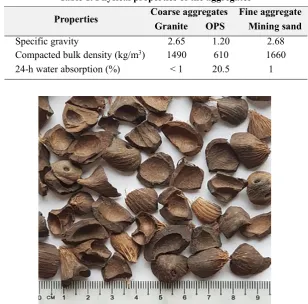
The crushed granite and OPS with a maximum size of 12.5mm were used as coarse aggregates as shown in Fig. 1. The size and grading of both OPS and crushed granite aggregates were selected in the same range. However, mining sand provided from local resources, with a maximum size of 4.75 mm and fineness modulus of 2.89 was used as fine aggregate. The physical properties of the fine and coarse aggregates are presented in Table 1.
2.2 Concrete Mixing and Mix Proportions
Two mix proportions (C1 and C2 mixes) with the same volume of binder were designed by using crushed granite (NWA) and oil palm shell (OPS) aggregates. C1 concrete mix with a density of 2340 kg/m3 is categorized as NWC
while C2 with density of 1900 kg/m3due to 100% replacement of the NWA by OPS is considered lightweight concrete
(LWC). BS EN 206-1 [20] specified the LWC as a concrete with the oven-dry density from 800 to 2000 kg/m3. The
between compressive strength at 28-day, OPS aggregate substitution level and oven-dry density for C1 and C2 concrete mixes. It was found that by increment of the OPS replacement level in NWC, the 28-day compressive strength was reduced together with dry density.
Furthermore, the experimental drying shrinkage strain was compared with two drying shrinkage prediction models selected from the standards and the researchers for both C1 and C2 mixes.
Table 1. Physical properties of the aggregates
Coarse aggregates Fine aggregate Properties
Granite OPS Mining sand
Specific gravity 2.65 1.20 2.68 Compacted bulk density (kg/m3) 1490 610 1660
24-h water absorption (%) < 1 20.5 1
Fig 1. - Oil palm shell lightweight aggregate
Mix OPC Water SP
Table 2. Concrete mix proportions Sand (kg) Aggregate (kg)
Slump Density Compressive
ID (kg) (liter) (gm) 0-2
mm 0-5
mm Granite OPS (mm) (kg/m
3) strength
(28-day, MPa)
C1 55 18.7 550 47 47 103.0 - 205 2340 74.4
C2 55 18.2 550 47 47 - 46.6 40 1900 40.5
2.3 Test Methods and Specimen Sizes
For both C1 and C2 mixes, the OPC, crushed granite and the pre-soaked and saturated surface dried OPS aggregates were blended in revolving drum mixer for 2-minute. Then 70% of the mixing water containing SP was added to the mixture for 3-minute mixing. After remaining water was added to the mixture, a 5-minute mix time was applied. Then the slump test for fresh concrete was carried out prior to the concrete sampling. The results are shown in Table 2.
The drying shrinkage strains of the concrete prisms with the size of 100 × 100 × 300 mm were precisely measured by the digital version of the DEMEC Mechanical Strain Gauge which was calibrated to measure based on micro-strain, as indicated in Fig. 3. The DEMEC points with spacing of 200 mm were fixed on three sides of the prisms. The initial measurement was recorded by the gauge type PLR-60-11 as indicated in Fig. 4. The specimens for the drying shrinkage of concretes were cured in 22 ± 2˚C water with for 7 days. Then, the samples were placed in the laboratory environment with a temperature of 30 ± 2˚C and relative humidity of 74 ± 4%.
Fig. 3. Pre-drilled stainless steel discs (DEMEC pints)
Fig. 4. The drying shrinkage measurement tool
3. Results and Discussions
3.1 Shrinkage Prediction Models
1.4210−2V
S
they were designed on the basis of two main factors namely, mathematical form of the model relating to the time, and fitting of the parameters and resulting expressions. In this study, ACI-209R and Eurocode (EC2) prediction models were applied to investigate the drying shrinkage behavior of the normal-weight, and low-density concretes. The selected parameters considered for the prediction of drying shrinkage strain of the different concretes are presented in Table 3. Furthermore, the summary of different factors considered by the selected prediction models is presented in Table 4.
Table 3 - Parameters for prediction models
Parameter Input data
Age of concrete 7 days
Relative humidity (%) 70.0 to 76.0 Compressive strength (28-day, MPa) 30.0 to 75.0
Type of cement OPC
Cement content (kg/m3) 400 - 550
Slump (mm) 40 to 245
Dimension of specimen (mm) 100 × 100 × 300
Table 4 - Factors for prediction of drying shrinkage Prediction models Factors
ACI-209R EN1992
Compressive strength (MPa) * *
Curing condition *
-Relative humidity * *
Volume to surface ratio (v/s) *
-Slump of fresh concrete * -Fine agg. to total aggregate (Af/A) *
-Type of cement * *
Water -
-Air content factor *
-Cross-section - *
Environmental -
-Lightweight concrete - *
3.2 ACI-209R Shrinkage Model
The ACI 209R [21] is an empirical model which has been using by designers since 1971 for prediction of drying shrinkage strains for lightweight and normal-weight concretes with low to moderate strength, under controlled environmental conditions. Furthermore, this model does not predict the shrinkage phenomena and no specific coefficient to penalize the long-term shrinkage of lightweight concrete. According to the ACI-209R, the shrinkage strain as S (t, tc) is calculated as shown in Equations 1 to 4. Where, t (days) is the age of concrete at the time of
shrinkage, tc(days) the age of concrete at the beginning of drying, and S∞is the ultimate shrinkage.
S
t, tc
f
t−tc
t−tc
(1)
S (2)
f 26.0e −6
S 78010 (Y
sh) (3)
An average value for f of 35 under 7 days moist curing condition and 55 for up to 3 days’ steam curing is
recommended by ACI [21], whilefalso can be computed from Eq. (2). The volume-surface ratio is represented as V/S.
The Ƴsh represents the product of seven applicable correction factors that take into consideration as follow; Ƴtc= curing
time coefficient, ƳRH = relative humidity coefficient, Ƴvs= factor depends on volume-surface ratio, Ƴs = slump factor
(slump in mm), Ƴψ= ratio of fine aggregate to the total aggregates, Ƴc= cement content in kg/m3, Ƴα= air content (%).
The ACI 209R [21] prediction model almost covers all the effective factors with direct or indirect impact on drying shrinkage of the concrete, as shown in table 4. The comparison of the experimental development of drying shrinkage strain and the ACI predicted values for concrete mixes are shown in Fig. 5. The ACI model was individually applied to each mix to estimate the shrinkage strain, although each mix has different compressive strength at 28-day. Table 5 shows the comparison of experimental and predicted results at early-ages. It was found that both conventional and OPS lightweight concretes gained sharp shrinkage strain in the first week of drying. However, for shrinkage, the lower rate of increase was observed for C1 mix at the age of 14 days. The difference between the results for conventional concrete was found about 66%, 50% and 22% for 3, 7 and 14 days, respectively. Furthermore, it was found that as the substitution of OPS in NWC increases the drying shrinkage sharply. The sharpest increase in shrinkage strain was observed for the C2 mix, which is about 76% difference between the experimental and predicted results.
At early ages (until 30 days), as drying period increases, the ACI 209R [21] predicted lower value compared to the experimental data. While, at later-ages, the ACI model presented almost a similar trend to the C1 mix. It overestimated the result for C1 by about 17%. However, for the C2 mix with 100% replacement of OPS, the ACI model predicted lower results. At about 9 months, shrinkage value for the C2 mix was approximately 60% lower than the experimental result. It can be stated that the incorporation of OPS in conventional concrete significantly increases the rate of shrinkage development at early-ages compared to conventional concrete, which significantly resulted in higher drying shrinkage strain at long-term ages.
Fig. 5 - Development and comparison of the drying shrinkage for C1 and C2 mixes with ACI-209R model [21]
Table 5. Early-age difference between experimental and ACI predicted drying shrinkage strains
Experimental drying shrinkage strain ACI predicted results
Mix ID (100-P/E*100)*
3-day 7-day 14-day 3-day 7-day 14-day
C1 60 89 102 21 (-66%) 45 (-50%) 80 (-22%) C2 141 301 335 21 (-85%) 45 (-85%) 80 (-76%) *(P/E) = the ratio of the predicted results to the experimental values.
3.3 Eurocode (EC2) Drying Shrinkage Model
0
cs cd ca (5)
Where, εcsis the total shrinkage, εcaand εcdshow the autogenous shrinkage and the drying shrinkage, respectively.
The estimated model of drying shrinkage is also measured as follows:
cd ds
t,ts
.k h.cd,0 (6)
c d, 00.85 RH
220110
d s1
− exp
f d s210
ck
(7)
t t
t −t s
ds s
t−t s
0.04h3(8)
cs
t,ts
3cd (9)where kh= coefficient that depends on the notional size (h0), βas (t) = factor is associated with the function of time (t)
in days. βds(t,ts) factor is the age of the experimental samples, t (in days) is the age of concrete, ts (in days) is the age
of concrete at beginning of drying and h0is the notional size. Table 4 represents the proposed factors for prediction of
the drying shrinkage.
The development of the experimental drying shrinkage strain and the EC2 predicted results for mixes are displayed in Fig. 6. Similar to the ACI model the EC2 model was also individually applied to each mix to estimate the shrinkage strain. Although each mix has different compressive strength at the age of 28-day. All the results were observed in two phases, in early-ages, both mixes showed a sharp gain in drying shrinkage as can be seen in Table 6. However, the EC2 showed similar results to experimental for the C1 mix at the age of 3-day as the drying age increases from 3 to 14 days, the difference between the estimated and the observational results was also increased. In general, it was found that the EC2 model is not giving appropriate results for C1 mix. Furthermore, the C2 mix showed the sharpest increase in shrinkage strain at early-ages, although the average prediction was significantly lower.
Fig. 6. Comparison and Development of the drying shrinkage for C1 and C2 mixes with EC2 model [22]
Table 6. Early-age difference between estimated and EC2 observational drying shrinkage strains
Mix ID Experimental drying shrinkage strain EC2 predicted results(100-P/E*100)*
3-day 7-day 14-day 3-day 7-day 14-day
C1 60 89 102 60
(0%) C2 141 301 335 (-58%)60
113 (+27%)
113 (-62%)
170 (+67%)
Fig. 6 showed the development trend of drying shrinkage experimental and predicted results for both C1 and C2 mixes. At about 9 months of drying, the EC2 model showed about 17% higher shrinkage strain for C1, whereas at the same age of drying, the estimated values by the Eurocode model were nearly 60% lower than the experimental values for the C2 mix. The results confirmed that the incorporation of OPS in conventional concrete remarkably increases the rate of shrinkage development in early ages compared to conventional concrete, which significantly resulted in higher drying shrinkage strain at long-term ages.
4. Conclusion
In the present study, drying shrinkage was compared by the experiment and prediction models at the early and long-term ages in normal and lightweight concretes containing oil palm shell (OPS) aggregate. Two prediction models, ACI-209R and EC2, were applied to estimate drying shrinkage strain. The obtained results of drying shrinkage are discussed as follow:
• Substitution of OPS up to 100% in conventional concrete with a dry density of 2340 kg/m3transformed it into the
lightweight concrete with a dry density of 1900 kg/m3. Due to fully substation of OPS, 45% reduction in
compressive strength was recorded at the age of 28-day.
• The higher substitution of OPS up to 100% in conventional concrete significantly increases the rate of shrinkage development at early-ages, compared to the conventional concrete, which resulted in higher drying shrinkage strain at long-term ages.
• The ACI-209R prediction model showed similar trend of drying shrinkage to the conventional concrete (C1 mix) while, it predicted remarkably lower results of the shrinkage values for OPS concrete (C2 mix) compare to the experimental results at early and later-ages. Same as ACI, at long-term ages, EC2 model predicted drying shrinkage values lower than the experimental values but it also showed almost similar trend to C1 conventional concrete.
• According to the predicted results from ACI and Eurocode models, no suitable model was found for prediction of drying shrinkage strain of the OPS lightweight aggregate concrete (C2 mix) at early and long-term ages.
References
[1] Silva, R. V., de Brito, J. & Dhir, R. K. (2016). Establishing a relationship between modulus of elasticity and compressive strength of recycled aggregate concrete. Journal of Cleaner Production, 112: 2171-2186.
[2] Batayneh, M., Marie, I. & Asi. I. (2007). Use of selected waste materials in concrete mixes. Waste management, 27(12): 1870-1876.
[3] Alimohammadi, V. & Sedighi M., (2017). Reduction of TDS in water by using magnetic multiwalled carbon nanotubes and optimizing with response surface methodology. Journal of Environmental Engineering, 144(3), 04017114.
[4] Salam, S. A., & Abdullah Ali, A., (1985). Lightweight concrete using oil palm shells as aggregates. Proceeding of the national symposium on oil palm by-products for agro-based industries, Kuala Lumpur, Malaysia.
[5] Liu, M. Y. J., Alengaram, U. J., Jumaat M. Z., & Mo, K. H. (2014). Evaluation of thermal conductivity, mechanical and transport properties of lightweight aggregate foamed geopolymer concrete." Energy and Buildings, 72, 238-245.
[6] Islam, M. M. U., Mo, K. H., Alengaram, U. J., & Jumaat, M. Z. (2016). Mechanical and fresh properties of sustainable oil palm shell lightweight concrete incorporating palm oil fuel ash. Journal of cleaner production, 115, 307-314.
[7] Alengaram, U. J., Al Muhit B. A. & bin Jumaat, M. Z. (2013). Utilization of oil palm kernel shell as lightweight aggregate in concrete–a review. Construction and Building Materials, 38, 161-172.
[8] Shafigh, P., Mahmud, H. B., Jumaat, M. Z. & Zargar, M. (2014). Agricultural wastes as aggregate in concrete mixtures–A review. Construction and Building Materials, 53: 110-117.
[9] Maghfouri, M., Shafigh P. & Aslam, M. (2018). Optimum Oil Palm Shell Content as Coarse Aggregate in Concrete Based on Mechanical and Durability Properties. Advances in Materials Science and Engineering, 2018, 1-14.
[10] Maghfouri, M., Shafigh, P., Ibrahim Z. B., & Alimohammadi, V. (2017). Quality control of lightweight aggregate concrete based on initial and final water absorption tests. IOP Conference Series: Materials Science and Engineering, 210 (1), 012022.
[11] ACI Committee 209, (1997), Prediction of Creep, Shrinkage, and Temperature Effects in Concrete Structures in ACI Manual of Concrete Practice. American Concrete Institute, Farmington Hills, Michigan: 209R.1-47.
[12] Clarke, J. L. (1993). Structural lightweight aggregate concrete (1sted.), Berkshire: British Cement Association.
[14] Teo, D., Mannan, M. A., Kurian, V. & Ganapathy, C. (2007). Lightweight concrete made from oil palm shell (OPS): structural bond and durability properties. Building and Environment, 42(7): 2614-2621.
[15] Shafigh, P., Mahmud, H. B., Jumaat, M. Z. B., Ahmmad, R. & Bahri, S. (2014). Structural lightweight aggregate concrete using two types of waste from the palm oil industry as aggregate. Journal of Cleaner Production, 80: 187-196.
[16] Shafigh, P., Alengaram, U. J., Mahmud, H. B. & Jumaat, M. Z. (2013). Engineering properties of oil palm shell lightweight concrete containing fly ash. Materials & Design, 49: 613-621.
[17] Mannan, M. A. & Ganapathy, C. (2002). Engineering properties of concrete with oil palm shell as coarse aggregate. Construction and Building Materials, 16(1): 29-34.
[18] Alengaram, U. J. (2009). Mechanical properties and structural behaviour of palm kernel shell foamed and non-foamed concrete, Ph.D Thesis. Jabatan Kejuruteraan Awam, Fakulti Kejuruteraan, Universiti Malaya.
[19] Standard & Industrial Research Institute of Malaysia, (1972). Specification for bricks and blocks of fired brickearth, clay or shale - part 2: Metric units. Malaysia: MS 76: 1972.
[20] European Standard (2000), Concrete-Prat C. Specification, performance, production and conformity. EN: 206-201.
[21] ACI Committee 209, A. C. (2008). Guide for modeling and calculating shrinkage and creep in hardened concrete, American Concrete Institute, Farmington Hills, Michigan: ACI 209.2 R-08.


![Fig. 5 - Development and comparison of the drying shrinkage for C1 and C2 mixes with ACI-209R model [21]](https://thumb-us.123doks.com/thumbv2/123dok_us/8433784.1698736/6.595.153.437.339.517/fig-development-comparison-drying-shrinkage-mixes-aci-model.webp)
![Fig. 6. Comparison and Development of the drying shrinkage for C1 and C2 mixes with EC2 model [22]](https://thumb-us.123doks.com/thumbv2/123dok_us/8433784.1698736/7.595.165.432.425.601/fig-comparison-development-drying-shrinkage-mixes-ec-model.webp)
