Infant at Birth Remains at Developmental Risk
WHAT’S KNOWN ON THIS SUBJECT: There has been no study of the development of triplets across the first years of life in a well-matched longitudinal design.
WHAT THIS STUDY ADDS: This study shows the development of triplets in the cognitive, neuropsychological, social, and emotional domains from birth to 5 years. We show that although most triplets display developmental catch-up in all domains, discordant triplets remain at a developmental risk.
abstract
OBJECTIVES:To examine whether the risk posed to infant development by triplet birth persists into childhood and whether growth-discordant trip-lets are at a particularly high developmental risk.
METHODS:Twenty-one sets of triplets were matched with 21 sets of twins and 21 singletons (N⫽126) for medical and demographic conditions and were followed from birth to 5 years. At 6, 12, and 24 months, cognitive development was assessed and mother-infant interactions were coded for maternal sensitivity and child social engagement. At 5 years, the children’s cognitive development and neuropsychological skills were tested, social engagement was coded from mother-child interactions, and behavior problems were examined. Maternal adjustment was assessed during in-terviews at 1 and 5 years.
RESULTS:Although triplets showed lower cognitive performance at 6, 12, and 24 months as compared with singletons and twins, differences were attenuated by 5 years in both global IQ and executive functions. Similarly, the lower social engagement observed across infancy and the higher in-ternalizing symptoms reported at 2 years for those in the triplet group were no longer found at 5 years. Difficulties in maternal adjustment among mothers of triplets decreased from 1 to 5 years. However, in 65.2% of the initial sample there was a weight discordance of⬎15% at birth, and the discordant triplets showed poorer cognitive and social development as compared with their siblings across infancy. At 5 years, the discordant children demonstrated lower cognitive and executive functions perfor-mance, decreased social engagement, and higher internalizing symptoms as compared with both siblings and peers.
CONCLUSIONS:Whereas most triplets catch up after an early develop-mental delay, the risk for discordant triplets seems to persist into child-hood. Such infants, who are at both biological and environmental risk, should receive special and consistent professional care.Pediatrics2009; 124:316–323
CONTRIBUTORS:Ruth Feldman, PhDaand Arthur Isaac Eidelman,
MDb,c
aDepartment of Psychology and the Gonda Brain Sciences
Center, Bar-Ilan University, Ramat Gan, Israel;bDepartment of
Neonatology, Shaare Zedek Medical Center, Jerusalem, Israel; andcDepartment of Pediatrics, Hebrew University School of
Medicine, Jerusalem, Israel
KEY WORDS
triplets, twins, multiple birth, cognitive development, executive functions, social engagement, parent-child relationship, longitudinal studies
ABBREVIATIONS
AGA—appropriate for gestational age CIB—Coding Interactive Behavior CRIB—Clinical Risk Index for Babies
MANCOVA—multivariate analysis of covariance ANCOVA—analysis of covariance
ES— effect size
www.pediatrics.org/cgi/doi/10.1542/peds.2008-1510
doi:10.1542/peds.2008-1510
Accepted for publication Nov 13, 2008
Address correspondence to Ruth Feldman, PhD, Bar-Ilan University, Department of Psychology and the Gonda Brain Sciences Center, Ramat-Gan 52900, Israel. E-mail: feldman@mail. biu.ac.il
PEDIATRICS (ISSN Numbers: Print, 0031-4005; Online, 1098-4275).
Copyright © 2009 by the American Academy of Pediatrics
Although triplets are the fastest grow-ing birth populations in the Western world1–6and medical outcome of
trip-let pregnancies has improved mark-edly in recent years,7–16little is known
about the long-term development of children born as part of a triplet set. To date, no well-designed longitudinal study has followed the development of triplets across the first years of life, leaving a gap in current knowledge as to the cognitive, social, emotional, and neuropsychological development of this population. In previous publica-tions,17–19we reported on the
develop-ment of triplets across the first 2 years as compared with twins and single-tons matched for demographic and medical conditions. We found that triplets as a group showed slower cog-nitive and social-emotional growth across infancy. Parents reported high parenting stress, the parent-infant relationship was less optimal, and triplets displayed more internalizing symptoms at 2 years. Consistent with research linking these early markers with later psychopathology and com-promised functioning,20–23the findings
show that triplets are at a higher risk for later cognitive deficits, academic underachievement, poor social adap-tation, and lower self-regulation and
underscore the need to assess
whether this risk attenuates or in-creases with time.
The risk imposed by triplet birth to infant development was further inten-sified for a specific subgroup of trip-lets who suffered growth retardation. Growth retardation is considered a special risk condition for infant de-velopment that is associated with cognitive delays, intrusive parenting, emotion dysregulation, and neurode-velopmental immaturity.24–28For 65.2%
of the triplet sets in our sample, birth weight discordance occurred. These discordant triplets displayed poorer cognitive development and
social-emotional functioning in comparison to their normally grown siblings and received the lowest amounts of sensi-tive parenting.17–19Thus, in addition to
being born at a greater risk as a result of the cumulative effects of multiple birth, growth retardation, and, often, prematurity, the discordant infant was raised in an environment marked by minimal opportunities for attuned par-enting. Such conditions create a para-doxical situation in which growth-retarded infants, who require higher levels of sensitive parenting to reach normative milestones,29 receive the
least amount of parental sensitivity, which places them at a higher develop-mental risk compared with singletons, twins, and nondiscordant appropriate-for-gestational-age (AGA) triplets.
The period between 2 and 5 years marks a stage of significant growth in children’s cognitive and social-emotional skills.30,31 Global cognitive
development is complemented by the development of neuropsychological skills, particularly executive functions that enable goal-directed planning, in-hibition, and hierarchical ordering of information. The development of exec-utive functions is particularly impor-tant before school entry and reflects the maturation of the prefrontal cortex during the preschool years.32,33
Chil-dren’s social engagement during teractions with their parents in-creases, and preschool-aged children show a growing adaptation to society’s codes of behavior.34–36 The preschool
years also signify an important time in the development of premature infants, who often show significant catch-up of physical and mental growth by school age.37,38In light of these developments,
is it important to assess whether the abnormalities noted in triplets across infancy persist into later child-hood or whether they attenuate as children mature, gain independence,
and acquire new cognitive and social competencies.
Cumulative risk models of infant devel-opment are guided by 2 central propo-sitions. First, early risk inherent in the infant’s biology or environment car-ries a lasting impact on developmental outcome.39,40 For instance, a
compro-mised neurologic profile or stable en-vironmental adversity, such as poverty or domestic violence, bear long-term negative consequence on children’s growth. Second, risk conditions exert both cumulative and interactive ef-fects on development, and the impact of intertwined risk is greater than the sum of each risk experienced indepen-dently. The triplet situation represents a unique condition, because the envi-ronment is typically not marked by persistent adversity only but by transi-tional stress related to the parenting of 3 infants simultaneously. Because the triplets in our sample did not show greater neurologic impairments as compared with the matched single-tons and twins, it was postulated that a developmental catch-up would occur for the triplet group as a whole be-tween 2 and 5 years. However, given that the discordant triplets suffered from several independent risk condi-tions related to multiple birth, growth retardation, and especially low paren-tal investment, it was hypothesized that the interactions of these risks may lead to a persistent developmen-tal delay in this subgroup.
In light of the factors described above, with this study we examined the devel-opment of triplets from birth to 5 years. The initial sample of carefully matched triplets, twins, and singletons was tested at 5 years for cognitive de-velopment and neuropsychological skills, with a focus on executive func-tions, social engagement, and behav-ior adaptation. Trajectories of cogni-tive and social development across the first 5 years were examined in 4
pothesized that the stress experienced by parents would decrease at 5 years and triplets would show catch-up after early developmental delay; however, among the discordant triplets, the catch-up would be less successful and low cognitive, neuropsychological, so-cial, and emotional abilities would still be observed at 5 years.
METHODS
Participants
The initial cohort included 23 consecu-tive sets of triplets born at a tertiary medical hospital in Israel. Each set of triplets was matched with a set of twins and a singleton child born dur-ing the same period. Infants were matched for birth weight, gestational age, medical risk, and family demo-graphics (maternal and paternal age and education). Birth weight was matched to the average of the triplet set while maintaining a comparable ratio of small for gestational age (birth weight ⬍10th percentile)/AGA (birth weight between the 10th and 90th per-centiles) and male/female infants in the 3 groups. Discordance, defined as birth weight⬎15% between the triplet with the highest birth weight and the triplet with the lowest birth weight, was found in 15 (65.2%) of the sets.
was noted in 5 (21%) sets. All children came from 2-parent families in which at least 1 parent was employed, mothers were older than 20 years, and families were middle class. Exclusion criteria were intraventricular hemorrhage grades III or IV, periventricular leukoma-lacia, perinatal asphyxia (defined as a 5-minute Apgar score of⬍7), and the ab-sence of signs of clinical encephalopa-thy, metabolic or genetic disease, and central nervous system infection or ab-normal neurologic examination results at discharge. At 5 years, 2 families with triplets missed appointments (1 be-cause of scheduling difficulties and the other because of an inability to locate the family), and the matching twins and sin-gletons were taken out of the final anal-ysis, resulting in 21 sets of triplets, 21 sets of twins, and 21 singletons (N ⫽ 126). Of the initial 15 sets with a discor-dant triplet, 14 returned at 5 years. De-mographic and medical information for the 126 participants appear in Table 1 and show no group differences. The study was approved by the institutional review board, and all families signed an informed-consent form.
Procedure and Measures
Cognitive development was assessed by trained psychologists at 6, 12, and
2nd Edition41and at 5 years (mean: 5.32
years [SD: 0.60]) with the Wechsler Preschool and Primary Scale of Intelli-gence42. Executive functions were
tested at 5 years with the Developmen-tal Neuropsychological Assessment.43
Child social engagement was coded from 10 minutes of free mother-child interactions (with each child sepa-rately for twins and triplets) at 6, 12, and 24 months and 5 years by using the Coding Interactive Behavior (CIB) manual.44Mothers reported children’s
behavior problems at 2 and 5 years on the Child Behavior Checklist,45and
ma-ternal adjustment was assessed at 1 and 5 years during the Parenting Trip-lets Interview.19
Infant medical risk was measured by the Clinical Risk Index for Babies (CRIB).46
Cognitive Testing
The Mental Development Index (MDI) of the Bayley Scales of Infant Develop-ment, 2nd Edition41was used at 6, 12,
and 24 months, and the verbal IQ score of the Wechsler Preschool and Primary Scale of Intelligence42was used at 5
years. Tests are normed to a mean of 100 (SD: 15). The MDI was selected on the basis of our previous findings that mental, but not psychomotor, abilities are lower in triplets across infancy. Verbal IQ is considered to be continu-ous with early mental abilities.
Executive Functions
The executive functions score from the Developmental Neuropsychological As-sessment,43 a standardized
instru-ment for assessing neuropsychologi-cal skills in pre and school-aged children, was used, normed to a mean of 100 (SD: 15).
Mother-Child Interaction
Interactions were coded by trained ob-servers blind to birth status by using
TABLE 1 Infant Medical and Family Demographic Factors
Singletons (N⫽21)
Twins (N⫽21 Sets,
42 Infants)
Triplets (N⫽21 Sets,
63 Infants)
Mean SD Mean SD Mean SD
Birth weight, g 1674.11 422.17 1646.38 475.28 1651.45 465.38
Gestational age, wk 32.24 2.71 32.52 2.76 32.38 2.74
Medical risk, CRIB score 1.63 2.45 1.30 1.90 1.43 2.19
Mother’s age, y 27.84 5.46 28.55 6.03 29.25 4.68
Mother’s education, y 14.56 2.42 14.21 1.47 14.01 2.33
Father’s age, y 30.08 5.95 31.93 7.59 32.06 5.01
Father’s education, y 13.50 3.01 13.93 2.56 14.15 2.95
Gender, % male 52.3 54.7 58.7
No. of siblings 1.50 1.13 1.32 1.21 1.0 .77
SGA percent 8.7 9.0 8.6
the CIB manual.44The CIB is a global
rating system of parent-infant interac-tion including 42 codes rated from 1 (low) to 5 (high) with good psychomet-ric properties.17,18,27,34,47–50The child
so-cial engagement composite was used, which includes child alertness, social initiation, vocalizations/verbal output, gaze, positive affect, joint attention, competent use of environment, and symbolic-creative play (Cronbach’s ␣
⫽.83–.91). Two coders were trained to 90% agreement. Reliability, measured on 15 sessions at each stage, averaged 95% (⫽0.83). Mean social engage-ment scores in healthy term infants are 3.10 (SD: 0.64) at 6 months, 3.45 (SD: 0.68) at 12 months, 3.76 (SD: 0.67) at 24 months, and 4.00 (SD: 0.59) at 5 years.
Behavior Problems
The internalizing score of the widely used parent-report Child Behavior Checklist45was used on the basis of
our previous findings that internaliz-ing, but not externalizinternaliz-ing, problems were especially high in triplets at 2 years.19Internalizing scores of⬎60
in-dicate mild risk, and scores of⬎64 in-dicate severe psychopathology.
Maternal Adjustment
Maternal adjustment scores averaged 4 questions from the hour-long inter-view considering maternal adaptation to parenting (␣⫽.78 and .72 at 1 and 5 years, respectively).
Statistical Analysis
Trajectories of cognitive development and social engagement at 6, 12, and 24 months and 5 years were examined with multivariate analysis of covari-ance (MANCOVA) with repeated mea-sure, with group (singletons, twins, triplets, discordant triplets) and child gender as the between-subject factors and children’s birth weight and CRIB scores as covariates. The repeated
polynomial was used to assess
changes between each time point and the next. Following main effects for group, univariate analysis of vari-ance with posthoc Scheffe´ tests was conducted. Internalizing symptoms at 2 and 5 years were examined with
repeated-measure MANCOVA with
group and child gender as the between-subject factors and birth weight and CRIB scores as covariates. Group dif-ferences in executive functions were examined with analysis of covariance (ANCOVA), controlling for birth weight and CRIB scores and with posthoc Scheffe´ tests. Using Pearson’s corre-lation we examined associations be-tween outcome measures at 5 years. The sample size provided sufficient power (d⫽0.85) to detect a medium effect size (ES) of 0.5.51
RESULTS
Cognitive Abilities
Repeated-measure MANCOVA control-ling for birth weight and CRIB score yielded a significant overall main ef-fect for time, indicating that intelli-gence changed with age for all infants (sphericity assumed F3⫽10.64;P⬍
.001; ES⫽0.14). IQ decreased from 6 to 12 months (F1,118⫽21.22;P⬍.001; ES
⫽ 0.27), increased from 12 to 24 months (F1,118⫽8.44;P⬍.001; ES⫽
0.12), and further increased from 2 to 5 years (F1,118⫽12.03;P⬍.001; ES⫽ 0.14). A main effect was found for group (F3,120 ⫽ 7.36; P ⬍ .01; ES ⫽
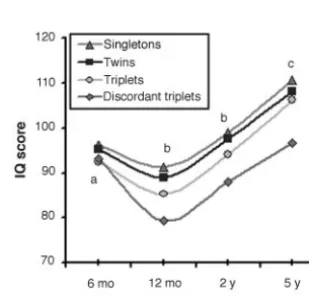
0.11). ANCOVA with posthoc Scheffe´ tests showed that at 6 months single-tons and twins scored higher than trip-lets and discordant triptrip-lets and that at 12 and 24 months singletons and twins scored higher than triplets, who scored higher than discordant triplets. However, at 5 years, differences were only found between singletons, twins, and triplets on the one hand and dis-cordant triplets on the other. The find-ings are presented in Fig 1, and data for 5 years appear in Table 2.
Social Engagement
Repeated-measure MANCOVA showed a main effect for time, indicating that social engagement changed with age (sphericity assumed F3 ⫽24.87;P⬍
.001; ES⫽0.43). Social engagement in-creased from 6 to 12 months (F1,118⫽
7.96;P⬍.001; ES ⫽0.08), increased from 12 to 24 months (F1,118⫽ 5.12; P ⬍ .01; ES ⫽ 0.06), and further in-creased from 2 to 5 years (F1,118 ⫽
4.99;P⬍.05; ES⫽0.06). Posthoc tests showed that at 6 months singletons and twins scored higher than triplets and discordant triplets; at 12 and 24 months, singletons and twins scored higher than triplets, and triplets scored higher than discordant triplets; and at 5 years, singletons, twins, and triplets scored higher than discordant triplets (Fig 2; Table 2).
Internalizing Symptoms
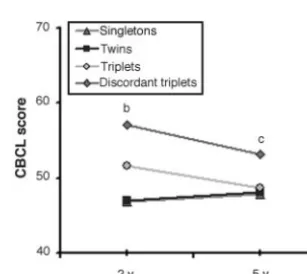
Repeated-measure MANCOVA showed no overall change from 2 to 5 years. However, the interaction of time and group was significant (F3,120 ⫽ 3.74; P⬍.01; ES⫽0.07). Whereas at 2 years singletons and twins scored lower than triplets who scored lower than discordant triplets, at 5 years the dis-cordant triplets scored above all other groups (Fig 3; Table 2).
FIGURE 1
Cognitive development from 6 months to 5 years in singletons (S), twins (T), triplets (Tr), and dis-cordant triplets (DTr).aS, T⬎Tr, DTr,bS, T⬎Tr
⬎DTr, andcS, T, Tr⬎DTr (P⬍. 05).
Executive Functions
ANCOVA with posthoc Scheffe´ tests showed a significant effect for group (F3,120 ⫽ 3.96; P ⬍ .05; ES ⫽ 0.05), and differences were found between the first 3 groups and the discordant triplets (Table 2). Discordant trip-lets scored especially poorly on the vi-sual attention and “tower” (planning) subsets.
Maternal Adjustment
Repeated-measure MANCOVA showed an overall change in maternal adjust-ment from 1 to 5 years (F1,56⫽3.32;
P⬍.01; ES⫽0.05), indicating better adjustment to parenting for all moth-ers. A group-by-time interaction was found (F1,56⫽3.77;P⬍.01; ES⫽0.07),
indicating greater change in adjust-ment among mothers of triplets.
Correlations Between Outcome Measures at 5 Years
Cognitive development correlated with executive functions (r ⫽ 0.36; P ⬍ .001), and IQ correlated with child so-cial engagement (r ⫽0.25;P⬍.05). Social engagement, in turn, was re-lated to lower internalizing symptoms (r⫽ ⫺0.30;P⬍.01). Higher maternal adjustment correlated with child so-cial engagement (r ⫽0.29;P⬍.01), executive functions (r⫽0.19;P⬍.05), and lower internalizing symptoms (r⫽ ⫺0.33;P⬍.01).
Discordant twins (n⫽5) did not show poorer performance than their sibling on any test at 5 years, indicating that the combination of discordance and triplet birth predisposes children to higher risk.
DISCUSSION
To our knowledge, this was the first study to follow the development of trip-lets across the first 5 years of life in the cognitive, neuropsychological, social, and emotional domains. Results indi-cate that after an initial delay in in-fancy, triplets showed a developmen-tal catch-up, and differences between singletons, twins, and triplets as a group were no longer observed at 5 years. However, a subgroup of triplet children, who were born with discor-dant low birth weights compared with their siblings and had an especially poor performance across infancy, con-tinued to demonstrate lower cognitive performance, executive functions, and
social engagement as compared with singletons, twins, and normally grown triplets at 5 years. We postulate that the critical factor contributing to this persistent lower performance was the comparative low birth weight of the discordant infant, reflecting a poor in-trauterine environment for this fetus compared with the siblings, and not any absolute weight percentile.52
These findings have practical implica-tions for the care of triplets and their parents in general and the need for special attention to discordant triplets in particular.
The triplet situation marks a unique developmental risk that likely stems from a combination of biological fac-tors (including triplet pregnancy and, often, prematurity) and environmental factors, particularly high parenting stress. Yet, triplets are often raised in environments with only transient risk.
FIGURE 2
Social engagement from 6 months to 5 years in singletons (S), twins (T), triplets (Tr), and dis-cordant triplets (DTr).aS, T⬎Tr, DTr,bS, T⬎Tr
⬎DTr, andcS, T, Tr⬎DTr (P⬍. 05).
FIGURE 3
Internalizing Symptoms at 2 and 5 Years in sin-gletons (S), twins (T), triplets (Tr), and discor-dant triplets (DTr).aS, T⬎Tr⬎DTr andbS, T, Tr
⬎DTr (P⬍. 05). CBCL indicates Child Behavior Checklist.
(N⫽21) (N⫽42) (N⫽49) Triplets
(N⫽14)
Mean SD Mean SD Mean SD Mean SD
Verbal IQ 110.72 14.66 108.31 17.51 106.27 16.42 95.63 15.31 4.03a; S, T, Tr⬎DTr .034
Social engagement 3.71 0.94 3.58 87 3.43 0.75 2.92 0.69 4.21a; S, T, Tr⬎DTr .028
Internalizing symptoms 47.89 10.38 48.03 11.69 48.71 10.87 53.26 10.26 3.84a; S, T, Tr⬍DTr .047
During the preschool years, children enter out-of-home care, form friend-ships, and engage in meaningful inter-actions within the sibling group; thus, nonkin providers, friends, and siblings become important contributors to growth and skill acquisition. At that stage, parenting stress decreases, and the effects of early biological risk are reduced among children with no neurologic impairments. The catch-up documented here between 2 and 5 years is unique in the developmental literature, particularly as it demon-strates such across-the-board im-provement in multiple developmental domains. These findings highlight the plasticity of development and send an optimistic message to parents and triplets as well as to researchers and clinicians who focus on the effects of early intervention.
In contrast, consistent with models on cumulative risk,21,22,27,39,40 the
discor-dant growth-retarded triplets re-mained at high risk. It is important to note, however, that the persistent de-lay for the discordant group occurred in the context of much developmental growth, and the children’s intelligence and social engagement increased
dra-matically from 1 to 5 years. Yet, the gains shown by these growth-retarded triplets were less than those observed in their siblings and significantly smaller than the substantial gains re-quired to catch up with their normally developing peers. This inability to close the developmental gap placed the discordant triplets at a higher risk during the entire dynamic preschool period.
The findings have clear implications for intervention and social policy. The data emphasize the need to find medical methods to decrease the rates of growth retardation in multiple-gestation pregnancies and to guide parents on the potential pitfalls in raising the discordant child. Parents should be aware of the need of growth-retarded children for maximal sensi-tivity during the first years to compen-sate for their low inborn regulatory abilities. The findings also highlight the importance of allocating funds to help parents of triplets during the stressful period of infancy. Parents typically re-port the centrality of instrumental help during the first months,53–56and such
assistance may reduce the develop-mental delay observed during infancy.
Finally, the delay in executive functions found among the growth-retarded triplets, particularly in planning and visual attention skills, may be espe-cially harmful on school entry. Early awareness of these difficulties may lead to special interventions for foster-ing these skills before school failure.
Limitations of the study relate to the fact that the sample was of middle-to-high socioeconomic status and all infants were of low medical risk; thus, the generalizability of the findings may be limited, especially because our growth-retarded children probably presented optimal functioning for this group. Future research is required to follow both AGA and growth-retarded triplets into later childhood and ado-lescence to ascertain if the neurode-velopmental abnormalities demon-strated here persist into later childhood and adolescence.
ACKNOWLEDGMENTS
This work was supported by the Israel Science Foundation (01/945) and the Irving B. Harris Foundation and the March of Dimes Foundation (#12-FY04-50).
REFERENCES
1. Blickstein I, Keith LG. Outcome of triplets and high-order multiple pregnancies.Curr Opin Obstet Gynecol.2003;15(2):113–117
2. Guyer B, Hoyert DL, Martin JA, Ventura SJ, MacDorman MF, Strobino DM. Annual summary of vital statistics: 1998.Pediatrics.1999;104(6):1229 –1246
3. Luke B. The changing pattern of multiple birth in the United States: maternal and infant charac-teristics, 1973 and 1990.Obstet Gynecol.1994;84(1):101–106
4. Martin JA, MacDorman MF, Mathews TJ. Triplet births: trends and outcomes, 1971–94.Vital Health Stat 21.1997;(55):1–20
5. Martin JA, Hamilton BE, Ventura SJ, Menacker F, Park MM, Sutton PD. Births: final data for 2001.
Natl Vital Stat Rep.2002;51(2):1–102
6. Blondel B, Kaminski M. Trends in the occurrence, determinants, and consequences of multiple births.Semin Perinatol.2002;26(4):239 –249
7. Lipitz S, Reichman B, Paret G, et al. The improving outcome of triplet pregnancies.Am J Obstet Gynecol.1989;161(5):1279 –1284
8. Pons JC, Charlemaine C, Dubreuil E, Papiernik E, Frydman R. Management and outcome of triplet pregnancy.Eur J Obstet Gynecol Reprod Biol.1998;76(2):131–139
9. Salat-Baroux J, Antoine JM. Multiple pregnancies: the price to pay.Eur J Obstet Gynecol Reprod Biol.1996;65(suppl):S17–S18
10. Santema JC, Bourdrez P, Wallenburg HC. Maternal and perinatal complications in triplet com-pared with twin pregnancy.Eur J Obstet Gynecol Reprod Biol.1995;60(2):143–147
12. Yuval Y, Seidman DS, Achiron R, et al. Intrauterine growth of triplets as estimated from liveborn birth weight data.Ultrasound Obstet Gynecol.1995;6(5):345–348
13. American College of Obstetricians and Gynecologists.Special Problems of Multiple Gestations. Washington, DC: American College of Obstetricians and Gynecologists; 1998. ACOG Educational Bulletin 253
14. Barr S, Poggi S, Keszler M. Triplet morbidity and mortality in large case series.J Perinatol.
2003;23(5):368 –371
15. Vantura SJ, Martin JA, Curtin SC, Mathews TJ, Park MM. Births: final data for 1998.Natl Vital Stat Rep.2000;48(3):1–100
16. Ziadeh SM. The outcome of triplet versus twin pregnancies.Gynecol Obstet Invest.2000;50(2): 96 –99
17. Feldman R, Eidelman AI. Does a triplet birth pose a special risk for infant development? Assessing cognitive development in relation to intrauterine growth and mother-infant interaction across the first two.Pediatrics.2005;115(2):443– 452
18. Feldman R, Eidelman AI, Rotenberg N. Parenting stress, infant emotion regulation, maternal sensitivity, and the cognitive development of triplets: a model for parent and child influences in a unique ecology.Child Dev.2004;75(6):1774 –1791
19. Feldman R, Eidelman AI. Parent-infant synchrony and the social-emotional development of triplets.
Dev Psychol.2004;40(6):1133–1147
20. Caspi A. The child is father of the man: personality continuities from childhood to adulthood.J Pers Soc Psychol.2000;78(1):158 –172
21. Cicchetti D, Cohen DJ. Perspectives on developmental psychopathology. In: Cicchetti D, Cohen D, eds.Developmental Psychopathology. New York, NY: John Wiley; 1995:3–22
22. Rutter M, Sroufe LA. Developmental psychopathology: concepts and challenges.Dev Psychopathol.
2000;12(3):265–296
23. Feldman R. Parent-infant synchrony and the construction of shared timing: physiological precur-sors, developmental outcomes, and risk conditions.J Child Psychol Psychiatry.2007;48(3– 4): 329 –354
24. McCarton CM, Wallace IF, Divon M, Vaughan HG Jr. Cognitive and neurologic development of the premature small for gestational age infant through age 6: comparison by birth weight and gestational age.Pediatrics.1996;98(6 pt 1):1167–1178
25. Hutton JL, Pharoah PO, Cooke RW, Stevenson RC. Differential effects of preterm birth and small gestational age on cognitive and motor development.Arch Dis Child Fetal Neonatal Ed.1997;76(2): F75–F81
26. Matilainen R, Heinonen K, Siren-Tiusanen H. Effect of intrauterine growth retardation (IUGR) on the psychological performance of preterm children at preschool age.J Child Psychol Psychiatry.
1988;29(5):601– 609
27. Feldman R, Eidelman AI. Neonatal state organization, neuromaturation, mother-infant interaction, and cognitive development in small-for-gestational-age premature infants.Pediatrics.2006; 118(3). Available at: www.pediatrics.org/cgi/content/full/118/3/e869
28. Geva R, Eshel R, Leitner Y, Valevski AF, Harel S. Neuropsychological outcome of children with intrauterine growth restriction: a 9-year prospective study.Pediatrics.2006;118(1):91–100
29. Belsky J. Theory testing, effect-size evaluation, and differential susceptibility to rearing influence: the case of mothering and attachment.Child Dev.1997;68(4):598 – 600
30. Case R. The role of the frontal lobes in the regulation of cognitive development.Brain Cogn.
1992;20(1):51–73
31. Sternberg RJ. Successful intelligence: finding a balance.Trends Cogn Sci.1999;3(11):436 – 442
32. Posner MI. Convergence of psychological and biological development.Dev Psychobiol.2002;40(3): 339 –343
33. Diamond A. Normal development of prefrontal cortex from birth to young adulthood: cognitive functions, anatomy, and biochemistry. In: Stuss DR, Knight RT, eds.Principles of Frontal Lobe Functions. London, United Kingdom: Oxford Press; 2002:466 –503
34. Feldman R, Eidelman AI. Biological and environmental initial conditions shape the trajectories of cognitive and social-emotional development across the first years of life.Dev Sci.2009;12(1): 194 –200
35. Nadel J, Muir D.Emotional Development. New York, NY: Oxford Press; 2005
36. Luby JL.Handbook of Preschool Mental Health. New York, NY: Guilford; 2006
Develop-ment for cognitive function of extremely low birth weight children at school age.Pediatrics.
2005;116(2):333–341
38. Sullivan MC, McGrath MM, Hawes K, Lester BM. Growth trajectories of preterm infants: birth to 12 years.J Pediatr Health Care.2008;22(2):83–93
39. Sameroff AJ, Fiese B. Models of development and developmental risk. In: Zeanah CH, ed.Handbook of Infant Mental Health.
40. Rutter M. Psychosocial resilience and protective mechanisms.Am J Orthopsychiatry.1987;57(3): 316 –331
41. Bayley N.Bayley Scales of Infant Development: Administering and Scoring Manual. New York, NY: Psychological Corporation, 1969
42. Wechsler D.Manual for Wechsler Preschool and Primary Scale of Intelligence. New York, NY: Psychological Corporation; 1967
43. Korkman M, Kirk U, Kemp S.NEPSY: A Developmental Neuropsychological Assessment. San Anto-nio, TX: Psychological Corporation; 1998
44. Feldman R.Mother-Newborn Coding System Manual. Ramat-Gan, Israel: Bar-Ilan University; 1998
45. Achenbach TM, Edelbrock C.Manual for the Child Behavior Checklist and Revised Child Behavior Profile. Burlington, VT: University of Vermont; 1983
46. International Neonatal Network. The CRIB (Clinical Risk Index for Babies) score: a tool for assess-ing initial neonatal risk and comparassess-ing performance of neonatal intensive care units [published correction appears inLancet. 1993;342(8871):626].Lancet.1993;342(8865):193–198
47. Feldman R, Weller A, Zagoory-Sharon O, Levine A. Evidence for a neuroendocrinological foundation of human affiliation: plasma oxytocin levels across pregnancy and the postpartum period predict mother-infant bonding.Psychol Sci.2007;18(11):965–970
48. Feldman R. Maternal versus child’s risk and the development of parent-infant and family relation-ships in five high-risk populations.Dev Psychopathol.2007;19(2):293–312
49. Feldman R, Keren M, Gross-Rozval O, Tyano S. Mother and child’s touch patterns in infant feeding disorders: relation to maternal, child, and environmental factors.J Am Acad Child Adolesc Psy-chiatry.2004;43(9):1089 –1097
50. Feldman R, Eidelman AI, Sirota L, Weller A. Comparison of skin-to-skin (kangaroo) and traditional care: parenting outcomes and preterm infant development.Pediatrics.2002;110(1 pt 1):16 –26
51. Cohen J. A power primer.Psychol Bull.1992;112(1):155–159
52. Mordel N, Benshushan A, Zajicek G, Laufer N, Schenker JG, Sadovsky E. Discordancy in triplets.
Am J Perinatol.1993;10(3):224 –225
53. Krall V, Feinstein SC.Psychological Development of High-Risk Multiple Birth Children. Chur, Switzerland: Harwood Academic Publishers; 1991
54. Booting J, MacFarlane A, Price F.Three, Four and More: A Study of Triplets and Higher Order Births. London, United Kingdom: Her Majesty’s Stationary Office; 1990
55. Bryan E.Twins, Triplets, and More: Their Nature, Development, and Care. London, United Kingdom: Penguin Books; 1992
56. Goshen-Gottstein E. The mothering of twins, triplets, and quadruplets.Psychiatry.1980;43(3): 189 –204
DOI: 10.1542/peds.2008-1510
2009;124;316
Pediatrics
Ruth Feldman and Arthur Isaac Eidelman
Services
Updated Information &
http://pediatrics.aappublications.org/content/124/1/316
including high resolution figures, can be found at:
References
http://pediatrics.aappublications.org/content/124/1/316#BIBL
This article cites 40 articles, 7 of which you can access for free at:
Subspecialty Collections
rning_disorders_sub
http://www.aappublications.org/cgi/collection/cognition:language:lea
Cognition/Language/Learning Disorders
al_issues_sub
http://www.aappublications.org/cgi/collection/development:behavior
Developmental/Behavioral Pediatrics
following collection(s):
This article, along with others on similar topics, appears in the
Permissions & Licensing
http://www.aappublications.org/site/misc/Permissions.xhtml
in its entirety can be found online at:
Information about reproducing this article in parts (figures, tables) or
Reprints
http://www.aappublications.org/site/misc/reprints.xhtml
DOI: 10.1542/peds.2008-1510
2009;124;316
Pediatrics
Ruth Feldman and Arthur Isaac Eidelman
Developmental Risk
Triplets Across the First 5 Years: The Discordant Infant at Birth Remains at
http://pediatrics.aappublications.org/content/124/1/316
located on the World Wide Web at:
The online version of this article, along with updated information and services, is
by the American Academy of Pediatrics. All rights reserved. Print ISSN: 1073-0397.