University of Pennsylvania
ScholarlyCommons
Publicly Accessible Penn Dissertations
1-1-2016
Incremental Processing and Optimization of
Update Streams
Mengmeng Liu
University of Pennsylvania, [email protected]
Follow this and additional works at:
http://repository.upenn.edu/edissertations
Part of the
Computer Sciences Commons
This paper is posted at ScholarlyCommons.http://repository.upenn.edu/edissertations/1853
For more information, please [email protected].
Recommended Citation
Liu, Mengmeng, "Incremental Processing and Optimization of Update Streams" (2016).Publicly Accessible Penn Dissertations. 1853.
Incremental Processing and Optimization of Update Streams
Abstract
Over the recent years, we have seen an increasing number of applications in networking, sensor networks, cloud computing, and environmental monitoring, which monitor, plan, control, and make decisions over data streams from multiple sources. We are interested in extending traditional stream processing techniques to meet the new challenges of these applications. Generally, in order to support genuine continuous query optimization and processing over data streams, we need to systematically understand how to address incremental optimization and processing of update streams for a rich class of queries commonly used in the applications.
Our general thesis is that efficient incremental processing and re-optimization of update streams can be achieved by various incremental view maintenance techniques if we cast the problems as incremental view maintenance problems over data streams. We focus on two incremental processing of update streams challenges currently not addressed in existing work on stream query processing: incremental processing of transitive closure queries over data streams, and incremental re-optimization of queries. In addition to addressing these specific challenges, we also develop a working prototype system Aspen, which serves as an end-to-end stream processing system that has been deployed as the foundation for a case study of our SmartCIS application. We validate our solutions both analytically and empirically on top of our prototype system Aspen, over a variety of benchmark workloads such as TPC-H and LinearRoad Benchmarks.
Degree Type
Dissertation
Degree Name
Doctor of Philosophy (PhD)
Graduate Group
Computer and Information Science
First Advisor
Zachary G. Ives
Second Advisor
Boon T. Loo
Subject Categories
Computer Sciences
INCREMENTAL PROCESSING AND OPTIMIZATION
OF UPDATE STREAMS
Mengmeng Liu
A DISSERTATION
in
Computer and Information Science
Presented to the Faculties of the University of Pennsylvania
in
Partial Fulfillment of the Requirements for the
Degree of Doctor of Philosophy
2016
Supervisor of Dissertation
Signature
Zachary G. Ives
Professor of Computer and Information
Science
Co-supervisor of Dissertation
Signature
Boon Thau Loo
Associate Professor of Computer and
Information Science
Graduate Group Chairperson
Signature
Lyle Ungar, Professor of Computer and Information Science
Dissertation Committee
Susan B. Davidson, Professor of Computer and Information Science (Chair)
Val Tannen, Professor of Computer and Information Science
Andreas Haeberlen, Assistant Professor of Computer and Information Science
Tyson Condie, Assistant Professor of Computer Science, University of California, Los
INCREMENTAL PROCESSING AND OPTIMIZATION OF UPDATE STREAMS
COPYRIGHT
2016
DEDICATION iii
iv ACKNOWLEDGEMENTS
Acknowledgements
This dissertation is not possible without the help from my advisors, collaborators,
friends and family. I am deeply indebted to those individuals who support me
through-out the years.
First of all, I would like to thank my advisors, Zachary Ives and Boon Thau Loo,
who offered me the opportunity to pursue graduate studies at Penn. Prof. Zachary
Ives led me into the field of database system research, and from him I learned tons of
research ideas which can even be traced back to some database research several decades
ago. He is generally knowledgable in most areas of database systems, and since he has
tremendous experience implementing various systems firsthand himself, he is always a
great resource to consult for solving problems encountered in practice. His knowledge
and vision greatly shapes my taste for database system research, and later on, when I
conducted research and development in industrial labs and companies, I can always recall
the various conversations I had with him, and use those ideas as a foundation to see how
they can be applied to different systems. Zack’s pursuit of perfection has a profound
influence on me, not only in doing research but also everything in life. Every paper
that we wrote together, every experiment that we demonstrated, and every presentation I
made throughout the years, underwent numerous revisions with him, and in retrospect,
each time I learned something new and pushed myself harder the next time around.
Through these endeavors, I learned how to effectively implement an idea, how to present
an experimental result, how to make the paper clear, and how to make the presentation
intuitive and to the point. All of these experiences tremendously helped me in not only
research skills but also almost every aspect in my professional life.
ACKNOWLEDGEMENTS v
amazed to see how deeply he cares about the student, sometimes it feels like the students
are also his own kids. He would go all the way from discussing research to making
arrangements and plans for the benefit of the students. His encouragement makes a
student feel secure and confident, even through difficult times such as having a paper
rejected, or going through difficult things in life. Although he has a busy schedule, he
always makes time to meet with the students, listen to their concerns, provide suggestions
and help them grow. His knowledge in declarative networks and datalog helped shape
and improve my initial research ideas, and I am glad to have the opportunity to work
with him on many papers and presentations together throughout the years.
I would also like to thank the other fantastic professors in the Penn DB group, Prof.
Susan Davidson and Prof. Val Tannen. We have weekly DB group seminars and
through-out the years I learned many great ideas from the seminar, and more importantly, it
helped shape my general sense of database research other than my main research area.
Prof. Susan Davidson is a great mentor in bridging the gap between theory and practice
in database research, and her recommendations in making papers and presentations
in-tuitive and clear have always had a great influence on me. Prof. Val Tannen is an expert
in database theory, and from him I learned the relationship between database theory and
logic, the foundation of datalog, provenance, as well as incremental view maintenance.
He has both a great taste of research and a great sense of humor, and his pursuit of
precision in formulating research problems has a great influence on me as well.
Besides the school work, I also did two fruitful summer internships at Microsoft Bing
and IBM Research - Almaden respectively. I would like to thank my mentor, Jingren Zhou
at Microsoft, who guided me into the field of big data systems in large-scale distributed
environment deployed real-life in industry. The internship project on optimizing multiple
scans of data streams on top of their big data system, SCOPE and Cosmos, has a great
influence not only on my research but also on my career later. I would also like to thank
my mentor, Ioana Stanoi at IBM Research - Almaden, who guided me into a project
of designing and implementing temporal relationships on top of an entity resolution
system. It was a very interesting project, and these experiences enriched my skills and
understanding of the field.
com-vi ACKNOWLEDGEMENTS
mittee members, Susan Davidson, Val Tannen, Andreas Haeberlen, and external member
Tyson Condie. I would also like to thank Susan Davidson, Val Tannen and Andreas
Haeberlen to sit on my WPE-II committee.
I would like to give my special thanks to Mike Felker for helping me go through many
tedious details of administrative tasks, and also to Cheryl Hickey and many other staff at
the department who made my life much easier.
My time at Penn would not be so enjoyable without the friends I made at Penn,
includ-ing all the DB group members: Medha Atre, Olivier Biton, Sarah Cohen-Boulakia, Linclud-ing
Ding, Anat Eyal, Todd J. Green, Xiaocheng Huang, Marie Jacob, Grigoris Karvounarakis,
Svilen Mihaylov, Sudeepa Roy, Julia Stoyanovish, Nicholas Taylor, Allen Zhepeng Yan,
Nan Zheng; as well as many Chinese friends with whom I spent many memorable
week-ends: Ling Ding, Peter Du, Liang Huang, Xiaocheng Huang, Changbin Liu, Qian Liu,
Tingting Sha, Gang Song, Wenqing Wang, Bin Yan, Zhepeng Yan, Zhuoyao Zhang,
Lim-ing Zhao, Jianzhou Zhao, Wenchao Zhou, Qihui Zhu, and many others.
I would also like to take this opportunity to thank my parents Xindong Liu and Lihua
Hu, for their love, encouragement and sacrifice. This dissertation is not possible without
their support for me and my family, and I dedicate this dissertation to them.
Last but not least, I dedicate this dissertation to my husband, Zhuowei Bao. We
have known each other since high school, and made a decision to come to the United
States to pursue our graduate studies together. Throughout the years, we have underwent
everything together, and I cannot imagine finishing this dissertation without the support
ABSTRACT vii
ABSTRACT
INCREMENTAL PROCESSING AND OPTIMIZATION OF UPDATE STREAMS
Mengmeng Liu
Zachary G. Ives and Boon Thau Loo
Over the recent years, we have seen an increasing number of applications in
network-ing, sensor networks, cloud computnetwork-ing, and environmental monitornetwork-ing, which monitor,
plan, control, and make decisions over data streams from multiple sources. We are
inter-ested in extending traditional stream processing techniques to meet the new challenges of
these applications. Generally, in order to support genuinecontinuousquery optimization
and processing over data streams, we need to systematically understand how to address
incrementaloptimization and processing of update streams for a rich class of queries
com-monly used in the applications.
Our general thesis is that efficient incremental processing and re-optimization of
up-date streams can be achieved by various incremental view maintenance techniques if we
cast the problems as incremental view maintenance problems over data streams. We
fo-cus on two incremental processing of update streams challenges currently not addressed
in existing work on stream query processing: incremental processing of transitive
clo-sure queries over data streams, and incremental re-optimization of queries. In addition
to addressing these specific challenges, we also develop a working prototype system As
-pen, which serves as an end-to-end stream processing system that has been deployed as
the foundation for a case study of our SmartCIS application. We validate our solutions
both analytically and empirically on top of our prototype system Aspen, over a variety of
viii CONTENTS
Contents
1 Introduction 1
1.1 Motivations . . . 3
1.2 Contributions and Goals . . . 7
2 Background 18 2.1 Query Optimization . . . 18
2.2 Query Execution . . . 24
2.3 Datalog . . . 28
3 Incremental Processing of Connectivity over Dynamic Networks 33 3.1 Distributed Recursive View Use Cases . . . 36
3.2 Execution Model and Motivations for New Distributed Recursive Techniques 38 3.3 Our Approach: Provenance for Efficient Deletions . . . 45
3.4 Optimizing Propagation of Tuple Provenance . . . 52
3.5 Producing Compact Provenance BDDs . . . 54
3.6 Optimizing Propagation of State . . . 58
3.7 Experimental Results . . . 59
3.8 Conclusion . . . 70
4 Incremental Re-optimization of Queries: The Declarative Approach 75 4.1 Declarative Query Optimization . . . 79
4.2 Achieving Pruning . . . 88
4.3 Incremental Re-Optimization . . . 96
CONTENTS ix
4.5 Conclusion . . . 116
5 Incremental Re-optimization of Queries: The Procedural Approach 117 5.1 Problem Statement of Cost-based Incremental Query Re-optimization . . . 118
5.2 Procedural Incremental Re-optimization Algorithms and Optimizations: Bottom-up Style and Top-down Style . . . 121
5.3 Bounds of Recomputations for Incremental Re-optimization . . . 124
5.4 Experimental Results . . . 127
5.5 Conclusion . . . 134
6 A Case Study: The Aspen System 137 6.1 SmartCIS Building Application . . . 139
6.2 System Architecture . . . 143
6.3 Federated Optimizer . . . 144
6.4 Stream Engine . . . 146
6.5 Conclusion . . . 146
7 Related Work 147
8 Conclusions and Future Directions 152
x LIST OF TABLES
List of Tables
1 A simplifiedSearchSpace relation encoding the and-or-graph for Q3S’s search
space. Primary keys are denoted by *. . . 85
2 Queries modified based on TPC-H and LinearRoad benchmark queries used
in our experiments . . . 104
3 Frequency of Adaptation (20sec stream) . . . 114
LIST OF FIGURES xi
List of Figures
1 The overview of this dissertation. . . 9
2 A physical operator tree (plan) for the example query . . . 19
3 Basic architecture: query processing nodes are placed in a number of
sub-networks. Each collects state information about its sub-network, and the nodes
share state to compute distributed recursive views such as shortest paths across
the network. . . 38
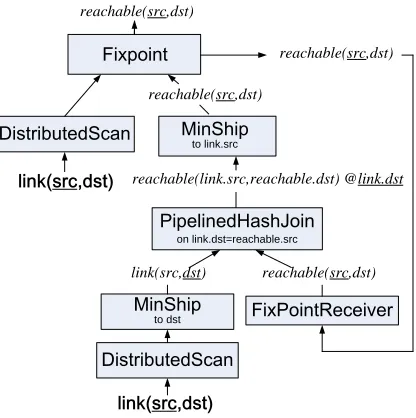
4 Recursive derivation ofreachablein recursive steps (bold indicates new
deriva-tions). Theatcolumn shows where the data is produced. Thetocolumn shows
where it is shipped after production (if omitted, the derivation remains at the
same node. The pv column contains the absorption provenance of each tuple
(Section 3.3). A tuple marked “*” is an extra derivation only shipped in the
absorption provenance model. . . 41
5 Network represented inlink relation . . . 42
6 Plan forreachable query. Underlined attributes are the ones upon which data
is partitioned. . . 42
7 DRed algorithm: over-delete and re-derive steps after deletion oflink(C,B). . . 44
8 Relational algebra rules for composition of provenance expressions. Note that
recursive fixpoint incorporates union. . . 46
9 An example network between nodes AandF . . . 55
10 Different variable orders representing the provenance forreachable(A,F) in
xii LIST OF FIGURES
11 Four different cases when edge(x,y) is added. A solid arc represents at least
one edge and a dashed arc represents zero or more edges . . . 57
12 reachablequery computation asinsertionsare performed . . . 63
13 reachablequery computation asdeletionsare performed . . . 64
14 regionquery computation asinsertions are performed . . . 65
15 Increasing the number of links (and nodes) for thereachablequery over inserts 66 16 Varying the number of physical query processing nodes in computingreachable query . . . 67
17 Depth-first search order versus na¨ıve random order onreachablequery . . . . 68
18 Aggregate selections performance onshortestPathandcheapestCostPathquery . 69 19 Datalog Rules for the Query Optimizer . . . 81
20 Query plan of our declarative query optimizer. Operators are in ellipses; views are in rectangles. Plan enumeration (SearchSpace) consists of 5rules, cost esti-mation (PlanCost)3rules, and plan selection (BestPlan) 2rules. See Figure19. 83 21 The and-or-graph for Q3S. Red edges denote the best plan. Rectangles and ovals denote “OR” and “AND” nodes respectively. Each “OR” node is labeled with itsBestCostand each “AND” node is labeled with itsLocalCostand Plan-Cost. . . 84
22 Datalog rules to express bounds computation . . . 93
23 Performance comparison for initial query optimization, across different optimizer ar-chitectures . . . 105
24 Performance during incremental re-optimization of TPC-H Q5— change to join selec-tivity estimate . . . 108
25 Performance during incremental re-optimization of TPC-H Q5 — updates to costs based on real execution over skewed data . . . 110
26 Performance breakdown of pruning techniques for initial optimization, across full query workload . . . 111
27 Performance breakdown of pruning techniques during incremental re-optimization of Q5whenOrdershas updated scan cost . . . 112
LIST OF FIGURES xiii
29 AQP Query Execution Time of SegTollS Query . . . 113
30 The and-or-graph for a simplified three way join query R1 1 R2 1 R3. Red
edges denote the best plan. Rectangles and ovals denote “OR” and “AND”
nodes respectively. . . 124
31 Performance of top-down vs bottom-up-style procedural incremental re-optimization
of TPC-H Q5— upon change to a join cost value . . . 129 32 Performance ratio of conditional testing vs non-optimized version during bottom-up
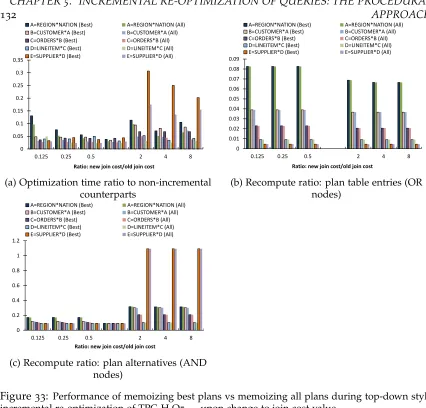
style incremental re-optimization of TPC-H Q5— upon change to a join cost value . 131 33 Performance of memoizing best plans vs memoizing all plans during top-down style
incremental re-optimization of TPC-H Q5— upon change to join cost value . . . 132
34 Normalized number of recomputed AND nodes to non-incremental bottom-up . . . 136
35 Display indicating a path to, and information about, the nearest machine with
LaTeX. . . 138
Chapter
1
Introduction
In the past decade, with the decreasing cost and the growing adoption of wireless
sen-sors, embedded devices and mobile phones, we are seeing a new class of monitoring and
control applications that instrument the environments for security, environmental control,
intelligent resource management and human assistance. Examples of such applications
include intelligent power grids, smart hospitals, home health monitors, energy-efficient
data centers, and building visitor guides. To support these applications, there is a need
for systems to bring together disparate data from databases (e.g., site information,
pa-tient treatments, maps) with data from the Web (e.g., weather forecasts, calendars), from
streaming data sources (e.g., resource consumption within a server), and from devices
embedded within an environment (e.g., generator temperature, RFID readings, energy
levels). Data has been generated at an unprecedented rate, and how to store,
manipu-late and make sense of this enormous amount of data becomes a crucial problem. It is
increasingly important to be able to turn the raw observations into high-level
decision-making and control, such as triggering alarms, identifying problematic users, notifying
overloaded machines, or predicting abnormal events.
There are many fundamental questions about how to develop these monitoring and
control applications in this emerging sensing world. Motivated from decades of success
from relational data management systems (RDBMS), we seek a programming
environ-ment and runtime system that can be generalized to any application domain. The most
important notion we can learn from relational data management systems is “data
2 CHAPTER1. INTRODUCTION
pendence”, which encompasses two levels. From the physical level, it means that user
applications should be immune from the changes on how to access the data, such as the
change to a storage device, or an indexing strategy. From the logical level, it means that
higher level abstractions such as user views should be hidden away from the changes to
the logical schema, such as tables, columns or rows. These data independence notions
can be easily applied to data management of monitoring and control applications as well.
In order for our intelligent environments to reach their full potential, what is necessary
is an extensible, multi-purpose data acquisition and integration substrate through which
the applications can acquire data — without having to be coded with special support for
new devices or network types. The key question is how to develop this unified
declar-ative query and integration substrate, which supports a multitude of stream and static
data sources on heterogeneous, possibly unreliable networks. Computation should be
ex-pressed in a single query language and “pushed” to where it is most appropriate, taking
into account capabilities, battery life, rates of change, and network bandwidth.
In the last several years, the database community has started to develop novel
solu-tions for managing these monitoring and control applicasolu-tions: a handful of data stream
management systems from both industry and academia have been proposed [14, 24, 51,
77, 88]. These data stream management systems (DSMS) have three major differences
compared to traditional relational data management systems (RDBMS). First, since data
sources become continuous, DSMSs require a dynamicdata model, which usually makes
”timestamp” first-class citizens. Here the ”timestamp” could mean the data generation
time, or the data arrival time, that could be associated with each single data tuple.
Dy-namic data sources also make the data modelevolve: traditional set semantics of relational
schema needs to be replaced by mutable data models. Second, the computational model
in DSMSs needs to becontinuousrather than static. Since data streams keep arriving to the
systems, in order to compute results based on a pre-defined query for the newly arrived
data, DSMSs need to continuously compute the results in a streaming non-blocking
fash-ion. Finally, DSMSs usually require query planners, or query optimizers, tocontinuously
1.1. MOTIVATIONS 3
1
.
1
Motivations
In the following paragraphs, we start with three prominent examples from the emerging
monitoring and control applications and discuss their unique challenges and
require-ments.
Example 1. One of the central questions any major network ISP provider is interested
in is, given any two access points in the network, whether they are connected at any
given point of time, and if connected, what is the optimal path between any two access
points. An access point may join or leave the network, and therefore the paths between
the access points are usually dynamic. The need for connectivity monitoring is even
more pressing in the realm of sensor networks, where any individual sensor is more
likely to run out of power or become unresponsive. All-pairs reachability and shortest
paths is usually the core computation behind proximity-type queries, which is extremely
valuable to applications that require an understanding of contagiousness and influence
of networks. Hence, it is often a challenging and important task to understand how to
efficiently compute and maintain the all-pairs end-point connectivity status.
Example2. With more and more sensors, RFIDs and embedded devices instrumented in
the environments, we have a huge opportunity to integrate the data gathered from the
physical world, with the data that we store in databases and data warehouses in static
forms, to drive new insights into decision-making and control. To make such integrated
applications successful, systems need to bring together data from different sources, static
or dynamic, and transform those raw observations through complex logic into smart
alerts or decisions. For example, to build a smart hospital, we could instrument the
clinics and medical devices with sensors, so that we could monitor the status of patients
in real-time.
In these real-time environmental monitoring applications, usually it requires
sys-tems to continuously monitor various signals to generate meaningful output in real-time.
Decision-making and control tasks can become very complex when they correlate
mul-tiple data sources and perform complex operations over them. Hence, finding the best
execution strategy can be particularly important: an inferior strategy may be
4 CHAPTER1. INTRODUCTION
plenty of decisions to make on how to execute a complex task, e.g., which two data
stream sources to join first, which function to carry out one before another, whether the
computation should be performed in-network or at a centralized place, and so on and
so forth. As the search space grows larger, and as it is in general hard to estimate how
bad a strategy could become, planning or optimizing for the most cost-efficient strategy
could become quite expensive itself. Indeed, as the data characteristics of stream sources
become volatile, constantre-planningis necessary to meet the up-to-date conditions, since
a locally optimum plan is unlikely to become optimal forever and may deteriorate the
overall performance of real-time execution.
Example3. As cloud computing becomes increasingly popular, more and more companies
and institutions need to instrument real-time monitoring, alerting and anomaly detection
into their normal24*7operation of their data centers. For example, a public cloud service
provider needs to monitor the user behaviors across multiple machines to determine the
aggregate usage to avoid a user from impacting others on a multi-tenancy cluster. Hence,
multiple data streams need to be monitored, such as the CPU consumption, memory
consumption or network usage for each user at every machine; and then be combined,
correlated and aggregated to determine important global indicators such as the energy
efficiency of the entire data center.
Real-time monitoring and alerting requires timely data stream integration, execution
and optimization. A cost-based optimization engine for data streams allows the system
to spend the majority of its resources on query execution once the various cost
parame-ters have been properly calibrated: it can be applied to highly complex plans and has the
potential to provide significant benefit if a cost estimation error was made, but it should
incur little overhead if a good plan was chosen. Unfortunately with a large number of
bursty data sources and complex queries, traditional cost-based query optimization
tech-niques from relational data management systems is too expensive to perform frequently.
In order to reduce the overhead, we hope to only modify the parts of computations when
necessary, that is, incrementally, across multiple query re-optimizations. It is ideal if we
always guarantee the best plan returned by a query re-optimizer, during cost-based
1.1. MOTIVATIONS 5
shared with previous rounds of query re-optimizations. Here the goal of a continuous
optimizer for data stream management systems is often to optimize the aggregate total of
latency of query results, returned in a pipelined real-time fashion, rather than a one-shot
optimization performed on the static data.
Unfortunately there are still several limitations of existing data stream management
systems that make them insufficient to fully support monitoring and control applications.
In general, in order to support genuine continuous query optimization and processing
over data streams, we need to systematically understand how to addressincremental
op-timization and processing of update streams for a rich class of queries commonly used
in the applications. Specifically, there are two main challenges that we found in existing
data stream management systems that we aim to systematically address in this
disserta-tion. The first is the incremental processing of transitive closure queries over dynamic
streams, and the second is the incremental re-optimization of queries. We will illustrate
both challenges in more detail below.
Challenge A: lack of support for incremental processing of transitive closure queries over dynamic state. As illustrated in our motivating examples, monitoring and control
tasks could become fairly complex. In particular, transitive closure queries are frequently
used to measure the reachability and influence in various kinds of dynamic networks.
Unfortunately, existing data stream management systems do not have native support for
handling recursive queries over dynamic data streams. Most times, they would require
application developers to express even a simple recursive query, such as a
reachability-style transitive closure query, to be written in a user-defined function. This approach is
very flexible. However, it is also error-prone because it requires the application developers
to carefully engineer the logic for recursive queries over dynamic streams without
assur-ance of accuracy. More importantly, without recursion supported as first-class citizens in
the execution graph, data stream management systems lacks the ability to reason about
incremental result generation, in a way that resembles incremental hash joins and
incre-mental aggregates, hence losing the opportunity for generic optimization, parallelism and
common tactics to enable efficient incremental computation.
6 CHAPTER1. INTRODUCTION
core component of the system, from the query language, to the query execution engine,
requires major enhancements. At the minimum, the query language needs to have the
expressiveness of recursive queries. From the query execution point of view, a fixpoint
operator is necessary and a loop needs to be introduced to the common DAG model
of the execution graph. To make the problem more challenging, under the data stream
model, data keeps arriving to the systems, hence we need to resort toincremental
recur-sion processing techniques to enable efficient query result generation. In the presence of
both insertions and deletions in update streams, sometimes a single update may have
cas-cading effects on the results of the entire query. Hence, it is important, yet challenging, to
design efficient generic incremental approaches to handle recursive queries over dynamic
data streams.
Challenge B: incapable of re-using work across multiple query re-optimizations. In
ad-dition to handling recursion, the problem of supporting rapidadaptationto runtime
con-ditions during query processing is essential as well. A query optimizer for data streams
typically relies on the data characteristics to make the correct cost estimations, and the
correctness of such cost estimations is vital to the quality of the plan picked by a query
optimizer. However, in the dynamic stream scenarios, data characteristics and properties
and the availability of system resources may be constantly changing. It is very difficult
to effectively choose a good plan for the entire data streams: data statistics may be
un-available or highly variable; cost parameters may change due to resource contentions or
machine failures; and indeed a combination of query plans might perform better than
any single plan. Hence, there is a real need to support rapidre-optimization, that is,
con-tinuouslysearching for the most cost-efficient plan upon changes of statistics. However,
existing DSMSs have no or very limited support for constant queryre-optimizations.
In-deed, in many scenarios, the optimal execution plan would only change when cumulative
changes of statistics take into effect. Often times most of the explorations and cost
estima-tions of plans can be reused; and a re-optimizer could only re-explore query plans whose
costs are affected by an updated cardinality or a delta cost value. If a re-optimizer does
not perform incremental computations across rounds, the overall overhead will quickly
1.2. CONTRIBUTIONS AND GOALS 7
of delayed latency. We find that the ability to re-use the work across a series of query
re-optimizations greatly affects the overall performance of query processing over the
life-time of stream query processing. This is a problem not well-studied in the context of
full-fledged cost-based query optimizer (instead of heuristic-based query optimizers) for
data streams, because there lacks a systematic analysis of the query re-optimization
prob-lem in a full cost-based manner. There are also huge challenges on how toincrementally
re-optimize while retaining the capabilities ofpruningeffectively.
Interestingly, although these two challenges seem unrelated from the first glance,
in-deed, they both concern with incremental processing of dynamic state. In the first
chal-lenge, thedynamic staterefers to dynamic network links, node arrival and departure, and
so forth. In the second challenge, changes in data statistics and cost parameters of
can-didate plans construct another form of dynamic state. This second form of state can also
be regarded as metadata state, e.g., statistics and summaries of data sources. This view
of the query re-optimization problem as another instance of theincremental computation
problem over dynamic state sheds some new insights on how to address these problems
in a generic and principled way. In both cases, we need to perform some complex
com-putations over the dynamic state in a continuous fashion. In order to achieve desirable
efficiency, we aim to demonstrate the feasibility and benefits of processing a task
incre-mentally, rather than from scratch.
1
.
2
Contributions and Goals
In this dissertation, we study generic approaches towards incremental recursive query
answering over dynamic data streams, and incremental query re-optimization of data
streams. Our general thesis is that efficient incremental processing and re-optimization
of update streams can be achieved by variousincremental view maintenance techniques if
we cast the problems as incremental view maintenance problems over data streams. In
particular, we make the following contributions:
• We formulate the problem of computing recursive tasks over dynamic data streams
as a classical incremental view maintenance problem, which facilitates many generic
8 CHAPTER1. INTRODUCTION
a novel, compactabsorption provenance as an annotation attached to each data item,
which enables us to directly detect when view tuples are no longer derivable and
should be removed, where the views are defined over a stream of insertions or
dele-tions. We also develop several heuristics to ensure that the absorption provenance
annotation, maintained in a Binary Decision Diagram (BDD), remains compact
un-der different topologies. We implement all of the above solutions in our Aspen
pro-totype system, and experimentally validate the performance under several different
scenarios. Results show that we have orders of magnitude savings compared to
prior approaches in various settings.
• We explore whether full-fledged cost-based incremental techniques for query
re-optimization can be developed, where an optimizer would only re-explore query
plans whose costs were affected by an updated cardinality or cost value; and whether
such incremental techniques could be used to facilitate more efficient adaptivity in
dynamic scenarios. We propose a rule-based and declarative approach to query
re-optimization. We develop a formulation of query re-optimization as an incremental
view maintenance problem, for which we develop novel algorithms like
incremen-tal aggregate selection, incremenincremen-tal reference counting and incremenincremen-tal pruning.
We implement our solutions in our prototype system, Aspen, with comprehensive
studies of performance against alternative approaches over a diverse set of
work-loads. Results show that we have an order-of-magnitude performance gains versus
non-incremental approaches to query re-optimization.
• We show that our approaches to incremental re-optimization from the declarative
perspective can be easily incorporated into traditional procedural-based query
mizers (e.g., bottom-up optimizers with dynamic programming and top-down
opti-mizers with branch-and-bounding), without changing their architectures. We study
how to design and implement full-fledged cost-based procedural incremental query
re-optimization frameworks and present both analytical and empirical results.
• We illustrate the design and implementation of our end-to-end stream query
pro-cessing prototype system, Aspen, and demonstrate a campus-motivated smart
1.2. CONTRIBUTIONS AND GOALS 9
ASPEN: A Generic Platform Answering Queries over Data Streams
(A case study: SmartCIS)
Execution Engine:
processing the best plan picked by the optimizer over data streams
Incremental Re-optimizer: continuously finding the best plan
for current conditions
Chapter 3:
Incremental Processing of Transitive Closure Queries over Data Streams Chapter 4:
Incremental Re-optimization of Queries (Declarative)
Chapter 5:
Incremental Re-optimization of Queries (Procedural)
Chapter 6: A Case Study: The ASPEN/SmartCIS system
Figure1: The overview of this dissertation.
Figure 1 shows the roadmap of this dissertation. We will demonstrate incremental
processing of transitive closure queries over data streams in Chapter3. In Chapter4, we
will illustrate how to address incremental re-optimizationof queries through the
declara-tive lens of incremental view maintenance. We then illustrate how our approaches can
be easily applied to traditional procedural-based query optimizers in Chapter5. We will
demonstrate the design and implementation of our end-to-end stream query processing
prototype system, Aspen, and demonstrate a campus-motivated smart building
applica-tion SmartCIS as a case study in Chapter6. Below we illustrate the main contributions
of each chapter in more detail.
Incremental processing of transitive closure queries over dynamic data streams (Chap-ter3).
In this work, we tackle the challenge of efficiently answering transitive closure queries
over dynamic data streams. Most of the motivating applications of this dissertation, e.g.,
networking monitoring and environmental monitoring and control applications, are
heav-ily reliant on transitive closure computations. In most of such applications, data streams
are generated from distributed devices in a streaming fashion (e.g., from geographically
10 CHAPTER1. INTRODUCTION
centralized monitoring and maintenance is prohibitively expensive in that it requires all
the devices to sync the data over the network continuously to be able to maintain the
global status. Hence, in these applications, a more realistic assumption is a
decentral-ized model, where each node only maintains the local information (e.g., the node’s own
connectivity to other devices) and can perform some computations on its own. The
ma-jority of past work on recursive queries [15,16] has focused on recursion in the context
of centralized deductive databases, and some aspects of that work have ultimately been
incorporated into the SQL-99standard and today’s commercial databases. However,
re-cursion is relatively uncommon in traditional database applications, and hence little work
has been done to extend this work to a distributed streaming setting. In contrast to prior
maintenance strategies for recursive views [40, 45], our work aims to minimize the overall
computation overhead — both across the network (which is vital to reduce the
communi-cation overhead) and inside the query plan (which reduces CPU computational latency).
We make the following contributions:
• We specify the connectivity monitoring tasks over dynamic networks as recursive
Datalog rules; this enables us to formulate the problem of computing recursive
tasks over dynamic data streams as a classical incremental view maintenance
prob-lem, which facilitates incremental view maintenance techniques to address the
chal-lenges.
• We develop a novel, compact absorption provenance as an annotation attached to
each data item, which enables us to directly detect when view tuples are no longer
derivable and should be removed, where the views are defined over a stream of
insertions or deletions. This approach improves the overall efficiency (e.g., both
network latency and CPU latency) compared to prior approaches [40,45].
• We develop several heuristics to ensure that the absorption provenance annotation,
maintained in a Binary Decision Diagram (BDD), remains compact under different
network topologies. This problem of finding the optimal-size provenance is
1.2. CONTRIBUTIONS AND GOALS 11
• We propose a novel MinShip operator in the execution engine of a DSMS, which
reduces the number of times that tuples annotated with provenance need to be
propagated across the network and in the query.
• In order to reduce the propagation of tuples that do not contribute to the answer,
we generalizeaggregate selection[89] to handle data streams. This approach reduces
the number of tuples being propagated when aggregations exist.
• We implement all of the above solutions in our Aspenprototype system, and
exper-imentally validate the performance under several different practical settings (e.g.,
with different Internet or sensor network topologies). Results show that we have
orders of magnitude savings compared to prior approaches in various scenarios.
This work enables a DSMS to efficiently answer transitive closure type of queries over
data streams in a potentially decentralized execution engine. It reduces network traffic
and query latency compared to previous solutions, hence improves the overall latency
of answering queries. This work also provides foundations for a DSMS to be able to
enrich its query language to handle recursions (e.g., a query language like Datalog),
and it advances the understanding of the general problem of incremental maintenance of
recursive views in a distributed setting.
Enable incremental query re-optimization in a declarative fashion (Chapter4).
In data stream management systems, it is increasingly important to support rapid
adaptationto runtime conditions during query processing. However, it is often not easy to
effectively choose a good plan during the course of query execution: data statistics may
be unavailable or highly variable; cost parameters may change due to resource contention
or machine failures; and in fact a combinationof query plans might perform better than
any single plan.
In the past, query optimization techniques in adaptive query processing systems fall
into three general classes: 1) operator-specific techniques that can adapt the order of
evaluation for specific combinations of operators rather than the full-fledged space [12,
58]; 2) eddies [10, 33] and related flow heuristics, which are highly adaptive but also
12 CHAPTER1. INTRODUCTION
3) approaches that use a cost-based query re-optimizer to re-estimate plan costs and
determine whether the system should change plans [54,56,72,85]. Of these, the last
cost-based query re-optimizer is the most flexible, in that it can handle all types of expressible
queries and not limited to a predefined set of operators or combinations. Perhaps most
importantly, a cost-based engine allows the system to spend the majority of its resources
on query execution once the various cost parameters have been properly calibrated: it can
be applied to highly complex plans and has the potential to provide significant benefit if
a cost estimation error was made, but it should incur little overhead if a good plan was
chosen. Unfortunately with a large number of bursty data sources and complex queries,
standard cost-based query optimizations are too expensive to perform frequently. In
order to reduce the overhead, we hope to only modify the parts of computations when
necessary, that is,incrementally, across multiple query re-optimizations. It would be great
if we always guarantee the best plan returned by a query re-optimizer, during cost-based
adaptivity query processing, but incur little overhead when most of the computations
could be shared with previous rounds of query re-optimizations.
Our goal in this line of work is to explore whether full-fledged cost-basedincremental
techniques for query re-optimization can be developed, where an optimizer would only
re-explore query plans whose costs were affected by an updated cardinality or a cost
value; and whether such incremental techniques could be used to facilitate more efficient
adaptivity in dynamic scenarios.
We address the problem of incremental re-optimization using a novel approach, which
is based on the observation that query optimization is essentially a search problem
involv-ing the derivation and subsequent pruninvolv-ing of state (namely, alternative plans and their
costs). Building an incremental re-optimizer requires preservation of some form of state
(e.g., , the pruned optimizer memoization table) across optimization runs — but
more-over, it must be possible to determine what plans have been pruned from this state, and
to re-derive such alternatives and test whether they are still viable. Rather than
invent-ing custom semantics for incrementally maintaininvent-ing state within a query optimizer, we
instead adopt an approach of developing an incremental re-optimizer expressed
declara-tively. From a declarative perspective, we can model the ever-changing state in a query
1.2. CONTRIBUTIONS AND GOALS 13
over the data. A query re-optimization problem is essentially an incremental view
main-tenance problem when we model the entire query optimization process as a set of views
over the dynamic input data. This also connects back to the previous line of work to
support recursive queries over data streams: with an execution engine capable of handle
recursions plus some extensions, we can leverage it to execute the query re-optimization
task as a query. In essence, we are exploring incrementally processing the results of a
query optimizer using a query processor. We develop a variety of novel incrementaland
recursive optimization techniques to capture the kinds of pruning used in conventional
optimizers, and to generalize them to the incremental case. An incremental optimizer
following our model can be competitive with a standard optimizer implementation for
initial optimization, and significantly faster for repeated re-optimizations. Moreover, in
contrast to randomized or heuristics-based optimization methods, we still guarantee the
discovery of thebestplan according to the cost model. Specifically, we make the following
contributions in this work:
• We define, design and develop a full-fledged cost-basedincrementalquery re-optimizer
that prunes yet supports incremental re-optimization.
• We propose a rule-based and declarative approach to query re-optimization. We
choose an abstraction level of specification that gives us a nice abstraction for
incre-mental processing, effective pruning as well as potential extensions to parallel and
distributed architectures. We develop techniques that decouple plan enumerations
and cost estimations, relaxing traditional restrictions on search order and pruning.
• We develop a variety of novel logic optimization strategies to prune the computation
of query optimization through the new abstraction of the query optimization
prob-lem, namely, aggregate selection with tuple source suppression, reference counting
and recursive bounding.
• We develop a formulation of query re-optimization as an incremental view
mainte-nance problem, for which we develop novel algorithms like incremental aggregate
14 CHAPTER1. INTRODUCTION
• We implement our solutions in our prototype system, Aspen, with comprehensive
studies of performance against alternative approaches over a diverse set of
work-loads. Results show that we have an order-of-magnitude performance gains versus
non-incremental approaches to query re-optimization.
• We demonstrate that incremental re-optimization can be incorporated to good
ben-efit in existing cost-based adaptive query processing techniques [54, 85], over
stan-dard LinearRoad [9] benchmarks.
Enable incremental query re-optimization in a procedural fashion (Chapter5)
In the previous work, we studied how to address the incremental re-optimization
problem under the declarative frameworks. In this work, we aim to leverage the insights
we gained from the declarative abstractions of the problem, and apply them to the more
traditional query optimization frameworks: procedural cost-based query optimization
engines. Examples of such engines include bottom-up style query optimizers [47, 86]
and top-down style query optimizers [39]. These traditional cost-based procedural-based
query optimizers were originally designed for single-pass query optimization, and we
strive to understand how to incorporate ideas of incremental re-optimization into these
traditional query optimization frameworks. The motivation of this study comes from
sev-eral observations. First, the traditional query optimization frameworks are widely used
in the industry and are already extremely complex, it is usually easier to incorporate the
new features in the same framework rather than rewriting everything from scratch.
Sec-ond, by restricting ourselves to traditional frameworks, we can understand the minimal
changes needed to be able to make a procedural query optimizer incremental.
We aim at incremental query re-optimization approaches for the full-fledged
cost-based query optimization frameworks, hence our work will be different from other
solu-tions proposed in the past, such as operator-specific techniques (e.g., [12]), eddies-based
flow-heuristic techniques (e.g., [10]) or heuristics-based cost-based re-optimization
tech-niques (e.g., [56]). We make the following contributions in this work:
1.2. CONTRIBUTIONS AND GOALS 15
• We leverage the lessons learned from the declarative perspective and present
in-cremental re-optimization algorithms for both bottom-up and top-down style
ar-chitectures, and discuss optimizations to improve recomputation and book-keeping
costs.
• We analyze the worst-case bounds for re-computations of AND and OR nodes
dur-ing incremental re-optimization.
• We empirically evaluate our procedural incremental re-optimization algorithms and
study the performance differences between top-down and bottom-up style
incre-mental re-optimization, and the difference to their non-increincre-mental counterparts.
We study the effects of different optimizations, and understand the empirical results
of the ratio of recomputed AND and OR nodes during incremental re-optimization.
Aspen: a prototype stream query processing engine (Chapter6).
We will describe the design and implementation of our own end-to-end stream query
processing prototype system, Aspen, and demonstrate a campus-motivated smart
build-ing application SmartCIS as a case study.
SmartCIS is motivated by the need to deploy a campus-wide smart building
infras-tructure for students and faculties. We can instrument our buildings and laboratories with
physical sensors, where the status of the room occupancy or labs machine availability can
be monitored in real-time. We can build lively in-building maps with different sensors
deployed in the hallways, and guide students to the nearest resource available with their
desired functionalities. SmartCIS is just one of the many promising applications that
could be built on top of the Aspensystem. Such a physical sensor-instrumented ”smart
building” infrastructure has the potential to be applied to many other areas as well, such
as energy-efficient data centers and smart hospitals.
Our Aspenprototype system is the core stream query processing engine behind these
applications, and we design it with the goal that it should be as generic as traditional
database systems such as IBM DB2and Oracle. It also resembles distributed data stream
management systems [8,14,24,51] and sensor query pressing systems [32,36,71].
16 CHAPTER1. INTRODUCTION
integration platform over a multitude of digital and physical data sources. Computation
is expressed in a single query language and is pushed to where it is most appropriate. We
also aim to provide a single data access layer for integrating sensor, stream and database
data, regardless of origins. As an end-to-end stream query processing system, Aspen
fea-tures a declarative query language (similar to StreamSQL) with a user query interface, a
compiler (which transforms the declarative query language into internal representations),
a heuristics-based federated query optimizer (which divides a query into subqueries that
are executed on either on the physical sensor or digital stream side of the query
subsys-tem), two sub-query execution engines (one over the static data sources and one over the
stream data sources), a uniform steam acquisition framework for various data sources
such as sensors, streams and static data from the databases, and a graphical display
in-terface to demonstrate the query results. Almost all of these components are challenging
and most are active open research areas. In this thesis, we will demonstrate 1) the
ar-chitectural design of a declarative stream and sensor integrated query processing system;
2) how Aspenenables a uniform stream acquisition framework for various data sources
such as physical sensors, digital streams, web data as well as databases; and finally, 3)
how Aspen uses a federated query optimizer that is able to partition a query specified
over heterogeneous data sources into a series of subqueries defined over a specific type
of data sources.
Aspenis relevant to the key topics discussed in this dissertation in several ways. First,
at the core of its stream query processing engine, there is a recursive query processing
engine that implements the core ideas of our solutions to the problem of incremental
processing of recursive queries. Since Aspenis designed to be able to execute recursive
queries (such as computing shortest paths over physically deployed sensors), our
techni-cal contributions there are a key enabler of a general-purpose stream query processing
system. Second, ourincremental query re-optimizationsolutions are a natural fit for a stream
query processing system like Aspen. In order to achieve the full potential of a cost-based
query optimizer over data stream sources, an adaptive and incremental query optimizer
is optimal. Third, Aspenfeatures many other novelties, such as a heuristic-based
feder-ated query optimizerover stream and sensor subsystems, a uniform data access layer, and
1.2. CONTRIBUTIONS AND GOALS 17
way that help the readers understand how to design and implement an end-to-end stream
query processing system. Aspenis also built upon stream and sensor query engines as
part of other prototypes developed from our collaborators, such as [75,76,92].
This dissertation is organized as follows. We first provide the background materials
and fundamental concepts behind the thesis in Chapter2, in topics like query
optimiza-tion, query execution and Datalog. Then we address the central topic of the thesis:
incre-mental processing of update streamsin the following three chapters. In Chapter3, we discuss
our approaches to the incremental executionof recursive queries over update streams. In
Chapter4, we introduce our approaches to address the incremental queryre-optimization,
in a novel declarative fashion. We then apply our techniques into the more traditional
procedural-based query optimization framework and discuss our approaches to
incre-mental query re-optimizationin a procedural fashion in Chapter 5. In Chapter 6, we
de-scribe our prototype system built as part of this thesis, Aspen, and describe SmartCIS as
a case study to demonstrate how we apply the approaches introduced in the thesis to
real-life applications. We then discuss the related work in Chapter7. Finally, in Chapter8, we
summarize the thesis and present several future directions.
Chapter 3 extends our previous papers [66, 67]. Chapter 4 and Chapter 5 provide
the full extended analysis and experimental results of our paper [61]. Chapter6is based
upon the following papers ( [62, 64]) which features the design and implementation of
Chapter
2
Background
In this chapter, we illustrate several background topics to this dissertation: query
opti-mization, query execution, and Datalog.
2
.
1
Query Optimization
In this section, we briefly review query optimization of SQL queries, as typically done in
traditional database management systems. Query optimization is the main topic in data
management systems because a query optimizer, together with a query execution engine,
are the two key components of the core of a data management system. Interesting readers
can refer to [25] for a survey on this topic.
Suppose we have an example query as follows.
select *
from A,B,C
where A.x = B.x and A.y = C.y
This query is a three-way join over relations A, B, and C. There are two different
join predicates in the “where” clause, and normally two relations are joined first as a
binary join, and the result of the first join is then joined with the third relation, also as
a binary join. An SQL query over a relational database can be implemented in various
ways. Figure2shows one possible physical plan to implement this query. An abstracted
representation of such an execution plan is a physical operator tree. The nodes represent
physical operators and the edges represent the data flow among the physical operators.
2.1. QUERY OPTIMIZATION 19
A
B
A B
C
(A B) C
. .
Ax Bx
. .
Ay C y
Table Scan A Table Scan B Indexed Scan C Indexed Nested-Loop Join
Sort-Merge Join
(A B)
Sort on A.x Sort on B.x . . Ax Bx
Figure2: A physical operator tree (plan) for the example query
Each operator takes one or more data streams as input, and outputs a data stream.
Ex-amples of physical operators shown on the graph include sort, table scan, index scan,
index nested-loop join, and sort-merge join. These physical operators do not necessarily
have an one-to-one mapping with their corresponding logical operators (typically joins,
selections, projects, aggregates, and unions). For example, “sort” has no corresponding
logical operator, hence a logical expression with a specific physical sort order associated
with it is usually called an “interesting order”. The execution engine is responsible for
implementing this physical operator tree that results in generating answers to the query,
and in the next section we will review query processing techniques in general.
For complex queries over multiple tables and indexes, there may be millions of
dif-ferent ways to implement a query: each physical operator tree may have difdif-ferentorders
of combining the tables (yet logically equivalent subject to rewriting rules), different join
methods such as hash joins or nested-loop joins, or different interesting orders. Choosing
the right method for processing a query over large workloads can produce a query result
in seconds, whereas choosing a wrong method can result in queries running for hours, or
even days. Query optimization aims at finding the most efficient physical operator tree
according to the cost etimations, for the execution engine to process. Query optimization
20 CHAPTER2. BACKGROUND
• A search space of candidate plans (or physical operator trees).
• A cost estimator to assign each candidate plan a cost, which is an estimation of the
needed resources to execute a plan, e.g., CPU, I/O, memory, bandwidth, etc.
• An enumeration algorithm to search through the candidate space, and find a query
plan with the minimal cost. Optionally, the numeration algorithm can be combined
with a pruning mechanism to shrink the size of the search space.
A desirable optimizer should meet the following criteria: 1) the search space includes
plans that have thelowest cost;2) the cost estimation isaccurate, and3) the enumeration
al-gorithm isefficient. It is an nontrivial task to meet these criteria, hence query optimization
has been a hot research area since the80’s.
Here we briefly review two different query optimization architectures that are
practi-cally successful over the last decades. Specifipracti-cally, we call them System R-style bottom-up
dynamic programming optimizers [47, 86] (System R was prototyped at IBM Research
Almaden and later used in IBM DB2and Oracle), and Volcano-style top-down
memoiza-tion with branch-and-bound pruning optimizers [38,39] (used in Microsoft SQL Server).
Note that we only review full-fledged cost-based query optimizers here: heuristics for
a certain subset of the search space could be applied, but in general transformations do
not necessarily reduce costs and therefore must be applied in a cost-based manner by the
enumeration algorithm to ensure consideration of low cost plans. Other randomized or
progressive query optimization techniques [72] have also been proposed but they are not
included in our discussions here.
Bottom-up style optimizers: bottom-up search with dynamic programming [47, 86].
We first review Bottom-up style optimization frameworks that feature bottom-up plan
enumeration with dynamic programming. We review the design features of these
opti-mizers with respect to the three angles outlined above: search space, cost estimation, and
enumeration/pruning algorithm.
• Search space: In a query optimizer, the original search space of a SPJ query
corre-sponds to linear sequence of join operators, e.g., ((A 1 B) 1 C) 1 D, rather than
2.1. QUERY OPTIMIZATION 21
cost-efficient plans to trade off the efficiency of query optimization itself. These
op-timizers utilize a rule-based query rewrite transformation module before carrying
out cost-based optimization. Query rewrite translates the original query graph into
a semantically equivalent query graph using expansion rules [68], and rewrite rules
include, for example, logically equivalent algebraic expressions subject to
commu-tativity or associativity of algebraic operators. Next, logical operators are extended
into physical operators to enlarge the search space in order for the system to find the
most efficient implementation in an extensible manner. For example, a join operator
can use either a nested loop or a sort-merge implementation, and a scan operator
can use either an index scan or a sequential table scan. There are also physical
operators that may not correspond to any logical operator, e.g., a sort operator is
a physical operator. These are often referred to as physical properties. Indeed, one
of the most important design feature of System R is the consideration ofinteresting
orders, that is, the combination of logical operator and physical properties form the
characteristics of a candidate plan in the search space.
• Cost estimation: The cost model used by a query optimizer assigns an estimated
cost to each partial or complete plan in the search space. Usually a cost model is
a linear combination of intermediate result sizes (cardinalities) weighed by factors
such as CPU cost, I/O cost, and so forth. Cost models for distributed plans also take
into account the communication costs for transferring data. The cost model usually
relies on: 1) a set of statistics maintained on relations and indexes, e.g., number of
data pages in a relation, number of distinct values in a column, possibly in data
structures like histograms; 2) formulas to estimate selectivity of predicates and to
project the size of the output data stream for every operator node, for example,
the size of the output of a join is estimated by taking the product of the sizes of
the two relations and then applying the joint selectivity of all applicable predicates;
and 3) formulas to estimate the CPU and I/O costs of query execution for every
operator. These formulas take into account the statistical properties of its input data
streams, existing access methods over the input data streams, and any available
22 CHAPTER2. BACKGROUND
of a sort-merge join on that stream may be significantly reduced). The cost model
then uses these statistics and formulas to compute the following information in a
bottom-up fashion for operators in a plan:1) the size of the data stream (cardinality)
represented by the output of the operator node; 2) any ordering of tuples created
by the output data stream of the operator node; and3) estimated execution cost for
the operator (and the cumulative costs of the partial plan).
• Enumeration/Pruning algorithm: An enumeration algorithm in a bottom-up style
query optimizer is analogous to backward-chaining enumeration in the AI
litera-tures. Plans are enumeratedbottom-up in a stratified way. This stratification starts
with enumerating leaf-level access plans, and then enumerates all intermediate
plans for combining two of these table access plans, and then three plans, and
so forth, until all the plans have been enumerated that produce the overall query
results for the original query. These optimizers usedynamic programming to prune
the search space, based on the principle of optimality. That is, in order to obtain an
optimal plan for the original query, it suffices to consider only the optimal plans for
subexpressions. As the enumeration algorithm is performed in a bottom-up order,
we can safely discard suboptimal plans for the subexpressions. The dynamic
pro-gramming approach reduces the search space fromO(n!)toO(n2n−1)wherenis the
number of binary joins in the plan, yet the search problem still has an exponential
upper bound.
Top-down style optimizers: top-down search with branch-and-bound pruning [38,39].
We then review top-down style optimization frameworks (e.g., Volcano, Cascades,
Ex-odus) [39] that feature top-down goal-directed search with branch-and-bound pruning.
Note that here we only review high-level designs and their specific differences to the
pre-vious bottom-up style optimizers. We discuss them in three angles: search space, cost
estimation and enumeration/pruning algorithms.
• Search space: These top-down optimizers universally use rules to represent the
knowledge of the search space. Two kinds of rules are used [38, 39]: the
2.1. QUERY OPTIMIZATION 23
rules map an algebraic expression into an operator tree. In comparison to rewriting
rules in bottom-up-style optimizers, 1) these systems do not use two distinct
op-timization phases because all transformations are algebraic and cost-based; 2) the
mapping from algebraic to physical operators occurs in a single step;3) most
impor-tantly, instead of applying rules in aforward chaining fashion (e.g., in the Starburst
query rewrite phase [47]), Volcano-style optimizers performgoal-driven application
of rules. In regards to linear plans or bushy plans, Volcano-style optimizers consider
both flexibly. They consider physical properties as well.
• Cost estimation: Similar to bottom-up style optimizers, cost estimations of
top-down style optimizers have to be performed in a bottom-up fashion, because the
cumulative cost of the plan depends on the costs of sub-plans and their statistics
too.
• Enumeration/Pruning algorithm: Top-down style optimizers achieve dynamic
pro-gramming in a top-down fashion through memoization. When presented with an
optimization task, they check whether the query expression has already been
ac-complished by looking up its logical and physical properties in the table of plans
(memoization table) that have been optimized in the past. Otherwise, it applies a
logical transformation rule, an implementation rule, or uses an enforcer to modify
properties of the data stream. In addition, it usesbranch-and-boundingto prune the
search space, that is, if a sub-plan exceeds the (loose) bound for its representing
subexpression (which is normally derived from parents and sibling expressions),
it can be safely pruned early and its subtrees do not have to be enumerated. The
effectiveness of pruning depends on the top-down search order, and on how fast it
reaches the best plan (and hence can use this to prune others effectively). However,
pruning is embedded in enumeration and hence has to be in a specific top-down
order as well.
Both bottom-up and top-down optimizers achieve the goal of guaranteeing the
dis-covery of the optimal plan with respect to a cost model. The quality of the plan does