AN AGENT BASED SMART SOLUTION
FOR VERTICAL HANDOVER IN 4G
KAILASH CHANDER
Research Scholar, Maharishi Markendeshwar University, Mullana
Asst. Professor, Tilak Raj Chadha Institute of Management & Technology, Yamuna Nagar, Haryana-135001, India.
Dr. Dimple Juneja
Professor, MCA Deptt. , Maharishi Markendeshwar University, Mullana, Haryana, India.
Dr. S.S Iyengar,
Roy Paul Daniel Professor and Chairman, Computer Science and Engineering. Louisiana State University, Baton Rouge, USA.
Dr. SUPRATIK MUKHOPADHYAY
Asst. Professor, Department of Computer Science, Louisiana State University, Baton Rouge, USA
Abstract:
The explosion of wireless technologies with their ever increasing popularity has made it essential to have vertical handoff solutions where users can move among a choice of networks proficiently and seamlessly. An array of mechanisms supporting vertical handoffs selecting the best promising network interfaces have recently been anticipated but none of these have turned to be a complete solution. This paper proposes an agent-based automated handover initiation & decision mechanism that enables wireless access network selection on the basis of user preferences thus providing more flexibility to the user. An attempt has been made to address the limitations pertaining to existing solutions.
Keywords: Vertical Handoff, Handoff Initiation, Handoff Decision, Mobile Agents, 4G Networks.
I. Introduction
The next generation network is an integration of variety of wireless access (WLAN [16], WiFi[24], WiMAX[22], and Bluetooth etc.), cellular networks (GSM[13], CDMA, GPRS[23], UMTS[15] etc.) and other earlier generation networks (PSTN, ISDN etc.). So it is apparent that next generation systems should integrate all existing and newly developed wireless communication systems, thereby providing global mobility and flexibility to users in terms of providing access to different services, enlarged coverage area, and more reliable wireless access even during network failures. To achieve this integration of various networks on a single device, issues such as whether to perform the handoff, selection of available access point, when to start the handoff and how to minimize the data loss are adding curse towards the development of vertical handoff procedures where vertical handoff allows the mobility of mobile node among different access points supporting different network technologies. Hence a procedure that basically addresses the above mentioned key issues is strongly desired.
environments. Unfortunately, they all involve the MN in mobility-related signaling hence inherit some of MIPv6 weaknesses such as high handover latency, power consumption , high packet loss, and extensive MIPv6 functionality in the IPv6 stack of the MN.
PMIPv6 is based on MIPv6 as it extends MIPv6 signaling and reuses many concepts such as the Home Agent (HA) functionality. In PMIPv6, a MN can be provided service continuity without any mobility function within the MN. If this protocol is intelligently integrated with MIH services, the handover process can be improved. Hence, in order to improve PMIPv6, this research work proposes the usage of mobile agents at the different level of PMIPv6 environment. The next para justifies the proposed used of mobile agents for intelligent integration.
Turning our attention towards the mobile agents, it is evident from the literature that the agent-based platform [17, 18] are able to drastically reduce the signaling traffic and service downloading traffic in the 3G mobile systems. The software mobile agents not only provide the competitive advantage by improving process quality but also integrate the new technology and specialized expertise. Agent technology finds its applications in wide areas such as user interfaces, mobile computing, information retrieval and filtering, smart messaging, telecommunications and the electronic marketplace. These software agents are inherently autonomous, pro-active, reactive, benevolent and rational. These smart agents interact with each other in a multi-agent system in various ways. The clusters of agents in a multi-agent framework are competitive, cooperative, task-oriented and can also provide an interface to users [27].
This works intends to exploit agent technology in 4G by proposing an agent oriented smart solution for vertical handover initiation and decision as 4G is still looking for an intelligent paradigm. The paper has been organized in five sections. Section II provides an overview of PMIPv6 and data flow in initial attachment and handover process. Section III explains related work and Section IV proposes an agent based solution for mobile node initial attachment and handover in PMIPv6 environment. Finally conclusions and future scope are presented in section V.
This work mainly focuses on local mobility and hence PMIPv6 has been explained in upcoming section. II. Proxy Mobile IPv6: An Overview
Proxy Mobile IPv6 comprises of two core elements i.e. Local Mobility Anchor (LMA) and the Mobile Access Gateway (MAG), which are responsible for mobility management. S. Gundavelli, et al.[10], proposed that when an Mobile Node (MN) moves and attaches itself to a new MAG then that MAG should detect the MN's attachment and initiate the necessary procedures to authenticate and authorize the MN by giving it access to the network.
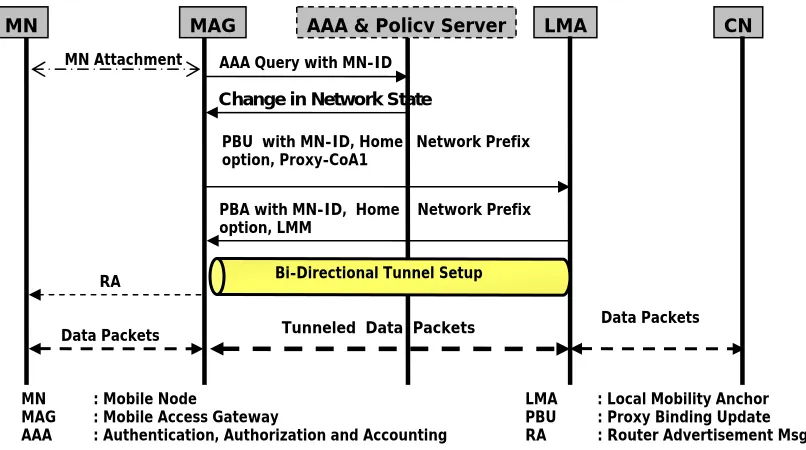
i. Initial Attachment and Signal Flow
a) Initially on attaching to MAG, MN-Identifier (MN-ID) of Mobile Node is authenticated via access security protocols on the network to be accessed.
b) After successful access authentication MAG obtains the MN’s profile.
c) MAG sends a Proxy Binding Update (PBU) to the LMA of Mobile Node regarding its current location. d) After receiving the PBU message, LMA assigns a MN-HNP (Home Network Prefix) and creates a Binding
Cache Entry (BCE) that binds the Proxy-Care of Address of MAG with MN-HNP.
e) It also establishes a bi-directional tunnel to MAG and sends a Proxy Binding Acknowledgement (PBA) message including the MN-HNP.
f) After receiving the PBA message, tunnel is being sets up between MAG and LMA. After that it sends Router Advertisement (RA) message to MN on the access link to advertise the MN-HNP as the hosted on-link-prefix.
g) On receiving RA messages Mobile Node configures the IP address. After completion of configuration procedure, MN uses this address for all future packets delivery.
ii. Handover between two MAGs
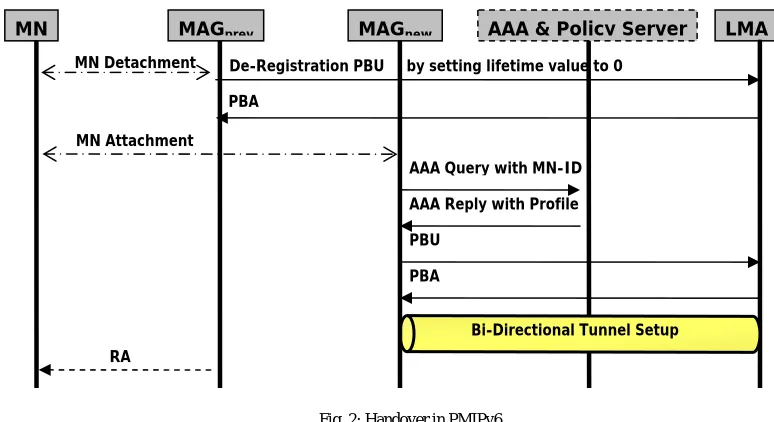
When MN moves to another access network belonging to MAGnew as shown in Fig.2, MAGprev detects that it has
moved away from its access link. Therefore, it follows the following steps for handover.
a) MAGprev sends a DeRegistration PBU (DeReg PBU) to LMA.
b) Once LMA received DeReg PBU, it sends a PBA message to MAGprev
MN MAG AAA & Policy Server LMA
MN Attachment AAA Query with MN-ID
Change in Network State
RA Bi-Directional Tunnel Setup
CN
Data Packets Data Packets
PBA with MN-ID, Home Network Prefix option, LMM
Tunneled Data Packets PBU with MN-ID, Home Network Prefix option, Proxy-CoA1
Fig. 1: PMIPv6 Initial Attachment and Signal Flow
MN : Mobile Node
MAG : Mobile Access Gateway
AAA : Authentication, Authorization and Accounting
LMA : Local Mobility Anchor
PBU : Proxy Binding Update
c) On the other hand when MAGnew detects the attachment of MN, it obtains the MN-profile using MN-ID. It
uses similar authentication steps as performed during initial attachment.
PMIPv6 suffers from unacceptable handover latencies [6] and packet losses. Where, Handover latency means the maximum time interval in which mobile Handover latency means the maximum time interval in which mobile node does not receive any packet due to the process of handover. And on the other hand packet loss means number of downstream packet lost at the mobile node during handover period. It offers a loose coordination of handover control, there is limited coordination in the LMA, which replaces existing bindings with new ones based on time-stamps provided in the proxy binding updates. Therefore it is necessary to design and specify PMIPv6 extension that enhances its performance.
III. Related Work
Lot of work has already been done to reduce the packet loss and lack of coordination problem in PMIPv6 and this section highlights the related work done so far to overcome these problems.
Vassilis E. Zafeiris et. al. proposed PL-PMIPv6 Packet-Lossless scheme[7] that eliminated the delay that the MAGnew sends the PBU message and receive PBA message. However handover delay is seriously affected by
accesses of wireless link during handover. Authors did not consider layer2 handoff delays. SPMIPv6 [6] is based on two triggers responsible for marking prediction of a possible handover, breaking the connection between MN and MAGprev.
Oh and Chae[11] proposed secure and channel-aware relay coding (SCRC) scheme for Network-based Localized Mobility Management (NETLMM). Where current MN1 utilizes another MN2 as relay coding node.
Choi et al.[12] introduced Smart Buffering Scheme, in which MAGprev buffers the packets which might be lost due
to attachment detachment process. When new MAG detects the attachment of MN it notifies the attachment to the MAGprev. The MAGprev forwards the buffered packets to the MAGnew. The only drawback is that every buffered
packet is having a time-stamp leading to high rate of packet discardment.
Since, agents are being deployed at different level of Multi-access provider (MAP), Network Provider and User Terminal, therefore these exist feasibility of deploying agents in PMIPv6.
MN MAGprev AAA & Policy Server LMA
MN Detachment De-Registration PBU by setting lifetime value to 0
PBA
RA
Bi-Directional Tunnel Setup
Fig. 2: Handover in PMIPv6
MAGnew
MN Attachment
AAA Query with MN-ID
AAA Reply with Profile
PBU
The literature [18] indicates that researchers have made an attempt towards introducing agent based paradigm in mobile networks. For instance, authors have proposed multi agent frameworks for cellular networks however no attention towards handover process has been paid.
Besides handover execution, developing mechanism for handoff initiation and decision making are also challenging in 4G wireless networks. In homogeneous networks, signal to noise ratio and perceived power are the two basic factors for handover initiation and decision. However in heterogeneous network (4G) the handover initiation and decision some additional factors such as user’s cost tolerance, contractual constraints, application requirements and priority, terminal device status (battery status etc.) need to be taken into account. A critical look at the literature highlights that significant work has been done towards the application of agents in mobile network. However, still there is a gap that needs to be bridged.
In order to bridge this gap, a smart solution that exploits mobile agents to meet the handover initiation & decision challenge has been proposed in the next section. The adoption of software agents as architectural elements is because of its unique features such as autonomy, persistence, and mobility.
IV. Proposed Solution
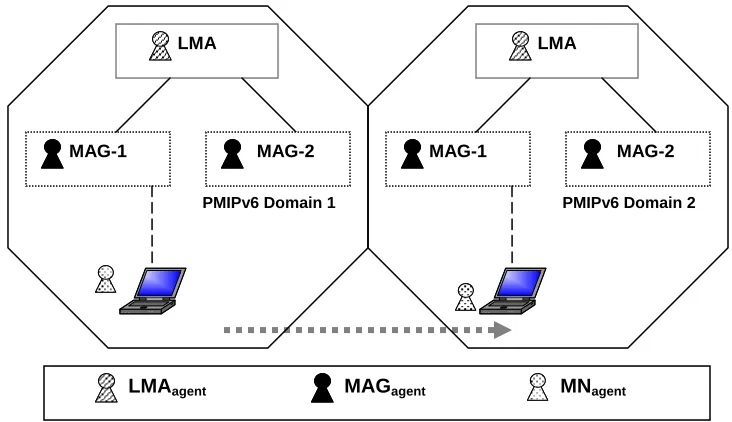
The proposed solution basically relies on agents as these will not only be responsible for initial attachment of MN to LMA but also for shifting from MAGprev to MAGnew in case of handoffs. The proposed solution mainly comprises of
three agents: MAGagents, LMAagents and MNagents. The existing solutions are based on hardwired devices and therefore
are not intelligent enough so as to provide independence to service providers as well as to users. Fig. 3 presents the high level view of the proposed solution where in deployment of mainly three agents are proposed.
This is achieved by assisting network devices with software agents. The intention is to provide self sustainable & independent intelligent networks assisted with software mobile agents.
Mobile Node Agents (MNagents) on a mobile node gets automatically activated when the device is turned on. The
initial responsibility of these agents is to manage the network connection as per the pre-defined preferences of the user. When the device roams, vertical handover need to be performed either on MNagents request or it can be
provider’s initiated. Following subsection illustrate the two solutions.
IV(i) Vertical Handover on MNagent Request
It is assumed that a MNagent would be invoked for the following three conditions: Fig. 3: High Level View of Proposed Work
MAG-1
LMA
PMIPv6 Domain 2
LMAagent MAGagent MNagent
MAG-2 MAG-1
LMA
MAG-2
b) Goes out of the range
c) Executing an application which is not supported by the currently connected network.
Out of these three cases the second case can be handled by the agents installed at MAG as in the present scenario location of the mobile device can be detected by broadcasting specific network signaling messages from mobile device. However, this process consumes device’s memory and power. The same process can be handed over to MAGagent which is having an ability to roam and detect the location of mobile device. Using this strategy
computational overheads of devices are reduced. The algorithm for the same has been explained later in this paper.
IV(ii) Vertical Handover on Provider’s Initiative
Vertical handover can be triggered by network provider in two cases only: a) Change in network policy
b) Change in the state of network.
In both the cases the agents deployed on the provider’s side initially detects the number of nodes, that need to moved according to current policy & later identifies the alternative access technology so that user’s device can be handed over.
Now for handling the two situations mentioned above the proposed agents and there functionalities are listed in table 1 and are explained in details as follows.
Table 1: Agents and their Functionalities
Agents Functionalities MNagents Managing connection and user profile
MAGagent Distribution of software driver, communication with neighboring MAGagents,
managing MN Identifications
LMAagent Managing bandwidth, Qos and services offered by network provider.
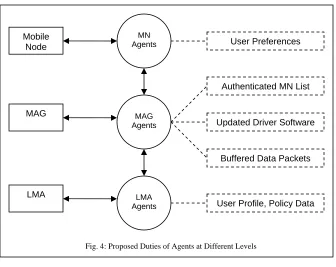
a) MNagent: Agent of the Mobile Node will be responsible for performing following activities exclusively for
user.
Responsible for storing the user preferences. It also interacts with MAGagent for application
requirements depending upon the data transmission.
These agents are also responsible for successful execution of handover initiated by the MAGagent.
b) MAGagent: It supports the activities of mobile node agents and LMAagent and provides the following services
It provides the latest versions of drivers and software libraries to Mobile Node and improves the utilization of the node’s network interface.
These agents also store the user’s profiles for authentication and authorization. The same can be used for configuring, when mobile node enters in MAG area.
All MAGagent provided with an additional buffer that stores the entire packet till the current
communication is on. When the mobile node (MN) moves to MAGnew, the previous MAGagent
forwards the buffered packet to new MAGagent there by avoiding the delay and packet loss
possibilities. In addition, each MAGagent maintains a log which records registration details of all
visiting agents. Moment, a new MNagent arrives on a new MAG, the new MAGagent checks the log
if the MNagent is already registered. If true, the authentication process is skipped and is directly
allotted the new MAGagent. If false, the authentication process is initiated and only then the
MAGagent is allotted. The log plays a significant role when the MN moves from one MAG to
another during the communication there by avoiding handover delay. c) LMAagent: LMA includes a Network Provider Agent.
--- Algorithm: Working of Mobile Agents at MN, MAG and LMA of PMIPv6 Domain
--- 1: begin
2: Input: Action Initiated (ai)
3: if (ai.equals “Turned ON” or ai.equals “Application Requirement” or ai.equals “Weak Signals” or ai.equals “Change in Network Policy” or ai.equals “Change in state of Network”)
4: if (ai.equals (Change in Network Policy || Change in state of Network) then
5: invoke LMAagent()
6: MAGagent LMAagent(ouput)
7: else
8: invoke MNagent()
9: MAGagent MNagent(output)
10: invoke MAGagent()
11: LMAagent, MNagent MAGagent(output)
12: end if
13: end if 14: end
---
--- Algorithm: Working of Mobile Agents at LMA of PMIPv6 Domain
--- 1: begin
2: if (mn doesn’t follows NewPolicy || Change in Network State) 3: LMAagent mnID to MAGagent
4: MAGprev.agent De.Reg.PBU to LMAagent
5: end if 6: end
---
MN Agents
MAG Agents
LMA Agents Mobile
Node
MAG
LMA
User Preferences
User Profile, Policy Data Authenticated MN List
Fig. 4: Proposed Duties of Agents at Different Levels
Updated Driver Software
Algorithm: Working of Mobile Agents at MN of PMIPv6 Domain
--- 1: begin
2: Read user preferences (mnUP)
3: Read available network provider (npN) 4: while mnUP != “empty” do
5: while npN != “empty” do
6: if mnUP[i] = = npN[j] then
7: exit while
8: else
9: j = j + 1
10: end if
11: end while
12: i = i+1
13: end while 14: end
---
--- Algorithm: Working of Mobile Agents at MAG of PMIPv6 Domain
--- 1: begin
2: Read MNlog
3: if mnID not exists in MNlog then 4: mnagent (PBUmsg) magagent
6: magagent. AAA (PBAmsg) mnagent
7: update MNlog with mnID
8: end if
9: establish tunnel between LMA, MN 10: smart_buffering data packets (MN,CN) 11: data transfer (MN,CN) smart_buffer 12: end
If MN follows New Policy
? Change in Network Policy
Smart Vertical Handover
Invoke
MNagent
Read User Preferences
If MN exists in
MNlog ?
Buffered Data Packet
Establish Tunnel between MN and
LMA Turned
ON
Application Requirement
Received Signal Strength
Invoke
MAGagent
Read MNlog
AAA by LMA
Update MNlog Invoke
LMAagent
Parallel reading of Neighboring MAGs and
Updation of MNlog
If Authenticated
?
Disconnection Buffering
Continues
Start Buffering
De-Registrati
o
n
Yes No
Yes Yes
No No
V. Conclusions and Future work
The work proposed a solution for handover initiation and decision in the context of 4G mobile communication systems. The MN, MAG & LMA were assisted with mobile nodes & hence was able to reduce handover latency & packet loss. Moreover, the proposed solution could potentially reduce the device memory & power consumption as the computational overheads has shifted from mobile device to network. The proposed framework mainly concentrated on the deployment of agents at various phases however, the factors related to agents such as reliability has been intentionally ignored. The factors affecting the performance of the agents exclusively shall be considered as future work.
REFERENCES
[1] Q. Zhang et al., “Efficient Mobility Management for Vertical Handoff between WWAN and WLAN,” IEEE Commun. Mag., vol. 41, no. 11, Nov. 2003, pp. 102–08.
[2] J. McNair and F. Zhu, “Vertical Handoffs in Fourth-Generation Multi-network Environments,” IEEE Wireless Commun., vol. 11, no. 3, June 2004, pp. 8–15.
[3] I. F. Akyildiz et al., “Mobility Management in Next-Generation Wireless Systems,” Proc. IEEE, vol. 87, no. 8, Aug. 1999, pp. 1347– 84.
[4] Kang, J.-E., Kum, D.-W., Li, Y., Cho, Y.-Z.: Seamless Handover Scheme for Proxy Mobile IPv6. In: IEEE International Conference on Wireless & Mobile Computing, Networking & Communication, pp. 410–414. IEEE Computer Society, Avignon (2008)
[5] Obele, B.O., Rhee, J.-K., Kang, M.: A Proposal for Reducing Handover Latency and Improving Route Optimization in Proxy Mobile IPv6. In: Advanced Communication Technology, ICACT2008, pp. 49–54 (2008)
[6] Mortaza S. Bargh, Bob Hulsebosch, Henk Eertink, Geert Heijenk, Jeroen Idserda, Julien Laganier, Anand R. Prasad, Alf Zugenmaier, "Reducing handover latency in future IP-based wireless networks: proxy mobile IPv6 with simultaneous bindings," wowmom, pp.1-10, 2008 International Symposium on a World of Wireless, Mobile and Multimedia Networks, 2008
[7] Seonggeun Ryn and Youngsong Mun “Scheme to Prevent Packet Loss during PMIPv6 Handover” M.L. Gavrilova and C.J.K. Tan (Eds.) : Trans. on Comput. Sci. VI, Springer-Verlag Berlin Heidelberg LNCS 5730, 2009, pp. 131-142.
[8] Vassilis E. Zafeiris , Emmanuel A. Giakoumakis, An Agent-Based Architecture for Handover Initiation and Decision in 4G Networks, Proceedings of the Sixth IEEE International Symposium on a World of Wireless Mobile and Multimedia Networks (WoWMoM'05), p.72-77, June 13-16, 2005
[9] D. Johnson, C. Perkins, and J. Arkko, “Mobility Support in IPv6”, IETF RFC 3775, Jun 2004,
[10] S. Gundavelli et al., “Proxy Mobile IPv6,” IETF Internet draft, draft-ietf-netlmm-proxymip6-01.txt, June 2007, work in progress. [11] Hayoung Oh and Kijoon Chae “A Secure and Delay-Efficient scheme for NetLMM”, International Conference On Mobile
Technology, Applications, And Systems Article No.: 62 Year of Publication: 2008 ISBN:978-1-60558-089-0
[12] Hyon-Young Choi et al. “Reactive Smart Buffering Scheme for Seamless Handover in PMIPv6” Springer-Verlag Berlin Heidelberg , ISSN0302-9743 (Print) 1611-3349 (Online) Volume 5401, December 2008 pp 568-571
[13] M. Rahnema, “Overview of The GSM System and Protocol Architecture” IEEE Communications Magazine, April 1993 p.p. 92-100. [14] Foundation for Intelligent Physical Agents. FIPA Specifications, http://www.fipa.org/specifications/index.html, 2005.
[15] Ma L, Yu F, Leung V, Randhawa T. “A new method to support UMTS/WLAN vertical handover using SCTP”. Proceedings of the IEEE VTC’03, Orlando, FL, U.S.A., 2003; 44–51.
[16] Hyosoon Park, Sunghoon Yoon, Taehyoun Kim, Jungshin Park, Misun Do, and Jaiyong Lee “Vertical Handoff Procedure and Algorithm between IEEE802.11 WLAN and CDMA Cellular Network” Springer Berlin / Heidelberg, vol. 2524/2003, pp. 103-112, January, 2003.
[17] Chie Dou and Yia-Pei Chen, His-Kun Chen "An Agent-Based Platform for Dynamic Service Provisioning in 3G Mobile Systems: Scenarios and Performance Analyses" Proceedings of the The 15th International Conference on Information Networking Page: 883, Year of Publication: 2001, ISBN: 0-7695-0951-7
[18] A.K. Sharma, Dimple juneja and Charu Bishnoi “Intelligent Agents in Call Management System”, KIMAS, April 18-21, 2005, Waltham, MA, USA, IEEE.
[19] D. Premec, NetExt Working Group, Internet Draft “Inter-technology handover in PMIPv6 domain” at www.ietf.org, March 9, 2009. [20] R. Koodli, “Mobile IPv6 Fast Handovers,” RFC 5268, June 2008
[21] Internet Engineering Task Force (IETF). www.ietf.org
[22] Wonil Roh and Vladimir Yanover “Introduction to WiMAX Technology” WiMAX Evolution: Emerging Technology and Applications Edited by Macro D. Katz and Frand H.P. Fitzek © 2009 John Wiley & Sons, Ltd. ISBN: 9780470696804
[23] Usha Communications Technologies, “General Packet Radio Service (GPRS) http://www.mobilein.com/GPRS.pdf
[24] Meeru Networks “Migrating to 802.11n While Supporting Legacy 802.11b/g Applications”, Wi-Fi Technology Note WF104 17 October 2006.
[25] A. Diab, A. Mitschele-Thiel, J. Xu, “Performance Analysis of Mobile IP Fast Authentication Protocol,” MSWiM’04, October 4-6, Venezia, Italy, 2004.
[26] H. Soliman, C. Castellucia, K. Malki, and L. Bellier, “Hierarchical Mobile IPv6 Mobility Management (HMIPv6),” RFC 4140, August 2005.