AUTOMATIC GENERATION CONTROL
OF MULTI AREA POWER SYSTEMS
USING ANN CONTROLLER
Bipasha Bhatia
Electrical Department, D.C.R.U.S.T., Murthal Haryana, India,
Mrs. Sanju Saini
Electrical Department, D.C.R.U.S.T., Murthal Haryana, India
Dr. Narender Kumar
Electrical Department, D.T.U., Bawana Delhi, India
Abstract:
This paper presents the use of one of the methods of artificial intelligence to study the automatic generation control of interconnected power systems. In the given paper, a control line of track is established for interconnected three area thermal-thermal-thermal power system using generation rate constraints (GRC) & Artificial Neural Network (ANN). The working of the controllers is simulated using MATLAB/SIMULINK package. The outputs using both controllers are compared and it is established that ANN based approach is better than GRC for 1% step load conditions.
Keywords: Load Frequency Control(LFC), Automatic Generation Control(AGC), ANN Controller, Area Control error(ACE), Tie-line, MATLAB / SIMULINK.
1. Introduction
One of the important issues in the operation of power system is Automatic Generation Control (AGC). It helps in supplying adequate and consistent electric power with good quality. It is the secondary control in LFC which re-establishes the frequency to its nominal value (50 Hz) and sustains the interchange of power between areas (in case of more than one control area). For this the load demand in the generator prime mover set is increased or decreased in the form of kinetic energy, resulting in change of frequency. The primary and tertiary control is performed by speed governors and economic dispatch respectively. The transient in primary, secondary and tertiary control is of the order of seconds and minutes respectively.
Automatic generation control (AGC) is defined as the regulation of power output of controllable generators within a prescribed area in response to change in system frequency, tie-line loading or a relation of these to each other, so as to maintain the scheduled system frequency and / or to establish the interchange with
other areas within predetermined limits [2].Thus, a plan is required to maintain the frequency and desired
controlled [9], [10], [11]. Artificial Neural Network (ANN) controller has advanced adaptive control configuration, faster control [3] and continues to function without needing any decision support software in case of a failure. The performance of ANN controller is compared with conventional Integral controller
2. Modeling including GRC
In power system having steam plants [16], power generation can change only at a specified maximum rate. The generation rate (from safety consideration of the equipment) for the units is quite low. If these constraints are not considered, system is likely to chase large momentary disturbances. This results in undue wear and tear of the controller. When GRC is considered the system dynamic model becomes non linear and linear control techniques cannot be applied for the optimization of the controller settings.
If the generated rates are included in the state vector, the system order will be altered. Instead of augmenting them, while solving the state equations, it may be verified at each step if the GRCs are violated. Another way of considering the GRCs for all the areas is to add limiters to governors as shown in figure below, i.e. the maximum rate of valve opening or closing is restricted by limiters.
Fig:Governor model with GRC
The GRC result in larger deviations in ACEs as the rate at which generation can change in the area is constrained by limits imposed. Therefore the duration for which power needs to be imported increases considerably.
3. Artificial neural network
The foundation of Artificial neural networks(ANN) are the simple models for neurons and their links can be successful for learning and decision making if the model is pattern based (the Perceptron model) and/or is memory storing and recall process (the Hopfield network). They have numerous applications even outside of neuroscience. Some basic features of neural networks are:
Noisy data can be used in the problem.
Fig 2: Simulink model of three area interconnected power system with non-reheat turbine using GRC
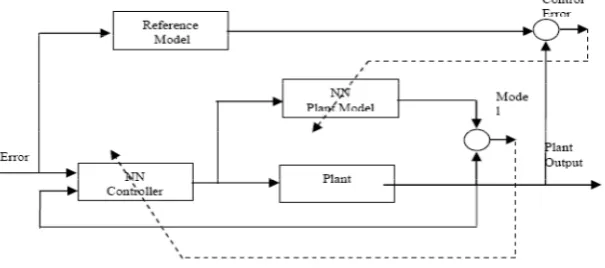
ANN is a system having elements called as neurons which processes the information and this information is transmitted by means of connecting links associated with weights, which is multiplied to the incoming signal (net input) for any typical neural net, and the output signal is obtained by applying activations to the net input. The block diagram of system added ANN architecture is shown in fig. 3
turbine1 1 .4s+1 turbine2 1 .4s+1 turbine 2 s governer3 1 .09s+1 governer2 1 .085s+1 governer1 1 .08s+1 governer 200 40s+1 generator2 50 10s+1 generator1 120 20s+1 generator .01 del Pl2 .01 del Pl1 .01 del Pl 1 .5s+1 .15 s T ransfer Fcn6
is predicted. It permits the updating of controller parameters. In the study, the frequency deviations, tie-line power deviation and load perturbation of the area are chosen as the neural network controller inputs. Control signals applied to the governors in the area act as the outputs of the neural network. The data required for the ANN controller training is obtained by designing the Reference Model Neural Network and applying to the power system with step response load disturbance.
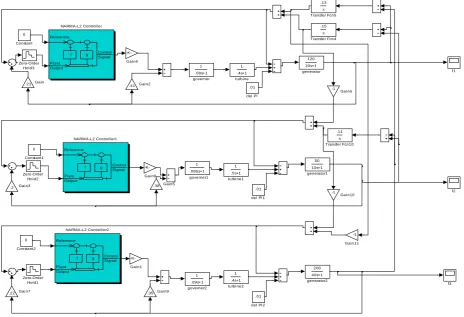
ANN controller used is a three-layer perceptron with one input, 15 neurons in the hidden layer, and one output. ANN Plant model is a three-layer perceptron with one input, 15 neurons in the hidden layer, and one output. The activation function of the networks neurons is trainlm function. 100 training samples have been taken to train 10 number of epochs. The proposed network has been trained by using the learning performance. Learning algorithms causes the adjustment of the weights so that the controlled system gives the desired response. (Fig. 4)
Fig 4: Simulink model of three area interconnected thermal-thermal-thermal plant with Neural Network Controller
5. Simulation and Result
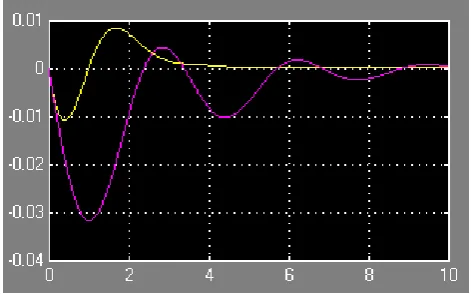
In the present work, a thermal-thermal-thermal interconnected power system has been developed using ANN controllers and integral controllers to demonstrate the performance of load frequency control using MATLAB/SIMULINK package. Fig. 5, 6, 7 & 8 respectively represent the plots of change in system frequency and tie-line power respectively for 1% step load variation.
governer1 1 .4s+1 turbine2 1 .5s+1 turbine1 1 .4s+1 turbine 1 .09s+1 governer2 1 .08s+1 governer 200 40s+1 generator2 50 10s+1 generator1 120 20s+1 generator f3 f2 f1 .01 del Pl 2
.01 del Pl 1 .01 del Pl Zero-Order Hold3 Zero-Order Hold2 Zero-Order Hold1 Zero-Order Hold 1 .085s+1 .13 s Transfer Fcn5 .15 s Transfer Fcn4 .11 s T ransfer Fcn10
Plant Output Reference Control Signal f g
NARMA-L2 Controll er2 Plant Output Reference Control Signal f g
NARMA-L2 Controll er1 Plant Output Reference Control Signal f g
NARMA-L2 Control ler
.35Gai n9 -K-Gain8
.22 Gain7
-1 Gai n6
.38Gai n5
-K-Gain4
.2 Gain3
.41 Gai n2
Fig. 5: Change in frequency with GRC & Fig.6 Change in frequency with GRC & ANN controller (Δf1 ) of area 1 ANN controller(Δf2) of area 2
Fig. 7: Change in frequency with GRC & ANN controller (Δf1 ) of area 3
6. Conclusions
From the responses obtained, it is clear that use of ANN controller improves dynamic performance and reduces the overshoots w.r.t frequency deviation in each of the areas. Therefore, the intelligent control approach using ANN concept is more accurate and faster. And also it gives better results even when GRC are considered.
References
[1] J.Nanda & A. Mangla,” Automatic Generation Control of an Interconnected Hydro-Thermal Syatem using conventional Integral & Fuzzy Logic Controller.” IEEE International Conference on Electric Utility Deregulation Reconstructing & Power Technology, April 2004
[2] Elgerd O. I. 1971. Electric Energy System Theory; An Introduction, Mc Graw Hill
[3] Demiroren A., Zeynelgil H.L., Sengor N. S. “The Application of ANN Technique to Load-frequency Control for Three- area Power System”, IEEE Porto Power Tech Conference, PPT001, Porto, Portugal, , 10th -13th September2001.
[4] Sandeep Bhongade, Prof.H.O.Gupta, "Artificial Neural Network based Automatic Generation Control scheme for Deregulated Electricity Market", IPEC,2010 Conference proceedings, pp.1158-1163,2010
[5] Bibhu Prasad Padhy, Barjeev Tyagi,"Artificial based Multi Area Automatic Generation Control scheme for a Competitive Electricity Market Environment", International Conference on Power systems, ICPS 09, pp.1-6, 2009.
[6] M.Ansarian, Shakouri,"A Novel Neural Optimal Approach for Decentralized Load Frequency Control design in Multi AreaPower System", Power and Energy Conference 172,2006
pp.1-[13] Surya Prakash , S. K. Sinha “Application of artificial intelligence in load frequency control of interconnected power system” INTERNATIONAL JOURNAL OF ENGINEERING, SCIENCE AND TECHNOLOGY, pp. 264-275, Vol. 3, No. 4, 2011.
[14] Hadi Sadat, “Powet System Analysis”, TMH, 2002.
[15] Murat LÜY, İlhan KOCAARSLAN, Ertuğrul ÇAM, M. Cengiz TAPLAMACIOĞLU, “LOAD FREQUENCY CONTROL IN A SINGLE AREA POWER SYSTEM BY ARTIFICIAL NEURAL NETWORK (ANN)”.