Behavior-Based Early Language Development on a
Humanoid Robot
Paulina Varshavskaya (Varchavskaia)
Artificial Intelligence Lab, MIT
NE43-937, 200 Technology Square
Cambridge, MA 02139 US
[email protected]
Abstract
We are exploring the idea that early lan-guage acquisition could be better modelled on an artificial creature by considering the prag-matic aspect of natural language and of its de-velopment in human infants. We have imple-mented a system of vocal behaviors on Kismet in which “words” or concepts are behaviors in a competitive hierarchy. This paper reports on the framework, the vocal system’s archi-tecture and algorithms, and some preliminary results from vocal label learning and concept formation.
1.
Introduction
We are exploring the idea that early language acqui-sition could be better modelled on an artificial crea-ture by considering the pragmatic aspect of natural language and its development in human infants. We believe that this will contribute to a solution to the “Grounding Problem” (Harnad, 1990) by providing a new level of grounding in intentions and function. The pragmatic approach to language acquisition is to consider first of all the intentions of a speech act. Language is not viewed as a denotational symbolic system for reference to objects and relationships be-tween them, as much as a tool for communicating intentions. The utterance is a way to manipulate the environment through the beliefs and actions of others.
We develop a system of vocal behaviors for the robot Kismet (Breazeal, 2000) which exemplifies the approach we believe should be taken to natural lan-guage acquisition by machines. The robot’s youthful appearance dictates the sort of interaction that hu-mans will have with it: scenarios of social scaffolding similar to the kinds of interactions that teachers have with human infants.
One step forward is to enable the robot to use the scaffolded environment to its advantage in order to learn to perform tasks and behave appropriately. Learning to communicate with the teachers using a
shared semantic basis is one aspect of learning to be-have in the world and manipulate it. We augment the existent motivational and behavioral systems of the robot with a set of vocal behaviors, regulatory drives, and learning algorithms, which together con-stitute Kismet’s Protolanguage Module.
In what follows, we first take a look at previous work in robotics in Section 2., and in human lan-guage development in Section 3. Then we present the architecture of Kismet’s protolanguage module in Section 4. and the algorithms in Section 5. Some preliminary results from experiments with the new system can be found in Section 6., and a discussion in Section 7.
2.
Previous Work
The current work was inspired by and built upon results and ideas in robotic language acquisition and adaptable behavior-based robotic architectures.
2.1
Robots acquiring natural language
2.2
Robots creating linguistic systems
Others have applied the principle of grounding word semantics in perceptual inputs of robots to acqui-sition and evolution of artificial languages, e.g. in (Steels, 1999) and (Steels and Kaplan, 2001). Those languages are used by populations of software agents which teleport themselves into active vision heads so they may perceive the scenes they describe to each other. These experiments are demonstrations of a computational model of language evolution. The resulting languages are not natural; they are con-structed specifically and exclusively for the purpose of playing the naming game and not intended for interaction with humans. Therefore, a human in-teracting with an agent from the experiment must learn the new language in order to engage in com-munication, which will be restricted by the rules of the game.
Also interesting is the work of Holly Yanco (Yanco, 1994), where a team of robots must collec-tively perform an atomic task by following a desig-nated leader (human or robot). Based on certain as-sumptions about the task and the environment, e.g., perfect communication, no inference of goals, and the simplicity of tasks, the robots create an artificial lan-guage to assist their collaborative effort. Again, the development of this language reflects its very spe-cific purpose, which is not necessarily human-robot interaction.
2.3
Adaptable behavior-based architectures
We combine the task of word and concept acquisi-tion with the behavior-based approach to robotics (Brooks, 1986) by conceiving of a concept as a kind of behavior, a process in a competitive hier-archy. However, traditionally behavior-based sys-tems have fixed architectures of behaviors designed in advance for a specific purpose. Our purpose, on the contrary, is to build and modify an architecture of protoverbal behaviors at runtime, as the robot learns to extract them from experience. We thefore take an approach similar to that of certain re-cent expansions in behavior-based robotics, which have included adaptive architectures. For example, in (Nicolescu and Matari´c, 2001) scenarios are de-scribed, in which humans act as teachers and col-laborators for robots. Robots learn to combine ex-isting behaviors into control networks from human demonstrations of tasks.
The work reported here builds on the Lateral be-havior architecture (Fitzpatrick, 1997), which was extended and modified to enable adaptable behav-ioral architectures in (Varchavskaia, 2002).
2.4
Novel approach of reported work
The problem we are attempting to address in the cur-rent work is that of demonstrating the development of a communicative system by an artificial creature in a social environment populated by benevolent hu-mans. This communicative system finds expression in strings of natural language. However, the em-phasis of the current approach is not on learning an extensive vocabulary or a verisimilar grammar, but on acquiring words with functional meanings. In-deed, the questions of grammar development are not addressed here at all, hence we refer to the task as “protolanguage”, meaning the presyntactic stage in language development. Reported here are very pre-liminary results obtained by taking this pragmatic approach to language acquisition. The main novelty of this research is the framework proposed here, in which concepts have procedural as well as declara-tive meaning. Concepts (i.e., words with meanings) are processes in a concurrent “mental” architecture which compete to be expressed by the creature. To the best of our knowledge, this approach has not yet been explored in machine learning of natural lan-guage.
This work was most influenced and inspired by certain results in developmental linguistics, to which we now turn.
3.
Development of Meaning and
Lan-guage in Humans
Human infants are surprisingly adept at learning about the structure of the environment, how to be-have in it, and how to express themselves and un-derstand others all at once, in the space of a few years. Bloom (Bloom, 2000) has shown that chil-dren are good at innately facilitated learning of so-cially transmitted information. This means that one of the most important attributes of the spoken lan-guage in the infant’s environment is that it fulfills a social function, to which the infant is sensitive and which enables her to acquire a new word or concept after a very limited number of examples, perhaps even one (see also (Pinker, 1999) for overview of ex-periments suggesting extremely fast word learning by young children and infants).
means of manipulating the behavior of other humans. When one person makes a speech act, in addition to communicating a piece of information, that person may have intentions to change the state of the world and especially the behavior of those who hear the ut-terance, in a particular way. “It has started to rain outside” often really means something like “Close the window, please”. The speaker expects the hearer to react in a certain way as a result of hearing the ut-terance, which then becomes the speaker’s tool for manipulation of others and of her surroundings.
This pragmatic view of the function of language is extremely important in trying to explain, or de-vise, an ability for early language acquisition, be-cause infants and young children specifically learn to use speech as a tool. Halliday identifies three main stages of linguistic development: (I) the child’s initial closed proto-linguistic system, (II) the transitional stage to that of adult language, and (III) the learn-ing of the adult language. In the first stage, the child has a finite number of meanings to convey and to that effect uses self-generated labels that may or may not resemble adult words for similar occasions. Halliday posits six initial functions of a developing proto-linguistic system that may be expressed in the first stage:
1. Instrumental- satisfying the child’s needs 2. Regulatory - controlling the behavior of others 3. Interactional- engaging in a social situation 4. Personal - asserting own unique self
5. Heuristic- exploring the environment 6. Imaginative - pretending and playing
These six functions of the child’s phase I proto-language seem to develop in that sequence and repre-sent the child’s growing cognitive ability and aware-ness. They also present a great starting point and timeline for an artificial system that would acquire a natural language in a way similar to human chil-dren. The infant’s protolanguage during Phase I is finite and formulaic (see also (Wray, 2000) for a dis-cussion of formulaic systems in the evolution of lan-guage), as will be the first part of Kismet’s language development module (see Table 1).
Note that we make no claims of faithfully following the developmental schedule of human infants. Nei-ther do we achieve a complexity of development that would approach that of an infant. The preceding summary shows the main source of inspiration for our pragmatics-based approach to language acqui-sition by an artificial creature, designed to exhibit certain properties of human infants. As can be seen in the next two sections, learning in the artificial sys-tem results from similar scenarios of, e.g., frustration
of a goal-directed behavior and an intuitive drive for vocalization.
4.
Kismet’s Protolanguage Module
In order to achieve communication between humans and a sociable robotic creature, words must be a tool used by the robot to manipulate its physical and so-cial world and they must be interpreted by humans as having such a pragmatic functional meaning. In Kismet’s case, it will start with proto-language and proto-verbal behaviors. The “proto” terms refer to the pre-grammatical early stage of development.
4.1
The robotic platform
Kismet is an expressive robotic head, designed to have a youthful appearance and perceptual and motor capabilities tuned to human communication channels. The robot receives visual input from four color CCD cameras and auditory input from a micro-phone. It performs motor acts such as vocalizations, facial expressions, posture changes, as well as gaze direction and head orientation.
Kismet’s control architectures run on a complex network of processors in real time (approaching 30 Hz for visual signals, and 8 kHz sample rate with frame windows of 10 ms for auditory signals), with minimal latencies (less than 500 ms). Low-level vi-sual processing and eye/neck motor control is per-formed by 12 networked 400 MHz PCs running QNX. The high-level perceptual system, the motivation and behavior systems, the motor skill system and the face motor control run on four Motorola 68332 microprocessors running L, a multi-threaded Lisp de-veloped in our lab. Expressive speech synthesis and vocal affect recognition execute on a dual 450 MHz PC running NT, and the speech recognition system (ViaVoice) and protolanguage module run on two 500 MHz PCs running Linux.
Although not a mobile robot and with all compu-tation off-board, Kismet is an autonomous agent in that it pursues its own agenda by engaging in spe-cific behaviors which are tuned to the satisfaction of its own “goals” and “desires”. The motivation is provided by a set of internal homeostatic variables called “drives”, such as the level of engagement with the environment or the intensity of social play, which must be maintained within certain normal bounds in order for Kismet’s system to be at equilibrium.
Figure 1: Kismet: the robotic head.
The behavior system provides structure and an ar-biter for the robot’s multiple behaviors. The lat-ter are all self-inlat-terested mechanisms which compete with each other to be active at any one time. The activation of a particular behavior will depend on the current state of the robot’s motivational system, as well as considerations of coherency, persistence and opportunism.
There are four lip actuators, and a single DoF jaw that together work to lip-synch to the speech pro-duced by a synthesizer. The synthesizer software is DECTalk v4.5, based on the Klatt synthesizer, cited in (Breazeal, 2000), which models the physiological characteristics of the human articulatory tract. This enables the robot to speak in a youthful tone of voice, and to vary the parameters of the synthesizer to ac-count for variation in its emotional state.
4.2
Proto-verbal behaviors
We have designed and implemented a new vocal be-havior system on Kismet which we call protoverbal for two reasons. On the one hand, the behavior ex-hibited by the system, if observed in a human in-fant, would be called a precursor to language devel-opment. The goal of the system is to produce the kind of vocal output that a prelinguistic infant may produce in the age range of 10-12 months, namely emotive grunts, canonical babblings, and a formulaic protolanguage (see Table 1) similar to that described in (Halliday, 1975). On the other hand, we believe that this foundation of vocal behaviors can serve as the pragmatic basis for more sophisticated natural language acquisition by the robot.
The system consists of two new drives (theSpeech
andExplorationdrives), and an architecture of vocal behaviors shown in Figure 2. The new system is based on the following components:
• Releasers are global variables which respond to certain conditions in the environment, as re-ported by the robot’s perceptual system, or in the internal state of the robot
Emotion Behavior Proto-linguistic Function anger, complain regulatory frustration
disgust withdraw instrumental or regulatory
fear, distress escape –
calm engage interactional joy display pleasure personal or
interactional sorrow display sorrow regulatory
or personal surprise startle response –
boredom seek –
Table 1: Correspondence between Kismet’s nonverbal be-haviors and proto-linguistic functions (Halliday, 1975). In some fields, – indicates that there is no clear corre-spondence. In this case, the grunting behaviors may be active.
• Drives are global objects with a changing level of activation, which regulate the likelihood of ac-tivation of certain behaviors, and are reset when these behaviors achieve their goals
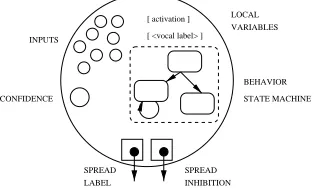
• Vocal Behaviors are behavior objects which consist ofreceptors,gains,elicitorswhich be-have like complex releasers, a level ofactivation, a state machine, avocal label, a measure of confidence, and output portsfor propagation of their activation and label. Details of a base behavior are shown in Figure 3.
[ activation ] [ <vocal label> ] INPUTS
SPREAD LABEL
SPREAD
BEHAVIOR STATE MACHINE LOCAL VARIABLES
CONFIDENCE
INHIBITION
Figure 3: Representation of a single pro-toverbal behavior.
The design of protoverbal behaviors presented here fits the description of a behavior as a a self-contained, self-interested and goal directed entity. All of them compete to establish which mode of vocal expression the robot is to engage in, and what phonemic string it is to produce.
Disgust Anger
Surprise
Frustrated
. . . .
ConceptMap
Global Releasers
Reader
Hearer
Speaker
Say This Individual
Grunts
Grunt
Babble HeardThis
Figure 2: Overall architecture of Kismet’s protoverbal behaviors, where rounded boxes represent instances of behaviors and circles represent connections between behaviors. Con-nections betweenHeardThisand individualConceptsare not shown for clarity (see section 5.1
will say next. A single vocal behavior does not de-pend on the operation of others. Behaviors may communicate indirectly by receiving each other’s confidence signal as input.
• Goal-directedness. The goal of each vocal be-havior is to assuage the robot’s Speech drive by making it say something. Different kinds of vo-calizations may satisfy different drives, e.g., the
Explorationdrive grows when there are no people present in the robot’s environment, and is satis-fied by canonical babbling.
• Competition. The competition between vocal behaviors is regulated by a priority scheme in the Lateral architecture (Fitzpatrick, 1997). Each behavior assigns its own priority locally to its computed activation level. Implementation de-tails can be found in (Varchavskaia, 2002); they correspond closely to the original implementation of behavior activation on Kismet.
The system consists of grunting behaviors, a single canonical babbling behavior, and a number of con-cept behaviors (this number may grow or shrink at runtime). All of the above execute and interact in the overall architectural framework shown in Figure 2. There are two specialized behaviors, Reader and
Hearer, which interface with Kismet’s perceptual sys-tem and procure global releasers for vocal behaviors. A singleSpeaker behavior is responsible for sending a speech request over to the robot.
All of the protoverbal behaviors (rounded boxes on the figure) have access to the global releasers and the currently heard string of phonemes.
The nature of the speech request is determined by competition among individual protoverbal behaviors implemented through the Lateral priority scheme.
To that effect, relevant behaviors write their vocal labels to connection objects, shown as small circles on the figure. The behavior with the highest activa-tion, and therefore the highest priority, will succeed in overwriting all other request strings with its own, whichSpeaker will end up passing on. A speech re-quest may be a rere-quest for a grunt, a babble, or a “word” - i.e., a phonemic string that is attached to one of the concept behaviors. Competition happens in two stages. First, the most active grunt writes its request to theGruntbuffer and the most active
con-cept writes its label to the Say This buffer. Then,
the most active of the three types of request buffers writes its output to Speaker. Any of these behav-iors only produce output when activation is above a threshold (determined empirically), so some of the time, the Protolanguage Module does not produce an output, and the robot remains silent.
The vocal behaviors are influenced by data on the robot’s current perceptual, emotional, and behav-ioral state. Figure 4 represents the way data and control flow between existing software components of Kismet’s architecture and the vocal behaviors de-veloped here.
Perception System
Behavior System
Motor System Speech
Releasers Complex
Simple Releasers
Vocal Behaviors
Figure 4: Control and data flow between vocal and other behaviors in Kismet’s architec-ture. Dark arrows indicate combined control and data flow between old components of the architecture. Light arrows follow the data flows only.
5.
Structures and Algorithms for
Pro-tolanguage Development
The development of the robot’s formulaic proto-lexicon hinges on two mechanisms: one for the up-date of the vocal label of an existing concept (or “word”), the other one for the creation and man-agement of novel concepts.
5.1
Acquisition of labels
TheConcept class implements the functionality of a single vocal behavior. Its overall architecture was briefly explained in Figure 3, and its state machine is presented in more detail in figure 5. After ini-tialization, the behavior can be in one of the seven states. On the figure, two non-default transitions are shown from the Decide state: to Activate1and
Hear states. They are determined as follows: after the OutputLabel state has executed, the transition goes toActivate1unless the behavior receives a sig-nal that there is a new speech input, in which case the transition goes toHear.
Initial
Activate1
Update Label
Output Label
Update Gains
Activate2 Hear
Decide
Figure 5: State machine of aConcept behav-ior.
Activate1 computes the behavior activation. If the activation is above a threshold, it transitions to
OutputLabel, whence the vocal label of the behav-ior is sent out. Otherwise, the next state remains the same, unless the condition for label update is satisfied. Then the transition function leads to the
UpdateLabelstate.
5.1.1
Attribution of label
When new speech input arrives, this activates the
Hearstate of everyConcept, which attempts to match
the heard phonemic string to the behavior’s vocal la-bel. The match value is computed based on the vocal label as a template against which to match, the con-fidence value for the behavior’s own vocal label, and an empirically determined global phoneme confusion matrix:
BestM atch(in, template) =max(M(in, template)) (1)
whereM(in, template)is a vector whose elements are best matches given a certain window size (window size is measured in phonemes and not in single char-acters):
M(in, template) = 1 n
" M
m(in, template)·m
Mm+1(in, template)·(m+ 1)
· · ·
Mn(in, template)·n
# (2)
wheremis the minimum allowed window size and
n=min(M AX W IN DOW SIZE, length(template))
The minimum window is set so that spurious one-phoneme matches are discarded. The matching mea-sures returned byMi()are scaled by the window size
in order to bias in favor of longer substrings. Mi()
itself uses the standard brute-force string searching algorithm.
in the vocal label is high,Concepttransitions to the
UpdateGainsstate.
If the activation level reaches above a threshold, the behavior transitions to the OutputLabel state, which sets the behavior’s priority to a value de-pendent on its activation and the confidence of the match, sets the output priority to the behavior’s ority, and outputs an inhibitory signal at that pri-ority level. The inhibitory outputs of each concept connect back to the HeardThis behavior. Such a signal received by HeardThis propagates further to
ConceptMapand inhibits the default creation of a new
Conceptwhen a new string of phonemes is heard (see section 5.2).
5.1.2
Updating of label and confidence
Whether or not the vocal label of aConcept should be updated is determined by a combination of con-ditions on theConcept’s confidenceC, the confidence Cheardin the accuracy of the heard phonemic string, the value of the best match between them and the current activationAof theConcept. The update la-bel valueUL is compared against a threshold to de-cide whether an update should take place (wherekis a scaling constant, chosen arbitrarily, andθthe acti-vation threshold,dis the distance measure between the two strings in the result of theBestM atch() call):
UL=
k Cheard
C d : A > θ , C 6= 0
0 : otherwise (3)
If theConceptis active, thenULwill be proportional to the confidence attached to the heard string, and inversely proportionate to the goodness of the match and to the level of theConcept’s own confidence. If it is not active, there is no reason to update the label. These computations depend on the confidence measure on the input speech string. This is com-puted insideHeardThisin the following way:
Cheard=def ault −
1
n
X
n
1
dn+ 1
Cn (4)
wheredef ault is a constant, dn is a distance mea-sure of the match betweenheardand the n’th tem-plate, Cn is the confidence for the n’th template, and the sum is taken over all templates that had at least a minimal match to the heard string. The in-dividualCnanddn are transmitted to theHeardThis behavior through incoming connections. N of these connections are created and we then let the active
Concept behaviors compete to overwrite those con-nections only.
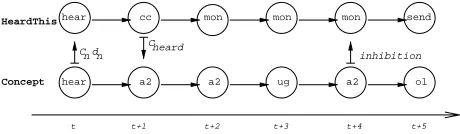
Note that Cn are used to compute Cheard but Cheard is needed to determine the update rule for the vocal label of conceptn. However, this situation does not start an infinite regression in our implemen-tation, as there is a clear time difference between the activation of the two connections, so that when
Cheard is received back atConcept, the behavior has switched to another state as shown in figure 6.
5.1.3
Updating of parameters
When a behavior is created, the gains are set to default values, which must be updated in state
UpdateGains to arrive at some consistent represen-tation of releaser properties for that behavior. The signals that the Concept has access to at this point
in the state machine include:
• its activation A
• the result of the matching process between its vocal label and the input phonemic string
• its confidence in its vocal label C
• a measure of confidence in the accuracy of the string heardCheard
• the current presence or absence of relevant re-leasers
From this information the behavior derives a rein-forcement signal UG computed as follows, where d is the distance measure returned by BestM atch(), which is equal to 0 when the match is perfect:
UG=
−k CheardC d : A > θ CheardC
d+ 1 : otherwise
(5)
This rule allows for both Type I and Type II errors: when the behavior is active even though something other than its label is heard, and when the behavior remains inactive and its label was heard. However, in the first case reinforcement should be weaker since it is quite often the case that the speech the robot hears is not describing any immediate features of the environment. Therefore we scale this type of signal by a smallerk. This does not eliminate the problem, but biases the computation in a simple way. UG is then used in the update rule for each of the gains in the vector:
Git+1 = Git + α RitGitUG (6)
This will not change the value ofGi(theith element of the gains vectorG) if its corresponding Receptor
Riwas not responding.
cc
a2 heard C
mon
a2 inhibition
t t+1 t+2 t+3 t+4 t+5
n d n C HeardThis
Concept hear hear
ol send mon
ug mon
a2
Figure 6: The timings of information transfer between
Figure 7: Activation of Kismet’s motorskill internal variable (solid line) and the “orient” fixed concept (ragged line). Motorskill = 0 corresponds to the activation of the orienting behavior.
The simplicity of the update rules is possible be-cause of the finite and very precisely described set of pre-existing releasers on Kismet. For a more scalable system, if we wish to maintain natural-time respon-siveness, we will want to consider more sophisticated techniques.
5.2
Acquisition of novel concepts
ConceptMap is the single behavior which acts as a very high-level manager of concepts. Described as such it sounds like precisely the homunculus which we are trying to avoid by creating this distributed architecture of behaviors. However, the functional-ity of ConceptMap is very tightly tied in with that ofHeardThisand should perhaps be implemented as two extra states within that behavior. That would perhaps be more acceptable in terms of the spirit of the project. The current implementation has singled outConceptMapmainly for the sake of readability.
The vocal labels of concepts serve also as the key in theConceptMapand may be used to remove a concept by finding the vocal label key. The map stores point-ers to all Concept behaviors, i.e., all non-grunting, non-babbling protoverbal behaviors. The map is ini-tialized to contain a small set of fixed concepts, which correspond to Kismet’s existing behaviors.
Every time a new spoken input is heard, a new
Concept will be generated by ConceptMap, with the heard phonemic string as its vocal label, unless in-hibitory signals are received byHeardThisvia any of itsNinput connections. When a new protoverbal be-havior is automatically generated from ConceptMap, its vector ofReceptorsis initialized to include one for every kind of releaser that is present in the system. All receptor gains are set to a default value. This exhaustive assignment will be remedied later as the gains are updated individually within each behavior.
6.
Preliminary Experiments
In (Varchavskaia, 2002), evaluation of ConceptMap
workings, the acquisition and labeling of concepts was hindered by poor phoneme recognition and the often unpredictable nature of the robot’s behaviors. Here we have attempted to remove some of these
obstacles. We have created an initial small vocabu-lary of 20 words, chosen arbitrarily as most often used in interactions with the robot. This vocab-ulary was transcribed phonemically and used with ViaVoice exclusively for the purposes of more con-sistent phoneme recognition. This initial vocabulary was augmented with novel phonemic strings when-ever novel concepts were added to the map. In this way, the robot is biased to hear the “words” it knows again, and we can eliminate much of the spurious creation of new concepts.
6.1
Labeling an existing behavior
During a 15 minute interaction, the human teacher attempted to teach Kismet labels for some of its original behaviors, such as orienting, search, and ex-pressing an emotion. The words used for this pur-pose were not present in the initial ViaVoice vocab-ulary. Figure 7 shows the correspondence between the activation pattern of the “orient” concept and the robot’s internal variable representing current mo-torskill. The table below shows the progression of la-bel updates within the “orient” concept; the teacher wanted Kismet to associate the phrase “look here” with the orienting behavior.
cycle: last heard: label: C: d:
200: h uh k ih h uh k iy 0.3 3.3 400: h uh k iy l uh k iy h 0.9 1.2 600: l uw h uh k ih 1.1 2.8 ...
A cycle refers to one scan cycle of the vocal behav-iors system, in which each behavior has exectuted for one state, and takes an average of about half a sec-ond. Figure 9 shows that appropriate labels were associated with fixed concepts, e.g.,/l uh k iy h/ with “orient”, /w ah n/ with “seek” (in this case, the robot was taught the label “wanna” for the seek-ing behavior).
6.2
Acquiring a perceptual category
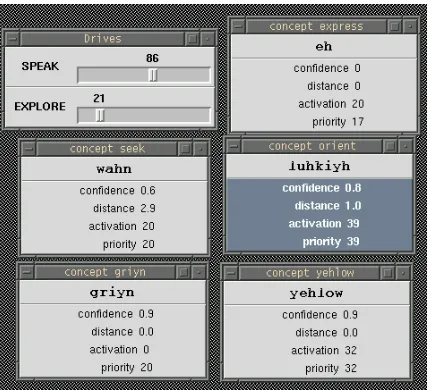
Figure 8: Partial screenshot of an interaction. ConceptMap on the right shows current protoverbal behaviors colored by their priority value. Details of winning behavior also in the main window.
Figure 9: Partial screenshot of an interaction. Highlighted concept won the priority competition.“orient”, “seek” and “express” are fixed concepts mirroring the activaiton of the robot’s nonverbal behaviors. “yehlow” and “griyn” are new concepts created by the system.
focused on it. Then the toy is removed and only shown again if the robot shows a seeking behavior and vocalizes a “request” which sounds similar to the color label. The words used were transcribed as strings of phonemes for ViaVoice. Figures 9 and 8 show that the concepts with corresponding labels were created. However, we do not at present have a satisfactory evaluation method that would demon-strate that the labels correspond precisely to that perceptual category.
7.
Discussion
The scope of the project was to provide a frame-work and a pragmatic, behavior-based approach to the problem of early concept and vocal label acqui-sition. Therefore, emphasis was placed on the
archi-tecture of the system rather than on the learning al-gorithms involved. Consequently, the methods used are often meant as placeholders for more sophisti-cated models.
Nevertheless, the preliminary results show that this approach may be fruitful. We have created a system of protoverbal behaviors, which operate for a purpose, namely the satisfaction of the robot’s drives, including a drive for communication. The framework allows the “words” in the robot’s pro-tolanguage to have grounded function and meaning. Currently we are focusing on developing ap-propriate evaluation methods to test the system. Future research will also involve integration of better phoneme recognition, through incorpora-tion of the out-of-vocabulary model reported in (Varchavskaia et al., 2001), and a mechanism for word segmentation from spoken utterances. We should also conduct more experiments, including those with naive subjects to test claims of natural-ness and meaningfulnatural-ness of interaction.
Acknowledgements
Funds for this project were provided by DARPA as part of the “Natural Tasking of Robots Based on Hu-man Interaction Cues” project under contract num-ber DABT 63-00-C-10102.
References
Bloom, P. (2000).How Children Learn the Meaning of Words. Cambridge: MIT Press.
Breazeal, C. (2000). Sociable Machines: Expressive Social Exchange Between Humans and Robots. PhD thesis, MIT.
Brooks, R. A. (1986). A robust layered control system for a mobile robot. IEEE Journal of Robotics and Automation RA-2.
build-ing an autonomous robot sentry. Master’s thesis, University of Limerick, Ireland.
Halliday, M. (1975). Learning How To Mean: Explorations in the Development of Language. Cambridge: MIT Press.
Harnad, S. (1990). The symbol grounding problem.
Physica D, 42:335–346.
Nicolescu, M. N. and Matari´c, M. J. (2001). Learn-ing and interactLearn-ing in human-robot domains. In White, C. and Dautenhahn, K., (Eds.), Special Issue of IEEE Transactions on Systems, Man, and Cybernetics, Part A: Systems and Humans, volume 31.
Oates, T., Eyler-Walker, Z., and Cohen, P. (2000). Toward natural language interfaces for robotic agents: Grounding linguistic meaning in sen-sors. In Proceedings of the 4th International Conference on Autonomous Agents, pages 227– 228.
Pinker, S. (1999). Words and Rules: The Ingredi-ents of Language. Basic Books.
Roy, D. K. (1999). Learning Words from Sights and Sounds: A Computational Model. PhD thesis, MIT.
Steels, L. (1999). The Talking Heads Experiment, vol.I Words and Meanings. Special pre-edition for LABORATORIUM, Antwerp.
Steels, L. and Kaplan, F. (2001). Bootstrapping grounded word semantics. In Briscoe, T., (Ed.),
Linguistic evolution through language acquisi-tion: Formal and Computational Models. Cam-bridge University Press.
Varchavskaia, P. (2002). Early pragmatic language development for an infant robot. Master’s thesis, MIT.
Varchavskaia, P., Fitzpatrick, P., and Breazeal, C. (2001). Characterizing and processing robot-directed speech. In Proceedings of the IEEE-RAS International Conference on Humanoid Robots.
Wray, A. (2000). A protolanguage with no declar-atives and no names. In Proceedings of the 3rd Conference on the Evolution of Language. Yanco, H. (1994). Robot communications: issues