The evolution of brain lateralization: a game
theoretical analysis of population structure
∗
Stefano Ghirlanda
1and Giorgio Vallortigara
21Group for Interdisciplinary Cultural Research, Stockholm University 1Department of Psychology, University of Bologna
2Department of Psychology and B.R.A.I.N. Centre for Neuroscience, University of
Trieste
Reprint of May 14, 2004
Abstract
In recent years, it has become apparent that behavioural and brain later-alization is the rule rather than the exception among vertebrates. The study of lateralization has been so far the province of neurology and neuropsy-chology. We show how such research can be integrated with evolutionary biology to more fully understand lateralization. In particular, we address the fact that, within a species, left- and right-type individuals are often in a definite proportion different from 1/2 (e.g., hand use in humans). We argue that traditional explanations of brain lateralization (that it may avoid costly duplication of neural circuitry and reduce interference between functions) cannot account for this fact, because increased individual efficiency is unre-lated to the frequency of left- and right-type individuals in a population. A further puzzle is that, if a majority of individuals are of the same type, in-dividual behaviour becomes more predictable to other organisms. Here we show that alignment of the direction of behavioural asymmetries in a popu-lation can arise as an evolutionarily stable strategy (ESS), when individually asymmetrical organisms must coordinate their behaviour with that of other asymmetrical organisms. Thus, brain and behavioural lateralization, as we know it in humans and other vertebrates, may have evolved under basically “social” selection pressures.
∗First published in Proceedings of the Royal Society of London, B271, 853–857 (2004). Minor
1
Introduction
Research in the last twenty years firmly establishes that most vertebrates show lat-eral biases in behaviour. For instance, toads (Lippolis et al. 2002), chickens (Evans et al. 1993) and fish (De Santi et al. 2001) react faster to predators approaching from the left. Left-side biases also exist in interactions with conspecifics, in fish (Sovrano et al. 1999, 2001), toads (Robins et al. 1997), lizards (Deckel 1995), chickens (Vallortigara 1992; Vallortigara et al. 2001), sheep (Peirce et al. 2000) and primates (Casperd & Dunbar 1996; Weiss et al. 2002; Vermeire et al. 1998). When handling objects, however, many animals use preferentially their right limbs (chickens: Mench & Andrew 1986; toads: Vallortigara et al. 1998; pigeons: Gün-türkün & Kesh 1987; crows: Hunt et al 2001; humans: McManus & Bryden 1992). The direction of the bias for a given function (e.g., right hemisphere bias for spatial functions, Vallortigara et al., in press) is often consistent across taxa (birds, reptiles, mammals), suggesting an ancient (very likely homologous) origin in early vertebrates (Vallortigara et al. 1999).
The main topic of this paper is the population structure of lateralization, that is what proportion of individuals is biased in one or the other direction. For instance, right-handers greatly outnumber left-handers in humans. Indeed, in most species where a lateral bias is present for a behaviour, left- and right-biased individuals are not equally common, with the minority type making up 10% to 35% of the pop-ulation. We refer to this as a population-level lateralization. It appears to be the most common situation (e.g., all examples above), although left- and right-type individuals are equally abundant in some cases (see below). Despite extensive re-search on lateralization, the determinants of population-level lateralization remain largely unexplored. Below we argue that lateralization at the population level can-not be explained by studying the neuropsychology of individuals, nor it can be a mere by-product of genetic expression. We then apply concepts from evolution-ary biology to show that uneven mixtures of left- and right-biased individuals can arise, and be evolutionarily stable (Maynard-Smith 1982), when individually asymmetrical organisms must coordinate with other asymmetrical organisms.
2
Individual efficency and the genetics of lateralization
population structure of lateral biases. To see why, let us indicate with (A,B) a brain in which the left side dominates for function A, and the right side for func-tion B. According to the efficiency hypothesis, an (A,B) brain would be superior to an (AB,AB) brain, i.e. a non-lateralized brain with both functions on both sides. However, the two opposite lateralizations (A,B) and (B,A) would be equally ef-ficient, and there would be no reason for one of them to be more common. The findings of McGrew & Marchant (1999) illustrate this point clearly. The authors studied foraging in chimpanzees (so-called “termite fishing”) and found that indi-viduals with a stronger hand preference forage more efficiently, but this does not depend on which hand is preferred. Indeed, right- and left-handed foragers appear to be equally common among chimpanzees.
Studies of the genetics of lateralization further strengthen the opinion that individual-level lateralization does not automatically produce population-level lat-eralization. For instance, mice can be artificially selected for the strength of paw preference, but not for the direction of this preference (Collins 1985). The same holds for asymmetrical eye morphology in Drosophila suboscura (Maynard-Smith & Sondhi 1960). In humans, the inheritance of handedness fits well one-locus models where one allele causes handedness and another left- or right-handedness at random (McManus & Bryden 1992; Annett 1995; Corballis 1997). This genetic mechanism could lead to any proportion of right-handers between 50% and 100%, and if handedness were selectively neutral we would expect to observe one of these extremes (due to loss of one allele by genetic drift). Yet, data from many populations, including Middle Age England, point to a rather stable proportion of about 85% right-handers (Steele & Mays 1995).
3
A game-theoretical analysis
later-alization (predictability by other organisms). In fact, in the absence of specific selective pressures favouring population-level asymmetry, and with the alleged advantages of individual lateralization, we would expect populations where indi-viduals with opposite lateralization are equally common.
The possibility we explore here is that population-level lateralization may arise when the fitness of individually asymmetrical organisms depends on what other individually asymmetrical organisms do. Examples of relevant selection pressures may be the need for coordination between individuals of a social species, and an-tagonistic interactions between lateralized individuals. If, due to such selection pressures, an uneven mixture of left- and right-type individuals can be evolution-arily stable, then stability of lateralization across taxa would follow from common ancestry, given that lateralization appears phylogenetically very old (Vallortigara & Bisazza 2002). We now formalize a simple game theory model showing that population-level lateralization can indeed be evolutionarily stable, although not in all conditions. The model is framed in the context of prey-predator interactions, but can be extended to other scenarios (see below).
We consider predators and group-living prey meeting in contests where prey have two lateralization strategies available: “left” and “right”. We assume that, when a predator attacks, lateralization affects prey escape probability in two ways. First, prey lateralized in the same direction have a greater chance of keeping to-gether as a group. This assumption is motivated by empirical research showing that lateralization can affect both the time of detection of predators (Lippolis et al. 2002) and the direction in which prey tend to escape (Cantalupo et al. 1995). Our second assumption is that predators are better at capturing the prey type they meet more often. For instance, predators may learn to anticipate prey escape movements, or to approach prey from a given direction. Let us write p(x) the probability that a prey survives an attack, given that a proportion x of its group-mates have its same lateralization. A simple yet fairly general way of writing p(x) is:
p(x) =p0+cg(x)−l(x) (1)
where p0 is a baseline escape probability, g(x)represents the benefit gained, under attack, by keeping together with a proportion x of fellow prey, and l(x) represents the cost of having the same directional bias as a proportion of other prey (both and are assumed positive). This cost is assumed to arise from predators having more success with the more common prey type. The parameter c allows to regulate the relative importance of g(x)and l(x).
probabilities as:
p(a) = p0+cg(a)−l(a)
p(1−a) = p0+cg(1−a)−l(1−a)
(2)
The condition for a given proportion a? to be an evolutionary equilibrium is that the escape probabilities of left- and right-type prey be equal, that is
p(a?) =p(1−a?) (3)
Furthermore, the equilibrium is stable if natural selection works to restore the proportion whenever slight deviations occur. This means that a small increase in the proportion of left-type prey, say by an amount ε, should increase the escape probability of right-type prey, and vice-versa. In formulae:
p(a?+ε)<p(1−a?−ε)
p(a?−ε)>p(1−a?+ε)
(4)
(Technically, it must be possible to find a value ofεsuch that the above equations hold for all smaller values). These equations provide us with a simple, general framework to study the evolutionary stability of populations composed of left-and right-type prey. The existence left-and nature of equilibria depends, of course, on what g(x) and l(x) are. Current knowledge, unfortunately, does not yield a detailed answer. To illustrate the possible outcomes of our model, we show below two specific forms of the functions g(x)and l(x), inspired from biological reality. We leave open to future research to establish the most appropriate functions in any concrete situation.
We have linked l(x)to the ability of predators at capturing a given prey type, as a function of this type’s abundance. That is, this function should measure the performance of predators as a function of the amount of practice with a given prey type. Empirically, performance curves of this kind are often well approximated by a negatively-accelerated function (Mackintosh 1974), which in the present context can be written
l(x) =1−exp(−kNx) (5)
where N is group size, and larger values of the positive parameter k lead to faster increase of performance with increasing prey abundance.
0 0.5 1 1.5 2 0
0.25 0.5 0.75 1
Importance of group vs. predation effects
Proportion of left−biased prey
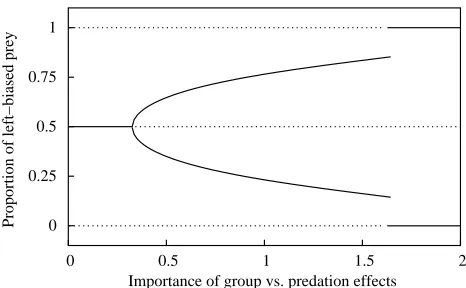
Figure 1: Equilibrium proportion of left-type prey in a group living species as a function of the parameter c in equation (1) (see text for details). Solid lines: stable equilibria; dashed lines: unstable equilibria. Parameters used are N=50 and k=5, see equations (5) and (6) in the text. The equilibrium proportion was obtained by standard methods for solving non-linear equations, as implemented by thefsolve function of the GNU/Octave software. Stability was checked using equation (4).
if a prey keeps together with a fraction x of individuals from a larger group of N. The probability of not being chosen as target is therefore
g(x) =1− 1
1+Nx (6)
majority of left-type prey and one with a majority of right-type prey. The intuitive content of such a situation is that the majority of prey get protection by keeping together, but pay a cost because predators are better at handling them. A minority of prey manages to enjoy the same escape probability by trading-off protection from the group with an advantage in the face of predators. Figure 1 also shows that the proportion of the majority prey type increases as c gets larger, until only populations composed entirely of one type of prey are stable. This corresponds to situations where the protection offered by the group is so large as to overcome any effect of differential ability in predators. For smaller values of c, populations composed of only one prey type are always unstable.
4
Conclusion
In summary, our model shows that populations consisting of left- and right-type individuals in unequal numbers — the most common situation among vertebrates — can be evolutionarily stable if being lateralized in one or the other direction has frequency-dependent costs and benefits (Raymond et al. 1996). We have ar-gued that, in prey-predator interactions, this can happen because of the interplay between individual lateralization, group living in prey and learning in predators. Vallortigara & Bisazza (2002) provide evidence that fits the model. Testing escape behaviour in 20 fish species, they found that 6 out of 10 solitary species (no group effects, or in the model) showed only individual-level lateralization, whereas all 10 shoaling species studied showed lateralization at the population level (P<0.01, Fisher’s exact probability test). Cases other than prey-predator interactions might be studied with the same logic. In social species, for instance, there appears to be ample opportunities for contrasting selective pressures on lateralization (Ray-mond et al. 1996), and this might result in the kind of frequency-dependence discussed above. In fact, individuals in social species often engage in both co-operation (favouring predictability of behaviour, hence majority-type individuals) and agonistic interactions (favouring unpredictability, hence minority-type indi-viduals). For instance, we know that agonistic interactions in gelada baboons are less likely to be elicited when a conspecific is on the baboon’s right side (Casperd & Dunbar 1996), although we ignore whether this is exploited by conspecifics.
Acknowledgments
We thank Richard J. Andrew, Michael Corballis, Magnus Enquist, Onur Gün-türkün, Chris McManus and Lesley J. Rogers for reading a preliminary version of this manuscript, and two anonymous referees for useful comments. SG has been supported by the Bank of Sweden Tercentenary Fund and Marianne och Marcus Wallenberg Stiftelse.
References
Andrew, R.J. (1991). The nature of behavioural lateralization in the chick. In Neural and behavioural Plasticity. The Use of the Chick as a Model (Ed. by R.J. Andrew), pp. 536-554, Oxford: Oxford University Press.
Annett, M. (1995). The right shift theory of a genetic balanced polymorphism for cerebral dominance and cognitive processing. Curr. Psychol. Cognit. 14: 427-480.
Burger, J. And Gochfeld, M. (2001). Smooth-billed ani (Crotophaga ani) preda-tion on butterflies in Mato Grosso, Brazil: Risk decreases with increased group size. Behav. Ecol. Sociobiol., 49: 482-492.
Cantalupo, C., Bisazza, A., Vallortigara (1995). Lateralization of predator-evasion response in a teleost fish (Girardinus falcatus). Neuropsychologia, 33: 1637-1646.
Casperd, L.M and Dunbar, R.I.M. (1996) Asymmetries in the visual processing of emotional cues during agonistic interactions by gelada baboons. Behav. Process., 37: 57-65.
Collins, R.L. (1985). On the inheritance of direction and degree of asymmetry. In Cerebral Lateralization in Nonhuman Species (Glick, S.D., ed.), pp. 41-71, New York, Academic Press.
Corballis, M.C. (1997). The genetics and evolution of handedness. Psychol. Rev., 104: 714-727.
De Santi, A., Sovrano, V.A., Bisazza, A., Vallortigara, G. (2001). Mosquitofish display differential left- and right-eye use during mirror-image scrutiny and predator-inspection responses. Anim. Behav., 61: 305-310.
Deckel, A.W. (1995). Lateralization of aggressive responses in Anolis. J. Exp. Zool., 272: 194-200.
Foster, W.A. and Treherne, J.E. (1981). Evidence for the dilution effect in the selfish herd from fish predation of a marine insect. Nature, 293: 508-510.
Güntürkün, O. and Kesh, S. (1987). Visual lateralization during feeding in pi-geons. Behav. Neurosci., 101, 433-435.
Hori, M. (1993). Frequency-dependent natural selection in the handedness of scale-eating Cichlid fish. Science, 260: 216-219.
Hunt, G.R., M.C. Corballis and Gray, R.D. (2001). Laterality in tool manufacture by crows. Nature, 414: 707.
Levy, J. (1977). The mammalian brain and the adaptive advantage of cerebral asymmetry. Ann. New York Academ. Sci., 299: 264-272.
Lippolis, G., Bisazza, A., Rogers, L.J., Vallortigara, G. (2002). Lateralization of predator avoidance responses in three species of toads. Laterality, 7: 163-183.
Mackintosh, N.J. (1974). The Pyschology of Animal Learning. London: Aca-demic Press.
Maynard-Smith, J. (1982). Evolution and the theory of games. Cambridge, U.K.: Cambridge University Press.
Maynard Smith J. & Sondhi K. C. (1960). The genetics of a pattern. Genetics 45, 1039-1050.
McManus, I.C. and Bryden, M.P. (1992). The genetics of handedness and cere-bral lateralization. In Handbook of Neuropsychology (Vol. 6) (Rapin, I. and Sega-lowitz, S.J., eds.), pp. 115-144, Elsevier, Amsterdam.
Mench, J.A. and Andrew, R.J. (1986). Lateralization of a food search task in the domestic chick. Behav. Neur Biol., 46, 107-114.
McGrew, W.C. and Marchant, L.F. (1999). Laterality of hand use pays off in foraging success for wild chimpanzees. Primates, 40: 509-513.
Peirce, J.W, Leigh A.E. and Kendrick, K.M. (2000). Configurational coding, fa-miliarity and the right hemisphere advantage for face recognition in sheep. Neu-ropsychologia, 38: 475-483.
Pilcher, T.J. (1986). The function of shoaling behaviour. In "The Behaviour of Teleost Fishes" (ed. T.J. Pitcher), pp. 294-337, London: Croom Helm.
Raymond, M., Pontier, D., Dufour, A., Moller, A.P. (1996). Frequency-dependent maintenance of left handedness in humans. Proc. R. Soc. Lond., B, 263: 1627-1633.
Rogers, L.J. (2000). Evolution of hemispheric specialisation: Advantages and disadvantages. Brain Lang., 73: 236-253.
Sovrano, V., Rainoldi, C., Bisazza, A., Vallortigara, G. (1999). Roots of brain specializations: Preferential left-eye use during mirror-image inspection in six species of teleost fish. Behav. Brain Res., 106: 175-180.
Sovrano, V.A., Bisazza, A., Vallortigara, G. (2001). Lateralization of response to social stimuli in fishes: A comparison between different methods and species. Physiol. Behav., 74: 237-244.
Steele, J. and Mays, S. (1995). Handedness and directional asymmetry in the long bones of the human upper limb. Int. J. Osteoarchaeol., 5: 39-49.
Treisman, M. (1975). Predation and the evolution of gregariousness. I. Models of concealment and evasion. Anim. Behav., 23: 779-800.
Vallortigara G. (1992). Right hemisphere advantage for social recognition in the chick. Neuropsychologia, 30: 761-768.
Vallortigara, G. (2000). Comparative neuropsychology of the dual brain: A stroll through left and right animals’ perceptual worlds. Brain Lang., 73: 189-219.
Vallortigara, G. and Bisazza, A. (2002). How ancient is brain lateralization? In Comparative Vertebrate Lateralization (L.J. Rogers and R.J. Andrew, eds.), pp. 9-69, Cambridge University Press, Cambridge, U.K..
Vallortigara, G., Pagni, P., Sovrano, V.A. (2004). Separate geometric and non-geometric modules for spatial reorientation: Evidence from a lopsided animal brain. J. Cogn. Neurosci., in press.
Vallortigara, G. Cozzutti, C., Tommasi, L., Rogers, L.J. (2001). How birds use their eyes: Opposite left-right specialisation for the lateral and frontal visual hemi-field in the domestic chick. Curr. Biol, 11: 29-33.
Vallortigara, G., Rogers, L.J., Bisazza, A., Lippolis, G., Robins, A. (1998). Com-plementary right and left hemifield use for predatory and agonistic behaviour in toads. NeuroReport, 9: 3341-3344.
Vermeire, B.A., Hamilton, C.R. and Erdmann, A.L. (1998). Right-hemispheric superiority in split-brain monkeys for learning and remembering facial discrimi-nations. Behav. Neurosci., 112: 1048-1061.