3410
Prolonging Sensor Network Lifetime by using
Energy-Efficient Cluster-based Scheduling
Technique
Arun Agarwal, Amita Dev, Khushboo Jain
Abstract: The energy consumption is one of the most common challenges in Wireless Sensor Network (WSN), as frequent communication between the sensor nodes (SNs) results in a huge energy drain. Moreover, a key challenge is to schedule the SN activities for data transmission by reducing energy utilization. To overcome this challenge we have proposed an Energy-Efficient Cluster-Based Scheduling Technique (EECST), which reduces the energy depletion for prolonging network lifetime. The proposed technique has three phases: In the first phase, a network model is built and Cluster head (CHs) are selected on the bases of the residual energy. In the second phase, EECST is introduced for the aggregation schedule. In the third phase, to maintain high residual energy across the WSN, an energy consumption model is presented. Simulation analysis and results proved that our EECST algorithm could meritoriously reduce energy intake and thereby enhance the network lifetime.
Keywords: Data Aggregation; Energy Efficiency; Network lifetime; Residual Energy; Scheduling Technique; Wireless Sensor Networks
————————————————————
1.INTRODUCTION
WSN comprises of huge number of SNs usually deployed in a random manner in areas to observe and collect physical measures from the environment like temperature, pressure or humidity. SNs communicate with each other by multi-hopping and other SNs acts as a relay to transfer and receive sensed data. In the majority applications, all SNs transmit their sensed data to a special sensor node named as base-station (BS) which associates the sensor network to the application interface and end-users. BS is supposed to have massive energy resources, higher processing capabilities, high transmission range and sufficient memory as compared to other SNs [1]. A significant issue in the design of WSN is energy consumption as the SNs are deployed in remote locations and where the battery replacement is almost impossible and unrealistic. Energy is consumed in sensing data and computing operations but a major part is utilized during data transmission and during data reception. The likelihood for dispensable SNs to stay is based on their energy exhaustion levels. Thus, the SNs required managing themselves for energy depletion and battery resources. If optimal power management is not there than then the SNs will have minimum lifetime. Thus grouping of SNs into clusters where selected cluster acts as a Cluster-Head (CH) are highly required to attain great energy efficiency which in succession enhance the senor network lifetime [2][3][4]. Our proposed scheduling technique termed as Energy-Efficient Cluster-based Scheduling Technique (EECST) is developed and implemented on cluster based organization in which the CH selection is based on the residual energy level which leads to huge energy conservations. The network model allows each
cluster to have normal SNs and the CHs perform the tasks of scheduling, data collection and data aggregation [5] and send the aggregated sensed data to the BS. Thus, the CHs drain energy at a higher rate as compared to the normal SNs due to their higher transmission frequency of receiving data from Cluster Member Nodes (MN) and sending data to BS. The EECST attempts to balance the energy utilization in the clusters by regularly selecting new CHs after every round of communication among all clusters. In addition, the CH monitors the cluster MNs for residual energy and based on which they are scheduled for sensing in successive rounds of data collection. The scheduling Technique proposed is based on the dividing the SNs in a cluster into active and inactive nodes. The active SNs are chosen based on their residual energy and perform their normal task of sensing and communicating with the CHs. Remaining SNs of the cluster act as inactive SNs, which sleeps during the operating and transmit their residual energy at the completion of the communication round. By this way we can preserve energy in the WSN for the prolong network lifetime. The remaining of the paper is systematized as follows: Section 2 describes the recent work, Section 3 presents the network model, CH selection scheme, energy model and our proposed algorithm (EECST) respectively. Section 4 presents the performance evaluation and results. Finally, the paper is concluded in Section 5.
2. RECENT WORK
In recent years, several works have been proposed to improve network life of cluster and energy efficiency during data transmission. In this section we present the valuable prior research accomplished in scheduling that are mainly determined towards energy efficiency and thereby improves overall network lifetime. The authors of [6] presented a novel distributed Power Scheduling (PS) algorithm for continuous monitoring of WSNs. The technique takes benefit of the time scale discrepancy among sensor network re-configuration stages and data transmitting stages. In [7] the authors proposed an EECBSS scheme, which is a cluster based scheduling technique that balances the energy efficiency and network lifetime. It has three phases: In first phase cluster
_______________________________
Arun Agarwal, PhD Research Scholar, Department of Computer Science, Guru Gobind Singh Indraprastha University, India Email: [email protected].
Amita Dev, Vice Chancellor, IGDTUW, Delhi, India Email: [email protected].
3411 topology is discovered and CH is selected based on residual
energy level. In the second phase, scheduling algorithm is presented which allocated a TDMA schedule to avoid collision. In the third phase, energy consumption model was introduced to maintain maximum residual energy level through the network. The authors of [8] have proposed an Energy efficient sleep scheduling for cluster based aggregation, which support high rate of data transmission and reduces energy consumption. The authors of [9] have presented an optimal RSSI CH selection (OCHS) algorithm that is also based on environmental conditions to achieve energy efficiency and enhanced network lifetime by effectively managing energy levels within the network. The originality of this work is that we have taken into consideration the received signal strength index (RSSI) of SNs from the base-station (BS). Simulation analysis and results proved that our OCHS algorithm can effectively enhance the network life- time by two times and thus it is an energy-efficient way to choose a CH. In research[10], instead of changing CH’s for dynamic clustering at every round, the authors have intend an optimal CH threshold function and an energy threshold function to postulate the dynamicity of CH on the based on the current energy intensities, thus enhancing the sensor network lifetime. The authors of [11] have proposed and implemented a High Energy First (HEF) algorithm which addresses the issue of predictability. It improves to be an optimal CH selection algorithm that prolong network lifetime. The authors of [12] have introduced a Power Aware (PA) technique to improve network lifetime. The idea was that the every sensor area should be supervised should be monitored relatively by one SN and other SN such that the network is monitored at all-time within their functioning range. The authors of [13] have presented a LSW which is a local wake-up scheduling method and is built on ant colony based scheduling scheme to enhance sensor network lifetime. The algorithm works in two phases: In first phase, it finds a set of SNs which provides full coverage and in the second phase finds the replacements of SNs which are draining out of energy. The authors of [14] have presented a new protocol Energy-Efficient Optimal Chain Protocol (EEOC) for increasing energy efficiency of WSN. The results of simulation is compared with LEACH, PEGASIS, and ACT etc. and concluded that important performance measures are First Node Die (FND), Half Node Alive (HNA) and Last Node Alive (LNA). EEOC outperforms the other protocols and ensure energy efficiency. The authors of [15] have presented a resilient steady clustering technique (RSCT) which will maintain durability and steadiness to the sensor network by reducing the unnecessary and avoidable cluster head (CH) changes and minimizing clustering and networking overheads. The authors have introduced a new SN that acts as a standby node (SBN) in the cluster. This SBN performs the tasks of CH, whenever the actual CH moves (or dies) from the cluster. Later the CH re-elect the new SBN. This process keeps the network available and serviceable without any interruption. The research carried out in [16] have presented and simulated EESCA, which is a hybrid CH selection algorithm to develop the energy efficient sensor network. The algorithm had eradicates the unnecessary overhead by revolving the CH role between the SNs at the precise time intervals, and thereby decreases the energy consumption considerably. Excessive modelling and simulation depicted that EESCA achieves low control overhead and offer a better load balancing over the
other comparing protocols. The authors in [17] had proposed LTSQR, which is an energy efficient routing protocol developed for WSN, which integrates three deliberations: localization, time synchronisation and QoS aware multipath routing. Performance of the LTSQR protocol was compare with LEDMPR and EQSR protocols based on the parameter like average delay, packet loss ratio, routing overhead, average energy consumption, packet delivery ratio, throughput, Network Lifetime. To address the various scheduling issues, the authors of [18] have proposed energy efficient MATSS algorithm which is multi-attribute time-slot scheduling (MATSS). The MATSS algorithm focus to prolong SN lifetime with prior available time-slot and multi-part dynamic routing (MPDR) neighbour conditions. Based on these parameters the SN scheduled as sleep and wakeup mode for each available time-slot. The SN selection performed depending on the state of neighbour SNs and energy parameter by distribution the data between them. The authors of [19] had proposed three protocols: distributed energy-efficient clustering (DEEC), developed DEEC (DDEEC) and enhanced DEEC (EDEEC). All the clustering methods were compared with CH energy reduction rates and sensor network lifetime. Performance analysis of results evicted that EDEEC protocol outperforms DECC and DDEEC protocols in terms of sensor network lifetime. The authors of [20] have proposed MALOKSER for operative clustering and secure routing within period to the BS. The main goal of the work was to improve network security and energy constraints in sensor networks. The performance was evaluate under parameters like minimum energy consumptions, packet deliver ratio, communication overheads, etc. and is compared with the competing techniques shows better results.
3. PROPOSED APPROACH
In this section “An Energy-Efficient Cluster-based Scheduling Technique” (EECST) which reduces energy consumption and put emphasis on increasing the network lifetime is discussed. As there exists several related work which give importance to network lifetime and energy efficiency of individual SNs. Our technique focus on the increasing the network lifetime of all clusters of the network based on cluster based scheduling and total energy consumption of cluster MNs.
3.1 Network Model
3412 Figure 1: Network Model
3.2 Cluster Head Selection
In each cluster, the cluster MNs creates a random energy probability E[p] in the cluster setup phase and computes a threshold, T(n) by the following relation:
( )
( ( )
(1)
Where n is the total SNs, G is the set of clusters, E[res] is the amount of residual mobile energy, E[high] is the highest energy of SN in a cluster, r is the current round number and E is the desired percentage for CH. A SN will be selected as a CH when E< E[p]. The chosen CHs will now broadcast a “JOIN-REQ” packet to its neighbors SNs. All the SNs in the network will collect this packet and send a “MEM-JOIN” packet to the nearest CH. On reception of this packet, each CH will maintain a routing-table of cluster MNs that belongs to that cluster. CH will also built a time-slot based on TDMA schedule. The CH will communicate the generated timeslots to all cluster MNs. By using this timeslots, the cluster MNs can transmit there sensed value and residual energy info to their respective CHs. After CH selection phase, each cluster MN will send its sensed data and residual energy to their respective CH as per their TDMA schedule. Each CH will be responsible for maintain the residual energy information of its respective MNs for each round. In the network setup phase, each CH collects the highest residual energy from its cluster MNs and transmits it to the next CH just before a round completes. In this way each CH will accumulate residual energy from their MNs and strive to discover the highest residual energy value E[high] of the WSN. Finally the E[high] value will be communicated to all CHs and the CHs will broadcast this value to their respective MNs for the calculation of threshold T(n) in the next round.
3.3 Scheduling Algorithm
The proposed scheduling algorithms identify the SNs based following modes: one is the ACTIVE mode in which the SN will perform normal operations and the other is the SLEEP mode in which the SN will not participate in any operation. After the clusters are formed and CHs are chosen, we will apply the process of our scheduling. To conserve energy we have classified SNs into two categories as ODD and EVEN within each cluster based on their unique Ids. Each round of communication will be divided into n fixed time slots from t1 to
tn for sensing. In t1, time-slot only ODD category of SN will
remain ACTIVE and EVEN category will SLEEP and in t2
time-slots EVEN category of SNs will be ACTIVE and ODD will SLEEP. Thus in each upcoming time-slots there will be switching among the ODD and EVEN numbered SNs until the
current round of communication completes. Both ACTIVE and SLEEP SNs will perform their tasks for each round and will send their residual energy E[res] just before the completion of that round for the calculation of the threshold T(n) for CH selection as discussed in previous section.
3.4 Energy Model
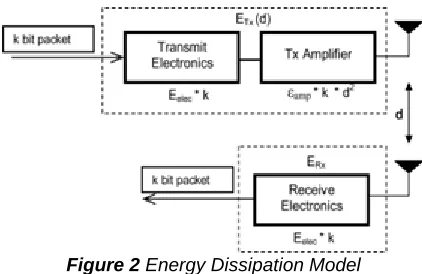
There are usually four working system of a SN which are processing unit, sensing unit, radio communication subsystem which includes a receiver, transmitter, amplifier and antenna ; and a energy unit. The energy dissipation in a SN is depended on the processing unit, sensing unit and radio unit of the SN. A simple model for the radio communication energy dissipation is assumed in which transmitter fritters energy to run the radio electronics.
Figure 2 Energy Dissipation Model
This model uses both free-space (fs) and multi-path (mp) fading channels depending on the distance between the transmitter and receiver. A threshold is defined to determine the channel to be used. If the distance is less than the threshold, fs channel is used on the other hand if the distance is greater than the threshold; the mp channel is used [21]. Thus, to send a k-bit data packet over a distance d, the radio spends:
( ) ( ) ( ) (2)
( ) {
(3)
where threshold d0 is given as
√
(4) To receive the data packet, the radio spends:
( ) ( ) (5)
3413
(6)
where tot is total energy expenses within the network, ETX is
the amount of energy utilized during transmission, ERX is the
energy utilized while receiving, Esleep is the energy consumed
when the SNs are in idle state, Eactive is the energy consumed
during data sensing and Eswitch is the energy spent in switching
from one mode to another. In this model, the ERX , Esleep, Eactive,
Eswitch are constants and ETX varies based on the distance
covered during transmission.
4.PERFORMANCE EVALUATIONS
This section describes the simulation environment and performance metrics that we have used to analyze EECST algorithm. We have presented results and demonstrate the proficiency analysis of our EECST algorithm in comparison with the Energy Efficient Cluster Based Scheduling Scheme EECSS[7] and Energy-Efficient Sleep-Scheduling for Cluster Based Aggregation EESSCBA[8].
4.1 Simulation Environment and Performance Metrics
4.1.1 Simulator Used:
We have used NS2.35 [22] simulator to demonstrate the performance analysis of EECST. To investigate the feasibility of our scheduling algorithm we have conducted experiment with varying SNs (25, 50, 75 and 100). In each scenario, the SNs are randomly deployed in the sensing field of 500m by 500m. All SNs have same transmission range of 50m. The simulation time will be 60sec and traffic is constant bit rate (CBR).
Table 1: Simulation Parameters
Parameter Value
WSN area 500m * 500m
No of SN 25,50,75,100
Protocols EECST,EECSS, EESCBA
Simulation time 60sec SN initial energy 10 J
Mobility Model Random waypoint Traffic Constant Bit Rate (CBR) Eelec (for Tx and Rx) 50 * 10-9 J/bit
Eamp 100 * 10-12 J
Data packet size 512 bytes
4.1.2 Performance Metrics:
We have evaluated the proficiency of EECST on the basis following metrics:
1. Energy Consumption: The energy consumption refers to the energy consumed during various modes (transmit, receive, sleep, active, switch) of SNs. The network model of EECST, the simulation leads to uniform distribution of energy utilization in WSN.
2. Network Lifetime: It is defined as the operational time of the network during which it is capable of performing
its dedicated tasks. The EECST enhances the lifetime by retaining energy of SNs and clusters.
3. Packet Delivery Ratio (PDR): It is the ratio of number of data packets that have been sent by the sender as compared with the number of data packets that have been successfully delivered to the receiver.
4. End-to-End Delay (EED): The simulation averages the time taken for a data packet for all successfully delivered data packets transmitted across the network from CHs to the BS.
4.2 Results and Discussion
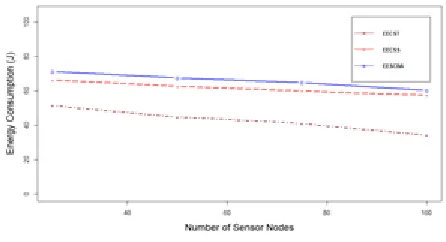
To examine the performance of our algorithms. The simulation parameters used during our experimentation for all approaches are mentioned in Table 1. The evaluation outcomes between EECST, EECSS and EESCBA in terms of energy consumption by varying the SNs are depicted in Figure 3. Here x-axis refers to the Number of SNs and the corresponding y-axis refers to the energy consumption. In EECST, as the number of SNs increases the energy consumption across the network decreases. This is possible only by the incorporation of network model, CH selection and our Scheduling approach. . During data transmission, the EECST protocol consumes around 20J and 25J less than the EECSS and EESCBA protocols respectively. The overall energy consumption is also balanced across the entire network in case of EECST.
Figure 3: Energy Consumption
3414 Figure 4: Network Lifetime
Figure 5 shows the comparison between EECST, EECSS and EESCBA in term of packet delivery ratio. On x-axis refers to the number of SNs and corresponding y-axis refers to the packet delivery ratio. By varying the SNs from 25 to 100, we have plotted the PDR in each case. It is evident from figure 4 that the PDR of our approach is always more than that of EECSS and EESCBA by 10% to 30% in all the scenarios.
Figure 5: Packet Delivery Ratio
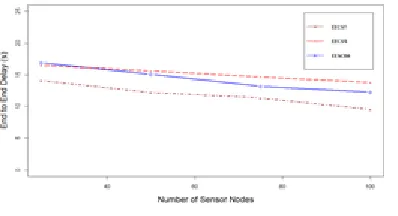
Figure 6 shows the comparison between EECST, EECSS and EESCBA in term of End-to-End Delay. On x-axis refers to the number of SNs and corresponding y-axis refers to the End to End Delay. By varying the SNs from 25 to 100, we have plotted the EED in each case. It is evident from figure 5 that the EED of our approach is always less than the other two algorithms by 20% to 25 % on varying the SNs.
Figure 4: End to End Delay
On the basis of above analysis and results, it has been apparently confirmed that EECST ensures high packet delivery ratio, higher energy efficiency, low end to end delay and prolonged network lifetime.
5. CONCLUSION AND FUTURE WORK
In a broad-spectrum, clustering in Sensor Networks has remained of great attention through industrial and research groups in the last decade. In this work, we have contributed a data scheduling technique EECST in order to improve energy efficiency and enhance network lifetime of a WSN. As discussed previously, EECST combines SNs into clusters, which results into energy efficient routing and data scheduling to support scalability in WSN. Our approach reduces communications overheads and energy draining which makes it appropriate for real-time large scale WSNs as we have
inculcate the requirement for fast minimum energy utilization and rapid convergence time with consideration to the cluster formation method. The most significant feature of EECST is the episodic selection of CHs, based on residual energies among all the SNs results in uniform distribution of energy consumption. Both analysis and extensive simulations support the quality and viability of our work.As future work, we will plan the additional development of recovery protocols just in case of CHs failure.
6 REFERENCES
[1]. Bhola A, Mhatre M, Jha CK “Energy efficient WSN using membership handshaking clustering technique for isolated nodes” presented in First International Conference on Smart Technologies in Computer and Communication (SmartTech-2017) [2]. Gupta K, Sikka V“Design Issues and Challenges in
Wireless Sensor Networks” International Journal of Computer Applications 112(4):26-32, February 2015.
[3]. Akyildiz, I.F.; Su,W.; Sankarasubramaniam, Y.; Cayirci, E. A survey on sensor networks. IEEE Commun. Mag.2002, 40, 102–114.
[4]. Gupta K, Yadav KP,” Data Collection Method to Improve Energy Efficiency in Wireless Sensor Network”. International Conference of Advance Research and Innovation (ICARI - 2015 )
[5]. Jain K, Bhola A (2018). “Data Aggregation Design Goals for Monitoring Data in Wireless Sensor Networks”, Journal of Network Security Computer
Networks, 4(3), 1–9.
http://doi.org/10.5281/zenodo.1464554.
[6]. C. Jandaeng, W. Suntiamontut, and N. Elz, “PSA: the packet scheduling algorithm for wireless sensor networks,” International Journal on Applications of Graph Theory in Wireless Ad Hoc Networks and Sensor Networks, vol. 3, no. 3, pp. 1–12, 2011. [7]. E. Srie Vidhya Janani and P. Ganesh Kumar,
“Energy Efficient Cluster Based Scheduling Scheme for Wireless Sensor Networks,” The Scientific World Journal, vol. 2015, Article ID 185198, 9 pages, 2015. https://doi.org/10.1155/2015/185198.
[8]. S. Jothi and M. Chandrasekaran, 2016. Energy Efficient Sleep-Scheduling for Cluster Based Aggregation in Wireless Sensor Network. Asian Journal of Information Technology, 15: 3718-3724. [9]. Jain K. and Bhola A. (2020). An Optimal
Cluster-Head Selection algorithm for Wireless Sensor Networks. WSEAS Transactions on Communications, ISSN / E-ISSN: 1109-2742 / 2224-2864, Volume 19, 2020, Art. #1, pp. 1-8 [10]. Jain K., Kumar A., Jha C.K. (2020)
Probabilistic-Based Energy-Efficient Single-Hop Clustering Technique for Sensor Networks. In: Bansal J., Gupta M., Sharma H., Agarwal B. (eds) Communication and Intelligent Systems. ICCIS 2019. Lecture Notes in Networks and Systems, vol 120. Springer, Singapore.
3415 clustering,” IEEE Transactions on Reliability, vol.
60, no. 3, pp. 675–688, 2011.
[12]. M. Cardei and D.-Z. Du, “Improving wireless sensor network lifetime through power aware organization,” Wireless Networks, vol. 11, no. 3, pp. 333–340, 2005.
[13]. M. K. Watfa and F. A. Shahla, “Energy efficient scheduling in WMSNs,” INFOCOMP Journal of Computer Science, vol. 8, no. 1, pp. 45–54, 2009. [14]. Agarwal A, Gupta K, Yadav K. (2016) A Novel
Energy Efficiency Protocol for Wsn Based on Optimal Chain Routing. IEEE Xplore 2016 3rd Int Conf Comput Sustain Glob Dev 488–493
[15]. Jain K, Kumar A, Vyas V. (2020) A resilient steady clustering technique for Sensor Networks. Special Issue Submission: Applications of Evolutionary Computing in Computer Science IJAEC: Volume 11, Issue 2.
[16]. Padmanaban Y, Muthukumarasamy M (2018) Energy-efficient clustering algo-rithm for structured wireless sensor networks. Inst Eng Technol. doi: 10.1049/iet-net.2017.0112
[17]. Palaniappan S, Periasamy P (2017) Enhanced approach for wireless sensor net-work based on localization, time synchronization and quality of service routing. Clus-ter Comput. doi: 10.1007/s10586-017-1488-x
[18]. Palaniappan S, Periasamy P (2017 Proposed Energy Efficient Multi Attribute Time Slot Scheduling Algorithm for Quality of Service in Wireless Sensor Network. Wireless Pers Commun doi.org/10.1007/s11277-017-4821-z
[19]. Kumari CU, Padma T (2019) Energy-Efficient Routing Protocols for Wireless Sensor Networks. In: Soft Computing and Signal Processing. Advances in Intelligent Systems and Computing, vol 898. Springer Singapore
[20]. Tyagi GDSS (2018) SMEER : Secure Multi ‑ tier Energy Efficient Routing Protocol for Hierarchical Wireless Sensor Networks. Wirel Pers Commun. doi: 10.1007/s11277-018-6101-y
[21]. W. Heinzelman,A. Chandrakasan, and H. Balakrishnan, , “An Application-Specific Protocol Architecture for Wireless Micro sensor network.” IEEE Transactions on Wireless Communications. 2002, vol.1 .no 4, pp 660-670.