Research Article Available online www.ijsrr.org ISSN: 2279–0543
International Journal of Scientific Research and Reviews
Biometrically Secured Electronic Voting Machine
P. Savitha
*, P. Jayachandar, P.Ragavi, P. Nandhini and M. Vijayan
Department of ECE, Velalar College of Engineering and Technology, Thindal, Erode, Tamilnadu, India- 638012
ABSTRACT
Political race day is one of the most energizing days of the year. Our country meets up to choose a pioneer who will speak to us on the worldwide stage for the following five years. We will choose a pioneer that will represent our privileges as residents, understudies, workers and managers. We will choose a pioneer that will ideally stay faithful to their obligations. Casting a ballot is the chance to add to the political procedure, and the framework was made to work best when everybody partakes. Hence, utilizing your entitlement to cast a ballot isn't only an expansion to the voter turnout insights distributed by each significant media site (which reliably show seniors as having the most elevated voter turnout - time for the young to get it). Your vote really matters and the country needs and needs to get your point of view. A majority rules system is an arrangement of government wherein the total of the populace takes an interest. Electronic Voting Machines (EVM) are being utilized in Indian General and State Elections to actualize electronic democratic to some extent from 1999 decisions and altogether since 2004 races. The EVMs diminish the time in both making a choice and announcing the outcomes contrasted with the old paper voting form framework. There were prior cases with respect to EVMs' tamparability and security which have not been demonstrated. After decisions of Delhi High Court, Supreme Court and requests from different ideological groups, Election Commission chose to present EVMs with Voter-Confirmed Paper Review Trail (VVPAT) framework.
KEYWORDS:
Ballot, Electronic Voting Machine (EVM), Voter-Confirmed Paper Review Trail(VVPAT)
* Corresponding author
P. Savitha
Department of ECE, Velalar College of Engineering and Technology,
Thindal, Erode, Tamilnadu, India- 638012
INTRODUCTION
Electronic surveying frameworks guarantee advantages to voters, for example, openness and comfort
that empower them to cast their votes whenever, from any Internet-associated registering gadget
anyplace on the planet. In any case, dissimilar to conventional paper-based democratic frameworks, an
e-surveying framework presents a few security dangers, for example, protection of vote; unlink capacity
of a voter, voter compulsion, mystery of incomplete political decision results, unquestionable status, and
survey honesty. The realness of a voter is another security concern, i.e., a voter must be distinguished
through a verification component that forestalls casting a ballot of unapproved voters or different
democratic from approved voters.
Another security concern is the control of votes by a tainted (e.g., infection, malware, etc)
casting a ballot gadget. Since the voters utilize their own gadgets to cast casts a ballot in a solo domain,
a malware-facilitated gadget could make unapproved adjustments to the voter's democratic decisions.
Numerous e-casting a ballot frameworks have been proposed, in any case, until now, every one of these
plans either neglect to give all the necessary security properties or are not for all intents and purposes
possible on light-weight figuring gadgets.
Right now, present a safe and evident surveying framework, SeVEP, that utilizes notable
cryptographic natives to give vote and voter's protection, and survey respectability, affirms the
personality of voters through a multifaceted verification plot, empowers different democratic inside the
permitted surveying time frame, forestalls twofold democratic, and accomplishes undeniable nature and
un coercibility within the sight of untrusted casting a ballot gadget. The security, execution, and relative
investigation as far as security properties and cryptographic costs show that SeVEP is secure, certain,
and pragmatic e-surveying framework.
EXISTING SYSTEM
When the last voter has casted a ballot, the Polling Officer responsible for the Control Unit will
press the 'Nearby' Button. From that point, the EVM won't acknowledge any votes. Further, after the
end of survey, the Balloting Unit is disengaged from the Control Unit and kept independently. Votes
can be recorded uniquely through the Balloting Unit.
Again the Presiding official, at the end of the survey, will hand over to each surveying specialist
present a record of votes recorded. At the hour of checking of votes, the all out will be counted with
During the tallying of votes, the outcomes are shown by squeezing the 'Result' button. There are
two shields to forestall the 'Result' button from being squeezed before the checking of votes formally
starts. This catch can't be squeezed till the 'Nearby' button is squeezed by the Polling Officer in-control
toward the finish of the democratic procedure in the surveying stall. This catch is covered up and fixed;
this can be broken uniquely at the including focus within the sight of assigned office.
PROPOSEDSYSTEM
The framework comprises of a carefully designed card where in all the records about the
individual are Stored. The voter need not find a workable pace at the surveying corners rather than this
issue can go direct to the Machine
Voters need to fix their unique mark acknowledgment. In view of the highlights of face and
Aadhar number gets coordinated with the individual who is station his/her vote. Face coordinating will
be finished utilizing the aadhar card information base utilizing MATLAB GUI. The voter finger is
coordinated with the database, Authorized individual's face will show in the MATLAB GUI. The voter
get a casted a ballot warning through GSM modem after voter choosing his area and his up-and-comer.
The productivity of a unique finger impression based biometric framework is generally high in
contrast with other biometric based validation frameworks like iris acknowledgment, retina examining,
voice acknowledgments or hand geometry or mark. They need to enter the OTP through matlab GUI. In
the event that unique finger impression is coordinated, at that point no one but they can ready to put a
vote.
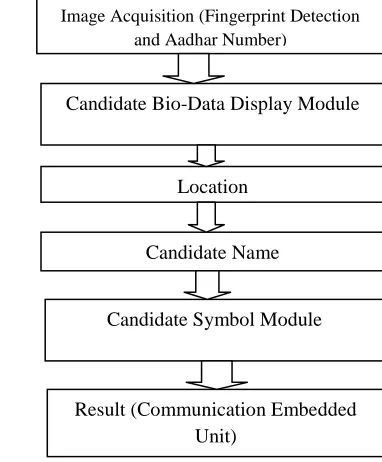
Figure 1. Block Diagram
Image Acquisition (Fingerprint Detection and Aadhar Number)
Candidate Bio-Data Display Module
Location
Candidate Name
Candidate Symbol Module
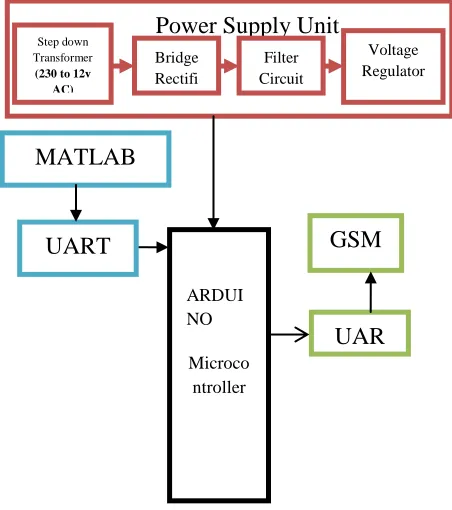
Figure 2. Hardware Unit
HARDWARE DESCRIPTION- ARDUINO UNO
The Arduino Uno is a microcontroller board dependent on the ATmega328 (datasheet). It has 14
computerized input/yield pins (of which 6 can be utilized as PWM yields), 6 simple information
sources, a 16 MHz fired resonator, a USB association, a force jack, an ICSP header, and a reset button.
It contains everything expected to help the microcontroller; basically associate it to a PC with a USB
link or force it with an AC-to-DC connector or battery to begin. The Uno contrasts from every previous
board in that it doesn't utilize the FTDI USB-to-sequential driver chip. Rather, it includes the
Atmega16U2 (Atmega8U2 up to variant R2) modified as a USB-to-sequential converter. Correction 2
of the Uno board has a resistor pulling the 8U2 HWB line to ground, making it simpler to place into
DFU mode.
Figure 3: Arduino Uno
Power Supply Unit Step down
Transformer
(230 to 12v AC)
Bridge Rectifi
er
Filter Circuit
Voltage Regulator
ARDUI NO
Microco ntroller
UART
Close to the AREF pin and two other new pins set close to the RESET pin, the IOREF that
permit the shields to adjust to the voltage gave from the board. In future, shields will be good both with
the board that utilization the AVR, which work with 5V and with the Arduino Due that work with 3.3V.
The subsequent one is a not associated pin that is saved for future purposes. "Uno" signifies one in
Italian and is named to stamp the up and coming arrival of Arduino 1.0.. The Uno and form 1.0 will be
the reference renditions of Arduino, pushing ahead. The Uno is the most recent in a progression of USB
Arduino sheets, and the reference model for the Arduino stage; for an examination with past forms, see
the file of Arduino sheets.
LCD DISPLAY
LCD (Liquid Crystal Display) screen is an electronic showcase module and locate a wide scope of
utilizations. A 16x2 LCD show is fundamental module and is regularly utilized in different gadgets and
circuits.
LCDs are economical
Easily programmable
Have no limitation of displaying special characters.
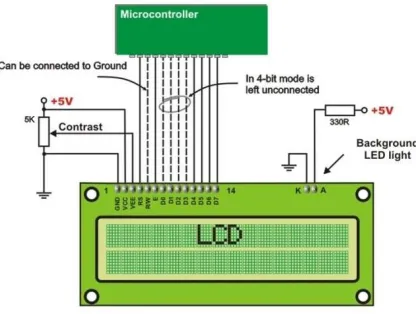
A 16x2 LCD implies it can show 16 characters for every line and there are 2 such lines.
Right now character is shown in 5x7 pixel framework. This LCD has two registers, to be specific,
Command and Data. The order register stores the order directions given to the LCD. An order is a
guidance given to LCD to do a predefined task like
Initializing it
Clearing its screen,
Setting the cursor position,
Controlling display & etc.
The information register stores the information to be shown on the LCD. The information is the ASCII
Figure 4. LCD Circuit Diagram
ARDUINO IDE
Arduino IDE represents Integrated Development Environment – An official programming
presented by Arduino.cc, that is for the most part utilized for composing, arranging and transferring the
code in the Arduino Device. Practically all Arduino modules are perfect with this product that is an
open source and is promptly accessible to introduce and begin arranging the code in a hurry.
It is effectively accessible for working frameworks like MAC, Windows, Linux and runs on
the Java Platform that accompanies inbuilt capacities and orders that assume an indispensable job for
investigating, altering and accumulating the code in the earth. A scope of Arduino modules accessible
including Arduino Uno, Arduino Mega, Arduino Leonardo, Arduino Micro and some more. Every one
of them contains a microcontroller on the board that is really modified and acknowledges the data as
code.
The fundamental code, otherwise called a sketch, made on the IDE stage will at last create a
Hex File which is then moved and transferred in the controller on the board.
The IDE condition principally contains two fundamental parts: Editor and Compiler where
previous is utilized for composing the necessary code and later is utilized for aggregating and
transferring the code into the given Arduino Module.This condition bolsters both C and C++
language.
APPLICATION AREAS OF SOFTWARE
Arduboy, a handheld game console basedon Arduino.
Ardupilot, dronesoftware and hardware.
C-STEM Studio, a platform for hands-on integrated learning of
computing, science, technology,engineering and mathematics (C-STEM) with
robotics.
OBDuino, a trip computer thatuses theon-board diagnostics interfacefound in most
modern cars.
OpenEVSE anopen-source electric vehicle charger
GSM
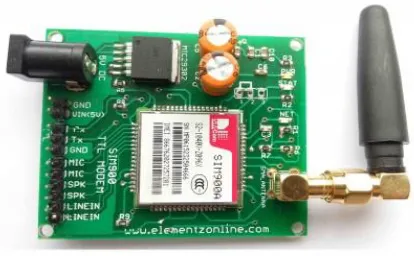
GSM is a portable correspondence modem; it is represented worldwide framework for versatile
correspondence (GSM). The possibility of GSM was created at Bell Laboratories in 1970. It is broadly
utilized versatile correspondence framework on the planet. GSM is an open and advanced cell
innovation utilized for transmitting versatile voice and information administrations works at the
850MHz, 900MHz, 1800MHz and 1900MHz recurrence groups.
Figure 5. GSM Modem
GSM framework was created as a computerized framework utilizing time division different
access (TDMA) system for correspondence reason. A GSM digitizes and lessens the information, at that
point sends it down through a channel with two unique floods of customer information, each in its own
specific schedule vacancy. The advanced framework has a capacity to convey 64 kbps to 120 Mbps of
information rates.
There are different cell estimates in a GSM framework, for example, full scale, miniaturized
cell measures in a GSM organize large scale, small scale, pico and umbrella cells. The inclusion zone of
every cell fluctuates as indicated by the execution condition.
PROCESS DESCRIPTION
The voter need to enter their unique mark through unique mark scanner and the picture gets
handled and coordinated with the pre given information in the Aadhar card. In the event that the unique
mark is coordinated, at that point the voter will be permitted to choose the area.
On the off chance that the chose area is likewise coordinated with Aadhar, at that point the voter
is permitted to choose the applicant name. In the wake of choosing the competitor name an OTP will be
produced and spring up on the screen. Voter needs to enter the OTP. On the off chance that the OTP
gets coordinated he will be permitted to choose the image. In the wake of choosing the image the casted
a ballot notice will be sent to the comparing number took on the Aadhar.
REFERENCES
1. Association Headquarters. “What are Public Opinion Polls? “ , Accessed: Jan. 31, 2019.
[Online]. Available:
https://www.historians.org/about-aha-and-membership/aha-history-and-
archives/gi-roundtableseries/pamphlets/em-4-are-opinion-polls-useful-(1946)/what-are-publicopinion-polls.
2. A. Wells. UK Polling Report. Accessed”, Jan. 31, 2019. [Online].Available:
http://ukpollingreport.co.uk/
3. Finle and C. Finley. (1999). Survey Monkey. Accessed: Jan. 31, 2019. [Online]. Available:
https://www.surveymonkey.com/
4. M. Blumenthal. (2018). Trump Approval Poll. Accessed: Jan. 31, 2019. [Online].
Available: https://www.surveymonkey.com/curiosity/trumpapproval-poll/.
5. A. Schneider, C. Meter, and P. Hagemeister. (2017). „„Survey on remote electronic voting.‟‟
[Online]. Available: http://arxiv.org/abs/1702.02798
6. D. L. Chaum, „„Untraceable electronic mail, return addresses, and digital pseudonyms,‟‟
Communication ACM, 1981; 24(2): 84–90.
7. M. R. Clarkson, S. Chong, and A. C. Myers, „„Civitas: Toward a secure voting system,‟‟ in
8. J. Benaloh, R. Rivest, P. Y. A. Ryan, P. Stark, V. Teague, and P. Vora, “End-to-End
Verifiability”, [Accessed:2019 Jan 2013 ] [Online]. Available from:
URL:https://www.microsoft.com/en-us/research/ publication/endend-verifiability/
9. F. Zagórski, R. T. Carback, D. Chaum, J. Clark, A. Essex, and P. L. Vora, „„Remotegrity: Design
and use of an end-to-end verifiable remote voting system,‟‟ in Applied Cryptography and
Network Security, M. Jacobson, M. Locasto, P. Mohassel, and R. Safavi-Naini, Eds. Berlin,
Germany: Springer, 2013; 441–457.
10.D. Chaum et al., „„Scantegrity II: End-to-end verifiability for optical scan election systems using
invisible ink confirmation codes,‟‟ in Proceedings of Electronic Voting Technology 2008;1–13.
11.R. Haenni and R. E. Koenig, „„Voting over the Internet on an insecure platform,‟‟ in Design,
Development, and Use of Secure Electronic Voting Systems, D. Zissis and D. Lekkas, Eds.
Hershey, PA, USA: IGI Global, 2014; 62–75.
12.B. Adida, „„Helios: Web-based open-audit voting,‟‟ in Proceedings of Security Symposium (SS)