© 2018 IJSRST | Volume 4 | Issue 2 | Print ISSN: 2395-6011 | Online ISSN: 2395-602X Themed Section: Science and Technology
Effect of UV - B Radiation on Plants
B. R. Gadi
Stress Physiology Laboratory, Department of Botany, Centre for Advanced Study, Jai Narain Vyas University, Jodhpur, Rajasthan, India
ABSTRACT
UV-B is a biologically active portion of ultraviolet light that has significant effects on the development and metabolism of plants. Despite it being a small component of sunlight, it can be damaging to many higher plant species and can cause mutations, damage to genetic material, reductions in photosynthetic activity, lower electron transfer rates, smaller shoot biomass, decreased leaf size, leaf number, and reductions in chlorophyll content, biomass and ultimately plant productivity. At the cellular level, it initially causes oxidative stress by increasing the reactive oxygen species (ROS) levels, which subsequently damage to proteins, lipids, and other biomolecules, thus, compromising the functionality and integrity of enzymes and cell membranes. Exposure to UV-B is obligatory for higher plants because of the need to maximize light capture for photosynthesis.UV-B radiation significantly increases enzymatic and non enzymatic antioxidants, cytosolutes (proline,sugars glycine betane), secondary metabolites and bioactive compounds for survival of plants. Plant Growth Regulators (PGRs) play important role in mitigating adverse effects of the radiation in plants. Plants have specific signaling pathway that regulate the protective gene expression responses to UV-B required for plant survival in sunlight. Recently, genetic engineering has contributed enormously to the develop transgenic plants . The identification of UV B stress-responsive genes and their subsequent introgression or overexpression within sensitive crop species are now being widely carried out by plant scientists.
Keywords : Antioxidants, Oxidative Stress, Photosynthesis, Transgenic Plants, UV B Radiation.
I.
INTRODUCTION
Solar radiation is of great importance for plants not only as a source of energy for photosynthesis but also as an environmental signal that regulates growth and development. The Ultra Violet (UV) spectrum is generally divided into three regions( UV –A,UV-B and UV –C): the UV-C region UV-B ( 280-315 nm) is of particular interest because this wavelength represents near about 1.5% of the total spectrum but can induce a variety of damaging effects through photochemical and photobiological reactions. In recent years, depletion of the stratospheric ozone layer because of industrialization and anthropogenic activities has led to an increase in UV-B radiation reaching the earth’s surface.
Effects On Plants :
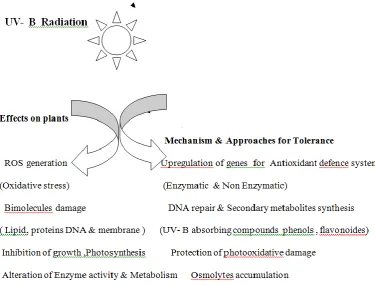
Enhanced UV-B radiation decreased plant height, dry weight, total biomass, seed germination, seed size, and yield per plant (Liu et al.2013). Growth reduction is mediated through leaf expansion , which is a consequence of the UV-B radiation effects on the rate and duration of both cell division and elongation (Hopkins et al.,2002). Increased UV-B radiation exposure reduced the photosynthetic rate of many species and, reduction in photosynthetic rate can be a consequence of damage to various molecular mechanisms of the photosynthetic machinery.It is mainly by degrading core proteins (D1 and D2) of photosystem II, inactivating RuBisCO, altering stomatal conductance, and inducing changes in photosynthetic pigments (Mpoloka,2008;Kohler,2017). Suppression of nodulation and inhibition of nitrogenase and nitrate reductase enzyme activity indicating negative impacts on Rhizobium -legume symbiotic nitrogen fixing system and nitrogen metabolism (Vijaylakshmi and Rajinderin,2014).
Low levels of UV-B exposures are not inhibitory in its action and promote metabolic processes on the way high level of UV-B decreased photosynthetic pigments (chlorophyll a, chlorophyll b and carotenoid) and carbohydrates while increased proline content in Coriandrum for protective mechanism (Kumar and Pandey,2017). UV-B-caused increase in concentrations of organic osmolytes such as proline and glycine betaine, which may be implicated in osmotic regulation (Ma X et al.,2016) .The proline accumulated in the seedling shoots of rice (Oryza sativa), mustard (Brassica juncea) and mung bean (Vigna radiate) exposed to UV-B radiation was studied by Saradhi et al. (1995). Accumulation of proline is an adaptive measure of plants against adverse conditions and it involves stabilization of proteins and antioxidant enzymes, balance of intracellular redox
homeostasis (ratio of NADP+/NADPH and GSH/GSSG) ,cellular signaling,scavenging of ROS such as superoxide radical (O2-), hydrogen peroxide
(H2O2) and hydroxyl (OH-) radicals (Saradhi et al.
1995.;Liang et al. 2013) . High doses of UV-B can cause membrane peroxidation through the development of reactive oxygen species (ROS) in plants (Kohler,et al, 2017). These ROS are highly reactive and they cause oxidative stress by initiating lipid peroxidation and degrading proteins, lipids and nucleic acids. To survive in stress conditions, plants are equipped with several low-molecular mass secondary metabolites i.e., ascorbate, glutathione, tocopherols, carotenoids, phenolic compounds and enzymatic antioxidants (SOD, POD, CAT) for scavenging the ROS (Mitller 2002). Superoxide dismutase (SOD) converts superoxide radicals to H2O2.
Catalase (CAT) and peroxidase (POD) are involved in converting H2O2 into water and oxygen thus removing
toxic radicals.
Increase in activity of enzymatic antioxidant (superoxide dismutase -SOD and Peroxidase – POD,Ascorbate peroxidase- APX) and non enzymatic antioxidant ( total phenolic content ) protect against UV- B radiation by detoxification of ROS ( Negi et al.,2015; Kohler et al.,2017). UV-B significantly enhanced antioxidant enzymes activities such as guaiacol peroxidase (POD), catalase (CAT), ascorbate peroxidase (APX) and glutathione reductase (GR) , and concentration of proline, H2O2 and
malondialdehyde (MDA) in the two Populus species (Ma et al.,2016) .
ultimately cell death (Lo et al., 2005; de Lima-Bessa et al., 2008). Takahashi et al (2015) suggested that low-UV-B–induced CPDs and/or DNA strand-breaks inhibit DNA replication and proliferation of Bright Yellow -2cells of tobacco ,whereas larger contents of high-UV-B–induced CPDs and/or DNA strand-breaks lead to cell death.
High levels of elevated UV-B radiation are genotoxic and causes cell disruptions by inducing chromosomal aberrations increasing TAB (%) and declined mitotic index (MI) % in plant cell (Kumar and Pandey,2017). Liu et al. (2015) suggested that reduced MI may be the outcome of breakdown of plant self-protection system and further inhibition of cell DNA replication, transcription and protein synthesis.
UVR8 photoreceptor controls the expression of numerous genes involved in the biosynthesis of flavonoids (protective phenolic sunscreens) and the gene encoding a cyclobutane pyrimidine dimer photolyase (UVR2), which is essential for repair of UV-B-induced DNA damage (Rizzini et al., 2011). UV-B light promotes phenylalanine ammonia lyase (PAL) activity which increases the production of phenolic metabolites (UV-B absorbing compounds, antioxidants ) that directly and indirectly protect against UVB-induced damage (Hideg et al., 2013; Kohler et al.,2017 ).
II.
APPROACHES TO IMPROVE TOLERANCE
OF PLANTS FOR UV -B RADIATION
Plant growth regulators (PGR’s) not only regulate plant growth and development of plant but also induce tolerance towards several abiotic stresses including drought, salinity, fluorides and mineral stresses (Gadi and Bohra,2005;Gadi and Gehlot,2011;Verma et al., 2012; Ram et al.,2014, Yadegari, 2017). Exogenous applied salicylic acid (Yadegari,2017), triadimefon (Rajindrin and Ramanujum,2006) , polyamines (Esmer et al.,2017)
and moderate salt treatment ( Ma et al,2016) alleviate UV –B radiation induced impairments in plants by improving antioxidant defence system, endogenous hormonal levels, secondary metabolites, cross tolerance etc.
SA treated seeds reduced UV-B radiation on concentrations of several polyphenols and produced more total phenolic, flavonoids, and antioxidants (Lee et al., 2013).Recently Yadegari (2017) investigated the comparative effects of phyto hormones on thyme seedlings and concludes that SA application was more suitable than IAA and GA regarding germination characters after UV radiation. Exogenous polyamine treatment also significantly mitigates UV-induced oxidative damage in Physcia semipinnata thalli (lichen) through a decrease of lipid peroxidation and can also protect the photosynthetic quantum yield (Esmer et al.,2017).
Moreover, it is evident that UV-A and UV-B treatment affects the template stability of DNA. This effect may be due to structural damage to DNA caused by oxidative stress. Polyamines play a part in protecting DNA against base alternations during exposure to UV illumination. Under UV-B radiation, moderate salinity reduced the oxidation pressure in both species, as indicated by lower levels of cellular H2O2 and membrane peroxidation, and weakened the
inhibition of photochemical efficiency (Ma et al.2016).
Figure 1. Effect of UV B radiation on plants
III.
CONCLUSION
UV-B radiation has adverse effects on plant growth, metabolism, photosynthesis, yield, cell cycle etc. Antioxidants, secondary metabolites, hormones play protective roles in plants. PGRs and transgenic plants improve the UV B stress tolerance capacity of plants which depends on plant species, environmental conditions, and severity of stress.
IV.
ACKNOWLEDGEMENTS
The author acknowledges to University Grant Commission, New Delhi for providing research facilities under Centre of Advanced Study (CAS) programme and Indian Academies of sciences (INSA-NASI-IASc ) Bangalore for granting Summer Research Fellowship.
V.
REFERENCES
[1]. Esmer,I.,Tuney,I., Ozakca, D. U. and Sukatar,A.(2017) Protective effects of polyamines against UV-A and UV-B illumination in Physcia semipinnata thalli. Botanica Serbia 41(1):17-24.
[2]. De Lia
Bessa,KM.,Armelini,M.G.,Chigancas,V.,Jacysyn, J.F.,Amarante-Mendes,G.P.,Sarasin,A.,
etal.,(2008).CPDs and 6-4 PPs play different roles in UV-induced cell death in normal and NER-deficient human cells. DNA Repair 7,303-312.doi:10.1016/j.dnarep.2007.11.003
[4]. Gadi, B. R. and Gehlot, R.K. (2011). Effect of bayleton on proline content and peroxidase activity in Psoralia odorata seedlings under salt stress. . Biochem. Cell. Arch. 11(1): 275-278. [5]. Huang, X., Yao, J., Zhao, Y., Xie, D., Jiang, X.,
and Xu, Z. (2016). Efficient rutin and quercetin biosynthesis through flavonoids-related gene expression in Fagopyrum tataricum Gaertn. hairy root cultures with UV-B irradiation. Front. Plant Sci. 7:63. doi: 10.3389/fpls.2016.00063
[6]. Hideg, É, Jansen, M. A. K., and Strid, Å. (2013). UVB exposure, ROS, and stress: inseparable companions or loosely linked associates? Trends Plant Sci. 18, 107-115.
[7]. Hopkins, L.Bond,M.A. and Tobin ,A.K. (2002) . Ultraviolet-B radiation reduces the rates of cell division and elongation in the primary leaf wheat (Triticum aestivum L. cv Maris Huntsman). Plant, Cell , Environ., 25 :617-624. [8]. Kohler H, Contreras RA, Pizarro M,
Cortés-Antíquera R and Zúñiga GE (2017) Antioxidant Responses Induced by UV-B Radiation in Deschampsia antarctica Desv. Front. Plant Sci. 8:921.
[9]. Kumar,G.and Pandey A.(2017). Effect of UV-B radiation on chromosomal organization and biochemical constituents of Coriandrum sativum L. Jordan J.Biol. Sci.10(2):85-93
[10]. Lee, M.J., Son, J.E. and Oh, M.M. 2013. Growth and phenolic content of Sowthistle grown in a closed-type plant production system with a UV-A or UV-B Lamp. Hort. Environ.Biotech., 54 (6): 492-500.
[11]. Liang X, Zhang L, Natarajan SK and Becker DF. 2013. Proline mechanisms of stress survival. Antioxid Redox Sig, 19:998-1011.
[12]. Liu F, Chen H and Han R. 2015. Different Doses of the Enhanced UV-B Radiation Effects on Wheat Somatic Cell Division. Cell Bio, 4:30-36. [13]. Lo,H.L.,Nakajima,S.,Ma,L.,Walter,B.,Yasui,A.,Et hell,D.W., etal.(2005). Differential biologic
effects of CPD and 6-4PPUV-induced DNAdamage on the induction of apoptosis and cell-cycle arrest. BMC Cancer 5:135.doi: 10.1186/1471-2407-5-135
[14]. Ma, X., Yong-Bin, O., Yong-Feng, G., Stanley, L., Tao-Tao, L., Yang W., Yong-Fu C., Yu-Fang S.,4 & Yin-An Yao1,3 Moderate salt treatment alleviates ultraviolet-B radiation caused impairment in poplar plants. Sci. Rep. 6, 32890; doi: 10.1038/srep32890.
[15]. Mittler R. (2002) Oxidative stress, antioxidants and stress tolerance. Trends Plant Sci 7: 405-410 [16]. Mpoloka S.W.(2008) Effects of prolonged UV-B
exposure in plants. Afric. J.Biotech. 7 (25):4874-4883.
[17]. Negi, P.N.,Sharma,V.K and Sarin ,N.B.((2015)Transgenic Tobacco Overexpressing Cytosolic Superoxide Dismutase Exhibit Enhanced Tolerance to UV-B Stress. Int. J. Innov. Res. Sci. Tech., 2 (08): 85-90.
[18]. Rajendiran.K. and M.P. Ramanujam. M.P.(2006) Interactive effects of UV-B irradiation and triadimefon on nodulation and nitrogen metabolism in Vigna radiata plants. Biol. Plant. 50 (4): 709-712.
[19]. Ram A,,Verma P. and Gadi B.R.(2014). Effect of Fluoride and Salicyllic Acid on Seedling Growth and Biochemical Parameters of Watermelon (Citrullus lanatus) .Fluoride .47(1) :49-55 [20]. Rizzini, L., Favory, J.-J., Cloix, C., Faggionato,
D., O’hara, A., Kaiserli, E., et al. (2011). Perception of UV-B by the Arabidopsis UVR8 protein. Science 332: 103-106.
[21]. Saradhi, P.P., Alia Sandeep, A., Prasad, K., Arora, S., 1995. Proline accumulates in plants exposed to UV radiation and protects them against UV induced peroxidation. Biochem. Biophys. Res. Commun. 209 (1), 1-5.
cells. Front. Plant Sci. 6:254. doi: 10.3389/fpls.2015.00254
[23]. Verma, P., Gadi, B. R. and Ram, A. (2012). Effect of Salicylic Acid on Photosynthetic Pigments and Some Biochemical Content in Vigna Seedlings under Cadmium Stress. J. Chem. Bio. Phy. Sci. 2(4):1801-1809.
[24]. Vijayalakshmi, R. and Rajendiran, K.(2014) Impact of ultraviolet-b radiation on nodulation and nitrogen metabolism in Phaseolus vulgaris L. c.v. prevail. Int.J. Adv. Biol. Res.4(3) : 339-342.