Research article
Available online
www.ijsrr.org
ISSN: 2279–0543
International Journal of Scientific Research and Reviews
Isolation of Lactic Acid Bacteria from Different Dung Samples and In
Vitro Screening for Certain Probiotic Properties
Patel Prittesh*and Lad Vrutika
C G Bhakta Institute of Biotechnology, Uka Tarsadia University, Maliba Campus, Bardoli Mahuva Road, Tarsadi, 394350, Dist Surat, (Gujarat) India. (M)-91-9913668812
ABSTRACT
Lactic acid bacteria as probiotics are a center of attention for the manipulation of human gastrointestinal (GI) micro biota as a means of introducing them into digestive tract. Whether or not the probiotic strains employed shall be of human origin is a matter of debate but this is not a matter of concern as long as strains shown to survive the transport in the human GI and to colonize human intestine. This includes survival in the stressful environment of the stomach such as high pH. The objective of present study was to isolate and characterize different lactic acid bacteria having probiotic properties from different animal dung samples viz., cow, horse, buffalo, cow infant, goat, buffalo infant. The selected 6 bacterial strains from each sample were investigated for tolerance for bile salt (0.3%, 0.5%, 1% and 1.5% concentrations), survival in acidic and alkaline condition, susceptibility to antibiotics, and salt tolerance of 1 to 10% concentrations, arginine hydrolysis ability and catalase activity. The selected strains were able to survive up to 1.0% bile salt, pH value 5 and 9 and salt tolerance up to 6%. Among all the strains, buffalo dung isolate was able to survive at 1.5% bile salt and was found to be most efficient. All the strains show positive results for arginine hydrolysis and negative results for catalase test. These results suggest that isolated strains are thought to survive stressful intestinal environment and are considered to be suitable for probiotic applications.
KEY WORDS
: probiotics, lactic acid bacteria, dung, bile tolerance.
*Corresponding Author:
Prittesh Patel
C G Bhakta Institute of Biotechnology, Uka Tarsadia University, Maliba Campus, Bardoli Mahuva Road, Tarsadi, 394350, Dist Surat, (Gujarat) India. (M)-91-9913668812
INTRODUCTION:
The isolation and screening of microorganisms from natural sources is always been an important
aspects of research. So far animal health is concern, probiotics are gaining important consideration for
their role they play in alleviate certain disease condition. In present study we have used various animal
dung samples to isolate and screen out certain probiotic properties. The term Probiotics comes from the
Greek word ‘pro bios’ which means ‘for live’1. Mention of dietary use of cultured dairy products
containing live microorganisms is found in the Bible and sacred books of Hinduism. Probiotics are live
micro-organisms that when administered in adequate amounts confer a health benefit on the host by
improving microbial balance in intestine2. According to Fuller (1991) the belief in the beneficial effects
of the probiotic approach is based on the knowledge that the intestinal microflora provides protection
against various diseases3. The expansion of new probiotic products has produced new scientific
achievements and a strong demand for improved and scientifically-based selection criteria4. However
when the great variety of species, strain characteristics, and the habitat specifics are considered, it
becomes apparent that a established probiotic effect on a one strain or species cannot be transferred to
other strains or species5.
Among the probiotic microorganisms, Lactic acid bacteria (LAB) are regarded as the major
group. Most probiotic microorganisms belong to Lactic Acid Bacteria, such as Lactobacillus sp,
Bifidobacterium sp and Enterococcus sp6. LAB as non pathogenic in nature have been essential in food
and feed fermentation for centuries, because they add the nutritional value to the products. Cattle dung
and poultry faeces represent sources from which potentially useful lactic acid bacteria could be isolated
and exploited for biotechnological applications7. Oral administration of LAB is well tolerated and
proven to be safe in 143 human clinical trials and no adverse effects were reported9. The aim of present
study is to isolate lactic acid bacteria from dung samples from six animals and representative six isolates
investigated for probiotic properties.
MATERIAL AND METHODS
:
Isolation of lactic acid bacteria from different dung samples
Dung samples from six different animals’ viz., cow, horse, buffalo, cow infant, goat & buffalo
infant were collected from the area around Bardoli, District Surat, Gujarat. Dung samples were collected
in early morning in sterile plastic bag and then taken to lab for further work. Isolation of lactic acid
gm of each dung sample was added into 10 ml of sterile distilled water followed by centrifugation at
2500 rpm for 5 min. The supernatants were then diluted up to 106 dilution factor and 0.2 ml from last 3
dilutions were spread on MRS agar plates. The plates were incubated for 48 hr in CO2 incubator at 37
°C. The colonies with yellowish zone indicate the acid production on MRS agar. The selected isolates
from each dung samples were the purified on new sterile MRS agar plate and stored at -4 °C for further
work.
Identification tests for Lactic Acid Bacteria
All the six isolates were subjected to microscopic observation for gram staining reaction.
Following biochemical test were performed.
Arginine hydrolysis test
In order to see ammonia production from arginine, MRS broth supplemented with arginine and
Nessler’s reagent were used. Sterile MRS broth containing 0.3% L arginine hydrochloride was
inoculated with 1% overnight grown isolates. Inoculated tubes were incubated at 37°C for 48 hour. After
incubation, ammonia production was detected by adding 100µl of cultures with same amount of
Nessler’s reagent on a white background. The change in colour was recorded. Bright orange color
indicates positive reaction while yellow colour indicates negative result. A negative control was also
maintained which did not contain arginine.
Catalase test
The presence of catalase activity can be confirmed by visible formation of gas bubbles from
hydrogen peroxide as it breakdown the hydrogen peroxide into water and gas bubbles. The test was
performed on overnight growth isolates on nutrient agar slant. After 24 hr 3% hydrogen peroxide was
added drop wise on culture in tube. Results were recorded by the production of bubbling on slant.
Bile tolerance
Starting culture was prepared by inoculating single colony of each isolates into sterile MRS broth
and incubated at 37°C for 24 hr. Bile tolerance was checked on MRS agar prepared with different
concentration of bile salts. 0.1ml of overnight grown culture were spreaded on MRS agar plate with 3%,
0.5%, 1.0% and 1.5% (w/v) bile salts (Himedia). Results were recorded after 24 hr in terms of presence
Acidic and alkali tolerance
Acid tolerance was determined using method described by Yeong-Soo Park9. The overnight
grown culture was used to inoculate MRS broth (v/v). 0.1ml culture was inoculated into 9.9ml of sterile
broth of various pH such as 3, 4, 5, 6, 7, 8, 9. The pH of all broth were adjusted with 1N HCl and 1N
NaOH. Inoculated broths were incubated at 37°C for 24 hr. The results were recorded and tabulated in
terms of presence and absence of growth.
NaCl tolerance
Each isolates were checked for their ability to tolerate different NaCl concentrations. MRS
broths (9.9ml) with various concentrations (1 to 10%) of NaCl were inoculated with active culture of
each isolate (0.1ml). Results were recorded after 48 hr of incubation at 37°C.
Antibiotics susceptibility
Antibiotic susceptibility of each isolates was checked and recorded in terms of resistant or
sensitive. All the isolates were inoculated with soft nutrient agar on previously poured and solidified 3%
agar. Antibiotic discs (C- Chloramphinicol, R- Rifampicin, P-Penicillin, and A-Ampicillin) were kept
circularly at regular interval in plate. Observations were taken after 24hr of incubation.
RESULT AND DISCUSSION
:
In the present study attempt were made to isolate and characterize lactic acid bacteria from six
animal dung samples to analyze its probiotic properties. The salient feature of findings is outlined as
below.
Isolation and Identification of lactic acid bacteria from different dung samples
Petrof (2009) mentioned that the isolation of probiotics is not limited to the human tract10. The
guts of several animal species, including pigs, rats and even poultry and other animals are good sources
of probiotics. Recently, L. johnsonii CRL 1647, isolated from the Apis mellifera L. bee gut, was shown
to exhibit a beneficial effect on honeybee colonies11. In vitro selection is the first approach used to select
a few strains that can be evaluated in vivo12. In present work, by direct method of isolation 37 lactic acid
producing bacterial isolates were obtained from all the six animal dung samples. All of them produced
acid on MRS medium containing bromo cresol purple. M ROGOSA (1951) developed a selective
medium for the isolation and enumeration of oral and faecal lactobacilli and Bifidobacterium that
is tolerated by lactobacilli and bifidobacteria, inhibits the growth of other organisms in sample. The
morphological characteristics was also investigated and showed that most of the isolates were gram
positive rod. Buffalo dung sample was found to be rich in the terms of microbial diversity with over 9
isolates obtained. Out of total 37 isolates, 6 representative isolates from each sample were selected for
further studies. These isolates viz., CD3, BD7, GD4, HD2, CID4 and BID6 were selected on the basis of
size of clear yellow color zone produced surrounding the colony within 24 hr.
In present study all the isolates were found to hydrolyze arginine. Furthermore all the isolates
were catalase negative, which indicates that all are lactic acid bacteria. Results of Cullimore (2000)
support our data14. Lactic acid bacteria constitute an essential part of the healthy gastrointestinal
microceology and are involved in the host metabolism15. Lactic Acid Bacteria are a group of
Gram-positive, non- spore forming, cocci or rod shaped, catalase-negative and fastidious organisms,
considered as ‘Generally Recognized as Safe’ (GRAS) organism16.
Bile tolerance
The ability to survive the action of bile salts is an absolute need of probiotic bacteria, and it is
generally included among the criteria used to select potential probiotic strains12. Investigation on bile
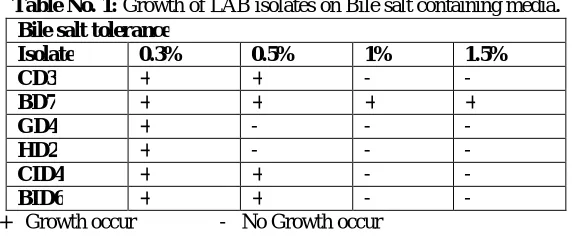
tolerance shows that only BD7 isolate from buffalo dung could grow in the range of 0.3 to 1.5%.
Furthermore CD3, CID4 and BID6 could able to grow up to 0.5% bile salt. GD4 and HD2 were the
sensitive to bile salt and could not able to survive after 0.3%. These data agreed with the report of D.O.
Darilmaz (2012), who reported that tolerance of lactobacillus spp. varied at different pH17. When
evaluating the potential of using lactic acid bacteria as effective probiotics it is generally considered
necessary to evaluate their ability to resist the effects of bile acids18.
Table No. 1: Growth of LAB isolates on Bile salt containing media.
Bile salt tolerance
Isolate 0.3% 0.5% 1% 1.5%
CD3 + + - -
BD7 + + + +
GD4 + - - -
HD2 + - - -
CID4 + + - -
BID6 + + - -
pH tolerance
According to FAO/WHO (2002) acid tolerance is one of the general criteria that are considered
during the selection of potential probiotic strains to guarantee their viability and functionality19.
Resistance to low pH is one of the important factors for selection of potential probiotics20. The survival
at low pH is important if intended to use in gastrointestinal tract for health improvement. The results of
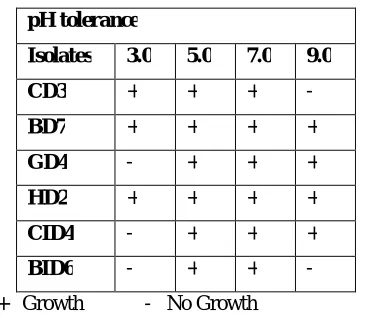
Acid tolerance are shown in Table no 2. Determination of acid tolerance of Lactic Acid Bacteria was
investigated for pH of 3.0, 5.0 and 9.0. Isolate CD3, BD7 and HD2 could grow at low pH 3, but their
growth was lower as compare to growth between pH5 and pH7. Among all the six isolate studied,
although at variable degree, only BD7 and HD2 isolates could grow in entire pH range studied. It
indicate that these isolates are resistance to broad pH range and able to survive at low ph and can be
used in probiotic applications. B. Hyronimus (2000) reported that Bacillus laevolacticus DSM 6475 and
all Sporolactobacillus strains tested except Sporolactobacillus racemicus IAM 12395 were resistant to
pH 321. Generally the survival rate was low at pH3 and pH9, moderate at pH7 and good at pH5.
Table No. 2: Growth of LAB isolates at pH 3, 5, 7 and 9 pH tolerance
Isolates 3.0 5.0 7.0 9.0
CD3 + + + -
BD7 + + + +
GD4 - + + +
HD2 + + + +
CID4 - + + +
BID6 - + + -
+ Growth - No Growth
NaCl tolerance
The result of NaCl tolerance presented in Table no.3. Determination of NaCl tolerance of Lactic
Acid Bacteria was investigated for NaCl tolerance of 1% to 10% in MRS broth. Initially the growth was
recorded in low salt concentration containing MRS broth. But later on most of the isolates were able to
grow up to 6% and visible growth recorded after 3 days of incubation at 37°C. Only BD7 isolate could
grow up to high salt concentration of 8%. Although the growth of CD3 and HD2 was recorded less but
Table No. 3: Growth of LAB isolates at 1 to 10% NaCl containing MRS broth NaCl tolerance
Isolates 1% 2% 3% 4% 5% 6% 7% 8% 9% 10%
CD3 +++ +++ +++ +++ +++ ++ + - - -
BD7 +++ +++ +++ +++ +++ +++ ++ + - -
GD4 +++ +++ +++ +++ +++ ++ - - - -
HD2 +++ +++ +++ +++ +++ ++ + - - -
CID4 +++ +++ +++ +++ ++ + - - - -
BID6 +++ +++ +++ +++ ++ + - - - -
+ Less growth ++ Good growth +++ Very good growth - No Growth
Antibiotic susceptibility
Lactic acid bacteria used as probiotics may serve as hosts of antibiotic resistance genes, which
can be transferred to pathogenic bacteria, so it is therefore important to verify that the single bacterial
isolates (strains) do not contain transferable resistance genes22. In present study antibiotic susceptibility
was check for all six isolates. In present study we have used four antibiotics namely
chloramphenicol, rifampin, penicillin and, ampicillin.. LAB isolates were found sensitive to
Chloramphenicol, rifampin and ampicillin and resistant to penicillin.Consistent with previous reports by
D'Aimmo, Modesto, and Biavati (2007) the susceptibility to different antibiotics could variable and
depending on the species23.
REFERENCES:
1. Gismondo MR, Drago L, Lombardi A. Review of probiotics available to modify gastrointestinal
flora. International Journal of Antimicrobial Agents. 1999; 12(4): 287-292.
2. FAO. WHO working Group report on Drafting Guidelines for the Evaluation of Probiotics in
Food. London, Ontario, Canada.. 2002.
3. Fuller, R. Probiotics in human medicine. 1991; 32(4): 439.
4. Tannock, Gerald W. Probiotic properties of lactic-acid bacteria: plenty of scope for fundamental
R & D. Trends in biotechnology. 1997; 15(7): 270-274.
5. Jürgen Schrezenmeir, Michael de Vrese. Probiotics, prebiotics, and synbiotics approaching a
definition. The American journal of clinical nutrition. 2001; 73(2): 361s-364s.
6. Klein Günter, Pack Alexander, Bonaparte Christine, Reuter Gerhard. Taxonomy and physiology
7. Uche Ruth Chiamaka, Ekundayo Emmanuel Olufemi. Screening cattle dung and poultry faeces
for isolation of lactic acid bacteria in Umuahia, Abia State, Nigeria. Academia Arena. 2013;
5(11): 1-4.
8. S. Naidua, W. R. Bidlacka & R. A. Clemensb. Probiotic spectra of lactic acid bacteria (LAB).
Critical reviews in food science and nutrition. 1999;39(1): 13-126.
9. Yeong-Soo Park , Ji-Young Lee , Yong-Suk Kim , and Dong-Hwa Shin. Isolation and
Characterization of Lactic Acid Bacteria from Feces of Newborn Baby and from Dongchimi.
Journal of Agricultural and Food Chemistry. 2002; 50(9): 2531-2536.
10.Petrof, Elaine O. Probiotics and gastrointestinal disease: clinical evidence and basic science.
Anti-inflammatory & anti-allergy agents in medicinal chemistry. 2009; 8(3): 260.
11.MC Audisio, MR Benítez-Ahrendts. Lactobacillus johnsonii CRL1647, isolated from Apis
mellifera L. bee-gut, exhibited a beneficial effect on honeybee colonies. Beneficial microbes.
2011; 2(1): 29-34.
12.Morelli, L. In vitro selection of probiotic lactobacilli: a critical appraisal. Current Issues in
Intestinal Microbiology. 2000; 1(2): 59-67.
13.M Rogosa, Joyce A. Mitchell, and Ralph F. Wiseman. A selective medium for the isolation and
enumeration of oral and fecal lactobacilli. Journal of Bacteriology. 1951; 62(1): 132.
14.Cullimore, D Roy. Practicalatlas for bacterial identification: CRC Press. 2000.
15.MF Fernandez, S Boris, C Barbes. Probiotic properties of human lactobacilli strains to be used in
the gastrointestinal tract. Journal of Applied Microbiology. 2003; 94(3): 449-455.
16.Nikita Choksi, Hemangi Desai. Isolation, identification and characterization of lactic acid
bacteria from dairy sludge sample. Journal of Environmental Research And Development. 2012;
7(1A).
17.D.O. Darilmaz, Y. Beyatli, and Z.N. Yuksekdag. Aggregation and hydrophobicity properties of 6
dairy propionibacteria strains isolated from homemade Turkish cheeses. Journal of food scienc.
2012; 77(1): M20-M24.
18.Lee Y-K, Salminen S. The coming of age of probiotics. Trends in Food Science & Technology.
1995; 6(7): 241-245.
19.FAO/WHO. Guidelines for the evaluation of probiotics in food. London Ontario, Canada. 2002.
20. Cakır, I. Determination of some probiotic properties on Lactobacilli and Bifidobacteria. Ankara
21.Hyronimus , C. Le Marrec, A. Hadj Sassi, A. Deschamps. Acid and bile tolerance of
spore-forming lactic acid bacteria. International Journal of Food Microbiolog. 2000; 61(2): 193-197.
22.D'Aimmo, Maria Rosaria, Modesto, Monica, & Biavati, Bruno. Antibiotic resistance of lactic
acid bacteria and Bifidobacterium spp. isolated from dairy and pharmaceutical products.
International Journal of Food Microbiology. 2007; 115(1): 35-42.
23.Danielsen Morten, Wind Anette. Susceptibility of Lactobacillus spp. to antimicrobial agents.