SPB: Scalable Polynomial Backoff Algorithm
For IEEE 802.11s Networks
A.B Nataraju, S.A Hariprasad
Abstract : Wireless Mesh Network (WMN) [1] is a popular choice in setting up cost-efficient alternative to provide broadband internet services to a larger geography. The performance of WMN is greatly impacted by the collision due to simultaneous transmissions by many users at the same time. This problem has been addressed by MAC layer using BEB [2] collision avoidance (CA) algorithm. There are many CA algorithms (EIED, EILD, MILD, PB, ISBA, EBO, HBA, etc.,) published in the recent past to reduce the collisions. These algorithms works better than BEB in specific network configurations (such as higher node density, delay sensitive data transmission …), otherwise they underperform when compared to BEB. This work proposes Scalable Polynomial Backoff (SPB) algorithm using fast decrease mechanism (after successful transmission) to support better throughput under varied node densities (grid sizes), and varied number of radio interfaces (1/2/3). The new algorithm has been tested for its performance using NS3 simulator [3]. The results show the SPB algorithm performs better than BEB in about 93% of network configurations against BEB and better than PB[4] algorithm in about 73% of network configurations (with application packet Size set to 1500 bytes).
Keywords : WMN, BEB, MAC, HWMP, MRMC, CA
———————————————————
1.
INTRODUCTION
WMNs have been projected as the most preferred alternative for next-generation wireless networks with cost effective last-mile connectivity. They essentially make use of multi-hop communication to support wireless services over a large geographical area. At the heart, the Mesh Router provides internet access to the Mesh Clients. A Mesh Router can be built out of general-purpose computing devices like, laptops, desktops, or on dedicated systems. The simplicity in adding the new routers make WMNs, the preferred technology for applications viz., Advanced Metering Infrastructure (AMI), intrusion detection systems, remote video surveillance, smart grids, environmental monitoring. In many applications, WMNs are expected to support internet services to heterogeneous clients over a large area through inter network. Increased demand for wireless Internet access has led to rapid growth in WLANs in recent years. The lion's share of this burgeoning market has been captured by IEEE 802.11 (WLAN) family of products. Most of the traffic carried on a typical WLAN is made up of non-real-time applications such as web browsing, email etc; WMN [5] is advancement over WLAN, which can provide wireless connectivity over a relatively large geography. In our previous work [6] , it was found that multiple radios in mesh routers provide better throughput performance. Still WMNs are undergoing rapid progress and inspiring numerous applications due to their enhanced capability against WLANs. However, many technical issues still exist in WMNs. Some of the common sets of problem areas, which needs to be handled in order to achieve better WMN performance are (a) choosing the most efficient backoff algorithm which has been developed for WLAN instead of the default BEB algorithm, (b) choosing the most efficient routing protocol which can work with complex meshed connections which makes wireless connectivity more and more complex to manage and support user data transmission, (c) multi radio devices can support better throughput but there is not much literature has been published on multi radio backoff schemes, which needs a serious deliberation on suitability of multi radio (MR) backoff (BO) schemes instead of single radio(SR) BO schemes. The following section discusses different works on CA algorithms for WLAN and WMN.
2.
RELATED WORK
observed that the BEB mechanism induces a heavy-tailed delay distribution in case of unlimited retransmissions. Also they have inferred that DCF is prone to long delays and not suited to carry delay-sensitive data. Anderton et.al, [11] have observed BEB may not be a best medium allocation algorithm under many of the application scenarios. Thus the work carried out in this work finds a greater significance for WMN throughput enhancement. B. Nithya et.al, [12] proposed an Integer Sequences based Backoff Algorithm (ISBA) which exploits cubic, exponential, jacobsthal and catalan integer sequences to estimate the proper Contention Window (CW) size. Based upon backoff stages and failure count of acknowledgments, these integer sequences are used to accomplish the adequate growth rate of CW. This leads to relatively efficient medium access to curtail end-to-end delay and collisions among contending stations. Suzhi et.al, [4] have observed that the BEB mechanism, the key collision avoidance scheme in DCF of 802.11, is fundamentally defected in inducing divergent moments of medium access delay. The delay variance can easily approach infinity with pragmatic system configurations, which translates into service starvation for some users and eventually leads to severe service inequality among users. The authors have shown that the application of power law delay can be mitigated by swapping BEB with polynomial back-off (PB). They have found, through a rigorous analysis, that all delay moments are finite with polynomial backoff, and thus fundamentally fix the problem of starvation and inequality. In addition, PB yields higher throughput with a practical network size when the order of the polynomial backoff function is set reasonablyBalador et.al, [13] inferred that the network performance can be improved when the multiple channels are used simultaneously over multi radios using different frequency bands. But for this mechanism to work properly the channels shall be separated spatially far apart to avoid any interference to communications over other channels at the same time. It is also observed the channels (1, 6, 11, and 14) or (2, 7, 12) or (3, 8, 13) can be used by routers / nodes simultaneously over different logical or physical radios. Supporting multiple simultaneous communications over channels separated in frequency domain is called as multi-radio / multi-interface based communication. The multi radio feature can supported over existing 802.11b/g/n hardware with software update or with brand new hardware to support the multi-radio functionality over multiple antennas. In [14], the authors have proposed an Enhanced BO (EBO) algorithm with different contention intervals dependent upon back off stage. The proposed hybrid algorithm is dynamic in nature and found to absorb the collisions more efficiently than BEB and other older variants of backoff algorithms. In our previous work [15], it is observed that Polynomial backoff (PB) is relatively better candidate for modification to support better WMN performance. This work tries enhancing PB to support higher throughput for WMNs. The following section tries explaining the test setup used for performance evaluation of SPB against BEB and PB algorithms.
3.
PROBLEM FORMULATION, ALGORITHM &
METHODOLOGY USED
The main goal of this work is to identify the optimal number of radio interfaces, packet size; and backoff algorithm to achieve peak throughput performance for WMNs. The CA algorithms in consideration are BEB, PB, and proposed algorithm (SPB).
The algorithm for SPB is as follows:
Algorithm – 1: Scalable Polynomial Backoff (SPB) Algorithm
Initialization of Parameters used:
σ = 2; CWmin = 31, CWmax = 1023; W0 = CWmin;
CWboStage = W0; slotTime =72µs
Backoff procedure after each collision:
1: ++ ;
2: CWboStage = (1+ σ )
boStage
* W0 ;
3: CWboStage = min (CWboStage , CWMAX)
4: BackoffTimer Random(0, CWboStage ) * slotTime;
5: SEND THE PACKET out after the BackoffTimer times out
Backoff procedure after each successful data transmission:
6: ( )
7: = ; // Reduce the back off stages
by a factor for THREE
8: else
9: = ;
10:
11: CWboStage = (1+ σ)
boStage
* W0
12: CWboStage = max (CWboStage , CWMIN)
13: BackoffTimer Random(0, CWboStage ) * slotTime;
14: SEND THE PACKET out after the BackoffTimer times out
The methodology to obtain the test results is as follows:
Algorithm – 2 : Methodology for performance evaluation [15] Initialization:
gridSize = 3x3, 4x4, 5x5, 6x6, 7x7; nInternfaces = 1, 2, 3;
packetSize = 400, 600, 800, 1000, 1200, 1400, 1500, 1600, 1800, 2000;
RngRun = 11, 22, 33, 44, 55, 66, 77, 88, 99, 101, 111, 122, 133, 144, 155, 166, 177, 199, 201, 211; // 20 values
Methodology:
1: Repeat for all packetSize // realized by m_packetSize
2: Repeat for all nInternfaces, // realized by m_nIfaces 3: Repeat for all gridSize, // realized by m_xSize &
m_ySize
4: Repeat NS-3 simulation with different RngRun
5: Run the NS-3 simulation with specific gridSize,
packetSize interfaces, and Random Seed number(RngRun)
6: ./waf --command-template="%s --m_xSize=4
--m_ySize=4 --m_packetSize=1400
--m_nIfaces=2 --m_step=170 --RngRun=22" --run scratch/HwmpGrid
7: This statement simulate 4x4 grid, nInterfaces
= 2, PacketSize = 1400;
8: Save the results; // result-1, 2, 3,….20
9: End - Repeat NS-3 simulation
10: Find the median of these 20 iterations and tabulate
for analysis/characterization.
11: End - Repeat for all gridSize
12: End - Repeat for all nInternfaces 13: End - Repeat for all packetSize
14: Repeat the above steps 1-13 for different MAC CA
algorithms viz., BEB, PB, and SPB.
15: Compare the Throughput from BEB with other algorithms.
For instance, Table 7: indicates difference in Throughput from PB and BEB algorithms THPB - THBEB
Similarly, Table 8 : indicates difference in Throughput from SPB and BEB algorithms THSPB - THBEB.
The following section discusses the experimental results obtained using the methodology mentioned above and inferences are drawn accordingly.
4.
EXPERIMENTAL SETUP FOR CONTENTION
AVOIDANCE ALGORITHM TEST
The following results have been observed from the extensive simulations using NS-3 simulator and the inferences have been drawn accordingly. The set of configurations considered in these simulations are listed in
Table 1.
Table 1- Simulation parameters [6][15]
Parameter Values
Computing environment and Operating System
Ubuntu 16.04 LTS, HP Compaq 8200 Elite MicroTower - 4GM RAM, 500GB HDD Core-i5, 3.09GHz processor.
Grid size (P x Q) 3x3, 4x4, 5x5, 6x6, 7x7 Step size (metre) 170
Radio Propagation Model ns3::ConstantSpeedPropagationDel ayModel
Propagation Loss Model ns3::LogDistancePropagationLossM odel
Payload size (bytes) 0,4, 0.6, 0.8, ... 2.0 KB Simulation time (sec) 175
No of simulation scenarios (driven by different random seed numbers, RngRun = 11, 22, 33, 44, 55, 66, 77, 88, 99, 101, 111, 122, 133, 144, 155, 166, 177, 188, 199, 211)
20
Topology Grid
Routing protocols
considered HWMP+PMP (IEEE 802.11s) Number of radio interfaces
(channel no. – 0, 5, 10) 1 / 2 / 3
Number of nodes = MxN 9 / 16 / 25 / 36 / 49 No. of Connections / flows 9 / 16 / 25 / 36 / 49 EnergyDetectionThreshold -89.0 dbm CcaMode1Threshold -62.0 dbm
WifiPhyStandard WIFI_PHY_STANDARD_80211b RtsCtsThreshold 2200 (Disabled)
User application ns3::OnOffApplication Application data rate 150kbps
Channel allocation schemes
considered. BEB, PB
Channels used in MR setup 1, 6, 11
HWMP protocol performance has been analyzed against the system Throughput parameter, which is defined as:
Throughput (bps): it is a measure of number of application data bytes received by the receiver in one unit of time.
∑ Total no. of app data bytes received Throughput = --- ∑ Total simulation time
Contention window ranges for different MAC protocols are set as follows.
1) PB – Polynomial Backoff (PB_PAPER_2) [4]
β = 2;
{ }
CWboStage =(1+ β ) boStage
* W0
Backoff range {0, CWboStage }
Backoff Timer Random(0, CWboStage ) * slotTime;
Send the packet after BackoffTimer Expires.
2) BEB – Binary Exponential Backoff [2]
{ ( )
}
Backoff range {0, }
Backoff Timer Random (0,CW) * slotTime;
Send the packet after BackoffTimer Expires.
3) SPB – Scalable Polynomial Backoff
β = 2;
{ }
CWboStage =(1+ β ) boStage
* W0
Backoff range {0, CWboStage }
Backoff Timer Random (0, CWboStage ) * slotTime;
Send the packet after BackoffTimer Expires.
II. RESULTS ANALYSIS &DISCUSSION
In this section, we present the results obtained using NS-3 simulator and inferences are drawn accordingly.
Note for decoding Table 2 - Table 9.
4x4_1 grid size = 4x4, number of Interfaces = 1 6x6_2 grid size = 6x6, number of Interfaces = 2 …
SIZE Packet SIZE
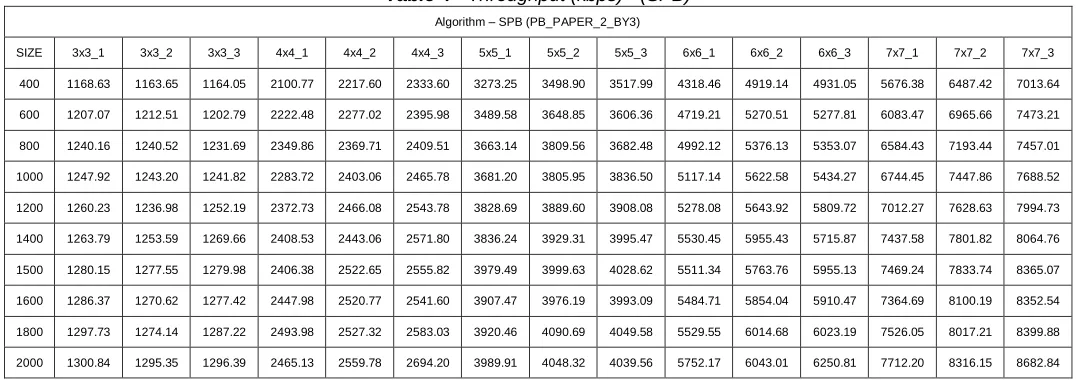
Table 2 - Table 5, list out the throughput (in kbps) with BEB, PB, and SPB algorithms.
Table 2 – Throughput (kbps) - (BEB)
Algorithm – BEB
SIZE 3x3_1 3x3_2 3x3_3 4x4_1 4x4_2 4x4_3 5x5_1 5x5_2 5x5_3 6x6_1 6x6_2 6x6_3 7x7_1 7x7_2 7x7_3
400 1161.35 1162.04 1165.74 2118.20 2183.42 2301.53 3239.60 3569.59 3422.76 4427.78 4921.48 4984.18 5810.75 6525.98 6896.29
600 1213.93 1216.29 1215.79 2222.04 2288.43 2362.13 3435.84 3662.47 3629.67 4826.96 5336.07 5253.05 6415.49 7121.34 7254.07
800 1246.97 1228.06 1226.36 2302.80 2337.31 2423.46 3674.58 3730.73 3686.08 5047.28 5459.10 5386.31 6715.52 7222.58 7365.16
1000 1245.96 1240.01 1250.65 2306.77 2437.24 2521.21 3619.89 3824.90 3827.13 5175.59 5532.75 5481.64 6854.76 7502.61 7697.23
1200 1258.88 1240.99 1252.28 2366.10 2343.60 2495.34 3857.69 4009.10 3920.76 5260.96 5604.71 5703.20 7233.34 7695.77 7847.47
1400 1268.42 1260.42 1263.26 2381.33 2485.36 2544.74 3755.57 4009.13 3961.10 5351.90 5863.01 5981.69 7230.72 7753.16 8104.65
1500 1266.61 1267.04 1261.69 2381.69 2493.78 2544.66 3896.76 3964.42 3944.26 5517.97 5753.46 5954.98 7405.08 7778.23 8313.34
1600 1266.85 1274.16 1265.45 2413.06 2413.45 2575.83 3887.91 4076.20 4041.46 5550.02 5901.56 6002.81 7424.27 7796.40 8268.23
1800 1327.10 1283.60 1284.45 2517.68 2507.10 2530.84 3978.27 4051.82 3950.72 5680.89 5773.33 6073.41 7633.75 7956.68 8557.23
2000 1309.66 1289.66 1299.35 2449.70 2586.00 2650.30 4067.98 4105.54 4053.70 5624.28 5993.13 6153.78 7526.26 8259.65 8379.65
The
Table 2, list out the throughput (kbps) by WMN with Binary Exponential Backoff (BEB) CA algorithm
Table 3 – Throughput (kbps) - (PB_PAPER_2)
Algorithm – PB (PB_PAPER_2)
SIZE 3x3_1 3x3_2 3x3_3 4x4_1 4x4_2 4x4_3 5x5_1 5x5_2 5x5_3 6x6_1 6x6_2 6x6_3 7x7_1 7x7_2 7x7_3
400 1166.49 1170.79 1171.59 2166.23 2209.19 2318.97 3258.01 3490.46 3554.33 4354.68 4849.01 4951.61 5634.88 6448.78 6904.13
600 1213.50 1207.97 1206.42 2245.39 2273.38 2390.31 3487.26 3634.77 3652.16 4758.99 5264.37 5207.34 6421.33 6951.63 7216.72
800 1225.13 1233.05 1228.29 2252.21 2297.61 2475.54 3667.47 3798.69 3667.41 4895.54 5407.54 5433.39 6559.48 7318.28 7482.71
1000 1246.48 1237.85 1246.46 2338.07 2350.93 2485.71 3733.29 3841.71 3899.20 5113.01 5601.45 5569.46 6953.29 7601.92 7791.30
1200 1257.60 1252.03 1251.67 2375.91 2364.00 2518.77 3771.78 3907.69 3924.43 5379.11 5710.16 5685.73 6800.97 7587.11 7817.66
1400 1314.95 1261.69 1272.55 2386.77 2391.80 2545.57 3966.97 4025.98 3933.80 5443.18 5721.62 5784.73 7127.68 7805.78 7989.72
1500 1279.90 1262.18 1270.60 2419.39 2515.07 2553.89 3902.97 3999.74 3913.63 5466.23 5943.22 5902.66 7380.57 7935.26 8034.82
1600 1293.00 1266.73 1268.30 2430.45 2464.53 2492.96 3819.08 4067.80 4079.84 5476.93 5964.18 5895.80 7486.77 7898.18 8405.39
1800 1282.62 1289.65 1280.68 2420.96 2452.69 2588.93 3918.95 4016.34 4053.37 5521.42 5972.43 5942.96 7505.97 8110.86 8327.55
2000 1308.33 1298.53 1294.18 2483.26 2539.58 2617.26 4007.54 4143.36 4096.19 5647.31 6133.55 6232.28 7724.57 8041.06 8490.83
The Table 3, list out the throughput (kbps) by WMN with polynomial backoff (PB) CA algorithm
Table 4 - Throughput (kbps) - (SPB)
Algorithm – SPB (PB_PAPER_2_BY3)
SIZE 3x3_1 3x3_2 3x3_3 4x4_1 4x4_2 4x4_3 5x5_1 5x5_2 5x5_3 6x6_1 6x6_2 6x6_3 7x7_1 7x7_2 7x7_3
400 1168.63 1163.65 1164.05 2100.77 2217.60 2333.60 3273.25 3498.90 3517.99 4318.46 4919.14 4931.05 5676.38 6487.42 7013.64
600 1207.07 1212.51 1202.79 2222.48 2277.02 2395.98 3489.58 3648.85 3606.36 4719.21 5270.51 5277.81 6083.47 6965.66 7473.21
800 1240.16 1240.52 1231.69 2349.86 2369.71 2409.51 3663.14 3809.56 3682.48 4992.12 5376.13 5353.07 6584.43 7193.44 7457.01
1000 1247.92 1243.20 1241.82 2283.72 2403.06 2465.78 3681.20 3805.95 3836.50 5117.14 5622.58 5434.27 6744.45 7447.86 7688.52
1200 1260.23 1236.98 1252.19 2372.73 2466.08 2543.78 3828.69 3889.60 3908.08 5278.08 5643.92 5809.72 7012.27 7628.63 7994.73
1400 1263.79 1253.59 1269.66 2408.53 2443.06 2571.80 3836.24 3929.31 3995.47 5530.45 5955.43 5715.87 7437.58 7801.82 8064.76
1500 1280.15 1277.55 1279.98 2406.38 2522.65 2555.82 3979.49 3999.63 4028.62 5511.34 5763.76 5955.13 7469.24 7833.74 8365.07
1600 1286.37 1270.62 1277.42 2447.98 2520.77 2541.60 3907.47 3976.19 3993.09 5484.71 5854.04 5910.47 7364.69 8100.19 8352.54
1800 1297.73 1274.14 1287.22 2493.98 2527.32 2583.03 3920.46 4090.69 4049.58 5529.55 6014.68 6023.19 7526.05 8017.21 8399.88
2000 1300.84 1295.35 1296.39 2465.13 2559.78 2694.20 3989.91 4048.32 4039.56 5752.17 6043.01 6250.81 7712.20 8316.15 8682.84
Table 5 – Throughput (kbps) - BEB, PB and SPB with packetSize – 1500 bytes
Algorithm – BEB, PB, SPB (Refer
Table 2 , Table 3, Table 4)
SIZE 3x3_1 3x3_2 3x3_3 4x4_1 4x4_2 4x4_3 5x5_1 5x5_2 5x5_3 6x6_1 6x6_2 6x6_3 7x7_1 7x7_2 7x7_3
BEB 1266.61 1267.04 1261.69 2381.69 2493.78 2544.66 3896.76 3964.42 3944.26 5517.97 5753.46 5954.98 7405.08 7778.23 8313.34
PB 1279.90 1262.18 1270.60 2419.39 2515.07 2553.89 3902.97 3999.74 3913.63 5466.23 5943.22 5902.66 7380.57 7935.26 8034.82
SPB 1280.15 1277.55 1279.98 2406.38 2522.65 2555.82 3979.49 3999.63 4028.62 5511.34 5763.76 5955.13 7469.24 7833.74 8365.07
Note: The Table 5, (Row-1500 extracted from
Table 2, Table 3, Table 4 ) plots the throughput with BEB, PB, SPB algorithms with different grid size (3x3, 4x4, 5x5, 6x6, 7x7), number of interfaces (1/2/3), and application packetSize = 1500 bytes.
Inference-1: (refer Table 5) SPB consistently perform better than BEB (row-1, androw-3) in 14/15 (93%) cases Inference-1: SPB perform better than PB (row-2, androw-3) in 11/15 (73%) cases
Table 6 - Differential throughput (kbps) - BEB, PB and SPB with packetSize – 1500 bytes
THPB(PB__PAPER_2) - THBEB (Refer Table 5)
SIZE 3x3_1 3x3_2 3x3_3 4x4_1 4x4_2 4x4_3 5x5_1 5x5_2 5x5_3 6x6_1 6x6_2 6x6_3 7x7_1 7x7_2 7x7_3
THPB -
THBEB
13.29 -4.85 8.91 37.70 21.29 9.23 6.21 35.33 -30.64 -51.74 189.76 -52.32 -24.51 157.03 -278.52 THSPB -
THBEB
13.53 10.51 18.29 24.69 28.86 11.16 82.73 35.21 84.36 -6.63 10.30 0.15 64.16 55.51 51.73
THSPB -
THPB
0.24 15.36 9.39 -13.01 7.57 1.93 76.52 -0.12 114.99 45.10 -179.46 52.47 88.66 -101.52 330.25
Inference-1: (refer Table 6) in 09/15 (60%) network configurations PB performs better than BEB (Refer row-1, PB, BEB). Also PB performs better than BEB when enabled with TWO radios. Also perform enhancement is not guaranteed with ONE / THREE radio interfaces (few negative values).
Inference-2: In 11/15 (73%) network configurations SPB performs better than PB (Refer row-3, SPB, PB)
Inference-3: In 14/15(93%) network configurations SPB performs better than BEB (Refer row-2, SPB, BEB). This indicates SPB is a better choice to replace BEB with better throughput than BEB irrespective of number of radio interfaces (1/2/3) enabled with the mesh router. Thus SPB is a better scalable algorithm than PB to replace BEB algorithm in WMN setup.
Inference-4: On an average 1% throughput enhancement by SPB against BEB (Refer row-2, SPB, BEB)
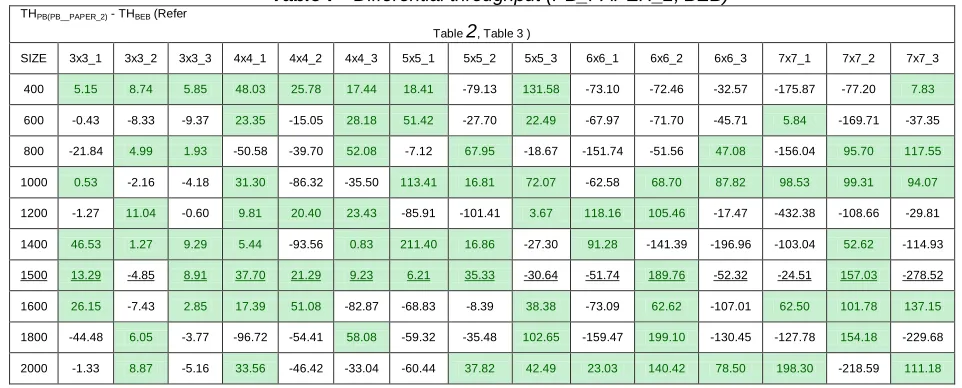
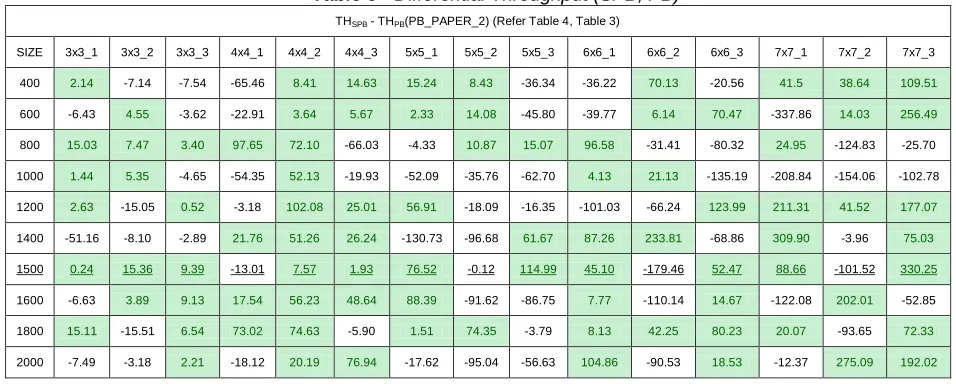
The following tables Table 7, Table 8, Table 9, list out the differential throughput between (PB, BEB), (SPB, BEB), (SPB, PB) respectively. A cell in these tables with green/gray shade indicates BEB underperform when compared to other CA algorithm.
For instance, when TH (PB 3x3_i1) > TH (BEB 3x3_i1) leads to positive value (gray shaded cell).
Table 7 - Differential throughput (PB_PAPER_2, BEB)
THPB(PB__PAPER_2) - THBEB (Refer
Table 2, Table 3 )
SIZE 3x3_1 3x3_2 3x3_3 4x4_1 4x4_2 4x4_3 5x5_1 5x5_2 5x5_3 6x6_1 6x6_2 6x6_3 7x7_1 7x7_2 7x7_3
400 5.15 8.74 5.85 48.03 25.78 17.44 18.41 -79.13 131.58 -73.10 -72.46 -32.57 -175.87 -77.20 7.83
600 -0.43 -8.33 -9.37 23.35 -15.05 28.18 51.42 -27.70 22.49 -67.97 -71.70 -45.71 5.84 -169.71 -37.35
800 -21.84 4.99 1.93 -50.58 -39.70 52.08 -7.12 67.95 -18.67 -151.74 -51.56 47.08 -156.04 95.70 117.55
1000 0.53 -2.16 -4.18 31.30 -86.32 -35.50 113.41 16.81 72.07 -62.58 68.70 87.82 98.53 99.31 94.07
1200 -1.27 11.04 -0.60 9.81 20.40 23.43 -85.91 -101.41 3.67 118.16 105.46 -17.47 -432.38 -108.66 -29.81
1400 46.53 1.27 9.29 5.44 -93.56 0.83 211.40 16.86 -27.30 91.28 -141.39 -196.96 -103.04 52.62 -114.93
1500 13.29 -4.85 8.91 37.70 21.29 9.23 6.21 35.33 -30.64 -51.74 189.76 -52.32 -24.51 157.03 -278.52
1600 26.15 -7.43 2.85 17.39 51.08 -82.87 -68.83 -8.39 38.38 -73.09 62.62 -107.01 62.50 101.78 137.15
1800 -44.48 6.05 -3.77 -96.72 -54.41 58.08 -59.32 -35.48 102.65 -159.47 199.10 -130.45 -127.78 154.18 -229.68
Inference-1: (refer Table 7) It can be inferred that Polynomial backoff (PB) works well when compared to BEB, Irrespective of number of interfaces, node density, packet sizes.
Inference-2: It can be inferred that PB with 2 or 3 radio interfaces (refer columns -- AxA_q, where A=3, 4, 5, 6, 7 and q = 2, 3), works well than BEB. In, 54% network configurations, PB work better than BEB.
Inference-3: It can also be inferred that PB works better than BEB when TWO / THREE radio interfaces are enabled on mesh routers. Relatively MR with TWO radios provides better results (consistently) than ONE / THREE radios.
Inference-4: In (09/15) 60% of network configurations, PB perform better than BEB (packet size = 1500 bytes)
Table 8 - Differential throughput (SPB, BEB)
THSPB - THBEB (Refer
Table 2, Table 4)
SIZE 3x3_1 3x3_2 3x3_3 4x4_1 4x4_2 4x4_3 5x5_1 5x5_2 5x5_3 6x6_1 6x6_2 6x6_3 7x7_1 7x7_2 7x7_3
400 7.28 1.60 -1.69 -17.44 34.18 32.07 33.65 -70.69 95.24 -109.32 -2.34 -53.13 -134.4 -38.56 117.35
600 -6.86 -3.78 -13.00 0.44 -11.41 33.85 53.75 -13.62 -23.31 -107.75 -65.56 24.75 -332.03 -155.68 219.14
800 -6.81 12.46 5.33 47.07 32.40 -13.95 -11.45 78.82 -3.60 -55.16 -82.97 -33.24 -131.09 -29.14 91.85
1000 1.97 3.20 -8.83 -23.05 -34.18 -55.43 61.31 -18.95 9.38 -58.45 89.83 -47.37 -110.31 -54.75 -8.71
1200 1.36 -4.01 -0.09 6.63 122.47 48.44 -29.00 -119.50 -12.68 17.12 39.21 106.53 -221.07 -67.14 147.26
1400 -4.63 -6.83 6.40 27.20 -42.30 27.06 80.67 -79.82 34.37 178.55 92.43 -265.82 206.86 48.66 -39.89
1500 13.53 10.51 18.29 24.69 28.86 11.16 82.73 35.21 84.36 -6.63 10.30 0.15 64.16 55.51 51.73
1600 19.52 -3.54 11.98 34.93 107.31 -34.23 19.57 -100.01 -48.37 -65.31 -47.51 -92.34 -59.58 303.79 84.31
1800 -29.36 -9.46 2.77 -23.70 20.22 52.18 -57.81 38.87 98.86 -151.34 241.35 -50.22 -107.70 60.53 -157.35
2000 -8.82 5.69 -2.96 15.43 -26.22 43.90 -78.07 -57.21 -14.14 127.89 49.89 97.03 185.94 56.50 303.20
Inference-1: (refer Table 8) in 93% of configurations, SPB perform better than BEB (packet size = 1500 bytes)
Inference-2: In about 56% cases SPB perform better than BEB with ONE/TWO/THREE radios enabled with mesh routers. SPB support more consistent enhanced performance when compared to PB. We can’t observe this consistency with PB algorithm.
Table 9 - Differential Throughput (SPB, PB)
THSPB - THPB(PB_PAPER_2) (Refer Table 4, Table 3)
SIZE 3x3_1 3x3_2 3x3_3 4x4_1 4x4_2 4x4_3 5x5_1 5x5_2 5x5_3 6x6_1 6x6_2 6x6_3 7x7_1 7x7_2 7x7_3
400 2.14 -7.14 -7.54 -65.46 8.41 14.63 15.24 8.43 -36.34 -36.22 70.13 -20.56 41.5 38.64 109.51
600 -6.43 4.55 -3.62 -22.91 3.64 5.67 2.33 14.08 -45.80 -39.77 6.14 70.47 -337.86 14.03 256.49
800 15.03 7.47 3.40 97.65 72.10 -66.03 -4.33 10.87 15.07 96.58 -31.41 -80.32 24.95 -124.83 -25.70
1000 1.44 5.35 -4.65 -54.35 52.13 -19.93 -52.09 -35.76 -62.70 4.13 21.13 -135.19 -208.84 -154.06 -102.78
1200 2.63 -15.05 0.52 -3.18 102.08 25.01 56.91 -18.09 -16.35 -101.03 -66.24 123.99 211.31 41.52 177.07
1400 -51.16 -8.10 -2.89 21.76 51.26 26.24 -130.73 -96.68 61.67 87.26 233.81 -68.86 309.90 -3.96 75.03
1500 0.24 15.36 9.39 -13.01 7.57 1.93 76.52 -0.12 114.99 45.10 -179.46 52.47 88.66 -101.52 330.25
1600 -6.63 3.89 9.13 17.54 56.23 48.64 88.39 -91.62 -86.75 7.77 -110.14 14.67 -122.08 202.01 -52.85
1800 15.11 -15.51 6.54 73.02 74.63 -5.90 1.51 74.35 -3.79 8.13 42.25 80.23 20.07 -93.65 72.33
2000 -7.49 -3.18 2.21 -18.12 20.19 76.94 -17.62 -95.04 -56.63 104.86 -90.53 18.53 -12.37 275.09 192.02
Overall inference:
1. It is inferred that BEB algorithm may not be the best choice for mesh routers in WMNs. With varied network configurations, BEB does not seem to work well. Same is true with other algorithms as well.
2. It can be inferred that SPB perform better than BEB more
consistently than PB. Thus SPB is suitable for working varied network configurations and hence suitable for scalable WMNs.
3. From the results we can infer that SPB does not put any restriction on number of radio interfaces enabled on each of the MRs to support higher throughput. Thus SPB is better scalable than PB / BEB algorithms.
CONCLUSION
In this work, we have proposed Scalable Polynomial Backoff (SPB) algorithm based on fast decrease mechanism to support higher throughput for WMNs. The SPB algorithm has been compared against PB and BEB algorithms using NS3 simulation results. The performance has been compared and contrasted in terms of packet size, grid size, number of radio interfaces. It is observed that SPB algorithm provide better throughput for WMNs when compared with PB and BEB algorithms. The SPB performance is consistent irrespective of the number of radio interfaces enabled on mesh routers. In about 93% of network configurations SPB perform better than BEB and in about 73% network configurations it performs better than PB (when packet size is set to 1500 bytes). In future we have plans to enhance SPB’s performance for varied WMN setups.
ACKNOWLEDGEMENTS
I would like to convey my sincere thanks to Dept. of ECE, AIT, which supported in running the NS3 [3] simulations in order to obtain these results.
REFERENCES
[1] I. F. Akyildiz, X. Wang, and W. Wang, ―Wireless mesh networks: A survey,‖ Comput. Networks, vol. 47, no. 4, pp. 445–487, 2005, doi: 10.1016/j.comnet.2004.12.001. [2] V. Bharghavan, A. Demers, S. Shenker, and L. Zhang,
―MACAW: A Media Access Protocol for Wireless LAN’s,‖ SIGCOMM Comput. Commun. Rev., vol. 24, no. 4, pp. 212–225, Oct. 1994, doi: 10.1145/190809.190334. [3] H. Tom, R. George, F. Sally, and Roy, Sumit,
―NS3-Simulator.‖ 2006.
[4] S. Bi and J. Zhang, Y, ―Mitigating power law delays: The use of polynomial backoff in IEEE 802.11 DCF,‖ in 2012 IEEE International Conference on Communications (ICC), 2012, pp. 2515–5210, doi: 10.1109/ICC.2012.6363967. [5] A. B. Nataraju and H. D. Maheshappa, ―Survey on Mac
Layer Solutions for Scalable Wireless Mesh Networks,‖ Int. J. Wirel. Commun. Netw. Technol., vol. 4, no. 4, pp. 68–73, 2015.
[6] A. B. Nataraju, H. D. Maheshappa, and A. Devkatte, ―Performance analysis of HWMP protocol for Wireless Mesh networks using NS3,‖ IEEE Reg. 10 Annu. Int. Conf. Proceedings/TENCON, pp. 1593–1598, Nov. 2016, doi: 10.1109/TENCON.2016.7848286.
[7] T. Imboden, K. Akkaya, and Z. Moore, ―Performance evaluation of wireless mesh networks using IEEE 802.11s and IEEE 802.11n,‖ in 2012 IEEE International Conference on Communications (ICC), 2012, pp. 5675–5679, doi:
10.1109/ICC.2012.6364932.
[8] A. B. Nataraju, H. D. Maheshappa, and B. R. Shilpashree, ―Implementation and Performance Analysis of DCWA MAC Protocol for Multihop Wireless Networks,‖ Int. J. Sci. Appl. Inf. Technol., vol. 4, no. 3, pp. 54–59, Jul. 2015.
[9] X. Sun and L. Dai, ―Backoff Design for IEEE 802.11 DCF
Networks: Fundamental Tradeoff and Design Criterion,‖ IEEE/ACM Trans. Netw., vol. 23, no. 1, pp. 300–316, Feb. 2015, doi: 10.1109/TNET.2013.2295242.
[10] T. Sakurai and H. L. Vu, ―MAC Access Delay of IEEE 802.11 DCF,‖ IEEE Trans. Wirel. Commun., vol. 6, no. 5,
pp. 1702–1710, May 2007, doi:
10.1109/TWC.2007.360372.
[11] W. C. Anderton and M. Young, ―Is our model for contention resolution wrong?: Confronting the cost of collisions,‖ in Annual ACM Symposium on Parallelism in Algorithms and Architectures, 2017, vol. Part F1293, pp. 183–194, doi: 10.1145/3087556.3087584.
[12] B. Nithya, U. Gupta, and H. Subbiah, ―Optimizing medium access using integer sequences in wireless networks,‖ in 2017 International Conference on Communication and Signal Processing (ICCSP), 2017, pp. 640–644, doi: 10.1109/ICCSP.2017.8286436.
[13] A. Balador, A. Movaghar, and S. Jabbehdari, ―History Based Contention Window Control in IEEE 802.11 MAC Protocol in Error Prone Channel,‖ J. Comput. Sci., vol. 6, 2010.
[14] X. Peng, L. Jiang, and G. Xu, ―Performance Analysis of Hybrid Backoff Algorithm of Wireless LAN,‖ in 2007 International Conference on Wireless Communications, Networking and Mobile Computing, 2007, pp. 1853–1856, doi: 10.1109/WICOM.2007.464.
[15] A. B. Nataraju and S. A. Hariprasad, ―Performance characterization of IEEE 802.11s compatible MAC protocols,‖ Int. J. Eng. Adv. Technol., vol. 9, no. 3, 2020.
AUTHORS’ PROFILE
Mr. Nataraju A.B, Assistant Professor, Dept. of ECE, AIT, Bangalore, completed his M.E degree from UVCE, Bangalore. He has work experience of over 9 years in Information Technology Industry (Huawei Technologies, Kodiak Networks, Sonus Networks…) and over 10 years in academia. +He is good with Computer Networking, VoIP, Internet Protocols, and Multimedia Communication. His research interest includes Wireless Networking, WMN performance enhancement, and wide area networking using WMNs. He has published about 10+ Conference/Journal publications. He is member of IEEE, IAENG, and CSI.
![Table 1. Table 1- Simulation parameters [6][15] 3) SPB – Scalable Polynomial Backoff β = 2;](https://thumb-us.123doks.com/thumbv2/123dok_us/8632750.1422458/3.612.34.292.245.607/table-table-simulation-parameters-spb-scalable-polynomial-backoff.webp)