A Study On Prediction Of Health Care Data Using
Machine Learning
M. Balamurugan, AVN Krishna, K. Balachandran, J. Bhuvana
Abstract: Every clinical-decision relies on the doctor’s experience and knowledge. Perhaps this conventional practice may look appropriate, but it may lead to unpredictable errors, biases, and maximized costs that may affect QoS (Quality-of-Service) given to patients. To help the doctor to save time, the conventional practice to analyze the data for clinical-decision support has to be updated. Machine Learning (ML) and Data Mining (DM) algorithms have applied to have greater and higher predictions. This paper studies a set of ML algorithms by which clinical-predictions are going to be more appropriate and cost-effective.
Index Terms: Classification, Health care, clustering, Data mining, Electronic-Health Record(HER), Health informatics, Machine Learning.
—————————— ——————————
1.
INTRODUCTION
Health-Informatics (HI) is one of the major challenging tasks in which more accuracy is required in prediction. EHR (Electronic-Health Record) contains health-related data of many patients. The major challenge is to analyze the huge data collections and to predict the disease based on the given data. In fact, the analysis and prediction processes are taken by the doctors and some other expertise persons. The doctors may predict the disease based on the symptoms exposed by the patient. With that experience and the knowledge of doctors may be restricted to a minimized level of disease prediction. Perhaps this conventional procedure looks better for minor diseases. The major milestone with the huge data is to have a greater analysis and collect knowledge from it. This is called as RLHC (Rapid-Learning-Health-Care) where the huge data is enormously growing but it requires appropriate analysis and predictions of diseases and other health-risks by the expertise persons. Recent advancement in ML in developing and executing it on patient’s health record dataset has depicted prominent outcomes. The ML models are completely dependent on labeled data for better predictions of the results. The state of art of ML models has given a bunch of solutions to provide better results for clinical tasks which seem to be impossible with traditional practices. The objectives of the ML models are to learn from the given data and to improve the prediction processes. This paper highlights some of the observations on ML and Data Mining strategies.
2 OBSERVATIONS
Mining of EHR data could provide core information which can enhance health-risk predictions and to enhance the clinical-decisions. The core objective of precise medication is to provide a qualitative model for patients which can predict health-status to prevent disability or some diseases. Many research studies have demonstrated the utilization of EHR
data to have a prediction on cancer, drug effects, interactions, and various diabetes subgroups. The ML models have been implemented in the process of accurate predictions on clinical-decisions. The ML model extracts the features from given EHR data and to give a solution for predictive tasks, mainly the decision-support, forecasting, disease diagnosis, virus anomaly detection, etc. The major hurdle with this task is to infer knowledge that is appropriate to the structural-pattern on the given input dataset. Another issue with the bio-medical dataset is full of incompleteness. These datasets may have affected by incompleteness, noise, unwanted information, etc. Hence it makes the implementation of ML oriented automated methods more difficult.
Objectives
The major objective of this paper is to study the ML models which help in better prediction of EHR Data.
This study carried out in three subsets:
Classification of ML methods
Classification of State of the art research in health-risk or disease prediction.
Deliver future research directions on the enhanced prediction process.
Background
Categorization of Machine Learning Models:
Figure.1: Categorization of Machine Learning Models
————————————————
M. Balamurugan, Department of CSE, CHRIST (Deemed to be University), Bengaluru, India.
AVN Krishna, Department of CSE, CHRIST (Deemed to be University), Bengaluru, India.
K. Balachandran, Department of CSE, CHRIST (Deemed to be University), Bengaluru, India.
ML Models develop knowledge-base (KB) based on learning the parameters from given input data and provides the appropriate predictions by matching the patterns. Enhanced results will be provided based on previous learning and experience by the ML models. Figure.1 depicts two ways of categorization: 1. Learning Categorization and 2. Learning-Problem categorization. The learning models help in selecting target functions that map input parameters to an appropriate output parameter.
The Learning Strategies includes:
a. Supervised Learning b. Un-Supervised Learning c. Semi-Supervised Learning d. Reinforcement Learning e. Deep Learning
2.1. Supervised Learning
This Learning mechanism works on the labeled data which means there are input and output parameters present in the datasets. The Learning process will be under supervision by which a given input variable will be mapped on to the appropriate output parameter. Both the training and testing datasets were labeled which make this model work faster. Learning models will come into the picture to identify the relationship between the input and output parameters. Applications of Supervised-Learning models are: Salary Predictions, Rain Predictions, Result analysis, etc.
2.2 Un-Supervised Learning
In this mechanism there will not be any labeled dataset, it means one cannot find any output parameters. There is no need of supervising the learning models. Here the model will learn by itself based on the patterns which are given to it. These algorithms look more unpredictable compared to other natural learning models. Applications of Unsupervised Learning models are: Clustering and associations.
2.3 Semi-Supervised Learning
The limitations with the supervised model are: it requires a labeled dataset; it requires both input and output parameters. The labeling of dataset is time-consuming operation. The limitation of unsupervised learning is: The cost of making a hypothesis or predations on the unlabeled dataset is high in terms of time. To avoid these circumstances, semi-supervised learning is used. Here partial supervision method is used. This semi-supervised method requires a fully labeled dataset. Based on the few available labeled dataset, it will perform labeling for the rest of the dataset. Major applications of Semi-supervised learning are: speech analysis, internet-content-classification, and protein-sequence-classification.
2.4 Reinforcement Learning
This learning strategy works on reward and punishment criteria. This learning process is very close to human learning. This algorithm learns how to adjust with the given environment and each action gives some impact on the environment which provides some guidelines or rewards to the algorithm. Traffic-Light-control, Robotics, and smartphones are some of the applications of this algorithm.
2.5 Deep Learning
This learning model mimics the human brain interactions. It is
one of the subsequent part of machine learning and it also makes use of Deep Neural-Networks. The entire learning model consists of three layers: input, output and the hidden layer. Based on the complexity of the problem, the number of hidden layers keeps on varying. This model is well suited when there is a large set of features extracted from the dataset. Applications of DL are speech analysis, object detection, and object recognition.
3 CLASSIFICATION METHODS
3.1. Supervised Learning
It is one of the algorithms which can be trained and tested for the prediction of real numbered outputs such as Temperature and Stock-Price etc. It relies on the hypothesis which can be linear, non-linear, quadratic and polynomial. The hypothesis relies on some hidden values and given input parameters. During the training process, the hidden parameters will be optimized by making use of gradient-descent algorithms.
3.2. Classification
It is one of the supervised-learning approaches where the computer program learns from given input parameters and classifies the unobserved or new data. This approach can have binary and multi-classification strategies. Major applications of classification are Speech, handwriting, bio-metric and document categorization. Various classification algorithms in ML are as follows: Linear Classification, Nearest-Neighbor, Support-Vector-Machine (SVM), Decision-Tree, Boosted-tree, Random-Forest and Neural-Networks (NN). Classification Techniques
1. Binary Classification 2. Multiclass Classification
Binary Classification
This is one of the simplest forms of ML approach. The major objective is to categorize the data into two buckets predicting which group it belongs to either True or False / 0 or 1 / Survival or non-survival. It can be implied in medical-science applications in terms of identifying true negative, true negative, false-positive, and false-negative strategies.
Multiclass classification
It can also be called as multinomial-classification which classifies the problem into various classes. These are different from multi-labeled classification strategies. These can be classified into three groups: 1. Transformation to Binary, 2. Extension from binary and 3. Hierarchical classification. Examples of these algorithms are K-NN, Naïve Bayes, Decision tree and SVMs.
3.3. Clustering
It involves the grouping of data-points. Based on the properties exhibited by the data, the Classification will be performed. The data-points which exhibits similar properties are made into various clusters. It comes under the family of Un-supervised learning and it is one of the most common strategies in statistical data analysis used in many fields. The well-known clustering technique is K-Nearest Neighbor (KNN).
4 LITERATURE SURVEY
and to enhance the accuracy during the diagnosis process. The clustering mechanism has been implemented to group the data-points and form optical partitioning-representative of various classes that have minimized intra-class distance, maximized inter-class distance and less-sensitive to data-points. This approach depends on Fuzzy-clustering and SFM (Support-Feature-Mechanism) approaches. Research experiments were carried out on the datasets from the University of California ML repository (UCI).
[2]. The proposed approach considered some applications on Edge-computing in IoT and focuses on Health-Care technologies. Health-Care solutions rely on real-time decision-making capability, but these may not be preferred by cloud computing because of associated Network-Delay and Latencies. IoT protocols such as MQTT have been used to fetch information from the cloud and perform offloaded operations.
[3]. This paper identifies the ML algorithms to perform enhanced predictions on chronic-disease outbreaks in frequently diseased areas. Experiments have been carried out on "regional chronic cerebral-infection disease". ANN model has been proposed (CNN-MDRP) which uses structured and Un-structured data from health-care organizations and hospitals. This model showed 94.8% accuracy with convergent-rate faster than CNN-based Unimodal disease risk-prediction methods (CNN-UDRP). [4] A cost-effective model LSTM (Long-Short-Term Memory)
NN has been formulated using features and several appropriate combinations of experimental concepts. The proposed methodology addresses the class imbalance problem using both expert and machine derived features. Evaluations of both the models have been performed towards prediction (F1 Measure and ROC-AUC). It also evaluates the cost savings. The results have been illustrated with AUC:0.77:F10.51 ; cost:22% of max possible savings.
[5]. The major objective of this study is to train ML models to recognize the patient's health with higher diagnostic accuracy. The design of the model depends on the retrospective and population-based register study. It deploys Swedish-health-services for the configuration process. A method for EHR (Electronic-Health Records) along with organizational data implied to train all six supervised ML Models to forecast all responsible mortality within one month period in many people. Models were trained by 65, 776ED visits along with 55,164 visits from distinct ED which have been not selected for testing. [6]. A latent-factor model has been utilized to overcome the
difficulty in the incomplete data. The experiment has been carried out on regional-chronic-illness of the cerebral infarction. Decision tree (DT) and Map-reduce algorithms have been implemented to work on both structured and unstructured data. The calculation exactness of the proposed scheme points to 94.7%. Comparatively provides mush faster convergence speed.
[7]. ML models have been implemented to perform predictions on EHR data and the performance is compared with the conventional approaches like Emergency-Severity-Index (ESI). Experimentation has been performed on NHAMCS (National Hospital and Ambulatory Medical-Care Survey) Emergency-Department (ED) data from the period of 2007-2015. It has been carried out on adults (age>=18years). The entire dataset has been divided into two portions:
Training and testing with a ration (70:30).
[8]. This paper implements the ML algorithms to predict the clinical-outcomes on ED patients with COPD exacerbation or Asthma. 70% of the training dataset some random samples such as routinely available triage has been used as predictors. It also compares the performance of the system by using the traditional ESI reference-model and the Logistic Regression.
[9]. The proposed approach provides the patient-centric Health-care application which is known as Health CPS which can be developed on Big-data technologies and cloud-based environment. This approach consists of two layers; 1. For collecting data and 2. For managing those data. The first layer is composed of unified standards for better security and the second layer is for storage distribution and parallel-computing. This research had shown the benefits of using cloud and Big-data analytics in the field of Medical-Science to get accurate predictions. [10]. A HealthFog model has been proposed to provide a
better diagnosis of heart diseases. A smart Health-care system has been deployed which makes use of Deep-Learning (DL) and some IoT devices. HealthFog model combines DL in Edge-Computing devices and is implemented in real-world applications of Heart-Disease analysis. These DL models require high configuration systems with CPU and GPU for training and the prediction process. High accuracy with low latencies has been depicted in combining DL models in Edge-Computing IoT devices.
[11].The objective of the paper is to perform brief study on Machine-Learning and to provide guidelines for the researchers. It provides a survey of ML algorithms. A keen observation of ML algorithms that can be suitable for medical-data analysis and predictions. This paper provides some research directions which are needed for health status predictions.
[12]. Various challenges in EHR data such as heterogeneity and temporality are addressed. The proposed model is assessed through predicting clinical-outcomes mainly; hospital-readmission or mortality. A piece of evidence for effective prediction on patient outcomes by combining the Ml algorithms has been depicted. Hence, it has been clearly shown that ML models are combined into a single framework for the effective representation of EHR data. [13]. The aim of this proposed model is to predict clinical
disposition and the clinical outcomes for children during ED Triage. The approach compares the performance using several triage approaches. Critical care and hospitalizations are the major outcomes of this proposed work. It implies four important Ml algorithms.ML models have been built for every clinical outcome and are compared with conventional triage-classification information.
[14]. An ML model and IBM built cloud used as a Platform-as-a-service (PaaS) to observe the critical patient's health condition. In this approach, ML played a key role in predicting health conditions. IBM Cloud and IBM Watson studio are used as a platform for this experimentation. Four major ML models have been implemented, mainly Logistic-Regression, Naïve-Bayes, K-NN classifier, Random-Forest and Decision tree as base predictors.
been briefly explained and demonstrated. The ML models have been implemented to analyze drug usage by the victims. The major intention of this research is to depict
how Ml models work on a small and large set of variables. Hence, these models extract consistent features from given EHR data regardless of no. of variables.
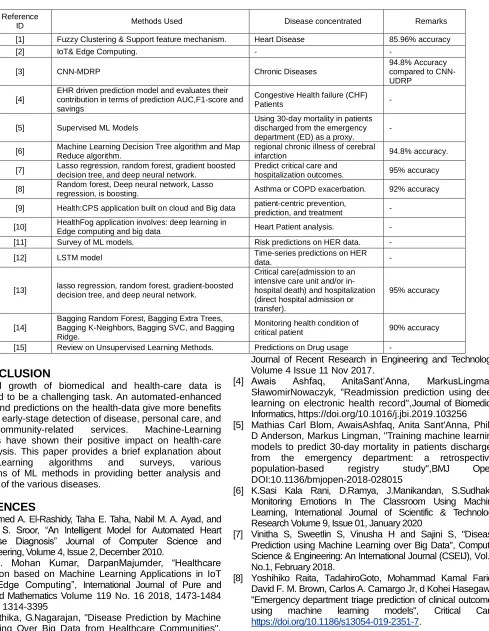
Table 1: Comparison of Machine Learning approaches
Reference
ID Methods Used Disease concentrated Remarks
[1] Fuzzy Clustering & Support feature mechanism. Heart Disease 85.96% accuracy
[2] IoT& Edge Computing. - -
[3] CNN-MDRP Chronic Diseases
94.8% Accuracy compared to CNN-UDRP
[4]
EHR driven prediction model and evaluates their contribution in terms of prediction AUC,F1-score and savings
Congestive Health failure (CHF)
Patients -
[5] Supervised ML Models
Using 30-day mortality in patients discharged from the emergency department (ED) as a proxy.
-
[6] Machine Learning Decision Tree algorithm and Map Reduce algorithm.
regional chronic illness of cerebral
infarction 94.8% accuracy.
[7] Lasso regression, random forest, gradient boosted decision tree, and deep neural network.
Predict critical care and
hospitalization outcomes. 95% accuracy
[8] Random forest, Deep neural network, Lasso
regression, is boosting. Asthma or COPD exacerbation. 92% accuracy
[9] Health:CPS application built on cloud and Big data patient-centric prevention,
prediction, and treatment -
[10] HealthFog application involves: deep learning in
Edge computing and big data Heart Patient analysis. - [11] Survey of ML models. Risk predictions on HER data. -
[12] LSTM model Time-series predictions on HER
data. -
[13] lasso regression, random forest, gradient-boosted decision tree, and deep neural network.
Critical care(admission to an intensive care unit and/or in-hospital death) and in-hospitalization (direct hospital admission or transfer).
95% accuracy
[14]
Bagging Random Forest, Bagging Extra Trees, Bagging K-Neighbors, Bagging SVC, and Bagging Ridge.
Monitoring health condition of
critical patient 90% accuracy
[15] Review on Unsupervised Learning Methods. Predictions on Drug usage -
5 CONCLUSION
The rapid growth of biomedical and health-care data is considered to be a challenging task. An automated-enhanced analysis and predictions on the health-data give more benefits to find out early-stage detection of disease, personal care, and other community-related services. Machine-Learning algorithms have shown their positive impact on health-care data analysis. This paper provides a brief explanation about Machine-Learning algorithms and surveys, various applications of ML methods in providing better analysis and prediction of the various diseases.
REFERENCES
[1] Mohamed A. El-Rashidy, Taha E. Taha, Nabil M. A. Ayad, and Hoda S. Sroor, “An Intelligent Model for Automated Heart Disease Diagnosis” Journal of Computer Science and Engineering, Volume 4, Issue 2, December 2010.
[2] Dr S. Mohan Kumar, DarpanMajumder, “Healthcare Solution based on Machine Learning Applications in IoT and Edge Computing”, International Journal of Pure and Applied Mathematics Volume 119 No. 16 2018, 1473-1484 ISSN: 1314-3395
[3] K.Karthika, G.Nagarajan, "Disease Prediction by Machine Learning Over Big Data from Healthcare Communities",
Journal of Recent Research in Engineering and Technology, Volume 4 Issue 11 Nov 2017.
[4] Awais Ashfaq, AnitaSant’Anna, MarkusLingman, SławomirNowaczyk, "Readmission prediction using deep learning on electronic health record",Journal of Biomedical Informatics, https://doi.org/10.1016/j.jbi.2019.103256 [5] Mathias Carl Blom, AwaisAshfaq, Anita Sant'Anna, Philip
D Anderson, Markus Lingman, "Training machine learning models to predict 30-day mortality in patients discharged from the emergency department: a retrospective, population-based registry study",BMJ Open, DOI:10.1136/bmjopen-2018-028015
[6] K.Sasi Kala Rani, D.Ramya, J.Manikandan, S.Sudhakar Monitoring Emotions In The Classroom Using Machine Learning, International Journal of Scientific & Technology Research Volume 9, Issue 01, January 2020
[7] Vinitha S, Sweetlin S, Vinusha H and Sajini S, "Disease Prediction using Machine Learning over Big Data", Computer Science & Engineering: An International Journal (CSEIJ), Vol.8, No.1, February 2018.
[8] Yoshihiko Raita, TadahiroGoto, Mohammad Kamal Faridi, David F. M. Brown, Carlos A. Camargo Jr, d Kohei Hasegawa, "Emergency department triage prediction of clinical outcomes using machine learning models", Critical Care,
[9] Tadahirogoto, MD, MPH, Carlos A, Camaro Jr., MD, DrPH, Mohammad Kamal Faridi, MPH, brain J, Yun,MD, MBA, MPH, Koheri Hasegawa, MD, MPH, "Machine Learning approach for predicting disposition of asthma and COPD exacerbations in ED", Elsevier Inc. https://doi.org/10.1016/j.ajem.2018.06.062 0735-6757/
[10] S.Biruntha, S.Balaji, S.Dhyakesh, B.R.Karthik Srini, J.Boopala, S.Sudhakar ,Digital Approach For Siddha Pulse Diagnosis, International Journal of Scientific & Technology Research Volume 9, Issue 02, February 2020.
[11] Y. Zhang, M. Qiu, C. Tsai, M. M. Hassan and A. Alamri, "Health-CPS: Healthcare Cyber-Physical System Assisted by Cloud and Big Data," in IEEE Systems Journal, vol. 11, no. 1,
pp. 88-95, March 2017.
DOI: 10.1109/JSYST.2015.2460747
[12] Tuli, Shreshth & Basumatary, Nipam & Gill, Sukhpal Singh & Kahani, Mohsen & Arya, Rajesh & Wander, Gurpreet & Buyya, Rajkumar. (2020). HealthFog: An ensemble deep learning-based Smart Healthcare System for Automatic Diagnosis of Heart Diseases in integrated IoT and fog computing environments. Future Generation Computer Systems. 104. 187-200. 10.1016/j.future.2019.10.043.
[13] Mr. Santosh A. Shinde, Dr. P. Raja Rajeswari, "Intelligent health risk prediction systems using machine learning: a review", International Journal of Engineering & Technology, DOI: 10.14419/ijet.v7i3.12654.
[14] Awais Ashfaq, "Predicting clinical outcomes via machine learning on electronic health records", Halmstad University Dissertations no. 58, ISBN 978-91-88749-24-6 printed) ISBN 978-91 -88749-25-3 Halmstad University Press, 2019 www.hh.se/hup.
[15] Tadahiro Goto, MD, MPH; CarlosA.CamargoJrMD, DrPH; Mohammad Kamal Faridi,MPH; RobertJ. Freishtat, MD, MPH; Kohei Hasegawa,MD, MPH, "Machine Learning-Based Prediction of Clinical Outcomes for Children During Emergency Department Triage", JAMA NetworkOpen.2019;2(1):e186937.doi:10.1001/jamanetworkop en.2018.6937.
[16] Asif Ahmed Neloy, SazidAlam, Rafia Alifbindu, Nusrat Jahan Moni, "Machine Learning-based Health Prediction System using IBM Cloud as PaaS", Proceedings of the Third International Conference on Trends in Electronics and Informatics (ICOEI 2019).
[17] IEEE Xplore Part Number: CFP19J32ART; ISBN: 9781 -5386-9439-8. [15]. Sara Khalid, Daniel Prieto-Alhambra, "Machine Learning for Feature Selection and Cluster Analysis in Drug Utilisation Research", 27 July 2019, springer.