Ročník LV 14 Číslo 1, 2007
129
THE EFFECT OF THE EGG`S SHAPE ON THE STRESS
DISTRIBUTION IN THE EGGSHELL AT INTERNAL
PRESSURE LOADING
Š. Nedomová, J. Buchar, I. K
ř
ivánek
Received: January 8, 2007
Abstract
NEDOMOVÁ, Š., BUCHAR, J., KŘIVÁNEK, I.: The effect of the egg`s shape on the stress distribution in the eggshell at internal pressure loading. Acta univ. agric. et silvic. Mendel. Brun., 2007, LV, No. 1, pp. 129–142
The infl uence of the eggshell shape on the stress distribution under internal pressure is studied. A mathe-matical description of the hen`s eggshell is proposed. The analytical expressions for the membrane solu-tion are presented. Obtained results are used for the evaluasolu-tion of a set of domestic hen`s eggs. 28 eggs were analysed in this study. The weight of eggs ranged from 49.55 g to 61.08 g, the egg shape ranged from 72.82 % to 84.94 %, the average eggshell thickness ranged from 0.343 to 0.433 mm. The eggshell strength is given namely by the maximum values both of meridian and circumferential forces. The dependence of the meridian force maximum on the egg shape index has some tendency to increase with egg shape index. The outlined linear dependence is very weak, the coeffi cient of correlation is about 0.45.
eggshell, elasticity, internal pressure, membrane analysis
The egg quality is mostly described by the value of the eggshell strength (Lin J. et al., 1995; Carnarius et al., 1996; Rezac et al., 2000; Nirasawa et al., 1998; Picman and Pripil, 1997). Máchal and Simeonovová (2002) mention the strength of eggshell from 29.05 N to 36.46 N. Positive correlations existed between strength of eggshell and index shape, also between strength of eggshell and ratio of eggshell (Máchal and Simeonovová, 2002). This strength is affected by many factors (thickness, porosity, chemical composi-tion etc.). One of them, which should be always inclu-ded when discussing the strength of eggshell, is their shape. There are various experimental techniques of the eggshell strength measurement [see for review e.g. Bain (1997)]. The most widely used is e.g. the quasi-static compression test which corresponds to the load-ing of eggs durload-ing their packload-ing. Durload-ing this test, eggs are compressed between two parallel plates by a stea-dily increasing load until failure results. This procedure enables to determine the force and the shortening of the egg at the moment of failure. These parameters are
of the infl uence of the variations in the egg shape on the values of principal stresses in the eggshell. These stresses determine the eggshell strength.
MATERIAL AND EXPERIMENTS
The eggs described in the previous chapter have been
used for the study of the infl uence of the egg shape. The weight, width, height and eggshell thickness are given in Table I. The width and height of the egg are used for the defi nition of the egg shape index:
Egg shape index = width/height × 100 (%).
I: Main characteristics of the tested eggs
Egg number weight (g) length (cm) width (cm) egg shape index (%)
eggshell thickness (mm)
sharp end blunt end middle of egg average
6562 58.24 5.48 4.34 79.20 0.410 0.420 0.415 0.415
6563 56.78 5.46 4.30 78.75 0.420 0.400 0.410 0.410
6564 57.41 5.53 4.30 77.76 0.420 0.380 0.420 0.407
6565 55.51 5.40 4.30 79.63 0.350 0.360 0.320 0.343
6566 54.81 5.53 4.21 76.13 0.420 0.430 0.420 0.423
6567 56.82 5.74 4.18 72.82 0.390 0.390 0.380 0.387
6568 55.97 5.45 4.28 78.53 0.410 0.420 0.420 0.417
6569 53.00 5.35 4.21 78.69 0.380 0.385 0.365 0.377
6570 59.13 5.59 4.31 77.10 0.390 0.430 0.395 0.405
6571 54.79 5.50 4.19 76.18 0.420 0.420 0.420 0.420
6572 58.19 5.62 4.31 76.69 0.410 0.410 0.390 0.403
6573 49.55 5.34 3.98 74.53 0.420 0.420 0.420 0.420
6574 59.51 5.61 4.35 77.54 0.390 0.360 0.420 0.390
6575 54.78 5.50 4.18 76.00 0.430 0.380 0.410 0.407
6576 61.08 5.66 4.36 77.03 0.400 0.370 0.390 0.387
6577 59.04 5.56 4.31 77.52 0.415 0.430 0.400 0.415
6578 53.67 5.35 4.21 78.69 0.380 0.400 0.380 0.387
6579 51.90 5.30 4.14 78.11 0.450 0.440 0.410 0.433
6580 53.81 5.35 4.23 79.07 0.365 0.350 0.350 0.355
6581 57.77 5.42 4.39 81.00 0.400 0.390 0.370 0.387
6582 59.19 5.58 4.31 77.24 0.410 0.410 0.390 0.403
6583 51.57 5.15 4.20 81.55 0.390 0.390 0.380 0.387
6584 55.45 5.48 4.26 77.74 0.380 0.355 0.360 0.365
6585 60.47 5.55 4.41 79.46 0.430 0.420 0.405 0.418
6586 50.44 4.98 4.23 84.94 0.410 0.390 0.375 0.392
6587 56.47 5.30 4.35 82.08 0.380 0.390 0.370 0.380
6588 59.69 5.54 4.35 78.52 0.410 0.410 0.395 0.405
6589 52.45 5.34 4.20 78.65 0.410 0.390 0.390 0.397
6590 51.79 5.17 4.18 80.85 0.415 0.400 0.375 0.397
6591 51.96 5.23 4.18 79.92 0.430 0.430 0.420 0.427
Average 55.71 5.44 4.26 78.37 0.405 0.399 0.392 0.399
The shape of the egg has been determined from the digital photo of the egg by the procedure described by Barton and Krivanek (2001). The egg shape can be described by the parametric equations:
x = acos(φ), y = asin(φ), where
1 + k2cos(φ) a = k1 –————————.
This description has been used in Buchar et al. (2001, 2003). Another expression has been obtained by analysing the results obtained by Entwistle et al. (1996). This procedure is based on the shape of an
eliptical profi le. The parametric form of this profi le is given by well known equations:
x = bcosθ y = asinθ,
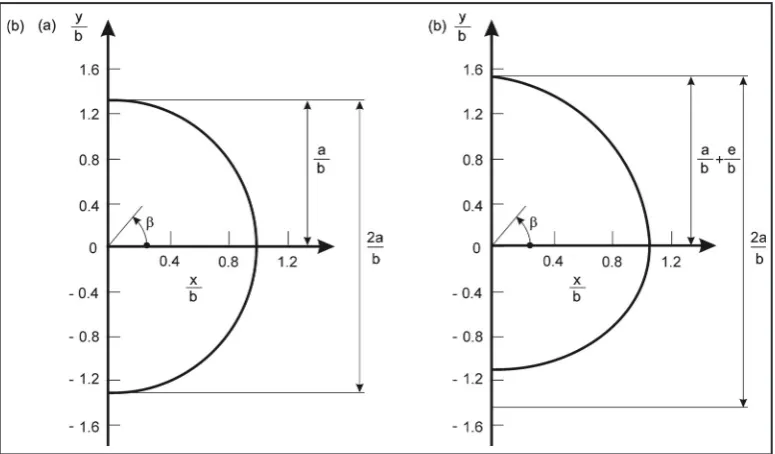
where a and b are the semi-major and semi-minor axes, respectively – see Fig. 1.
⎛ ⎞
⎜ ⎟
⎝ ⎠
1: Schematic of the meridian shape; a – ellipse, b – modifi ed ellipse
The meridian of the egg is described by a modifi ca-tion of these equaca-tions – see Kitching (1997). x = bcosθ y = (a + esinθ)sinθ,
where e/b is relatively small. The meaning of single parameters is shown in Fig. 1b. The angle β shown in Fig. 1 is given by
a e
tgβ = — + —sinθ tgθ. b b
The example of the relation between the angles θ and β is shown in Fig. 2.
The egg shape index is than given by the ratio b/a. This second approach seems to be more convenient
because the single parameters are easily measurable. Their values are given in Table II.
II: Parameters of the parametric equation describing the eggshell shape
Egg number length (cm) width (cm) egg shape index (%)
a (cm) b (cm) e (cm)
6562 5.48 4.34 79.20 2.740 2.170 0.400
6563 5.46 4.30 78.75 2.730 2.150 0.420
6564 5.53 4.30 77.76 2.765 2.150 0.410
6565 5.40 4.30 79.63 2.700 2.150 0.380
6566 5.53 4.21 76.13 2.765 2.105 0.350
6567 5.74 4.18 72.82 2.870 2.090 0.430
6568 5.45 4.28 78.53 2.725 2.140 0.470
6569 5.35 4.21 78.69 2.675 2.105 0.360
6570 5.59 4.31 77.10 2.795 2.155 0.310
6571 5.50 4.19 76.18 2.750 2.095 0.320
6572 5.62 4.31 76.69 2.810 2.155 0.350
6573 5.34 3.98 74.53 2.670 1.990 0.380
6574 5.61 4.35 77.54 2.805 2.175 0.420
6575 5.50 4.18 76.00 2.750 2.090 0.400
6576 5.66 4.36 77.03 2.830 2.180 0.450
6577 5.56 4.31 77.52 2.780 2.155 0.430
6578 5.35 4.21 78.69 2.675 2.105 0.460
6579 5.30 4.14 78.11 2.650 2.070 0.390
6580 5.35 4.23 79.07 2.675 2.115 0.370
6581 5.42 4.39 81.00 2.710 2.195 0.310
6582 5.58 4.31 77.24 2.790 2.155 0.320
6583 5.15 4.20 81.55 2.575 2.100 0.350
6584 5.48 4.26 77.74 2.740 2.130 0.360
6585 5.55 4.41 79.46 2.775 2.205 0.430
6586 4.98 4.23 84.94 2.490 2.115 0.390
6587 5.30 4.35 82.08 2.650 2.175 0.330
6588 5.54 4.35 78.52 2.770 2.175 0.380
6589 5.34 4.20 78.65 2.670 2.100 0.410
6590 5.17 4.18 80.85 2.585 2.090 0.450
6591 5.23 4.18 79.92 2.615 2.090 0.400
Average 5.44 4.26 78.40 2.718 2.130 0.390
The knowledge of the parametric equations x(θ), y(θ) enables to evaluate the expression for the coordi-nates of the center of the meridian curvature, x0, y0: [8e3sin3θ+aesinθ(a + 2esinθ) + a(a2 – b2)] x0 = ————————————————— cos2θ
(2esin3θ + a)b
(a2 – b2 – 4e2)sinθ + 6esinθ(esinθ + a) – 3ae
y0 = ——————————————————.
2esin3θ + a
The radius of the curvature R is given by the expres-sion:
R = √(x(θ) – x0)2 + (y(θ) – y 0)2.
3: Egg meridian shape and center of the meridian curvature. Egg No 6562 in Table II.
The radius of the curvature is shown in Fig. 4.
4: Radius of the curvature. Egg No 6562.
The values of parameters a, b and e which deter-mine the shape of egg exhibit a relatively large scatter.
5: Distrubution of the main parameters given in Table II
The more detailed analysis of the given data leads to the conclusion that the parameters describing the eggs shape are independent of the eggshell thickness. The parametric equations of the egg meridian have been used for the evaluation of elastic stress and strain dis-tribution in the pressurised eggshell using of the fi nite element method (Entwistle et al., 1996). Even if this method is very effective, it´s use is too complicated for the evaluation of the egg shape effect. For these purpo-ses some analytical solution of the stress distribution is
desirable. If we take into account that the thickness to principal radius ratio is always very small in any posi-tion and there are no rapid change of shape or discon-tinuity in the shell the membrane analysis can provide this analytical solution without any signifi cant error.
STRESS ANALYSIS
The schematic of the membrane analysis (see e.g. Šejnoha and Bittnarová, 1999) is shown in Fig. 6.
According to this fi gure the forces on the element of the eggshell is given by
2 roNΦcosΦ = ro2p
NΦ NΨ —— + —— = p,
rΦ rΨ
where rΦ, rΨare meridian and circumferential (princi-pal) radius of curvature at P, and NΦ, NΨ are the prin-cipal forces per unit length of shell in the meridian and circumferential directions at P. P is the internal pressure and shell thickness is denoted as t.
Solution of the above equations is
pro prΨ NΦ = ———– = ——–
2cosΦ 2
prχΨ rΨ NΨ = ——– 2 – —— .
2 rΦ
The gradient of normal at P is given by:
dx —–
dθ tgΦ = – ——.
dy —–
dθ
If we use the parametric equations we obtain:
bsinθ tgΦ = ———————. cosθ(a + 2esinθ)
This expression is useful for the evaluation of the next geometric characteristics:
dy2 3/2 1 + —–
dx rΦ = ——————
d2y ——
dx2
dy cosθ[a + 2esinθ] —– = – ———————
dx bsinθ
d dy
—– —–
d2y dθ dx a + 2esin3θ —— = ————— = – —————.
dx2 dx b2sin3θ
—–
dθ
The use of these expressions leads to:
[cos2θ(a + 2esin3θ) + b2sin2θ]3/2 rΦ = —————————————.
b(a + 2esin3θ)
Very similar procedure gives the expression:
b[(a + 2esinθ)2 + b2sin2θ]1/2 rΨ = ———————————.
a + 2esinθ
Now we obtain expressions for the forces:
1 √(a + 2esinθ)2 cos2θ + b2sin2θ NΦ = — pb ————————————
2 a + 2esinθ
1 √(a + 2esinθ)2 cos2θ + b2sin2θ √(a + 2esinθ)2 cos2θ + b2sin2θ 3/2 NΨ = — pb ————————————— 2 + b2(a + 2esin3θ) ——————————————— . 2 a + 2esinθ (a + 2esinθ) [b2sin2θ + (a + 2esinθ)2]
Stresses (σΦ,σΨ) are calculated by dividing corre-sponding forces by the thickness t.
RESULTS
In the given chapter the obtained equations will be
analyzed for the dimensions given in Table I and II and for the internal pressure of 1 MPa. In Fig. 7 the meridian stress is plotted against the angle β.
7: Meridian stress for elliptical meridian and for the egg meridian. The dimensions for egg No 6562 are used.
It is obvious that the excentricity e leads to some transition from symmetric distribution of stress to non-symmetric one. In order to give some insight on this effect the meridian force has been used. This force
is not affected by the eggshell thickness. In Fig. 8 the infl uence of the parameter e on the meridian force dis-tribution is shown.
The increase in e generally leads to the shift of the maximum value of the stress towards to the blunt end of the egg. The same tendency may be reported for the circumferential stress and/or force, respectively.
In Fig. 9 the distribution of the meridian stress for the
fi rst 8 eggs from table II is shown. It may be seen that there is a relatively signifi cant infl uence of the varia-tion of parameters a, b, e and thickness.
9: Meridian stress distribution along to the angle β
If we take the meridian force the infl uence of the thickness is excluded. The distribution of this force is given in Fig. 10. From this fi gure one can see that the measure of the variation in meridian forces incre-ases from sharp to blunt end of egg. Looking on data in Table II one can see that there are groups of data with the same values of the parameter e. In Fig. 11 the distribution of the meridian forces for the eggs with
e = 0.35 cm is plotted. The signifi cant infl uence of the values of parameters a and b can be derived from this fi gure. These parameters describe the height and length of the specimen and thus the egg shape index. If we take into account the meridian stress, i.e. if we take the eggshell thickness the distribution is futher changed – see Fig. 12.
11: Meridian force distribution along to the angle β. Excentricity e = 0.35 cm.
12: Meridian stress distribution along to the angle β. Excentricity e = 0.35 cm.
Similar conclusions have been obtained for some other groups of eggs with constant value of the para-meter e. It means that a hypothesis may be postulated that the infl uence of the eggshell geometry can be described using the egg shape parameter b/a.
The eggshell strength is given namely by the
13: The infl uence of the egg shape index on the maximum of the meridian force
The maximum of the circumferential force maximum on the egg shape index is independent – see Fig. 14.
14: The infl uence of the egg shape index on the maximum of the circumferential force
The used theory of the stress evaluation in the egg-shell is based on some assumptions which neglect e.g. bending and torsion effects etc. – see e.g. Šejnoha and Bittnarová (1999) for details. In order to decide if this simplifi cation is admissible or not the fi nite element analysis, which effectively solved the full shell equa-tions, has been performed. For the numerical simu-lation the FEMLAB software has been used see e.g.
15: The fi nite element model of the egg No 6562 By using this method, we can fi nd the distribution of the stress not only on the egg`s surface but also through the eggshell thickness. For our purposes the distribution of the meridian stress on the egg`s surface has been evaluated. An example of such distribution is displayed in Fig. 16. It may be seen that the stresses obtained by the analytical method are nearly identical with stresses obtained from numerical computation.
Namely the maximum values of this stress are nearly identical. Similar results were obtained for all tested eggs. It is obvious that the used membrane analysis leads to very good results. For the given eggshell geo-metry, it is thus not necessary to use a numerical ana-lysis which is generaly very complicated in compari-son with the analytical solution.
CONCLUSIONS
In the given paper the shape of eggs have been described by parametric equations which have been obtained by the modifi cation of parametric equati-ons for ellipsoid. These parametric equatiequati-ons involve three parameters a, b, e. The equations closely fi tted the actual shape of eggs. The eggs from one line of hens collected on the same day differ in values of the above mentioned parameters very signifi cantly. Pro-nounced difference in eggshell thickness can be also reported at the same time. The use of membrane ana-lysis gives some insight on the stress distribution. Both stresses (meridian and circumferential) stron-gly depend on the position along the meridian. The maximum of both stresses has been found at the blunt end of the egg. Generally, the distribution of stress
is dependent on all parameters, i.e. a, b, e and on the eggshell thickness. There is only a weak linear depen-dence of the maximum value of the meridian stress on the egg shape index. From the practical point of view the stress distribution in the eggshell must be evaluated for every egg. A reliable prediction of this distribution is probably impossible.
Nevertheless, it has also to be noted that the inter-nal pressure is not likely to be the typically occurring load which eggshell has to withstand. A more typical loading represents e.g. the compression test described in the introduction. At this loading there is no chance to fi nd some analytical solution. The stress distribu-tion must be evaluated by the soludistribu-tion of the full shell equations. The results of this research should appear in some forthcoming papers.
SOUHRN
Vliv tvaru vajec na rozložení napětí ve vaječné skořápce při zatěžování vnitřním přetlakem V práci je sledován vliv tvaru vajec na napětí ve skořápce při zatěžování vnitřním přetlakem. Toto, poně -kud atypické, namáhání vaječné skořápky bylo zvoleno z důvodu možnosti stanovit napjatost pomo-cí analytických vztahů. Je navržen popis tvaru vajec ve formě modifi kované elipsy. Při tomto popisu je tvar skořápky určen třemi parametry. Velikost těchto parametrů u vajec jedné linie slepic vykazuje značnou variabilitu. Ukazuje se, že velikost těchto parametrů nemá vztah k tloušťce skořápky. Pro hod-nocení stavu napjatosti je použito mebránové teorie skořepin, kdy jsou zanedbávány ohybové a krouticí účinky. Porovnání s výpočtem pomocí metody konečných prvků, kdy tato zjednodušení nejsou použita, ukazuje, že zmíněná teorie dává výsledky prakticky shodné s výsledky uvedené numerické simulace. Jsou odvozeny vztahy pro membránové síly a napětí napětí ve vaječné skořápce. Ukazuje se, že veličiny se výrazně mění podél meridiánu (obrys řezu skořápky a roviny jdoucí osou rotace skořápky) a dosa-hují maximálních hodnot na tupém konci vaječné skořápky. Distribuce napětí a jejich velikosti závisí na parametrech určujících tvar vajec a na tloušťce vaječné skořápky. Z výsledků vyplývá, že neexistuje možnost predikce vlivu parametrů na velikost maximálních hodnot napětí. Jistou výjimku představuje maximum meridiánového napětí, které vykazuje lineární závislost na indexu, který popisuje tvar vajec. Tato závislost je však poněkud nižší. Napjatost tak musí být stanovována pro každé zkoumané vejce. To pak platí i pro případy zatěžování, kdy je třeba použít numerické simulace (stlačování vajec mezi dvě -ma deskami ap.).
vaječná skořápka, pružnost, membránová teorie skořepin, vnitřní přetlak, tvar vajec, napjatost
ACKNOWLEDGEMENT
The support of this work by the Internal Grant Agency of the Mendel University of Agriculture and Forestry under contract No: 4IG11/2004 is gratefully acknowledged.
REFERENCES
ALLMAN, J. D.: Evaluation of the constant strain tri-angle with drilling rotation. Int. J. Numer. Engng, 1988, 26, 12: 2645–2655.
BAIN, M.: A reinterpretation of eggshell strength. In: Eggs and Eggshell quality (S. E. Solomon, Ed.), Manson Publishing/The Veterinary Press/Iowa
State University Press, 1997, p. 131–142. ISBN 0813828279
BARTOŇ, S., KŘIVÁNEK, I.: Determination of parameters of egg`s perimeterby analysis of digital photography in Maple. Proc. Of the Symposium on the Quality food evaluation, March 8, Brno, 2001 BUCHAR, J., SIMEONOVOVA, J.: On the identifi
qua-sistatic compression. In: 19th CAD – FEM USERS MEETING 2001 - International Congress on FEM Technology.17–19. October 2001, Potsdam, Berlin Germany, Published by CAD – Fem GmbH, Mun-chen, 2001, Vol. 2, p 1–8
BUCHAR, J., NEDOMOVÁ, Š., SIMEONOVOVÁ, J.: Identifi cation of the eggshell elastic properties. Proc. of the 37th International Conference Expe-rimental Stress Analysis, Milovy, June 3–6, 2003. Brno: VUT, Fakulta strojní, 2003, p 5–6. ISBN 80-214-2314-5
CARNARIUS, K. M., CONRAD, K. M., MAST, M. G., MACNEILL, J. H.: Relationship of eggshell ultrastructure and Shell Strength to the Soundness of Shell Eggs. Poultry Science 1996, 75, 5: 656– 663.ISSN 0032-5791
ENTWISTLE, K. M., SILYN-ROBERTS, H., OCHI-ENG ABUODHA, S.: The relative fracture streng-ths of the inner and outer surfaces of the eggshell of the domestic fowl. Proceedings - Royal Society of London, Series B – Biological Sciences, 1995, 262, 1364: 169–174.ISSN 0962-8452
ENTWISTLE, K. M., REDDY, T. Y.: The Fracture Strength under Internal Pressure of the Eggshell of the Domestic Fowl. Proceedings – Royal Society of London, Series B – Biological Sciences, 1996, 263, 1369: 433–438. ISSN 0962-8452
KITCHING, R.: Pressurised Eggshell Analysis.: Int. J. Mech. Sci., 1997, 39, 4: 391–396. ISSN 0020-7403
LIN, J., PURI, V. M., ANANTHESWARAN, R. C.:
Measurement of eggshell thermal – mechanical properties. Transaction of the ASAE, 1995, 38, 6: 1769–1776. ISSN 0001-2351
MÁCHAL, L., SIMEONOVOVÁ, J.: The relation-ship of shortening and strength of eggshell to some egg quality indicators and egg production in hens of different initial laying lines. Arch. Tierz., 2002, 45, 3: 287–296. ISSN 0003-9438
MANCEAU, J. R., HENDERSON, J. M.: Physical properties of eggshells. Transactions of the Ame-rican Society Agriculture Engineering, 1970, 13: 436
NIRASAWA, K., TAKAHASHI, H., TAKEDA, H., FURUKAWA, T., TAKEDA, T., NAGAMINE, Y.: Restricted maximum likehood estimates of genetic parameters and genetics trends of chickens diver-gently selected for eggshell strength. Journal of Animal Breeding and Genetics, 1998, 115, 5: 375– 382.
PICMAN, J., PRIPIL, S.: Is greater eggshell densi-ty an alternative mechanism by which parasitic cuckoos increase the strength of their eggs?, Jour-nal for Ornithology, 1997, 138, 4: 531–541. ISSN 0021-8375
REZAC, P., POSCHL, M., HAVLICEK, Z.: Relati-onship of plasma oestradiol–17 beta and choleste-rol levels to eggshell strength in laying hens. Czech Journal of Animal Science, 2000, 45, 7: 313–318. ŠEJNOHA, J., BITTNAROVÁ, J.: Shells (Skořepiny).
Lecture notes. Czech Technical University. Prague. 1999, 82 p. (in Czech)ISBN 80-01-01944-6
Address