Database Aware Memory Reconstruction for
Object Oriented Programming Paradigm
Dr. Vandana Bhagat, Dr. (Fr.) Jossy George
Abstract— Data storage is a big challenge in front of industries and researchers when its growing enormously. Traditional data storage strategy was fulfilling the business needs till the data was in structured format. But now due to Internet of Things (IoT) compatible devices unstructured data is more than structured one. In such cases traditional data storage strategy won't work efficiently. Initially data storage devices used to store the data irrespective of its logical storage. It means the record was stored either in array format or block format. Such type of storage was not matching physical and logical structure. Logically, structured data is generated as an attribute of particular entity, but physically it gets stored in a sequential memory storage either as file or as memory block. Object Based Storage pattern(OBS) stores the data in the way object gets generated by the programmer and accordingly memory is allocated for that object. Object contains all the data related to that particular entity which makes it easy to retrieve it back. Current study includes comparative advantages, operations and study of different service providers of object-based storage. We also focused on the current need of object-based storage structure for big data analysis and cloud computing.
Index Terms— Block-Storage, Cloud Object Storage, Distributed file system, File Storage, Metadata, Object Based Storage, Object Storage Device.
—————————— ——————————
1 I
NTRODUCTIONInnovations in Artificial Intelligence are responsible to generate enormous amount of data every day. Many embedded applications and devices are collecting the data from different sources and converting it into big data. This data is in structured as well as unstructured format. The real challenge in such case is to maintain the data for easy access which responds and gives required output faster. In upcoming days most of the companies and businesses are willing to incorporate IoT services in their applications. IoT based applications need big amount of data to be generated, transferred and analyze for each millisecond. Due to this, the demand of optimized data storage solutions has been increased to handle all such digital contents. The solution for this is not only to generate and use big data storage devices, but also there is a need of intelligent data storage strategies for optimized use of memory [1]. The study summarizes the evolution of data storage structure as and when it was required by industries [2]. It also discusses the challenges of traditional data storage solutions and object-based storage as a solution for unstructured data. Relational database management system mostly concentrates on textual data. Unstructured data like images, videos or audio files are difficult to store in traditional data storage structure. There is a need of object-based storage structure for improved performance [1].
A- Contribution: The main focus of this paper is on data aware memory reconstruction using object-based storage. Current study also comprises of object-based storage
components, its service providers and its compatibility with multiple applications like big data and data storage service in cloud.
B- Organization: Section I includes brief introduction of the overall study, Section II contains related research work of other authors, Section III contains data storage evolution, Section IV focuses on OBS structure and its basic I/O operations, Section V contains OBS application in cloud to manage distributed database and Section VI comprises of OBS service providers. Finally, Section VII concludes about the study.
2
L
ITERATURER
EVIEWObject based storage comprehends various types of keys to maintain security of data in object storage devices. Paper has listed and explains different types of commands which are used to achieve object-based storage operations. [4]
White paper by panasas. has talked about the basic structure of Object based storage. It also explained read/write operations in it. Author has diagrammatically represented each step of I/O operations in Object storage device [5] Several industries are providing Object storage devices to store the data as an object. Drew Robb has listed all the service providers of object storage devices. The survey also described features of all services to make comparative study for customers.[6]
Object based storage is optimized solution for database aware storage. The data is loosely structured to manage various type of data storage strategies. Such data storage features are perfectly suited for cloud based distributed data management and Big Data analysis. [7]
3 E
VOLUTION OFD
ATA STORAGE STRUCTURESThe data which is getting generated is both Structured and unstructured format. Maintenance of structured data is ————————————————
Dr. Vandana Bhagat is currently working as Assistant Professor in
CHRIST (Deemed to be University), Lavasa,Pune, India. E-mail: [email protected]
Dr. (Fr.) Jossy George is Director & Dean, CHRIST (Deemed to be
comparably simple as relational DBMS can be used for it. Structured data is the data which is having common attributes and it can be stored as a record. Relational data storage technique is suitable for structured data. Day by day the pattern and type of data has been changed [8]. To make the things more user friendly, visible and realistic, unstructured data came into picture. Unstructured data was further classified into textual and non textual format [9]. Textual data consist of text documents, presentations or emails while non textual data consist of images, audio and video files. As there was already the solution for structured data, the real challenge was unstructured data storage[9]. Initially the traditional file storage methodology was suitable solution for such type of data, but gradually as the data started growing and became dynamic in nature, its maintenance became difficult due to file system strategies [10]. Metadata which was needed to be maintained for each file was very huge. Due to this, locating the correct file at correct time was a challenge.[11] Fig. 1 describes data storage strategy for diverse types of storage model like file storage, block storage and object-based storage [2]. The storage techniques evolved due to dynamicity of the data.
Fig 1. Data Storage Structure
The efficient paradigm was object storage. Following are the reason why object storage took over to file storage in many cases.
A. Issues in File structure:
1. The data is collected mainly to generate insight from it. To achieve this, the data has to be collected and organized in meaningful way. The data should be applicable to find some pattern form it or it should be capable of making some analysis. Through file storage these types of analysis and insights can't be generated [12].
2. The system which stores data is required to scale well. Scaling file system is difficult because file system generates lots of metadata as well as we have to take care of backup management of it.
3. File systems are made up for human and not for HTTP(S). Through programs it is tedious to share and manage the file in file system. It prone to generate errors and take lots of time and effort to manage it through file system.
B. Solutions in Object Storage:
1. Storing and retrieving objects in the memory is simple and straightforward than file system. Files are stored in file system whereas objects are stored in the form of flat structure. 2. Object storage provides flexibility for storing metadata of object. The metadata can include type of application, need and importance of application, data protection level, object should be replicable or not, delete time and so on.
3. Files has been accessed by HTTP(S). Easily accessible files can be projected for analysis and other operations. Object storage handles this well. Maximum platforms offering object-based storage contain REST APIs to access the files through HTTP(S). APIs also useful for authentication and to obtain file properties. File system expects manual operations.[11]
4 O
BJECTB
ASEDS
TORAGEObject based storage maintains blocks of data that makes-up a file together and attached all metadata associated with it in the same file. This technique avoids hierarchical structure used in file storage. [6]
When the application needs to upload a file, it creates the metadata and stores it to the database, along with putting the file to the object store. Later when the file is needed, the application queries the database for the metadata and based on the available info, it gets the file.
An OSD is similar to a logical unit. Conventional block-oriented device, organizes the data as an array of unrelated blocks and object storage organizes the data in the form of storage object. An object holds the group of logically related data together. OSDs handles low-level storage, security tasks and space management. As host-based file system is not applicable, the only way to fetch the object is using object ID [13].
The ANSI T10 SCSI OSD standard defines four types of objects as mentioned in Fig.2
The root object - The Object Storage Device itself The objects - Formed by SCSI commands as of the
application or client
Collection objects - A group of user objects participating in a specific project.
Partition objects - User defined objects containers of sharing common security and space management features.[11]
There are two categories of object attributes:
Storage attributes - It is used to handle block allocation for the data, like block pointers, logical length of the block, capacity and used space and OID.
User attributes - This is used by metadata managers for storing high-level data about an object. It commonly stores cost, capability, capacity of the object, security, power usage by an object, its performance and many more.[4]
To handle object storage system following OSD-specific commands are used:
APPEND (write without offset) CREATE (object), REMOVE (object)
CREATE COLLECTION, REMOVE COLLECTION, LIST COLLECTION, FLUSH COLLECTION
CREATE PARTITION, REMOVE PARTITION, FLUSH PARTITION
FLUSH (force object to media), FLUSH OSD, LIST
(objects) FORMAT (OSD)
GET ATTR (of an object), SET ATTR READ (object with OID), WRITE
SET KEY (shared secret for a single object) SET MASTER KEY (shared secret for OSD)
Benefits of Object based storage: Manages space intelligently
Data pre-fetching and data catching Can be shared by multiple clients.
Performance scaling with an offloaded data path. Trusted security.
a. OSD Security
After processing the command, the OSD confirms,
That the ability (which OSD object can be accessed) is not modified at all.
That the ability authorized the requested operation for a particular object
OSD allows the operations, based on rights given by the capability after passing through above criterions. Other than this, clients can also request a credential permitting read, write, or delete operations.
The structure for the data is created by security manager. This document is used by the client which defines access to logical unit of object storage for particular operation of specific object.
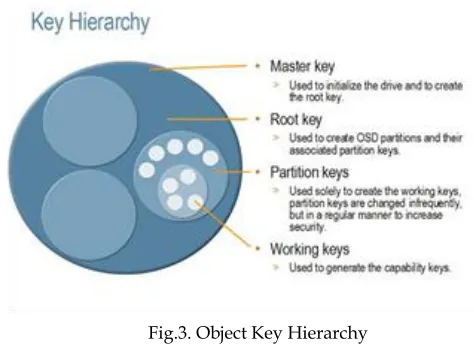
b. OSD Shared Secret Key Hierarchy:
Fig. 3 has described the hierarchy of OSD shared secrete key. The order is from highest to lowest in the list.
Master key - In the hierarchy of the keys this is highest level
key which allows only authorized access to the drive. This remains fixed till not changed by driver owner.
Root key - It is almost same like Master key. Only difference is it will not be used to initialize the driver. Also, it can be used to set new root/master key. Root key cannot be used to initialize the drive or to set new master/root key. This key can be changed as needed.
Partition keys - This key produce working keys for every partition. Every object storage is segregated into several partitions. Each partition contains unique working key and partition key.
Working keys - This key used to produce capability key. which is needed to access a particular object. It gets used frequently, therefore it is recommended to refresh them frequently.[4]
Fig.3. Object Key Hierarchy
c. Object Based Storage Components
Mainly four components are involved in Object Storage Architecture.
i. Objects
In object-based storage, an object is fundamental unit. An object contains data of the file and storage attributes which helps storage device for block allocation. User attributes help to store high level information of object.
Objects maintains their own attributes to interact with storage system. With this technique each data manages itself. This reduces the work of storage system by increasing its flexibility.
ii. Object-based Storage Device (OSD)
In object-based storage each object autonomously manages and serves its local storage. The device providing these features contains its own RAM, network interface, processor and disk. It is an intelligent device which smartly manages its own data without disturbing other operations in an application.
Major functions provided by object-based storage are:
and can't be accessed outside. It can be accessed only by its object Ids. Compute node requests object ID for read and write operation within the object as per the length of data block ask for.
Intelligent Layout – Optimized data organization on the disk and its pre-fetching is managed by object storage memory and processor. Additional information provided by object and its protocol helps read/write operations and memory management for layout.
Metadata Management – Metadata in object-based storage is associated with object itself. It includes blocks associated with an object and length of each block.
iii. Distributed File System
It commands to compute nodes for read/ write objects to the OSDs. The distributed file system offers three main functions in the Object Storage Architecture [14].
POSIX File System Interface –To perform standard file operations like Open/Close/Read/Write, distributed file system provides POSIX interface.
Caching – For incoming data balancing, to aggregate multiple write operation for well-organized transmission and to maintain metadata and security tokens, various types of caches are needed in distributed file system.
Striping/RAID – Distributed file system breaks an object to component objects. These specified sized subsets, that object is striped across, are sent to each OSD as an attribute of an object. [5]
iv. Metadata Server (MDS)
The metadata server navigates all the request to appropriate data in database which cause bottleneck when traffic increases. In object-based storage metadata server is removed and allowed all clients to communicate straight with storage device offering high throughput.
Fig 4. Object Storage Operations
As per the flow shown in Fig.4 following are the steps of read and write operations of object-based storage:
READ Operations:
Client Initially Contacts Metadata Server.
Metadata Server Returns List of Objects and security Capability.
Client Sends Read Requests and Capability to OSD. Data transfer between Client and OSD.
WRITE Operations:
Client Initially Contacts Metadata Server.
Metadata Server Returns List of Objects and security Capability.
Client pass Write Requests and Capability to OSD. Data transfer between Client and OSD. [5]
5 C
LOUD OBJECT BASED STORAGE As object-based storage architecture maintain the data in highly distributed format, data remains safe from any disaster or hardware failure. [15]
Objects are placed in flat address space which decreases schema complexity and became easy to scale.
Due to replication technology of object-based storage architecture data remains protected.
In this data storage strategy, data can be scaled unlimitedly.
I/O requests don‘t go through central control unit to help distributed storage system for managing spreader data.[16]
Cloud object storage gateway facilitates communication between clients. It is placed in client‘s system facilitating transaction between cloud storage and local applications. It also manages data deduplication, data compression and encryption. [15].
A. Object based storage in Cloud:
Due of globalization, industries can provide the service across the world. Industries are spreading their boundaries over large geographical area. Clients and sub-branches of industries are connecting to share the services. Cloud computing plays an important role in this evolution.[17] It facilitates common repository to store the data for multiple clients simultaneously irrespective of their geographical location. Object based storage exactly suits this nature of data sharing [18]. This is because cloud storage works efficiently in absence of tight bounding of database structure which was used in traditional data storage strategies [19]. Object based storage doesn‘t ask for schema designing, and it saves the data as an object which manages independent addressing with object id [20].
Object based storage precisely suits cloud-based data storage, due to its features like, easily scalable architecture, multi-tenancy capability, REST APIs facilities and Distributed nature. It also maintains user defined data structure format with Metadata attached to it for reference. As objects are not bounded with each other or do not maintain any relationship with each other, they can scale independently and can be accessed irrespective of geographical location of the client. [12]
Big data comprises of huge volume, high speed and variant type of information that demands smart processing and innovative algorithms for enhanced insights. Big data is basically gets generated by multiple applications like e-commerce, social media and IoT devices. This data is collected across horizontal applications, which will be utilized by customers to fulfill their daily needs or for future perdition or for recommendations. Big data technique requires scale out architecture with various APIs, single flat namespace, huge amount of storage, user defined data storage strategy and location independent data access. These features are acquired by object-based storage. Therefore, object-based storage is specifically suitable for big data operations [21]. Object based storage maintains metadata with its object which helps to generate analysis from the data, as complete data related to particular object is available at one place. Such architecture is easily scalable therefore developer can add as agile response to real world situation. [12]
6 O
BJECTB
ASED STORAGE PROVIDERSObject based storage is better solution for unstructured data storage. Different industries have implemented this storage type to provide the service for customers [22]. Software like Amazon(S2), Google Cloud, Alibaba, Zadara Storage, Digital Ocean and many more provide object-based storage features [23]. Following is the list of object-based storage providers [3].
IBM Cloud Object Storage: IBM added its own technology in
Cleversafe Dispersed Storage Network (dsNet) and create IBM Cloud Object Storage. With large amount data storage this technique also provides data availability, reliability and security. As per the data usage frequency different services are available [23].
Tarmin GridBank Enterprise:Majorly used in data-intensive
industries for fast growing unstructured data problems which faces compliance requirements and data governance. It provides solitary integrated data-centric management model. [17]
Dell EMC ECS: Mainly generated for cloud-based
applications, consolidated backup, standard deployment, storage services and IoT
Quantum Lattus: Manages merged data storage with its
security as an individual instance. Added advantages of third-party applications. Mainly suitable for large documents and or irregular growth.
NooBaa: It facilitates the companies to extend their data inside the organization, on cloud or in both. It is easy to deploy to existing objects and cloud without migrating before usage. [3]
Other than these there are some more service providers who provide object based storage like NetApp StorageGrid, Hitachi Content Platform and Caringo. [3]
7
C
ONCLUSIONDue to IoT portable devices, big amount of structured and unstructured data is getting generated every second. Such a huge data is maintained in data warehouses. Data storage is main challenge in front of all industries providing data warehouse and analysis tools for decision making. There are enough solutions for structured data, but still researchers and industry people are struggling for optimize storage of unstructured data. Many researchers and data storage industries came up with object-based storage as optimized solution for the same. Object based storage being different from traditional file storage and block storage, solved different issues raised by traditional data storage systems. Many industries are now integrating object-based storage as their storage engine. Different service providers came up to provide object-based storage. Object based storage is typically suits for cloud-based storage and for big data technology, because of its unique features. In future object-based storage can become the solution for unstructured data which was always a big challenge.
REFERENCES
[1] M. Mesnier, G. R. Ganger, E Riedel, "Object-based storag", IEEE Communications Magazine 41(8):84 - 90, September 2003
[2] Barbagallo, T. What‘s the Difference Between Block, File and Object-based Data Storage? [Blog] Block vs. File vs. Object Data Storage. Available at: https://www.caringo.com/blog/back-basics-object-storage, June 2019
[3] J.Hendricks, R.R.Sambasivan,S. Sinnamohideen, G. R.Ganger, "Improving small file performance in object-based storage" ,Parallel Data Laboratory, Carnegie Mellon University, CMU-PDL-06-104 , May 2006 [4] C. Bandulet, "The Storage Evolution: From Blocks, Files
and Objects to Object Storage Systems ―, Tutorial, SNIA Education Committee, Storage Networking Industry Association, 2007
[5] panasas,"OBJECT STORAGE ARCHITECTURE",
WHITE PAPER, Available at:
https://www.sstc.co.jp/products/Panasas/OSA_WP_ FINAL.pdf, April 2007,
[6] D. Robb, "Object Storage Vendors: Buying Guide", Article by Enterprise Storage Forum, May 2018
[7] M. O‘Connell, "Object storage systems: the underpinning of Cloud and Big Data initiatives", Tutorial, SNIA Education Committee, Storage Networking Industry Association, 2013
[8] V. Bhagat, ‗IMPACT OF DATA STORAGE TRENDS ON QUERY EXECUTION‘, INTERNATIONAL JOURNAL OF RESEARCH IN COMPUTER APPLICATIONS AND ROBOTICS, Vol.6 Issue 2, Pg.: 25-33 February 2018
[9] Dell Product Group, "Object Storage: A Dell Point of
View", Available at:
[10]J. Kim, M. Carlson, S. Jang, A. McDonald, "File vs. Block vs. Object Storage ―, Part of the SNIA ESF ―Great Debate‖ Webcast Series, Ethernet Storage, SNIA Education Committee, Storage Networking Industry Association, April 2018
[11]N. Tiwari, "Object storage: What is it all about?", [Blog] Available at: https://blog.minio.io/object-storage-what-is-it-all-about-62920ca164ca, April 2016
[12]Cloudian, Inc., "Object Storage vs. File Storage: What‘s the Difference?", [Blog] Available at: https://cloudian.com/blog/object-storage-vs-file-storage/, 2017
[13]Red Hat, Inc., "File storage, block storage, or object storage?" . [Blog] Data Storage. Available at: https://www.redhat.com/en/topics/data-storage/file-block-object-storage, 2019
[14]K. D. Keyser F. J. Luc De Schrijver, S. Blyweert, " HIERARCHIC STORAGE POLICY FOR DISTRIBUTED OBJECT STORAGE SYSTEMS", Patent Application Publication, US 2019/0012235A, January 2019.
[15]Intel Corporatio, "Build a High-Performance Object Storage-as-a-Service Platform with Minio", 0319/JS/CAT/PDF, 338821-001EN, 2017
[16]Orit Wasserman, "Cloud object storage: the right way", Open Source Summit, linux foundation, 2018
[17]M. Rouse,"cloud object storage". [Blog] Techtarget,
Searchstorage. Available at:
https://searchstorage.techtarget.com/definition/cloud-object-storage, December 2017
[18]Amazon Web Services, Inc., "What is Cloud Object Storage?" . [Blog] Available at:
https://aws.amazon.com/what-is-cloud-object-storage/, 2019
[19]N. Bennis, A. McDonald, "Cloud Object Storage 101 ―, Cloud Storage, SNIA Education Committee, Storage Networking Industry Association, July 2016
[20]S. Visvanathan, P. Sarda, I. Langouev, "Deletion and restoration of archive data in cloud/object storage", US 2019/0220360A1, Patent Application Publication, July 2019
[21]L. Rupprecht, R. Zhang, B. Owen, P. Pietzuch, D. Hildebrand, "SwiftAnalytics: Optimizing Object Storagefor Big Data Analytics"
[22]C. Harvey,"Cloud Storage Providers: Choosing the Best Vendor for Your Needs", enterprisestorageforum, cloud based, April 2018