Continuous
Plat
forming
By
E.
L.
Pollitzer
Corporate Research Center, UOP Inc., Des Plaines, Illinois, U.S.A.
I n the most recent innovation i n catalytic reforming very small quantities
of the platinum catalyst are continuously withdrawn, regenerated, and returned to the system. The operating economics of the continuous and stable production of gasoline and hydrogen o0fer great advantages i n the achievement of maximum yield.
Since the first commercial Platforming unit went on stream in 1949, the basic Platforming system design has been repeatedly re- evaluated and new reforming schemes have been examined on numerous occasions. A number of significant engineering develop- ments have been incorporated in reactor design and in similar essential but unobvious areas. Until recently, however, all alternate processing schemes that were evaluated were found to be economically less attractive than the standard system under prevailing market conditions.
The anticipated requirement to produce unleaded gasoline prompted a re-examination of a number of refining processes ( I ) . I t became obvious that reforming to significantly higher unleaded (clear) octane numbers would play a major role in this area. At the same time, the commercialisation of new hydrogen-consuming processes resulted in the need for larger quantities of hydrogen on a continuous basis.
The projected increase in the clear octane number of reformate requires substantially more severe reforming conditions and this caused concern because of the drastic effects on yield. Curve A in Figure I shows a typical yield-octane relationship in a 400 psig operation. It is obvious that the curve becomes quite steep at higher octanes, causing a yield loss that could only be partially recovered by the use of modern high-yield catalysts. A similar situation developed in the case of reformers directed toward the production of aromatics as petrochemical raw
materials. The growing demand for aromatics dictated a shift to higher severity operations, but, at the pressures normally used, the absolute yield of aromatics suffered.
A continuous Platforming unit i n operation al the Chamlin Petroleum Company, Corpus Christi, Texas. Six such units are now on stream and a further forty-six are in various stages of design and construction The advantages of low pressure operation operations, but the quantities involved are are offset by higher catalyst coking rates small enough-and the frequency high (Figure 2) which necessitate more frequent
regenerations. Over the past decade or so, the development of improved catalysts has more than kept pace with the gradual decrease in average operating pressure-and the gradual increase in average severity. While modern bimetallic catalysts permit rather long cycle lives under present-day conditions, a further shift to substantially higher severities would require much more frequent regenera- tion. This, it was felt, would aggravate the second problem mentioned above: the re- quirement for a continuous supply of hydrogen for other processing units.
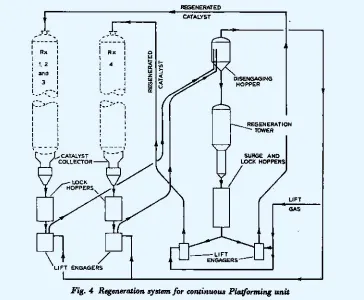
Consideration of all these requirements and limitations led to the concept of “Continuous Platforming”. I n this system, very small quantities of catalyst are withdrawn from an operating reactor, restored to fresh quality and returned to the system. Catalyst with- drawal and addition are actually batch
enough-to approach a continuous operation. The rate of catalyst circulation is low relative to the total inventory and, thus, has no discernible effect on the steady-state operation of the system.
A large number of engineering problems had to be solved in the design of the new system and details can be found in the references cited (2-5). For example, the design pressure drop of conventional Plat- forming units has been approximately roo psi for some years. This has resulted in reason-
able horsepower requirements for higher pres- sure units (Case A in the table) and acceptable requirements for lower pressure units made possible by bimetallic catalysts (Case B). At the still lower pressures made possible by Continuous Platforming (Case C ) , the 100-psi pressure drop is totally unacceptable. The equipment in the gas recycle system conse- quently had to be redesigned and optimised to reduce the pressure drop to 60 psi. This reduced compressor requirements to very nearly the levels characteristic of higher
Effect of Platformer Operating Pressure on Compressor Horsepower Requirements
I
Case A B CD
Compressor Discharge Pressure, psig 400 300 200 194
Suction Pressure, psig 300 200 100 134
Circuit Pressure Drop, psi 100 100 100 60
pressure units and, in practice, to below these values because the continuous system permits the use of lower recycle ratios.
I n other respects, several features of Platforming lent themselves ideally to thc conversion of continuous operation. Thus, spherical catalysts have been used in Plat- forming for over 20 years and this is an optimum shape for continuous transport. Similarly, the radial-flow type reactors employed by UOP are characterised by a high length-to-diameter ratio, lending themselves readily to moving catalyst through the bed with good distribution and very little attrition. I t was decided that some of the reactors should be stacked on top of one another to simplify the catalyst-handling systems. So far all the three-reactor systems and many four-reactor systems have been designed with all reactors stacked. Some four-reactor systems have been designed with three
reactors stacked and the fourth separate; this has the advantage, in some designs, of having about 50 per cent of the catalysts in each stack.
designed, solid-state, logic system with a visual display at the control board. This minimises operator attention and also helps maintain maximum safety. The regeneration tower itself is designed so as to complete the regeneration in a short period of time in order to minimise the size and cost of eyuip- ment as well as the inventory of catalyst not being used in processing. I t should be emphasised that the economical size of the regeneration section is made possible only by the high stability of modern bimetallic catalysts. The relatively low rates of catalyst recycle depend on the maintenance of stable performance at the very severe conditions used.
The first Continuous Platformer was put on stream in January 1971 at the Coastal States Petrochemical Co. plant in Corpus Christi, Texas, and is shown schematically in Figure 3. It has been on-stream since that time with minor interruptions and has completed more than 20 cycles-that is, the entire load of catalyst has passed through the regenerator over 20 times. The cycle time
is an independent variable that can be ad- justed to the severity of the regeneration. This first unit was loaded with an R-16 type platinum-rhenium catalyst, and the yields as well as temperature requirements have remained completely stable.
T h e second unit, shown on page 3, was put in operation just about a year later in January
1972, and has now completed more than 30
cycles. This unit utilises an R-22 catalyst- an advanced bimetallic formulation designed for higher yields. Since the two units are essentially identical with respect to operating conditions and feedstock properties, the steady-state operation of the Continuous Platformers allows a rather accurate com- parison of the yields obtained with the two catalysts. The yield from the R-22 unit is consistently 1.2 LV-per cent-higher than
the R-16 unit and very close to the delta of 1.4 LV-per cent predicted from UOP pilot plant data. The R-22 unit also produced 150 SCFB more hydrogen.
The Continuous Platforming concept has found wide acceptance since its inception. As of this writing, six such units are on-stream. A total of 46 (representing a capacity of over 600,000 BSD) are in various stages of plan- ning, design, construction and operation. In a number of these, only the processing section will be built initially, and the unit will be operated on a semi-regenerative basis until increased severity requirements warrant the addition of the regeneration facilities. Over half of the completed units, however, have regeneration installed.
I t is obviously too early to assess the effect of the new technique on catalyst and noble metal requirements. It was explained above that economical design is based on a relatively small regeneration section and that this, in turn, depends on good catalyst stability under very adverse conditions. Thus, a shift away from platinum catalysts is totally unlikely and even a reduction in platinum content appears economically questionablc. The trend toward improved bimetallic and multi- metallic catalysts is therefore likely to con- tinue.
The extreme emphasis on long-term stability may, however, be relaxed, and this may permit more latitude in the design of catalysts capable of producing improved yields of desired products. Overall, the technique may well accelerate the growth of catalytic reforming; the operating economics and the overwhelming advantage of contin- uous and stable gasoline and hydrogen production should make the process attractive to many refineries.
References
I E. L. Pollitzer, Platinum Metals Rev., 1972, 16,
2 E. A. Sutton, Hydrocarbon Processing, I971,50,
3 E. A. Sutton, A. R. Greenwood and F. H. Adams, Oil Gas J., 1972,70, (21), 52
4 P. J. Kuchar, M. W. Schrepfer and E. A.
Sutton, presented at American Petroleum Insti- tute, Division of Refining, New York, May 1972 (2), 42
(91, 1-51
5 J. VandeVen and J. Mackey, Oil Gas J., 1973,