© 2018 IJSRST | Volume 5 | Issue 3 | Print ISSN: 2395-6011 | Online ISSN: 2395-602X Themed Section: Science and Technology
Efficient Water Distribution using Blockchain
Ashwin M, Ramya M, Apeksha B G, Prof. Animesh Giri
Department of Information science and Engineering, Pesit Bangalore South Campus, Hosur Road, Electronic City, Bangalore, Karnataka, India
ABSTRACT
Inspired and encouraged by the recent surge in interests around blockchains and its various applications, we propose and scrutinize an idea of block chains used for efficient and equitable water distribution/management in cities. Blockchains enable a distributed peer to peer network analogous to an open ledger where the peers can verify and validate the data therefore eliminating the possibility of falsification. The problem with water management (distribution) in cities (especially those inhabited by people belonging to both extremes of financial status) is that it is unfair or partial. The distribution of water is done in such a way as to please those who are financially well-off, whereas the pleas and worries of the economically backward are ignored. In our proposed idea, the water distribution is based on the population density and the corresponding need in amount of water [assessed based on a few factors discussed below]. A blockchain is used because every node can verify whether they are receiving their equitable share of water or not. Cost assessing metrics and ways of payment are also discussed.
Keywords: water distribution system, blockchains, population density.
I.
INTRODUCTIONBlockchains, as of now, are being implemented at its budding stage in various fields and industries, mainly Finance/Banking. Other fields include health care, real estate and the government sector. The reason behind the interest in blockchains is that with a block chain being implemented in an application, it can run in a decentralized fashion without the need of a centreof authority, and still achieve the same functionalities, which wasn’t previously possible.
Falsification of data is eliminated as the network of peers is decentralized and security of the data is ensured through the heavy use of cryptography, this brings authoritativeness in all transactions in the network.
Now, the problem we hope to solve using blockchains, Water Management (Unfair Water
Distribution). It is evident in almost all the cities that the people who are financially well-off are free from various problems faced by the economically backward; one such problem is the availability of water. It only makes sense that water should be distributed to the different areas in a city based on their population density. We discuss a way to ensure that there is a proper water distribution system. Equitable distribution of water is what we hope to achieve through our proposedidea.
II.
DRAWBACKS OF EXISTING SYSTEMA. Incomplete coverage and inadequate infrastructure.
There is an incomplete and inaccurate coverage of water distribution by the publicsupply. Many parts of cities are deprived of water Many cities do not have any kind of infrastructure system in place for proper water distribution.
B. Losses in distribution gounnoticed
The major problem in cities is huge losses of water during distribution. This is due to leakage from broken distribution pipes and incomplete metering and billing. The leakages can occur in distribution pipes or in storage tanks and these leakages are often unnoticed or paid no heed to.
C. Impropermaintenance
The water distribution systems in cities often suffer from inadequate maintenance.
This is the main cause of distribution losses. Hence the water distribution system will not last for a longer time.
III.
BLOCK CHAIN AND ITS WORKING
The block chain is an incorruptible digital ledger of economic transactions that can be programmed to record not just financial transactions but virtually everything of value and this is the driving force behind the implementation of block chains in all of its applications.
By storing blocks of information that are identical across its network, the block chain cannot be controlled by any single entity and has no single point of failure. The network is also transparent as the access to data is open to peers within the network (public). To sum up, block chain is a robust, incorruptible and transparent network of peers, ideal
for maintaining transactional details of anything withvalue.
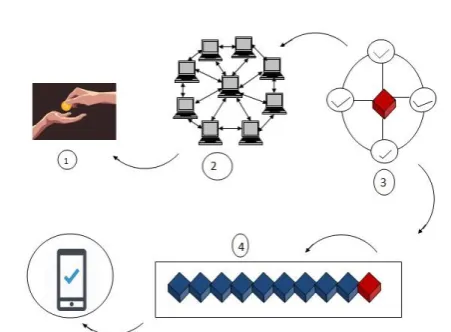
The best way to explain a block chain network is to imagine it to be a continuously growing and self-auditing network which checks any transaction or data verifies and validates the same and adds it as a new block to the existing blockchain. The working of a block chain network is as follows: 1. Firstly, there is a request for a transaction from
within thenetwork.
2. The request is broadcast to all the peers in the network.
3. The network of nodes, then verify and validate thetransaction.
4. Once verified, the transaction is added to the existing block chain, as a new unalterable and permanentblock.
Figure 1. Illustration of steps involved in a blockchain network.
IV.
AN OVERVIEW OF THE PROPOSEDSYSTEM
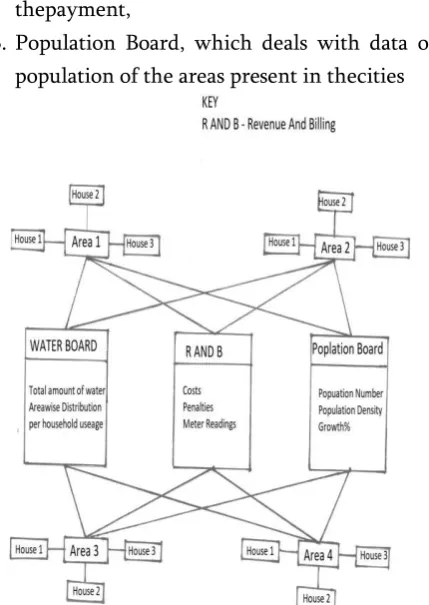
The network of nodes contains all the houses (or any individual building with its own water connection), and three other nodes:
1. Water Board, the node which is in charge of the distribution ofwater,
2. Revenue and Billing, the board which deals with thepayment,
3. Population Board, which deals with data of the population of the areas present in thecities
Figure 2. The nodes involved in the proposed system
The main function of these three nodes is to relay information/data to other nodes in the network, the validation of transactions is still left to the peers and not in the hands of the WaterBoard.
The Water Board has the data about total amount of water, area wise distribution, Demand increase/decrease%.
The Revenue and Billing node has data about the costs, penalties, and meterreadings.
The Population Board has the data about Total Population, Population density, growth %.
Now with these nodes transmitting/broadcasting the data to the network , all the peers are open to check if they are receiving the equitable amount of water or not . If not, they can approach the Water Board regarding the same.
Figure 3.Hashing, Encryption and Validation of data andblocks.
V.
THE PROPOSED SYSTEM AND BLOCKCHAIN IN THE NETWORKLike a typical Blockchain network, the role of the miners in the proposed remains the same, validating the data before the block is added to the existing chain, using various algorithms. The miners, here are operating without any incentive, so likely to be a governmentofficial.
areas , each node can check if their area has received the equitable share from the main water distribution board , and if their house or building has received the equitable share of water from the area-wise pumping station.
The distribution of water to each area is ascertained by the population density of the area. The data on the population distribution and density is processed using an algorithm which partitions the total water available to the areas in such a way that the ratio of water supplied to that of population, is maintained constant for all the areas.
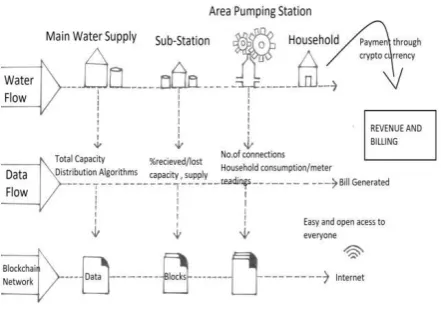
With the data broadcasted from the three nodes (Water Board , R and B , Population Board ) each node is open to run some simple algorithms to calculate the rightful amount of water it , or the area the node (building with water connection) is in, should receive . With this information each node is capable to validate any transaction. A typical transaction in this system would contain the details about the water received and consumed by a node and the corresponding charge for the usage. With these details the payment for the water usage by a node is done to the Revenue and Billing through crypto currency.
Figure 4. Flow of data in the network
VI.
ADVANTAGES OF PROPOSED SYSTEM
A Transparency
As block chain is a distributed, peer to peer network, all data is accessible by all the peers in the network. So through this all people can know how much water they are allotted .Hence equality is assured.
B Scalability
Once the system has been implemented in a city, the addition of new nodes or the increase in the network is accommodated with relative ease and doesn’t affect the functional performance of the system.
C Incorruptible
Falsification of data is almost impossible to achieve in a network implementing blockchain. Therefore hacking the network or any other malicious activities are futile.
D Detection of leakages orpilferages
Using the system, the net consumption of water can be easily determined, with this data any abnormalities are evident and can be identified, these include leakages andpilferages.
VII.
LIMITATIONS OF PROPOSED SYSTEMA .Complexity
Blockchains technology involves an entirely new vocabulary. Thankfully, there are several efforts at providing glossaries and indexes that are thorough and easy tounderstand.
B . Reliance on Government Bodies
system is essential for the implementing the proposedsystem.
D .Favorable to people with access to technology Though the system might solve the problem of unfair water distribution, the people who don’t have access to technology (smart phones, computers)might still not be direct participants of the network; hence they are at the mercy of others to ensure that they get their rightful share of water.
VIII.
FUTURE PROSPECTS
A. Payment
Cashless payment, crypto currency promises to be the norm in the future. Lots of technical advancements in this field are almost certain to happen, and these advancements can easily be implemented in the proposed system as well.
B.Automation and Prediction
After the system is in place, up and running, there are a lot of features that could be added to enhance its functionalities.
Developments in IOT and machine learning are on the rise, with proper implementation, IOT can be used to automate the entire distribution system and Machine learning, to predict patterns of draught and water availability to ensure better preparedness.
IX.
CONCLUSION
With water being a scarce commodity of late, it is paramount that everyone gets their rightful share and uses it wisely. Hence we require a sustainable water management/distributionsystem.
With the proposed system in place, fair water distribution in a city is certain. This system in combination with right knowledge about block chain among people can solve most of the problems of the current water managing/distribution system. By using blockchains as the building block, this
system ensures an equitable and secured water distributionsystem.
As blockchain is emerging out as a new technology, much advancements will be made in this field. This will help the proposed system enhance its functionalities so that most of the limitations can beovercome.
X.
REFERENCES
[1].Blockchains and smart contract for internet of things-DOI10.1109/Access.2016.2566339.
Source:IEEE Xplore
[2].What is blockchain technology? - https://blockgeeks.com/guides/what-is-
blockchain-technology/
[3].The energy block chain: How blockchain could be a catalyst for the distributed grid. – https://www.greentechmedia.com/.../the- energy-blockchain-could-be-a-catalyst-for- the-distributed-grid
[4].Distributed ledger technology: beyond block
chain
- https://www.gov.uk/government/...data/.../gs-16-1-distributed-ledger-technology.pdf
[5].In India, water problems are ‘man made’: Comments on the draft water policy-2012-