Program Designed for Maintenance of Certi
fi
cation
abstract
OBJECTIVE: Pediatricians are required to perform quality improve-ment for board recertification. We developed an asthma project within the Pediatric Physicians’ Organization at Children’s, an independent practice association affiliated with Boston Children’s Hospital, designed to meet recertification requirements and improve asthma care.
METHODS: The program was based on the learning collaborative model. We developed practice-based registries of children 5 to 17 years of age with persistent asthma and helped physicians improve processes of asthma care through education, data feedback, and sharing of best practices.
RESULTS:Fifty-six physicians participated in 3 cohorts; 594 patients were included in the project. In all cohorts, improvements occurred in the use of asthma action plans (62.4%–76.8% cohort 1, 50.6%–88.4% cohort 2, 53.0%–79.6% cohort 3) and Asthma Control Tests (4.6%–55.2% cohort 1, 9.0%–67.8% cohort 2, 15.2%–61.4% cohort 3). Less consistent improvements were observed in seasonal influenza vaccines, controller medications, and asthma follow-up visits. The proportion of patients experiencing$1 asthma exacerbation within the year declined in all 3 cohorts (37.8%–19.9%,P= .0002 cohort 1; 27.8%–20.7%,P= .1 cohort 2; 36.6%–26.9%,P= .1 cohort 3). For each cohort, asthma exacerbations declined to a greater extent than those of a comparison group.
CONCLUSIONS:This asthma quality improvement project designed for maintenance of certification improved processes of care among patients with persistent asthma. The learning collaborative approach may be a useful model for other board-recertification quality improve-ment projects but requires a substantial investimprove-ment of organizational time and staff.Pediatrics2014;134:e242–e248
AUTHORS:Louis Vernacchio, MD, MSc,a,b,cMary E. Francis,
RN,aDaniel M. Epstein, MD,a,b,cJean Santangelo, RN, BSN,a
Emily K. Trudell, MPH,aMeghan E. Reynolds,aand Wanessa
Risko, MD, ScDa,b,c
aPediatric Physicians’Organization at Children’s, Brookline,
Massachusetts;bDivision of General Pediatrics, Boston Children’s
Hospital, Boston, Massachusetts; andcDepartment of Pediatrics,
Harvard Medical School, Boston, Massachusetts
KEY WORDS
asthma, quality improvement
ABBREVIATIONS
ABP—American Board of Pediatrics
HEDIS—Healthcare Effectiveness Data and Information Set MOC—maintenance of certification
PCP—primary care pediatrician
PPOC—Pediatric Physicians’Organization at Children’s QI—quality improvement
Dr Vernacchio designed the analysis, performed the original analysis, reviewed and revised the analysis, and drafted the original manuscript; Ms Francis, Dr Epstein, Ms Santangelo, and Dr Risko conceptualized and designed the project, supervised all aspects of the implementation, and reviewed and revised the analysis; Ms Trudell performed the original analysis and reviewed and revised the analysis; Ms Reynolds drafted the original manuscript; and all authors reviewed and revised the manuscript, and approved thefinal manuscript as submitted. www.pediatrics.org/cgi/doi/10.1542/peds.2013-2643
doi:10.1542/peds.2013-2643
Accepted for publication Feb 10, 2014
Address correspondence to Louis Vernacchio, MD, MSc, Pediatric Physicians’Organization at Children’s, 77 Pond Ave, Ste 205C, Brookline, MA 02445. E-mail: [email protected]. edu
PEDIATRICS (ISSN Numbers: Print, 0031-4005; Online, 1098-4275). Copyright © 2014 by the American Academy of Pediatrics
FINANCIAL DISCLOSURE:The authors have indicated they have nofinancial relationships relevant to this article to disclose.
FUNDING:This work was funded by internal funds of the Pediatric Physicians’Organization at Children’s.
In 2010, the American Board of Pediatrics (ABP) replaced its previous certification requirements with a new 4-part contin-uous process for recertification. This new maintenance of certification (MOC) process, designed to demonstrate pedi-atricians’lifelong commitment to learn-ing, clinical competence, and practice improvement, includes (1) validation of professional standing and licensure, (2) documentation of ongoing lifelong learning and self-assessment, (3) a se-cure examination, and (4)“Performance in Practice,” a requirement for quality improvement (QI) activities performed within the candidate’s own practice.1,2It
is expected that through ABP-approved QI projects, pediatricians will learn how to measure and improve quality in their own practices. The implementation of this new MOC process was met with some skepticism among physicians who felt these activities would be time-consuming, expensive, and unlikely to yield sustainable improvements in pe-diatric practice and/or beneficial out-comes for patients.3,4
To facilitate meeting the MOC require-ments among its member physicians, the Pediatric Physicians’ Organization at Children’s (PPOC), an independent prac-tice association of more than 200 pri-mary care pediatricians (PCP) affiliated with Boston Children’s Hospital, de-veloped an ABP-approved QI project aimed at enhancing the care of children with persistent asthma. We chose to fo-cus on asthma for this initiative because it is one of the most common chronic disorders in childhood, affecting nearly 7 million children in the United States in 2010.5Despite such a high prevalence,
studies show that the care of pediatric persistent asthma remains inadequate6
and the goals of asthma management aimed at reducing impairment and risk of exacerbations are not being met.7
We designed our program to focus on improving practice performance in the following 5 processes of asthma care
suggested by the literature to improve outcomes for children with asthma: (1) receipt of a seasonal influenza vaccine,8,9
(2) completion of$2 maintenance vis-its per year for asthma care,10(3)filling
$1 prescription for an asthma con-troller medication within the year,11–16
(4) completion of at least 1 Asthma Control Test,17 and (5) completing at
least 1 updated asthma action plan.18
We also measured the occurrence of asthma exacerbations requiring medi-cal attention to determine if these interventions reduced the risk of exac-erbations among participating patients.
METHODS
Participants
The PPOC is an independent practice association of.80 privately owned pe-diatric practices affiliated with Boston Children’s Hospital, which cares for an estimated 300 000 children in eastern Massachusetts. All PPOC pediatricians who were due for ABP recertification were eligible to participate in the project. Based on the dates of recertification, 3 cohorts were enrolled. Thefirst cohort participated from December 1, 2009, through November 30, 2010, the second from October 1, 2010, through Septem-ber 30, 2011, and the third from March 1, 2011, through February 28, 2012.
A registry of patients with persistent asthma was developed for each par-ticipating PCP in 2 ways. First, the PPOC has access to claims data from 4 com-mercial insurance companies in Mas-sachusetts, which includes an estimated one-quarter of all PPOC patients. Using this database, children 5 to 17 years of age and who met Healthcare Effective-ness Data and Information Set (HEDIS) criteria for persistent asthma were in-cluded in the project. HEDIS criteria for persistent asthma identify patients who have experienced 1 or more of the fol-lowing events in each of 2 consecutive calendar years: at least 1 inpatient ad-mission or emergency department visit
with asthma as the principal diagnosis; at least 4 outpatient asthma visits with asthma as 1 of the listed diagnoses and at least 2 medication-dispensing events; or at least 4 asthma medication– dispensing events (unless all prescrib-ing events were for leukotriene receptor antagonists).19 Second, patients who
were not included in the claims data-base or who were included but did not meet formal HEDIS criteria for persis-tent asthma were chosen by the PCP for inclusion if the PCP felt they suffered from persistent asthma based on clini-cal knowledge of the patient or evidence from the practice’s medical record.
The Project
The project was organized and run by 2 physician medical directors, the organi-zation’s director of QI, and a QI consul-tant who was primarily responsible for producing data reports and coaching the participating practices. The goal of the project was for each participating PCP to improve performance on the 5 identified processes of asthma care among their identified patients with persistent asthma. It was planned for each cohort to meet in person 4 times during their respective 12-month in-tervention period, although because of delays in getting necessary approvals, cohort 1 was able to meet only 3 times. These face-to-face meetings each lasted 2 hours and used the Institute for Healthcare Improvement’s learning col-laborative model, a longitudinal learning curriculum bringing together multiple practice teams to seek improvement in performance in a collaborative fash-ion.20 Approximately one-third of each
meeting was devoted to didactic pre-sentations on asthma epidemiology and management and core QI concepts. Asthma concepts covered included the following: recommendations of the 2007 National Heart, Lung, and Blood Institute asthma guidelines; environmental fac-tors in asthma control; longitudinal monitoring of asthma patients; and the
of Plan-Do-Study-Act cycles, defining and measuring process and outcome mea-sures, and creating run charts to track performance over time. The remaining two-thirds of each meeting was devoted to (1) disclosure of each participant’s performance to date; (2) facilitated small group discussions (4–10 participants per group); and (3) large group discussions focused on identification of best practices for patient education, patient activation and adherence, and asthma care delivery.
Between in-person meetings, the QI consultant had at least monthly com-munication with each participating practice via e-mail or telephone to collect data, review progress, and troubleshoot implementation issues. Throughout the program, the QI consultant devoted∼10 hours per week to the project. The medical directors and the director of QI attended 1 to 2 meetings per month to review the project’s progress and de-voted an average of 1 to 2 hours per week to planning aspects of the project.
Data Analysis
For each cohort, the baseline period was defined as the 1-year period preceding the project, and the intervention period was defined as the 1-year period of active project participation. Compliance with asthma care process measures was determined by retrospective chart re-view and was available for all patients included in the project. Asthma exacer-bations were defined as any of the fol-lowing: (1) hospitalizations or emergency department visits for asthma, (2) out-patient visits coded as asthma with acute exacerbation or with status asthmaticus, and (3) outpatient visits for asthma with an oral steroid prescribed and were determined by analysis of paid insurance claims. Claims data were available only for the subset of the project’s patients who were insured by 1 of 4 commercial
sure and the proportion experiencing 1 or more exacerbations over the 12-month period were compared between the baseline and intervention periods for each cohort by the McNemar test.
To determine whether changes in the proportion of patients experiencing 1 or more asthma exacerbations from the baseline to intervention period were associated with participation in the project, proportions were determined for a comparison group for each cohort consisting of PPOC patients who met HEDIS criteria for persistent asthma for the same time periods as the patients enrolled in the project but whose PCP was not participating in the MOC pro-ject. The change in the proportion of patients experiencing 1 or more asthma exacerbations from the baseline to in-tervention periods was compared be-tween the MOC patients and the control patients by logistic regression analysis.
This project met our institution’s defi -nition of QI and was therefore exempt from institutional review board review.
RESULTS
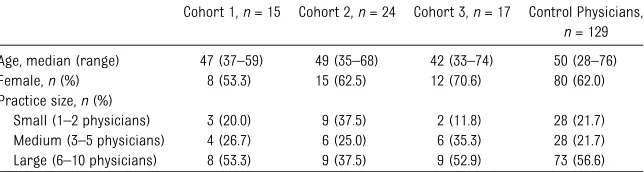
Cohort 1 consisted of 15 participating physicians from 12 different practices and 194 patients, cohort 2 consisted of 24 participating physicians from 21 different practices and 268 patients, and cohort 3 consisted of 17 physicians from 12 different practices and 132 patients. A description of participating physicians is shown in Table 1.
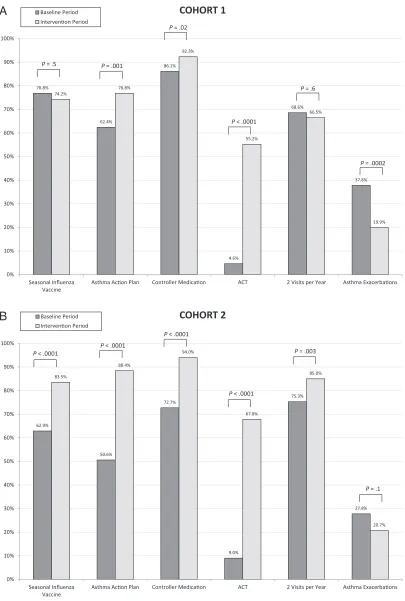
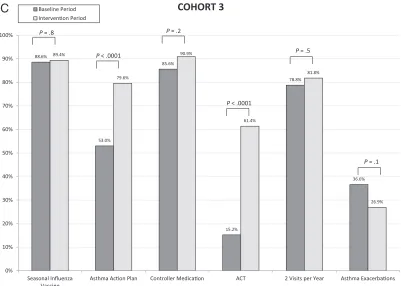
1 exhibited significant improvements in updated asthma action plans (62.4%– 76.8%%, P = .001), use of controller medications (86.1%–92.3%, P = .02), and completed Asthma Control Tests (4.6%–55.2%, P , .001). Cohort 2 demonstrated significant improve-ments in all 5 process measures, in-cluding seasonal influenza vaccine (62.9%–83.5%, P , .0001), asthma action plans (50.6%–88.4%,P,.0001), controller medications (72.7%–94.0%, P,.0001), Asthma Control Tests (9.0%– 67.8%,P,.0001), and at least 2 asthma visits within the year (75.3%–85.0%,P= .003). Cohort 3 demonstrated improve-ments in asthma action plans (53.0%– 79.6%,P,.0001) and Asthma Control Tests (15.2%–61.4%,P,.0001).
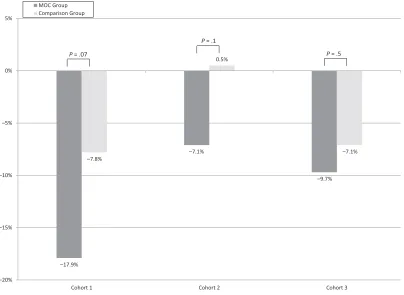
The proportion of patients experiencing 1 or more asthma exacerbations within the year declined from the baseline year to the intervention year in all 3 cohorts. The decline was statistically significant for cohort 1 and of borderline statistical significance for cohorts 2 and 3 (37.8%– 19.9%,P= .0002 for cohort 1; 27.8%– 20.7%,P= .1 for cohort 2; 36.6%–26.9%, P= .1 for cohort 3; Fig 1). To account for possible secular trends in asthma exacerbations, we compared the base-line to intervention changes within each cohort to a control set of PPOC patients whose primary care physicians did not participate in the MOC program. As shown in Figure 2, for each of the 3 cohorts, asthma exacerbations declined to a greater extent in the MOC group
TABLE 1 Description of Participating Physicians
Cohort 1,n= 15 Cohort 2,n= 24 Cohort 3,n= 17 Control Physicians,
n= 129 Age, median (range) 47 (37–59) 49 (35–68) 42 (33–74) 50 (28–76) Female,n(%) 8 (53.3) 15 (62.5) 12 (70.6) 80 (62.0) Practice size,n(%)
FIGURE 1
Comparison of asthma processes and outcomes from baseline to intervention period for each cohort. A, cohort 1; B, cohort 2; C, cohort 3.
compared with the comparison group, and the comparison was of borderline statistical significance for cohorts 1 and 2 (17.9% decline for MOC participants vs 7.8% decline for controls in cohort 1,P= .07; 7.1% decline vs 0.5% increase in cohort 2, P= .1; 9.7% decline vs 7.1% decline in cohort 3,P= .5).
Fifty-three (94.6%) of the 56 physicians who participated in the program qualified to receive 25 Part 4 credits toward their recertification by ABP.
DISCUSSION
The implementation of this ABP-approved asthma QI project by 3 cohorts of pedia-tricians using practice-based registries and a learning collaborative model was associated with significant improvements in processes of asthma care. In each co-hort, a higher proportion of patients had updated asthma action plans and had completed at least 1 Asthma Control Test during the intervention phase compared
with the baseline period. There were also improvements, although less dramatic and consistent, in receipt of seasonal
in-fluenza vaccine, prescription of at least 1 controller medication, and completing 2 asthma office visits within the year. It should be noted that these 3 measures began at higher levels in the baseline period than asthma action plans and Asthma Control Tests and thus had less room for improvement.
An important question for QI work is whether process improvements trans-late into improved health outcomes for patients. In this case, we measured the proportion of patients experiencing 1 or more asthma exacerbations requiring medical attention because studies have shown that exacerbations are a useful marker for uncontrolled asthma.21,22
We compared the proportion experi-encing an asthma exacerbation from the baseline to intervention period in each cohort and found consistent declines in all 3 cohorts, which suggests
that the improvements we observed in process measures translated into im-proved patient outcomes. However, be-cause asthma exacerbation rates can
fluctuate seasonally and from year to year, and because there may be a natu-ral trend toward a reduction in asthma severity for some children with persis-tent asthma over time,23,24 we also
reasons such as sample size limitations to lack of comparison groups. The most important such limitation in our study was the lack of an ideal comparison group. The most suitable comparison group that we were able to use consisted of patients from our own network whose physicians did not participate in the MOC project. However, because asthma has been an important focus of QI efforts within our organization for many years and because our member physicians interact in a variety of ways, there may have been“contamination”of our com-parison group to some extent, making it more difficult to show a difference be-tween our participants and controls.
Perhaps the most relevant lessons from this project revolve around the value of the ABP’s QI requirement for recertifi -cation and the suitability of the learning collaborative model for others who wish to emulate it. Beyond the objective evi-dence of improvements in care pro-cesses discussed previously, the staff
involved in the project were enthusiastic about the learning collaborative ap-proach, particularly in its ability to allow practices to share lessons they were learning throughout the project with their peers to accelerate one another’s progress. This benefit would be lacking from a QI approach that involved more of a “top-down” model with the central organization teaching practices to im-prove in a one-on-one manner or indeed that involved individual practices work-ing on their own in isolation. The cost of such an approach, however, is the sub-stantial investment of organizational resources required, particularly the time of staff and medical directors with advanced QI training. It is unclear how many pediatric primary care organ-izations are equipped to field similar learning collaboratives or how many PCPs are members of an organization willing and able to run them. As for our own organization, in substantial part because of the experience of the asthma
project reported here, we are commit-ted to the learning collaborative ap-proach as an effective method of practice-based QI and have embraced it for many of our major QI initiatives. To date, we have successfully obtained ABP MOC credit for our physicians partici-pating in learning collaboratives fo-cused on well-child care, care of the adolescent, patient experience, family engagement, achieving meaningful use of the electronic health record, effective use of the electronic health record to improve care, integrating behavioral health services in the primary care medical home, and group medical visits. We are in the planning stages for ad-ditional ABP-approved learning col-laboratives on office management of concussions and musculoskeletal inju-ries and ambulatory risk management.
CONCLUSIONS
This asthma QI project demonstrated that an ABP-approved project based on
FIGURE 2
Comparison of change in asthma exacerbations from baseline to intervention period among MOC participants and comparison groups.
with persistent asthma while allowing effort. Because of its success, we have improvement.
REFERENCES
1. American Board of Pediatrics. To maintain certification. About maintenance of certifi ca-tion (MOC). Available at: https://www.abp.org/ ABPWebStatic/?anticache=0.9492465040985828# murl%3D%2FABPWebStatic%2Fmocabout. html%26surl%3D%2Fabpwebsite%2Fmoc% 2Faboutmoc%2Faboutmoc.htm. Accessed June 20, 2013
2. Miles PV. Maintenance of certification: the role of the American Board of Pediatrics in improving children’s health care. Pediatr Clin North Am. 2009;56(4):987–994
3. Strasburger VC, Greydanus DE. Maintenance of certification: the elephant in the room. Clin Pediatr (Phila). 2010;49(4):307–309
4. Hertz BT. Where do you stand? Maintenance of certification process sparks debate. Med Econ. 2011;88(23):24–25, 30–21, 36–29
5. Bloom B, Cohen RA, Freeman G. Summary health statistics for U.S. children: National Health Interview Survey, 2010.Vital Health Stat 10. 2011;(250):1–80
6. Halterman JS, Auinger P, Conn KM, Lynch K, Yoos HL, Szilagyi PG. Inadequate therapy and poor symptom control among children with asthma: findings from a multistate sample.Ambul Pediatr. 2007;7(2):153–159
7. National Asthma Education and Prevention Program. Expert panel report 3 (EPR-3): guidelines for the diagnosis and manage-ment of asthma-summary report 2007. J Allergy Clin Immunol. 2007;120(suppl 5): S94–S138
8. Kramarz P, Destefano F, Gargiullo PM, et al; Vaccine Safety Datalink team. Does influenza vaccination prevent asthma exacerbations in children?J Pediatr. 2001;138(3):306–310
9. Ong BA, Forester J, Fallot A. Does influenza vaccination improve pediatric asthma out-comes?J Asthma. 2009;46(5):477–480
10. Smith SR, Wakefield DB, Cloutier MM. Re-lationship between pediatric primary provider visits and acute asthma ED vis-its. Pediatr Pulmonol. 2007;42(11):1041– 1047
11. Schatz M, Cook EF, Joshua A, Petitti D. Risk factors for asthma hospitalizations in a managed care organization: development of a clinical prediction rule.Am J Manag Care. 2003;9(8):538–547
12. Farber HJ, Chi FW, Capra A, et al. Use of asthma medication dispensing patterns to predict risk of adverse health outcomes: a study of Medicaid-insured children in managed care programs. Ann Allergy Asthma Immunol. 2004;92(3):319–328
13. Fuhlbrigge A, Carey VJ, Adams RJ, et al. Evaluation of asthma prescription mea-sures and health system performance based on emergency department utiliza-tion.Med Care. 2004;42(5):465–471
14. Schatz M, Nakahiro R, Crawford W, Mendoza G, Mosen D, Stibolt TB. Asthma quality-of-care markers using administrative data. Chest. 2005;128(4):1968–1973
15. Broder MS, Gutierrez B, Chang E, Meddis D, Schatz M. Ratio of controller to total asthma medications: determinants of the measure. Am J Manag Care. 2010;16(3):170–178
16. Vernacchio L, Trudell EK, Muto JM. Corre-lation of care process measures with childhood asthma exacerbations. Pediat-rics. 2013;131(1). Available at: www.pediat-rics.org/cgi/content/full/131/1/e136
17. Jia CE, Zhang HP, Lv Y, et al. The Asthma Control Test and Asthma Control Question-naire for assessing asthma control: sys-tematic review and meta-analysis.J Allergy Clin Immunol. 2013;131(3):695–703
18. Ducharme FM, Bhogal SK. The role of written action plans in childhood asthma.Curr Opin Allergy Clin Immunol. 2008;8(2):177–188
19. Schatz M, Zeiger RS, Yang SJ, et al. Persistent asthma defined using HEDIS versus survey cri-teria.Am J Manag Care. 2010;16(11):e281–e288
20. Institute for Healthcare Improvement. The breakthrough series: IHI’s collaborative model for achieving breakthrough improvement. IHI innovation series white paper. 2003. Available at: www.ihi.org/resources/Pages/IHIWhitePapers/ TheBreakthroughSeriesIHIsCollaborativeModel forAchievingBreakthroughImprovement.aspx. Accessed April 18, 2014
21. Jackson DJ, Sykes A, Mallia P, Johnston SL. Asthma exacerbations: origin, effect, and prevention. J Allergy Clin Immunol. 2011; 128(6):1165–1174
22. Sears MR. Epidemiology of asthma exac-erbations.J Allergy Clin Immunol. 2008;122 (4):662–668, quiz 669–670
23. Fuhlbrigge AL, Carey VJ, Finkelstein JA, et al. Validity of the HEDIS criteria to iden-tify children with persistent asthma and sustained high utilization. Am J Manag Care. 2005;11(5):325–330
DOI: 10.1542/peds.2013-2643 originally published online June 16, 2014;
2014;134;e242
Pediatrics
Trudell, Meghan E. Reynolds and Wanessa Risko
Louis Vernacchio, Mary E. Francis, Daniel M. Epstein, Jean Santangelo, Emily K.
Maintenance of Certification
Effectiveness of an Asthma Quality Improvement Program Designed for
Services
Updated Information &
http://pediatrics.aappublications.org/content/134/1/e242
including high resolution figures, can be found at:
References
http://pediatrics.aappublications.org/content/134/1/e242#BIBL
This article cites 20 articles, 2 of which you can access for free at:
Subspecialty Collections
http://www.aappublications.org/cgi/collection/asthma_sub Asthma
sub
http://www.aappublications.org/cgi/collection/quality_improvement_ Quality Improvement
following collection(s):
This article, along with others on similar topics, appears in the
Permissions & Licensing
http://www.aappublications.org/site/misc/Permissions.xhtml
in its entirety can be found online at:
Information about reproducing this article in parts (figures, tables) or
Reprints
http://www.aappublications.org/site/misc/reprints.xhtml
DOI: 10.1542/peds.2013-2643 originally published online June 16, 2014;
2014;134;e242
Pediatrics
Trudell, Meghan E. Reynolds and Wanessa Risko
http://pediatrics.aappublications.org/content/134/1/e242
located on the World Wide Web at:
The online version of this article, along with updated information and services, is
by the American Academy of Pediatrics. All rights reserved. Print ISSN: 1073-0397.