ICASCT2521 | ICASCT | March-April-2017 (3)5 : 122-127]
22 & 23.04.2017
In association with
I
nternational
Journal
of
Scientific
Research in
Science and
Technology
122
Data Driven Simulation Framework for Taxi Ride Sharing
P. Potri Rathna1, Dr.T.Revathi2 1
Information Technology, Mepco Schlenk Engineering College, Sivakasi, Tamil Nadu, India [email protected]
2Head of Department, Information Technology, Schlenk Engineering College, Sivakasi, Tamil Nadu, India
ABSTRACT
In the modern era vehicles are increasing exponentially with respect to its population. The urban cities are facing many challenges in transportation and energy consumption. The foremost approach will be taxi ride-sharing which effectively reduces traffic congestion, gasoline consumption, and pollution. Our proposed method will simulate a real-time data-driven framework for analysing the taxi ride-sharing in various scenarios. In this approaches the taxies and trips are modelled as separate entities for simulating a rich set of realistic scenarios. A new optimization algorithm is described to address the computational complexity and scalability is achieved by an efficient indexing scheme combined with parallelization. The framework is evaluated using a real-time streaming information obtained from the user.
Keywords : Taxi Ride-Sharing, Shortest-Path, Scheduler, Scalability, Apache Spark
I.
INTRODUCTION
Metropolitan cities are facing huge challenges due to a substantial increase in vehicles over the year, and this leads to traffic congestion, gasoline consumption, and pollution. Optimal strategy to decrease the stream of traffic and resource consumption [1] will be a taxi-ride sharing and at the same time, it needs to serve the transportation of city dwellers. The unused taxi can be efficiently filled by ride-sharing services. Every country wants to minimize its traffic and pollution, and the taxi company wants to get higher profit in each margin; and people wants to reach their destination faster with minimal cost. Sharing a taxi-ride has been identified as an optimization problem where the aim is to identify an optimal ride-sharing schedules [2], [3], [4], [5], [6], [7]. Some private organization is already providing ride-sharing services such as Uber, Ola, Lift, Via, Bandwagon and Cab With Me.
The process of deploying taxi-ride sharing needs a better understanding of its tradeoffs. The data-driven approaches are applied by providing a large volume of data for better understanding of the problem. The
tradeoffs of taxi sharing are very challenging because there are multiple stakeholders with different and often with conflicting interests. Initially, the problem has been devised on the basis of survey data and analysis of psychological incentives. The graph-based model to this problem has been proposed by Santi et al. [8] which computes optimal sharing strategies for the trips and it uses two key parameters namely: maximum number of trips that can be shared and the maximum delay the passengers are willing to tolerate. This helps to study the passenger's inconvenience in sharing a taxi and for processing this model the passengers trips details need to be known in advance.
and taxi-specific constraint like a number of passengers per taxi, a maximum number of shared trips. A new linear optimization algorithm is proposed for efficient indexing and assigning a trip to the taxis based on the cost factor. The efficiency of the method is analysed by providing a real-time streaming information.
II.
RELATED WORK
The dynamic pickup and delivery problem [2], [3], has been addressed by linear programming [4], [5], [6]. This will be suitable for small-scale problems, for example, sharing within a certain distance. The real-time taxi dispatching uses heuristic-based method [12] but the scalability is very limited.
The data-driven method evolves with larger benefit and flexibility and the proposed method is similar to Santi et al. [8]. They used a "shareability network", where a node represents taxi trips, and the nodes get connected if they share the trips. This shareability network depends on two parameters the maximum number of shared trips per service and the maximum delay a passenger can tolerate in sharing a taxi. Let k be the maximum trip it can share and ∆ be the maximum delay. This problem may lead to NP-hard for the higher k value and, it is tractable only for k=2. Similarly, the network size increases with ∆ value, for larger ∆ value the network will be larger and this will increase the computation time. However, the obtained results from the model will not be feasible for real time scenarios because this will not explicitly consider the taxi positions and their capacity
For example, there are two trips t1, t2 and this trips needs to be shared in a beneficial manner. For serving the passenger request there should be a cab c. Consider that c is serving some trips t1 and some other trip ti. If t1 and t3 are served by c in this order then it can't serve to the request of t2 and similarly, if t1 and t2 are assigned to
c then it can't serve to t3 anymore or if it serves then the cost will be more.
According to this method, the trips of the passenger has to be known in advance for processing, this will be another limitation of this. This method is well suited for car pooling because in car pooling the time and location of each trip are fixed but this assumption is not suitable for taxi ride-sharing where trip request arrives at dynamic and real. To solve this issue Santi et al.
proposed a refinement technique to their model which prunes the shareability network by keeping a time window . However, in real time, this works only for
=0.
Ma et al. [9], [10] proposed a taxi ride-sharing dispatching method in real-time. Ma et al. splits the region into grid cells and calculate the distance "heuristically". This attains the fastest response because the heuristic calculation provides the shortest path with minimal computation. The accuracy of the system is very less and the results depend on the selected grid size. Similar to Ma et al. the proposed method response time will also be fast if the queries match with the cabs. Cache coherent indexing scheme is used for finding exact shortest path scheme for optimization.
Hung et al. [11] scheduling algorithms match the taxi with dynamic passenger trip requests. The taxis are scheduled with minimal cost by satisfying trip waiting and service time constraint. This uses Kinetic tree algorithms like branch-and-bound and mixed-integer programming. This type of kinetic algorithms can be integrated with the proposed algorithm.
III.
DATA DRIVEN SIMULATION
When a dynamic trip request is issued by the passenger, our model schedule a taxi for the trip request by optimizing the pre-defined cost function under the constraint.
3.1 Simulation Components
Taxi Fleet: Indicates the set of taxis that are participating in taxi ride-sharing and the taxis are on dynamic. Here taxis are considered as a distinct entity which includes parameters like a maximum number of shared trips, passenger capacity, maximum pickup waiting time, extra time for drop off, vehicle speed, occupancy of people, the list of stops for sharing.
Passengers: People involve in sharing and the passenger size should be more than or equal to one. Includes the parameters like drop off location and a set of sharing constraint.
Road Network: A directed graph G(V,E) is used to represent the road network. when a vehicle flows in both direction of a road then the bi-directed graph is used. Weights are used to incorporate the traffic condition.
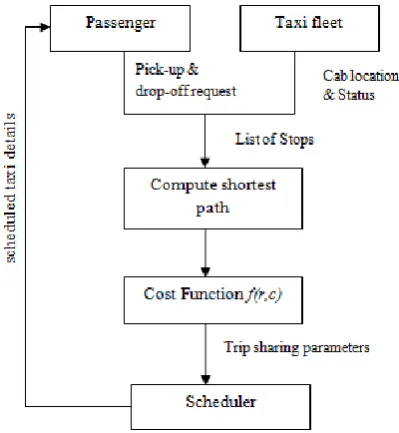
Figure 1: Overview of the Taxi Ride-Sharing
3.2 Data-Driven Simulation
The ride-sharing scenarios are simulated based on a set of input parameters and operate in an event-driven fashion where the states are updated when a new pickup request has been issued. When a new pickup request issued by the passenger then all taxis needs to update their status to the scheduler. Then the scheduler picks an appropriate taxi with minimal cost by computing the additional cost function f.
Input Parameters Description
m number of taxies involving in ride-sharing
C Default taxi capacity
nshare Maximum number f trips to be shared
tdelay /ddelay Additional time/distance
delay each customer could spend by default
textra / dextra Extra time /distance each
customer could spend by default
f(r,c) A cost function that a given taxi C and a pick-up request
r, returns the cost of accommodating r with C.
Table 1: Input parameters for simulation
IV.
SIMULATION ALGORITHM
Figure 1 shows the architecture of the proposed method. The aim is to minimize the total cost or maximize the total utility while meeting a set constraint. Let the additional cost function be f( ri, cj ) for a cab cj for the trip ri, n be the number of trips and m be the number of taxis. The total travel cost T( i ) for the initial i trips can be calculated using
( ) { ( ) * ( )+
( )
All the trips are considered in a chronological order. The real time dispatching is done by minimizing Tc(n). The cab detail cj is updated for every trip ti based on the
elapsed time.
4.1 Simulation Phase
The simulation takes the data in an event-driven fashion for scheduling the trip with a taxi of minimal cost with respect to set of constraint. The parameters are shown in table 1.
___________________________________________ Algorithm 1 Simulating taxi ride-share
Input: a set of trips, R={r1,r2}
Parameters : m-no.of c abs, c-capacities of cabs, nshare,
ndelay, nextra, f(r,c)
STEPS :
1.Sort the values of R in chronological order and store it in R
2. Initialize the capacity to all cabs C {c1,c2,…., cm }
3. Iterate i till |R| by assigning i value as 1
4. Subtract TimeofPickUp(ri-1) from TimeofPickup(ri)
and store it in ElapsedTime 5. Assign infinity(∞) to f*
6. Iterate j till m by assigning j value as 1 7. updatecabstatus (ci)
8. Assign f(ri,cj) tofij
9. if f* greater than fij then
10. assign fij to f*
11. assign cj to c*
12. end if 13. end for
14. Assign trip ri to the cab c* (ri ,c*)
As of Algorithm 1, each trip is considered in chronological order. For each passenger pickup request
ti, examine the cab C status and update the status based on their elapsed time. Additional cost f(ti,cj) for each cab is calculated and assign ri to the cab with minimal additional cost. The speed of the cab is cab is needed for updating its state hence, calculate speed using the trip duration and distance.
Simultaneously, update the cab occupancy and planned stops.
__________________________________________ Algorithm 2 Cost Function f(t,c)
Input: r: trips, c:cab
Parameters : nshare ,ndelay ,nextra,
STEPS :
1. Assign list of stops of C including its current location {s0 ,s1 ,….., sk } to S
2. Calculate Shortest Path between sk and r.pdrop and
store the value in Ddrop
3. Compute FindPickUpLocation(r,c,s, Ddrop) and store
the value in idxpick ,D*
4. Checkif idxpick is less than or equal to k then
5. subtract Ddrop from D* and store in Dpick
6. Compute FindDropOffLocation (r,c,s ,idxpick
,D*,Dpick) and store the value in idxdrop ,D*
7. end if 8. return D*
Output D* : an additional distance for cab c to accommodate
The Additional cost calculated in Algorithm 2, is used for finding the optimal route for the cab cj which includes the pick-up and drop-off locations of ri and compare its cost with the current route for cj. This optimal route computation is called as Sequential Ordering Problem (SOP) which is a kind of Travelling Salesman Problem [18]. The heuristic search is used for computing the best route for cj, for this first find the pick-up location ppick and place it in the stop S and assume that the order to visit the stops are same and similarly, the drop-off pdrop is added to end of the route. While computing additional cost f(ri,cj), the occupancy of the taxi is also checked. Once ri to the cab cj is
assigned with the minimal cost, update the stops S
details . The list of scheduled stops of cab cj will be
S={s0,s1,……sk}, and ppick and pdrop be the pick-up and drop-off locations of ri.
Let us assume that the drop-off will happen after the last stop sk for computing the additional distance to accommodate ri Insert ppick between sl-1 and sl. If D1, D2 and D3 be the lengths of shortest paths between sl-1and
ppick, ppick and sl, and sl-1 and sl then the additional distance will be defined as, D= D1 + D2 – D3+ Ddrop , and
the algorithm performs pruning and stops if the delay constraint is no longer satisfied (Algorithm 3) by using this algorithm pick-up order of passenger is calculated. ___________________________________________ Algorithm 3 FindPickUpLocation
Input: r trip, c cabs, s={s0, s1,….., sk} list of stops of
c including its current location, Ddrop the shortest
distance between sk and pdrop
Fields: c.C capacity of c, r.op number of passengers
of r
Parameters: nshare, ndelay, nextra
STEPS:
1. Assign the cab passenger count value to idx 2. Assign infinity(∞) to newdist(D*)
3. Increment the k value and store it in idxpick
4. Iterate the for loop till k, by assigning idx+1 value to j.
5. Compute the shortest path between previous location and current pick-up location then store the value in D1
6. Compute the shortest path between current pick-up location and stopj location then store the value
in D2.
7. Compute the shortest path between previous location and stopj location then store the location
in D3.
8. If ddelay <= 1 && dextra <= 2 for all trip then
9. D=D1 + D2 -D3 + Ddrop
10. Check if olddist(D) < newdist(D*) then 11. Assign D value to D*
12. Assign j value to idxpick
13. end if
14. else if ddelay not satisfied for trip r
15. break 16. end if
17. assign sj value to prev
18. end for Return idxpick. D*
Similarly, the drop-off of the passenger is computed using the Algorithm 4. In the algorithm, the best position for pdrop is searched. As like the FindPickUpLocation process, for each sl {sp-1 = ppick, sp, sp+1,…….sk-1}. Then query the shortest path between sl and pdrop, pdrop and sl+1, and sl and sl+1, will be D4, D5, D6 respectively. Then the additional cost of each new route will be defined as , D = Dpick + D4 + D5 - D6. For example, consider l=5000,
______________________________________ Algorithm 4 FindDropOffLocation
Input: r trip, c cabs, s={s0, s1,….., sk} list of stops of
c, idxpick index of S where to insert ppick, D*
additional distance obtained from FindPickUpLocation, Dpick additional distance to
insert ppick at idxpick
Parameters : ddelay, dextra
STEPS:
1. Assign ppick value to prev
2. Iterate the for loop till k, by assigning idxpick
value to j
3. Compute the shortest path between the previous location and passenger drop location then store the value in D4
4. Compute the shortest path between passenger drop location and stop(sj) location then store the
value in D5.
5. Compute the shortest path between previous location and stop(sj) location then store the
location in D6.
6. Check if ddelay <= 1 && dextra <= 2 for trips are
satisfied then
7. D=Dpick + D4 + D5 - D6
8. If olddist(D) is less than newdist(D*) then 9. Assign D value to D*
10. Assign j value to idxdrop
11. end if 12. end if
13. assign sj value to prev
14. end for
Return idxdrop. D*
4.2 Cache Coherent Shortest Path Index
The shortest path queries are used extensively in our algorithm (Algorithm 2, 3, 4), at this point the computation spends much time. Each computation of
f(ri,cj) makes a series of the queries for all stops of cj, for the finding solution with minimal cost. Initially, precompute all the shortest distance between each nodes and cache the distance for all intersection pairs. This will reduce the cache misses and can be used for fast retrieval of distance if the same queries repeated. The matrix storage size is simply small and would fit completely on commodity computers. Thus the shortest path queries are now reduced to memory access.
An efficient and easy method to increase cache coherent of shortest path lookups has been proposed. Transport the shortest path matrix, forward lookups become backward lookups and vice versa and an additional transposed matrix has been included in the shortest path queries to convert all forward lookups to backward lookups. The cache-coherent layout will
systematic
allyreduce the number of cache misses. This efficiently reduces up to six times than the single core.
V.
EXPERIMENTAL SETUP
The experiment is performed with real-time user data. For getting the user information the android application is used and for executing the process Apache Spark is used. The streamed dynamic data is processed continuously using Spark.
Figure 2. The saving percentage of total cost for travel distance through sharing ride for nshare=1,2,3,4.
5.1 Data
An Android application is created for getting user details which include information like a passenger name, number of passengers for a ride, pick-up and drop-off location and their date and time of travel. The application is created using Android Studio IDE. The application will use the Google Map detail for getting the user pick-up and drop-off location. In this, the android application will act as a client end which sends data to the server.
The Apache Spark will act as a back end for processing. It seamlessly gets user data dynamically and runs the scheduling algorithm for scheduling the user request with an appropriate cab. For processing the user request each trip is represented with the following fields: taxi ID, pick-up time, pick-up and drop-off locations, travel distance in kilometers and number of passengers details are stored in server side. Assume that the maximum number of extra stops, which is at most 2nshare. For
keeping the waiting and service times as reasonable, set
0 5 10 15 20 25 30 35 40 45
s
av
in
g
%
nshare=1 nshare=2 nshare=3 nshare=4
ddelay=5 minutes and dextra= 10 minutes and set each
taxi's capacity C=4 for simplicity. The Fig.2 explains the total cost saving % for a passengers who undergone for sharing taxis where nshare=1,2,3,4
VI.
CONCLUSION
In this paper, we present a data-driven simulation for taxi-ride sharing to improve flexibility and scalability for rich set of realistic ride-sharing scenarios. The main goal of scheduling algorithm is to work seamlessly in allocating a taxi request with a cab of minimal cost Cache-coherent layout helps to speed up the shortest path queries and speed up the entire processing. The implementation of our model if fully done with Apache Spark, which enables of variety batch analysis tasks. The future work we would like to implement the load balancer for the shortest path queries. In this, the shortest path database could be loaded on a separate machine. This will allow making a better use of computing resources when having multiple simulator instances.
VII.
REFERENCES
[1].
V. Handke and H. Jonuschat, Flexible Ridesharing. Springer Berlin Heidelberg, 2013.[2].
J. Yang, P. Jaillet, and H. Mahmassani, "Real-timemultivehicle truckload pickup and delivery problems," Transportation Science, vol. 38, no. 2, pp. 135–148, 2004.
[3].
G. Berbeglia, J.-F. Cordeau, and G. Laporte, "Dynamic pickup and delivery problems," EJOR, vol. 202, no. 1, pp. 8 – 15, 2010.[4].
A. Marin, "Airport management: taxi planning," Annals of Operations Research, vol. 143, no. 1, pp. 191–202, 2006.[5].
G. Keith, A. Richards, and S. Sharma, "Optimization of taxiway routing and runway scheduling," in AIAA Guidance, Navigation and Control Conference and Exhibit, 2008.[6].
P. Shaw, "Using constraint programming and local search methods to solve vehicle routing problems," in Principles and Practice of Constraint Programming CP98, ser. Lecture Notes in Computer Science, M. Maher and J.-F. Puget, Eds. Springer Berlin Heidelberg, 1998, vol. 1520, pp. 417–431.[7].
B. Coltin and M. Veloso, "Scheduling for transfers in pickup and delivery problems with very large neighborhood search," in AAAI, 2014, pp. 2250– 2256.[8].
P. Santi, G. Resta, M. Szell, S. Sobolevsky, S. Strogatz, and C. Ratti, "Quantifying the benefits of vehicle pooling with shareability networks," PNAS, vol. 111, no. 37, pp. 13 290–13 294, 2014.[9].
S. Ma, Y. Zheng, and O. Wolfson, "T-share: Alarge-scale dynamic taxi ridesharing service," in ICDE. IEEE, 2013.