© 2018 IJSRST | Volume 4 | Issue 2 | Print ISSN: 2395-6011 | Online ISSN: 2395-602X Themed Section: Scienceand Technology
Efficient and Secure Data Access Control for Multi-Authority Cloud Storage
Systems
D.V.L.Saraswathi1, Dr. K V V S Narayana Murthy2, Dr. D. Mohan Reddy3
1PG Scholar, Department of Computer Science and Engineering,Amalapuram Institute of Management Sciences and
College of Engineering, Mummidivaram,East Godavari District, Andhra Pradesh, India
2Professor, Computer Science and Engineering, Amalapuram Institute of Management Sciences and College of
Engineering, Mummidivaram,East Godavari District, Andhra Pradesh, India
3Professor & Principal, Amalapuram Institute of Management Sciences and College of Engineering, Mummidivaram, East
Godavari District, Andhra Pradesh, India
ABSTRACT
Information get to control is an effective method to give the information security in the cloud however because of information outsourcing over untrusted cloud servers, the information get to control turns into a testing issue in cloud storage frameworks. Attribute based Encryption (ABE) procedure is viewed as a most dependable cryptographic leading instrument to ensure information owner's immediate control on their information out in the open cloud storage. The past ABE plans include just a single authority to keep up the entire Attribute set, which can expedite a solitary point block both security and execution. Paper proposed the plan, an expressive, proficient and revocable decentralized way information get to control plot for multi-authority cloud storage frameworks, where there are various experts exist and each authority can issue Attribute s autonomously. Keywords: Attributes -Based Encryption, Access control, data storage, Multi-Authority.
I.
INTRODUCTION
Presently a day's cloud computing is a shrewdly created innovation to store information from number of customer. Cloud computing enables clients to remotely store their information over cloud. Remote reinforcement framework is the dynamic strategy which limits the cost of actualizing more memory in an association. It helps government organizations and undertakings to diminish money related overhead of information administration. They can separate their information reinforcements remotely to outsider cloud storage suppliers than keeping up their own particular server farms. An individual or an association does not require acquiring the capacity gadgets. Rather they can store their information to the cloud and chronicle information to keep away from data misfortune if there should be an occurrence of framework disappointment like equipment or
programming disappointments. Cloud storage is more adaptable, yet security and protection are accessible for the outsourced information turns into a genuine concern. To accomplish secure information exchange in cloud, reasonable cryptography technique is utilized. The information owner should after encryption of the record, store to the cloud. In the event that a third individual downloads the document, they can see the record in the event that they had the key which is utilized to unscramble the encoded record. To defeat the issue Cloud processing is one of the rising innovations, which contains enormous open appropriated framework. It is vital to ensure the information and security of client. Characteristic based Encryption is a standout amongst the most reasonable plans for information get to control out in the open mists for it can guarantees
information owners coordinate control over
benefit. Till now, there are numerous ABE plans proposed, which can be partitioned into two classes; Key Policy Attribute-based Encryption (KP-ABE) and additionally Cipher-text Policy Attribute-based Encryption (CPABE). In KP-ABE plans, decode keys are joined with get to structures and in cipher-text it is marked with extraordinary property sets, for characteristic administration and key appropriation a authority is mindful. The expert might be the human asset division in an organization, the enrollment office in a college, and so on. The information owner characterizes the entrance arrangements and encodes the information as per the characterized strategies. Each client will be issued a mystery key mirroring its properties. A client can decode the information at whatever point its qualities coordinate the entrance arrangements. Access control techniques guarantee that approved client get to information of the framework. Access control is a strategy or methodology that permits, denies or confines access to framework. It likewise screens and record all endeavors made to get to a framework. Access Control
can likewise recognize unapproved clients
endeavoring to get to a framework. It is an instrument which is especially imperative for insurance in PC security. The Cloud stockpiling is an imperative administration in cloud computing. The Cloud Storage offers administrations for information owners to have their information over cloud condition. A major test to information get to control plot is information facilitating and information get to administrations. Since information owners don't totally believe the cloud servers additionally they can never again depend on servers to do get to control, so the information get to control turns into a testing issue in cloud storage frameworks. Along these lines the decentralized information get to control plot is presented.
II.
Related Work
An threshold multi-expert CP-ABE get to control plot for open cloud storage, named TMACS, in which
plan. Cipher-text-Policy Attribute-based Encryption (CP-ABE) is viewed as a standout amongst the most appropriate advances for information get to control in cloud storage, since it gives information owners more straightforward control on get to approaches. Be that as it may, it is hard to specifically apply existing CP-ABE plans to information get to control for cloud storage frameworks due to the Attribute denial issue. For that composed an expressive, productive and revocable information get to control conspire for multi-expert cloud storage frameworks, where different authorities exist together and every expert could issue properties autonomously. In particular, it proposed a revocable multi-authority CP-ABE plot, and applies it as the fundamental procedures to plan the information get to control conspire. Sharing information in a multi-owner way while saving information and personality protection from an untrusted cloud is a testing issue, because of the regular difference in the enrollment. For that proposes a safe multi-owner information sharing plan, named Mona, for dynamic gatherings in the cloud. By utilizing bunch signature and dynamic communicate encryption procedures; any cloud client can secretly impart information to others. In the mean time, the capacity overhead and encryption calculation cost of this plan are autonomous with the quantity of denied clients.
III.
Existing Methodologies
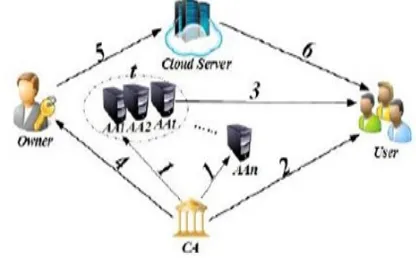
The plan structure of TMACS condensed in Fig. 1. In TMACS, AAs should right off the bat enroll to CA to pick up the comparing personality and authentication (help, aid. cert). At that point AAs will be associated with the development of the framework, helping CA to complete the foundation of framework parameters. CA acknowlthresholds clients' enlistment and issues the authentication (uid, uid. cert) to each lawful client. With the endorsement, the client can contract with any t AAs one by one to pick up his/her mystery key (SK). Owners who need share their information in
the cloud can pick up the general population key (PK) from CA.
Fig. 1: Framework and Basic Protocol Flow
At that point the owner can scramble his/her information under predefined get to approach and transfer the cipher-text (CT) to the cloud server. Client can uninhibitedly download the cipher-text (CT) that he/she is keen on from the cloud server. Be that as it may, he/she can't unscramble the cipher-text (CT) unless his/her attributes.
(1) AA registers to CA to gain (aid; aid: cert); (2) User registers to CA to gain (uid; uid: cert); (3) User gains his/her SK from any t out of n AAs; (4) Owners gain PK from CA;
(5) Owners upload (CT) to the cloud server; (6) Users download (CT) from the cloud server.
Fig. 2: General stream of author's AnonyControl and AnonyControl-F conspire in this framework, there are four sorts of elements: N Attribute Authorities, Cloud Server, Data Owners and Data Consumers. A client can be a Data Owner and a Data Consumer all the while. Authorities are expected to have intense calculation capacities, and they are regulated by government workplaces since a few characteristics somewhat contain clients' by and by identifiable data. The entire quality set is separated into N disjoint sets and controlled by every authority, along these lines every expert knows about just piece of characteristics. A Data Owner is the substance who wishes to outsource encoded information document to the Cloud Servers. The Cloud Server, who is expected to have sufficient capacity limit, does only store them. Recently joined Data Consumers ask for private keys from the majority of the authorities, and they don't know which qualities are controlled by which experts. At the point when the Data Consumers ask for their private keys from the authorities, experts together make comparing private key and send it to them. All Data Consumers can download any of the encoded information documents, however just those whose private keys fulfil the benefit tree Tp can execute the operation related with benefit p. The server is assigned to execute an operation p if and just if the client's certifications are confirmed through the benefit tree Tp. Author proposes another revocable multi-expert CP-ABE convention in view of the single-authority CP-ABE proposed by Lewko and Waters. That is author extend it to multi-expert situation and make it revocable. Author applies the systems in Chase's multi-expert CP-ABE convention to entwine the mystery keys produced by various authorities for a similar client and keep the agreement assault. In particular, author isolates the usefulness of the authority into a worldwide authentication expert (CA) and different property experts (AAs). The CA sets up the framework and acknowlthresholds the enrolment of clients and AAs in the framework. It appoints a worldwide client personality uid to every
client and a worldwide expert character help to each property authority in the framework. Since the uid is comprehensively extraordinary in the framework, mystery keys issued by various AAs for the same uid can be entwined for unscrambling. Likewise, on the grounds that every AA is related with a guide, each Attribute is discernable despite the fact that a few AAs may issue a similar quality. To manage security issue in Multi-Authority Attribute Based Encryption, rather than utilizing the framework interesting open key to encode information, author's plan requires all credit experts to produce their own open keys and uses them to scramble information together with the worldwide open parameters. This keeps the testament authority in plot from decoding the cipher-text. To tackle the quality disavowal issue, author doles out a rendition number for each property. To enhance the productivity, author designate the workload of cipher-text refresh to the server by utilizing the intermediary re-encryption strategy, to such an extent that the recently joined client is likewise ready to decode the beforehand cloud information, which are scrambled with the past open keys, on the off chance that they have adequate Attribute s. To accomplish secure information sharing for dynamic gatherings in the cloud, Authors hope to join the gathering signature and dynamic communicate encryption strategies.
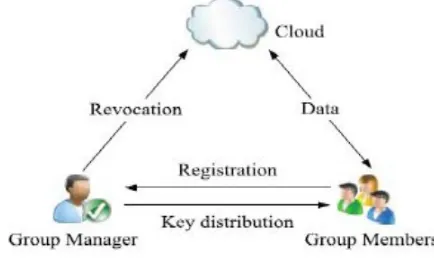
Fig. 3: System model for MONA
This gathering mark plot empowers clients to namelessly utilize the cloud assets, and the dynamic
information owners to safely share their information documents with others including new joining clients.
IV.
Analysis and Discussion
Author proposes another threshold multi-authority CP-ABE get to control conspire TMACS, out in the open cloud storage, in which all AAs together deal with the entire property set and offer the ace key α. Exploiting (t, n) limit mystery sharing, by connecting with any t AAs, a lawful client can produce his/her mystery key. Therefore, TMACS maintains a strategic distance from any one AA being a solitary point bottleneck on both security and execution. The examination comes about demonstrate that author's entrance control plot is strong and secure. It can without much of a stretch find proper estimations of (t, n) to influence TMACS to secure when not as much as t experts are traded off, likewise vigorous when no not as much as t authorities are alive in the framework. Further, in light of proficiently consolidating the conventional multi-authority conspire with TMACS, build a half breed plot that is more reasonable for the genuine situation. This plan tends to characteristics originating from various experts, security and framework level heartiness. Author examines the deficiency of DAC-MACS in managing Attribute denial. What's more, discovered that, if a disavowed client needs to get to the unapproved content whose entrance approach can be fulfilled by his/her repudiated qualities, the main activity is to utilize author's proposed assault calculation to change the new-rendition cipher text to the old-form one on the off chance that he/she can plot with the cloud authority co-op to get enough cipher text refresh keys. The security powerlessness exists in light of the fact that DAC-MACS wrongly utilize a bidirectional re-encryption conspire in the cipher text refreshing strategy. This defencelessness enables any gathering to re-encode the cipher-text between old-rendition and new-adaptation, just on the off chance that he/she can get the CUKs between these two variants. Author's
proposed plans accomplished fine-grained benefit control and personality namelessness while leading benefit control relies upon client's character. More critical is, this framework can endure up to N − 2 expert bargain, which is for the most part incline toward extraordinarily in Internet-based cloud computing condition. Likewise directed security and execution examination which demonstrates that AnonyControl both secure and proficient for cloud storage framework. The AnonyControl-F acquires the security from the AnonyControl and in this way is equally secure as it, yet additional correspondence overhead is brought about amid the 1-out-of-n absent exchange. Author proposed a revocable multi-expert CPABE conspire that could bolster productive quality repudiation and developed a compelling information get to control plot for multi-authority cloud storage frameworks. Author additionally demonstrated that this plan was provable secure in the irregular prophet display. The revocable multi-authority CPABE is reliable strategy, which can be connected in any remote stockpiling frameworks and online informal organizations and so forth. Authors composed a safe information sharing plan Mona for dynamic gatherings in an untrusted cloud. In Mona, clients can impart information to others in the gathering without uncovering personality protection to the cloud. Additionally, Mona is effective in client disavowal and new client joining. All the more extraordinarily, proficient client disavowal can be accomplished by open repudiation list without refreshing the private keys of the other outstanding clients, and new clients can specifically unscramble documents put away in the cloud without their interest. In addition, the capacity overhead and the encryption calculation cost are consistent. By investigation it is demonstrated that proposed plot was fulfil the security necessities and productivity.
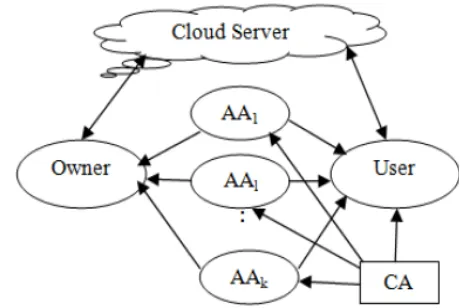
Data get to control framework in multi owner cloud storage: There are five elements in framework as appeared in Fig. 2, an authentication expert (CA), characteristic authorities (AAs), information (owners), the cloud (server) and information buyers (clients). A worldwide trusted declaration expert in the framework is CA. CA sets up the framework and furthermore acknowlthresholds the enlistment of the considerable number of clients and in addition AAs in the framework. For each legitimate client in the framework, the CA allots a special client personality to it and furthermore produces a one of a kind open key for that client. In any case, the CA doesn’t engaged with property administration and making of mystery keys that are related with properties. For instance, the CA might be the Social Security Administration, a free office of the United States government. Each client can be issued special Social Security Number (SSN) as its worldwide character. Every AA is a free Attribute authority that is in charge of entitling and disavowing client’s credits as per their part or personality in its area. In this proposed conspire, each characteristic is related with a solitary AA, however every AA can deal with a subjective number of properties. What's more, every AA has added up to control over the structure and semantics of its qualities. Each AA is in charge of creating an open property key for each quality it oversees and a mystery key for every client mirroring their Attribute s.
Fig. 2: Decentralized manner data access controlling
VI.
Outcome and Possible Result
In a multi-authority decentralized information get to controlling framework properties are from various fields and oversaw by various experts. This technique is most proper for the information get to control of cloud storage frameworks. Clients contain qualities that would be issued by different information owners. Clients can likewise share the information utilizing access approach characterized with characteristics from numerous authorities.
VII.
Conclusion
Proposed a revocable decentralized information get to control framework can bolster effective Attribute
repudiation for multi-expert cloud storage
frameworks. It disposes of unscrambling overhead of clients as indicated by characteristics. This safe characteristic based encryption system for vigorous information security that is being partaken in the cloud. This revocable multi-expert information gets to plot with certain outsourced unscrambling and it is secure and evident. This plan will be a promising procedure, which can be connected in any remote stockpiling frameworks and online interpersonal organizations and so forth.
VIII.
REFERENCES
[1]. L. Cheung and C. C. Newport, “Provably secure ciphertext policy ABE," Proc. ACM Conf. Computer &Communications Security, pp. 456-465, 2007 S. Ruj, A. Nayak, and I. Stojmenovic, “DACC: cloud access control in clouds," Proc. TrustCom’11, pp. 91-98, IEEE, 2011
[3]. Junzuo Lai, Deng, R.H., Chaowen Guan, and Jian Weng, "Attribute Based Encryption With Verifiable Outsourced Decryption," IEEE Trans. Information Forensics and Security, vol.8, no.8, pp. 1343-1354, Aug. 2013
[4]. J. Hur and D. K. Noh, “Attribute-based access control with efficient revocation in data outsourcing systems," IEEE Trans. Parallel and Distributed Systems, vol. 22, no. 7, pp.1214-1221, Jul. 2011
[5]. J. Hur, “Improving security and efficiency in attribute-based data sharing," IEEE Trans. Knowlthreshold and Data Engineering, vol. 25, no. 10, pp. 2271-2282, Oct. 2013
[6]. M. Chase and S. S. M. Chow, “Improving privacy and security in multiauthority attribute-based encryption," Proc. CCS’09, pp.121-130, 2009
[7]. M. Chase, “Multiauthority attribute-based encryption," Proc.TCC’07, pp. 515-534, Springer, 2007
[8]. S. Müller, S. Katzenbeisser, and C. Eckert, “Cloud attribute-based encryption," Proc. 11th Int. Conf. Information Security and Cryptology, pp. 20-36, Springer, 2008
[9]. A. B. Lewko and B. Waters, “Decentralizing
Attribute-based Encryp- tion," Proc.
EUROCRYPT’11, pp. 568-588, Springer, 2011 [10]. H. Lin, Z. Cao, X. Liang, and J. Shao, “Secure
threshold multiauthority attribute based
encryption without a central authority," Inf. Sci., vol.180, no. 13, pp. 2618-2632, 2010
[11]. Wei Li, Kaiping Xue, Yingjie Xue, and Jianan Hong, “TMACS: A Robust and Verifiable Threshold Multi-Authority Access Control System in Public Cloud Storage", IEEE Transactions on parallel and cloud systems, VOL.24, NO. 06, October 2015.
[12]. Jianan Hong, Kaiping Xue and Wei Li, “Comments on “DAC-MACS: Effective Data Access Control for Multi-authority Cloud Storage Systems"/Security Analysis of Attribute
Revocation in Multi-authority Data Access Control for Cloud Storage Systems", IEEE transactions on information forensics and security, VOL. 10, NO. 06, June 2015.
[13]. Taeho Jung, Xiang-Yang Li, Zhiguo Wan, and Meng Wan, “Control Cloud Data Access
Privilege and Anonymity with Fully
Anonymous Attribute-Based Encryption", IEEE transactions on information forensics and security, VOL. 10, NO. 01, January 2015. [14]. Kan Yang and Xiaohua Jia, “Expressive,
Efficient, and Revocable Data Access Control for
Multi-Authority Cloud Storage", IEEE
Transactions on parallel and cloud systems, VOL. 25, NO. 07, July 2014.
ABOUT AUTHORS:
D.V.L.SARASWATHI is currently
pursuing her M.Tech Computer
Science & Engineering at
Amalapuram Institute of
Management Sciences and College of Engineering, Mummidivaram.
Dr. K V V S Narayana Murthy is currently working as a Professor in Computer Science and Engineering
at Amalapuram Institute of
Management Sciences and College
of Engineering, Mummidivaram. He has an 16 years
of teaching experience. His research interests include data mining, Network Security and areas of expertise in DLD, CO, FLAT, CD etc.
Dr. D. MOHAN REDDY received
the B.Tech. Degree from