Long-Term Security-Constrained Unit Commitment:
Hybrid Dantzig–Wolfe Decomposition
and Subgradient Approach
Yong Fu
, Member, IEEE
, Mohammad Shahidehpour
, Fellow, IEEE
, and Zuyi Li
, Member, IEEE
Abstract—The solution of a long-term security-constrained unit commitment (SCUC) problem, which often spans several months to a year, may consider multiple long-term fuel and emission constraints in addition to operating constraints embedded in short-term SCUC. The size and the complexity of long-short-term SCUC are often beyond reasonable computing time and resources. Hence, Lagrangian relaxation is applied in this paper to manage cou-pling constraints over the entire period. Based on dual relaxation, the large-scale optimization problem is decomposed into many tractable short-term SCUC subproblems without long-term fuel and emission constraints. The resource penalty prices are linking signals for the coordination of subproblems. The short-term SCUC may be solved by any numerical optimization methods, including mixed integer programming and Lagrangian relaxation. A hybrid subgradient and Dantzig–Wolfe decomposition approach is pre-sented for managing Lagrangian multipliers in the large-scale dual optimization of long-term SCUC problem. The proposed hybrid approach is a tradeoff between calculation speed and accuracy of the long-term SCUC solution. A modified IEEE 118-bus system is analyzed to exhibit the effectiveness of the proposed approach.
Index Terms—Dantzig–Wolfe decomposition, Lagrangian re-laxation, mixed integer programming, pseudo unit cost curve, resource penalty prices, security-constrained unit commitment (SCUC), subgradient method.
NOMENCLATURE
Fuel contract price of unit time at weekly in-terval .
Ramping down rate limit of unit . Emission function of unit (type ). Upper limit of emission of unit (type ). Upper limit of emission of unit group (type ). Production cost function of unit at time at weekly interval .
Fuel consumption function of unit . Lower limit of fuel consumption of unit . Upper limit of fuel consumption of unit . Lower limit of fuel consumption of unit group . Upper limit of fuel consumption of unit group . Index for unit.
Commitment state of unit at time at weekly in-terval .
Manuscript received February 23, 2005; revised June 12, 2005. Paper no. TPWRS-00098-2005.
The authors are with Electrical and Computer Engineering Department, Illi-nois Institute of Technology, Chicago, IL 60616 USA (e-mail: [email protected]; [email protected]; [email protected]).
Digital Object Identifier 10.1109/TPWRS.2005.857286
Index for line. , Index for unit group.
Number of units. Number of fuel groups. Number of emission groups.
Number of periods under study (52 weeks). Number of hours at each weekly interval (168 h). Index of weekly interval.
Real power generation of unit at time at weekly interval .
System demand at time at weekly interval . Lower limit of real power generation of unit . Upper limit of real power generation of unit . Power flow on line at time at weekly interval . Capacity of line .
Spinning reserve of unit at time at weekly in-terval .
System spinning reserve requirement at time at weekly interval .
Operating reserve of unit at time at weekly in-terval .
System operating reserve requirement at time at weekly interval .
Startup cost of unit at time at weekly interval . Shutdown cost of unit at time at weekly interval . Startup fuel consumption of unit at time at weekly interval .
Shutdown fuel consumption of unit at time at weekly interval .
Startup emission of unit at time at weekly interval (type ).
Shutdown emission of unit at time at weekly interval (type ).
Index for time.
Minimum Up time of unit . Minimum Down time of unit . Ramping up rate limit of unit . Optimal value of original problem.
Optimal value of Lagrangian relaxation function. Optimal value of Lagrangian dual function. Optimal value of LP master problem.
Optimal value of subproblem at weekly interval . Reduced cost.
OFF time of unit at time at weekly interval . ON time of unit at time at weekly interval .
Vector of real generation at time of weekly in-terval .
Vector of phase shifter angle at time of weekly interval .
Lower limit vector of phase shifter angle. Upper limit vector of phase shifter angle. Given variables.
I. INTRODUCTION
A
VAILABLE, affordable, and clean sources of energy are viewed as a prerequisite for economical strength in any in-dustrialized society. The emission allowance is becoming more momentous as a resource constraint (upper limit) in electricity restructuring when the national economy relies increasingly on a complex and interdependent energy infrastructure. The pos-sibility of replacing coal and oil burning plants with natural gas plants (e.g., combined cycle units) could greatly improve the sustainability of forests, waters, and farmlands, which are negatively affected by acid deposition. The long-term solution with fuel and emission constraints and its coordination with security-constrained unit commitment (SCUC) could represent interactions among electricity market, fuel market, and environ-ment [1].In restructured markets, including the PJM interconnection, the New York market, and the U.K. Power Pool, market opera-tors have the authority and responsibility to commit and dispatch system resources and curtail loads for maintaining the system security, simulate and determine optimal operating strategies, disseminate information on locational marginal prices (LMPs) and congested lines for generation resource and transmission expansion planning, and coordinate maintenance scheduling of generating units and transmission lines for security purposes. These functions signify the coordination between short-term (e.g., daily or weekly) and long-term (e.g., monthly or yearly) SCUC solution strategies. In order to accurately realize these functions in competitive markets, the following input data are to be solicited by market operators for running SCUC:
• chronological hourly loads and generation biddings; • physical characteristics of generating units and
transmis-sion components (i.e., lines and phase shifters); • transmission security requirements;
• load curtailment contracts; • fuel availability and constraints; • emission allowance and constraints.
SCUC solves a nonconvex mixed integer optimization problem for accomplishing a secure and economical generation scheduling task in restructured power systems. The task is real-ized by minimizing the total operating cost of supplying hourly loads and startup/shutdown costs of generating units while satisfying temporal generation and transmission constraints. SCUC is a centralized unit commitment decision that utilizes individual participants’ submitted bids. In addition, generating companies could use a priced-based unit commitment (PBUC) to minimize their financial risks and maximize their strategies in a highly volatile electricity market.
Various optimization techniques have been considered for the solution of short-term SCUC. However, the solution of
Fig. 1. Primal decomposition solution of the long-term SCUC.
long-term SCUC could be a cumbersome task in a broad context of energy, economics, and environment with highly detailed electrical model and predicted information for large-scale power systems. Although long-term SCUC can be solved by applying the same strategy as that of short-term SCUC, which includes extending the number of scheduling periods, the large dimensionality of the long-term SCUC problem could render the scheduling solution intractable. The exact solution of long-term SCUC could also be constrained by exorbitant computing time.
Analytical methods for the solution of long-term SCUC are proposed in the literature, which focus mainly on fuel alloca-tion constraints. Generally, contractual requirements such as take-or-pay and supply chain limits such as limited pipeline ca-pacity could represent fuel consumption limits. References [2] and [3] used a network flow algorithm to solve the fuel dispatch problem and applied a heuristic method for unit commitment. However, as generation constraints become more complicated, such a heuristic solution strategy could fail.
Decomposition is a practical scheme for long-term SCUC that divides SCUC into a master problem and several small-scale subproblems and develops a coordination strategy be-tween the master problem and subproblems. Both primal (via resource targets) and dual (via pseudo resource dispatch prices) approaches could be considered for the solution of the decom-position problem [4].
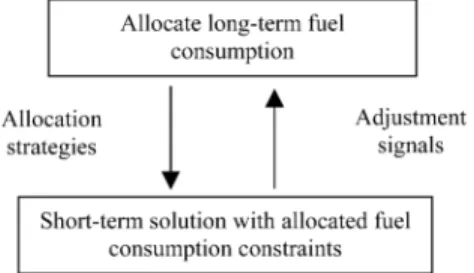
Fig. 1 depicts the primal method in which the long-term fuel consumption limits are allocated to a sequence of fuel consump-tion constraints that are used directly by the short-term oper-ation scheduling. The short-term optimal operoper-ation could in-versely impact the economics of long-term fuel scheduling and the overall system security when considering limited fuel con-sumption as well as generation and transmission constraints.
The short-term solution in Fig. 1 would feed back adjust-ment signals for the reallocation of long-term fuel resource con-straints. The reserve capacity was used in [5] and [6] as a coor-dination indicator between the long-term fuel allocation and the short-term optimal operation. The long-term solution was up-dated if the available reserve capacity at any planning interval was less than a minimum threshold. Reference [7] used the cu-mulative energy supply mismatch representing daily planned energy and the actual daily supply of energy as a coordination indicator. If the cumulative error exceeded a prescribed value, the long-term optimization would be carried out further. How-ever, such coordination strategies are based on dynamic sched-uling that reallocates fuel consumption to the remaining periods of planning. So, the global optimization may not be achieved,
Fig. 2. Dual decomposition solution of the long-term SCUC.
and a nonoptimal fuel allocation at any period could result in infeasible schedules at other periods.
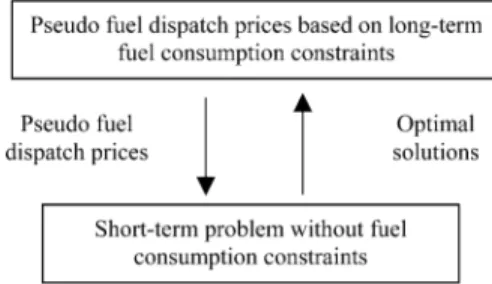
When we relax the coupling constraints into the objective func-tion to solve the long-term problem, the new price is called pseudo price, which may impact generation scheduling. A lower pseudo fuel dispatch price, which differs from contract price, could result in higher fuel consumptions and vice versa. So, the dual method shown in Fig. 2 was introduced as a price-based coordination ap-proach [8]–[10]. In that apap-proach, the calculation of pseudo fuel dispatch price is the key task, and fuel consumption constraints are not taken into account at the short-term solution stage.
Reference [8] used a linear fuel dispatch problem to obtain fuel dispatch prices. However, the price of unlimited and expensive fuel presumably supplying every unit could dramatically impact the corresponding fuel dispatch prices and lead to a different short-term optimal solution. In addition, a feasible solution can only be determined based on the method presented in [8]. An adaptive fuel allocation decision was implemented in [9] to dis-patch power generation by applying pseudo fuel disdis-patch prices and was conditional on past realizations. The fuzzy sets were introduced in [10] for calculating pseudo fuel dispatch prices.
In this paper, long-term coupling constraints such as fuel and emission are taken into account simultaneously with short-term operating constraints. The Lagrangian relaxation algorithm is applied to the entire period to relax complicated and linking constraints into the objective function of long-term SCUC. Based on this dual relaxation, the original large-scale optimiza-tion problem is decomposed into tractable subproblems, which represent the short-term SCUC without fuel and emission constraints. Different solution strategies may be employed to solve short-term SCUC subproblems, including mixed integer programming and Lagrangian relaxation.
Resource penalty prices are used as the linking signal to pro-vide the coordination among short-term SCUC subproblems. By using price signals, a new pseudo cost curve is formed for each unit at the subsequent iteration of short-term SCUC. The dual relaxation problem provides the lower bound of optimal solu-tion to long-term SCUC. Accordingly, a near-optimal solusolu-tion is obtained that is sufficient for long-term analyzes.
The subgradient method provides a simple iterative solution with minute computation cost for the Lagrangian dual problem [11]–[13]. The prefixed step size is used to modify the cor-responding Lagrangian multipliers. Initially, the convergence speed is high, which will slow down as the number of iterations increases with a near-optimal solution. In addition, the subgra-dient method is not a descent method (i.e., the grasubgra-dient method) and the objective function could increase, which is remedied by
selecting proper step sizes and heuristic strategies. Accordingly, Lagrangian multipliers have to be adjusted skillfully.
Dantzig–Wolfe decomposition is an efficient optimization method when applied to large-scale problems with a special block angular structure [14], [15]. Such problems consist of individual constraints representing nearly all variables (e.g., fuel and emission constraints in long-term SCUC). The remaining constraints are divided into several sets with corresponding variables represented in individual rows. These sets repre-sent subproblems (e.g., short-term SCUC). The solution of Dantzig–Wolfe decomposition is based on column generation for entering basis by solving subproblems. Unlike the subgra-dient method, the Dantzig–Wolfe decomposition method is able to properly define new Lagrangian multipliers for subsequent subproblems. The fast and monotonic convergence is a distinct feature of Dantzig–Wolfe decomposition. However, the unpre-dictable cycling phenomenon, discussed in Section II, could interrupt the iterative process of calculating the optimal solution. In addition, few columns are known in initial steps, which could result in a poor approximation of Lagrangian function.
Considering the advantages and the disadvantages of the above two methods, we propose a hybrid method in this paper. The long-term SCUC is an extension of short-term SCUC, so its computational requirement is predicted based on the short-term SCUC performance. In general, if we assume the average solu-tion time for a one-week SCUC is , the total computational time of the long-term SCUC would be about , where is the number of periods and is the number of iterations, which depends on the required calculation accuracy. The proposed approach, which is a tradeoff between calculation speed and accuracy, could successfully combine the advantages of subgradient and Dantzig–Wolfe decomposition methods for the solution of Lagrangian relaxation problem. Other methods, such as bundle method (BM) and volume algorithm (VA), could also be applied to large-scale optimization. However, their performance in the long-term SCUC problem will be evaluated in our future studies.
The rest of the paper is organized as follows. Section II pro-vides the mathematical model of long-term SCUC. Section III discusses the solution methodology. Section IV presents and dis-cusses in detail a modified IEEE 118-bus system with 54 units. The conclusion drawn from the study is provided in Section V.
II. LONG-TERMSCUC FORMULATION
The objective of the long-term SCUC is to minimize the cost of supplying the load in (1) while satisfying the prevailing con-straints
(1) The objective function (1) is composed of production cost and startup and shutdown costs of individual units for the given pe-riod. The concept of utilizing an interval , one week in our long-term formulation, adds another dimension to the SCUC so-lution that makes it different from the short-term SCUC formu-lation and solution [16], [17].
Generation constraints include the system power balance (2), system spinning and operating reserve requirements (3),
(2)
(3) ramping up/down limits (4),
(4) minimum up/down time limits (5),
(5) and real power generation limits (6).
(6) Additional system-wide constraints such as fuel constraints (7) and (8)
(7)
(8) and emission limits (9) and (10)
(9)
(10) for individual and group units are included for representing the interactions among electricity market, fuel market, and environ-mental constraints. For instance, the ISO may allocate the con-sumption of limited fuel and emission allowance to generating units owned by a GENCO, which are represented by constraints (8) and (10). In addition, (7)–(10) represent coupling constraints in long-term SCUC.
In a long-term SCUC problem, we check dc network security constraints at the operation state as follows:
(11)
In addition, constraint (12) provides limits on phase shifter angles (12) where in (1)–(12) (13) (14) (15) Equations (13)–(15) points out that the energy production as well as startup and shutdown costs of unit at time at weekly interval are equal to the multiplication of contracted fuel price and the fuel usage. In a competitive energy market, generating unit owners could select fuel suppliers and submit the related in-formation, such as fuel contract prices and limits, to the ISO for generation scheduling. Such market arrangements could result in various fuel contract prices for generating units even within a GENCO. The fuel contract price could also vary with time. For instance, in severe weather situations (e.g., hot summer or cold winter days), the fuel demand may peak, which could re-sult in a higher contract price. Fuel and emission are considered critical coupling constraints for long-term SCUC. Other cou-pling constraints, such as ramping (4) and minimum up/down time constraints (5), which link successive weekly intervals, are managed based on one of the following two strategies:
1) Constraints (4) and (5), which link successive weekly in-tervals, will be ignored. Accordingly, short-term SCUC simulations discussed in Section III-B will be indepen-dent of one another, which can be processed in parallel to speed up the solution. As a result, the accuracy may suffer slightly.
2) Short-term SCUC subproblems will be solved sequen-tially, and constraints (4) and (5) will be satisfied within SCUC simulations. Accordingly, the short-term SCUC for week 1 is solved first, and its results provide initial conditions for the short-term SCUC in week 2. In this case, no parallel processing will be explored for acceler-ating the implementation.
The difference between the two alternatives signifies the tradeoff between speed and accuracy. In this paper, we adopted the second alternative.
III. LONG-TERMSCUC SOLUTION
The solution process for long-term SCUC is discussed as follows.
A. Lagrangian Relaxation
We consider the Lagrangian relaxation method for the solu-tion of long-term SCUC (1)–(12). This method has proved to be an efficient solution approach for large-scale optimization problems [18]. Coupling constraints (7)–(10) are relaxed and dualized into the objective function (1) by using non-negative Lagrangian multipliers (resource penalty prices and ). The Lagrangian relaxation problem (1)–(12) is formulated in terms of Lagrangian function as in (16) subject to Constraints (2)–(6) and (11) and (12).
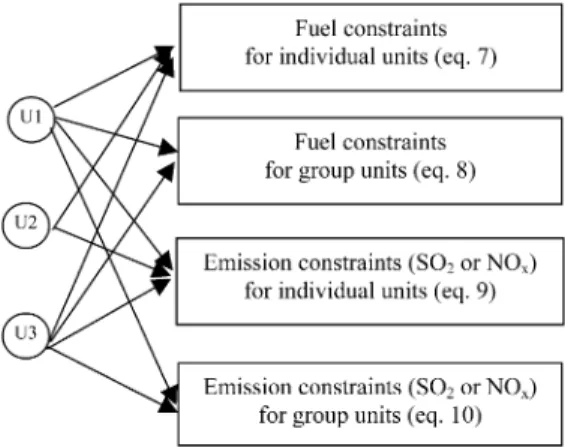
The relaxed coupling constraints transform the original problem into easier-to-solve subproblems. Before implementing the decomposition, corresponding terms for each unit at time at weekly interval are identified. For the sake of clarity, a simple example is shown in Fig. 3, which reflects the relationship be-tween individual units and coupling constraints. In this example, there are three coal-burning thermal units. Constraints (7) and (9) exist for each unit. Constraints (8) and (10) are for a predefined group that only involves units 1 and 3. Consequently, a total of eight coupling constraints are considered with Lagrangian mul-tipliers for each unit listed in Table I, if considering either or emission. These elements are applied as coefficients to
form new energy production as well as startup and shutdown cost curves for each unit, which will be discussed in Section III-B. Accordingly, the Lagrangian function (16) is reformulated in (17) for clarity subject to Constraints (2)–(6) and (11) and (12). The feasible region of the Lagrangian relaxation problem en-compasses that of the primal problem because the coupling con-straints (7)–(10) are added to the objective function. For any feasible generation scheduling solutions and any non- negative Lagrangian multipliers and , the optimal value of Lagrangian relaxation problem is always less than or equal to that of primal problem . In other words, the solution of the La-grangian relaxation problem could find the tightest LaLa-grangian
(16)
Fig. 3. Individual units and coupling constraints(m = n = 1).
TABLE I
LAGRANGIANMULTIPLIERS FOREACHUNIT(m = n = 1)
lower bound on . In order to get the tightest possible bound on the optimal value, we solve an auxiliary problem by opti-mizing the bound over all possible values of Lagrangian multi-pliers. So, the Lagrangian dual function (18) is defined for cal-culating the lower bound nearest to the optimal primal solution (18)
B. Solution of Short-Term SCUC Subproblems
For given values of multipliers, the last four terms in (17) are constant, which are eliminated for optimization purposes. After applying two alternative strategies, described in Section II, for dealing with constraints (4) and (5), we decompose the La-grangian function into small-scale subproblems. In order to repre-sent the subproblems, the new energy production
as well as startup and shutdown costs of unit at time of the weekly interval are represented by (19)–(21)
(19)
(20)
(21)
The curves for each unit are the linear combination of corre-sponding fuel usage and emission curves. Fuel contract price and resource penalty prices ( and ) are coefficients of the linear combination. The pseudo unit with the three cost curves is used in the formulation of weekly subproblem as follows:
(22) S.t. Constraints (2)–(6) and (11) and (12).
The cost function (22) represents a traditional short-term SCUC subproblem at period without fuel consumption and emission allowance constraints. Lagrangian multipliers ( and ) are used as linking signals for coordinating the subproblems. Based on given Lagrangian multipliers, weekly unit commit-ment and generation dispatch are calculated in weeks 1 through , which lead to the calculation of practical fuel usage and emission over the entire study period. A feasible solution for the original problem will be generated if these values satisfy coupling constraints (7)–(10). Otherwise, multipliers will be updated as discussed in Section IV.
Any of the existing methods in the literature could be em-ployed to solve the term SCUC subproblem. The short-term solution methodology should not impact the convergence property of the long-term Lagrangian relaxation algorithm. Ref-erence [19] introduced a direct method in which dc transmis-sion flow constraints were replaced with penalty variables that appear directly in the Lagrangian function for solving unit com-mitment (UC). In other words, dc transmission constraints were relaxed by multipliers in UC. However, the addition of multi-pliers could make it more difficult to obtain the optimal UC so-lution as the number of constraints becomes much larger.
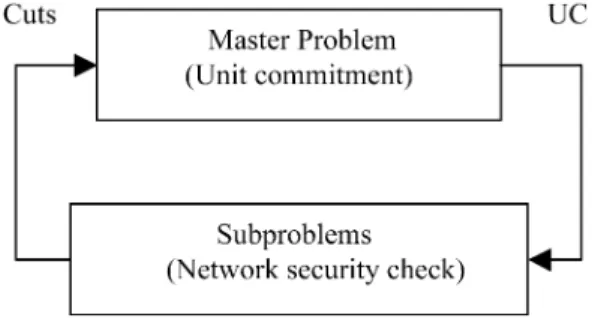
In this paper, a decomposition approach is used to solve the short-term SCUC subproblem. At first, the approach applies Benders decomposition for separating UC in the master problem from the dc network security check in subproblems (see Fig. 4). The Benders decomposition technique has a good convergence property when applying the linear programming (LP) duality theory [20], [21].
Then, the master problem uses the augmented Lagrangian relaxation method to solve UC. Both power balance (2) and
Fig. 4. Short-term SCUC solution process.
system reserve (3) constraints are relaxed in the objective func-tion (22) via Lagrangian multipliers. The relaxed problem is then decomposed into subproblems for each unit. The dy-namic programming (DP) process is used to search the optimal commitment for a single unit. The Lagrangian multipliers are updated based on the violations of constraints (2) and (3). The convergence criterion is satisfied if the duality gap in Lagrangian relaxation is within a given limit.
The subproblem checks dc network security constraints at time for the UC solution. If any network violations arise, corresponding Benders cuts will be formed and fed back into the master problem for the recalculation of UC. The iterative process will continue until all network violations are eliminated. The detailed solution process was presented in [22]. We em-phasize that our short-term SCUC solution could be extended to consider ac network constraints. A full Newton–Raphson method is applied for minimizing system security violations and obtaining corresponding Benders cuts. A comparison of ac and dc results is given in [23]. However, for the purpose of long-term SCUC solution, we resort to dc network constraints in order to speed up the optimization process.
C. Implementation of Relaxed Lagrangian Problem
Various methods such as subgradient and Dantzig–Wolfe decomposition could solve the Lagrangian dual problem. However, the two algorithms differ in terms of assumptions, approximation strategies, and convergence. For instance, the Dantzig– Wolfe decomposition algorithm converges mono-tonically, while the subgradient algorithm is not monotonic and could result in an excessive number of iterations before its termination. In this paper, we consider a hybrid method that combines subgradient and Dantzig–Wolfe decomposition algorithms. The two algorithms as well as the hybrid method are discussed next for the solution of long-term SCUC.
1) Subgradient Method: The subgradient method was
ap-plied in various contexts to produce lower bounds for large-scale optimization programs. The subgradient method is an iterative approach in which Lagrangian multipliers are updated for cal-culating a new iteration. Without the loss of generality, mul-tiple fuel usage and emission allowance constraints (7)–(10) in long-term SCUC are replaced here by the inequality
with non-negative Lagrangian multipliers . Here, represents the UC state and dispatch . At the th iteration, the subgra-dient of Lagrangian function (16) at is . Multipliers will be updated based on
(23)
where is the step size. The easiest approach to defining the step size is to use a constant number that is independent of the iteration . However, coupling constraints will not be indepen-dent in practice and may even compete with each other. For in-stance, the satisfaction of fuel constraint tends to cause the vi-olation of emission constraint and vice versa. In this paper, the traditional formula for step size is presented as follows:
(24)
where is an estimated upper bound of Lagrangian relax-ation function and scalar is a number between 0 and 2. The scalar could be adjusted when there is no improvement in the solution iterations.
The new Lagrangian multipliers will be used in the sub-sequent iteration of the short-term SCUC subproblem (22) at period . This procedure is attractive because of its low computational cost. However, the practical convergence of the subgradient method is unpredictable. For some cases, conver-gence is quick and fairly reliable, while other cases tend to produce a cycling behavior in the multiplier sequence and/or the Lagrangian objective value. Usually, the iterative process is terminated after a fixed number of iterations.
2) Dantzig–Wolfe Decomposition Method: The Dantzig–
Wolfe decomposition method has become a powerful and extensively applied tool for solving large-scale mixed integer programs. Column generation is viewed as a technique for exe-cuting the Dantzig–Wolfe decomposition algorithm. A simple introduction to the method is presented in the Appendix. In this paper, we sequentially execute short-term SCUC starting from week 1 through week and consider the linkage between two successive weekly interval due to coupling constraints (4) and (5). In other words, weekly short-term SCUC problems are not independent.
We reformulate the master problem as the one whose columns could come from feasible solutions of short-term SCUC sub-problems (22), subject to (7)–(10). The variables are the weights attached to these solutions. The following formulation is the th iteration of master problem for calculating Lagrangian multi-pliers of the short-term SCUC subproblem within the weekly interval :
(25) S.t.
(26)
Fig. 5. Hybrid method for the solution of long-term SCUC.
(28)
(29) (30) (31) This formulation is a mixed integer problem, and if the in-teger constraint (31) is dropped, a new LP relaxation of the master problem (LP master) will be formed by (25)–(30). The Lagrangian duality theory shows that the LP master is equiva-lent to the Lagrangian dual defined by dualizing the master con-straints (26)–(30). Reference [24] showed that the strength of Dantzig–Wolfe decomposition or LR scheme is based on the fact that subproblems do not have the integrality property. Con-sequently, th optimal dual variables and for coupling constraints (26)–(29) in the LP master correspond to th La-grangian multipliers and for dualized coupling constraints (7)–(10), while the th dual variable is for the convexity con-straint (30). These values are used for calculating the subsequent iteration of short-term SCUC subproblems to check if a new column with negative reduced cost can be generated by the fol-lowing optimality criterion:
(32)
If (32) is satisfied, a new column will exist and be added to the new LP master for optimization; otherwise, the optimal bound on is found and the iteration process will be terminated.
In addition, the optimal bound in each iterative step is always contained in the bracket between the optimal value of the current LP master problem and the Lagrangian lower bound with the previous Lagrangian multipliers, because the LP master is the dual of the Lagrangain dual problem. Accordingly, the second termination criterion is presented as follows:
(33) However, we must make sure that the iterative process does not get into a cycling process. If columns get repeated (i.e., cy-cling phenomenon), the LP master problem cannot be improved and the iteration will be terminated. Accordingly, we will select the most optimal solution among existing feasible solutions.
3) Hybrid Method: Considering the advantages and the
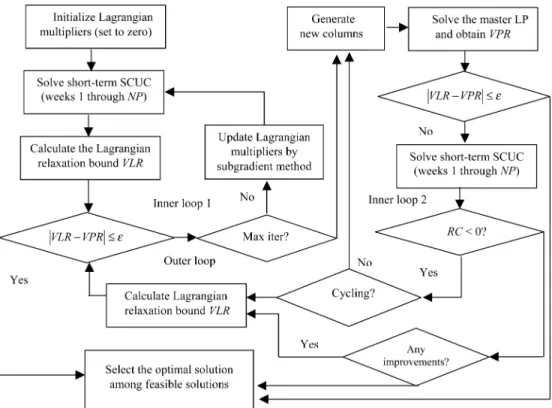
disadvantages of both methods, a hybrid method is proposed in this paper. The hybrid method combines subgradient and Dantzig–Wolfe decomposition methods. Fig. 5 shows the detailed solution process.
The subgradient method is used within the first inner loop, and, after initializing Lagrangian multipliers, short-term SCUC subproblems are solved for weeks 1 through . Then, the La-grangian lower bound is obtained and Lagrangian multi-pliers are updated for the next iteration according to (23). Fea-sible solutions of long-term SCUC are derived and the loop cal-culation will stop after a fixed number of iterations. The ini-tial phase uses the subgradient method with a large step size in order to generate a good initial set of columns at the beginning of method. In fact, it is observed that the convergence of subgra-dient iterations is much faster at the beginning of the iterative process.
All previous columns corresponding to feasible solutions of a subset of long-term SCUC constraints, represented by the solu-tions of the short-term SCUC subproblem, are added to the LP master problem (25)–(30) once the second inner loop starts. The columns generated in the first inner loop contain more useful in-formation than those generated by the standard method, which could yield an artificial column with a high operating cost for starting the column generation method [24]. The value of the LP master problem is taken as the current estimate of the optimum of the Lagrangian dual. The estimate improves as the iterative process proceeds. When the termination criterion (33) is satisfied, the program will stop. Otherwise, short-term SCUC subproblems are executed for weeks 1 through . If the re-duced cost is positive or zero, (32) cannot be satisfied and the program will stop. Otherwise, a new column is found and added to the new LP master. At this loop, there is no need for any ad-justment of step sizes. Lagrangian multipliers are automatically and definitely calculated based on the LP master formulation (25)–(30).
However, if columns get repeated or further improvement in the solution is required, the first inner loop with the advantage of minor adjustment will resume and (33) will be checked at the subsequent iteration for the termination of the program. The cal-culation of outer loop between subgradient and Dantzig–Wolfe decomposition methods will continue until a stopping criterion is satisfied. In case the program stops, we will select the most optimal solution among feasible solutions.
The hybrid method cannot guarantee a true optimal solu-tion. A near-optimal solution will suffice for the simulation of long-term power system operation. However, if a primal fea-sible solution cannot be obtained, we will resort to load shed-ding based on the currently available best UC result as discussed in [25]. In addition, Dantzig–Wolfe decomposition is dual to Lagrangian relaxation and cutting plane (CP) methods. The ad-ditional hybrid method, which combines subgradient and CP ap-proaches, can also be used in the long-term SCUC model.
IV. CASESTUDIES
A modified IEEE 118-bus system is used in this section to demonstrate the simulation of the proposed approach for solving the long-term SCUC with multiple fuel and emission constraints. We intend to solve the hourly UC and generation dispatch over the long-term horizon. Such objectives may not be successfully realized by the short-term SCUC calculation due to the larger scale of long-term solution. The proposed approach is tested in an eight-week case study, which could be considered a long-term horizon. The system shown in Fig. 6 is composed of 54 thermal units, 186 branches, and 91 loads. The annual peak load is 6000 MW. The test data for the 118-bus system are given in motor.ece.iit.edu/data/ltscuc.
The weekly peak load as a percentage of annual peak load is listed in Table II. The definition of fuel and emission groups is listed in Table III. Generating units, which are burning coal, oil, and gas, are defined as fuel groups (FGroup) 1, 2, and 3, respec-tively. Generating units with emission constraints are listed in
Fig. 6. One-line diagram of IEEE 118-bus system.
TABLE II
WEEKLYPEAKLOAD ASPERCENTAGE OFANNUALPEAKLOAD
TABLE III FUEL ANDEMISSIONGROUPS
emission groups (EGroup) 1, 2, or 3. The long-term fuel con-sumption and emission allowance constraints over eight weeks are listed in Tables IV and V, respectively. Under the market situation, take-or-pay fuel contracts are to be fulfilled by com-mitting coal and gas-burning units. At the same time, maximum fuel supply and emission allowance constraints will have certain impacts on the long-term UC and generation dispatch. In order to discuss the efficiency of the proposed approach on long-term SCUC, we present the following three cases.
• Case 1: Base case without fuel consumption or emission allowance constraints.
• Case 2: Fuel consumption constraint is added to Case 1. • Case 3: Emission allowance constraint is added to Case 2. Theses cases are studied as follows.
• Case 1: This case is considered as a base case without fuel consumption or emission allowance constraint, which is
TABLE IV
LONG-TERMGROUPFUELCONSUMPTIONCONSTRAINTS
TABLE V
LONG-TERMGROUPEMISSIONALLOWANCECONSTRAINTS
TABLE VI
FUELCONSUMPTION FOREACHCASE
TABLE VII EMISSIONLEVEL FOREACHCASE
solved by sequentially simulating short-term SCUC prob-lems. The solution in Case 1 will provide necessary in-sights for subsequent analyzes of Cases 2 and 3 (i.e., whether a near-optimal resource allocation strategy has been reached in Cases 2 and 3). Without fuel consumption and emission allowance constraints, large and econom-ical coal-burning units (e.g., units 4 and 5) are committed to supply system loads over the entire eight-week period. In this case, oil-burning and gas units are not committed. Consequently, oil and gas consumptions in Table VI are equal to zero. According to Table VII, units in EGroups 2 and 3 generate no emissions ( and ). The long-term SCUC solution of Case 1 is the most economical so-lution with a total operating cost of $75.572 M as listed in Table VIII.
• Case 2: If we take fuel consumption constraints into ac-count, constraints on FGroups 1 and 3 cannot be satis-fied based on the Case 1 results. The coal consumption exceeds its 70 000 000 MBtu limit and the take-or-pay contract for gas consumption cannot be fulfilled. So, the proposed hybrid method is applied to mitigate constraint violations.
TABLE VIII
WEEKLY ANDTOTALOPERATINGCOST($M)
TABLE IX
FUELCONSUMPTION FOR THEHYBRIDMETHOD INCASE2
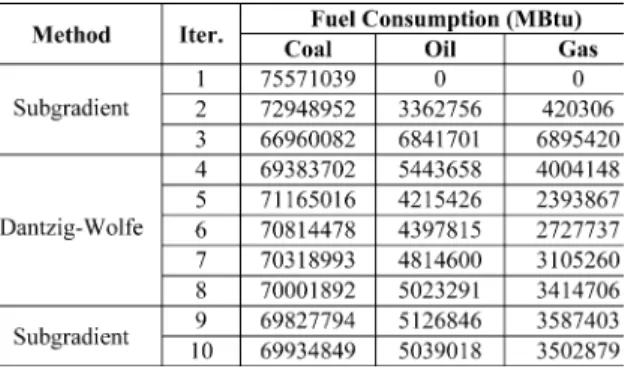
A total of ten iterations are executed and presented in Table IX. The subgradient method is implemented at the first three iterations in order to supply initial feasible solutions of short-term SCUC to Dantzig–Wolfe de-composition. An uneconomical feasible solution, which satisfies long-term SCUC constraints, is obtained at the third iteration, which is due to the large step size. Then, Dantzig–Wolfe decomposition is applied to improve the solution. Accordingly, the coal consumption by the large and economical coal-burning units will approach iteratively to its supply limit of 70 000 000 MBtu. In this phase, step sizes are not adjusted and Lagrangian multi-pliers are generated directly via the LP master (25)–(30). However, the inner loop 2 (i.e., Dantzig–Wolfe decom-position) is terminated at the eighth iteration based on the stopping criterion (32), which means that no new column can be generated and added to the next iteration of LP master problem. So, the near-optimal feasible solution of $78.832 M is obtained from the fourth iteration. The coal consumptions by FGroup 1 are 69 383 702 MBtu and the subgradient method is utilized again to improve the so-lution. The minor step size will provide minor adjust-ments for optimizing the solution. The near optimal solu-tion obtained at the tenth iterasolu-tion with an operating cost of $78.476 M is shown in Table VIII, which is lower than that of the previous solution and higher than that of Case 1. The value of Lagrangian relaxation for the hybrid method is compared with that of subgradient method in Fig. 7. The figure shows that the subgradient method pro-ceeds at a slower speed to the converged dual value, which is almost equal to $78.50 M. However, the hybrid method
Fig. 7. Value of Lagragian relaxation(V LR)in Case 2.
Fig. 8. Value of primal problem(V P )versus iteration numberkin Case 3.
converges much faster, which is due to the Dantzig–Wolfe decomposition method.
According to Case 1, the coal consumption should be equal to its upper limit (70 000 000 MBtu) in Case 2 when an absolute optimal solution is reached. However, by using the proposed method, the coal consumption is calculated as 69 934 849 MBtu, which is very close to its upper limits. Accordingly, the proposed near-optimal solution based on decomposition is quite acceptable for long-term analyzes.
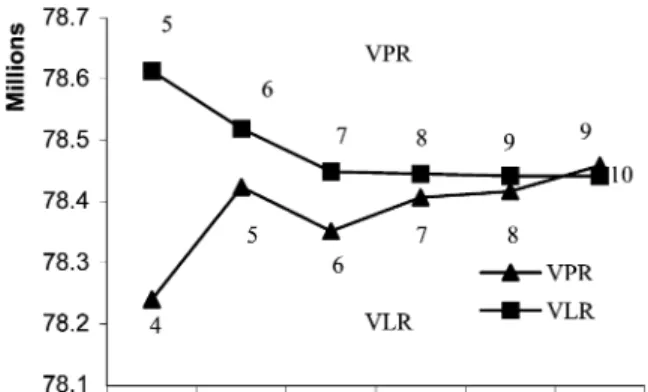
• Case 3: In this case, emission constraints are added to Case 2. According to the optimal solution in Case 2, there are two emission constraint violations ( and ) for EGroup 2 as shown in Table VII. In order to satisfy fuel and emission constraints, gas-burning units with rel-atively high cost are committed to supply the additional loads. During the iterative process shown in Fig. 8, the value of primal problem (VP) is calculated based on the corresponding dual solution (e.g., UC and generation dis-patch). The infeasible solutions, which cannot satisfy fuel and emission constrains at iterations 1–3, 5, 6, and 12, are also presented in Fig. 8 for demonstrating the conver-gence trend. A total of 13 iterations are needed in this case. Using the subgradient iterations, a feasible solu-tion of long-term SCUC is found at the fourth iterasolu-tion. Then, iterations 5 through 9 are based on Dantzig–Wolfe
Fig. 9. Optimal values of current LP master problem and the Lagrangian relaxation in Case 3.
decomposition. The optimal values of current LP master problem and the Lagrangian relaxation with the previous Lagrangian multipliers are shown in Fig. 9. Accordingly, the optimal value of LP master problem in the tenth iter-ation is the same as that at the ninth iteriter-ation. The reason is that the ninth iteration Lagrangian multipliers fail to provide any better information for yielding new optimal value for and Lagrangian multipliers. The column generation method is terminated since the cycling phe-nomenon occurs at this phase. The subgradient method is used between iterations 10 and 13 with an optimal oper-ating cost of $78.481 M. Correspondingly, fuel consump-tion and emission listed in Tables VI and VII are within their limits.
Table X presents the hourly UC on the first day of week 2. Table XI shows, based on the percentage of time that units are committed, the list of base units (committed more than 85% of the time in eight weeks), intermediate units (between 85% and 10% of time), peaking units (less than 10% of time), and OFF units. In this case, 20 units are committed to supply the base load and 49 units are ON when weekly peak loads occur.
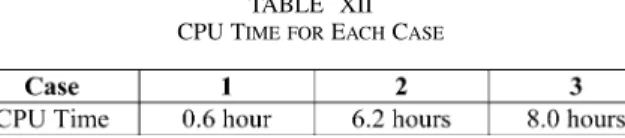
The above three cases are tested on a 1.8-GHz personal com-puter. A typical CPU time for the weekly SCUC with dc network constraints is about 5 min. The total CPU time for each case based on the hybrid method is listed in Table XII. However, the CPU time depends on the available CPU, power system char-acteristics, load level, number of constraints, robustness of the system, and the required calculation accuracy.
V. CONCLUSIONS
According to the above analyzes, penalty price signals (Lagrangian multipliers) can be used effectively to optimize the allocation of fuel consumption and emission allowance. The proposed hybrid approach applies subgradient and Dantzig– Wolfe decomposition approaches to solve the long-term SCUC problem. The hybrid method is a tradeoff between calcula-tion speed and exactness. We use the Lagrangian relaxacalcula-tion algorithm to deal with coupling constraints over a longer time horizon. As a result, the original problem is divided into tractable subproblems, i.e., short-term SCUC, without fuel and emission constraints. Benders decomposition is applied to the short-term SCUC. Benders decomposition is a popular optimization technique with a good convergence property based
TABLE X
UCON THEFIRSTDAY OFWEEK2INCASE3
TABLE XI
CLASSIFICATION OFUNIT INCASE3
on the LP duality theory. We could use different optimization techniques to solve the short-term SCUC whose solution methodology (whether or not a decomposition technique is
TABLE XII CPU TIME FOREACHCASE
applied) should not impact the convergence of long-term La-grangian relaxation algorithm.
Three cases were studied in this paper. Case 1 considered a base case without fuel consumption or emission allowance con-straint, which can be solved by sequentially simulating short-term SCUC problems. The solution in Case 1 provided the nec-essary insight for the subsequent analyzes in Cases 2 and 3. The purpose of Case 2 was to show the impact on optimal solution based on either fuel consumption or emission allowance allo-cation. We selected the former. Case 3 was used to study the interaction between coupling constraints, i.e., fuel consumption and emission allowance limits.
The following long-term SCUC problems will be considered in our future studies.
1) In this paper, a deterministic model is proposed that is regarded as a basic block for a probabilistic model of SCUC. The probabilistic model could simulate longer term (multiyear) scenarios in electricity market. Due to the volatile nature of market, sources of uncertainty in operating conditions such as the forecasted fuel contract price, load growth rates, and equipment availability could also be taken into account by the Monte Carlo method. 2) Long-term dispatch of water resources for the
hy-drothermal generation scheduling will be modeled and analyzed.
3) Parallel computing techniques will be applied in order to improve the performance of proposed long-term solution and its coordination with the short-term SCUC.
4) The proposed long-term SCUC solution provides ad-ditional information such as LMPs and locations of congested lines for various operation and planning ap-plications, including equipment maintenance, long-term price-forecasting based on transmission operation and contingencies, and generation resource and transmission expansion planning. These SCUC issues will be consid-ered based on the expanded modeling of hydrothermal systems.
APPENDIX
DANTZIG–WOLFEDECOMPOSITIONPRINCIPLE
Dantzig–Wolfe decomposition is a widely used optimization technique for solving very large-scale mixed integer programs. The method operates by forming an equivalent master problem and a set of independent subproblems. The resulting algorithm involves iterations between subproblems, whose objective func-tions contain variable parameters, and the master problem. Sub-problems receive a set of parameters (dual multipliers or prices) from the master problem and then send their solutions to the master problem, which combines these with previous solutions in an optimal way and computes new prices and send them back to the subproblems. The iteration proceeds until an optimality test is passed.
In order to discuss the decomposition process for the long-term SCUC problem, the original optimization problem is shown as follows:
(A1)
S.t. (A2)
(A3) (A4) where represents the UC state and dispatch in long-term SCUC. The first set of constraints identifies the coupling con-straints (e.g., fuel and emission concon-straints) and the remaining represents constraints, which are only for the main subproblem, including short-term SCUC problems. The reason a coefficient matrix with angular structure is not representing constraint (A3) is due to the selected solution strategy in this paper, which se-quentially solves short-term SCUC problems. In other words, weekly SCUC problems are not treated as fully independent of each other. Then, the Lagrangian dual problem of the original problem is formed as
(A5) A proof given in [26] shows that the (A5) problem is equivalent to its relaxed primal problem given as
(A6)
S.t. (A7)
(A8) where denotes the convex hull of a set. A possible
solu-tion of is points of , but a cheaper
option is extreme points of . So, the re-laxed primal problem (A6)–(A8), the so-called LP master, can be rewritten as
(A9)
S.t. (A10)
(A11)
The Dantzig–Wolfe decomposition principle solves the opti-mization problem at the main subproblem level rather than the master program level where only new simplex multipliers or prices and , corresponding to constraints (A10) and (A11), respectively, are obtained. After dropping the constant term in the Lagrangian dual problem (A5), the main subproblem is
(A12)
S.t. (A13)
(A14) In order to handle the main subproblem, additional decompo-sition is executed sequentially for solving small-scale short-term
SCUC problems. The small-scale problem is presented as follows:
(A15)
S.t. (A16)
(A17) where , , and are subvectors and and are sub-matrices.
According to the LP duality theory [27], the solution is op-timal if and only if
(A18)
If the above condition is not satisfied, then a new column is appended to the LP master problem and a new iteration of the algorithm is started.
REFERENCES
[1] M. Shahidehpour, Y. Fu, and T. Wiedman, “Impact of natural gas in-frastructure on electric power systems,”Proc. IEEE, vol. 93, no. 5, pp. 1042–1056, May 2005.
[2] A. B. R. Kumar, S. Vemuri, L. A. Gibbs, D. F. Hackett, and J. T. Eisen-hauer, “Fuel resource scheduling, Part III, the short-term problem,”IEEE Trans. Power App. Syst., vol. PAS-103, no. 7, pp. 1556–1561, Aug. 1984. [3] A. B. R. Kumar, S. Vemuri, L. P. Ebrahimzadeh, and N. Farahbakhshian, “Fuel resource scheduling, the long-term problem,”IEEE Trans. Power Syst., vol. 1, no. 4, pp. 145–151, Nov. 1986.
[4] J. Gardner, W. Hobbs, F. N. Lee, E. Leslie, D. Streiffert, and D. Todd, “Summary of the panel session ’Coordination between short-term oper-ation scheduling and annual resource allocoper-ations,”IEEE Trans. Power Syst., vol. 10, no. 4, pp. 1879–1889, Nov. 1995.
[5] M. K. C. Marwali and S. M. Shahidehpour, “Coordination between long-term and short-long-term generation scheduling with network constraints,” IEEE Trans. Power Syst., vol. 15, no. 3, pp. 1161–1167, Aug. 2000. [6] M. Shahidehpour and M. Marwali,Maintenance Scheduling in
Restruc-tured Power Systems. Norwell, MA: Kluwer, 2000.
[7] E. Handschin and H. Slomski, “Unit commitment in thermal power sys-tems with long-term energy constraints,”IEEE Trans. Power Syst., vol. 5, no. 4, pp. 1470–1477, Nov. 1990.
[8] S. Vemuri and L. Lemonidis, “Fuel constrained unit commitment,”IEEE Trans. Power Syst., vol. 7, no. 1, pp. 410–415, Feb. 1992.
[9] F. N. Lee, J. Liao, and A. M. Breipohl, “Adaptive fuel allocation using pseudo prices,”IEEE Trans. Power Syst., vol. 7, no. 2, pp. 487–496, May 1992.
[10] J. Handke, E. Handschin, K. Linke, and H. H. Sanders, “Coordination of long- and short-term generation planning in thermal power systems,” IEEE Trans. Power Syst., vol. 10, no. 2, pp. 803–809, May 1995. [11] S. Wang, M. Shahidehpour, D. Kirschen, S. Mokhtari, and G. Irisarri,
“Short-Term generation scheduling with transmission and environ-mental constraints using an augmented Lagrangian relaxation,”IEEE Trans. Power Syst., vol. 10, no. 3, pp. 1294–1301, Aug. 1995. [12] N. Z. Shor,Minimization Methods for Non-Differentiable Functions, ser.
Springer in Computational Mathematics New York, 1985.
[13] D. P. Bertsekas, Nonlinear Programming, 2nd ed. Belmont, MA: Athena Scientific, 1999.
[14] G. B. Dantzig and P. Wolfe, “Decomposition principle for linear pro-grams,”Oper. Res., vol. 8, pp. 101–111, 1960.
[15] L. Lasdon, Optimization Theory for Large Systems. New York: Macmillan, 1970.
[16] Z. Li and M. Shahidehpour, “Generation scheduling with thermal stress constraints,”IEEE Trans. Power Syst., vol. 18, no. 4, pp. 1402–1409, Nov. 2003.
[17] M. Shahidehpour, H. Yamin, and Z. Y. Li,Market Operations in Electric Power Systems. New York: Wiley, 2002.
[18] M. L. Fisher, “Optimal solution of scheduling problems using La-grangian multiplier, part I,”Oper. Res., vol. 1973, pp. 1114–1127, 1973.
[19] C. L. Tseng, S. S. Oren, C. S. Cheng, C. A. Li, A. J. Svoboda, and R. B. Johnson, “A transmission-constrained unit commitment method,” in Proc. Thirty-First Hawaii Int. Conf. System Sciences, vol. 3, Jan. 1998, pp. 71–80.
[20] A. M. Geoffrion, “Generalized Benders decomposition,”J. Optimiz. Theory Appl., vol. 10, no. 4, pp. 237–261, 1972.
[21] M. Shahidehpour and Y. Fu, “Benders decomposition—Applying ben-ders decomposition to power systems,”IEEE Power Energy Mag., vol. 3, no. 2, pp. 20–21, Mar./Apr. 2005.
[22] H. Ma and M. Shahidehpour, “Transmission constrained unit commit-ment based on Benders decomposition,”Elect. Power Energy Syst., vol. 20, no. 4, pp. 287–294, Apr. 1998.
[23] Y. Fu, M. Shahidehpour, and Z. Li, “Security-constrained unit commit-ment with AC constraints,”IEEE Trans. Power Syst., vol. 20, no. 3, pp. 1538–1550, Aug. 2005.
[24] M. Guignard. Lagrangean Relaxation. [Online]. Available: http://top. umh.es/top11201.pdf.
[25] Y. Fu, M. Shahidehpour, and Z. Li, “AC contingency dispatch based on security-constraints unit commitment,”IEEE Trans. Power Syst., to be published.
[26] A. M. Geoffrion, “Lagrangian relaxation for integer programming,” in Mathematical Programming Study, 1974, vol. 2, pp. 82–114. [27] G. B. Dantzig,Linear Programming and Extension. Princeton, N.J.:
Princeton Univ. Press, 1963.
Yong Fu(M’05) received the B.S. and M.S. degrees in electrical engineering from Shanghai Jiaotong University, Shanghai, China, in 1997 and 2002, respectively. Presently, he is working toward the Ph.D. degree at Illinois Institute of Technology, Chicago.
His research interests include power systems re-structuring and reliability.
Mohammad Shahidehpour(F’01) is the Bodine Professor and Chairman in the Electrical and Com-puter Engineering Department at Illinois Institute of Technology (IIT), Chicago. He is the author of 300 technical papers and four books on electric power systems planning, operation, and control. His books include Maintenance Scheduling in Restructured Power Systems(Norwell, MA: Kluwer, 2000),Restructured Electrical Power Systems(New York: Marcel Dekker, 2001),Market Operations in Electric Power Systems(New York: Wiley, 2002), andCommunication and Control of Electric Power Systems(New York: Wiley, 2003).
Dr. Shahidehpour is the recipient of the 2005 IEEE/PES Best Paper Award and the Best Paper Award from the PES/Operations Committee in 2004. He is also the recipient of the Edison Electric Institute’s Outstanding Faculty Award, HKN’s Outstanding Young Electrical Engineering Award, Sigma Xi’s Outstanding Researcher Award, IIT’s Outstanding Faculty Award, and the University of Michigan’s Outstanding Teaching Award. He is the past president of National Electrical Engineering Honor Society (HKN) and has served as the Editor of the IEEE TRANSACTIONS ONPOWERSYSTEMS, Guest Editor of IEEE POWER ANDENERGYMAGAZINE, and Guest Editor of Special Issue of IEEE TRANSACTIONS ONPOWERSYSTEMS. He has been a Member of the Editorial Board ofKIEE Journal of Power Engineering(Korea),HKN Bridge Magazine, IEEE TRANSACTIONS ONSYSTEMS, MAN,ANDCYBERNETICS, IEEE POWER
ENGINEERINGLETTERS, and IEEE POWER ANDENERGYMAGAZINE. He is an IEEE Distinguished Lecturer and has lectured across the globe on electricity restructuring issues and has been a Visiting Professor at several universities.
Zuyi Li (M’03) received the B.S. degree from Shanghai Jiaotong University, Shanhai, China, in 1995, the M.S. degree from Tsinghua University, Beijing, China, in 1998, and the Ph.D. degree from Illinois Institute of Technology, Chicago, in 2002, all in electrical engineering.
Presently, he is an Assistant Professor in the Elec-trical and Computer Engineering Department and a Research Scientist in the Electric Power and Power Electronics Center, Illinois Institute of Technology. He is the coauthor ofMarket Operations in Electric Power Systems(New York: Wiley, 2002).