Copyright & reuse
Content in the Kent Academic Repository is made available for research purposes. Unless otherwise stated all content is protected by copyright and in the absence of an open licence (eg Creative Commons), permissions for further reuse of content should be sought from the publisher, author or other copyright holder.
Versions of research
The version in the Kent Academic Repository may differ from the final published version.
Users are advised to check http://kar.kent.ac.uk for the status of the paper. Users should always cite the published version of record.
Enquiries
For any further enquiries regarding the licence status of this document, please contact: [email protected]
If you believe this document infringes copyright then please contact the KAR admin team with the take-down information provided at http://kar.kent.ac.uk/contact.html
Citation for published version
Chotpitayasunondh, Varoth and Douglas, Karen (2018) Measuring Phone Snubbing Behavior: Development and Validation of the Generic Scale of Phubbing (GSP) and the Generic Scale of Being Phubbed (GSBP). Computers in Human Behavior . ISSN 0747-5632.
DOI
https://doi.org/10.1016/j.chb.2018.06.020
Link to record in KAR
http://kar.kent.ac.uk/67366/
Document Version
Scale of Phubbing (GSP) and the Generic Scale of Being Phubbed (GSBP) Varoth Chotpitayasunondh, Karen M. Douglas
PII: S0747-5632(18)30297-8 DOI: 10.1016/j.chb.2018.06.020 Reference: CHB 5572
To appear in: Computers in Human Behavior Received Date: 16 March 2018
Accepted Date: 18 June 2018
Please cite this article as: Varoth Chotpitayasunondh, Karen M. Douglas, Measuring Phone Snubbing Behavior: Development and Validation of the Generic Scale of Phubbing (GSP) and the Generic Scale of Being Phubbed (GSBP), Computers in Human Behavior (2018), doi: 10.1016/j. chb.2018.06.020
This is a PDF file of an unedited manuscript that has been accepted for publication. As a service to our customers we are providing this early version of the manuscript. The manuscript will undergo copyediting, typesetting, and review of the resulting proof before it is published in its final form. Please note that during the production process errors may be discovered which could affect the content, and all legal disclaimers that apply to the journal pertain.
Measuring Phone Snubbing Behavior: Development and Validation of the Generic Scale of Phubbing (GSP) and the Generic Scale of Being Phubbed (GSBP)
Varoth Chotpitayasunondh 1 and Karen M. Douglas 1 University of Kent, United Kingdom
1 School of Psychology
Keynes College University of Kent Canterbury, CT2 7NP United Kingdom
E-mail: [email protected]; [email protected].
Abstract
Ignoring and being ignored by others in favor of a smartphone is a common feature of everyday communication. However, little research has examined this phenomenon known as phubbing
and even less research has determined how to measure it. This paper reports the results of six studies designed to develop and validate the Generic Scale of Phubbing (GSP) to assess
phubbing behavior, and the Generic Scale of Being Phubbed (GSBP) to assess the experience of being phubbed. After reducing and refining items with the assistance of expert panels,
exploratory and confirmatory factor analyses were conducted to further reduce the number of items and finalize the scales. Finally, the psychometric properties of both scales were examined. Data from 1,836 respondents from the general public were recruited from six online surveys (N = 352, 333, and 224 for the GSP; N = 358, 341, and 228 for the GSBP). The four-factor 15-item GSP and the three-factor 22-item GSBP were developed and revealed good construct validities, criterion validities, convergent validities, discriminant validities, internal consistency
reliabilities, and test-retest reliabilities.
Measuring Phone Snubbing Behavior: Development and Validation of the Generic Scale of Phubbing (GSP) and the Generic Scale of Being Phubbed (GSBP)
1. Introduction
The use of smartphones has increased dramatically in recent years. Ninety eight percent of Internet users aged between 16-20 years now own at least one smartphone and spend over four hours online using them each day (Young, 2017). Smartphones have revolutionized the way people communicate with each other, but whilst sometimes people use smartphones to enhance their social interactions, at other times people ignore their conversation partner(s) and
concentrate on their smartphones instead (Geser, 2004). This act of phubbing—a portmanteau of the words “phone” and “snubbing” (Haigh, n.d.)—has started to gain research attention in recent years (e.g., Chotpitayasunondh & Douglas, 2016; Karadağ et al., 2016; Roberts & David, 2016; Roberts & David, 2017). Specifically, researchers have studied some of the antecedents and consequences of being a phubber (the person who is phubbing), or a phubbee (the person being phubbed). However, to date there is no validated way of measuring either of these two
phenomena, which is limiting research progress. Existing scales have been developed for the purpose of specific research questions with little attention to the psychometric properties of the scales or their generalizability (e.g., Chotpitayasunondh & Douglas, 2016; Karadağ et al., 2016; Roberts & David, 2016; Roberts & David, 2017). The current research aims to address this issue by developing two scales to measure the experiences of phubbing and being phubbed.
2. Background
2.1. Phubbing
Phubbing occurs when people snub or ignore other people in their company by concentrating on their smartphone instead (e.g., Abeele, Antheunis, & Schouten, 2016;
Abramova, Baumann, Krasnova, & Lessmann, 2017; Nazir & Pişkin, 2016;Ugur & Koc, 2015). It is considered to be a multi-dimensional construct. For example, Karadağ et al. (2015) found that phubbing can be explained by mobile phone addiction, SMS addiction, social media addiction, Internet addiction, and game addiction. Chotpitayasunondh and Douglas (2016) revealed moderate correlations between phubbing behavior and smartphone addiction, Internet addiction, and the fear of missing out.
A phubber may experience an inability to monitor or control their smartphone and Internet use appropriately, a compulsive apprehension about missing an opportunity for other satisfying events, and an inability to regulate mobile phone use and etiquette when experiencing temptation (Chotpitayasunondh & Douglas, 2016). However, since existing research is
correlational, it is difficult to conclude which of these variables are causes and which are
consequences of phubbing. There is also likely to be a complex interplay between these factors. It nevertheless appears however, that phubbing involves negative experiences for the phubber.
2.2. Being phubbed
Being a phubbee involves being at the receiving end of phubbing behavior
(Chotpitayasunondh & Douglas, 2016). Other researchers have referred to this behavior in specific contexts as “pphubbing” (i.e., being phubbed by spouse or significant other; Roberts & David, 2016), and “bphubbing” (i.e., being phubbed by bosses or supervisors; Roberts & David, 2017). People can be phubbers and phubbees at the same time. Ignoring interaction partners in favor of a smartphone may cause phubbing behaviors to be reciprocated (Chotpitayasunondh & Douglas, 2016). Individuals may remain silent or exhibit reactionary behaviors when they are phubbed (Karadağ et al., 2016).
In a similar way to being a phubber, being a phubbee appears to have negative
consequences. For example, phubbees are less satisfied with their interactions (Abeele et al., 2016; Chotpitayasunondh & Douglas, in press; McDaniel & Coyne, 2016; Roberts & David, 2016), feel less connectedness to their interaction partners (Krasnova, Abramova, Notter, & Baumann, 2016; Misra, Cheng, Genevie, & Yuan, 2014), and experience thwarted fundamental human needs, especially the need to belong (Chotpitayasunondh & Douglas, in press). The importance of these two phenomena for the quality of social interaction therefore requires that researchers have adequate tools to measure them.
2.3. How are phubbing and the experience of being phubbed measured?
Existing attempts at measuring phubbing and the experience of being phubbed are scarce and have been typically designed to address particular research questions in specific
communicative contexts. Measures related to phubbing include the Perceived Social Norms of Phubbing scale (PSNP; Chotpitayasunondh & Douglas, 2016) which was developed to measure the observations of others’ phubbing behavior and the inference of others’ approval of phubbing, and the Technology Device Interference Scale (TDIS; McDaniel & Coyne, 2016) and
Technology Interference in Life Examples Scale (TILES; McDaniel & Coyne, 2016) which were developed to measure how often participants perceive their partner to allow technology to
interrupt time they spend together. However, there has been little consideration of the scale development process and the psychometric properties of these instruments beyond noting internal consistency and factor loadings. Only a few studies have included the steps of scale development in greater detail. For example, development of the 10-item Phubbing Scale (PS;
Karadağ et al., 2015) included an exploratory factor analysis (EFA) on a pool of items, which was generated using data from focus group interviews. A two-factor structure was revealed
measuring “communication disturbance”—i.e., a disturbance in one’s existing communications by dealing with mobile phones in a face-to-face communication environment, and “phone obsession”—i.e., a need of mobile phone in environment lacking face-to-face communication. However, this scale has limited generalizability. The scale was developed on university students whose native language was Turkish, without any information on linguistic and cross-cultural adaptation. Other psychometric properties such as construct validity, concurrent validity, convergent validity, discriminant validity, and test-retest reliability, were not reported.
Furthermore, EFA was not followed by confirmatory factor analysis (CFA) to cross-validate the EFA-informed priori factor structure of measurement (Henson & Roberts, 2006). Moreover, several items do not seem to measure phubbing at face value. For example, “When I wake up in the morning, I first check the messages on my phone” and “My mobile phone use increases day by day” may represent phone addiction in general rather than specific phubbing behavior.
To measure the experience of being phubbed, the Partner Phubbing Scale (Pphubbing; Roberts & David, 2016) and the Boss Phubbing Scale (Bphubbing; Roberts & David, 2017) have been developed. The nine-item Pphubbing measure was created to assess respondents’ romantic partner phubbing and study its effects on interpersonal relationships. The EFA results of an initial pool of items revealed a single-factor structure. Although data retrieved randomly from the general population may enhance generalizability of the Pphubbing scale, the replicability of the scale is somewhat questionable. The EFA and CFA were conducted on the same data set without random splitting. For cross-validation, a number of researchers have suggested that the data-driven EFA and theory-driven CFA should be carried out on the data set collected
independently in all cases (Cabrera-Nguyen, 2010; Knafl & Grey, 2007; Worthington &
assess respondents’ boss/supervisor phubbing and study its relationships with employee
engagement (Roberts & David, 2017). However, only internal consistency was provided and no factor analysis results, neither EFA nor CFA, were reported. Moreover, both the Pphubbing and Bphubbing scales were developed to answer specific questions about being phubbed by specific people in specific contexts, and not about the general experience of being phubbed, which could be applied to a variety of people and a variety of contexts. Also, since there is evidence that being phubbed strongly relates to the multidimensional experience of being ostracized (Chotpitayasunondh & Douglas, in press), it is possible that the general experience of being phubbed is not a unidimensional construct.
2.4. Overview of the present studies
Considering the growing relevance of, and interest in, studying phubbing, the issue of measurement must now be addressed. Much more research is required to illuminate the psychology of phubbing, but research is limited by the lack of a well-validated measure of individual differences in phubbing and the experience of being phubbed. It is also important for researchers to develop measures that are both multidimensional and generalizable. In the current research, the Generic Scale of Phubbing (GSP) and the Generic Scale of Being Phubbed (GSBP) have been developed and validated through Study 1 (a-c) and Study 2 (a-c) respectively.
Studies 1a and 2a involved the initial development stages of collating candidate items, using an expert panel to refine the items, and administering the scales to a pool of participants to establish factor structures. Studies 1b and 2b were designed to replicate these factor structures through confirmatory factor analysis (CFA) and to examine the convergent and concurrent validity of the scales. Studies 1c and 2c aimed to established test-retest reliabilities and discriminant validities of both scales. Participants, ranging in age from 18 to 65 years of age,
were drawn from general public samples (from North American, European, and Asian countries) to increase generalizability.
3. Study 1a and Study 2a: Item development and EFA of the GSP and the GSBP
These studies aimed (1) to generate the initial GSP and GSBP through EFAs, (2) to identify the underlying scale structures, and (3) to examine each scale’s internal consistency. An initial set of items were rated and refined by an expert panel. Participants then completed the scales and the factor structure and internal consistency of the scales was examined.
3.1. Method
3.1.1. Participants. To recruit a diverse general population sample, 361 (Study 1a) and 364 participants (Study 2a) were recruited via the crowdsourcing platform Prolific Academic. Participants who took part in one study were not able to participate in the other study.
Participants who completed the questionnaire were paid £0.40. Data from nine participants in Study 1a and six participants in Study 2a were omitted because they had missing data for two or more items. Study 1a had a final sample of 352 participants (175 men, 175 women, one
transgender, and one participant did not provide any gender information) ranging in age from 18 to 61 years of age (M = 34.82, SD = 10.42). Participants were primarily White/Caucasian (80.6%), full-time workers (51.3%), and had college-level education (62.7%). Study 2a had a final sample of 358 participants (130 men, 226 women, one transgender, and one participant did not provide gender information). Age ranged from 18 to 63 years (M = 36.00, SD = 10.83). Participants were primarily White/Caucasian (89.1%), full-time workers (53.9%), and had college-level education (58.7%).
3.1.2. Procedure and materials. Initial pools of 40 items for the GSPand 40 items for the GSBP were developed to reflect phubbing behavior and to represent the experience of being phubbed,
respectively. Items were developed by reviewing the academic literature on phubbing behaviors and phone-associated behavioral addiction behaviors. Each item of GSP framed the respondent as a person who starts snubbing his/her communication partner(s) in a social situation by paying attention to his/her phone instead. Each item of GSBP framed the respondent as a person who is ignored by his/her communication partner(s) in a social interaction because his/her
communication partner(s) use their phones instead. To prevent acquiescence response bias, both positively and negatively coded items were created (Watson, 1992). Next, the 40 items for each scale were given to an independent expert panel, who were experienced social psychologists (n = 3), to ensure that each item was understandable, relevant to the subject, and to allow for further item development and refinement. Items rated poorly by experts were revised or removed from the initial item pool. As a result, 33 items for both the GSP and GSBP were retained. To emphasize only true phubbing behaviors (GSP), the instruction to respondents was as follows:
“We would like you to think about your mobile phone use during your face-to-face social interactions with others.”
To emphasize only the experience of being phubbed (GSBP), the initial instruction to respondents was as follow:
“We would like you to think about others’ mobile phone use during your face-to-face social interactions with others.”
Respondents for both scales then received the following common instructions:
“…Think about your social interactions on the whole (e.g., with friends, acquaintances, family, your partner) and the extent to which the following statements apply to you. In my face-to-face social interactions with others ….”.
Participants responded to items on a seven-point scale, with a label associated with each point (1
= Never, 2 = Rarely, 3 = Occasionally, 4 = Sometimes, 5 = Frequently, 6 = Usually, 7 = Always; = .93, M = 43.38, SD = 16.60 for Study 1a and = .96, M = 86.54, SD = 24.09 for Study 2a). At the end of the study, participants were debriefed, thanked and paid.
3.2. Study 1a results
EFA using principal axis factoring method was conducted to examine the internal structure of the 33-item GSP. Based on the observed Eigenvalues and visual inspection of the scree plot, a five-factor solution was initially extracted. All negatively worded items were found to load onto a single factor. As there was no clear conceptual grouping other than their negative phrasing this was deemed indicative of differential item function rather than a true latent
dimension (Greenberger, Chen, Dmitrieva, & Farruggia, 2003). Accordingly, all negatively worded items were dropped. EFA was repeated on the remaining pool of 29 items. The significance of Bartlett’s test of sphericity, 2(406) = 7497.11, p < .001, and the size of the
Kaiser-Meyer-Olkin measure of sampling adequacy, KMO = .97, showed that the 29 items had adequate common variance for factor analysis (Tabachnick & Fidell, 2007).
Four factors emerged with Eigenvalues larger than 1.00. The four-factor solution
explained 65.72% of the total variance. Promax oblique rotation with kappa value of 4 was used based on the assumption that the factors should be related to one another. Following rotation, the first factor accounted for the largest amounts of variance. To ensure minimal ambiguity between factors, criteria for an acceptable factor were: (1) the minimum eigenvalue of one, and (2) a minimum of three items loading on each factor (Costello & Osborne, 2005). Item selection was based on the following criteria: (1) if an item loaded less than .5 on a factor, it was discarded, and (2) if an item loaded .5 or greater on a factor but its cross-loading on the other factor was at
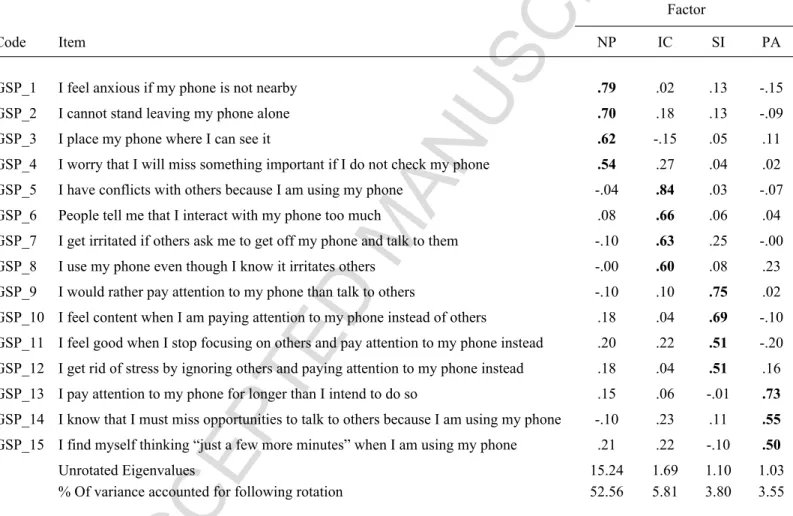
.32 or higher and there are several adequate to strong loaders on each factor, it was discarded (Tabachnick & Fidell, 2007). As a result, four factors and 15 items were retained for the final version of scale. Factor pattern matrix loading, item loadings for the first unrotated factor, Eigenvalues, and variance accounted for by each factor are shown in Table 1.
Table 1. GSP Items and Factor Loadings Obtained with Exploratory Factor Analysis
Factor
Code Item NP IC SI PA
GSP_1 I feel anxious if my phone is not nearby .79 .02 .13 -.15
GSP_2 I cannot stand leaving my phone alone .70 .18 .13 -.09
GSP_3 I place my phone where I can see it .62 -.15 .05 .11
GSP_4 I worry that I will miss something important if I do not check my phone .54 .27 .04 .02 GSP_5 I have conflicts with others because I am using my phone -.04 .84 .03 -.07 GSP_6 People tell me that I interact with my phone too much .08 .66 .06 .04 GSP_7 I get irritated if others ask me to get off my phone and talk to them -.10 .63 .25 -.00 GSP_8 I use my phone even though I know it irritates others -.00 .60 .08 .23 GSP_9 I would rather pay attention to my phone than talk to others -.10 .10 .75 .02 GSP_10 I feel content when I am paying attention to my phone instead of others .18 .04 .69 -.10 GSP_11 I feel good when I stop focusing on others and pay attention to my phone instead .20 .22 .51 -.20 GSP_12 I get rid of stress by ignoring others and paying attention to my phone instead .18 .04 .51 .16 GSP_13 I pay attention to my phone for longer than I intend to do so .15 .06 -.01 .73
GSP_14 I know that I must miss opportunities to talk to others because I am using my phone -.10 .23 .11 .55
GSP_15 I find myself thinking “just a few more minutes” when I am using my phone .21 .22 -.10 .50
Unrotated Eigenvalues 15.24 1.69 1.10 1.03
% Of variance accounted for following rotation 52.56 5.81 3.80 3.55
Study 1a, n = 352. Rotated loadings of EFA above 0.5 are shown in bold. GSP = Generic Scale of Phubbing; NP = Nomophobia; IC = Interpersonal Conflict; SI = Self-isolation; PA = Problem Acknowledgement.
The pattern of loadings reflected conceptually meaningful, cohesive, and distinct groupings. Factor one, which we termed Nomophobia (NP), reflected fear of detachment from
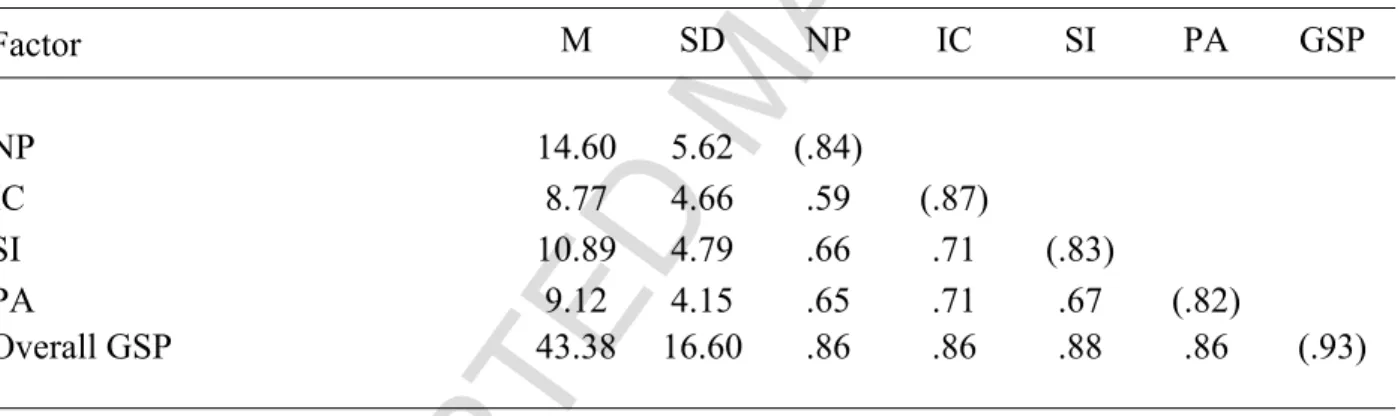
one’s mobile phone. This factor contained four items ( = .84). The second factor, which we termed Interpersonal Conflict (IC) contained four items ( = .87) concerning perceived conflict between oneself and others. The third factor, which we termed Self-Isolation (SI), consisted of four items ( = .83) concerning using phone to escape from social activities and isolate oneself from others. The fourth factor, which we termed Problem Acknowledgement (PA), contained three items ( = .82) relating to acknowledgement that the participants has a phubbing problem. Correlations between factors were positive and moderate to strong, and each factor was strongly correlated with the overall score, as shown in Table 2.
Table 2. Descriptive Statistics and Correlations Between Factor Scores and Overall GSP Score
Factor M SD NP IC SI PA GSP NP 14.60 5.62 (.84) IC 8.77 4.66 .59 (.87) SI 10.89 4.79 .66 .71 (.83) PA 9.12 4.15 .65 .71 .67 (.82) Overall GSP 43.38 16.60 .86 .86 .88 .86 (.93)
N = 352. All correlations significant at the p < .001 level (2-tailed). Cronbach’s alphas are shown in the diagonal.
3.3. Study 2a results
EFA using the principal axis factoring method was conducted to examine the internal structure of the 33-item GSBP. Based on the observed Eigenvalues and visual inspection of the scree plot, a three-factor solution was initially extracted. Four negatively worded items were
found to load onto a single factor similar to the items in GSP and were dropped. EFA was repeated on the remaining pool of 29 items. The significance of Bartlett’s test of sphericity,
2(406) = 7972.75, p < .001, and the size of the Kaiser-Meyer-Olkin measure of sampling
adequacy, KMO = .98, showed that the 29 items had adequate common variance for factor analysis (Tabachnick & Fidell, 2007).
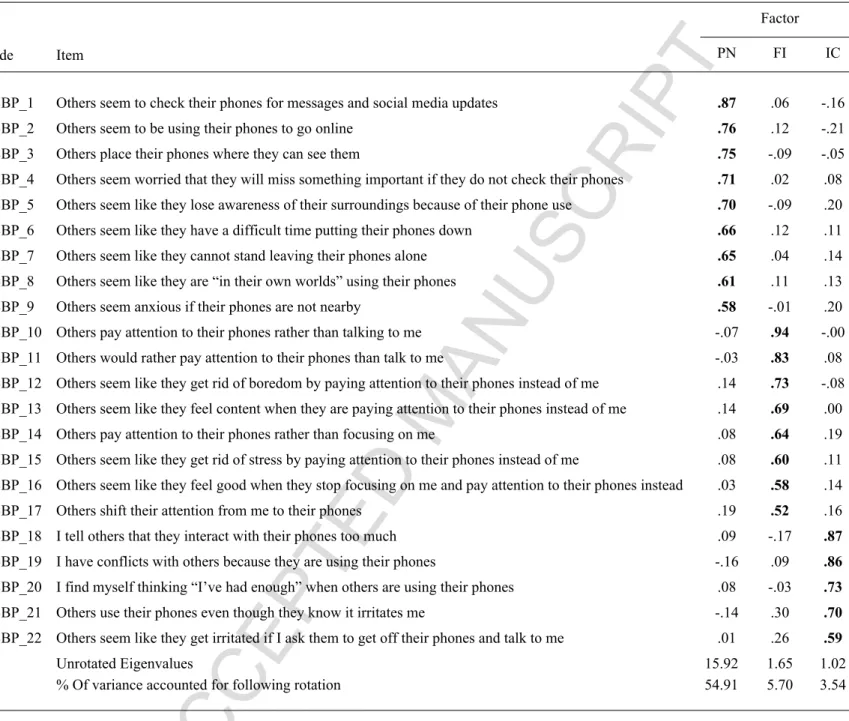
The three-factor solution explained 64.14% of the total variance. Promax oblique rotation was used based on the assumption that the factors should be related to one another. Following rotation, the first factor accounted for the largest amounts of variance. Criteria for an acceptable factor and item selection were similar to what we used in Study1a. As a result, three factors and 22 items were retained for the final version of scale. Factor pattern matrix loading, item loadings for the first unrotated factor, Eigenvalues, and variance accounted for by each factor are shown in Table 3.
Table 3. GSBP Items and Standardized Factor Loadings Obtained with Exploratory Factor Analysis
Factor
Code Item PN FI IC
GSBP_1 Others seem to check their phones for messages and social media updates .87 .06 -.16 GSBP_2 Others seem to be using their phones to go online .76 .12 -.21 GSBP_3 Others place their phones where they can see them .75 -.09 -.05 GSBP_4 Others seem worried that they will miss something important if they do not check their phones .71 .02 .08 GSBP_5 Others seem like they lose awareness of their surroundings because of their phone use .70 -.09 .20 GSBP_6 Others seem like they have a difficult time putting their phones down .66 .12 .11 GSBP_7 Others seem like they cannot stand leaving their phones alone .65 .04 .14 GSBP_8 Others seem like they are “in their own worlds” using their phones .61 .11 .13 GSBP_9 Others seem anxious if their phones are not nearby .58 -.01 .20 GSBP_10 Others pay attention to their phones rather than talking to me -.07 .94 -.00 GSBP_11 Others would rather pay attention to their phones than talk to me -.03 .83 .08 GSBP_12 Others seem like they get rid of boredom by paying attention to their phones instead of me .14 .73 -.08 GSBP_13 Others seem like they feel content when they are paying attention to their phones instead of me .14 .69 .00 GSBP_14 Others pay attention to their phones rather than focusing on me .08 .64 .19 GSBP_15 Others seem like they get rid of stress by paying attention to their phones instead of me .08 .60 .11 GSBP_16 Others seem like they feel good when they stop focusing on me and pay attention to their phones instead .03 .58 .14 GSBP_17 Others shift their attention from me to their phones .19 .52 .16 GSBP_18 I tell others that they interact with their phones too much .09 -.17 .87
GSBP_19 I have conflicts with others because they are using their phones -.16 .09 .86
GSBP_20 I find myself thinking “I’ve had enough” when others are using their phones .08 -.03 .73
GSBP_21 Others use their phones even though they know it irritates me -.14 .30 .70
GSBP_22 Others seem like they get irritated if I ask them to get off their phones and talk to me .01 .26 .59
Unrotated Eigenvalues 15.92 1.65 1.02
% Of variance accounted for following rotation 54.91 5.70 3.54
Study 2a, n = 358. Rotated loadings of EFA above 0.5 are shown in bold. GSBP = Generic Scale of Being Phubbed; PN = Perceived Norms; FI = Feeling Ignored; IC = Interpersonal Conflict.
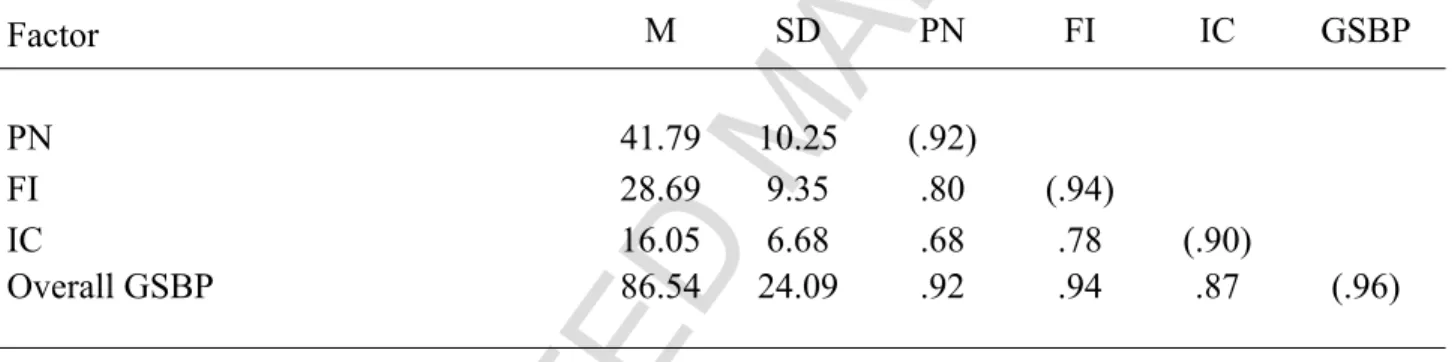
The pattern of loadings reflected conceptually meaningful, cohesive, and distinct groupings. Factor one, which we termed Perceived Norms (PN), reflected descriptions of what others do with their phones. This factor contained nine items ( = .92). A second factor, which we termed Feeling Ignored (FI) contained eight items ( = .94) concerning feeling ignored by other’s phone use. A third factor, which we termed Interpersonal Conflict (IC), consisted of five items ( = .90) concerning perceived conflict between oneself and others due to mobile phone use. Correlations between factors were moderate to strong and positive, and each factor was strongly correlated with the overall score, as shown in Table 4.
Table 4. Descriptive Statistics and Correlations Between Factor Scores and Overall GSBP Score
Factor M SD PN FI IC GSBP
PN 41.79 10.25 (.92)
FI 28.69 9.35 .80 (.94)
IC 16.05 6.68 .68 .78 (.90)
Overall GSBP 86.54 24.09 .92 .94 .87 (.96)
N = 358. All correlations significant at the p < .001 level (2-tailed). Cronbach’s alphas are shown in the diagonal.
3.4. Discussion
The results of a data-driven EFA conducted on a pool of GSP items suggests that four important factors of phubbing are nomophobia, interpersonal conflict, self-isolation, and acknowledgement of problem. The 15 items retained from the original pool of 33 were chosen to represent phubbing behavior by ensuring variability across factor loadings. The final four-factor 15-item GSP and its subscales revealed good internal consistencies. The results of an EFA
conducted on a pool of GSBP items suggest that three important factors of being phubbed are perceived norms, feeling ignored, and interpersonal conflict. The 22 items retained from the pool of 33 were chosen to represent the experience of being phubbed. The three-factor 22-item GSBP revealed excellent internal consistencies.
The purpose 2 was to (a) raplicate the
factor structure of the UBQ through
con
fi
rmatory factor
analysis (CFA) and reliability results
obtained in Study 1 in a new sample
of university students and (b)
examine the convergent, divergent,
and incremental validity of the scale.
The purpose of Study 2 was to (a)
replicate the factor structure of the
UBQ through con
fi
rmatory factor
analysis (CFA) and reliability results
obtained in Study 1 in a new sample
of university students and (b)
examine the convergent, divergent,
and incremental validity of the scale.
4. Study 1b and Study 2b: CFA and validity evaluations of the GSP and the GSBP
These studies aimed (1) to replicate the factor structures of the GSP and GSBP through CFA, (2) to evaluate the model fits, (3) to evaluate the convergent and discriminant validities on the scale construct levels, and (4) to examine the concurrent validities and convergent validities of the scales. Appropriate measures were chosen from previous literature to assess scale validities, as outlined in the method (Materials, Studies 1b and 2b).
4.1. Method
4.1.1. Participants. In Study 1b, 333 participants (108 men, 223 women, one transgender, and one participant did not provide gender information) were recruited from Prolific Academic. Age ranged from 18 to 65 years (M = 32.06, SD = 9.45). Participants were primarily
White/Caucasian (90.1%), full-time workers (37.5%), and had college-level education (51.6%). In Study 2b, 341 participants (133 male, 205 female, two transgender, and one participant did not provide gender information) completed the questionnaire. Age ranged from 18 to 73 years (M = 33.14, SD = 11.24). Participants were predominately White/Caucasian (89.4%), full-time workers (40.2%), and had college-level education (59.5%). No cases with missing values were found. Participants who took part in the previous studies were not able to participate in these studies. Participants who completed the questionnaires were paid £0.50 for Study 1b and £0.59 for Study 2b.
Generic scale of phubbing. The 15-item GSP scale developed from Study 1a was used without modification ( range from .85 to .92, M = 45.84, SD = 18.65).
Phubbing scale. The Phubbing scale (PS; Karadağ et al., 2015) was used to examine the concurrent validity of the GSP. This scale was chosen because it was previously established to assess the same construct as the GSP. It consists of 10 items determining the extent to which individuals are distracted from conversation partners, connected with their phones, and escape from social communications. Participants rated themselves from 1 (never) to 5 (always) on a five-point scale ( = .88, M = 2.32, SD = 0.76). Items included: “My eyes start wandering on my phone when I’m together with others”, “I feel incomplete without my mobile phone”, and “My mobile phone use increase day by day” (Karadağ et al., 2015).
To examine convergent validities, the GSP scale was administered to participants alongside instruments of constructs that theoretically should be related (Widaman, Little, Preacher, & Sawalani, 2011). According to the Phubbing Model proposed by
Chotpitayasunondh and Douglas (2016), constructs related to phubbing such as Internet
addiction, smartphone addiction, and fear of missing out should relate closely to the measure of phubbing in social interactions. These were therefore included as follows.
Fear of missing out scale. The FoMOs, developed by Przybylski, Murayama, DeHaan and Gladwell (2013) is a 10-item questionnaire asking respondents to rate how well statements (e.g., “I get anxious when I don’t know what my friends are up to” and “When I miss out on a planned get-together it bothers me”) describe them on a five-point scale (1 = not at all true for me, 5 = extremely true of me; = .86, M = 2.31, SD = 0.79).
Smartphone addiction scale – short version. The 10-item SAS-SV was shortened and modified from the original 33-item Smartphone Addiction Scale (SAS). This scale items were
designed to assess the level of the smartphone addiction risk such as “Feeling impatient and fretful when I am not holding my smartphone” and “Having my smartphone in my mind even when I am not using it” (Kwon, Kim, Cho, & Yang, 2013). Participants responded on a six-point scale (1 = strongly disagree, 6 = strongly agree; = .90, M = 26.41, SD = 10.43).
Short version of Internet addiction test. This instrument was shortened from the original 20-item Internet Addiction Test (IAT). The 12-item s-IAT, rated on a five-point scale (1 =
rarely, 5 = always; = .90, M = 24.53, SD = 9.15), assesses Internet addictive behavior based on the DSM-IV criteria (Diagnostic and Statistic Manual of Mental Disorder, 4th Edition) for
pathological gambling and alcoholism such as “How often do you feel preoccupied with the Internet when off-line, or fantasize about being-online?” and “How often do you choose to spend more time on-line over going out with others?” (Pawlikowski, Altstötter-Gleich, & Brand, 2013).
4.1.3. Study 2b materials
Generic scale of being phubbed. The 22-item GSBP scale developed from Study 2a was used without modification ( range from .92 to .97, M = 90.22, SD = 26.48).
Partner phubbing scale. The Partner Phubbing Scale (Pphubbing; Roberts & David, 2016) was included to test the concurrent validity of the GSBP. It was chosen because it was developed to assess the same construct of being phubbed, but in a specific situation (romantic relationships). The Pphubbing Scale consists of nine items determining the extent to which an individual’s romantic partner uses or is distracted by his/her mobile phone during time together (Roberts & David, 2016). Participants rated themselves from 1 (never) to 5 (always) on a five-point Likert scale on items such as “My partner places his or her cell phone where they can see it when we are together”, “My partner glances at his/her cell phone when talking to me”, and “My partner uses his or her phone when we are out together” ( = .92, M = 2.89, SD = 0.99).
To examine convergent validities, we included measures that theoretically should be related to the GSBP (Widaman et al., 2011). Constructs related to phubbing such as social connectedness, belongingness, friendship, and perceived social support should relate closely to a measure of being phubbed in social interactions. We measured these constructs as follows.
Social connectedness scale. The negatively-worded eight-item SCS, developed by Lee and Robbins (1995), was designed to assess the sense of social connectedness, affiliation, and companionship by asking participants to rate how much they agree with statements such as “Feeling impatient and fretful when I am not holding my smartphone”, “I have no sense of togetherness with my peers”, and “I don’t feel that I participate with anyone or any group”. Participants responded on a six-point Likert scale with an inverse direction of the rating system (1 = strongly agree, 6 = strongly disagree; = .95, M = 33.90, SD = 9.58). A higher score indicates a better-perceived sense of connectedness and belongingness in social situations.
General belongingness scale. The 12-item GBS, rated on a seven-point Likert scale (1 =
strongly disagree, 7 = strongly agree; = .95, M = 58.14, SD = 14.86), assesses a general sense of achieved belongingness such as “When I am with other people, I feel included”, “I feel as if people do not care about me”, and “When I am with other people, I feel like a stranger” (Malone, Pillow, & Osman, 2012). Scores were reversed on negatively-worded items.
Friendship scale. The FS consists of six items, rated from 0 (not at all) to 4 (almost always) on a five-point Likert scale ( = .87, M = 16.10, SD = 5.33). The scale items assess social connection and social isolation such as “It has been easy to relate to others”, “I had someone to share my feeling with”, and “When with other people, I felt separate from them” (Hawthorne, 2006). A higher score indicates stronger social connectedness.
Multidimensional scale of perceived social support. The MSPSS, developed by Zimet, Dahlem, Zimet and Farley (1988), is a 12-item scale asking respondents to rate how well statements (e.g., “There is a special person who is around when I am in need”, “I can count on my friends when things go wrong”, and “I can talk about my problems with my family”)
describe them on a seven-point Likert scale (1 = very strongly disagree, 7 = very strongly agree;
= .93, M = 5.23, SD = 1.20). This scale was designed to assess the perceived adequacy of support relating to the source of social support (i.e., family, friends, and significant others).
4.1.4. Procedures. To determine how well the models fit to the data, goodness-of-fit indices were used to evaluate the overall fit of proposed scale models: the chi-square per degree of freedom (2/df) ratio, the comparative fit index (CFI), the goodness of fit index (GFI), the normal
fit index (NFI), the standardized root mean square residual (SRMR), and the root mean squared error of approximation (RMSEA) with confidence intervals. Values close to .06 for the RMSEA and .08 for the SRMR are indicative of an adequate model fit (Hu & Bentler, 1999), as are values close to .90 for the GFI (Dimitrov, 2014) and values close to .95 for the CFI and NFI (Schreiber, Nora, Stage, Barlow, & King, 2006). We hypothesized that the GSP would predict the phubbing outcome of the Phubbing Scale and the GSBP should predict the being phubbed outcome of the Partner Phubbing Scale.
According to the Fornell-Larcker testing system, convergent validity and discriminant validity on the scale construct levels were assessed by computing the amount of the variance capture by the construct (i.e., Average Variance Extracted or (AVE), and the shared variance with other construct (i.e., Composite Reliability or (CR). A level of CR higher than 0.7 indicates that the reliabilities of the constructs are adequate. An AVE value for each construct larger than 0.5 indicates acceptable convergent validity in the level of scale construct. The level of AVE for
each attribute higher than all squared of inter-construct correlations involving the construct indicates discriminant validity in the construct level (Fornell & Larcker, 1981).
Participants completed all scales as described above. They were also asked to indicate their age, gender, occupation, education level, and ethnicity. They were debriefed, thanked, and paid. AMOS version 24.0 was used to conduct a CFA on the 15-item GSP from Study 1a using a four-factor structure and the 22-item GSBP from study 2a using a three-factor structure. The intercorrelations between variables, internal consistency reliabilities, convergent validities, and concurrent validities were computed by using SPSS software.
4.2. Study 1b results
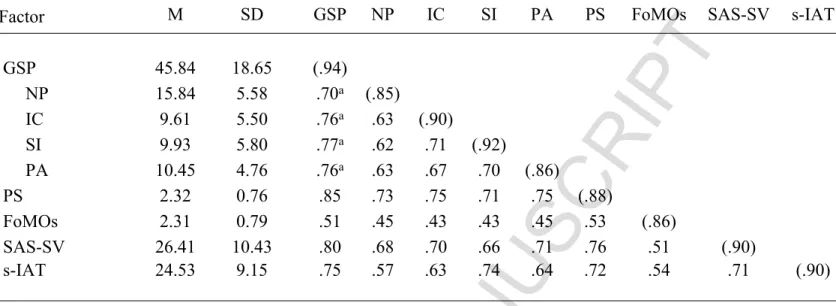
All means, standard deviations, and Pearson product-moment correlation coefficients calculated among all variables are shown in Table 5. All intercorrelations between variables were in the expected directions.
Table 5. Means, Standard Deviations, and Intercorrelation Between Variables in Study 1b
Factor M SD GSP NP IC SI PA PS FoMOs SAS-SV s-IAT
GSP 45.84 18.65 (.94) NP 15.84 5.58 .70a (.85) IC 9.61 5.50 .76a .63 (.90) SI 9.93 5.80 .77a .62 .71 (.92) PA 10.45 4.76 .76a .63 .67 .70 (.86) PS 2.32 0.76 .85 .73 .75 .71 .75 (.88) FoMOs 2.31 0.79 .51 .45 .43 .43 .45 .53 (.86) SAS-SV 26.41 10.43 .80 .68 .70 .66 .71 .76 .51 (.90) s-IAT 24.53 9.15 .75 .57 .63 .74 .64 .72 .54 .71 (.90)
N = 333. All correlations were significant at the p < .001 level (2-tailed). a Correlations between GSP subscales and
total were computed with the subscale removed from the total score. Cronbach’s alphas are shown in the diagonal. PS = Phubbing Scale; FoMOs = Fear of Missing Out Scale; SAS-SV = Smartphone Addiction Scale – Short Version; s-IAT = Short Version of Internet Addiction Test.
4.2.1. Factor analyses and construct validity of the GSP. CFAs were performed, comparing the proposed four-factor construct model with an alternative unidimensional construct model which had all items loaded onto only one factor. We compared two models using the standard fit indices (2/df, CFI, GFI, RMR, and RMSEA). The one-factor model displayed poor fit
according to those indices (2 (90, N = 333) = 840.23, p < .001, 2/df = 9.34, CFI = .80, GFI =
.70, NFI = .78, SRMR = .08, RMSEA = .16), while the second-order four-factor model displayed better fit (2 (86, N = 333) = 260.36, p < .001, 2/df = 3.03, CFI = .95, GFI = .90, NFI = .93,
SRMR = .04, RMSEA = .08). The model with four-factors was more parsimonious and had more theoretically expected model parameters. The model was further re-modified by adjusting one covariance path at a time on the basis of modification indices and par changes (Schreiber et
al., 2006). An investigation of model modification indices indicated adding two covariance paths, i.e., e5–e6 and e13–e15. Results from modified model depicted in Figure 1 displayed even more acceptable fit indices (2 (84, N = 333) = 184.37, p < .001, 2/df = 2.20, CFI = .97,
GFI = .93, NFI = .95, SRMR = .04, RMSEA = .06).
To determine reliability, convergent validity, and discriminant validity on the level of scale construct, the Average Variance Extracted (AVE) and the Composite Reliability (CR) were
computed. As seen in Table 6, each construct’s CR was higher than 0.7, which indicates that the reliabilities of the constructs were adequate (Fornell & Larcker, 1981). Moreover, the AVE for each attribute was larger than 0.5, which indicates convergent validity at the construct level, and was higher than all squares of inter-construct correlations—i.e., shared variances—which is an indicator of discriminant validity between the constructs according to Hair, Black, Babin and Anderson (2010).
Table 6. AVEs, CRs, and Shared Variances for Each GSP Construct
Shared Variance AVE CR NP IC SI PA Nomophobia 0.59 0.85 1 Interpersonal Conflict 0.69 0.90 .40 1 Self-isolation 0.74 0.92 .38 .50 1 Problem Acknowledgement 0.68 0.86 .40 .45 .49 1
4.2.2. Convergent validity of the GSP. If the GSP instrument has convergent validity in the between-scale level, then constructs similar to GSP (e.g., internet addiction, smartphone addiction, and fear of missing out) should relate closely to the measure of phubbing behavior. As seen in Table 5, mean GSP scores strongly correlated with scores on the SAS-SV (r = .80, p
< .001) and s-IAT (r = .75, p < .001). Additionally, GSP scores showed moderate correlation with FoMO scores (r = .51, p < .001).
4.2.3. Criterion-related validity of the GSP. To examine concurrent validity, the correlation coefficient between the GSP and PS was calculated. The total score on the GSP correlated positively and significantly with the two-factor 10-item PS, r = .85, p < .001. A standard
multiple regression analysis was conducted with PS as the criterion variable and the scores on each GSP subscale as criterion predictors. The multiple regression model of the GSP
significantly predicted phubbing behaviors in the general population, F(4, 328) = 219.46, p < .001. Mean GSP score accounted for 72.8% of the variation in phubbing behavior with adjusted
R2 = 72.5%, a large size effect according to Cohen (1988). Nomophobia (NP) was the strongest
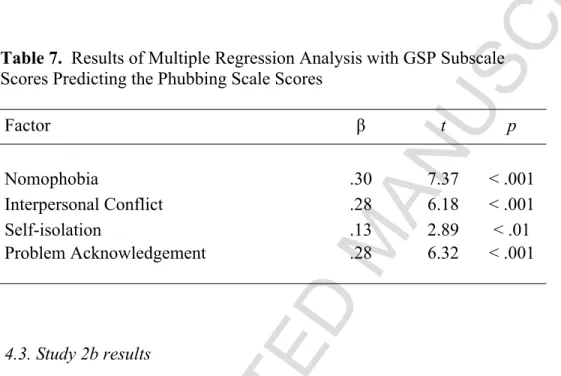
predictor of the regression model (see Table 7 for standardized β values, t-test, and p-values).
Table 7. Results of Multiple Regression Analysis with GSP Subscale Scores Predicting the Phubbing Scale Scores
Factor β t p Nomophobia .30 7.37 < .001 Interpersonal Conflict .28 6.18 < .001 Self-isolation .13 2.89 < .01 Problem Acknowledgement .28 6.32 < .001 4.3. Study 2b results
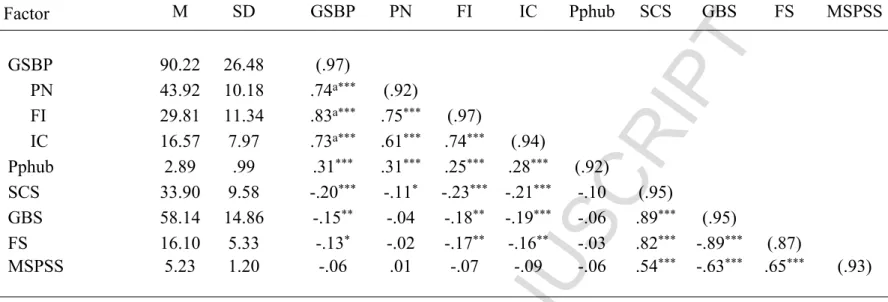
All means, standard deviations, and Pearson product-moment correlation coefficients calculated among all variables are shown in Table 8. All intercorrelations between variables were in the expected directions.
Table 8. Means, Standard Deviations, and Intercorrelations Between Variables of Study 2b Factor M SD GSBP PN FI IC Pphub SCS GBS FS MSPSS GSBP 90.22 26.48 (.97) PN 43.92 10.18 .74a*** (.92) FI 29.81 11.34 .83a*** .75*** (.97) IC 16.57 7.97 .73a*** .61*** .74*** (.94) Pphub 2.89 .99 .31*** .31*** .25*** .28*** (.92) SCS 33.90 9.58 -.20*** -.11* -.23*** -.21*** -.10 (.95) GBS 58.14 14.86 -.15** -.04 -.18** -.19*** -.06 .89*** (.95) FS 16.10 5.33 -.13* -.02 -.17** -.16** -.03 .82*** -.89*** (.87) MSPSS 5.23 1.20 -.06 .01 -.07 -.09 -.06 .54*** -.63*** .65*** (.93)
N = 341. a Correlations between GSBP subscales and total were computed with the subscale removed from the
total score. Cronbach’s alphas are shown in the diagonal. Pphub = Partner Phubbing Scale; SCS = Social Connectedness Scale; GBS = General Belongingness Scale; FS = Friendship Scale; MSPSS =
Multidimensional Scale of Perceived Social Support. *** p < .001
** p < .01 * p < .05
4.3.1. Factor analyses and construct validity of the GSBP. CFAs were performed comparing the proposed three-factor construct model with an alternative unidimensional construct model, which had all items loaded onto only one factor. We compared two models using the standard fit indices (2/df, CFI, GFI, RMR, and RMSEA). The one-factor model displayed poor fit
according to those indices (2 (209, N = 341) = 2028.59, p < .001, 2/df = 9.71, CFI = .76, GFI =
.54, NFI = .74, SRMR = .09, RMSEA = .16), while the second-order three-factor model
displayed better fit (2 (206, N = 341) = 783.77, p < .001, 2/df = 3.81, CFI = .92, GFI = .82, NFI
= .90, SRMR = .05, RMSEA = .09). The model with three-factors was more parsimonious and had more theoretically expected model parameters. The model was further re-modified by
adjusting one covariance path at a time on the basis of modification indices and par changes (Schreiber et al., 2006). An investigation of model modification indices indicated adding eight covariance paths, i.e. e1 – e2, e2 – e9, e4 – e8, e6 – e7, e10 – e11, e12 – e17, e15 – e16, e18 – e19. Results from modified model depicted in Figure 2 displayed improved acceptable fit indices (2 (198, N = 341) = 433.96, p < .001, 2/df = 2.19, CFI = .97, GFI = .90, NFI = .94,
SRMR = .04, RMSEA = .06).
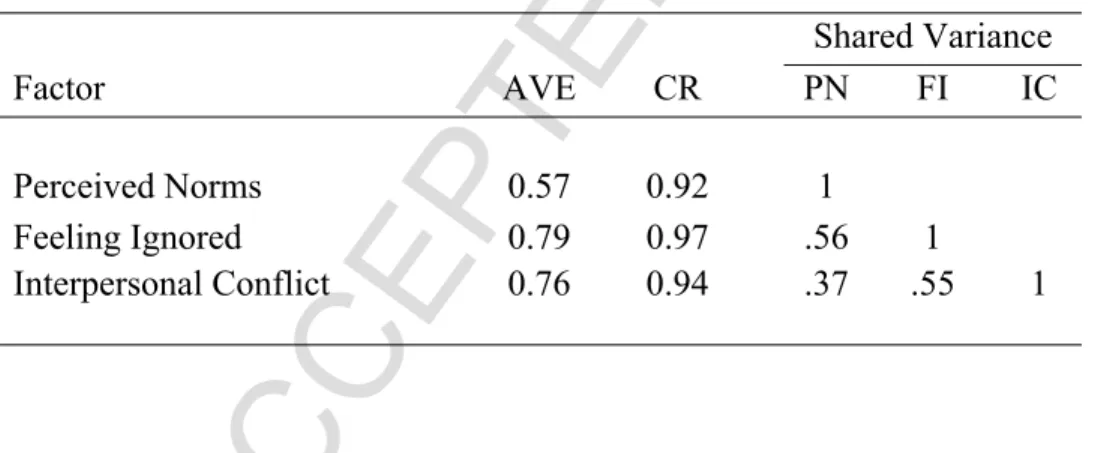
To determine reliability, convergent validity, and discriminant validity on the construct level, the AVE, and CR were calculated. As seen in Table 9, each construct’s CR was greater than 0.7, which indicates excellent reliabilities of the constructs. Moreover, the AVE of each of the latent constructs was larger than 0.5, which indicates convergent validity on the construct level, and was slightly higher than the largest shared variances with any other latent variables, which indicates adequate discriminant validity between the constructs (Hair et al., 2010).
Table 9. AVEs, CRs, and Shared Variances for Each GSBP construct
Shared Variance
Factor AVE CR PN FI IC
Perceived Norms 0.57 0.92 1
Feeling Ignored 0.79 0.97 .56 1
Interpersonal Conflict 0.76 0.94 .37 .55 1
4.3.2. Convergent validity of the GSBP. Constructs similar to the GSBP such as social connectedness, belongingness, friendship, and perceived social support should relate to the measure of being-phubbed in social interactions. As seen in Table 8, mean GSBP scores modestly correlated with scores on the SCS (r = -.20, p < .001), GBS (r = -.15, p < .01), and FS
(r = -.13, p < .05) in expected directions. However, MSPSS scores showed no significant correlation with either GSBP scores (r = -.06, p = .32) nor Pphub scores (r = -.06, p = .31).
4.3.3. Criterion-related validity of the GSBP. The total score on the GSBP correlated positively and significantly with the nine-item Partner Phubbing Scale, r = .31, p < .001. A standard multiple regression analysis was conducted with Pphubbing as the criterion variable and the scores on each GSBP subscale as criterion predictors. The multiple regression model of the GSBP statistically significantly predicted being-phubbed by partners, F(3, 338) = 14.03, p < .001, adj. R2 = .10. However, Feeling Ignored (FI) did not add significance into the regression
model (see Table 10 for standardized β values, t-test, and p-values).
Table 10. Results of Multiple Regression Analysis with GSBP Subscale Scores Predicting the Partner Phubbing Scale Scores
Factor β t p
Perceived Norms .25 3.19 < .01
Feeling Ignored -.06 -.69 .49
Interpersonal Conflict .18 2.29 < .05
4.4. Discussion
The results indicated that the GSP and the GSBP had acceptable psychometric properties. The results of the CFA suggest that the intended second-order four-factor measurement structure was retained in the 15-item GSP and the intended second-order three-factor measurement
structure was retained in the 22-item GSBP. Moreover, all items loaded strongly and
validity, and discriminant validity on the construct level were excellent, as well as internal consistency reliability, concurrent validity, and convergent validity on the scale level.
For the GSBP, the construct reliability, convergent validity, and discriminant validity on the construct level were excellent, as well as internal consistency, reliability and concurrent validity on the scale level. However, the convergent validities were unexpectedly low. Only small associations were observed. In this scenario, even though the measures employed in this study were expected to assess a similar construct, it is possible that a novel concept of the experience of being phubbed differed across those measures. Failure to find the strong evidence of convergent validity could be the results of unexpected divergent conceptualizations of the constructs of interest (Antony & Barlow, 2011). The MSPSS scale as a measure of perceived social support comes from several sources, not only conversation partners but also friends, family, and significant others outside the social interactions. It is possible that, even though individuals have been phubbed extensively in social interactions, they can still perceive social support from people outside those interactions in which they are engaging. Similarly, the modest correlations found between the GSBP and the SCS, the GBS, and the FS scale may represent some overlap between those constructs. It is possible that the SCS, the GBS, and the FS scale represent social connectedness, belongingness, and social isolation in general, whereas the GSBP focuses only on a specific social interaction. Overall therefore, we are satisfied that the GSBP displays satisfactory concurrent and convergent validities.
5. Study 1c and Study 2c: test-retest reliabilities and discriminant validities of the GSP and
the GSBP
These studies aimed (1) to explore the scale test-retest reliabilities, and (2) to evaluatethe discriminant validities of the GSP scale and the GSBP scale. To ensure the establishment of the
scale’s test-retest reliability, the GSP and the GSBP were administered twice, with a four-week interval. In order to examine the discriminant validities between measures, the GSP scale was administered to participants along with the instruments that are assumed to measure different constructs (Widaman et al., 2011). We included appropriate measures from previous literature as indicated and explained in the Method (Materials, Studies 1c and 2c).
5.1. Method
5.1.1. Participants. In Study 1c, 224 participants (111 men, 112 women, and one transgender) were recruited Prolific Academic (Time 1). A subsample of 165 participants (73.66% retention rate) completed the questionnaire in a follow-up measurement (Time 2). Participants who took part in previous studies were not able to participate in this study. Participants were paid £0.50 for Time 1 and an additional £0.17 for Time 2. Age ranged from 18 to 65 years (M = 33.17, SD
= 10.80). Participants were primarily White/Caucasian (88.4%), full-time workers (43.8%), and had college-level education (63.8%). No cases with missing values were found.
In Study 2c, 228 participants (93 men, 132 women, one transgender, and two participants did not provide gender information) were recruited from Prolific Academic (Time 1). A
subsample of 153 participants (67.11% retention rate) completed the questionnaire in a follow-up measurement (Time 2). Participants were paid £0.59 for Time 1 and an additional £0.17 for Time 2. Participants who took part in previous studies were not able to participate in this study. Age ranged from 18 to 66 years (M = 34.40, SD = 11.05). Participants were primarily
White/Caucasian (87.3%), full-time workers (46.9%), and had college-level education (67.1%). No case with missing value was found.
Generic scale of phubbing. The 15-item GSP scale developed from Study 1a was used unchanged. The internal reliabilities of the GSP scale in this study were excellent ( range from .86 to .93 for Time 1 and range from .86 to .92 for Time 2).
To measure discriminant validity, we included the IPIP Introversion Scale (Goldberg et al., 2006), the Schizotypal Personality Questionnaire-Brief Form (Raine & Benishay, 1995), and
the Social Desirability Scale (Stöber, 2001). The GSP should measure true phubbing behavior of the phubber rather than the avoidance of eye contact by introverts or individual with schizotypal personality. It should also measure the level of phubbing behavior rather than the level of social desirability orientation in individuals who are low in communication apprehension.
IPIP introversion scale. Introversion was measured using the 16-item I-16 scale (Goldberg et al., 2006). Participants were asked to rate how well statements (e.g. “Want to be left alone” and “Enjoy spending time by myself”) describe them on a five-point Likert scale (1 =
very inaccurate, 5 = very accurate; = .83, M = 35.97, SD = 6.55). Higher scores reflected higher levels of introversion.
Social desirability scale. The 17-item SDS-17 scale is a measure of behaviors which are considered socially desirable (Stöber, 2001). Participants respond to each statement (e.g. “In conversations I always listen attentively and let others finish their sentences” and “I always stay friendly and courteous with other people, even when I am stressed out”) on a dichotomous response format, labeled “True” and “False,” resulting in a score 1 or 0 points, respectively ( = .64, M = 9.80, SD = 3.08). Higher scores indicated higher levels of social desirability.
Schizotypal personality questionnaire—brief form. This SPQ-B scale (Raine & Benishay, 1995), developed from the original SPQ (Raine, 1991), consists of 22-items with dichotomous response format (1 = Yes, 0 = No; = .83, M = 10.79, SD = 4.95). It assesses
schizotypal personality traits such as “I feel very uncomfortable in social situations involving unfamiliar people” and “I tend to keep in the background on social occasions”. Higher scores indicated higher levels of schizotypal personality.
5.1.3 Study 2c materials
Generic scale of being phubbed. The 22-item GSBP scale developed from Study 2a was used unchanged. The internal reliabilities of the GSBP scale in this study were excellent ( range from .92 to .96 for Time 1 and range from .93 to .96 for Time 2).
To measure discriminant validity, we used the Life Orientation Test-Revised (Scheier, Carver, & Bridges, 1994), the Paranoia Scale (Fenigstein & Vanable, 1992), and the Patient Health Questionnaire (Spitzer, Kroenke, Williams, & Patient Health Questionnaire Primary Care Study Group, 1999). The GSBP scale should measure the true experience of being phubbed rather than a pessimistic attitude, paranoid thoughts, or negative perceptions that result from depression. We would therefore only expect small or non-significant correlations among these factors.
Life orientation test-revised. The 12-item LOT-R is a revised version of the original LOT scale (Scheier & Carver, 1992). This scale items were designed to assess optimism versus pessimism such as “I'm always optimistic about my future” and “Overall, I expect more good things to happen to me than bad”. Of the 10 items, three items measure optimism, three items measure pessimism, and four items serve as fillers (Scheier et al., 1994). Participants responded on a five-point Likert scale (0 = strongly disagree, 4 = strongly agree; = .82, M = 6.83, SD = 2.82 for the optimism subscale and = .84, M = 5.77, SD = 3.03 for the pessimism subscale).
Paranoia scale. The Paranoia scale (PS; Fenigstein & Vanable, 1992) is a 20-item measure of ideas of paranoia for use with a non-clinical population. Individuals were asked to
what extent 20 statements characterize them (e.g. “No one really cares much what happens to you” and “I tend to be on my guard with people who are somewhat more friendly than I expected”) on a five-point Likert scale ranging from 1, not at all applicable to me, to 5,
extremely applicable to me ( = .96, M = 44.43, SD = 18.43). Higher scores indicated greater beliefs and attitudes characteristic of paranoia.
Patient health questionnaire. The nine-item PHQ-9, rated on a four-point Likert scale (0 = not at all, 3 = nearly every day; = .89, M = 7.86, SD = 6.08), assesses the presence and severity of depression based on the DSM-IV criteria for depression such as “Little interest or pleasure in doing things” and “Feeling down, depressed, or hopeless” in the last two weeks (Spitzer et al., 1999). Higher scores indicate higher severity of depression.
5.1.4. Procedures. These studies aimed to establish test-retest reliabilities and discriminant validities of the instruments. A four-week timeframe was considered long enough to ensure that participants would not recall previous questionnaire responses (Anastasi & Urbina, 1997). Participants were unable to view their previous responses. The ICC estimates and their 95% confidence intervals were calculated based on an absolute-agreement and two-way mixed-effects model. A t-test was also conducted to examine whether there was a significant difference in GSP and GSBP scores over time. Results from GSP and GSBP over two time-points should be stable and reproducible when used on the same respondents. In order to examine the
discriminant validities between measures, the correlation coefficients are expected to be no correlation to moderate correlation (0 ≤r≤ .6) indicating a divergent validity of the measures compared (Netemeyer, Bearden, & Sharma, 2003).
Participants completed all scales as described above. They also indicated their age, gender, occupation, education level, and ethnicity. They were then debriefed, thanked, and paid.
5.2. Study 1c results
5.2.1. Discriminant validity of the GSP. Small negative correlations were found between phubbing behavior and introversion (r = -.14, p < .05), and between phubbing behavior and social desirability (r = -.13, p < .05). A small positive correlation was found between phubbing behavior and schizotypal personality (r = .28, p < .001). Low to moderate correlations are determined as evidence of discriminant validity (Bearden & Netemeyer, 1999) and therefore verify that phubbing measures a different construct to the other measured variables.
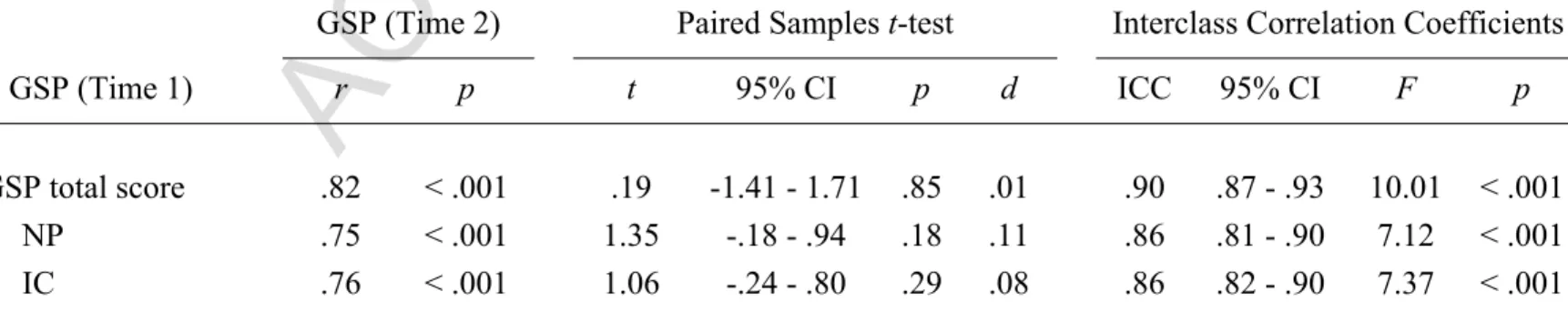
5.2.2. Test-retest reliability of the GSP. Within the test-retest sample (N = 165), mean GSP scores at Time 1 (Day 0) and Time 2 (Day 28) were 42.08 (SD = 17.03) and 41.93 (SD = 16.64), respectively. The intraclass correlation coefficient (ICC) was conducted and showed an
excellent degree of reliability index in test-retest. The average measure ICC of the GSP was .90 with a 95% confidence interval from .86 to .93, F(164, 164) = 10.00, p < .001. The Pearson’s correlation and ICC results of each subscales are also shown in Table 11. The correlation between mean GSP scores at Time 1 and Time 2 was positive and strong (r = .82, p < .001). Additionally, a paired samples t-test was also conducted to confirm the scale’s repeatability. Results revealed that overall mean GSP scores and mean scores from each subscale did not change significantly over the four-week interval, as shown in Table 11.
Table 11. Correlations between GSP (Time 1) and (Time 2), Paired Samples t-test and ICC Results
GSP (Time 2) Paired Samples t-test Interclass Correlation Coefficients
GSP (Time 1) r p t 95% CI p d ICC 95% CI F p
GSP total score .82 < .001 .19 -1.41 - 1.71 .85 .01 .90 .87 - .93 10.01 < .001
NP .75 < .001 1.35 -.18 - .94 .18 .11 .86 .81 - .90 7.12 < .001
5.3. Study 2c results
5.3.1. Discriminant validity of the GSBP. As expected, small to moderate significant correlations were found between the experience of being phubbed, optimism, pessimism, paranoia, and depression. No significant correlation was found between being phubbed and optimism (r = .05,
p = .48). Significant moderate correlations were found between being phubbed and pessimism (r
= .36, p < .001), between being phubbed and paranoia (r = .53, p < .001), and between being phubbed and depression (r = .36, p < .001). Non-significant to moderate correlations are determined as evidence of discriminant validity (Netemeyer et al., 2003).
5.3.2. Test-retest reliability of the GSBP. Within the test-retest sample (N = 153), mean GSBP scores at Time 1 (Day 0) and Time 2 (Day 28) were 81.96 (SD = 25.18) and 82.36 (SD = 26.42), respectively. The intraclass correlation coefficient (ICC) was conducted and showed an
excellent degree of reliability index in test-retest. The average measure ICC of GSBP was .90 with a 95% confidence interval from .86 to .92, F(152, 152) = 9.53, p < .001. The Pearson’s correlation and ICC results of each subscale are also shown in Table 12. The correlation between mean GSBP scores at Time 1 and Time 2 was positive and strong (r = .81, p < .001). Additionally, a paired samples t-test was conducted to confirm the scale’s test-retest reliability. Results revealed that overall mean GSBP scores and mean scores from each subscale did not change significantly over the 4-week interval, as shown in Table 12.
SI .66 < .001 -1.74 -1.22 - .08 .08 -.14 .79 .72 - .85 4.82 < .001
PA .77 < .001 .25 -.42 - .54 .80 .02 .87 .83 - .91 7.80 < .001
N = 165. GSP = Generic Scale of Phubbing; NP = Nomophobia; IC = Interpersonal Conflict; SI = Self-isolation; PA = Problem Acknowledgement.
5.4. Discussion
The pattern of small correlations provides evidence for the discriminant validity of the GSP scale. The GSP was either independent of other theoretically unrelated psychological constructs or was at most only weakly associated with them. Additionally, both results from a Paired Samples t-test and ICC indicated that overall mean scores of the GSP slightly decreased but did not significantly change over time, which represented the scale’s test-re-test reliability.
The pattern of non-significant to moderate correlations provides evidence for the discriminant validity of the GSBP scale. In this study, correlations between the experience of being phubbed, pessimism, depression, and paranoia in the moderate range (e.g. r = .40 - .60) would indicate that the GSBP is associated with the measure of partly related constructs, while being distinct from them (Wood, Garb, & Nezworski, 2007). Although there are no current theoretical connections or known patterns of correlations among measures employed in this study, results still showed slightly high correlations between the GSBP and the Paranoia scale. It is possible that if one is feeling paranoid, then one would hypervigilant to potential threats
Table 12. Correlations between GSBP (Time 1) and (Time 2), Paired Samples t-test, and ICC Results
GSBP (Time 2) Paired Samples t-test Interclass Correlation Coefficients
GSBP (Time 1) r p t 95% CI p d ICC 95% CI F p
GSBP total score .81 < .001 -.31 -2.94 - 2.14 .76 .03 .90 .86 - .92 9.53 < .001
PN .77 < .001 .73 -.72 - 1.57 .47 .06 .87 .82 - .91 7.73 < .001
FI .74 < .001 -.18 -1.30 - 1.08 .85 .01 .85 .80 - .89 6.81 < .001
IC .73 < .001 -1.60 -1.59 - .17 .11 .13 .84 .79 - .89 6.44 < .001
N = 153. GSBP = Generic Scale of Being Phubbing; PN = Perceived Norms; FI = Feeling Ignored; IC = Interpersonal Conflict.
occurred in social interaction. Individuals with a paranoid personality may assume that their conversation partner will harm them or give a silent treatment to them, even if no evidence exists to support this expectation. They may suspect on the basis of little or no evidence that their conversation partners are phubbing. However, while the moderate correlation between the experience of being phubbed and paranoia may sound questionable, it is still within an acceptable range of correlation coefficient supported discriminant validity(Netemeyer et al., 2003). Additionally, both results from a Paired Samples t-test and ICC indicated that overall mean scores of the GSBP slightly increased but did not significantly change over the time, which represented the scale’s test-re-test reliability.
6. Summary of GSP and GSBP studies
The four-factor 15-item GSP was developed through Studies 1a, 1b, and 1c and the three-factor 22-item GSBP was developed through Studies 2a, 2b, and 2c. After reducing and refining items with the assistance of expert panels, EFA and CFA were conducted to further reduce the number of items and finalize the scales. Finally, the psychometric properties of the GSP scale and the GSBP scale were examined. The GSP scale revealed good construct validities, criterion validities, convergent validities, discriminant validities, internal consistency reliabilities, and test-retest reliabilities. The GSP scale can therefore be used as a tool to measure the unique behavior of phubbing in social interaction. The GSBP scale revealed good construct validities, criterion validities, internal consistency reliabilities, and test-retest reliabilities. It also revealed acceptable convergent validities and discriminant validities. The GSBP scale can therefore be used as a tool to measure the experience of being phubbed in social interaction.
7. General discussion
behavior and the other measuring the experience of being phubbed. Up to this point, the literature was lacking scales to measure these two phenomena that are a pervasive feature of everyday life. It is important to be able to measure phubbing and the experience of being phubbed because researchers know very little about their influence over people’s daily
communication. Validated, context-free scales will provide the springboard for future studies on this important topic. To our knowledge, this research is the first to psychometrically develop measures of these constructs. The GSP and the GSBP represent promising alternatives to
existing context-dependent measures of phubbing behavior and the experience of being phubbed. Studies 1a and 2a identified four facets of phubbing behavior (nomophobia, interpersonal conflict, self-isolation, and problem acknowledgement) and three facets of being phubbed
(perceived norms, feeling ignored, and interpersonal conflict) through a series of sequential steps, including item generation and EFA. Previous measures have not revealed the existence of these dimensions and suggested only unidimensional structures of these constructs (Karadağ et al., 2015; Roberts & David, 2016; Roberts & David, 2017). Studies 1b and 2b confirmed these factor structures via CFA. These findings ensured that each important facet of phubbing behavior and the experience of being phubbed are reflected in both new instruments comprehensively. These two studies provided evidence of good internal reliabilities and
criterion-related validities for the GSP and GSBP scales. The GSP study also revealed excellent convergent validity. However, the GSBP study revealed weaker evidence of convergent validity. Both scales also revealed excellent reliability, convergent validity, and discriminant validity at the construct level. Studies 1c and 2c provided further evidence of discriminant validities and test-retest reliabilities of the GSP and GSBP scales, respectively. Results revealed that the GSP construct was independent of unrelated psychological constructs including introversion, social