DOI: 10.4018/978-1-60960-015-0.ch012
Chapter 12
Spam Detection Approaches
with Case Study Implementation
on Spam Corpora
Biju Issac
Swinburne University of Technology (Sarawak Campus), Malaysia
INTRODUCTION
Over the last years, unsolicited bulk mail, better known as spam, has become one of the most an-noying problems of the Internet. The increase of
spam emails uses bandwidth and fills up databases and therefore the global network becomes more crowded and less useful. Even though spam emails do not damage the data in the way that viruses do, they do harm the business intentions. For example, spam emails wastes user’s time since the users devoid of anti-spam protection have to
EXECUTIVE SUMMARY
Email has been considered as one of the most efficient and convenient ways of communication since the users of the Internet has increased rapidly. E-mail spam, known as junk e-mail, UBE (unsolicited bulk mail) or UCE (unsolicited commercial mail), is the act of sending unwanted mail messages to e-mail users. Spam is becoming a huge problem to most users since it clutter their e-mailboxes and waste their time to delete all the spam before reading the legitimate ones. They also cost the user money with dial up connections, waste network bandwidth and disk space and make available harmful and offensive materials. In this chapter, initially we would like to discuss on existing spam technologies and later focus on a case study. Though many anti-spam solutions have been implemented, the Bayesian spam detection approach looks quite promising. A case study for spam detection algorithm is presented and its implementation using Java is discussed, along with its performance test results on two independent spam corpuses – Ling-spam and Enron-spam. We use the Bayesian calculation for single keyword sets and multiple keywords sets, along with its keyword contexts to improve the spam detection and thus to get good accuracy. The use of porter stemmer algorithm is also discussed to stem keywords which can improve spam detection efficiency by reducing keyword searches.
check which email is spam manually and then delete it. Sometimes, users can easily overlook or delete important email because of confusing it with spam. Email spamming often contains decep-tive, worthless content or even a virus attachment. Spam emails are getting better in its ability to break anti-spam filters and it would take a great deal of research to get it fully eradicated by coming up with very intelligent anti-spam filters. Spam-mers are also becoming more innovative, so that the anti-spam research is having a great relevance these days. There are various anti-spam techniques that have been created and implemented since spam started infiltrating user’s inboxes. The most popular and direct way to prevent spam is the anti-spam filters. Anti-anti-spam filters are the software tools that block spam messages automatically. These filters vary in functionality from black list (spammer list) and white list (trusted user list) to content-based filters. There are a lot of anti-spam filters or spam detection schemes available in the market.
The spammer’s methods of avoiding detec-tion evolve constantly, differing significantly from what has been used in the past. For every techniques created for filtering the emails, a new method to spread spam also comes out, mak-ing the battle between the spammers and mail agent even more challenging. We would like to introduce a Bayesian approach to the anti-spam solution, considering the context of keywords found. First we implement a simple Bayesian filter based on single keyword sets. Then we improve that by using multiple keyword sets and assigning a higher weightage to them. Finally, we further refine the anti-spam filter by using context matching technique along with the previous steps. The keywords are mapped to a keyword context, which is a collection of other keywords where the specific keyword is found.
The spam relayed by different countries in second quarter of 2007 is shown as a graph in Figure 1 (E-mail spam, na). This gives a good indication that some selected countries are the top
relay points of spam emails. The actual spammer may or may not be sending spam emails from the country of his residence or may use compromised PCs elsewhere, even in other countries.
EXISTING AND RELATED WORKS
A number of research works are happening in the field of spam detection techniques. Some are listed below. Sasaki and Shinnou proposed a new spam detection technique using the text cluster-ing based on vector space model. Their method computes disjoint clusters automatically using a spherical k-means algorithm for all spam/non-spam mails and obtains centroid vectors of the clusters for extracting the cluster description. For each centroid vectors, the label (`spam’ or `non-spam’) is assigned by calculating the number of spam email in the cluster. When new mail arrives, the cosine similarity between the new mail vec-tor and centroid vecvec-tor is calculated. Finally, the label of the most relevant cluster is assigned to the new mail (Sasaki & Shinnou, 2005). When classifying emails as spam and ham (which is a valid email), a false positive is the valid email that was erroneously classified as spam and a false negative is the spam email that was erroneously classified as valid email. For email classification as spam or non-spam, naive bayes classification was used in several systems (Kiritchenko & Ma-twin, 2001; Chan & Poon, 2004; Schneider, 2003; Androutsopoulos et al., 2000). Chiu et al. presents an alliance-based approach to classify, discovery and exchange interesting information on spam mails. The spam filter is built based on the mixture of rough set theory, genetic algorithm and XCS (eXtended Classifier System) classifier system (Chiu, Chen, Jeng, & Lin, 2007). Sirisanyalak et al. uses an email feature extraction technique for spam detection based on artificial immune systems that extracts a set of four features that can be used as inputs to a spam detection model (Sirisanyalak & Sornil, 2007). Dhinakaran et al. collected 400
thousand spam mails from a spam trap set up in a corporate mail server for a period of 14 months form January 2006 to February 2007, which is a sample of world wide spam traffic. Studying the characteristics of this sample helps to better un-derstand the features of spam and spam vulnerable e-mail accounts. They believe that this analysis is highly useful to develop more efficient anti spam techniques. In their analysis they classified spam based on attachment and contents (Dhinakaran, Lee & Nagamalai, 2007).
Zhou et al. explains on Good Word Attack that thwarts spam filters by appending to spam messages sets of “good” words, which are com-mon in legitimate e-mail but rare in spam. They present a counterattack strategy that first attempts to differentiate spam from legitimate e-mail in the input space, by transforming each email into a bag of multiple segments, and subsequently applies multiple instance logistic regression on the bags. They treat each segment in the bag as an instance. An e-mail is classified as spam if at least one instance in the corresponding bag is spam, and as legitimate if all the instances in it are legitimate (Zhou, Jorgensen & Inge, 2007). Gao et al. propose a system using a probabilistic boosting
tree to determine whether an incoming image is a spam or not based on global image features, i.e. color and gradient orientation histograms. The system identifies spam without the need for OCR and is robust in the face of the kinds of variation found in current spam images (Gao, Yang, Zhao, Pardo, Pappas & Choudhary, 2008). Balakumar et al. uses ontology for Statistical based filter-ing: understanding the content of the email and Bayesian approach for making the classification (Balakumar & Vaidehi, 2008). Ali et al. investi-gates current approaches for blocking spam and proposes a new spam classification method by using adaptive boosting algorithm. Experiment was carried out to evaluate the results of spam filtering and the results were supporting adaptive boosting algorithm (Ali & Xiang, 2007). Lan et al. present a filtering mechanism applying the idea of preference ranking. This filtering mechanism will distinguish spam emails from other email on the Internet. The preference ranking gives the similarity values for nominated emails and spam emails specified by users, so that the ISP/end us-ers can deal with spam emails at filtering points. They designed three filtering points to classify nominated emails into spam email, unsure email
and legitimate email (Lan & Zhou, 2005). Ming et al. used a method of spam behaviour recogni-tion filtering. The method identifies the spam according to the behaviour of mail sent, set up the model by Bayes technique, and in the mail filtering application to filter the spam by stages (Ming, Yunchun & Wei, 2007).
Other more prevalent anti-spam methods are listed below. Word filters are a quite an easy and effective way to block obvious spam mails. Word filters simply identify any email that contains certain key words, like “viagra, penis enlarge-ment” that are commonly found in spam mails. Rule-based scoring systems are more complex. As word filters simply just block emails that contain certain key words, rule-based scoring systems use rules to analyze emails and assign scores to each key word it finds. Bayesian filters can adapt automatically to changes in spam mails. To determine the likelihood that an email is spam, these filters use Bayesian analysis to compare the words or phrases in the email to the frequency of the same words or phrases in the intended recipi-ent’s past emails (both regular and spam). Black list IP is a common spam blocking technique that simply involves organizations to manually keep a list of the IP addresses of known spammers (a “black list”) so that emails from those addresses are blocked. RBLs (Realtime Blackhole List), also known as DNSRBLs, check every incoming email’s IP address against a list of IP addresses in the RBL. If the IP address is part of the RBL, then the email is identified as spam and blocked. Black List Sender Email Addresses is a simple spam blocking technique where users create a black list from addresses that should be prevented from entering the network and reaching the user’s inbox (Barracuda Networks, 2004). There are dif-ferent types of spam filters that are available today. Let’s look at some of the different kinds of spam filters that are available (Types of Spam Filters, na) and they are discussed as follows.
Content Based Filters
These are the traditional type of spam filters that analyze the message subject, headers and content searching for specific words or phrases, or other indicators of spam. Whenever an unsolicited mail comes into your mail box, the user can create a new filter by choosing certain words, or phrases from the message that indicate it is spam. But spammers know that their messages were being marked by these content filters and have resorted to counter the content filter through words with special char-acters inserted like “Vi@gra”, “p.0.r.n”, “L|0|a|n|$” etc. This effort is getting increasingly popular that previous versions of content-based filters are not delivering well in terms of performance. But as one can perform wildcard searches and has the ability to see the spammer’s attempts at obfuscating the words such as in the examples shown above, the mails can be classified as spam. A vast majority of spam emails are less legible because of their effort to bypass the content-based filters. The content based approach nevertheless is quite flexible. We can easily specify the filtering to the exact type of spam message that is in question and avoid regular words that we use daily communication. But on the downside, it requires more effort and hands on tuning, along with regular updation. As spammers look to novel approaches to circumvent the filters, the filters need to be modified to deal with them.
Bayesian Based Filters
Thomas Bayes developed an approach that al-lowed one to find the probability of an event oc-curring based on the probabilities of two or more independent events. Bayesian filters are based on this approach using Bayes equation. These filters when implemented as software, have to be trained from a set of known good and bad e-mails. During training they extract tokens (which are
keywords) and store them in a data store. When the filter analyze an email message, the message is split into tokens and the presence of such tokens is attributed a value according to the following criteria such as – the frequency of the token in spam messages, the frequency of the token in good messages, the number of spam messages, and the number of good messages. After applying Bayes equation, a spamicity value is extracted that gives the probability of an email message being spam or not. The Bayesian based filters require little maintenance and follow-up than the other filters. Once the filter has been trained, it is quite self reliant as it can self-adapt automatically to changing trends in spam. The Bayesian filters are self learning in nature and it will continue to learn from newly arrived email messages. But on the downside, its filtering is only as good as the mes-sages on which the filter is trained. Many filters based on this approach comes as pre-trained, but not on the email messages received by the user. It will thus require some time before the filter can reach its optimum levels of performance, after being trained by user’s incoming mail pattern.
Whitelist or Blacklist Filters
These are very simple and elementary types of filters which are not used independently, but can be used as part of an integrated email filtering system. Whitelist filters will not accept e-mail from any address outside the list of known good e-mail addresses. On the contrary, Blacklist filters allow messages from any address except the list of known bad email addresses. The blacklists can be locally kept and administered or accessed through the Internet. The readily available Blacklists on the Internet are known as RBLs or Realtime Blackhole Lists. Even though whitelists are guaranteed to thwart e-mail from unwanted sources, it is a drastic measure with very little flexibility. Sometimes the people that compile RBLs - the realtime blacklists
available on the Internet put entire ranges of IP addresses on their blacklist even though previous abuse occurred only on a certain part of that range. This results in a situation where wrong people get blocked as a result of stopping the spammer and is a debatable issue.
Challenge/Response Filters
Challenge/Response filters features the option to automatically send a response to an anonymous sender by asking them to act further so that their message will be received. This approach is referred to as a “Turing Test” – named after a test devised by British scientist Alan Turing to determine if machines can possibly think. Of late, we can see the appearance of some Internet services that does perform this Challenge/Response function for the user and require the sender of an e-mail to visit their web site to facilitate the receipt of their message.
Community Filters
These types of filters work on the basis of “com-munity knowledge” of spam and this knowledge is resident on a central server. When a user receives a spam message, they simply mark it and inform the server. Based on the information given to the central server, a message fingerprint is added to the database. When a number of people have identi-fied the message as spam, it will be stamped as spam and would be stopped from user’s inboxes in future. On the positive side, it is easy to set up and minimal administration is needed. On the down side, before enough people identify the email as spam, somebody will be receiving the spam messages. Different people can have dif-ferent view points on what spam mail is and so some good mails may be stopped, thus increasing the possibility of false positives.
CASE STUDY OF CONTENT BASED
BAYESIAN ANTI-SPAM FILTER
We would be looking into a content based Bayesian anti-spam filter. Bayesian filtering works on the principle that the probability of an event occurring in the future can be inferred from the previous occurrences of that event (Graham, 2003).
The Bayesian method has some advantages. It takes the whole email message into consideration. It notes the keywords that identify spam, but it also notes words that denote valid mail. The advantage of the Bayesian method is that it considers the most interesting or specific key words and comes up with a probability that a message is spam. Thus Bayesian filtering is an efficient and intelligent approach because it examines all aspects of an email message, compared to keyword checking that stamps a mail as spam on the basis of a single word. Bayesian type of filter is constantly self-adapting and self-learning. By learning from new email spam and new valid emails, the Bayesian filter evolves and adapts to new spam techniques as it automatically notices spammer’s tactics. This technique is also sensitive to the user as it learns the email habits of the company and understands that. Another interesting aspect is that the Bayes-ian method is multi-lingual and international. A Bayesian anti-spam filter, being adaptive, can be used for any language required. The self adaptive nature and the evolving intelligence enable such the filter to catch more spam. This filter is difficult to break compared to a keyword filter.
Spam emails can be processed through Bayes-ian filters using keywords, is widely known. Single keyword or multiple keyword combinations can be used to decide on spam score. Along with the keywords, we used keyword contexts. Making a spam decision by merely using keywords cannot be that accurate. Once the keyword is checked using its context, the picture becomes clearer and a more accurate decision can be taken in classifying a mail as spam. Context is a set of remaining keywords that is mapped to every keyword chosen as shown
in Figure 2. For example, if the [keyword 1] has a context of [keyword 2, keyword 3 … keyword n], then [keyword 2] has a context of [keyword 1, keyword 3 … keyword n] etc. Generally, the keywords chosen can be uncommon or critical nouns (or combinations), along with acronyms, names etc. An exemption text file of common words can be used during implementation, to avoid classifying those common words as keywords.
The anti-spam algorithm can be described as follows. Accept the incoming mails and extract keywords from subject line and email contents as one-keyword (k1i), two-keyword (k2i), three-keyword (k3i) or multi keyword sets. Form contexts Cij for content keywords (k1i), two-keyword (k2i) and three-keyword (k3i) sets. The context for any keyword is a set that contains all other keywords except itself. Thus a keyword or keyword com-binations can have more than one context, as different spam can contain different sets of key-word combinations. Use the identified keykey-words to assign a Bayesian probability related score. The keyword contexts are compared to the set of existing keywords, to find a context matching percent (CMP).
Three approaches are discussed here –Bayesian using single keywords, Improved Bayesian with multiple keywords and Improved Bayesian with keyword context matching (Graham, 2003; Issac & Raman, 2006).
Bayesian Approach with
Single keywords
This approach is done in many spam filters, as one part of the implementation. The commercial spam filters are mostly composite products which implements more than one idea. The Bayesian probability p(k) for keyword k is given as in Equation 1: ( ) ( ) ( ) ( ) s k p k s k ns k = + (1)
where, s(k) is the number of spam emails with keyword k and ns(k) is the number of non-spam emails with keyword k. The overall weighted spam score is calculated as follows. The Bayesian score for single keywords and multi-keywords are calculated and no weights are assigned to multi-keywords. The keyword scores are totaled to get the spam score for a given mail.
The Bayesian probability p(sk) for single keyword set sk, ( ) ( ) ( ) ( ) s sk p sk s sk ns sk = + (2)
where, s(sk) is the number of spam emails with all single keyword set sk and ns(sk) is the number of non-spam emails with all single keyword set sk. Similar approach is adopted for multi-keywords.
Improved Bayesian Approach
with Multiple Keywords
The previous approach treats all the keywords, whether single or multiple words in the same manner. In comparison to the previous method,
here weights are assigned to multiple keywords, giving it more importance in the spam score calcu-lation. Weights associated with one, two and three keywords (or multiple keywords) are denoted as Wk1i, Wk2i and Wk3i respectively, where i = 1 to n (where Wk1i < Wk2i < Wk3i). Spam score for one, two and three keywords are denoted as Sk1i, Sk2i and Sk3i respectively, where i = 1 to n. Bayesian calculation is done with weights and keywords scores are determined, which are eventually added to get the spam score.
The Bayesian probability p(mk) for multi-keyword set mk, ( ) ( ) ( ) ( ) s mk p mk s mk ns mk = + (3)
where, s(mk) is the number of spam emails with all multi-keyword set mk and ns(mk) is the number of non-spam emails with all multi-keyword set mk. In the simulation done, the multiple keywords present are assigned different weights in spam score calculation as follows: Two keywords can be assigned a weight of MK_WEIGHT*2 (constant value), three keywords are assigned a weight of
MK_WEIGHT*3, four keywords or more are assigned a weight of MK_WEIGHT*4. Single keywords are not assigned any weights.
Improved Bayesian with
Keyword-Context Approach
To further improve the accuracy, we added the keyword context score or context matching per-cent score to the improved Bayesian score, which sensed multiple keywords. Spam score for one, two and three keywords with corresponding keyword contexts are Skc1i, Skc2i and Skc3i respectively, where i = 1 to n. This score is calculated with respect to the matches spam mail keywords con-texts find in the existing database of keywords. For example, consider a keyword [viagra] that has a context of [word 1, word 2, word 3, word 4] in a mail received. Matching percentage can be given as x% for keyword context match. If two words match out of four, then matching percentage would be 50%. The keyword context score (Skcij) would be a function of this matching percentage. This spam score for keyword-context pairs can have a greater contribution in the overall score. This is effected by W1 and W2, where W1 is the weight (say, 70%) associated with keyword score and W2 (say, 30%) is associated with keyword-context score component in Equation 4. These values can be fine-tuned for best results. Weights associated with contexts that corresponds to one, two and three keywords are Wkc1i, Wkc2i and Wkc3i respectively, where i = 1 to n (where Wkc1i < Wkc2i < Wkc3i).
The Total Spam Score = Total weighted Bayesian score for all keywords found + Total weighted score based on matching percent for all keyword-contexts found, corresponding to all keywords. That can be mathematically expressed as in Equation 4: ; 1 2 1; 1 ( ) ( ) i n j n total ij ij ij ij i j S W Sk Wk W Skc Wkc = = = = =
å
´ + ´ (4)For each keyword, the corresponding contexts are formed. The presence of spam keyword itself doesn’t guarantee a good spam score, but key-words with contexts if present, can give a good spam score. Threshold and weight factors should be fine tuned in different stages (Issac & Raman, 2006; Androutsopoulos, Koutsias, Chandrinos, Paliouras & Spyropoulos, 2000).
A number of so-called stemming Algorithms, or stemmers, have been developed, which attempt to reduce a word to its stem or root form. Thus, the key terms of a query or document are represented by stems rather than by the original words. This not only means that different variants of a term can be conflated to a single representative form – it also reduces the dictionary size, that is, the number of distinct terms needed for representing a set of documents. A smaller dictionary size re-sults in a saving of storage space and processing time. We will be using one such approach called Porter stemming algorithm (Porter, 1980) in our implementation to reduce dictionary size and thus better efficiency.
IMPLEMENTATION AND ANALYSIS
The implementation program was written in Java and the software once developed was trained and tested using two public spam corpuses – Ling-spam Corpus (small size) and Enron-spam Corpus (big size) as found in (Software and data – Natural Language Processing Group, na).
The text based spam detector was implemented in Java for the three approaches outlined, with single and multi-keyword detection capability. The code has extensive features to process text from the emails and to extract keywords. The fol-lowing steps were done to develop the software into its working mode.
1. A ignore word list was formed with common words that should be ignored as keywords. These are the common words in English.
2. The mails files were read from the spam corpus one by one during training session and two files were created. One file with single keywords and multiple keywords and another file with only single keywords. The multiple keywords are those continuous words that can be found in any mail text (e.g. best selling pills).
3. The two files created are sorted in ascending order. The file names of the keyword origin are appended at the end of every line. 4. Using TreeSet class in Java, multiple
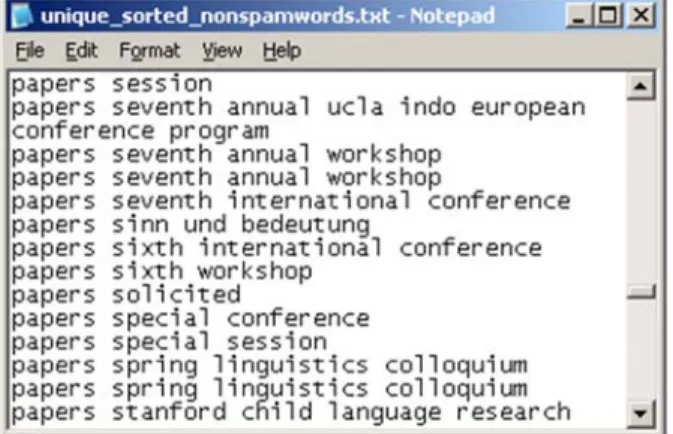
en-tries were removed, as a set doesn’t store duplicate entries. Now the two files contain only unique words along with its file name, where it is found. The file names were later removed as in Figure 3 and 4 and it shows the captured key words.
5. Based on the above files, the count or fre-quencies of all these keywords in these two files are taken separately. This gives the number of mails where these single keywords or multiple keywords were found.
6. During the testing phase, the mails are checked for single and multiple keywords
by reading those files. Binary search is used on sorted files.
7. The frequencies of all single keywords are added in spam and non-spam to find the bayesian score. Similarly, the frequencies of all multiple keywords are added in spam and non-spam to find the bayesian score. 8. Weights are used (rather multiplied) if
necessary, especially for multiple keyword frequency to improve the overall score accuracy.
9. Context matching percent is also calculated for all keywords, based on how many single or multiple keyword match is found during testing phase.
Ling-spam corpus is a mixture of 481 spam messages and 2412 messages sent via the Linguist list, a moderated (hence, spam-free) list about the profession and science of linguistics. Attachments, HTML tags, and duplicate spam messages received on the same day are not included. The corpus contains 10 directories with a combination of non-spam and spam mails amounting to 2893 total mails.
Figure 3. The file showing multiple (yet unique) spam keywords in different spam emails captured dur-ing testdur-ing session on spam corpus
Enron-spam corpus contains preprocessed and raw forms of Enron-Spam datasets, amounting to 33716 total messages. The “preprocessed” directory contains the messages in preprocessed format. Attachments, HTML tags, and duplicate spam messages received on the same day are not included. The “raw” directory contains the mes-sages in their original form. Spam mesmes-sages in non-Latin encodings, ham messages sent by the owners of the mailboxes to themselves (sender in “To:”, “Cc:”, or “Bcc” field), and a handful of virus-infected messages have been removed, but no other modification has been made. The corpus is arranged into 6 directories that contains a combination of non-spam and spam messages.
In the Ling-spam corpus used (under bare directory), it contained contains 10 subdirecto-ries (part1, ... part10). These correspond to the 10 partitions of the corpus that were used in the experiment. The 9 parts (part1 to part 9) were used for training and one part was used for test-ing (part 10). Later, all possible combinations of folders were used – nine for training and one for testing. Each one of the 10 subdirectories contains
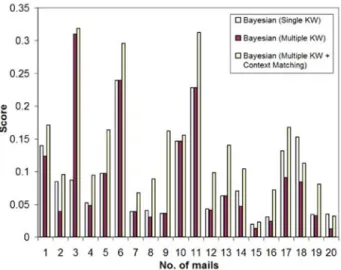
spam and legitimate messages, one message in each file. In Enron corpus, it was organized into 6 folders. Each time five folders are used for train-ing and the remaintrain-ing one was used for testtrain-ing. In our implementation, we extracted only the first 100 keywords from all the mails for spam score analysis. Figure 5 shows the scores during Ling-spam testing.
The average number of training and testing mails used in each of the 10 runs in Ling-spam corpus were as follows:
No. of Training Non-Spam mail = 2171 No. of Training Spam mail = 432 No. of Testing Non-Spam mail = 242 No. of Testing Spam mail = 49
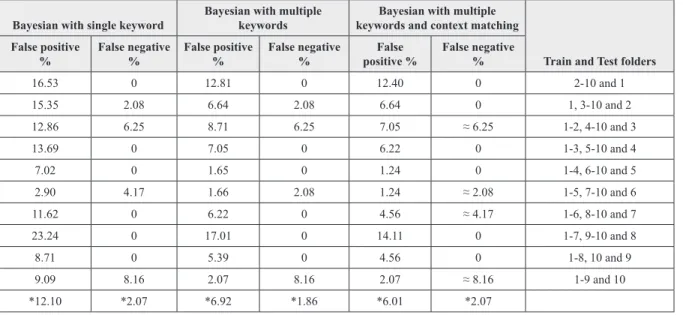
The spam thresholds set were as follows: Bayesian with single keywords (0.15), Bayesian with multiple keywords (0.15) and Bayesian with multiple keywords and context matching (0.24). Table I shows the comparison of all possible combinations on folders in Ling-spam. You can see the three implemented Bayesian approaches
Figure 4. The file showing multiple (yet unique) non-spam keywords in different spam emails captured during testing session on spam
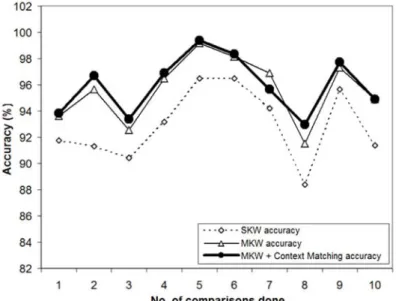
and the corresponding false positives and false negatives. Thus the average spam detection ac-curacy was around 96%. The acac-curacy graphs for all approaches are shown in Figure 6.
The average number of training and testing mails used in each of the 6 runs in Enron-spam corpus were as follows:
No. of Training Non-Spam mail = 12533 No. of Training Spam mail = 15671 No. of Testing Non-Spam mail = 4012 No. of Testing Spam mail = 1500
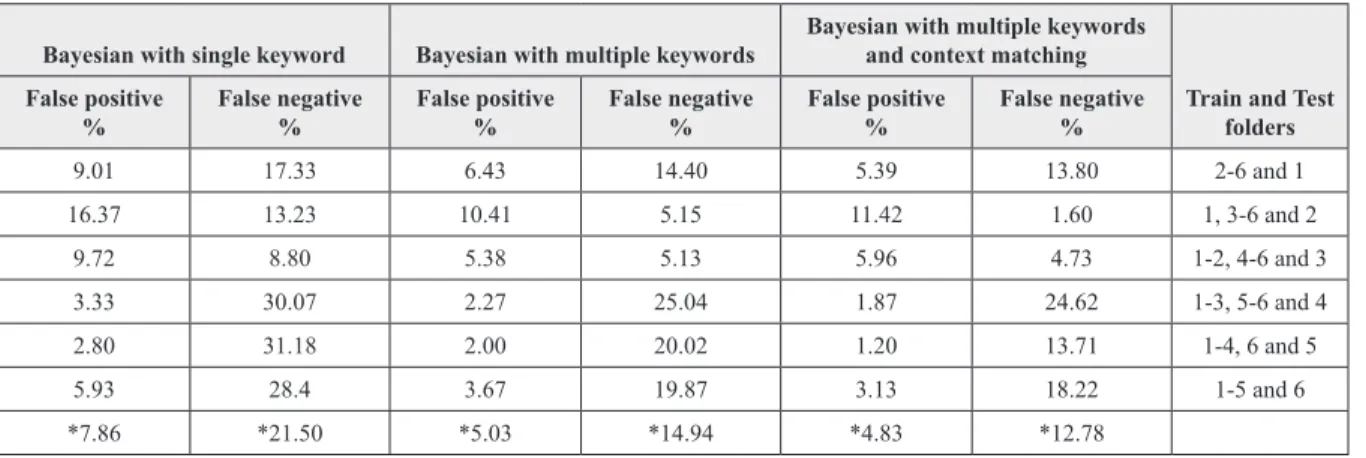
Figure 7 shows the scores during Enron-spam corpus testing. The spam thresholds set were as follows: Bayesian with single keywords (0.57), Bayesian with multiple keywords (0.59) and Bayesian with multiple keywords and context matching (0.70). Table II shows the comparison of all possible combinations on folders on Enron.
Generally the false positives and false negatives are getting lower for the third case with context matching. Thus, the false positives (non-spam as spam) and false negatives (spam as non-spam) percentage is lesser for the third category, that we
Figure 5. The graph showing the spam scores for emails during testing session on Ling-Spam corpus
Figure 6. The graph for Ling-spam corpus showing the spam score accuracy for the three approaches (single keyword, multiple keyword, multiple keyword with context matching)
proposed. Thus the average spam detection accu-racy was around 92%. The accuaccu-racy graphs for all three approaches are shown in Figure 8.
We wanted to check the effect of Porter stem-ming algorithm (Porter, 1980) on spam detection. The Porter stemming algorithm (or ‘Porter stem-mer’) is a process for removing the commoner
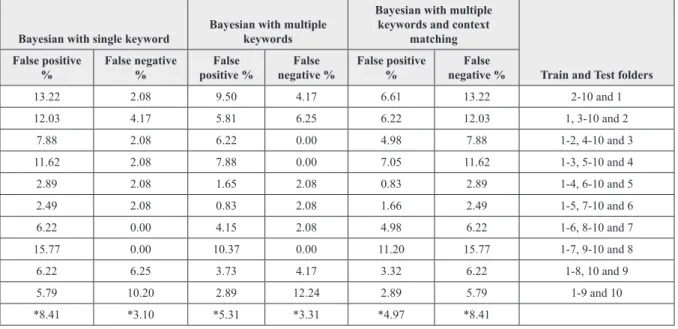
morphological and inflexional endings from words in English. Its main use is as part of a term nor-malization process that is usually done when setting up Information Retrieval systems. We used this algorithm to do spam detection using stem key-words, rather than using full keykey-words, on the above two corpuses and it yielded the results as
Table 1. Comparison table for ling-spam corpus
Bayesian with single keyword Bayesian with multiple keywords keywords and context matchingBayesian with multiple
Train and Test folders False positive
% False negative % False positive % False negative % positive %False False negative %
16.53 0 12.81 0 12.40 0 2-10 and 1 15.35 2.08 6.64 2.08 6.64 0 1, 3-10 and 2 12.86 6.25 8.71 6.25 7.05 ≈ 6.25 1-2, 4-10 and 3 13.69 0 7.05 0 6.22 0 1-3, 5-10 and 4 7.02 0 1.65 0 1.24 0 1-4, 6-10 and 5 2.90 4.17 1.66 2.08 1.24 ≈ 2.08 1-5, 7-10 and 6 11.62 0 6.22 0 4.56 ≈ 4.17 1-6, 8-10 and 7 23.24 0 17.01 0 14.11 0 1-7, 9-10 and 8 8.71 0 5.39 0 4.56 0 1-8, 10 and 9 9.09 8.16 2.07 8.16 2.07 ≈ 8.16 1-9 and 10 *12.10 *2.07 *6.92 *1.86 *6.01 *2.07 Note: *Average
follows in table III and IV. You can see the three implemented Bayesian approaches and the cor-responding false positives and false negatives. We did not observe considerable amount of ment in spam detection, though there is improve-ment in keyword search efficiency. With porter stemmer approach the number of keywords would be smaller, as we consider only the stem keywords. Enron corpus (large corpus) spam detection aver-age is better for all cases combined (89.9%
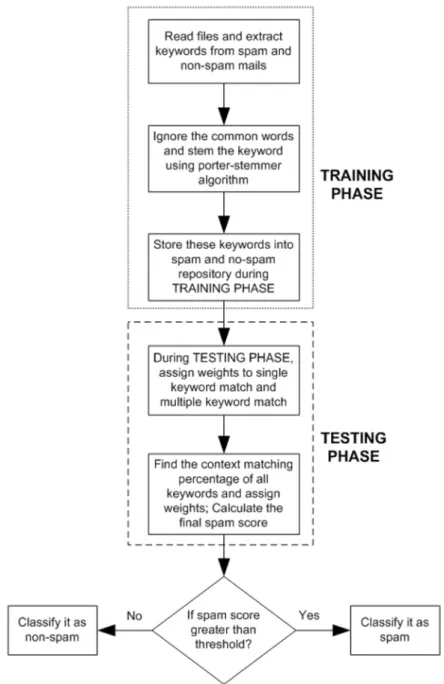
accu-racy compared to 88.8%) with Porter stemmer. With context matching sub-case, it is 91.7% ac-curacy compared to 91.2%. So that is an encourag-ing sign. Figure 9 shows the flow chart of the spam detection scheme that was implemented.
We also want to show the spam detection results of some commercial Bayesian filters available and the test results have been taken from an ex-ternal source (Spam Filter Reviews, na). The sample size used in all cases is generally quite
Table 2. Comparison table for enron-spam corpus
Bayesian with single keyword Bayesian with multiple keywords Bayesian with multiple keywords and context matching
Train and Test folders False positive
% False negative % False positive % False negative % False positive % False negative %
9.01 17.33 6.43 14.40 5.39 13.80 2-6 and 1 16.37 13.23 10.41 5.15 11.42 1.60 1, 3-6 and 2 9.72 8.80 5.38 5.13 5.96 4.73 1-2, 4-6 and 3 3.33 30.07 2.27 25.04 1.87 24.62 1-3, 5-6 and 4 2.80 31.18 2.00 20.02 1.20 13.71 1-4, 6 and 5 5.93 28.4 3.67 19.87 3.13 18.22 1-5 and 6 *7.86 *21.50 *5.03 *14.94 *4.83 *12.78 Note: *Average
Figure 8. The graph for Enron corpus showing the spam score accuracy for the three approaches (single keyword, multiple keyword, multiple keyword with context matching)
less compared to what the author had done, espe-cially with Enron corpus. Some of them use hybrid schemes along with other anti-spam approaches. The author had not verified the results himself. See the false positive and false negative values as compared to author’s findings and some of which looks compatible.
STEPS TO FURTHER IMPROVE
SPAM DETECTION
Some other additional steps that can improve the overall spam detection capability can be added as follows:
1. Check for any embedded hyperlinks within the email text, with the centralized
hyper-Table 3. Comparison table for ling-spam corpus using porter stemmer algorithm
Bayesian with single keyword Bayesian with multiple keywords
Bayesian with multiple keywords and context
matching
Train and Test folders False positive
% False negative % positive %False negative %False False positive % negative %False
13.22 2.08 9.50 4.17 6.61 13.22 2-10 and 1 12.03 4.17 5.81 6.25 6.22 12.03 1, 3-10 and 2 7.88 2.08 6.22 0.00 4.98 7.88 1-2, 4-10 and 3 11.62 2.08 7.88 0.00 7.05 11.62 1-3, 5-10 and 4 2.89 2.08 1.65 2.08 0.83 2.89 1-4, 6-10 and 5 2.49 2.08 0.83 2.08 1.66 2.49 1-5, 7-10 and 6 6.22 0.00 4.15 2.08 4.98 6.22 1-6, 8-10 and 7 15.77 0.00 10.37 0.00 11.20 15.77 1-7, 9-10 and 8 6.22 6.25 3.73 4.17 3.32 6.22 1-8, 10 and 9 5.79 10.20 2.89 12.24 2.89 5.79 1-9 and 10 *8.41 *3.10 *5.31 *3.31 *4.97 *8.41 Note: *Average
Table 4. Comparison Table for Enron-Spam Corpus using porter stemmer algorithm
Bayesian with single keyword Bayesian with multiple keywords
Bayesian with multiple keywords and context
matching
Train and Test folders False positive
% negative %False False positive % negative %False False positive % False negative %
9.31 16.20 7.00 12.53 3.76 16.20 2-6 and 1 14.72 11.23 11.10 3.34 7.20 3.01 1, 3-6 and 2 8.85 8.87 6.16 4.40 3.49 5.60 1-2, 4-6 and 3 3.00 27.98 2.33 21.12 0.93 25.43 1-3, 5-6 and 4 3.87 28.27 2.67 12.82 1.80 13.66 1-4, 6 and 5 5.73 25.09 3.80 14.64 2.40 16.62 1-5 and 6 *7.58 *19.61 *5.51 *11.48 *3.26 *13.42 Note: *Average
Figure 9. The flow chart of the Bayesian spam detection scheme with stemming and keyword contact matching
Table 5. Comparison Table for different commercial Bayesian anti-spam filters
Type of filter Message count Spam False positive False negative
Outlook spam filter 1361 89.05% 3.53% 2.87% IHateSpam filter 2030 89.95% 3.74% 6.4% SpamBully filter 695 89.86% 2.43% 1.14%
InBoxer filter 2588 86.13% .97% 9.51% MailWasher Pro filter 1407 91.61% 0.71% 18.27%
link blacklist. Stamp it as spam, if the link is found in hyperlink blacklist. This single step if positive, can override other spam score calculations.
2. The user software interface can have a “Report Spam” option, to report the anti spam server software, on the status of the new incoming emails. This ensures auto-matic on-going training in real time. The reported spam details are used for training and fed to database, once minimum n users have reported it as spam.
3. Special characters (like $, -, *, digits 1-9, ‘, “, -#, etc.) introduced by spammers to con-fuse spam filters can be extracted/removed or replaced (say, 0 with o) from keywords to improve filtering.
4. Growing White List and Black Lists can be maintained as a local (or global) online repository that could be checked for existing spam signatures. Implement a white-list, which is a list of “fully permitted” email addresses. Black-listed email addresses will also be ranked based on how many people reported it as spam or phishing addresses. 5. Securing of SMTP Server is another
op-tion. SMTP servers from registered static IP address only should be allowed. It should support SMTP user authentication and be standardized to work only in this way. No SMTP relays should be allowed. SMTP servers should not be allowed to run from a dynamic IP address, as spammers could run their own SMTP servers from dial-up connections. Optionally, digital signatures can be gradually made mandatory in email-ing systems so that sender identity cannot be forged. This will prevent further email messages with spoofed sender addresses as such emails would be rejected. Only a valid sender can now send emails.
6. Implementing Grey Listing is a good option too. The Grey listing approach proposed by Harris (Harris, 2004) looks at three pieces
of information that form a signature – the IP address of the host attempting the deliv-ery, the envelope sender address and the envelope recipient address. If the receiving side has never seen this signature, the email would be rejected for the first time and it would become a bounced email. It would be allowed in only a second time (when the sender resends), after a delay of 25 minutes to 4 hours. Generally, this would stop spam emails to a great extent, since spammers may not resend (most of the time) their emails with the same signature.
7. Matching DNS names can improve the scenario. The web links in spam emails are also checked for veracity with the original organizations web domain, through a DNS query. If it is a concocted website link and a domain, the link can immediately be notified to the user and the central server database can be updated with the details. For example, consider a spam email with Citibank details, asking the user to click a web link to update Citibank account details. The first 2 octets in IP address of Citibank in decimal dot notation is 192.193 and this can be checked with the forged domain’s IP address. 8. Email authentication can ensure that
mes-sage is sent by the intended person who is the sender of the mail. The attacker normally forges the return address and would send email from a similar-looking domain to that of an original domain. There are different approaches proposed for email authentica-tion, as of now. Return address forgery can be tackled by Sender-ID and SPF by check-ing DNS records to ensure whether the IP address of the sending MTA (Mail Transfer Agent) is an authorized sender. Domain level cryptographic signatures can also be used to provide authentication through Domain keys by cross-checking the DNS record. Cryptographically signed emails can be a
good option especially if signing becomes a normal way of sending emails.
CONCLUSION
Spam emails are also known as junk mails and most of the time, the spam is about commercial advertising or some fake get-rich-quick schemes etc. This chapter discusses some existing work on spam detection research and focuses on a case study done on two spam corpora. The spam detec-tion implementadetec-tion in Java and the subsequent analysis on two independent spam corpuses (Ling-spam and Enron-(Ling-spam) shows that the Bayesian approach taking into account multiple keywords and keyword contexts looks very promising. The idea is very practical and can be implemented with much promise. The inclusion of porter stemmer algorithm to stem keywords can improve spam detection efficiency, as the search happens with a lower number of stem keywords. Thus the ex-perimental results show that the proposed method is quite efficient and useful in identifying spam emails. Like in most anti-spam approaches, the filter needs to be trained with known spam and non-spam mails, so that it can classify the spam mails correctly later.
REFERENCES
Ali, S., & Xiang, Y. (2007). Spam Classification Using Adaptive Boosting Algorithm, 6thIEEE/
ACIS International Conference on Computer and
Information Science (pp.972 – 976). Australia:
IEEE Computer Society.
Androutsopoulos, I., Koutsias, J., Chandrinos, K. V., Paliouras, G., & Spyropoulos, C. D. (2000). An Evaluation of Naive Bayesian Anti-Spam Filtering. Workshop on Machine Learning in the New Information Age, 11th European Conference
on Machine Learning (pp. 9-17). Spain: LNCS
Springer.
Androutsopoulos, I., Paliouras, G., Karkaletsis, V., Sakkis, G., Spyropoulos, C., & Stamatopoulos, P. (2000). Learning to filter spam e-mail: A com-parison of a naive bayesian and a memory-based approach, 4th PKDD’s Workshop on Machine
Learning and Textual Information Access. France: LNCS Springer.
Balakumar, M., & Vaidehi, V. (2008). Ontology based classification and categorization of email,
Conference on Signal Processing,
Communica-tions and Networking (pp.199-202). USA: IEE
Computer Society.
Barracuda Networks. (2004). An Overview of
Spam Blocking Techniques, White paper.
Chan, K. J., & Poon, J. (2004). Co-training with a single natural feature set applied to email clas-sification, IEEE International Conference on Web
Intelligenc. China: IEEE Computer Society.
Chiu, Y., Chen, C., Jeng, B., & Lin, H. (2007). An Alliance-based Anti-Spam Approach, Third International Conference on Natural Computation
(pp.203-207). China: IEEE Computer Society. Dhinakaran, C. Lee J. K., & Nagamalai, D. (2007). An Empirical Study of Spam and Spam Vulnerable email Accounts, Conference on Fu-ture generation communication and networking
(pp.408-413). Korea: IEEE Computer Society. E-mail spam (na). Wikipedia article, Retrieved January 20, 2010, from http://en.wikipedia.org/ wiki/Anti_spam_filter
Gao, Y., Yang, M., Zhao, X., Pardo, B., Pappas, Y. W., & Choudhary, T. N. (2008). Image spam hunter,
IEEE International Conference on Acoustics,
Speech and Signal Processing (pp.1765-1768).
USA: IEEE.
Graham, P. (2003). Better Bayesian Filtering. Retrieved May 25, 2006 from http://www.paulgra-ham.com/ better.html
Harris, E. (2004). The Next Step in the Spam Control War: Greylisting, Retrieved February 25, 2009 from http://projects.puremagic.com/ greylisting/whitepaper. htm
Issac, B., & Raman, V. (2006). Implementation of Spam Detection on Regular and Image based Emails - A Case Study using Spam Corpus,
MMU International Symposium on Information
and Communication Technologies (pp.431-436).
Malaysia: Multimedia University.
Kiritchenko, S., & Matwin, S. (2001). Email classification with co-training in the Centre for Advanced Studies on Collaborative Research (pp.1-8). Ontario, Canada.
Lan, M., & Zhou, W. (2005). Spam filtering based on preference ranking, Fifth International Confer-ence on Computer and Information Technology (pp.223-227). China: IEEE Computer Society. Ming, L., Yunchun, L., & Wei, L. (2007). Spam Filtering by Stages, International Conference
on Convergence Information Technology (pp.
2209-2213).
Porter, M. F. (1980). An algorithm for suffix strip-ping. Program, 14(3), 130–137.
Sasaki, M., & Shinnou, H. (2005). Spam detec-tion using text clustering, International
Confer-ence on Cyberworlds (pp.1-4). Singapore: IEEE
Computer Society
Schneider, K. (2003). A comparison of event models for naive bayes anti-spam e-mail filter-ing, 11th Conference of the European Chapter of
the Association for Computational Linguistics. Hungary: ACM
Sirisanyalak, B., & Sornil, O. (2007). An artificial immunity-based spam detection system, IEEE
Congress on Evolutionary Computation
(pp.3392-3398). Singapore: IEEE.
Software and data (n.d.). Software and data –
Natu-ral Language Processing Group. Retrieved March
20, 2009 from http://nlp.cs.aueb.gr/software.html Spam Filter Reviews. (n.d.). Spam Filter Reviews. Retrieved January 25, 2010, from http://www. whichspamfilter.com /Reviews/ SpamFilterRe-views.htm
Types of Spam Filters. (n.d.). Types of Spam Filters. Retrieved January 25, 2010 from http:// www.whichspamfilter.com/ TypesOfFilters.htm Zhou, Y., Jorgensen, Z., & Inge, M. (2007). Combating Good Word Attacks on Statistical Spam Filters with Multiple Instance Learning.
IEEE International Conference on Tools with Artificial Intelligence (pp.298-305). France: IEEE Computer Society.
KEY TERMS AND DEFINITIONS
Spam: Spam emails are unwanted and unso-licited emails send by a person for commercial advertising and to breach security of computers with virus attachments.Ham: Ham emails are regular and valid emails.
False Positive: When classifying emails as spam and ham, a false positive is the valid email that was erroneously classified as spam.
False Negative: When classifying emails as spam and ham, a false negative is the spam email that was erroneously classified as valid.
Bayesian Classifier: Bayesian Classifier puts incoming email into two or three groups – spam and ham (and sometimes “not-sure” which is a mail that isn’t clearly spam or ham and hence is grouped into the third category).
Email Filtering: It is the processing of e-mail to organize it according to the automatic processing of incoming messages. The term also applies to the intervention of human intelligence in addition to the anti-spam techniques.