Exploring Web Services from a Business Value Perspective
Bas van der Raadt
Vrije Universiteit
Dept. of Computer Science
Amsterdam, The Netherlands
[email protected]
Jaap Gordijn
Vrije Universiteit
Dept. of Computer Science
Amsterdam, The Netherlands
[email protected]
Eric Yu
University of Toronto
Fac. of Information Studies
Toronto, Canada
yu@fis.utoronto.ca
Abstract
Emerging web services technologies provide an open infrastructure for automated business interaction, thereby creating new opportunities for business actors to collabo-rate within a networked constellation of enterprises via the Internet. The basis for a viable network of web services (the supporting information system of such a networked constellation of enterprises) is a value model that shows sound value propositions to all actors involved. Require-ments engineering techniques can be developed to support: (1) exploring alternative business models, and (2) evalu-ating alternatives on their economic viability, leading into the design and implementation of technical systems. In this paper we present a Business-oriented Approach Supporting web Services Idea Exploration (BASSIE), which exploits the synergy between the agent- and goal-oriented i* framework and the value-basede3valueframework. The approach it-erates between exploration of structural alternatives and qualitative evaluation using i*, and quantitative modeling and evaluation of business value usinge3value. The ap-proach is illustrated with a real-life case study in digital music distribution.
1. Introduction
Web services technology is increasingly important for automated business interaction and application integra-tion between enterprises. Web services add a thin SOAP/WSDL/UDDI layer on top of software components, which allows these components to interoperate using the In-ternet as a transport mechanism.
So far, the research on web services has taken a rather technical perspective, such as the development of standards and technologies. The main goal is to arrive at truly dis-tributed computing, without having the need for enterprises to know each other in advance, and thus to beforehand agree about specific protocols and arrangements for integration of
their software components. However, to actually use web services as the glue between enterprises, it is important to understandhowandwhythese enterprises have to cooperate from a business perspective in the first place. Only then it is appropriate to consider web services technology for inter-enterprise integration.
To this end, we propose a Business-oriented Approach Supporting web Services Idea Exploration BASSIE that utilizes goal-oriented requirements engineering and value modeling to understand and explain a constellation of en-terprises, cooperating with each other, and potentially using web services to do so. The approach starts with articulat-ing the strategic business goals of the enterprises that want to cooperate – e.g., profitability, market share etc. It then focuses on devising alternatives for reaching those goals – thus taking a goal-oriented approach – for which we use modeling and evaluation techniques from thei*framework [18]. We complement this goal-oriented approach with a value-based approach, using techniques from thee3value framework [5] to construct a value model for each alter-native and evaluate whether that model is satisfactory for each enterprise involved in the network constellation – i.e., whether they all gain an economic profit. Our method cre-ates a link between strategic (profitability) goals set by en-terprises and the way in which they create value in order to reach those goals. The result is a sound understanding of a constellation of enterprises and a good starting point for the design of web services to arrive at interoperability.
In the requirements engineering community, the empha-sis has been on a single system or single enterprise environ-ment, which is not sufficient for networkedconstellations of enterprises. On the other hand, the business community (e.g., [16]) has studied networked value constellations ex-tensively, but is lacking a sufficiently thorough and concep-tual approach with a good business strategic starting point from which it leads to business process definitions to even-tually arrive at the technical design and implementation of a web services system. As such, BASSIE aims to add to existing RE-techniques the network constellation
perspec-tive, and to the business community theconceptualization perspective.
BASSIE provides detailed guidelines on the use of i* ande3valuemodeling and evaluation techniques. In [13], BASSIE is presented in detail, showing several iterations of exploring multiple alternatives, from a strategic business value viewpoint, to the business process viewpoint, and the information systems (web services) viewpoint. In this pa-per, we focus on illustrating the strategic business value viewpoint.
The paper is structured as follows. Section 2 presents the background on digital music distribution – the real-life case study we use to illustrate the approach. We then intro-duce the two frameworks integrated into our methodology, namelyi*ande3value, in Section 3. Section 4 illustrates BASSIEthrough the case study, and reflects on the lessons learned during the construction of our method (Section 4.3). The paper ends with related work on the topic of web ser-vices requirements engineering from a business perspective (Section 5), and our conclusions (Section 6).
2. The Digital Music Value Constellation
We consider the business challenges for music distribu-tion arising from Internet radio. For each time an Internet radio station plays a musical recording to one listener, it has to pay a clearance fee to one or more rights societies. A rights society (e.g., the Society of Composers, Authors and Music Publishers of Canada, SOCAN) represents the rights of musicians and producers (rights holders) by collecting clearance fees from radio stations and re-partitioning them among the rights holders.
Traditionally, rights societies have a national focus, rep-resenting rights holders within a single country, partly because ethereal radio stations stay within geographical boundaries. This changes with the emergence of Internet radio, and the liberalization of the rights clearance market – any rights society may now have members from any coun-try. It is uncertain whether the current music rights clear-ance value model is able to generate significant average fees for the rights holders, and whether it results in a monetary profit for all business actors involved. Web services technol-ogy, which enables automated interaction among dynami-cally configured business actors, offers opportunities for the redesign of the business relationships among actors within the digital music rights clearance domain.
To come to such a redesign of the current music rights clearance model, issues at several levels need to be ana-lyzed and addressed. At the business level we are concerned with how value is created, distributed, and consumed; rights societies keep existing members and attract new members by generating a revenue for them, while staying competi-tive and profitable for themselves in an international rights
clearance market. At the business process level, operational activities by various actors need to coordinated and stream-lined – e.g., efficient identification of rights societies for each right holder. Finally, at the information systems level, an effective information system is needed to support the ex-change of play reports and clearance requests among Inter-net radio stations and rights societies. The case study in Section 4 addresses the issues from a business value per-spective. For an illustration ofBASSIEdealing with the is-sues at the other levels we refer to [14].
3. Two Underlying Frameworks
BASSIE draws on the complementary use of a goal-oriented approach and a scenario-path approach as proposed in the User Requirements Notation (URN), an ITU-T stan-dards proposal in the Z.150 series of recommendations.
3.1. Goal-Oriented Exploration of Strategic Actors
The i* framework [18] provides a goal- and agent-oriented approach for exploring possible alternatives for creating new or improving existing business or information system situations. The framework consists of two parts: (1) modeling concepts for the visualization of strategic ac-tor networks showing alternatives for how they depend on each other, and how they address their internal interests and concerns in order to achieve them, and (2) evaluation techniques for analyzing which alternative sufficiently ad-dresses these interests and concerns most satisfying. The i* framework provides a means for combining all issues of concern to be addressed into one or more models, and analyzing the influence of specific issues on other issues. i*modeling was first applied to business model analysis in [19].
3.2. Value-Based Requirements Engineering
Thee3valueframework [5] provides an approach for ex-ploring business ideas from an economic value perspective, thus focusing on value-based requirements issues specifi-cally. It contains modeling constructs, based on the Use Case Maps (UCM) notation [2], for creating a value model that shows how objects of economic value are created, dis-tributed and consumed in a network of multiple actors. e3valueis a scenario-based framework, allowing the eval-uation of various scenarios of the same value model. An e3valuemodel does not indicate the sequence of activities within the model, but indicates how the exchanges of ob-jects of value depend on each other. It describes steps in which one or more value models are constructed and eval-uated on their economic viability from three viewpoints:
(1) business value, (2) business process, and (3) informa-tion system. The business value viewpoint focuses on how value is created, using economic reciprocity as the main ra-tionale; actors are only willing to offer value objects when they receive sufficient compensation in return. The business process viewpoint spotlights how a business idea is put into operation by showing the operational process flow and oper-ational expenses. The information system viewpoint shows its main software components and their interactions, as well as its operational and investment expenses.
4.
BASSIE
The key idea ofBASSIEis to usei*modeling constructs to devise alternatives for achieving the strategic goals within a network of depending actors.i*provides a qualitative ap-proach for constructing and evaluating models that show the relations between a wide range of issues of concern (from strategic business requirements to functional and non-functional system requirements). However, because we are aiming to create an economically viable network of actors we need a means for quantitative evaluation of alternatives on their economic viability. For this we usee3value.
The outline of our iterative exploration approach is to first create an i* model of the current situation (if it ex-ists), or a new model (based on a new idea), and then create an e3valuemodel based on that i*model. The e3value model is evaluated on its ability to create value for each ac-tor involved. The quantitative e3valueevaluation results are then imported into thei*model as checkmark labels, in order to allow a qualitative evaluation of the model to de-termine whether the outcome of the strategic profitability goals have a negative or positive influence on other strate-gic goals. Based on this qualitative evaluation, the overall viability of the model is determined. If an alternative is vi-able from a business value perspective, it is then explored from other points of view (business process viewpoint and after that information system viewpoint) in a similar man-ner, using a combination ofi*andUCM. If an alternative is not viable, a new alternative is devised and evaluated, using the knowledge gained from previous iterations, following the same steps described above, until a viable alternative is discovered.
4.1. Current Rights Clearance Model
In our case study, we start with an existing situation, thus the first step in our exploration is to evaluate the current rights clearance model to see whether it generates sufficient revenues for each actor involved. If the model is profitable, there is no need to change the model.
4.1.1 Model Construction
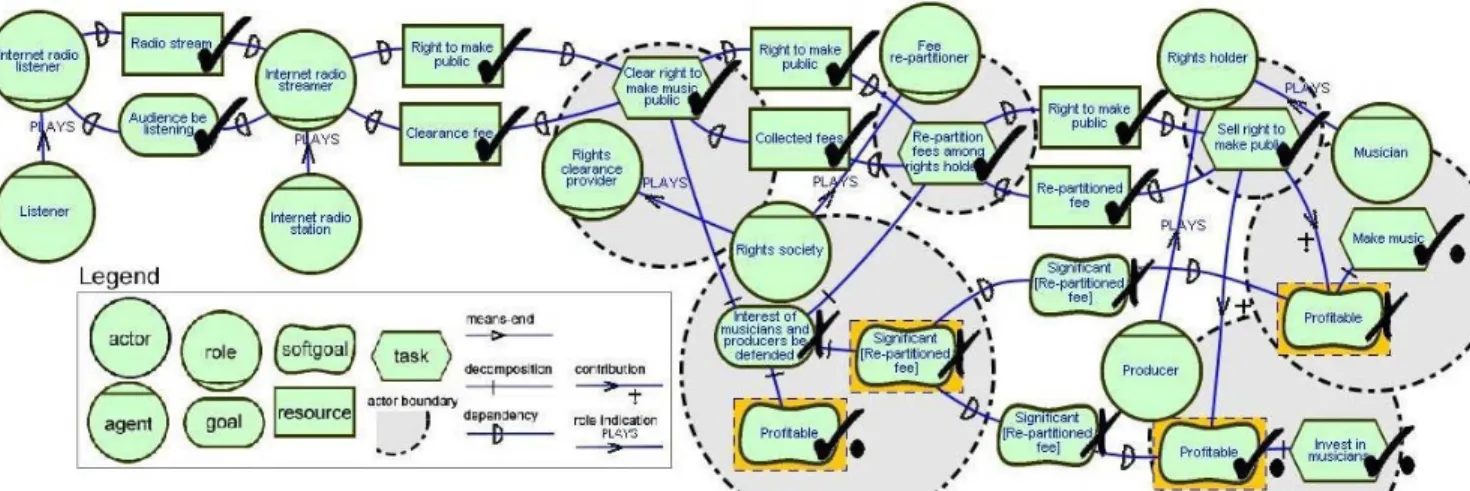
Thei*model in Figure 1 shows the actors as they are cur-rently organized in the rights clearance business. The cen-tral concept ini*is that of strategic actors, and how they de-pend on each other to achieve what they want. The generic concept ofactormay be further specified as an agent or a role. Anagentis a concrete actor with specific capabilities. Aroleis an abstract characterization of an actor’s respon-sibilities and behavior within a context. For example, in Figure 1, the actorListenerplays the role ofInternet radio listener. In this role it depends onInternet radio streamer, played byInternet radio station, for aRadio stream, which is represented as a resource dependency. A resource is a physical or information entity with its availability as its main concern. Dependencylinks indicate which agent or role depends on which other agent or role for what. By listening to that stream, Internet radio listener creates an audience. Therefore, Internet radio streamer depends on Internet radio listenerfor the goalAudience be listeningto be reached. Agoalis a condition or state of affairs that an actor would like to achieve.
Internet radio station is not allowed to make a musi-cal recording public without the approval (Right to make public) of the rights holders of that recording. Therefore, Internet radio station buys, in exchange for a Clearance fee, the Right to make public from Rights society, which plays the role Rights clearance provider in which it per-forms the taskClear right to make music public– a task is a specific procedure performed by an agent or a role – to clear the rights with the correspondingRights holderagents it represents. Then, Rights society, in its role as Fee re-partitioner, receives these Collected feesand distributes a Re-partitioned fee to everyRights holder by carrying out the taskRe-partition fees among rights holders. Rights so-cietyhas a strategic goalInterests of musicians and produc-ers be defended, which is decomposed into two tasks in-ternal to the two roles it plays, and two strategic soft goals internal to the agent itself. Decompositionlinks define the sub-components of tasks and goals.
ARights holder, played by bothProducerandMusician agents, holds rights to a musical recording and performs the taskSell right to make public. They receive aRe-partitioned fee fromFee re-partitionerbased on the individual shares they own in exchange for the Right to make publictheir music. MusicianandProducerboth depend onRights so-cietyfor receiving aSignificant [Re-partitioned fee], which is a soft goal. Asoft goalis a non-functional (quality) at-tribute that, unlike a (hard) goal, has no clear-cut criteria for successful achievement. The soft goalSignificant [Re-partitioned fee]has no hard criteria for determining when it is reached; it is subjective for eachMusicianorProducer agent as to when aRe-partitioned feeis perceived to be sig-nificant.
Figure 1.i*model of the current digital music value chain
By performing the taskSell right to make publicin their role asRights holder, bothMusicianandProduceragents positively contribute to their being Profitable, which is a strategic soft goal decomposed from their high-level strate-gic tasks (Make musicandInvest in musiciansrespectively). Acontributionlink describes the positive or negative impact of one element on another.
Some questions about the model arise in respect to its economic viability, which we cannot answer without the use of a quantitative evaluation approach. IsRights societyable to create significant fees for the rights holders, while keep-ing enough profit for itself?
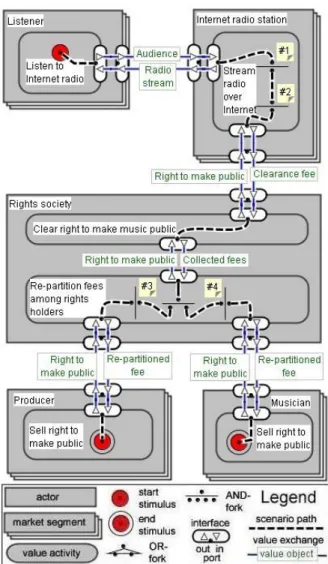
Figure 2 depicts ae3valuemodel of the current rights clearance situation to allow a quantitative evaluation for an-alyzing its economic viability. In ane3valuemodel, an ac-toris an independent economic, often legal, entity that per-forms one or more value activities. A special actor, called amarket segment, represents a group of actors who value objects equally. Figure 2 shows that aListenerlistens to the Radio stream of an Internet radio station– actors within theListenermarket segment equally value the objectRadio stream– thus creating anAudience. Avalue objectis a ser-vice, a product, or even an experience that is of economic value to at least one of the actors within a value model. Au-dienceis of value to the radio station because it can play ad-vertisements in exchange for a fee. Note that an advertise-ment company buying air time for its advertiseadvertise-ments from Internet radio stationis omitted because of irrelevance to the value evaluation of the rights clearance process.
Internet radio stationperforms the value activityStream radio over the Internet. Avalue activityrepresents a task carried out by an actor that adds value and produces one or more value objects. Radio streamis of value toListener. For every track per Listener played by theInternet radio stationit has to pay aClearance feeto theRights society
representing the rights holders of that track. Rights society performs two value activities: (1)Clear right to make music public, and (2)Re-partition fees among rights holders.
In order to perform the first value activity it requires a Clearance feefromInternet radio stationat its value in port, in exchange for theRight to make publicat its out port. An actor uses avalue portto provide to (out port), or request value objects from (in port) other actors. A potential value object trade, which is represented by a value exchange, is the exchange of a Clearance fee from Internet radio sta-tion toRights society. However,Internet radio station is only willing to provide a Clearance feefor something of value (i.e.,Right to make public) in return (economical reci-procity). Avalue interfaceindicates such a willingness by grouping value ports that provide value objects an actor is willing offer with value ports that request other objects that actor wants to receive in return. At value interface level, the exchange of value objects is atomic; either all exchanges occur as specified or none at all. A value interface does not indicate the temporal ordering of objects to be exchanges on its ports, and it may also contain several in ports and out ports.
The second value activity carried out by Rights so-ciety involves re-distributing the Collected fees as a Re-partitioned fee to the Producer and Musician agents in-volved. In exchange for this fee,Rights societyreceives the Right to make public, which it needs to carry out the task Clear right to make music public.
Thevalue scenarioin Figure 2, which shows how value exchanges depend on each other, consists of ascenario path coming from astart stimulus(aListenerperforming the ac-tivityListen to Internet radio) to anend stimulus(Musician andProducerperformingSell right to make public). A sce-nario results in several paths when using anOR-fork, or can split in multiple sub-paths when using anAND-fork.
Figure 2.e3valuemodel of the current digital music value chain
The model in Figure 2 is derived from thei*model in Figure 1 usingBASSIEguidelines in the following steps:
1. An i*agent is converted into ane3valueactor (if it involves a single agent) or a market segment (if it in-volves multiple agents that assign the same value to objects) with the same name
2. The dependencies betweeni*roles played byi*actors are translated to value interfaces at the boundary of the matching actors in thee3valuemodel
3. Value interfaces at actor boundary are related via value exchanges between the matchinge3valueactors and market segments in the opposite direction as depen-dencies between the correspondingi*roles
4. Tasks internal toi*roles are mapped to value activities internal to the matching actors and market segments in thee3valuemodel
5. The dependencies of tasks internal toi*roles are con-verted into value interfaces and added to the matching value activities
6. Value activities are related to other value interfaces via value exchanges in the opposite direction as the depen-dencies of tasks internal toi*roles
Dependencies betweeni*agents cannot be converted to e3valueconstructs, since these represent the strategic ra-tionale behind the network of business actors. For detailed guidelines that describe how to deal with exceptions we re-fer to [14].
4.1.2 Model Evaluation
The objective of evaluating thee3valuemodel is to deter-mine whether all actors involved gain value from the current rights clearance model. Then, the evaluation results of the e3valuemodel are imported into thei*model in order to verify the model’s viability – whether the strategic goals of all agents in thei*aresatisficed, and how possibledenied goals negatively affect other (sub)goals and dependencies in the model.
In order to carry out the quantitative evaluation of the e3valuemodel, the number of instances of the actors in the e3valuemarket segments has to be specified, as well as the number of scenario occurrences, and valuation functions for the value ports requesting or offering money objects. This is done based on known figures (taken from the Society of Composers, Authors and Music Publishers of Canada (SO-CAN) [15]), and assumptions made for yet unknown factors (see Table 1). We assume SOCAN is the only rights soci-ety that represents Canadian artists. We focus on Canadian radio stations and music listeners only. With the valuation functions, and the figures and assumptions from Table 1, we can calculate the profitability sheet for each of the actors. Figure 3 depicts the profitability sheet of Rights society, generated with the e3editor tool, showing that it receives a profitable CAN$ 3,000 per month. The rights holders, however, fail to receive a significant average fee (Musician CAN$ 0.16 andProducerCAN$ 24 respectively).
The properties in Table 1 that are followed by a ‘#’ and a number between brackets are represented in Figure 2 by an AND-fork. Internet radio stationhas two such AND-forks annotated #1 and #2. The first one makes a conversion from a stream to a track, since the radio stations will be charged per track; it models that each one hour stream results in 12 tracks played. Because we are exploring the situation of the national rights society in Canada, which only represents
Property Value
No. of potential listeners (high-speed Internet connections)
3,300,000 (2002) No. of estimated listeners 330,000 (10%) No. of occurrences per month 20 (1
occur-rence = 1 hour music stream) No. of Internet radio stations 150
No. of rights societies 1 (SOCAN) No. of tracks per 1 hour music stream
(#1)
12 (music only channel) Percentage of Canadian songs played
(#2)
25% Clearance fee per track per listener per stream
CAN$ 0.00136 Fee for collecting & re-partitioning 1
clearance fee
11% of clear-ance fee
No. of musicians 74,500
No. of producers 500
No. of producers per track (#3) 1 No. of musicians per track (#4) 8 Fraction of fees to musicians 50% Fraction of fees to producers 50%
Table 1. Assumptions for current model in-volving SOCAN
the rights of Canadian musicians and producers, it is neces-sary to define which part of all played music has Canadian rights holders. Therefore, AND-fork labeled #2 represents that 25% of all music played in Canada is that of Canadian artists. Furthermore, because we assume on average 1 Pro-ducerand 8Musicianactors are involved in each recording, the collected fees should be re-partitioned accordingly. The cardinalities of the actors in these market segments are mod-eled by AND-forks labmod-eled #3 and #4, respectively, which both reside within theRights societymarket segment. The incoming fee for 1 track results in outgoing fees for 8 Mu-sicianactors and for 1Producer.
Thee3valueevaluation results are imported asi* check-mark labelsSatisficed( ),Weakly satisficed( ), and De-nied( ) into thei*model as evaluation starting points in Figure 1 (indicated by a striped square filled with yellow), and propagated through the model using a qualitative label-ing algorithm [3]. The resultlabel-ing labels show that the inabil-ity ofProducer,MusicianandRights societyto get any sig-nificant profits influences their ability to reach their strate-gic tasks and goals. This indicates that the current existing music rights clearance model is not viable for several actors involved when it comes to clearing fees for Internet radio stations. Our conclusion is that we should come up with an
alternative rights clearance model that is more economically viable.
Figure 3. Profitability sheet of the Rights so-ciety actor
4.2. Seeking Business Model Alternatives
The main problem with the current model is that no sig-nificant profitability can be established when it comes to clearing rights for Internet radio stations. To solve this, the number of listeners should significantly increase. One way to do this is to collect fees in an international, rather than a national, context. This, however, introduces the need for a national rights society to collaborate with rights societies from other countries. Additionally, international regulations are planning to liberalize the music rights clearance market so that any rights holder can use the services of any rights society from any country. This also requires an international and competitive approach for the rights societies. The focus of our next alternative should therefore be to create a model that (1) increases the number of Internet radio listeners for which clearance fees should be paid, and (2) copes with in-ternational issues. We will try to achieve this by adding a new actor, namely aClearing coordinator.
Internationalizing the rights clearance market creates new problems for radio stations – how to find the rights so-ciety that clears rights for a specific artist, group, or track. It does not necessarily have to be the rights society from the country of origin of an artist to be the one that clears the rights for that artist; it could be any rights society re-siding in any country in the world. To make it possible for radio stations to find the rights society that does clear the rights for a specific artist, rights societies should cooperate through a negotiation process. To make such negotiation process possible we need a common infrastructure so that rights societies can communicate and cooperate in a stan-dardized way. This common infrastructure will be provided
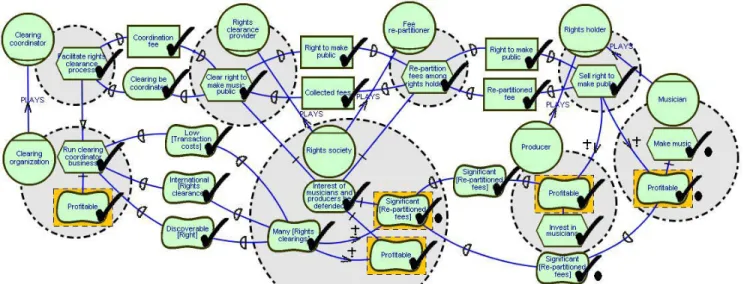
Figure 4.i*model of the clearing coordinator alternative
by the newly introducedClearing coordinatoractor, which is facilitated by web services technology at the information system level.
4.2.1 Model Construction
Figure 4 depicts thei*model of the clearing coordinator al-ternative. The roleClearing coordinator, which is played byClearing organization, acts as a facilitator for the rights clearance process. Clearing coordinatorstrives to satisfice the goal Clearing be coordinatedby performing the task Facilitate rights clearance processin exchange for a Coor-dination feereceived fromRights clearance provider. This task is an ends forClearing organizationto achieve its high-level strategic taskRun clearing coordinator business.
Also, some new dependencies from Rights society to Clearing organizationare introduced. The soft goal Dis-coverable [Right] shows that Rights society depends on Clearing organization for enabling anInternet radio sta-tionto find the rightRights society. International [Rights clearance]illustrates thatRights societydepends on Clear-ing organizationto operate on an international scale. Fi-nally,Clearing organizationis also depended upon to pro-vide Low [Transaction costs]. These three dependencies all determine howMany [Rights clearings]are processed. A high number of rights clearings positively influences the ProfitabilityofRights societyand its ability to generate Sig-nificant [Re-partitioned fees].
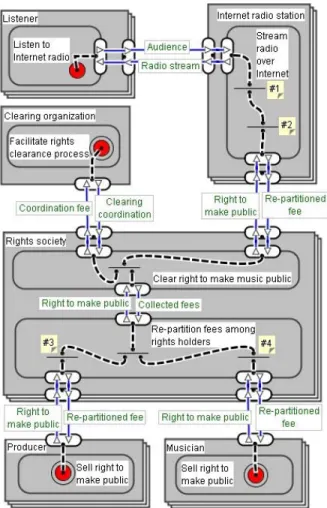
Thee3valuemodel derived from thei*model in Figure 4 is shown in Figure 5. It also shows the newly introduced Clearing organizationactor performing the value activity Facilitate rights clearance process. Furthermore,Rights so-cietyis now a market segment, because the model now
rep-resents a liberal, international music rights clearance, which involves several competing rights societies.
4.2.2 Model Evaluation
The key change in the value model is that the number of lis-teners is extensively grown because of the international fo-cus – 153,300,000 high-speed Internet connections world-wide, of which 10% make up the estimated number of lis-teners [13]. Furthermore, the fee for facilitating one rights clearing is 5%, and the fee for collecting & re-partitioning one clearance fee is 6% per occurrence, because we assume thatRights societywill pay for the clearing coordination and not theInternet radio stationorRights holder. We assume world-wide 15,000 Internet radio stations to be active, and 10% of all music played world-wide to be Canadian music. With these changed figures we evaluate the e3value model, from which we can conclude that with a monthly in-come of about CAN$ 25,000, this alternative is quite prof-itable for the Clearing organization. However, this alter-native is even more profitable for Rights society, with a monthly revenue of about CAN$ 30,000. The alternative also results in quite a significant monthly fee forProducer of about CAN$ 445 – a spectacular increase of more than 1800%. On the other hand, a fee of CAN$ 3 still does not represent a noteworthy average fee forMusician, in spite of the same increase in revenue asProducer.
Importing thee3valueevaluation results in thei*model in Figure 4, and propagating these checkmark labels shows that almost every goal, task, and soft goal is marked Satis-ficed, except forMusician; itsProfitablesoft goal and the Make musictask are bothWeakly satisficed. The soft goal Significant [Re-partioned fee]internal to Rights societyis
Figure 5. e3valuemodel of the clearing coor-dinator alternative
also assigned the checkmark labelWeakly satisficed. It seems that we need to explore additional alternatives to construct a model that offers theMusicianagent a sig-nificant average fee for allowing its music to be made pub-lic through Internet radio, but it may be hard to do so (see [14]). Nevertheless, in the clearing coordinator alternative, certain (main-stream) musicians will receive a significant fee because their music is played much more often than the average, thus not fully denying theProfitablesoft goal to be achieved. Also, this alternative allows rights societies to compete fairly on a free rights clearing market.
4.3. Discussion
In developingBASSIE, we studied business cases from three domains: digital music distribution, transaction infor-mation aggregation, and direct mail. Two of them are from real-life organizations. The example we use to illustrate our approach in this paper is based on an extensive study by the
second author on the exploration of new opportunities for the Dutch rights society SENA, triggered by the increas-ing number of Internet radio stations streamincreas-ing music via the Internet [9]; the value models originate from that report. The figures used to perform thee3valueevaluation of those models are taken from the Canadian rights society SOCAN [15], as the SENA figures are proprietary. While construct-ing and validatconstruct-ing our approach, we learned some important lessons, which we used to improve our the method.
Lesson 1: The first alternative for a value model is hardly ever viable. Devising a value model that is prof-itable for each actor involved requires in-depth knowledge of the domain, and about the reasons why certain models are not viable in that domain.
Remedies.A way to gain this knowledge is to iteratively explore alternatives. Alternatives that do not seem viable after evaluation provide knowledge about what needs to be changed in order to construct a viable model (checkmark la-bels in the evaluatedi*not labeledSatisficedindicate this). This knowledge is used to devise a model that is more likely to be viable in the next iteration of the approach.
Lesson 2: An alternative that is profitable may still be infeasible. In [14] we show an alternative for the music rights clearance model in which a central clearing organiza-tion acts as a proxy between Internet radio staorganiza-tion an rights society. This alternative’se3valueevaluation results in the same conclusions drawn for the clearing coordinator alter-native’s profitability. However, based on the i*evaluation this alternative seems infeasible because it introduces a de-pendency that makes the rights society critically rely on the central clearing organization to run its business, an unac-ceptable vulnerability.
Remedies. We usei*to assess and draw final conclusions about the overall viability of an alternative, since it allows a general, qualitative evaluation of alternatives. e3valueis used to focus on the economic issues specifically.
Lesson 3: It is not always possible to construct a value model in which all actors involved make an av-erage profit. The exploration of different alternatives for clearing rights to make music public through Internet radio, indicates that different value models are possible. None of the alternatives seem profitable for all the actors involved, however. Rights societies do want to cope with clearing rights for Internet radio stations, so they do need a value model for realizing this.
Remedies. The only remedy is to implement this model when no better alternative is at hand. The clearing coordi-nator alternative realizes significant revenues for the rights society, which is the most important actor. Musicians do not receive a significant average fee, but certain (main-stream) musicians will receive a significant fee.
5. Related Work
Although the main focus in web services literature is on technical issues, some research is done on web service re-quirements engineering from a business perspective. Most of this research starts at business processlevel stating the business activities web services support, instead of from a business strategy perspective indicating the strategic busi-ness goals to be reached using web services.
For example, theDysCOframework allows exploration of concepts like business-to-business cooperation, e-service aggregation, and dynamic re-configuration of business roles [12]. Its aim is to reconcile the need for flexibility in busi-ness relationships with the need for stability and reusabil-ity of business processes. DysCOis not goal-oriented and therefore does not allow reasoning about the business strate-gic goals from which business processes are derived.
Work by Terai et al. provides a framework for coordi-nating web-based services based on business models [17]. They provide a means for constructing and linking business activities to web services activities. This framework also starts from a business process perspective and therefore also omits reasoning about business strategic goals.
The Rapid Service Development (RDS) method defines an integrated approach for the development of e-business services, with a particular focus on business-to-business transactions [4]. This framework allows modeling both business and technical concepts of electronic business ser-vices, but it does not provide a clear bridge between the business and technical design spaces. RDS also underex-poses the early-phase requirements that capture the original business idea, and it does not contain evaluation techniques for determining the economic viability of service ideas.
Papazoglou et al. describe a design method for web ser-vices and business processes [11]. It provides (1) a frame-work for identifying web services and their relationships, and (2) guidelines for web services design from both func-tional and non-funcfunc-tional perspectives. The method allows describing business process objectives, plus it also states the importance of generating revenues with web services oper-ating between organizations; it includes roper-ating and billing models. However, the method does not contain a profitabil-ity evaluation. It aims at developing web services from a business process and service perspective rather than from a business stakeholder and strategic perspective.
Van de Kar et al. provide a design approach that inves-tigates relationships between business models and services [10]. It describes a revenue model, which indicates actors involved and the service fees they pay and receive. They, however, do not provide techniques for profitability evalu-ation. Also they ignore the operational and technical costs of the activities performed to create revenues, as well as the strategic goals to be reached with the provided services.
Ardagna et al. describe a method that allows designers to evaluate and select the minimum-cost implementation alter-native of a web-based system [1]. It provides a means for es-timating cost implications of architectural choices through a sequence of steps for going from requirements analysis to physical implementation. This method, however, only fo-cuses on the expenses made with technically implementing and operational running web-based systems; it omits costs made from a business process viewpoint. Also, it does not address the issue of revenue creation from a business value perspective.
Other research that combines goal-oriented and value-based approaches by Zlatev et al. [21] and Gordijn et al. [8] does not allow modeling and evaluating how the business actors involved in a networked constellation depend on each other for reaching their strategic goals. For instance, an end-consumer could depend on an Internet radio station to reach the goal of listening to music. Also, this research omits the visualization and analysis of multiple alternatives for reach-ing the same strategic goals. Both aspects are vital since web services systems typically involve several business ac-tors that depend on each other, and for which more than one viable implementation alternative exist. Our methodology does allow to address these issues.
6. Concluding Remarks
Companies are increasingly trying to reach business strategic goals (e.g., economic profitability) in networked constellations of enterprises, using enabling web services technology as an infrastructure for automated business in-teraction. Based on a well thought-out business idea, these companies should be able to create, analyze and select an profitable implementation alternative for the supporting web services system of such a networked constellation. For this they need a requirements engineering approach that starts at articulating and analyzing the strategic business goals, before other issues, such as supporting business pro-cesses and information systems, are addressed.
By combining two frameworks that both focus on differ-ent aspects –i*aims at strategic goals and intentions, and e3valuefocuses on added economic value – our approach enforces a wide outlook on the alternatives explored; these used frameworks seem to connect and complement each other very well. Exploring an alternative from two addi-tional viewpoints, analyzing operaaddi-tional and technical is-sues in a detailed manner is useful in analyzing the overall viability of an alternative. Our approach provides a means to do just that (see [14]). Finally, the iterative flow of steps makes BASSIEa very efficient and light-weight approach for exploring ideas for networked business constellations in which knowledge from previous infeasible alternatives is used to construct new alternatives.
Besides improving and validating BASSIE, future re-search could be to extend our methodology to go from busi-ness requirements to an architectural design of the support-ing web services system. Our approach describes steps for describing the global components within the web ser-vices system [14] using the Use Case Maps (UCM) nota-tion [2], but on a conceptual level, not detailed enough to use as a design for implementation. Also, looking into how other frameworks may be used to evaluate implementation alternatives from a specific perspective, such as we used e3valueto assess their economic viability from a business value perspective, might be a topic for further research. Fi-nally, integrating the existing toolsOME3[20] ande3editor [7], which support modeling and evaluatingi*ande3value models respectively, might allow automated model check-ing for consistency between the different types of i*and e3valuemodels.
References
[1] Ardagna, D. and Francalanci, C. (2002), A cost-oriented methodology for the design of web based IT architectures,Proceedings of the 2002 ACM sym-posium on Applied computing, Madrid, Spain, ACM Press, pp. 1127–1133.
[2] Buhr, R.J.A. (1999), Making Behaviour a Concrete Architectural Concept, Proceedings of the 32nd An-nual Hawaii International Conference on System Sci-ences (HICSS’99), Hawaii, USA.
[3] Chung, L., Nixon, B.A, Yu, E. and Mylopoulos, J. (2000),Non-Functional Requirements in Software En-gineering, Kluwer Academic Publishers.
[4] ter Doest, H., Jonkers, H., van der Spek, J., van Leeuwen, D., Reitsma, J. and Owusu, J. (2002), Sys-tematic Design of an E-marketplace for Interior Prod-ucts, Proceedings of the 2nd IFIP Conference on E-Commerce, E-Business, E-Government (I3E 2002), pp 97–111, October 7-9, Lisbon, Portugal, Kluwer. [5] Gordijn, J. and Akkermans, J.M. (2003) Value-based
requirements engineering: exploring innovative e-commerce ideas,Requirements Engineering, Volume 8, Issue 2, Jul, Springer-Verlag, pp 114–134.
[6] Gordijn, J. and Janssen, M. (2003), Introduction to the First International E-Services Workshop, ICEC 03, Proceedings of the Fifth International Conference on Electronic Commerce (ICEC’03), Pittsburgh, USA, pp 3–4.
[7] Gordijn, J. (2004), The e3value draw-ing tool, version 3.03, available at URL: http://www.few.vu.nl/
∼gordijn/tools.htm (last accessed Feb 2005).
[8] Gordijn, J., Kartseva, V., Schildwacht, J., Wieringa, R.J. and Akkermans, J.M. (2004), Developing a Domain-Specific Cross-Organizational RE Method. Proceedings of The 12th International Conference on Requirements Engineering (RE’04).
[9] Gordijn, J., Sweet, P., Omelayenko, B., Hazelaar, B. (2004), Digital Music Value Chain Application, OBELIX project deliverable IST-2001-33144, Ams-terdam 2004, EC restricted distribution.
[10] van de Kar, E, Maitland, C. F., de Montalvo, U. W., and Bouwman, H. (2003), Design guidelines for mo-bile information and entertainment services: based on the Radio538 ringtunes i-mode service case study, Proceedings of the 5th international conference on Electronic commerce, Pittsburgh, Pennsylvania, ACM Press, pp 413–421.
[11] Papazoglou, M. P. and Yang, J. (2002), Design Methodology for Web Services and Business Pro-cesses,Proceedings of the Third International Work-shop on Technologies for E-Services, Springer-Verlag, pp 54–64.
[12] Piccinelli, G. and Mokrushin, L. (2001), Dynamic E-Service Composition in DySCo, Proc. 21st Interna-tional Conference on Distributed Computing Systems (ICDCS-21), Phoenix, Arizona, USA.
[13] Rose, B. and Lenski, J. (2003) Internet and Multi-media 10: The Emerging Digital Consumer, Arbi-tron/Edison Media Research.
[14] van der Raadt, B. (2005), Business-Oriented Explo-ration of Web Services Ideas – Combining Goal-Oriented and Value-Based Approaches, Master’s The-sis, Dept. of Computer Science, Vrije Universiteit, Amsterdam, The Netherlands.
[15] SOCAN (2003), SOCAN Facts Brochure: An Intro-duction to Canada’s Leading Performing Rights Or-ganization, November, 2003.
[16] Tapscott, D., Ticoll D. and Lowy, A. (2000), Digi-tal CapiDigi-tal – Harnessing the Power of Business Webs, Nicholas Brealy Publishing, London, UK.
[17] Terai, K., Izumi, N. and Yamaguchi, T. (2003), Co-ordinating Web Services based on business models, Proceedings of the 5th international conference on Electronic commerce, Pittsburgh, Pennsylvania, ACM Press, pp 473–478.
[18] Yu, E. (1995), Modelling Strategic Relationships for Process Reengineering, Ph.D. dissertation, University of Toronto.
[19] Yu, E., Liu, L. and Li, Y. (2001) Modelling Strate-gic Actor Relationships to Support Intellectual Prop-erty Management, Proceedings of the 20th Inter-national Conference on Conceptual Modeling (ER-2001), Yokohama, Japan, November 27-30, LNCS 2224 Spring Verlag. pp. 164–178.
[20] Yu, E., Liu, L. and Yu, Y. (2000), Or-ganization Modelling Environment (OME), version 3, May-June, available at URL:
http://www.cs.toronto.edu/km/ome/
(last accessed Feb 2005).
[21] Zlatev, Z., van Eck, P., Wieringa, R. and Gordijn, J. (2004),Goal-Oriented RE for e-services, Interna-tional Workshop on Service-oriented Requirements Engineering workshop at RE’04.