Doctoral Dissertations University of Connecticut Graduate School
8-27-2018
Bayesian Variable Selection with Applications to
Neuroimaging Data
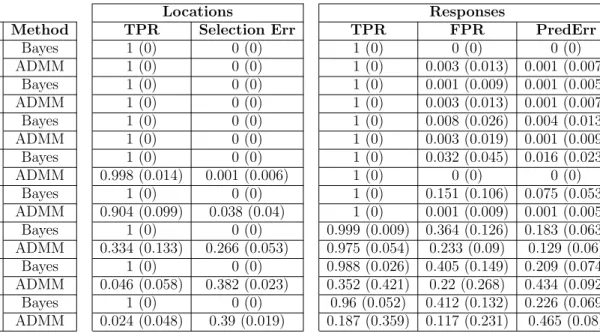
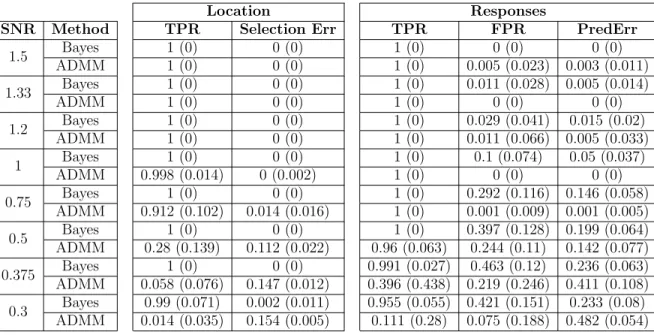
Shariq Mohammed
University of Connecticut - Storrs, [email protected]
Follow this and additional works at:https://opencommons.uconn.edu/dissertations
Recommended Citation
Mohammed, Shariq, "Bayesian Variable Selection with Applications to Neuroimaging Data" (2018).Doctoral Dissertations. 1893.
Applications to Neuroimaging Data
Shariq Mohammed, Ph.D. University of Connecticut, 2018
ABSTRACT
In this dissertation, we discuss Bayesian modeling approaches for identifying brain
re-gions that respond to certain stimulus and use them to classify subjects. We specifically
deal with multi-subject electroencephalography (EEG) data where the responses are
binary, and the covariates are matrices, with measurements taken for each subject at
different locations across multiple time points. EEG data has a complex structure with
both spatial and temporal attributes to it. We use a divide and conquer strategy to build
multiple local models, that is, one model at each time point separately both, to avoid
the curse of dimensionality and to achieve computational feasibility. Within each local
model, we use Bayesian variable selection approaches to identify the locations which
respond to a stimulus. We use continuous spike and slab prior, which has inherent
vari-able selection properties. We initially demonstrate the local Bayesian modeling approach
which is computationally inexpensive, where the estimation for each local modeling could
be conducted in parallel. We use MCMC sampling procedures for parameter estimation.
complexity parameter built within the model. A prediction strategy is built utilizing
the temporal structure between local models. The spatial correlation is incorporated
within the local Bayesian modeling to improve the inference. The temporal
character-istic of the data is incorporated through the prior structure by learning from the local
models estimated at previous time points. Variable selection is done via clustering of
the locations based on their activation time. We then use a weighted prediction strategy
to pool information from the local spatial models to make a final prediction. Since the
EEG data has both spatial and temporal correlations acting simultaneously, we enrich
our local Bayesian modeling by incorporating both correlations through a Kronecker
product of the spatial and temporal correlation structures. We develop a highly scalable
estimation approach to deal with the ultra-huge number of parameters in the model.
We demonstrate the efficiency of estimation using the scalable algorithm by performing
simulation studies. We also study the performance of these models through a case study
Applications to Neuroimaging Data
Shariq Mohammed
B.Math.(Hons.), Indian Statistical Institute, 2012 M.Sc., Chennai Mathematical Institute, 2014
M.S., University of Connecticut, 2017
A Dissertation
Submitted in Partial Fulfillment of the Requirements for the Degree of
Doctor of Philosophy at the
University of Connecticut
Copyright by
Shariq Mohammed
APPROVAL PAGE
Doctor of Philosophy Dissertation
Bayesian Variable Selection with Applications to
Neuroimaging Data
Presented by
Shariq Mohammed, B.Math.(Hons.), M.Sc., M.S.
Major Co-Advisor Dr. Dipak K. Dey Major Co-Advisor Dr. Yuping Zhang Associate Advisor Dr. Ming-Hui Chen Associate Advisor Dr. Haim Bar University of Connecticut 2018
Acknowledgments
I would like to extend my deepest gratitude to my advisor Professor Dipak K. Dey
for his constant support and guidance. I am continually impressed by his dedication,
enthusiasm and positivity. Apart from being an amazing advisor, he has also been
extremely supportive of both my academic and non-academic endeavors. I am also
grateful to his wonderful wife, Rita Dey, who has been extremely gracious and helpful.
Both will always remain close to my heart and will be missed.
I would like to thank my co-advisor, Professor Yuping Zhang for supporting and
guiding me, and being very patient throughout my PhD. I would also like to extend my
thanks to my associate advisors, Professor Ming-Hui Chen and Professor Haim Bar for
their insightful suggestions in improving my work. I am grateful to Professor Kun Chen
for motivating and guiding me whenever I sought his help, without any reservations.
I am grateful to the Department of Statistics for all the teaching opportunities and
financial support through fellowships. I thank all the faculty in the department,
espe-cially the ones I have taken courses from, for motivating and kindling my interest in
Statistics. I am fortunate to have interacted with my fellow graduate students, and
heartily thank them for being there throughout this long journey. I also extend my
thanks to Megan, Tracy and Anthony for their cheerful smiles and phenomenal support
I would also like to acknowledge University of Connecticut and Travelers Insurance,
for supporting the research through grants, both for this dissertation and otherwise.
A special thanks to my teacher, academic brother and friend, Sourish Das, for
be-lieving in my abilities and showing the right direction.
A big thanks to all the friends I have made here, miles away from home. I am
fortunate to have met these awesome people at UConn and will cherish all the moments.
Special thanks to my other friends, in the US and from back home, who have been
there for me through all the times, and dealt with much of my unnecessary ranting, but
still stand by me and let me be myself. I would specifically like to thank Irfan, Ankit,
Debrishi and Aritra for their constant support in both personal and academic fronts.
Lastly, wherever I stand in my career, it is because of the two incredible people
-Shabeer Ahmed (Papaji, my father) and Kausar Banu (Maa, my mother). There are
no words I can use to thank them enough, for all the sacrifices they have made and all
that they have been through, to make me and Shaheer (my brother) the people we are.
I could not have asked for a better person than Shaheer, as a brother. To Maa, Papaji
and Shaheer - I love you and am extremely lucky to have you in my life. I would also
Contents
Acknowledgments iv 1 Introduction 1 1.1 Variable Selection . . . 3 1.2 Electroencephalography (EEG) . . . 6 1.3 Dissertation Outline . . . 102 Local Modeling of EEG Data Using Continuous Spike and Slab Prior 13 2.1 Introduction . . . 13
2.2 Data and Notation . . . 16
2.3 Local Aggregate Modeling Extension . . . 18
2.4 Spike and Slab Prior with Latent Variable . . . 21
2.4.1 Normal Link . . . 22
2.4.2 Scale Mixture of Normal Link . . . 24
2.5 Two-Stage Variable Selection . . . 26
2.5.1 First-Stage Variable Selection . . . 27
2.5.2 Second-Stage Variable Selection . . . 29
2.6 Prediction . . . 31
2.8 Case Study: EEG Data . . . 37
2.9 Discussion . . . 41
3 Spatial Structured Spike and Slab Prior for Modeling EEG Data 43 3.1 Introduction . . . 43
3.2 Data Structure and Preliminaries . . . 46
3.3 Spatial Structured Spike and Slab Prior . . . 48
3.4 Variable Selection . . . 54
3.5 Prediction . . . 58
3.6 Simulation Study . . . 60
3.7 Case Study: EEG Data . . . 65
3.8 Conclusion . . . 72
4 Spatio-Temporal Bayesian Analysis of High-Dimensional EEG Data 74 4.1 Introduction . . . 74
4.2 Preliminaries . . . 78
4.3 Spatio-Temporal Local Modeling . . . 80
4.3.1 Model Setup . . . 81
4.3.2 Posterior Distributions . . . 82
4.4 Estimation . . . 84
4.4.1 Scalable Approximate Estimation . . . 86
4.6 Prediction . . . 92
4.7 Simulation Study . . . 93
4.8 Case Study: EEG Data . . . 97
4.9 Discussion . . . 100
5 Conclusions and Future Works 102 A Bayesian Interpretation and Posterior Density of a Local Model 107 A.1 Aggregation Penalty . . . 107
A.2 Posterior Density . . . 108
B Characterization of Posterior Distribution for Spatial Parameters 110 B.1 Moment Generating Function . . . 110
B.2 Mean and Variance . . . 112
C Estimation through EM Algorithm 115 C.1 Evaluation of E-Step . . . 116
C.2 Evaluation of M-Step . . . 117
D Spatio-Temporal Estimation Strategies 124 D.1 Posterior Distribution . . . 124
D.2 Matrix Inversion Strategy . . . 127
List of Tables
1 Simulation results showing the mean prediction error and the average
number of locations selected along with their respective standard
devia-tions - in the case of small mean complexity 0<w <¯ 0.2. . . 35
2 Simulation results showing the mean prediction error and the average
number of locations selected along with their respective standard
devia-tions - in the case of moderate mean complexity 0.3<w <¯ 0.5. . . 35
3 Prediction rates for EEG data. . . 39
4 Average true positive rate and selection error are shown, along with the
standard error across fifty replications. Error rates for response prediction
are also presented. Results shown for high, medium, and low SNR values
with number of locations as 25. . . 63
5 Average true positive rate and selection error are shown, along with the
standard error across fifty replications. Error rates for response prediction
are also presented. Results shown for high, medium, and low SNR values
6 Average true positive rate and selection error are shown, along with the
standard error across fifty replications. Error rates for response prediction
are also presented. Results shown for high, medium, and low SNR values
with number of locations as 100. . . 64
7 Error rates from multiple fivefold cross-validations on the EEG data using
local Bayesian modeling approach and the local aggregate modeling (Hu
and Allen [2015]). . . 69
8 Simulation results for the comparison of exact and scalable algorithms
under different settings of L and τ. The average time taken for both
algorithms under each setting is given along with the number of times the
scalable algorithm is faster than the exact one. Mean prediction error on
List of Figures
1 Example of an EEG cap with electrodes (Source: dreamstime.com). . . . 7
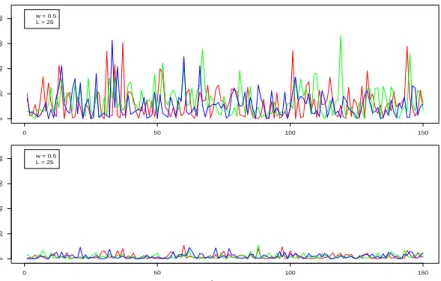
2 |βˆ|for the model withL= 25, τ = 150 andw= 0.5. The panel on the top
shows three parameters whose true values are non-zero and the bottom
panel shows three parameters whose true values are zero. . . 36
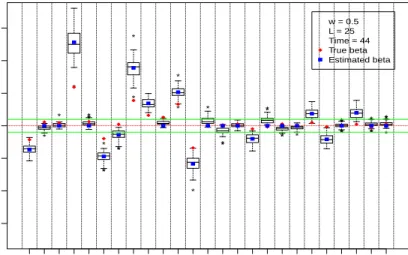
3 MCMC samples of the β2 (L= 25, τ = 150, and w= 0.5) . . . 37
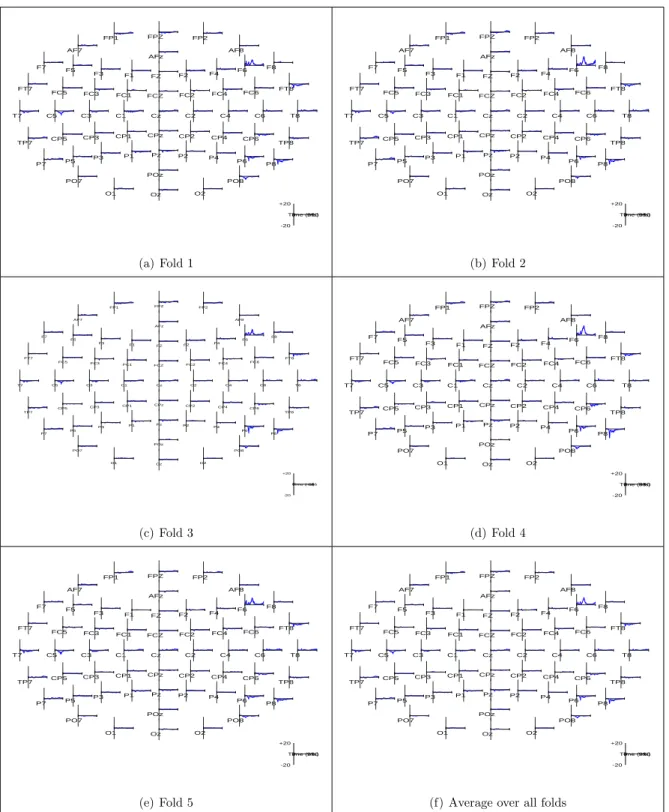
4 Variable selection from local Bayesian modeling using fivefold cross-validation.
The Figures 4(a)-4(e) show ˆβ for each of the five folds. Estimates shown
are obtained using Wcut thresholding method. Figure 4(f) shows the
parameter estimates ˆβ averaged over all five folds. . . 40
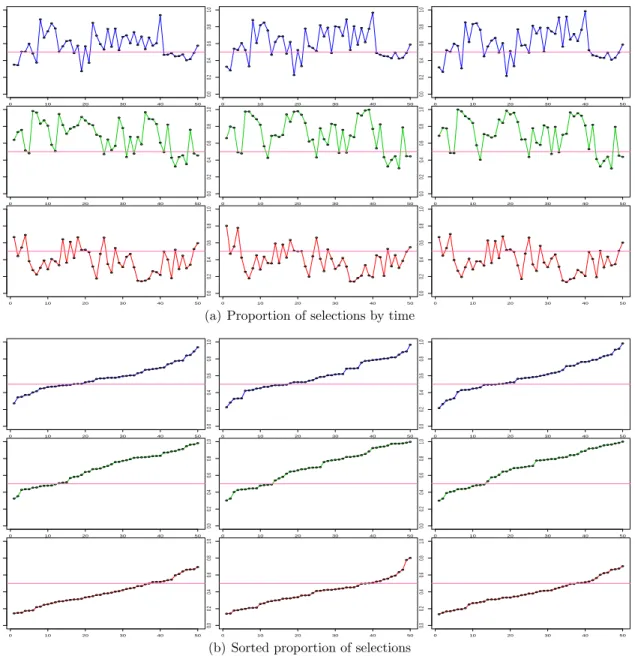
5 Proportion of selectionspl are shown in Figure 5(a) as a time series plot
for nine locations across 50 time points. Figure 5(b) shows the sorted
proportion of selections ˜pl for the same nine locations. . . 56
6 Boxplots of observed signal-to-noise ratio for each location and estimates
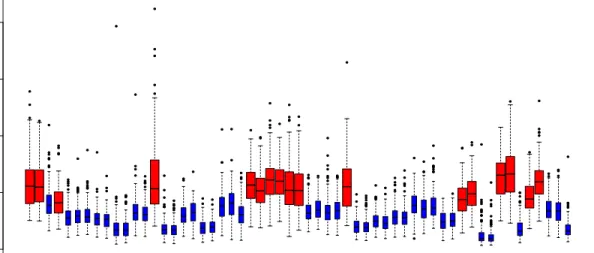
of coefficients corresponding to locations based on local Bayesian modeling. 68
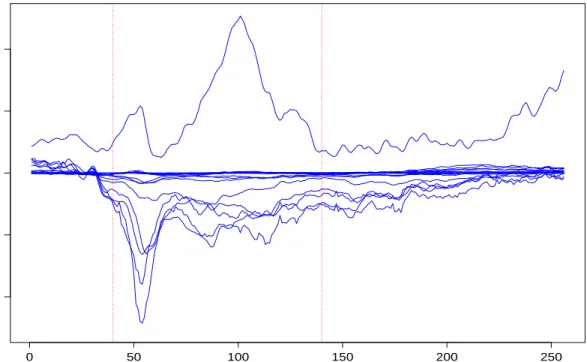
7 Mean estimated coefficients (not scaled) from local Bayesian modeling
using fivefold cross-validation, shown for the locations which are selected
8 Estimated local prediction probabilities from a specific fivefold
cross-validation on the EEG data. Each row corresponds to cross-validation data
from one distinct fold. The left (right) column corresponds to subjects
whose true response is y = 1(0). The solid (blue) lines represent ˆy = 1
and the dashed (red) represent ˆy = 0. . . 71
9 Topographic plot of the estimates ˆβ averaged out from each run across
Chapter 1
Introduction
Recent technological advances in the field of biomedical sciences have led to the
genera-tion of huge amounts of data. It is very common to encounter data with high dimensions,
where the covariates could be matrices or even tensors, instead of the usual vector of
covariates. In such cases, the data has multiple correlation structures acting
simulta-neously and can provide insight into the underlying structure when integrated into the
modeling approaches. With spectacular evolution of data acquisition and storage
facil-ities, along with big memory and computational capabilities of modern technologies, it
is also very often that we encounter the problem of having a huge number of predictors
compared to the observations. With such immense technological advances and
improv-ing capabilities of machines to extract and store huge amounts of data, it has become
necessary to exploit the structure within the data, to develop procedures for efficient
sta-tistical analysis. Handling such massive data to produce meaningful stasta-tistical inference
is a challenge, both in terms of the intricate mathematical modeling by incorporating
the structural information of the underlying biology, as well as the heavy computational
Among the many statistical applications in the field of biological research, analysis of
the functioning of complex structure of the brain has gained immense importance in the
recent times. There has been a recent trend of promoting interdisciplinary studies for
the science of mind and its realization in biological and artificial systems. Consequently,
the need of neuroscientific, behavioral, and theoretical research in the brain and
cog-nitive sciences has become extremely pertinent. Some of the interdisciplinary research
includes language plasticity, neurobiology of language, dynamical systems science
(mod-eling systems that undergo continuous change), language and logic, philosophy of mind,
evolution of communication, language acquisition, learning, reading, and communication
disorders, neurophysiology, behavioral neuroscience, and molecular genetic neuroscience,
among others.
With fast improving imaging techniques, it is very much feasible to extract data
at extremely granular levels leading to its richness. However, due to the cost involved
with such procedures, we often do not obtain neuroimaging data for a large number
of subjects. This leads to a problem of dealing with ultra-high number of covariates
compared to those of the observations. To address the issue of such high-dimensionality
we are prompted to use efficient modeling procedures incorporating variable selection. In
terms of modeling multi-subject neuroimaging data, variable selection can be interpreted
as spatial clustering of the regions in the brain from where significant electrical activity
emanates. Often, variable selection techniques are used within the modeling to discard
to understand the underlying process to a large extent. Also, using the covariates to
learn about the characteristics of the observations in the data, is of equal importance.
In this dissertation, we consider a multi-subject neuroimaging data as a motivating
example, where the data is observed for two categories of subjects originating from an
underlying experiment. We address the issue of high-dimensionality by incorporating
variable selection techniques into the modeling. We also use the spatial clustering
gen-erated to be able differentiate between the categories with reasonably high precision,
while still being able to understand the underlying process of the electrical activity. In
section 1.1, we discuss a few variable selection strategies studied in different scientific
applications. We then briefly describe, in section 1.2, the data collection procedure of
electroencephalography along with its structure. In section 1.3 we give an outline of how
the dissertation is organized.
1.1
Variable Selection
Variable and feature selection have taken a center-stage in the areas of application for
which datasets with massive number of covariates are available. Some of these areas
include gene expression analysis, text processing of internet documents, and
combina-torial chemistry, bioinformatics and biomedical studies, among many others. Generally,
the objective of variable selection is threefold: (i) to improve the predictive performance
provide a better understanding of the underlying process that generated the data. In
the machine learning literature, a lot of approaches have been developed to address
such optimality issues. A basic review of the concepts of feature construction, feature
ranking, multivariate feature selection, efficient search methods, and feature validity
as-sessment methods are given in Guyon and Elisseeff [2003]; and a survey on different
varaible selection algorithms is provided in Chandrashekar and Sahin [2014].
In the context of statistical modeling, one of the crucial questions to address is
the choice of an optimal model from a set of plausible models. When we encounter
significantly higher number of covariates compared to those of the observations (which
is the curse of high-dimensionality with p n), then incorporating variable selection
into the modeling becomes inevitable. One of the most popular techniques called Lasso
was proposed by Tibshirani [1996] which is a penalized least squares method imposing
anL1-penalty on the regression coefficients. As a consequence of usingL1-penalty, lasso
simultaneously obtains both continuous shrinkage and automatic variable selection. This
was later extended by Zou and Hastie [2005] via elastic net, which encouraged grouping
of covariates by facilitating strongly correlated predictors to be in or out of the model
simultaneously. Many other penalized likelihood approaches via regularization are used
for variable selection. Based on the type of penalties considered, efficient algorithms for
estimation have also been developed such as Friedman et al. [2010] and Fan and Li [2001],
among many others. Other dimension reduction techniques such as principal component
ideal when the interpretation of the statistical inference on individual variable/feature
is relevant in the context of the application.
Instead of directly searching for single optimal model, the task of model selection
in the Bayesian framework is done via parameter estimation. Bayesian variable
selec-tion methodologies usually depend on the properties or characteristics desired from the
model. The degree of sparseness required from the model can be input using an
optimal-ity criterion into the prior, which from a decision theoretic perspective could be viewed as
a loss function (Burnham and Anderson [2002]). Using indicator variables as parameters,
Kuo and Mallick [1998] introduced a Bayesian variable selection approach by
incorpo-rating all possible subsets of predictors to the usual regression equation. Dellaportas
et al. [2002] suggest an alternative model, called Gibbs Variable Selection (GVS), which
extends a general idea of Carlin and Chib [1995] by sampling from a pseudo prior which
has minimal effect on the posterior. Stochastic search variable selection approaches were
introduced through spike and slab priors by George and McCulloch [1993] and extended
to the multivariate case by Brown et al. [1998]. The spike and slab priors were studied
more extensively and extended to rescaled and continuous spike and slab prior by
Ish-waran and Rao [2005]. Other approaches include adaptive shrinkage through Jeffrey’s
prior (Hobert and Casella [1996]) and the Bayesian lasso via the Laplacian shrinkage
(Park and Casella [2008]). Model space approaches include reversible jump Markov chain
Monte Carlo (Green [1995]) and the composite model space (Godsill [2001]). O’Hara
Bayesian variable selection strategies. Our focus through this dissertation would be on
the spike and slab prior and its variants.
1.2
Electroencephalography (EEG)
Understanding how the human brain works has always been of interest and studied by
scientists, psychologists, and statisticians for a long time. These types of data arise
from various applications in neuroimaging such as magnetic resonance imaging (MRI),
functional MRI (fMRI), electroencephalography (EEG) and magnetoencephalography
(MEG), and other medical imaging procedures such as mammography and ultrasound
imaging. Many attempts have been made for the statistical analysis of such
neuroimag-ing data. Smith and Fahrmeir [2007] use Bayesian variable selection and model averagneuroimag-ing
for a series of regressions located on a lattice. Ising prior is used to spatially smooth the
indicator variables representing whether the variable is zero or not in each regression.
Other recent Bayesian modeling approaches with applications to fMRI data include Lee
et al. [2014]. Based on Bayesian model selection and generative embedding, Stephan
et al. [2017] reviewed single patient analysis and prediction strategies, and developed
generative models for inferring individual disease mechanisms in psychiatry and
neu-rology. Frequentist methods analyzing the data as graphical networks (Ginestet et al.
[2017]) aim at answering questions such as difference in networks between categories of
Figure 1: Example of an EEG cap with electrodes (Source: dreamstime.com).
EEG is a noninvasive technology to record the dynamic whole-brain electrical activity,
generated by the synchronized activity of thousands of neurons (in voltage). These
measurements are recorded through the electrodes placed on the scalp surface as shown
in Figure 1. EEG also provides excellent time resolution, allowing us to analyze which
brain areas are active at a certain time. The main objective of EEG is to extract the
spatial and temporal correlations in the brain activity and functional complexity. EEG
analysis has been widely studied as a part of neuroscience, neural engineering, and
clinical studies. Analyzing the electrical activity in the brain caused due to response to
a certain stimulus entails another major challenge of having to deal with low
A problem of major significance in the study of human brain is the localization of
functional regions in the human brain. Determination of current sources within the brain
is called source localization or the EEG inverse problem. Many scientists in the field of
both clinical and computational neuroscience are interested in addressing this problem.
In terms of statistical modeling, the electrical activity recorded for each subject from
different locations on the brain could be considered as covariates. Since the electrical
activity is recorded at different locations at multiple time points, the subject level
co-variates can be considered as a matrix with an inherent complex correlation structure.
The problem has gained a lot of attention in the neurophysiology and signal processing
community. A survey on the solution of the inverse problem using existing methods in
EEG source localization, is given in Grech et al. [2008] and Jatoi et al. [2014].
Handling such data using classical statistical and machine learning approaches might
be computationally inefficient or might compromise on the correlation structure within
the modeling framework. In such cases, often we have the scenario of p n, due to
which the curse of dimensionality is acute and there are insufficient degrees of freedom
to estimate all the parameters within the model. In multi-subject EEG data, we have
measurements of electrical activity in the brain taken at multiple locations across time,
for each subject. This implies that the subject level covariates are matrices, instead
of vectors, and therefore the multi-subject EEG data is a tensor. Recent statistical
advances have addressed the problem of handling tensor data. Zhou et al. [2013] have
the covariates by reducing the ultra-high dimensionality to a manageable level. More
recently, classification problems have been addressed through logistic tensor regression
by Tan et al. [2012], with applications to facial image recognition and motion data.
However, in this dissertation, to analyze such high-dimensional and structural data, we
discuss a Bayesian approach. We use a divide and conquer strategy to build multiple
models to achieve computational efficiency. Specifically, in the case where p n, it
is appealing to incorporate Bayesian strategies as it combines prior information with
the data, within a decision theoretic framework. Small sample Bayesian modeling also
provides inferences that are conditional on the data and are exact, without reliance
on asymptotic approximation. To address the problem of identifying the active brain
regions is analogous to doing variable selection or spatial clustering of different regions
of the brain.
The data we consider throughout this dissertation arises from a large study to
exam-ine EEG correlates of genetic predisposition to alcoholism. Electrical activity is measured
through electrodes placed on the scalps of the subjects which were sampled at a high
fre-quency. Two groups of subjects, alcoholic and control were exposed to pictures of objects
as visual stimuli from the Snodgrass and Vanderwart [1980] picture set. The data
collec-tion process is described in more detail in Zhang et al. [1995]. The complete version of the
data set is publicly available at https://archive.ics.uci.edu/ml/datasets/eeg+database.
We mainly work with the cleaned version of this dataset provided in the supplementary
1.3
Dissertation Outline
In this dissertation, we address the problem of understanding the extremely complex
structured EEG data through Bayesian approaches. We incorporate variable selection
strategies into the prior structure to identify the regions of interest in the brain. We also
deal with the computational complexity issues by using divide and conquer strategies
within the modeling to make the estimation and inference feasible.
In Chapter 2, we present a Bayesian variable selection method to identify the active
regions in the brain as a response to a certain stimulus. We build binary classification
models of subject-level responses using binary regression with Gaussian models on the
latent variables. We also study the scaled normal priors on the latent variables, as they
cover a large family of distributions. We use the continuous spike and slab priors to
in-corporate variable selection within the modeling. Due to the computational complexity,
we build many local (at different time points) models and make predictions by
utiliz-ing the temporal structure between the local models. We perform a two-stage variable
selection for each of these local models. We demonstrate the effectiveness of such
model-ing through the results of a simulation study. We then present the performance of these
models on multi-subject neuroimaging (EEG) data to study the effects on the functional
states of frontal cortex and parietal lobe for chronic exposure of alcohol. We also discuss
In Chapter 3, we develop a similar Bayesian approach for the analysis of
high-dimensional neuroimaging data. Unlike the assumptions in Chapter 2, we incorporate
spatial correlation structures within the modeling to improve the inference. We
specifi-cally deal with EEG data, where we have a matrix of covariates corresponding to each
subject from either the alcoholic or control group. The matrix covariates have a natural
spatial correlation based on the locations of the brain. We employ a divide and
con-quer strategy by building multiple local Bayesian models at each time point separately.
We incorporate the spatial structure through the structured spike and slab prior, which
has inherent variable selection properties. We also have temporal correlation within the
covariates as the measurements are taken over time. This temporal structure is
incor-porated within the prior by learning from the local model from the previous time point.
We pool all the information from the local models and use a weighted average to design
a prediction method. We perform some simulation studies to show the efficiency of our
approach and demonstrate the local Bayesian modeling with a case study on EEG data.
We also discuss some crucial advantages of using the local modeling approach on such
high-dimensional data with low signal-to-noise ratio.
Motivated by the results from the local Bayesian modeling in Chapter 2 and 3, we
further develop the modeling strategies. In Chapter 2 we have an appealing
compu-tational advantage of estimating the local models in parallel. Whereas in Chapter 3,
having incorporated the spatial correlation, we learn from the local model at previously
same problem of binary classification of neuroimaging data with matrix valued
covari-ates, but we now incorporate both spatial and temporal correlations simultaneously
within the local Bayesian modeling approach. The spatio-temporal correlation structure
is incorporated through the Kronecker product of the spatial and temporal covariance
structures into the continuous spike and slab prior. We then address the computational
complexities arising from such modeling structure to achieve feasible estimation
proce-dures. We develop a highly scalable estimation procedure based on MCMC sampling
to completely avoid large matrix inversions and huge sequential estimations. The
scal-ability is achieved by incorporating a likelihood approximation and predictive inference
strategy within the sampling procedure. We describe both the exact estimation using
Gibbs sampling and the scalable estimation algorithms. We then do a simulation study
to compare the performance of the exact and scalable algorithms in terms of variable
se-lection, prediction and computation time. The main advantage of the scalable algorithm
is that the computation time is reduced, as the computations for all the spatio-temporal
parameters need not be done sequentially, which would be the case if we used the
ex-act estimation algorithm. We then use the spatio-temporal modeling along with the
scalable estimation algorithm to study a multi-subject neuroimaging data through an
EEG case study. We draw comparisons of the results based on independent local
mod-eling from Chapter 2, the spatial structured local modmod-eling from Chapter 3, and the
spatio-temporal modeling of Chapter 4. We end the dissertation with a discussion, some
Chapter 2
Local Modeling of EEG Data Using
Continuous Spike and Slab Prior
2.1
Introduction
In this chapter, as a motivating example, we deal with multi-subject neuroimaging data
through a case study on electroencephalography (EEG), one of the popular noninvasive
brain-imaging techniques which monitors electrical activity in the brain. The main
ob-jective of EEG analysis is to extract information from brain in a spatio-temporal pattern
and learn about the functional connectivity between different brain areas as a response
to certain stimulus. Understanding such patterns through an automated procedure is
of extreme importance in many areas of neuroscience research, including in the study of
neurophysiological oscillations associated with normal brain functions and the changes
in these processes caused by diseases or through interventions. This understanding is
also crucial in the development of brain-computer interfaces and clinical investigations.
and high-dimensionality pose great challenges in building efficient statistical models.
We focus on identifying brain regions associated with the response to a certain
stim-ulus, by classifying the disease status based on the neuroimaging data. There have
been several methods proposed to handle data where the subject-level covariates are
matrices. The most common approach to handle such data is by vectorizing the matrix
of covariates, which clearly lands us into a high-dimensionality problem. Voxel-based
methods (Worsley et al. [2004]) have been proposed, where the image data at each voxel
is considered as a response and clinical variables as predictors, to generate a statistical
parametric map of test statistics or p-values across all voxels. Another approach (Caffo
et al. [2010]) is to first reduce the dimensions through methods such as principal
compo-nent analysis (PCA) and then fit the models based on the reduced dimensions obtained.
However, it is well known that the dimensions obtained through PCA might not be easily
interpretable. Several frequentist approaches have proposed regularization methods for
matrix GLMs by using low-rank constraints, penalties or low-rank structured coefficient
models (Zhou et al. [2013], Zhou and Li [2014]) or placing two-way penalties on the
covariance matrix (Tian et al. [2012]) or local aggregate modeling using spatio-temporal
penalties (Hu and Allen [2015]). In this chapter, we discuss a Bayesian approach to
ana-lyze such high-dimensional data by exploiting its inherent structure, using a divide and
conquer strategy to build multiple models with computational efficiency. Bayesian
anal-ysis combines prior information with the data in a natural and principled way, within
analogous to that of doing variable selection or spatial clustering on the regions. We
will use one of the popular variable selection priors - continuous spike and slab prior
(Ishwaran and Rao [2005]) to incorporate variable selection within our modeling setup.
In section 2.2, we introduce the notation we use, discuss the structure of the data in
detail, and give a brief overview of our modeling strategy. In section 2.3, we begin our
analysis by considering the local aggregate modeling (Hu and Allen [2015] and discuss its
interpretation from a Bayesian perspective, along with its computational challenges. In
section 2.4, we propose local Bayesian modeling using the spike and slab prior (Ishwaran
and Rao [2005]). We consider normal prior (section 2.4.1) on the latent variable in the
model and then extend it to scale mixture of normal priors (section 2.4.2). We also
discuss the parameter estimation using Gibbs sampling along with the advantages of our
modeling setup. In section 2.5, we propose a two-stage variable selection strategy where
the first stage variable selection is done by thresholding and the second stage by analyzing
the consistency of selections from the first stage. Our prediction method, as described
in section 2.6, incorporates the temporal pattern within the modeling framework. In
section 2.7, we show the results from a simulation study where we test the performance
of our models for varying number of parameters (across both the dimensions of the
covariates). In section 2.8, we apply our local Bayesian modeling to the multi-subject
neuroimaging data through a case study on the EEG data, and present our analysis
of the reaction of the brain regions to visual stimulus. In section 2.9, we give a short
2.2
Data and Notation
We start with some notation which we will use throughout this dissertation. We denote
tensors by X, matrices by X, vectors by x, and scalars by x. Let vec(X)∈Rnp be the
vectorized version ofX∈Rn×p, and let the matricized version of the tensorX ∈
Rn×p×q
be written as X(1) ∈Rn×pq along the first mode and similarly for other modes.
Let y ∈ {0,1}n be the vector of subject-level binary responses. For n independent
subjects, L locations on the brain and τ time points, let Xn×L×τ be the tensor of pre-dictors from the EEG data. These prepre-dictors are continuous variables as EEG measures
the change in voltage resulting from ionic current within the neurons of the brain.
An elementary approach is to start by assuming that (y,X) follows a matrix gen-eralized linear model (matrix GLM) as g(µ) = α+X(1)vec(B), where µ =E(y|X) is
the conditional mean response,g(.) is the canonical link function,α∈Ris the intercept
term, and the coefficient matrix given asB= [β1, . . . ,βL]∈Rτ×L. Unfortunately, these
matrix GLM models are ultra-high dimensional statistical problems where n is of the
order of tens or hundreds and Lτ is of the order of tens of thousands to even millions,
creating a pn situation.
To achieve computational efficiency of the algorithm, Hu and Allen [2015] propose
local aggregate modeling approach, which shall be discussed in section 2.3. In the local
aggregate modeling, GLMs are fit at each location separately and then an ensemble
model at any location, the number of covariates corresponding to each subject would
be τ. The number of time points at which the measurements are collected in the EEG
data could be very large compared to the number of subjects, as it depends on the
frequency used during the data collection process. For example, if the data is collected
at a frequency of 256 Hz for a duration of 5 seconds, then we would have a total of
256 ×5 = 1280 measurements for each location and each subject. In contrast, even
the high-density EEG sensors do not have more than a couple of hundreds of channels
(locations). Hence, we propose to build local models at each time point separately, where
the subject-level covariates for each local model would be the measurements at different
locations at that particular time point, as shown in (2.2.1). That is, we use Xt ∈Rn×L
as the covariates at time pointt. We then incorporate the variable selection through the
prior structure within our local Bayesian modeling.
response z }| { y1 .. . yn n×1 ∼ Time 1 z }| { X1 n×L β1 L×1 Time 2 z }| { X2 n×L β2 L×1 . . . Timeτ z }| { Xτ n×L βτ L×1 (2.2.1)
2.3
Local Aggregate Modeling Extension
In the local aggregate modeling approach (Hu and Allen [2015]), one models the
multi-subject binary response vector from the EEG data at each location separately through
local GLMs: g(µl) = αl+Xlβl, ∀l = 1, . . . , L, where Xl ∈Rn×τ is the data at location
l,µl=E(y|Xl) is the local conditional mean andαl is the local intercept. An ensemble
of these local models is built using the regularization
min α,B L X l=1 h l(y;αl+Xlβl) +λ sm locβ T l Ωβl+λ sp loc||βl||2 i +λaggtr(BGBT), (2.3.1)
whereΩ is the second order difference matrix penalizing the squared distances between
coefficients at adjacent time points, G=D−W is the Laplacian matrix with D as the
degree matrix for the locations and W as the adjacency matrix of the weights assigned
to the edges between two connected locations. The quantities λsmloc, λsploc and λagg are the
tuning parameters for local smoothing, local separability, and aggregation respectively
and ||.||2 denotes theL2-norm. The term
L P l=1
||βl||2 treats coefficients at each location as
a group and zeros out all elements of βl and is similar to group lasso, as it is separable
in locations.
We now consider the penalty terms in the minimization problem in equation (2.3.1)
from a Bayesian perspective. For the location penalty, we have L X l=1 λsmlocβTl Ωβl+λsploc||βl||2 = L X l=1 βTl λsmlocΩ+λsplocIτ βl, where (λsm locΩ+λ sp
locIτ) is clearly a positive definite matrix (hereIτ is the identity matrix of dimensionτ). From a Bayesian perspective, this can be thought of as having Gaussian
priors on βl such that
βliid∼ N 0,(λlocsmΩ+λsplocIτ)−1
, ∀ l = 1, . . . , L. (2.3.2)
For the aggregation penalty, we have (see Appendix A.1)
L X l=1 λaggtr(BGBT) = 1 2 τ X t=1 βTt. λagg(D−W) βt.,
where for each t = 1, . . . , T, βTt. = (βt1, . . . ,βlt) is the vector of coefficients from B
corresponding to time point t, N(l) is the set of all neighbors of the location l, and
G = D−W is the Laplacian matrix as mentioned earlier. G is positive semidefinite,
which restricts us from considering independent Gaussian priors on βt..
We could address this by adding an extra separability penalty term in (2.3.1) for the
aggregation part, which would then make it
L X l=1 λsmaggtr(BGBT) + τ X t=1 λspagg||βt.||2 = τ X t=1 βTt.(λsmaggG+λspaggIL)βt.,
where λsmagg and λspagg are the tuning parameters for smoothing and separability (similar
to what we had for locations earlier) in the temporal dimension respectively. The matrix
(λsm
aggG+λspaggIL) is positive definite whenIL is the identity matrix of dimension L, and we can consider it as a prior on time points as follows:
βt. iid∼N 0,(λaggsmG+λspaggIL)−1
, ∀t = 1, . . . , τ. (2.3.3)
The prior specifications given in (2.3.2) and (2.3.3) are essentially priors on the
columns and rows of the coefficient matrix B. In (2.3.2), if the locations are
indepen-dent, then the temporal structure is exploited using a second order difference matrix
Ω. Similarly, assuming independence across the time points in (2.3.3), the spatial
de-pendence between locations is exploited. These can be implemented as simple Gaussian
priors to do the estimation. But these priors just by themselves do not possess any
variable selection properties. Owing to the large number of locations or time points, we
are motivated to use priors with inherent variable selection properties. The structure
of connections in the human nervous system is extremely complex, and we might not
always have access to the degree matrix D and adjacency matrix W, in which case
the number of parameters to estimate increases rapidly. With these considerations, we
propose a hierarchical Bayesian model using spike and slab priors in the next section.
Spike and slab priors have inherent variable selection properties, where each component
2.4
Spike and Slab Prior with Latent Variable
In the EEG data described in section 2.2, the number of subjects n is of the order of
hundreds whereas, the number of predictors Lτ is of the order of tens of thousands. If
we consider a Bayesian model with y as the binary response variable and X(1) as the
n ×Lτ matrix of predictors, then we encounter the problem of Lτ n. In such a
case, Bayesian modeling for variable selection has limitations as it is computationally
infeasible to visit all 2Lτ models in the MCMC chain.
To surpass the Lτ n issue, we propose local Bayesian modeling, which fits local
models at each time point separately. As our response is binary, we use latent variable
regression (Albert and Chib [1993]) with spike and slab prior on the coefficient vectors.
Let us denote Y = [y1, . . . ,yτ] ∈ {0,1}n×τ as the matrix of the collection of response
vectors and Z = [z1, . . . ,zτ] ∈ Rn×τ as the matrix of latent vectors, where yt is the
response vector at time point t and zt is the latent variable vector corresponding to
the time point t. Although we use the notation yt for the binary response vector at
time point t, note that y1 = y2 = . . .=yτ. In this section, we propose local Bayesian
modeling with normal link as well as scale mixture of normal link on the latent variable.
The scale mixture of normal link covers a wide variety of family of distributions, of
which normal link would become a special case. In particular, we consider the Student’s
2.4.1
Normal Link
For each time point t ∈ {1, . . . , τ} and for each i= 1, . . . , n, we defineyit = 1 if zit >0
and yit= 0 otherwise. If the zt are modeled as
zt|βt∼N(Xtβt,In), (2.4.1)
then it can be easily shown that yit are independent Bernoulli random variables with
pit = P(yit = 1) = Φ(xTitβt), where xTit is the ith row of the matrix Xt and Φ(.) is
the cumulative distribution function of standard normal distribution. We now consider
the spike and slab prior (Ishwaran and Rao [2005]) on the coefficient vector βTt =
(β1t, . . . , βLt) as follows: βlt|ζlt, νlt2 ind ∼ N(0, ζltνlt2) (2.4.2) ζlt|v0, wt iid ∼ (1−wt)δv0(.) +wtδ1(.) (2.4.3) νlt−2|a1, a2 iid ∼ Gamma(a1, a2) (2.4.4) wt ∼ U(0,1), (2.4.5)
where ζltνlt2 is the hypervariance with ζlt as an indicator taking one of the two values
1 or v0. For a real number c, δc(.) is the discrete measure concentrated at c. Here,
v0 (a small quantity near zero), a1 and a2 (shape and rate parameters of a gamma
spike at v0 and a right-continuous tail (Ishwaran and Rao [2005]). The parameter wt is
the complexity parameter dealing with the size of the models (which is the number of
nonzero coefficients inβt). Its value controls the probability ofβltbeing chosen (ζlt= 1)
or not (ζlt=v0).
Let ζTt = (ζlt, . . . , ζlt), ν−t2 T
= (νlt−2, . . . , νtl−2) and assume γlt = ζltνlt2. Let Γt =
diag(γt), where γTt = (γ1t, . . . , γLt). See Appendix A.2 for the posterior density of
zt,βt,ζt,ν
−2
t and wt. Given yt (note that yt = y for all t ∈ {1, . . . , τ}), the full conditional distributions of zit,βt, ζlt, νlt−2 and wt are given as:
1. zitare independent withzit|βt ind
∼ N(xTitβt,1) truncated at the left by zero ifyit= 1,
and zit|βt ind
∼ N(xT
itβt,1) truncated at the right by zero if yit= 0.
2. βt|zt,γt∼N(ΣtXTtzt,Σt), where Σt= (XtTXt+Γ−t1) −1. 3. ζlt|βlt, νlt2, wt ind ∼ w1,l,t w1,l,t+w2,l,tδv0(.) + w2,l,t w1,l,t+w2,l,tδ1(.), where w1,l,t= (1−wt) 1 √ v0 exp− β 2 lt 2v0νlt2 and w2,l,t =wt exp − β 2 lt 2ν2 lt . 4. νlt−2|βlt, ζlt ind ∼ Gammaa1+12, a2 + β2lt 2ζlt . 5. wt|(ζ1t, . . . , ζLt)∼Beta 1 + #{l|ζlt = 1},1 + #{l|ζlt =v0} .
We see that the posterior distributions of all the parameters are from standard
distribu-tions and hence we can use Gibbs sampling for the estimation within each local model.
4 and 5 as numbered above. We start withβtequal to the parameter estimate from a
lo-gistic regression model whenXtis regressed ony. For a few time points, the coefficients
might yield a singular covariance structure of posterior distributions within the MCMC
chain. For such time points, we start with the initial value of βt as a zero vector. We
choose an initial value for the complexity parameter as wt(0) and the initial value ofζt is
generated asL independent samples from a discrete distribution which generates 1 with
probabilityw(0)t and v0 with probability 1−w (0)
t . The initial value ofνlt2 is chosen as the mode of its prior distribution which is a2/(a1 + 1), wherea1 >2 for all l = 1, . . . , L.
2.4.2
Scale Mixture of Normal Link
By introducing latent variables, the probit regression on the binary response vector yt
has an underlying normal regression on zt. To incorporate heavier tails in the prior
specification for the latent vector in (2.4.1), instead of a normal link we consider the
scale mixture of normal link
zt|βt,Ct∼N(Xtβt,Ct), (2.4.6)
where Ct = ctIn with ct as the scaling factor. If the scaling factor is fixed, the full
conditional distributions of zit and βt are given as
• zit are independent with zit|βt, ct ind
∼ N(xT
itβt, ct) truncated at the left by zero if
yit = 1, and zit|βt, ct ind
∼ N(xT
• βt|zt,γt∼N(ΣtXTtC
−1
t zt,Σt) where Σt = (XTtC
−1
t Xt+Γ−t1)−1.
The full conditionals of the other parameters remain the same as in the normal link case
in section 2.4.1.
Now let us consider ct as an arbitrary scaling factor, and consider the prior c−t1 ∼
Gamma(q2,q2), where q2 is the value for the scale and rate parameters of gamma density.
The full conditionals of zlt,βt, ζlt, νlt−2 and wt are the same as the full conditionals of
these parameters in the fixed scaling factor case. The full conditional distribution of ct
is given by c−t1|zt,βt∼Gamma n+q 2 , q 2+ 1 2 n P i=1 [zit−xTitβt]2
. The Gibbs sampler for the
scale mixture of normal prior is implemented in a similar way as for the normal prior.
We start with the same initial values as in the normal prior case. Here, the initial value
of Ct can be considered as the identity matrix In.
It is well-known that considering the prior distribution on the latent variable as
zit|βt, ct ∼ N(xTitβt, ct) with a prior on the scaling factor as c
−1 t ∼ Gamma( q 2, q 2) is
equivalent to having the prior zit|βt ind
∼ tq(xTitβt,1) that gives a link function from
Stu-dent’stdistribution withqdegrees of freedom andxT
itβtas its location parameter. There are several advantages of considering t link in the model. It provides flexibility in
mod-eling: by varying the degrees of freedom (heavy or thin tailed), we can choose the value
for q which supports the data better. Also, a Student’st distribution with appropriate
degrees of freedom approximates a logistic distribution (Mudholkar and George [1978],
Kim et al. [2007]). Hence, we can also compare the performance of the model under a
Let us consider the prior on the scaling factor with different scale and rate
param-eters, such as c−t1 ∼Gamma(q1
2, q2 2), where q1 2 and q2
2 are the scale and rate parameters
of gamma density, respectively. This prior on the scaling factor in conjunction with
zit|βt, ct∼N(xTitβt, ct) as the prior distribution on the latent variables, is equivalent to
having a generalized t-distribution (Arellano-Valle and Bolfarine [1995]) with q1 as the
shape parameter or degrees of freedom,q2 as the scale parameter andxTitβtas its location
parameter. When the scale and rate parameters are the same, i.e., when q1 = q2 = q,
then we have a Student’s t-distribution as a special case of a generalized t-distribution,
as seen before. For a binary response dataset, if the probability approaches 0 or 1 at a
faster rate than a probit link, then a generalized t-link may fit the data better than a
Student’s t-link. In section 2.7 and 2.8, we shall present results corresponding to t-link.
2.5
Two-Stage Variable Selection
We fit local Bayesian models for each time point as specified in section 2.4. Note that
we can obtain exact zero coefficients when we use the frequentist variable selection
approaches via regularization. However, when we use MCMC methods to obtain samples
from posterior distributions, we do not obtain exact zero estimates after shrinkage. In
this section, we discuss thresholding criteria for estimates from our Bayesian model. If
the covariates of local models at each time point are locations, then thresholding the
We propose a two-stage variable selection strategy as follows: (i) by using thresholding
methods in the first-stage to force point estimates with smaller magnitudes to zero, and
(ii) in the second-stage, we analyze the spacings of the binary sequence obtained from
the first-stage to determine the final selection of locations.
2.5.1
First-Stage Variable Selection
In our problem, we focus on the estimation of theβt, which are the parameter estimates
corresponding to the locations. As the posterior distribution of βt is a multivariate
normal distribution, we consider its posterior mean ˆβt as the estimate of βt and
appro-priately threshold them to do the variable selection. The posterior mean obtained using
the spike and slab prior shrinks the null coefficients, while the larger coefficient values
are retained with higher magnitude. We could consider different thresholds to obtain
the final estimates. For the rescaled spike and slab model, as described in Ishwaran and
Rao [2005], the Zcut method, which is a hard shrinkage rule, is considered as a threshold
rule to force the coefficients to be zero. They also show that, when compared with OLS,
the Zcut method has an oracle like misclassification property. In the Zcut method the
coefficients are set to zero by treating the posterior mean values as N(0,1) statistics
and comparing them with appropriate thresholds from a standard normal distribution.
Using the formal definition (Ishwaran and Rao [2005]), the Zcut estimates (the set of
βtZ ={βˆlt:|βˆlt|> zα/2}, (2.5.1)
where ˆβt = ( ˆβ1t, . . . ,βˆLt) are the posterior mean estimates from the spike and slab model,
α is a fixed user-specified value and |.| denotes the absolute value. All the remaining
coefficients which do not pass the criteria in (2.5.1) are set to zero.
Taking a cue from the Zcut method, we formulate another way of thresholding using
ˆ
wt, the posterior mean of the complexity parameterwt. We rank the posterior means ˆβt
in the decreasing order of their absolute values and choose the first bLwˆtc coefficients as
the nonzero coefficients and set the rest of them to zero. We refer to this as the Wcut
method where the coefficients are set zero or nonzero as follows:
βWt ={βˆlt: rank |βˆlt|
<bLwˆtc}, (2.5.2)
where rank(xi) is the rank of xi, and bxcdenotes the floor function. If a predetermined
constant is used as a threshold, then the set of nonzero coefficients are βCt = {βˆlt :
|βˆlt|> k}. We refer to it as the Ccut thresholding criteria, of which the Zcut method is
a special case.
Using any of the above thresholding methods, at each time point t, we obtain a set
of variables with nonzero coefficients and the rest of the variables are set to zero. When
the covariates are locations, these two sets of coefficients can be considered as a spatial
different spatial clusters for each of those local models. That is, the set of variables
selected by local models might not be the same across all the time points, as the signal
in the data might not remain throughout the duration, and the brain regions responding
to a stimulus might change with time. Hence, we propose to use the union of all the
variables selected for each of the local models. After fitting the spike and slab model for
each time point, the set of covariates selected by Zcut, Wcut, and Ccut in the first-stage
variable selection are given by βZ, βW, and βC respectively, where
βm =βm1 ∪βm2 ∪. . .∪βmτ with m =Z, W, or C. (2.5.3)
Because of the large number of time points, taking a union of locations selected at each
time point might not be very efficient. We resort to a second-stage of variable selection
using the selection information of locations from the first-stage. We analyze the pattern
of selection of each location to determine its final selection status.
We shall present our simulation results for both Zcut and Wcut thresholding
meth-ods. For brevity we will consider Wcut as our thresholding method for the first-stage
variable selection throughout this chapter, unless specified otherwise.
2.5.2
Second-Stage Variable Selection
After the first-stage variable selection, coefficients of each location can be looked at as a
selected by the local model at time t and ˆβlt 6= 0 indicates selection. For each location
we can consider a binary sequence of indicators across all time points. We analyze the
spacings of this binary sequence (Albert [2013]) to perform the second-stage variable
selection. Consider a binary (0 or 1) sequence of indicators withR ones in the sequence
and the rest zeros. For simplicity of notation, let us assume that for some location,
the spacings e1, . . . , eR+1, denote the number of times that location was not selected
between two consecutive selections. We consider a Bayes factor test statistic by modeling
er with a geometric distribution. We assume that e1, . . . , eR+1 are independent, where
er is geometric with selection probability ur, that is, f(er|ur) = (1−ur)erur for er =
0,1,2, . . .. We consider two models: a passive model and an active model. We assume
that the location is passive if u1 = . . . = uR+1 = u, indicating that the location is
being randomly selected and doesn’t have a consistent behavior as it would if it was
being selected consecutively. In this model, the spacings are independent and identically
distributed according to a geometric distribution with parameter u. We then consider
an improper prior g(u) = 1/(u(1− u)) on the constant selection probability. Let us
denote this passive model by M. For the active model, we assume that the selection
probabilities vary across the time points - if a location is being selected at a time point,
then it should have a streaky behavior by being selected in the consecutive time points.
We assume that the selection probabilities have a beta distribution (re-parameterized)
with mean parametermand precision parameterK, whereK =a+b, anda,bare shape
that the mean parameter has a non-informative prior proportional to 1/(m(1−m)). We
denote this model as MK. More details of the passive (streaky) and active (consistent)
models are provided in Albert [2013]. We define the Bayes factor in support of the active
model MK, over the passive model as
BFK =
f(e|MK)
f(e|M) ,
where f(e|H) denotes the marginal model of the spacings given model H. Since
speci-fying the value of K is crucial and difficult to access, we compute the test statistic for a
range of values ofK and define the statistic log BF = max
K log BFK. The statistic log BF is a measure of evidence in support of the location being selected. For computations, we
use the BayesTestStreak package in R, developed by Albert [2013].
Letel be the spacings corresponding to the binary sequence of indicators for location
l. We compute the Bayes factor test statistic BFKl corresponding the the spacingsel. In
the second-stage variable selection, we select all those locations for which BFKl >BF0,
where BF0 is an appropriate threshold, to identify the locations which have an indication
of being active. The coefficients of all the locations not selected are set to zero.
2.6
Prediction
Once we obtain the estimates after the two-stage variable selection, we assign the
re-sponse for the ith subject as 1 with probability Φ(xT
1−Φ(xTitβˆt/ˆct), where Φ(.) is the cumulative distribution function of a standard normal
distribution. We now have a local prediction vector for each local model at time point
t. As these local prediction vectors could be different at different time points, we
pro-pose to predict the subject-level responses as the class indicator with the longest length
of run for the subject i. When the response is binary (class A and B), we assign the
subject-level response as class A when the length of the longest run of class A is higher
than that of the length of the longest run of class B.
Depending on the subject and the stimulus, the neurons might react to a stimulus
after a certain reaction time and for a duration of time interval. Assigning a class for
predicting a subject-level response based on the length of the longest run will be able
to capture this behavior when making the final predictions. It also accounts for the
temporal structure within the local models. This way of prediction is preferable as
opposed to aggregating the local predictions at different time points, as it accounts for
the temporal aspect of the modeling.
2.7
Simulation Study
To better understand the performance of our local Bayesian modeling, we present the
results of our modeling on simulated examples of data. It is computationally
challeng-ing to simulate data inspired by the spatio-temporal neuroimagchalleng-ing data. As in most
and then using the true coefficients β0t to generate yt would not be appropriate. In our
scenario of EEG data, the subjects are fixed and as a consequence, the response vector
for the local modeling at the time point t is given by yt = y for all t = 1, . . . , τ. To
address this issue, we first generate a response vector y ∈ RN from a Bernoulli
distri-bution with a predetermined probability. We generate Ut ∈ RN0×L at each time point
t, where N0 > N. ChoosingN0 sufficiently large and using the response y, we generate
the rows of Xt∈RN×L by sampling from the rows ofUt such that Xtβ0t corresponds to
the response vector y. For the simulations, from the N rows, we consider n(< N) rows
for the training dataset and the remaining (N −n) as the test dataset.
The true complexity of each local model varies based on β0t for each time point t. In
this simulation study, we consider two cases based on the mean complexity parameter,
¯
w=
τ P t=1
wt/τ: one in which the true value of the mean complexity is small (0<w <¯ 0.2)
and the other in which it is moderate (0.3 < w <¯ 0.5). To generate the parameters
with the chosen mean complexity parameter, we first fix a value w, and generate the
indicator vector ζt by simulating from a discrete distribution taking values as 1 or v0
with probability w and (1−w), respectively. To incorporate the spatial structure in
the data, we consider theζt by sorting it in a decreasing order, as this would guarantee
that the same set of locations be selected across different time points. This type of
sorting creates two clusters within the locations. The first few locations (in the indexing
order) as the first cluster and the remaining as the second cluster. We then consider
generate the trueβtfrom a multivariate normal distribution with mean0and covariance
matrix Γt, where Γt = diag(ζ1tν12t, . . . , ζLtνLt2 ). We choose w such that ¯w complies with
the constraints in each case.
In both the small mean complexity (0<w <¯ 0.2) case and the moderate mean
com-plexity (0.3<w <¯ 0.5) case, we consider the number of locations as L= 25,50, and 75
and the number of time points as τ = 50,150, and 250. In each case, we have nine
combinations with the above choices of L and τ. We demonstrate results for the
mod-els with scale mixture of normal priors on the latent variables. In both the small and
moderate mean complexity cases, when L = 25,50, and 75 we consider the degrees of
freedom of the Student’s t prior as q= 1. The probability of the Bernoulli distribution
to generate y is considered as 77/122, in accordance with the neuroimaging data, to
maintain the proportion of subjects with a particular characteristic in these types of
data. We consider 122 (= N) observations with 100 (= n) observations in the training
dataset and the rest of them in the test dataset.
We present the simulation results (mean prediction error and average #L selected
with their standard deviations) from the local Bayesian modeling with variable selection
and prediction as described in previous sections. Table 1 shows results where the mean
complexity parameter is small with 0 < w <¯ 0.2. Results of the variable selection are
shown for both the Zcut and Wcut thresholding methods. Similarly, Table 2 shows
results where the mean complexity parameter is moderate with 0.3 < w <¯ 0.5. From
Z Cut W Cut
L τ Prediction Error #L Selected Prediction Error #L Selected
25 50 22.64% (19.03) 1.60 (1.36) 11.36% (17.50) 6.58 (2.37) 150 16.45% (16.63) 1.78 (1.25) 7.09% (14.02) 8.36 (2.24) 250 10.18% (14.71) 2.02 (1.12) 5.27% (14.15) 9.52 (2.71) 50 50 36.09% (15.43) 1.94 (1.57) 3.73% (6.67) 12.48 (3.74) 150 17.46% (14.53) 2.82 (1.51) 1.45% (4.05) 16.26 (3.07) 250 12.27% (11.40) 3.24 (1.65) 1.18% (4.39) 17.62 (3.06) 75 50 34.45% (12.46) 3.08 (1.44) 5.82% (7.57) 20.46 (4.67) 150 24.27% (11.96) 3.74 (1.82) 1.46% (3.72) 25.94 (4.49) 250 17.27% (10.22) 4.52 (1.78) 1.18% (7.10) 26.84 (5.20)
Table 1: Simulation results showing the mean prediction error and the average number of locations selected along with their respective standard deviations - in the case of small mean complexity 0<w <¯ 0.2.
in terms of variable selection and prediction error. This is reasonable as the Wcut
thresholding method is based on the posterior samples of the complexity parameter
w, whereas the Zcut method is a thresholding method based on the standard normal
distribution irrespective of the assumptions within the model.
Z Cut W Cut
L τ Prediction Error #L Selected Prediction Error #L Selected
25 50 31.64% (11.06) 2.54 (1.55) 5.82% (9.14) 7.56 (2.31) 150 23.46% (15.13) 3.06 (1.62) 4.27% (11.74) 9.08 (2.58) 250 17.09% (14.82) 3.50 (1.37) 0.09% (0.64) 10.36 (2.55) 50 50 34.00% (9.55) 5.20 (1.86) 6.00% (5.84) 16.12 (3.22) 150 26.73% (13.23) 6.46 (2.00) 1.09% (2.17) 18.52 (3.48) 250 24.45% (11.17) 6.96 (2.63) 0.09% (0.64) 20.26 (3.89) 75 50 40.55% (10.38) 6.84 (2.00) 9.18% (7.32) 25.34 (5.93) 150 36.73% (10.46) 7.80 (2.44) 2.36% (3.34) 28.78 (5.44) 250 31.64% (11.36) 9.02 (3.13) 0.82% (2.19) 32.38 (5.07)
Table 2: Simulation results showing the mean prediction error and the average number of locations selected along with their respective standard deviations - in the case of moderate mean complexity 0.3<w <¯ 0.5.
Time 0 50 100 150 0 20 40 60 80 w = 0.5L = 25 Time 0 50 100 150 0 20 40 60 80 w = 0.5L = 25 Time |beta|
Figure 2: |βˆ| for the model with L = 25, τ = 150 and w = 0.5. The panel on the top shows three parameters whose true values are non-zero and the bottom panel shows three parameters whose true values are zero.
is lower, the number of covariates in the overall dataset is huge. For example, with the
Wcut thresholding method in moderate mean complexity case, our model chooses 15
locations for each time point, when the number of locations is considered asL= 50 and
the number of time points is considered as τ = 50. Here, although the original number
of locations for each local model is 50, we are essentially able to achieve lower prediction
error even when the overall number of covariates (L×τ = 2500) is much larger than the
number of observations (n = 100). From Table 2, we see that Wcut thresholding method
can do efficient variable selection compared to Zcut by choosing appropriate number of
locations across time points. We note that within a choice of L, the prediction error
decreases as the number of time points increases. This is an important aspect as EEG
of the number of locations selected when the algorithm is repeated multiple times.
Figure 2 shows the estimated values of (six locations) parameters ˆβlt. In Figure 2,
the top panel shows the estimated value ˆβlt of three coefficients whose true values are
nonzero across all the time points and the bottom panel shows ˆβlt for those locations
whose true values are zero. These plots show that the algorithm can clearly distinguish
between zero and nonzero coefficients during estimation. Figure 3 shows the
side-by-side boxplots for the MCMC samples ofβ2 along with their true and estimated values.
Figures 2 and 3 were created under the setting where L= 25, τ = 150, andw= 0.5.
* * * ** *** ** * ** * * * * * * * ** ** ** * * * * * ** * * *** * * **** 1 2 3 4 5 6 7 8 9 11 13 15 17 19 21 23 25 −30 −20 −10 0 10 20 30 w = 0.5 L = 25 Time = 44 True beta Estimated beta Covariates P ar ameter Estimates
Figure 3: MCMC samples of the β2 (L= 25, τ = 150, and w= 0.5)
2.8
Case Study: EEG Data
In this section we present results of our local Bayesian modeling of the multi-subject
(EEG). The data set we consider is open access and can be obtained at https://
archive.ics.uci.edu/ml/datasets/eeg+database. This EEG data arises from a
study to examine EEG correlates of genetic predisposition to alcoholism. We use the
cleaned version of this data set provided in the supplementary material of