heterogeneous objectives in an era of austerity
Article (Accepted Version)
Abdullah, Aminah, Khadaroo, Iqbal and Napier, Christopher (2018) Managing the performance of arts organisations: pursuing heterogeneous objectives in an era of austerity. The British
Accounting Review, 50 (2). pp. 174-184. ISSN 0890-8389
This version is available from Sussex Research Online: http://sro.sussex.ac.uk/id/eprint/70395/ This document is made available in accordance with publisher policies and may differ from the published version or from the version of record. If you wish to cite this item you are advised to consult the publisher’s version. Please see the URL above for details on accessing the published version.
Copyright and reuse:
Sussex Research Online is a digital repository of the research output of the University.
Copyright and all moral rights to the version of the paper presented here belong to the individual author(s) and/or other copyright owners. To the extent reasonable and practicable, the material made available in SRO has been checked for eligibility before being made available.
Copies of full text items generally can be reproduced, displayed or performed and given to third parties in any format or medium for personal research or study, educational, or not-for-profit purposes without prior permission or charge, provided that the authors, title and full bibliographic details are credited, a hyperlink and/or URL is given for the original metadata page and the content is not changed in any way.
Manuscript Draft
Manuscript Number: BAR-D-17-00087R1
Title: Managing the performance of arts organisations: Pursuing heterogeneous objectives in an era of austerity
Article Type: SI: Public Services
Keywords: Performance management; control; museums; art galleries; austerity
Corresponding Author: Professor Iqbal Khadaroo, Ph.D., FCCA, FHEA Corresponding Author's Institution: University of Sussex
First Author: Aminah Abdullah, PhD
Order of Authors: Aminah Abdullah, PhD; Iqbal Khadaroo, Ph.D., FCCA, FHEA; Christopher Napier, PhD
Abstract: This study provides insight into how two national arts
organisations located in London manage their performance in the pursuit of heterogeneous objectives, within the confines of external influences. These organisations significantly rely on the government for funding and are therefore required to implement policy initiatives, albeit at arm's length from the government. Performance management systems (PMSs) were primarily designed to enable trustees discharge their statutory duties of collecting, preserving, and displaying objects and works of arts, which were reflected in a management agreement containing the government's strategic priorities. The findings show that the changing politico-economic climate has subtly started to change values, accountability relationships and realities in the field of arts and culture. Whilst arts organisations emphasised socio-cultural objectives in strategic planning and operational processes, external pressures arising from austerity has subtly started to displace socio-cultural values. Business language, vocabularies, and tools commonly used in the private sector are insidiously taking roots in arts organisations. Austerity provided a signal to executives that the survival of their core activities was at stake and, they have to engage in income generating activities to support their core activities.
1 2 3 4 5 6 7 8 9 10 11 12 13 14 15 16 17 18 19 20 21 22 23 24 25 26 27 28 29 30 31 32 33 34 35 36 37 38 39 40 41 42 43 44 45 46 47 48 49 50 51 52 53 54 55 56 57 58 59 60
Managing the performance of arts organisations: Pursuing heterogeneous objectives in an era of austerity
1 2 3 4 5 6 7 8 9 10 11 12 13 14 15 16 17 18 19 20 21 22 23 24 25 26 27 28 29 30 31 32 33 34 35 36 37 38 39 40 41 42 43 44 45 46 47 48 49 50 51 52 53 54 55 56 57 58 59 60 61 Abstract
This study provides insight into how two national arts organisations located in London manage their performance in the pursuit of heterogenous objectives, within the confines of external influences. These organisations significantly rely on the government for funding and are therefore required to implement policy initiatives, albeit at arm’s length from the government. Performance management systems (PMSs) were primarily designed to enable trustees discharge their statutory duties of collecting, preserving, and displaying objects and works of arts, which were reflected in a management agreement containing the government’s strategic priorities. The findings show that the changing politico-economic climate has subtly started to change values, accountability relationships and realities in the field of arts and culture. Whilst arts organisations emphasised socio-cultural objectives in strategic planning and operational processes, external pressures arising from austerity has subtly started to displace socio-cultural values. Business language, vocabularies, and tools commonly used in the private sector are insidiously taking roots in arts organisations. Austerity provided a signal to executives that the survival of their core activities was at stake and, they have to engage in income generating activities to support their core activities.
1 2 3 4 5 6 7 8 9 10 11 12 13 14 15 16 17 18 19 20 21 22 23 24 25 26 27 28 29 30 31 32 33 34 35 36 37 38 39 40 41 42 43 44 45 46 47 48 49 50 51 52 53 54 55 56 57 58 59 60 1.Introduction
Arts organisations play an important role in the implementation of the politico-economic and socio-cultural priorities of governments in civilised societies (Foucault, 2009). As such, in many countries they are primarily funded from public funding which in turn creates accountability expectations from governments who have to demonstrate value for money (ter Bogt & Tillema, 2016; Zan, Baraldi, Ferri, Lusiani, & Mariani, 2012). In line with the new public management (NPM) ideology of distancing government’s political decisions from service delivery (Hood, 1995), national arts organisations in the UK are organised as non-departmental public bodies (NDPB) to enable them carry out activities at arm’s length from the government, although they are accountable for implementing policy initiatives.
Private sector management practices have been introduced in the arts sector, under the banner of NPM because of the perceived superiority of market-based economic principles (Hellstrom & Lapsley, 2016; Hood, 1995). However, prior studies have found that the imposition of economic rationality and the act of measuring or managing of the arts by numbers can have real, and often perverse, consequences, such as short-termism - the disposal of major heritage assets and collections leading to a loss in cultural value (Ellwood & Greenwood, 2016), and focussing on getting done what gets measured (Crepaz, Huber, & Scheytt, 2016). Whilst performance management systems (PMSs) aim to provide rationalisation in the form of justification of actions and make explicit means-ends relationships, there may be frustration when implementing PMSs in practice (Townley, Cooper, & Oakes, 2003), because of differences in language, translation, interpretation and fit with existing culture, leading to divergence and sedimentation (Ferri & Zan, 2014; Hyndman, et al., 2014). Moreover, the adoption of context specific strategies by different types of organisations may lead to different configurations, implementations, and usages of PMSs (Quattrone & Hopper, 2005).
This study examines how national arts organisations manage their performance in the pursuit of heterogenous objectives, within the confines of external influences. It highlights the power of structures, pressures and constraints in influencing organisational practices and values. It draws on Ferreira & Otley’s (2009) extended framework for performance management and adds external influences discussed in the critical accounting literature (Jeacle & Miller, 2016; Oakes , Townley, & Cooper, 1998; ter Bogt & Tillema, 2016) to frame our analysis of external pressures and constraints influencing performance management practices. It makes a theoretical contribution to the functional (Chenhall, 2003) and descriptive (Ferreira & Otley, 2009; Otley, 1999) methodological approaches adopted in prior performance management studies, by adopting a critical methodology which is helpful in providing insights into interests that underlie relationships (Broadbent, 2002).
At the empirical level, this study illustrates how a PMS in a hybrid public sector and charity setting operates, highlights the power of governance technologies (e.g. management agreement with the government, strategic and business plans, and performance reporting) in transcending organisational and departmental boundaries to shape values, and discusses some of the implications of austerity in arts sector. This study is mainly based on data collected from published sources and interviews conducted with senior executives of a national museum and a national arts gallery located in London. These two arts organisations “are important centres for scholarship and research, as well as being hugely popular visitor attractions”, and are ranked in the top 10 leading visitor attractions in the UK (ALVA, 2016; HM Government, 2016, p. 2).
This paper is organised as follows. The next section draws on the performance management literature to provide a framework for grounding the empirical analysis of performance management practices in arts organisations. The third section explains this study’s research methods. The fourth section presents the empirical findings in relation to
1 2 3 4 5 6 7 8 9 10 11 12 13 14 15 16 17 18 19 20 21 22 23 24 25 26 27 28 29 30 31 32 33 34 35 36 37 38 39 40 41 42 43 44 45 46 47 48 49 50 51 52 53 54 55 56 57 58 59 60 61
the PMS discussed in the second section. The final section provides some discussion and concludes the paper.
2. The performance management of arts organisations
The pervasive use of private sector management practices in arts organisations has prompted researchers to suggest that these practices have colonised the lifeworlds of arts and culture (Oakes & Oakes, 2016). For example, the deployment of investment appraisal techniques (Mikes & Morhart, 2017), business planning models (Oakes , et al., 1998) and economic value measurement systems (Ellwood & Greenwood, 2016) makes certain things visible and others less visible although the latter may be as important, if not more important. This section provides an overview of private sector performance management techniques which may be used to manage arts organisations and draws on the critical literature to highlight the issues that are specifically relevant to managing arts organisations to provide a framework for analysing our findings.
The balanced scorecard (Kaplan & Norton, 2001), which links financial (i.e. shareholder) to non-financial performance perspectives (i.e. customer, internal business processes, and learning and innovation) in terms of cause and effect, has been universally applied in private, public and not for profit sectors to clarify, communicate and manage strategies. In a report commissioned by the Arts Council England, Royce (2011) argued that an arts organisation should have a sound business model, similar to the balanced scorecard to be successful beyond the short term. More specifically, “it must be attractive to a range of co-investors (funders, donors, customers/visitors, staff, artists and other arts organisations); it must be agile: able to innovate and both to initiate and respond to change, in strategic and thoughtful fashion; it must be able to achieve its goals and to execute its strategy in cost-efficient and effective ways; and it must also be well-led, well-managed and have a strong and appropriate organisational culture, which aligns and supports its mission and values” (pp. 14-15). However, the relevance of this proposed PMS may be questioned because it primarily focuses on economic rationality and internal processes and is unable to effectively explain complexities and vested interests that underlie strategic planning and implementation processes (Norreklit, 2000). Even if performance can be defined from the perspectives of relevant stakeholders, the causality between performance measures and results may be difficult to ascertain in some sectors because of opacities, uncertainties and flaws (Dambrin & Robson, 2011).
Contingency theory suggests that there is no universal PMS that can fit all organisations. According to Donaldson (2001, p. 1), the “essence of the contingency theory paradigm is that organizational effectiveness results from fitting characteristics of the organization, such as its structure, to contingencies that reflect the situation of the organization”. To improve performance, organisations are motivated to continually change (their structure and strategies) in response to changes in their contingencies to obtain an optimal fit. The major independent variables in the external environment and within the organisational boundary that were found to have a relationship with the dependent variables of performance include culture, competition, technology, uncertainties, organisational size, structure, strategy and compensation (Chenhall, 2003; Otley, 2016). In a comprehensive review of the contingency theory literature, Otley (2016, p. 45) interestingly commented that “all research on these topics has to take a ‘contingency’ approach as it becomes recognized that universal solutions to problems in organizational control generally do not exist”. However, Otley (2016, p.45 & 48) found that most contingency studies have neglected qualitative non-financial variables, and as such he cautions that the adoption of a functional and “mechanistic approach that will develop into a predictive mechanism for the design of optimal control systems is misguided” and recommends future studies to deploy
1 2 3 4 5 6 7 8 9 10 11 12 13 14 15 16 17 18 19 20 21 22 23 24 25 26 27 28 29 30 31 32 33 34 35 36 37 38 39 40 41 42 43 44 45 46 47 48 49 50 51 52 53 54 55 56 57 58 59 60
“a much wider range of research approaches”. That is, the modelling, systematic measuring and testing of correlations and causality among performance variables by the inclusion of control variables, similar to controlled observations and experimentations carried out in the natural sciences, may not be appropriate in settings where they are complex influences, uncertainties and uncontrollable variables that are difficult to quantify.
Ferreira and Otley (2009, p. 263) developed an extended PMS by elaborating on and adding to the performance perspectives in Otley’s (1999) to provide “a research tool for describing the structure and operation of performance management systems (PMSs) in a more holistic manner”. However, Ferreira and Otley (2009, p. 267) acknowledge that they have not included external contextual factors, which they view “as contingent variables that might explain why certain patterns of control are more or less effective, rather than characteristics of the control system that need to be incorporated into a description.” Neely, Adams, and Kennerley (2002) provide complementary insights into the role of external influence. They suggest that organisations are more likely to prosper and survive in the long term if they adopt a stakeholder centred approach when designing PMSs. They propose a comprehensive and integrated performance management prism that requires managers to think about stakeholders’ expectations (who are the stakeholders and what do they want and need?), and stakeholders’ contributions’ (what does the organisation want and need from its stakeholders?).
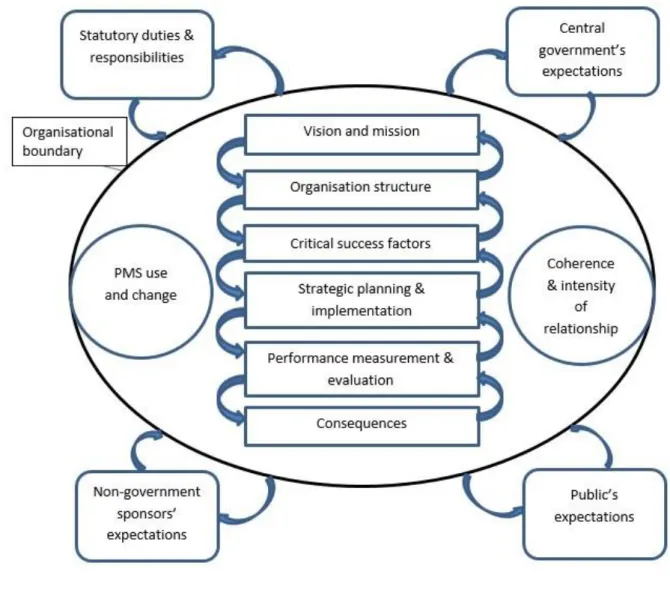
Core dimensions of performance (i.e. mission and vision, structure, critical success factors, strategic planning and implementation, performance measurement and evaluation, and consequences) are of primary concern to members working within the organisation’s boundary (Otley, 1999) – See figure 1. The vision statement is expected to succinctly and inspirationally clarify where an organisation wants to be in the future, whilst the mission statement is expected to explain why and for what purposes an organisation exists and how it intends to progress towards achieving its vision. Critical success factors are the activities that an organisation is expected to carry out and are the pre-requisites for progressing towards the achievement of organisational vision (De Vasconcellos, Sousa, & Hambrick, 1989). Information flows from internal and external sources form the basis for performance evaluation. The information flows may lead to change in strategic objectives and directions, depending on whether they are being used as single loop learning (i.e. treating objectives and strategies as fixed or given) or double loop learning (i.e. changing objectives and strategies in response to internal and external stimulus). Ferreira and Otley (2009) included the dimensions of PMS use and change, and coherence and intensity of relationships to provide a second level of analysis, because they pervade across the core performance dimensions at the centre of the diagram. The interactive use of PMS to discuss strategic and operational issues and the diagnostic use of PMS to trouble-shoot problems may lead to fine-tuning, refinements and changes of the core performance dimensions (Simons, 1995).
Figure 1 adds external influences that are relevant for understanding performance management of arts organisations (Ellwood & Greenwood, 2016; Jeacle & Miller, 2016; Oakes & Oakes, 2016; Oakes , et al., 1998; ter Bogt & Tillema, 2016; Townley, et al., 2003). The purpose of this skeletal framework (Laughlin, 1995) is to illustrate the interests that are embedded in PMSs of arts organisations when pursuing politico-economic and socio-cultural objectives. As Oakes , et al. (1998, p. 277) found, the conception of PMS as “mere acts of technical transcription concealed the force this process involved” in directing “attention away from the shifting of cultural capital toward economic capital and the diminution of existing identities”. The autonomy of an organisation to pursue strategic actions, and its ability to define boundaries within a particular field depend on the economic, social, and cultural capitals that it possesses (Bourdieu & Wacquant, 1992).
1 2 3 4 5 6 7 8 9 10 11 12 13 14 15 16 17 18 19 20 21 22 23 24 25 26 27 28 29 30 31 32 33 34 35 36 37 38 39 40 41 42 43 44 45 46 47 48 49 50 51 52 53 54 55 56 57 58 59 60 61
Figure 1: A performance management framework for arts organisations
Feedback & feedforward learning loops: information flows and interactions.
Source: Adapted from Chenhall (2003); Ferreira and Otley (2009); Kaplan and Norton (2001); Neely, et al. (2002)
1 2 3 4 5 6 7 8 9 10 11 12 13 14 15 16 17 18 19 20 21 22 23 24 25 26 27 28 29 30 31 32 33 34 35 36 37 38 39 40 41 42 43 44 45 46 47 48 49 50 51 52 53 54 55 56 57 58 59 60
Prior critical accounting studies have provided insights into the influences that drive socio-cultural and politico-economic objectives of arts organisations (Ellwood & Greenwood, 2016; Zan, Blackstock, Cerutti, & Mayer, 2000) and highlighted the “challenges in managing the arts, in particular the delicate balancing of the possible tensions between creativity and economic constraint” (Jeacle & Miller, 2016, p. 1). In the context of arts organisations in Alberta, Oakes , et al. (1998, p. 258) consider the discourses of “power as central to understanding how control works in modern society and organizations”. These authors argue that organisational planning and control systems provide sanctions to legitimise influential discourses (of managers and their external constituents), and serve as a mechanism for producing pedagogical knowledge and understanding of an organisation and its activities.
The adoption of private sector calculative practices in the arts sector may have real consequences, beyond the phenomena being measured or valued (Hines, 1988) because the act of adoption has the potential to significantly influence core values and identities (Oakes , et al., 1998). Whilst accounting technologies provide the conceptual tools for decision making (such as recognising the economic reality of a transaction, an activity or an asset), they only paint a partial picture that matters for a particular purpose and from a particular perspective e.g. decision usefulness for investors, in contrast to accountability for future generations. For example, Oakes and Oakes (2016) found that the lifeworld of arts organisations which were mainly funded by Arts Council England was partly corrupted by accounting and commercial values. Managers were apparently aware of the inadequacy of numbers in capturing the full value of arts but nevertheless “played out the charade of advocacy and legitimacy, claiming to demonstrate impact when they knew the essence of the arts is always out of reach” (p. 50). They call for future studies to “develop further understanding of the management of austerity and funding constraints in arts organisations” (p. 50).
Ellwood and Greenwood (2016) examined the challenges and consequences of the attempt by government and accounting standard setters to pressure arts organisations to recognise the economic value of their heritage assets. Arts organisations resisted pressures to place economic values on their collections because the determination of economic value is fraught with ambiguities, the measurement and preservation of economic value may result in the disposal of historically and culturally significant collections, and recognition of assets paints a picture of affluence which may affect funding from potential donors.
In contrast, Mikes and Morhart (2017, p. 67) argued that accounting can play a catalysing role by “transforming a niche cultural project into a commercially viable popular culture product, while enhancing – rather than violating – the project’s artistic authenticity.” In the context of the Netherlands, ter Bogt and Tillema (2016) found that accounting fostered trust between theatres and the municipalities and mediated the tensions between conflicting creativity and control objectives. They “show that, despite the formal picture set out in performance agreements and accounting documents, the control relationship between theatres and municipalities might appear to be very ‘loose’ and informal in practice.” (p. 6). They argue that trust and relational controls play an important role in complementing formal accounting controls in relationships, especially when organisations are faced with multiple objectives and when performance is difficult to define and measure.
The next section explains how data has been collected and analysed for the purpose of this study.
1 2 3 4 5 6 7 8 9 10 11 12 13 14 15 16 17 18 19 20 21 22 23 24 25 26 27 28 29 30 31 32 33 34 35 36 37 38 39 40 41 42 43 44 45 46 47 48 49 50 51 52 53 54 55 56 57 58 59 60 61 3. Research methods
This study draws on interviews conducted with participants involved in the PMS of a national museum and a national arts gallery located in London, and on information that are in the public domain.
Prior to conducting interviews, we analysed documents from secondary sources to engage in informed and meaningful discussion with the interviewees. More specifically, we analysed Acts of Parliament and management agreements, because PMSs are expected to enable trustees and museum directors discharge their statutory duties and deliver on the government’s priorities specified in these documents (Oakes , et al., 1998). We also analysed the strategic plans, annual reports, key performance indicators, and minutes of meetings to understand how trustees and executives respond to external influences. When analysing these documents, we paid particular attention to issues pertaining to: socio-cultural and politico-economic themes and priorities, governance structures, and accountability relationships. We also visited the museum and arts gallery prior to conducting the interviews to understand the socio-cultural activities they undertake, collections they have on display, and commercial and non-commercial facilities they provide to visitors.
A total of twenty-one face-to-face interviews were conducted with trustees and executive directors who had substantial experience and knowledge of performance management issues and challenges facing the arts sector. These individuals were passionate about the world of arts and cultural policies, and played an important role in balancing socio-cultural imperatives and politico-economic constraints (Oakes & Oakes, 2016; ter Bogt & Tillema, 2016). Sixteen interviews were conducted with trustees and executive directors from the two arts organisations – the contact details of these interviewees were available in the minutes of meetings of the arts organisations which are publicly available on their webpages. Five interviews were conducted with directors from the Department for Digital, Culture, Media & Sport (DCMS) and non-government sponsors – the contact details of these interviewees were provided by the trustees and executive directors of the arts organisations who regularly interacted with them.
The core dimensions of performance, challenges posed by austerity, and responses to pressures were discursively apprehended during the interviews which were semi-structured in nature (Townley, et al., 2003). The following questions were asked guide the interviews: What are the objectives of your organisation? What are the roles of the trustees and executives and how do they interface with relevant interest groups? How is performance managed? By who, through what processes, and what areas are particularly emphasised? How effective are performance management processes and measures in terms of achieving objectives? What constraints, pressures and challenges does your organisation face, and how does it respond to them?
To enable candid replies, interviewees were informed that their names would not be disclosed when writing the findings, but were cautioned that the name of the organisation may be identifiable as this study also uses information in their annual reports and strategic plans which are in the public domain. They were also informed they could withdraw from the interview process at any time and, make any comment off the record. All interviewees consented in writing to participate in the study, verbally consented to be recorded, and did not express concern that the name of their organisation may be identified. The interviews lasted between 60 and 90 minutes. The recordings were immediately transcribed by one of the researchers after the interviews to enable accurate recall of issues discussed (Miles & Huberman, 1994). The transcripts were also checked for accuracy by another researcher.
All the transcripts were read and analysed in relation to themes that have been highlighted in the performance management literature, discourses in policy and regulatory
1 2 3 4 5 6 7 8 9 10 11 12 13 14 15 16 17 18 19 20 21 22 23 24 25 26 27 28 29 30 31 32 33 34 35 36 37 38 39 40 41 42 43 44 45 46 47 48 49 50 51 52 53 54 55 56 57 58 59 60
documents, corporate plans and annual reports, to identify pertinent and contentious issues and to frame this study’s findings. This process requires reflexivity and acknowledgement of the researchers’ own interests (e.g. arising from the choice of a particular paradigm or theoretical framework) and position they occupy in the intellectual field (Bourdieu & Wacquant, 1992; Said, 1994) – i.e. in the communication of a particular reality, we may be complicit in constructing that reality (Hines, 1988). The objective of this study is not to generalise, but to provide insights into performance management issues and challenges faced by the two arts organisations studied which may resonate with experiences in other settings (Berry & Otley, 2004).
4. Findings: The performance management of arts organisations
The findings are presented in relation to the inter-related dimensions of performance discussed in the literature. External influences are discussed first, as these drive performance management processes within arts organisations.
External structural influences driving organisational objectives
Both the museum and the arts gallery are well established organisations – they were officially opened in the mid and late nineteenth century respectively. Their governance structure, within which they pursue their socio-cultural and politico-economic objectives, is quite complex. Although they are organised as non-departmental public body (NDPB) to enable their executives carry out activities at arm’s length from the government, they contribute towards the performance objectives of DCMS in return for the public funding they receive. They are also exempt charities under Schedule 3 of the Charities Act 2011, meaning that the DCMS is their principal regulator for charity law purposes. This regulatory framework partly drives the mission, objectives and activities, as stated in the annual report of the museum: “During 2016–17 the Board of Trustees of the Science Museum (the SMG Board) agreed a new vision and mission for SMG…which takes due regard of the Charity Commission’s general guidance on public benefit and informs all decision-making, future planning and strategic priorities” (National Audit Office, 2017, p. 5).
The statutory duties of the trustees are specified in the National Heritage Act 1983 and the Museums and Galleries Act 1992, which state that they are responsible to: (a) care for, preserve and add to the works of arts in their collection; (b) secure the works of arts exhibited to the public; (c) make the works of arts and documents available to persons seeking to inspect them in connection with study or research; and (d) generally promote the public’s enjoyment and understanding of arts. The trustees are also politically accountable to the ministers (from DCMS and the Cabinet Office) who are responsible for appointing them on the board of national museums and arts galleries, although “the recruitment of Trustees takes place in accordance with the procedures defined by DCMS and the Office of the Commissioner for Public Appointments” (National Audit Office, 2017, p. 41). The government controls the criteria for making senior appointments, such as the desirability of candidates possessing specialised knowledge about arts, culture, history and collections, and commercial knowledge about fundraising, and income generation, and thus indirectly plays a role in embedding values at the strategic level in arts organisations.
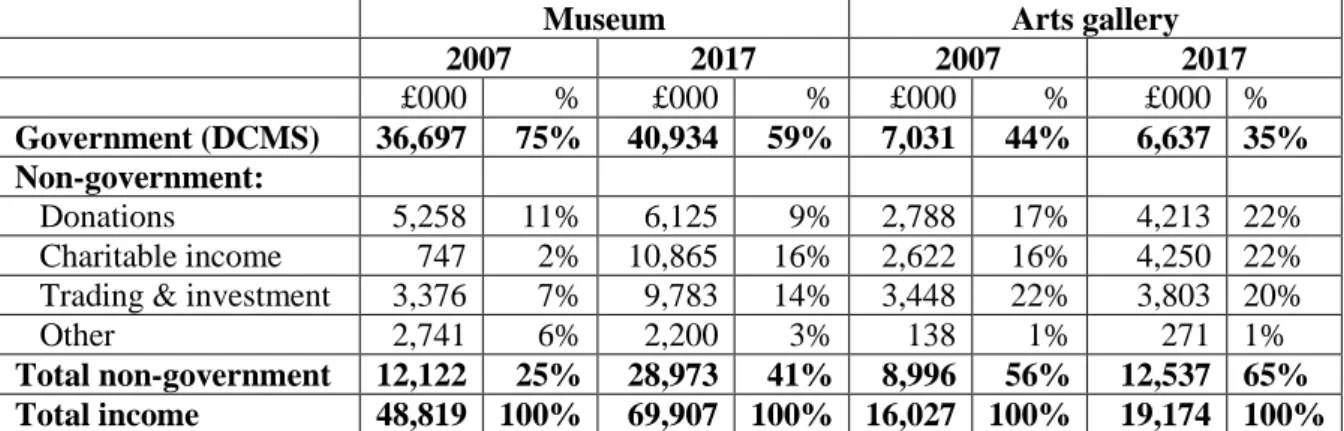
The arts organisations engaged in fundraising and commercial activities to supplement their funding from government and charitable sources, which may create conflict among objectives. Table 1 shows their funding structure in 2007 and 2017, and highlights the impact of the government’s austerity agenda that began in 2010. Although government funding for the museum has increased in nominal terms from £37m to £41, a director of finance from the museum explained that this has declined in real terms and that the rate of
1 2 3 4 5 6 7 8 9 10 11 12 13 14 15 16 17 18 19 20 21 22 23 24 25 26 27 28 29 30 31 32 33 34 35 36 37 38 39 40 41 42 43 44 45 46 47 48 49 50 51 52 53 54 55 56 57 58 59 60 61
increase in their unavoidable costs, which are mostly fixed, was greater than the rate of inflation:
Government funding has fallen by more than 25% in real terms between 2010 and now, and next year it will fall. Our funding was cut for 2015-16. So we would have to find additional funding to make up the difference or cut expenditure to reflect that. We are an organisation that has very high fixed costs - all of these buildings to maintain and collections to look after. Lots of our costs are unavoidable. Costs have gone up far faster than the rate of inflation, and yet our funding is falling.
Table 1: Sources of funding
Museum Arts gallery
2007 2017 2007 2017 £000 % £000 % £000 % £000 % Government (DCMS) 36,697 75% 40,934 59% 7,031 44% 6,637 35% Non-government: Donations 5,258 11% 6,125 9% 2,788 17% 4,213 22% Charitable income 747 2% 10,865 16% 2,622 16% 4,250 22% Trading & investment 3,376 7% 9,783 14% 3,448 22% 3,803 20%
Other 2,741 6% 2,200 3% 138 1% 271 1%
Total non-government 12,122 25% 28,973 41% 8,996 56% 12,537 65%
Total income 48,819 100% 69,907 100% 16,027 100% 19,174 100%
Source: Annual reports (2007 and 2017).
The proportion of non-government funding as a percentage of total funding in 2007 to 2017 has increased for both arts organisations, which can potentially change accountability relationships because reliance on funding is a source of influence (ter Bogt & Tillema, 2016). It is interesting to note that interviewees from the arts gallery pointed out that they wanted greater control of the funds they raised from other sources - the total funding for the arts gallery was about 65%, as compared to the museum which was 41% in 2017. However, a principal curator from the museum highlighted that placing greater reliance on non-government funding may influence the values of arts organisations:
Donors have too many restrictions – we don’t want to touch them. If they want to get their names on the main hall, that is fine, but we don’t want to be driven by donors. I am very concerned if the government funding goes down, because we would have to heavily rely on the donors. This would then affect the political drivers and political culture of the museum.
Whilst austerity has pressured arts organisations to raise income from non-government sources, the financial crisis has taken its toll on non-government funding. This has led to stiff competition among arts organisations from a declining pool of funding. As commented by a deputy CEO from the arts gallery:
Winning donations from benefactors is an uphill struggle, even for the most adept of fundraisers. Charitable donations to arts and culture were down by about 20 per cent last year.
In summary, PMSs are expected to enable arts organisations discharge their statutory duties and meet the accountability expectations of their funders and themselves.
1 2 3 4 5 6 7 8 9 10 11 12 13 14 15 16 17 18 19 20 21 22 23 24 25 26 27 28 29 30 31 32 33 34 35 36 37 38 39 40 41 42 43 44 45 46 47 48 49 50 51 52 53 54 55 56 57 58 59 60
Vision, mission, organisation, and critical success factors
Arts organisations operate within the confines of statutory, government and economic influences. The vision and mission reflected their core values which were primarily geared towards the pursuit of socio-cultural objectives. For example, both organisations articulated their vision and mission in their annual reports and corporate plans as follows: ‘building a scientifically literate society’, ‘inspire next generations of scientists, inventors and engineers’, and ‘promote through the medium of portraits the appreciation and understanding of the men and women who have made and are making British history and culture’. Whilst interviewees were generally enthusiastic to talk about the socio-cultural objectives of their organisation, they highlighted that the pursuit of these objectives were influenced by resources and administrative constraints imposed by their funders.
The mission and vision, which featured in official documents such as annual reports and strategic plans, played a pedagogic role in communicating the values of senior management (Oakes , et al., 1998). They were aimed at enabling trustees discharge their statutory responsibilities, and enabling the museum director discharge her/his ‘personal accountability’ to the Secretary of State for Culture, Media and Sports (i.e. the minister in charge of DCMS) for safeguarding public funds. A director of development from the museum explained the accountability structure as follows:
Trustees and the chair of the board of trustees are appointed by DCMS. Our museum director who is the chief executive of the group, is appointed by the prime minister… I report to a finance and general purpose sub-committee of the board of trustees, and to the board of trustees on a quarterly basis on income. I attended these meetings to explain fund-raising performance, and compliance with ethics policy: who are we getting money from, why, and for what purpose?
In return for the funding provided by DCMS, the chair of the board of trustee and museum director were required to sign a management agreement with the Secretary of State for Culture, Media and Sport. The Secretary of State explicitly highlighted her financial priorities for the arts organisation by stating that it should ‘continue to pursue commercial and philanthropic approaches to generating revenue which will complement grant-in aid’ but couched her socio-cultural priorities in broad terms by stating that it should ‘ensure that free entry to the permanent collections would be made available’, and ‘protect world-class collections and front-line services’ (DCMS, 2017a).
Whilst the government’s socio-cultural priorities were loosely specified in the management agreement (i.e. one page), administrative matters were quite comprehensively covered (i.e. 30 pages). Financial and administrative matters relating to governance and performance that were covered in greater depth include: financial management, duties to deliver on the strategic priorities of DCMS, broad performance objectives of the arts organisation in relation to statues and the implementation of public policies, risk management and internal control procedures, procurement, accounting information to be disclosed and reported to DCMS, formal review meetings with DCMS, and responsibilities of the parties to the agreement.
As compared to the formal relationship between arts organisations and the government, the relationship with non-government funders depended on the size of the funding and purpose for which funding was provided. The agreement ranged “from a strong legal contract with major corporate donors, to a purely verbal philanthropic agreement with trusts and foundations” (Director, arts gallery). When undertaking projects, museum
1 2 3 4 5 6 7 8 9 10 11 12 13 14 15 16 17 18 19 20 21 22 23 24 25 26 27 28 29 30 31 32 33 34 35 36 37 38 39 40 41 42 43 44 45 46 47 48 49 50 51 52 53 54 55 56 57 58 59 60 61
and the arts gallery met their non-government funders’ socio-cultural priorities whilst simultaneously fulfilling their duties to DCMS. Project-specific success factors were identified for subsequent monitoring and evaluation. As stated by the director of development from the museum:
You have to set up project objectives for the project and meet sponsors’ priorities, but you have to meet the government’s priorities as well. Sponsors monitor the project quite closely; you will need to meet them very regularly. You would have to demonstrate that you have used the fund to meet objectives, and to evaluate achievement of objectives afterwards.
In summary, the core values in the vision and mission of arts organisation, which provide the framework for strategic planning and reporting to relevant authorities, reflect the statutory duties of senior management.
Strategic planning and implementation
The long-term strategic and short-term business plans played a pedagogic role in terms of providing departments, teams and individuals with a planning and control tool that would subsequently be used to assess their contributions to organisational objectives (Oakes , et al., 1998). In this respect, the chairman of board of trustees and the museum director stated that the strategic planning “document captures the top-level long-term priorities and is to be used actively as a touchstone for decision-making throughout the next decade or so” (Museum, 2017, p. 38).
Arts organisations distinguished between ‘core’ and ‘support’ values to differentiate the values that mattered most to them. Whilst both organisations placed significant emphasis on their socio-cultural objectives (e.g. inspire people, create knowledge, increase audience and sustain growth of collections) which they termed ‘core’ priorities, they also acknowledged the importance of ‘support’ priorities such as the generation of income. In response to funding pressures, the museum stated that by 2030 “it will be an exemplar among museums for commercial activity and entrepreneurship” (Museum, 2017, p. 36).
The interviewees generally identified themselves with the socio-cultural values espoused in the management agreement, and in the strategic plans. However, they also acknowledged the importance of income generating activities in supporting core values, such as introducing special paid exhibits, new products or service, and trading in coffee and gift shops. For example, a director of public engagement from the museum broadly highlighted these values as follows:
Our strategic plan reflects the history of the museum what we choose to focus and how we want to position the museum in the next ten years, how we want to be perceived by our stakeholders, the funding environment, and the needs of the stakeholders who provide us with funding in particular, but all these things are very much related. Fundamentally the strategic plan is a bold statement about who we are, why we matter, what we intend to do, but it is written with a view to securing funding for the organisation because we need to raise money to do what we want to do.
The different components of the strategic plan were ‘owned’ by directors and their heads of departments, denoting segregation of duties and responsibilities in the pursuit of different, but related, objectives. For example, the curators were concerned with issues related to collections, whilst the directors of engagement were concerned with the profile of audience,
1 2 3 4 5 6 7 8 9 10 11 12 13 14 15 16 17 18 19 20 21 22 23 24 25 26 27 28 29 30 31 32 33 34 35 36 37 38 39 40 41 42 43 44 45 46 47 48 49 50 51 52 53 54 55 56 57 58 59 60
and the commercial task force was interested in income generating activities. As explained by a director of public engagement from the art gallery:
The strategic plan for public engagement strategy group, which I chair and am responsible for, is written in collaboration with my heads of department and their staff. In practice, they will each ‘own’ different elements of the public engagement strategy. We will review each of those activities in order to understand what’s going on, whether we are performing in a way that we want to, etc. Ultimately, I then have to report that to the Executive Board who will then report to the trustees, and there is a whole suite of processes that are in place to enable us deliver those strategies. For example, we have a ‘commercial task force’ that deals with commercial income, we have a ‘content strategy board’ that sets the content of the public programme, we have a ‘public engagement programme board’ that governs our projects.
In contrast to the strategic plan which spanned a decade and articulated the board of trustees’ and the museum director’s strategic priorities, the arts organisations prepared an annual business plan to articulate the operational activities that departmental managers and individuals intend to undertake in the pursuit of long term objectives. Surprisingly, a chief curator used the cause-effect vocabulary in the balanced scorecard (Kaplan & Norton, 2001) as follows: “Every individual has a performance development plan, where personal objectives are informed by the departmental objectives and linked to the museum’s business plan for the next twelve months”.
DCMS did not interfere with operational matters which were the responsibility of the executives. However, it was involved in making senior appointments and dealing with administrative and strategic matters through a ‘bureaucratic chain’. There was an element of trust between DCMS and the arts organisations (ter Bogt & Tillema, 2016), as apprehended from our interview with a director of development from the museum:
To a large extent, DCMS just let us get on with our work. They can directly contact our trustees if they have a problem regarding the things that we do. But they actually know what we are doing, because we articulate what we do clearly, we report to them every quarter, so there is a bureaucratic chain. To some extent there is an element of trust. Where they flex their muscle, is on the appointment of board of trustees and chairman. Regarding day to day operations, they are flexible.
However, it would be naïve to think that DCMS does not indirectly influence operational activities. This is because the long-term strategic plan of the chairman of the board of trustees and the museum director which informs the operational matters in the annual business plans is itself based on the management agreement which focusses on the strategic priorities of the Secretary of State for Culture, Media and Sports. As stated by the chairman and museum director in the strategic plan “the priorities and goals in Inspiring Futures will be reflected in Annual Plans from 2017/18, which will set out specific actions and deliverables…This overarching strategic framework will also inform the subject-specific strategies and plans that are produced from time to time.” (Museum, 2017, p. 38).
In summary, the management agreement, strategic framework, and business plans have penetrated the departmental boundaries of arts organisations to shape values of the different teams working to pursue common objectives. These documents contain private sector performance management vocabularies which have entrenched arts organisations.
1 2 3 4 5 6 7 8 9 10 11 12 13 14 15 16 17 18 19 20 21 22 23 24 25 26 27 28 29 30 31 32 33 34 35 36 37 38 39 40 41 42 43 44 45 46 47 48 49 50 51 52 53 54 55 56 57 58 59 60 61
Performance measurement, evaluation and consequences
Performance was evaluated externally in relation to the management agreement signed by the board of trustees, the museum director and the Secretary of State for Culture, Media and Sports, and internally in relation to the annual plan and the strategic plan.
The external monitoring process is aimed at enabling DCMS discharge its parliamentary accountability for using taxpayers’ money. DCMS provides official statistics of the arts organisations they sponsor and delegate the responsibility of compiling performance indicators to the chairman of the board of trustees and museum director who are required to follow the DCMS’s ‘Performance Indicator Guidance Document’ (DCMS, 2017b). However, a director of engagement from a museum argued that they should not be judged on the basis of generic KPIs:
The KPIs are simplistic and don’t reflect our strengths as a scientific research institute – we have many scientists who produce scientific knowledge as compared to other museums who don’t. We are different, yet we are judged on the basis of generic KPIs, alongside others.
However, the external KPIs were used symbolically to loosely manage performance. No targets were assigned and there were no financial consequences: The management agreement does not say: ‘we will give you x if you achieve y in terms of performance’ (Deputy CEO, arts gallery).
The feedback loop from DCMS to the arts organisations was weak. As pointed out by a director of public engagement from the arts gallery:
We sign the management agreement with DCMS at the beginning of every four years, telling us what the grant-in aid is going to be and what KPIs we must report on, but the document don’t ever get referred to again…The information just literally goes into a black hole and nobody sees it again.
Some interviewees commented that lack of feedback was the result of downsizing of the museum team in DCMS which affected its ability to effectively engage with the arts organisations. As pointed out by a trustee: ‘DCMS itself was not spared from the funding cuts’. The UK government has reduced the number of key performance indicators (KPIs) from 12 to 3 (i.e. visitor numbers, philanthropic income, and items on loans) to reduce the administrative burden of data collection and analysis (DCMS, 2017b), and in response to the widespread criticisms of the use of performance targets in the arts sector “which can act as millstones around the neck of creativity” (McMaster, 2008, p. 4).
Unsurprisingly, interviewees highlighted that their internal KPIs were more helpful than DCMS’s generic KPIs. A director from the museum provided the following examples of qualitative issues they monitor using internal KPIs: “visitor satisfaction, number and quality of our publications, number of publications in top ranked journals, self-generated income, and number of scientist visiting and using our collection for research purposes”. However, he admitted that other factors such as “what visitors take away from the museum, in terms of understanding and inspiration to become scientist” are difficult to capture. A bottom-up approach was followed when designing these KPIs i.e. they were discursively agreed by the departmental directors and their teams, tailored to capture heterogeneous objectives and critical success areas, and used diagnostically as traffic lights to signal progress towards achieving strategic objectives (Simons, 1995). A director of finance and planning from the arts gallery explained that:
1 2 3 4 5 6 7 8 9 10 11 12 13 14 15 16 17 18 19 20 21 22 23 24 25 26 27 28 29 30 31 32 33 34 35 36 37 38 39 40 41 42 43 44 45 46 47 48 49 50 51 52 53 54 55 56 57 58 59 60
We use a range of KPIs, as in a traffic light system, to measure our progress, and what we hope to achieve, by way of activities. Our progress is not only measured against the KPIs, but is also measured against whether we deliver the things that we expected to deliver, and if we didn’t, why not? My reporting to the trustees is a combination of the KPIs and activities, which they find helpful.
Evaluation processes not only created knowledge about activities and performance to enable the steering of organisational activities, but also enabled self-reflection and learning. As commented by a director of public engagement:
We don’t set internal KPIs for the fun of it - I mean we really use them. I have about half a dozen KPIs for my public engagement strategy which I feel are fundamental for me to know how we are doing, and whether we are moving in the right direction. For example, we segment our market into two or three segments and use a KPI to measure our engagement with the target audiences or segments. Currently we are engaging 31% with a particular segment but by 2018 we want to increase our engagement to 35%. That KPI is a meaningful measure which is linked to the objectives in our strategy document, such as fund raising or engagement with a minority group, or inspiring people.
DCMS loosely monitored the performance of arts organisations at a distance, whilst tightly specifying the ground rules that arts organisations should follow to demonstrate value for money. Internal performance evaluation processes were praised for their emancipatory potential of enabling discrete organisational units evaluate the effectiveness of their activities when pursuing heterogeneous objectives.
5. Discussion and conclusion
This study has provided insights into the complex influences that shape the PMSs of national arts organisations. PMSs were primarily designed to enable trustees discharge their statutory duties of collecting, preserving, and displaying objects and works of arts, which were reflected in the management agreement containing the government’s strategic priorities, such as fostering interest in science, technology engineering and mathematics (STEM), creating cohesion among the population and reaching specific groups such as ethnic minorities, women and young people (DCMS, 2017a). PMSs of arts organisations were also influenced by changes in political and economic climate, and reflected the efforts of trustees and executives at interpreting and responding to these changes in their strategic plans and operational activities.
Dependence on funding is a major source of influence (ter Bogt & Tillema, 2016). In return for public funding, arts organisations are required to contribute to the strategic priorities of the Secretary of State of Culture, Media and Sports. The latter is politically accountable to the Cabinet Office and the Parliament for obtaining value for money in the pursuit of policy objectives. In line with the NPM ideology of distancing politicians from service delivery to make managers accountable for results (Hood, 1995), national arts organisations are organised as NDPBs to provide them with immunity from political interference. However, the government was able to obtain action at arm’s length through two main governance technologies which were hierarchical in nature: control over the appointment of trustees and museum directors, and the management agreement. DCMS was primarily concerned with financial reporting, policy priorities and administrative matters. Despite the financial and administrative focus aimed at increasing transparency, DCMS could not effectively assimilate the information produced by arts organisations and
1 2 3 4 5 6 7 8 9 10 11 12 13 14 15 16 17 18 19 20 21 22 23 24 25 26 27 28 29 30 31 32 33 34 35 36 37 38 39 40 41 42 43 44 45 46 47 48 49 50 51 52 53 54 55 56 57 58 59 60 61
effectively engage with them because DCMS itself was not spared from the funding cuts. This lack of feedback unsurprisingly created the impression that the information was going into a blackhole. Nevertheless, DCMS intervened to over-ride an important strategic decision taken by the museum’s executives to close one of its branches due to funding cuts and falling visitor numbers, because the political implication of the closure outweighed the financial implication.
The findings illustrate the power of governance technologies in transcending organisational and departmental boundaries to shape values and create identities through learning and reflection. Whilst accounting technologies, such as PMSs and strategic plans, are designed to communicate a reality by rendering things visible, they have the potential to create a reality of the things that are most valued by influential groups. For example, management agreement drove the long-term strategic and short-term business plans and made ‘core’ and ‘support’ strategic themes visible. These documents played a pedagogic role in creating knowledge to enable organisational steering and learning (Oakes , et al., 1998). Heads of departments and individuals identified with the themes and objectives inscribed in strategic and business plans, and aligned their operational activities to pursue the strategic themes emphasised by senior management.
Generic KPIs have the tendency to standardise and homogenise. Whilst the appropriateness and usefulness of KPIs have been blanketly questioned in the literature (Oakes & Oakes, 2016), this study distinguishes between generic and specific KPIs and highlights the purposes they serve. Generic KPIs, which were reduced from 12 to 3, were symbolically used to demonstrate contributions of arts organisations to DCMS’s priorities, whilst providing autonomy to arts organisations to differentiate themselves. Generic KPIs were used because it is difficult to precisely define and measure the outputs and outcomes of different arts organisations by designing specific KPIs, which would have further hindered managerial discretion and increased administrative burdens. Interviewees devised their own specific KPIs to capture information of interest to them, but admitted that not all information can be captured by performance measures.
The implications of austerity should be carefully assessed by the government, because of its potential to change accountability structures, displace socio-cultural values, and change identities. Austerity and the government’s funding cuts pressured arts organisations to find alternative sources of funding to support their core activities. Competition has intensified among arts organisations who are competing for the same pot of funding which has reduced. Interviewees highlighted that they are placing greater emphasis on fundraising and moving towards a US model of funding their activities through donations and commercial activities, although they are unable to charge for access to their general collections as part of the condition of the grant-in aid from DCMS. However, a significant increase in the proportion of non-government funding to total funding may require a reconfiguration of the current governance structure which prioritises accountability to the government.
External pressures arising from austerity resulted in the emphasising of politico-economic values and the subtle displacement of socio-cultural values, which may be counterproductive to the government’s own policy initiatives of, for example, widening citizens’ participation in the arts sector. The pursuit of market solutions to the problem of austerity may marginalise certain groups and change values, as arts organisations are tempted to attract visitors who are more likely to spend, put-up special exhibits for which visitors have to pay to gain access, use scarce space for commercial activities, and cut costs by reducing the number of engagement projects they undertake (Oakes & Oakes, 2016). The focus on economic objectives (e.g. fundraising activities) may conflict with social-cultural objectives, in the deployment of scarce managerial time and space resources.
1 2 3 4 5 6 7 8 9 10 11 12 13 14 15 16 17 18 19 20 21 22 23 24 25 26 27 28 29 30 31 32 33 34 35 36 37 38 39 40 41 42 43 44 45 46 47 48 49 50 51 52 53 54 55 56 57 58 59 60
External politico-economic pressures arising from austerity and the financial crisis helped to inculcate new vocabularies to reconfigure identities. The language, vocabularies, and tools commonly used in the private sector (such as strategic and business plans containing mission, strategies, SMART goals, cause-effect relationships, profit, and income-generating activities) were insidiously taking root in the arts sector (Mikes & Morhart, 2017). Reliance was placed on private sector “external experts who advised, guided and challenged” arts organisations in the preparation of strategic and business plans that provide the overarching framework for governing arts and culture (Museum, 2017, p. 5). This strategic document, prepared by financial expert, created visibilities on strategic themes that formed the basis for operational action by executives and their teams. Austerity provided a signal to executives that they have to embrace these vocabularies to support their core activities, the survival of which were at stake.
The government’s austerity discourse has brought changes that are subtly redefining the field of arts and culture. Arts organisations share some complicity in the process of changing their values by implementing externally imposed imperatives in the guise of austerity that may threaten the production of cultural goods. Managers were complicit in their own control, by accepting the government’s austerity agenda and adopting PMS modelled on the private sector to change their practices, identities and what they value in the field of arts. Whilst funding is required to support the pursuit of socio-cultural objectives, arts organisations do not necessarily have to engage in fundraising and commercial activities, which may become a core activity and an end in themselves, to support arts and culture if these are truly public good.
1 2 3 4 5 6 7 8 9 10 11 12 13 14 15 16 17 18 19 20 21 22 23 24 25 26 27 28 29 30 31 32 33 34 35 36 37 38 39 40 41 42 43 44 45 46 47 48 49 50 51 52 53 54 55 56 57 58 59 60 61 References
ALVA. (2016). Visits made in 2015 to visitor attractions in membership with ALVA. London: Association of Leading Visitor Attractions.
Berry, A. J., & Otley, D. T. (2004). Case-based research in accounting. The real life guide to accounting research, 231-255.
Bourdieu, P., & Wacquant, L. (1992). An invitation to reflexive sociology: University of Chicago Press.
Broadbent, J. (2002). Critical accounting research: a view from England. Critical Perspectives on Accounting, 13, 433-449.
Chenhall, R. H. (2003). Management control systems design within its organizational context: findings from contingency-based research and directions for the future. Accounting, Organizations and Society, 28, 127-168.
Crepaz, L., Huber, C., & Scheytt, T. (2016). Governing arts through valuation: The role of the state as network actor in the European Capital of Culture 2010. Critical Perspectives on
Accounting, 37, 35-50.
Dambrin, C., & Robson, K. (2011). Tracing performance in the pharmaceutical industry: Ambivalence, opacity and the performativity of flawed measures. Accounting, Organizations and Society, 36, 428-455.
DCMS. (2017a). Arts gallery management agreement: 2016-2020. London: DCMS.
DCMS. (2017b). Sponsored Museums Performance Indicators 2015/16. London: Department for Digital, Culture, Media & Sports.
De Vasconcellos, E. S., Sousa, J. A., & Hambrick, D. C. (1989). Key success factors: Test of a general theory in the mature industrial‐ product sector. Strategic management journal, 10, 367-382.
Donaldson, L. (2001). The contingency theory of organizations: Sage.
Ellwood, S., & Greenwood, M. (2016). Accounting for heritage assets: Does measuring economic value ‘kill the cat’? Critical Perspectives on Accounting.
Ferreira, A., & Otley, D. (2009). The design and use of performance management systems: An extended framework for analysis. Management Accounting Research, 20, 263-282. Ferri, P., & Zan, L. (2014). Ten years after: The rise and fall of managerial autonomy in Pompeii.
Critical Perspectives on Accounting, 25, 368-387.
Foucault, M. (2009). Security,Territory, Population: Lectures at the Collège de France, 1977-1978. London: Palgrave Macmillan.
1 2 3 4 5 6 7 8 9 10 11 12 13 14 15 16 17 18 19 20 21 22 23 24 25 26 27 28 29 30 31 32 33 34 35 36 37 38 39 40 41 42 43 44 45 46 47 48 49 50 51 52 53 54 55 56 57 58 59 60
Hellstrom, C., & Lapsley, I. (2016). Humour and happiness in an NPM world: Do they speak in jest?
Critical Perspectives on Accounting, 37, 51-64.
Hines, R. D. (1988). Financial accounting: in communicating reality, we construct reality.
Accounting, Organizations and Society, 13, 251-261.
HM Government. (2016). 2015 to 2020 government policy: museums and galleries. London: HM Government.
Hood, C. (1995). The “New Public Management” in the 1980s: variations on a theme. Accounting, Organizations and Society, 20, 93-109.
Hyndman, N., Liguori, M., Meyer, R. E., Polzer, T., Rota, S., & Seiwald, J. (2014). The translation and sedimentation of accounting reforms. A comparison of the UK, Austrian and Italian experiences. Critical Perspectives on Accounting, 25, 388-408.
Jeacle, I., & Miller, P. (2016). Accounting, culture, and the state. Critical Perspectives on Accounting, 37, 1-4.
Kaplan, R. S., & Norton, D. P. (2001). Transforming the balanced scorecard from performance measurement to strategic management: Part I. Accounting horizons, 15, 87-104. Laughlin, R. (1995). Empirical research in accounting: alternative approaches and a case for
“middle-range” thinking. Accounting, Auditing & Accountability Journal, 8, 63-87. McMaster, B. (2008). Supporting Excellence in the Arts. Department for Culture, Media and. Mikes, A., & Morhart, F. (2017). Bringing Back Charlie Chaplin: Accounting as catalyst in the
creation of an authentic product of popular culture. Management Accounting Research, 35, 66-82.
Miles, M. B., & Huberman, A. M. (1994). Qualitative data analysis: A sourcebook. Beverly Hills: Sage Publications.
Museum. (2017). Museum: Inspiring futures - strategic priorities 2017-2030. London: Museum. National Audit Office. (2017). Museum annual report and accounts 2016-2017: Report and
Accounts presented to Parliament pursuant to Section 9(8) of the Museums and Galleries Act 1992. London: HMSO.
Neely, A. D., Adams, C., & Kennerley, M. (2002). The performance prism: The scorecard for measuring and managing business success: Prentice Hall Financial Times London. Norreklit, H. (2000). The balance on the balanced scorecard a critical analysis of some of its
assumptions. Management Accounting Research, 11, 65-88.
Oakes, H., & Oakes, S. (2016). Accounting colonisation and austerity in arts organisations. Critical Perspectives on Accounting.
1 2 3 4 5 6 7 8 9 10 11 12 13 14 15 16 17 18 19 20 21 22 23 24 25 26 27 28 29 30 31 32 33 34 35 36 37 38 39 40 41 42 43 44 45 46 47 48 49 50 51 52 53 54 55 56 57 58 59 60 61
Oakes , L., Townley, B., & Cooper, D. (1998). Business Planning as Pedagogy: Language and Control in a Changing Institutional Field. Administrative Science Quarterly, 43, 257-292. Otley, D. (1999). Performance management: a framework for management control systems research.
Management Accounting Research, 10, 363-382.
Otley, D. (2016). The contingency theory of management accounting and control: 1980–2014.
Management Accounting Research, 31, 45-62.
Quattrone, P., & Hopper, T. (2005). A ‘time–space odyssey’: management control systems in two multinational organisations. Accounting, Organizations and Society, 30, 735-764.
Royce, S. (2011). Business models in the visual arts. Arts Council England, Londres.
Said, E. W. (1994). Representations of the Intellectual: BBC Reith Lectures. New York: Vintage Books.
Simons, R. (1995). Levers of control: how managers use innovative control systems to drive strategic renewal: Harvard Business Press.
ter Bogt, H., & Tillema, S. (2016). Accounting for trust and control: Public sector partnerships in the arts. Critical Perspectives on Accounting, 37, 5-23.
Townley, B., Cooper, D., & Oakes, L. (2003). Performance measures and the rationalization of organizations. Organization Studies, 24, 1045-1071.
Zan, L., Baraldi, S. B., Ferri, P., Lusiani, M., & Mariani, M. M. (2012). Behind the scenes of public funding for performing arts in Italy: hidden phenomena beyond the rhetoric of legislation.
International Journal of Cultural Policy, 18, 76-92.
Zan, L., Blackstock, A., Cerutti, G., & Mayer, M. C. (2000). Accounting for art. Scandinavian Journal of Management, 16, 335-347.