University of Zurich Main Library Strickhofstrasse 39 CH-8057 Zurich www.zora.uzh.ch Year: 2018
Non-parent of Origin Expression of Numerous Effector Genes Indicates a
Role of Gene Regulation in Host Adaption of the Hybrid Triticale Powdery
Mildew Pathogen
Praz, Coraline R ; Menardo, Fabrizio ; Robinson, Mark D ; Müller, Marion C ; Wicker, Thomas ; Bourras, Salim ; Keller, Beat
Abstract: Powdery mildew is an important disease of cereals. It is caused by one species, Blumeria graminis, which is divided into formae speciales each of which is highly specialized to one host. Recently, a new form capable of growing on triticale (B.g. triticale) has emerged through hybridization between wheat and rye mildews (B.g. tritici and B.g. secalis, respectively). In this work, we used RNA sequencing to study the molecular basis of host adaptation in B.g. triticale. We analyzed gene expression in three B.g. tritici isolates, two B.g. secalis isolates and two B.g. triticale isolates and identified a core set of putative effector genes that are highly expressed in all formae speciales. We also found that the genes differentially expressed between isolates of the same form as well as between different formae speciales were enriched in putative effectors. Their coding genes belong to several families including some which contain known members of mildew avirulence (Avr) and suppressor (Svr) genes. Based on these findings we propose that effectors play an important role in host adaptation that is mechanistically based on Avr-Resistance gene-Svr interactions. We also found that gene expression in the B.g. triticale hybrid is mostly conserved with the parent-of-origin, but some genes inherited from B.g. tritici showed a B.g. secalis-like expression. Finally, we identified 11 unambiguous cases of putative effector genes with hybrid-specific, non-parent of origin gene expression, and we propose that they are possible determinants of host specialization in triticale mildew. These data suggest that altered expression of multiple effector genes, in particular Avr and Svr related factors, might play a role in mildew host adaptation based on hybridization.
DOI: https://doi.org/10.3389/fpls.2018.00049
Posted at the Zurich Open Repository and Archive, University of Zurich ZORA URL: https://doi.org/10.5167/uzh-160617
Journal Article Published Version
The following work is licensed under a Creative Commons: Attribution 4.0 International (CC BY 4.0) License.
Originally published at:
Praz, Coraline R; Menardo, Fabrizio; Robinson, Mark D; Müller, Marion C; Wicker, Thomas; Bourras, Salim; Keller, Beat (2018). Non-parent of Origin Expression of Numerous Effector Genes Indicates a
in Plant Science, 9:49.
Edited by: Kostya Kanyuka, Rothamsted Research (BBSRC), United Kingdom Reviewed by: Timothy L. Friesen, Agricultural Research Service (USDA), United States Eduard Akhunov, Kansas State University, United States
*Correspondence: Salim Bourras [email protected] Beat Keller [email protected] Specialty section:
This article was submitted to Plant Microbe Interactions, a section of the journal Frontiers in Plant Science
Received:29 August 2017
Accepted:10 January 2018
Published:30 January 2018
Citation:
Praz CR, Menardo F, Robinson MD, Müller MC, Wicker T, Bourras S and Keller B (2018) Non-parent of Origin Expression of Numerous Effector Genes Indicates a Role of Gene Regulation in Host Adaption of the Hybrid Triticale Powdery Mildew Pathogen. Front. Plant Sci. 9:49. doi: 10.3389/fpls.2018.00049
Non-parent of Origin Expression of
Numerous Effector Genes Indicates a
Role of Gene Regulation in Host
Adaption of the Hybrid Triticale
Powdery Mildew Pathogen
Coraline R. Praz1, Fabrizio Menardo1, Mark D. Robinson2, Marion C. Müller1,
Thomas Wicker1, Salim Bourras1* and Beat Keller1*
1Department of Plant and Microbial Biology, University of Zürich, Zürich, Switzerland,2Department of Molecular Life
Sciences and SIB Swiss Institute of Bioinformatics, University of Zürich, Zürich, Switzerland
Powdery mildew is an important disease of cereals. It is caused by one species,Blumeria graminis, which is divided into formae speciales each of which is highly specialized to one host. Recently, a new form capable of growing on triticale (B.g. triticale) has emerged through hybridization between wheat and rye mildews (B.g. tritici and B.g. secalis, respectively). In this work, we used RNA sequencing to study the molecular basis of host adaptation in B.g. triticale. We analyzed gene expression in three B.g. tritici isolates, two B.g. secalisisolates and two B.g. triticaleisolates and identified a core set of putative effector genes that are highly expressed in allformae speciales. We also found that the genes differentially expressed between isolates of the same form as well as between differentformae specialeswere enriched in putative effectors. Their coding genes belong to several families including some which contain known members of mildew avirulence (Avr) and suppressor (Svr) genes. Based on these findings we propose that effectors play an important role in host adaptation that is mechanistically based onAvr-Resistance gene-Svrinteractions. We also found that gene expression in theB.g. triticalehybrid is mostly conserved with the parent-of-origin, but some genes inherited from B.g. tritici showed a B.g. secalis-like expression. Finally, we identified 11 unambiguous cases of putative effector genes with hybrid-specific, non-parent of origin gene expression, and we propose that they are possible determinants of host specialization in triticale mildew. These data suggest that altered expression of multiple effector genes, in particularAvrandSvrrelated factors, might play a role in mildew host adaptation based on hybridization.
Keywords:Blumeria graminis, effectors, host adaptation, hybridization, plant pathogenic fungi, powdery mildew, RNA-Seq
INTRODUCTION
Crops are threatened by rapidly evolving pathogen populations, resulting in economically important yield losses and requiring continuous breeding for new resistant cultivars (Oerke, 2006). In cereals, plant pathogenic fungi are considered the most important cause of disease and pathogens such as powdery mildew and leaf rust can cause up to 20 and 50% of yield losses in wheat, respectively (Conner et al., 2003; Huerta-Espino et al., 2011; Dean et al., 2012). These two pathogens are obligate biotrophs that require living host cells to complete their life cycle. To do so, a very close interaction with the host is established through the formation of a haustorium. This invasive feeding structure allows the fungus to take up nutrients and deliver effector proteins into the plant cell. Biotrophic fungi encode for a remarkably large repertoire of so called effectors, as compared to hemi-biotrophic or necrotrophic fungal plant pathogens (Lo Presti et al., 2015). For instance, over 1,000 putative effectors have been identified in the genome of rust fungi from the genus
Melampsora (Basidiomycetes) (Hacquard et al., 2012; Saunders et al., 2012) and over 500 in cereal powdery mildews (Pedersen et al., 2012; Praz et al., 2017).
Such large effector repertoires with possibly high levels of functional redundancy are hypothesized to provide a selective advantage to increase fitness of the pathogen (Birch et al., 2008). However, effectors that are recognized by plant resistance proteins, so called avirulence proteins, result in restriction of growth of the pathogen to specific host species or cultivars. Only few avirulence genes have been cloned so far from obligate biotrophic fungi and the majority was isolated from the flax rust fungus Melampsora lini (Dodds et al., 2006; Ravensdale et al., 2011). In cereal powdery mildews, four avirulence effector genes were identified so far: two in barley powdery mildew and two in wheat powdery mildew. In barley powdery mildew, Avra1
and Avra13are recognized byMla1 and Mla13, respectively, two
alleles of the barleyMlaresistance gene (Lu et al., 2016). In wheat powdery mildew,AvrPm3a2/f 2is recognized byPm3aandPm3f, two alleles of the wheatPm3resistance gene, whileAvrPm2is recognized by Pm2(Bourras et al., 2015; Praz et al., 2017). In addition to putative effectors acting as canonicalAvrgenes, wheat powdery mildew also encodes for a suppressor of avirulence,
SvrPm3a1/f 1, a putative effector gene capable of suppressing the
AvrPm3-Pm3 mediated race-specific resistance (Bourras et al., 2015, 2016; Parlange et al., 2015). It was also shown that mildew
AvrandSvrgenes are highly upregulated at 2 days post infection, which is consistent with the formation of the haustorial feeding structure, a landmark for successful host colonization.
Despite the identification of several effectors acting as avirulence factors in biotrophic plant pathogens, the primary biological and biochemical functions of these proteins and their role in fungal virulence remain largely unknown. It was shown in different plant pathogenic fungi that effectors are involved in virulence by either suppressing plant immunity or by avoiding recognition by the plant. In Ustilago maydis, the effector Pit2 inhibits a set of cysteine proteases that promote salicylic acid-associated plant defenses. Pep1, another effector of the same pathogen, suppresses plant immunity by inhibiting a component
of the ROS-generating system (Hemetsberger et al., 2012). In
Cladosporium fulvum, Ecp6 sequesters oligosaccharides from invading hyphae to prevent elicitation of host immunity (de Jonge et al., 2010). In barley powdery mildew, host induced gene silencing (HIGS) was used to downregulate the expression of effector genes and revealed a functional role in fungal virulence and haustoria formation of 10 effectors [BEC1005, BEC1011, BEC1016, BEC1018, BEC1019, BEC1038, BEC1040, and BEC1054 (Pliego et al., 2013); CSEP0105 and CSEP0162 (Ahmed et al., 2015), and CSEP0055 (Zhang et al., 2012)]. BEC1054 was later shown to target several barley proteins including a pathogenesis-related-5 protein isoform, suggesting a role in suppressing pathogen-associated molecular pattern (PAMP)-triggered immunity (PTI) (Pennington et al., 2016a); CSEP0105 seems to promote fungal virulence by interfering with a barley small heat shock protein (Ahmed et al., 2015) and CSEP0055 contributes to the aggressiveness of the fungus, especially at sites of secondary penetration, and interacts with the barley pathogenesis-related protein PR17c (Zhang et al., 2012). Thus, although the molecular function of most of the effectors of biotrophic fungi remains unknown, there is some evidence that effectors are relevant for virulence of biotrophic fungi, and this also in cereal powdery mildews.
Genome-wide transcriptomic studies have been increasingly used to study the genes involved in fungal virulence and host-pathogen interactions, in particular putative effector genes. Several transcriptomic studies in biotrophic fungal pathogens such as Puccinia striiformis, as well as hemibiotrophs such as Magnaporthe grisea, Zymoseptoria tritici, and Leptosphaeria maculansall found strong upregulation of putative effector genes during host infection, thus substantiating their role in host-pathogen interactions (Kawahara et al., 2012; Garnica et al., 2013; Hacquard et al., 2013; Sonah et al., 2016). It was also shown that effector gene expression in plant pathogenic fungi occurs in different waves during host invasion, suggesting stage-specific regulation of different subsets of the effector repertoire (Cantu et al., 2013; Hacquard et al., 2013; Rudd et al., 2015; Palma-Guerrero et al., 2016; Sonah et al., 2016). InLeptosphaeria maculans, stage-specific expression of different effector waves was identified in transcriptomic studies comparing cotyledon and stem colonization of oilseed rape by the pathogen (Sonah et al., 2016). Finally, studies of quantitative differences in gene expression between pathogen races and lineages revealed the existence of both isolate and lineage-specific patterns of gene expression (Duplessis et al., 2011; Palma-Guerrero et al., 2017). In particular, Duplessis and colleagues found that most of the effectors upregulated in wheat stem rust and poplar leaf rust are lineage-specific, suggesting possible roles in host adaptation (Duplessis et al., 2011).
Cereal powdery mildew diseases are caused by one species,
Blumeria graminis(B.g.), which is divided in subspecies called
formae speciales(ff.spp.), each of which is adapted to a specific host species (Troch et al., 2014b). Five mildewformae speciales
grow on cultivated cereals:B.g. triticion wheat, B.g. hordeion barley,B.g. secalison rye, B.g. avenae on oat, andB.g. triticale
on triticale and wheat (Troch et al., 2014b). Of these, triticale powdery mildew is the most recently described form of mildew
that has emerged in Europe in the early 2000s (Troch et al., 2012, 2014a).B.g. triticale arose from a hybridization between
B.g. triticiandB.g. secalisfollowed by backcrosses inB.g. tritici
and leading to a hybrid genome showing a mosaic structure of segments of the wheat and rye mildew donors (Menardo et al., 2016). In particular, it was shown that the genome composition and evolution ofB.g. triticaleis reminiscent of that of the host, triticale, which is also a recent artificial hybrid of wheat and rye, introduced as an agricultural crop in the twentieth century. It is not known how gene expression in the hybrid mildew is affected and whether parental expression patterns are maintained. In particular, it is not known if there are genes with hybrid-specific regulation in the triticale mildew, and if such regulation can contribute to host-adaptation at the transcriptional level.
Here we study gene expression levels in the hybrid triticale mildew and in the parental wheat and rye mildew genome donors. We identify a core set of genes that are highly expressed irrespective of the forma specialis, and show they are highly enriched in candidate effectors. We also identify differentially expressed genes between isolates and betweenformae speciales, and show they are also enriched in candidate effectors. We show that gene regulation in the hybrid is biased toward aB.g. secalis -like expression, and identify putative effectors with non-parent of origin gene expression. Finally, we propose that transcriptional regulation represents an additional level of polymorphisms controlling host adaptation where effectors can be activated to suppress resistance or inactivated to escape recognition.
MATERIALS AND METHODS
Fungal Isolates, Plant Growth Conditions,
Inoculation, and Tissue Harvest
The isolates of B.g. tritici (96224, JIW2 and 94202) were propagated onTriticum aestivumcultivar “Chinese Spring” and theB.g. secalisisolates (S-1391 and S.1459) on cultivar “Matador” of Secale cereale. Ten days old detached leaf segments were infected with fresh spores and the infected leaf segments were kept on benzimidazole agar plates at 20◦
C and 70% humidity with a 16 h light/8 h dark cycle (Parlange et al., 2011). TheB.g. triticaleisolates THUN-12 and T3-8 were maintained the same way on triticale cultivar Timbo and were previously described in
Menardo et al. (2016).
RNA Extraction and Sequencing
Each pathogen-host infection combination was replicated three times and leaf segments of each of the replicates were collected at 2 days after infection. The leaf segments were directly frozen in liquid nitrogen and total RNA was extracted using the miRNeasy mini kit from Qiagen according to the manufacturer’s instructions (Qiagen). RNA quality was checked by gel electrophoresis and also based on the 260:280 ratios measured with a spectrophotometer (Nanodrop, Thermo Fisher Scientific, Waltham, MA, USA). 100-bp single end stranded libraries were created for theB.g. triticiisolates and 125-bp single-end stranded libraries for theB.g. secalisisolates. All libraries were sequenced with the Illumina HiSeq platform at the Functional Genomics Center Zürich (http://www.fgcz.ch/) (Supplementary
Table 1). TheB.g. triticale—triticale libraries were produced as previously described in Menardo et al. (2016, Supplementary Table 1).
Reference Genome Improvement and
Annotation
Illumina sequences of the reference isolate 96224 were obtained and aligned to the reference genome (Wicker et al., 2013) using CLC Genomics Workbench version 7.5 with automatic word and bubble size. The Extract Consensus Sequence function from CLC was used to correct the reference genome with a minimum coverage of 10. Four loci were recently re-sequenced in different
Avr gene mapping projects: the loci containing AvrPm3a2/f2
(Accession number KT714072), SvrPm3a1/f1 (available upon request) andAvrPm2(Accession number KX765276) (Bourras et al., 2015; Parlange et al., 2015; Praz et al., 2017) and an additional locus obtained from BAC sequencing (unpublished data, available upon request). All sequences were integrated into an updated version of the genome version. Finally, the annotation obtained by Praz and colleagues was transferred to this new reference sequence (Praz et al., 2017). The mildew genome sequence, the corresponding GFF annotation, and all gene sequences (CDS) used in this study are available under the accession number PRJEB23548.
Mapping
Prior to the mappings, a genome index was generated for theB.g. triticireference genome including the annotation file (CDS) with the following command: STAR –runMode genomeGenerate –genomeFastaFiles –sjdbGTFtagExonParentTranscript –sjdbOverhang 100.
Quality control was done using FastQC (https://www. bioinformatics.babraham.ac.uk/projects/fastqc/) on all RNA-seq libraries (see Supplementary Figure 1). We tested four different mapping parameters using the sequence aligner software STAR (Dobin et al., 2013) with all libraries and finally the libraries were mapped on the improved B.g. tritici reference genome using STAR with the following command: STAR –outFilterMultiMapNmax 1 – outFilterMismatchNoverLmax 0.01 – alignIntronMax 500. All genomic sequencing read libraries (see Supplementary Table 2) were also mapped using STAR (Dobin et al., 2013) using the same parameters.
Identification of Presence/Absence Gene
Polymorphism
We used featureCount 1.4.6 to obtain read count value for genomic coverage of the 7,138 annotated mildew genes (Liao et al., 2014) using the mapping obtained by aligning the genomic reads of the isolates on the reference genome with STAR. Read count normalizations were performed based on library size and gene length. A coverage value was obtained for every gene in every isolate and, after manual curation, genes with a coverage smaller than 5 were considered as missing in the corresponding isolate (Supplementary Figure 2, Supplementary Text 1).
Expression Analyses
Read counts were determined from the mapping files with featureCounts 1.4.6 (Liao et al., 2014) using default parameters and the –M option that specifies that multi-mapping reads should be counted. Statistical analysis was done with the R package edgeR and genes were tested for differential expression with a general linear model and tagwise estimation of dispersion (Robinson et al., 2010). Normalization for RNA composition was performed in edgeR using the command calcNormFactors(). A gene was considered as expressed if the cpm (count per million) was >10 in at least three of the 21 replicates. We used three different designs for the comparison between isolates,
formae speciales and specific analysis of expression in the hybrid, and estimated dispersion using the following functions: estimateGLMCommonDisp(), estimateGLMTrendedDisp(), and estimateGLMTagwiseDisp(). We fitted a negative binomial generalized log-linear model to the read count for each gene using the glmFit() function and tested for differential expression with the glmLRT() function with different contrasts for pairwise comparisons. The R Script where all these parameters are detailed is available as Supplementary Data Sheet 1.
A gene was considered differentially expressed if it had a log2FC > |1.5| with an adjusted p-value (FDR) < 0.01. In addition we also performed the same analyses with different thresholds: log2FC<|1|, log2FC<|2|, log2FC<|2.5|. In the study of gene expression conservation in the hybrid triticale mildew, the expression of a gene in a B.g. triticaleisolate was considered similar toB.g. triticiorB.g. secaliswhen log2FC<
|1.5|. Pairwise comparisons were used to compare isolates and
formae speciales. For the expression in the hybrid, four pairwise comparisons were done: T3-8 vs.B.g. tritici, T3-8 vs.B.g. secalis, THUN-12 vs. B.g. tritici and THUN-12 vs. B.g. secalis. The Venn diagramms were produced using EulerAPE (Micallef and Rodgers, 2014).
We have also compared our mapping and read count strategy with the RNA-Seq analysis pipeline “Salmon” (Patro et al., 2017), using standard parameters. Correlation between the two strategies was assessed using the “lm” function form the R package “stats” for fitting linear models.
Gene Enrichment and Gene Ontology
Analyzes
The list of candidate effector genes as well as their classification in families used in this study was obtained from Praz et al. (2017). Sequences of those 595 putative effectors are available as Supplementary Data Sheet 3 and the list of putative effector families as Supplementary Data Sheet 4. We considered all putative effectors, non-effector secreted proteins (identified with SignalP,Nielsen et al., 1997; Petersen et al., 2011) and putative proteins involved in the secretory pathway (identified with TargetP,Emanuelsson et al., 2000) as the secretome. Enrichment analyses were performed with R using Fisher’s exact test and results with a p-value smaller than 0.01 were considered significant.
To perform GO enrichment analyses, we used Blast2Go (Götz et al., 2008). We first performed a Blastx search against the NCBI
non-redundant (nr) database (https://www.ncbi.nlm.nih.gov). Standard parameters were used to filter the output, and hits were considered significant if the blastp-value was smaller than 10e-8. Only 20 hits per gene sequence were kept. These results were imported into the Blast2go interface and subsequent analyses were done as described in the Blast2go manual (https://www. blast2go.com/images/b2g_pdfs/b2g_user_manual.pdf). First an InterProScan search was performed and then the GO terms obtained were added to the annotation. Later the GO terms were mapped and the annotations of “molecular function,” “biological process,” and “cellular component” were performed. Finally enrichment analyses were done for the different sets of genes identified using the “Enrichment Analysis” function of Blast2Go. This function uses the Fisher’s Exact Test and corrects for multiple testing.
In addition we performed Blast searches against the conserved domain database (CDD) (https://www.ncbi.nlm.nih. gov/Structure/cdd/cdd.shtml) using standard parameters, with the protein sequences of the top5% genes and the DE genes and manually analyzed the data.
Phylogeny Analysis
We used GMAP (version 2016-05-01-1, Wu and Watanabe, 2005) to retrieve the 257 genes in the assembly of 14 B.g. triticiisolates, 5B.g. secalisisolates, the twoB.g. triticaleisolates of interest (Menardo et al., 2016), and in B.g. hordeigenome using the sequences of theB.g. triticireference isolate 96224 as template. We then aligned these genes using muscle (v3.8.31, Edgar 2004) and maximum likelihood trees were inferred with RAXML 8.2.8 (Stamatakis, 2014) using a GTR GAMMA model (Yang, 1993, 1994), and bootstrap support was computed using 10,000 replications. We manually inspected the trees to determine if the gene in all B.g. tritici isolates and all B.g. secalis isolates cluster in two different clades thus allowing possible separation of sequence origin.B.g. triticalehaplotypes clustering in aB.g. triticiclade were considered as having a coding sequence originating fromB.g. tritici, andB.g. triticalehaplotypes clustering in a B.g. secalis clade were considered as having a coding sequence originating fromB.g. secalis.
We defined the promoter as the 1kb region upstream of the gene start. The consensus sequence for the promoter regions was retrieved by mapping of the genomic reads of the B.g. tritici,
B.g. secalisand the twoB.g. triticaleisolates T3-8 and THUN-12 on the reference genome. We could not retrieve the promoter sequence in B.g hordei because mapping of B.g. hordei reads on the B.g. tritici reference genome is not possible since the two genomes are highly divergent. The consensus sequences were called using bcftools consensus function after selecting only heterozygous SNPs and position with a minimum coverage of 10. These sequences were then aligned using muscle (v3.8.31,Edgar, 2004) and maximum likelihood trees were inferred with RAXML 8.2.8 (Wu and Watanabe, 2005; Stamatakis, 2014) using a GTR GAMMA model (Yang, 1993, 1994), and bootstrap support was computed using 10,000 replications. The trees were manually inspected to define if the promoter sequence in the two B.g. triticaleisolates cluster in aB.g. tritici-clade or in aB.g. secalis -clade using the same approach as for the gene sequence.
RESULTS
Transcriptomes of Wheat, Rye, and
Triticale Mildews Are Distinct
We studied gene expression in three isolates of wheat mildewB.g. tritici(96224 and 94202 originating from Switzerland and JIW2 from the United Kingdom), two of rye mildewB.g. secalis(S-1391 and S-1459 from Switzerland) and two of triticale mildewB.g. triticale(T3-8 from Switzerland and THUN-12 from Poland). All isolates were grown on their susceptible hosts (wheat, rye, and triticale, respectively) and samples for RNAseq were collected at 2 days post infection (dpi). At this specific stage of the infection, haustoria were formed, indicating successful plant colonization (Figure 1). RNA from three independent biological samples was extracted from infected leaves and sequenced. The RNAseq data ofB.g. triticaleon triticale were obtained from a previous study (Menardo et al., 2016; see section Materials and Methods).
We first tested four sets of mapping parameters using STAR (Dobin et al., 2013) allowing different thresholds for mismatches and multimappers (see Supplementary Table 3). We found that the percentage of mapped reads was very similar irrespective of the mapping strategy, and we therefore decided to use stringent parameters allowing 1% mismatch and one multimapper. We then used featureCounts to obtain counts values for each replicate. To further validate our mapping strategy, we compared the counts obtained with STAR and featureCounts to those
obtained with a recently described method, Salmon (Patro et al., 2017). We found 99.9% correlation between the counts thus demonstrating that our mapping strategy is appropriate (see Supplementary Figure 3).
With the chosen mapping parameters, we could align 3.7–8.8% of the total reads to the B.g. tritici reference genome (Supplementary Table 1), and found that 6,203 out of 7,138 annotated genes were expressed in at least one isolate (see section Materials and Methods). Multidimensional scaling analysis performed on the expression data of those 6,203 expressed genes showed that the differentformae speciales can be grouped in three distinct clusters, indicating significant differences in gene regulation between wheat, rye, and triticale mildews (Figure 2). This result also shows that the threeformae speciales can be clearly distinguished based on our whole transcriptome data.
Highly Expressed Genes Are Common to
All
Formae speciales
and Enriched in
Candidate Effector Genes
To quantify and compare gene expression levels in the studied isolates we used a pipeline for RNAseq studies based on R and the edgeR package (R Development Core Team, 2005; Robinson et al., 2010). We considered the genes encoding candidate effectors (595 genes) (Praz et al., 2017) as a separate functional
FIGURE 1 |Micrographs of wheat, rye, and triticale powdery mildew growing on their respective susceptible hosts at 2 dpi.(A)B.g. triticiisolate 96224 on the wheat cultivar “Chinese Spring.”(B)B.g. secalisisolate S-1391 on the rye cultivar “Matador.”(C)B.g. triticaleisolate THUN-12 on the triticale cultivar “Timbo.” Haustoria are indicated with “H” and secondary hyphae with “SH.” Lower panels show magnifications from the upper panels depicting fully formed haustoria.
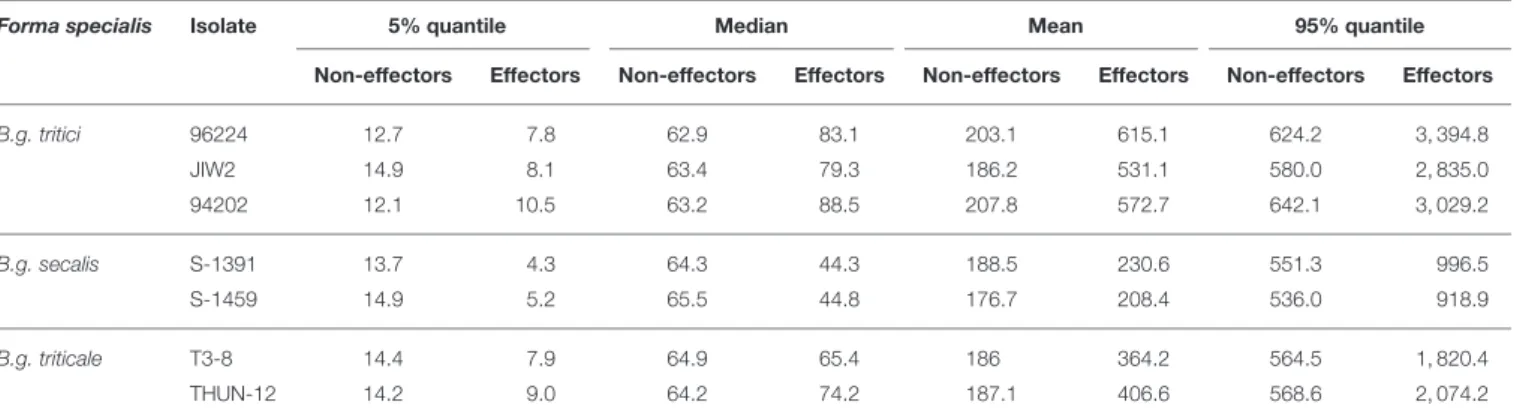
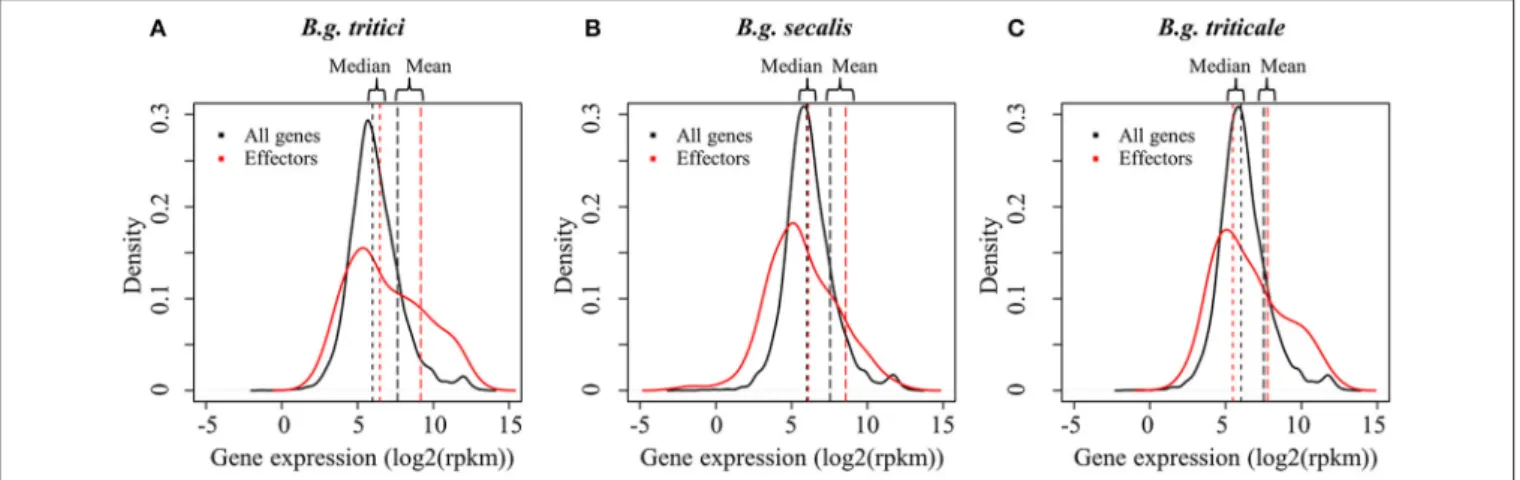
group likely involved in fungal virulence, and containing potential targets of the plant immune system. Using a genome-wide comparison of gene expression levels, we found that the mean expression of candidate effector genes was significantly higher than the gene expression average, irrespective of the mildew isolate or theforma specialis(Table 1,Figure 3).
Then, to study the nature of highly expressed genes in more detail, we selected the 5% most highly expressed ones (top 5%) in each isolate. In wheat mildew, we found that 279 out of the top 5% 345 highly expressed genes are common to all three isolates
FIGURE 2 |Multidimensional scaling plot of RNAsequencing data. Multidimensional scaling plot representing the 21 RNA-seq libraries. Colors represent the differentformae specialesand different dots/shapes represent individual isolates. Dimension 1 and dimension 2 separate the libraries based on the expression values of 6,203 genes prior to differential gene expression analysis. Dimension 1 separates theformae specialesand shows that the expression of theB.g. triticaleisolates is closer to the one ofB.g. triticithan the one ofB.g. secalis.Dimension 2 separates the isolates ofB.g. tritici.
(81%,Figure 4A). Similarly, when comparing across all isolates of wheat, rye and triticale mildew, we found that 255 out of the 418 top 5% genes are common to allformae speciales(62.5%,
Figure 4B). We will hereafter refer to those 418 genes that are in the top 5% in at least one of the studied isolates as the “most HE genes,” and refer to the subset of 255 genes that are highly expressed in all threeff.spp.as the “core HE genes.”
To further analyze the most HE genes for specific gene composition or predicted protein function, we first used gene ontology (GO) annotations for “molecular function,” “cellular component,” and “biological process” and compared the results to genome-wide GO annotations (see Supplementary Data Sheet 2). We found no statistically significant enrichment in any specific GO term in this gene set, and the same was found when extending the analysis to a sample including the top 10% most highly expressed genes. We then performed blast searches against protein conserved domain databases (https://www.ncbi.nlm.nih. gov/Structure/cdd/cdd.shtml) and found a high proportion of proteins involved in basal cellular processes (e.g., ribosomal proteins), indicating a massive investment of the fungus in basal metabolism and housekeeping functions consistent with invasive fungal growth at 2 dpi (see Supplementary Table 4).
Most importantly, we found a significant enrichment in candidate effector genes (Fisher exact testp-value<0.01) as they account for 28, 24, and 13% of the top 5% in wheat, triticale and rye mildews, whereas they represent 8, 7.8, and 7% of the total expressed genes in the sameformae speciales, respectively (Table 2). Similarly, when considering the most HE and core HE genes, candidate effectors represent 27.3% (114 genes) and 11.4% (29 genes) of each gene set, respectively. Of these 114 candidate effector genes, (i) fifteen are members of theAvrPm3a2/f2family (Bourras et al., 2015), (ii) seven belong to theAvrPm2 family which also contains the barley mildew avirulence geneAvra13, and two functionally characterized mildew effectors BEC1011 and BEC1054 (Pliego et al., 2013; Lu et al., 2016; Pennington et al., 2016a; Praz et al., 2017), (iii)fourare members of the wheat powdery mildewSvrPm3a1/f1 suppressor gene family (Bourras et al., 2015; Parlange et al., 2015), (iv) fourteen are members of the family containing the functionally characterized BEC1016
TABLE 1 |Gene expression characteristics for all isolates of the threeformae speciales.
Forma specialis Isolate 5% quantile Median Mean 95% quantile
Non-effectors Effectors Non-effectors Effectors Non-effectors Effectors Non-effectors Effectors
B.g. tritici 96224 12.7 7.8 62.9 83.1 203.1 615.1 624.2 3, 394.8 JIW2 14.9 8.1 63.4 79.3 186.2 531.1 580.0 2, 835.0 94202 12.1 10.5 63.2 88.5 207.8 572.7 642.1 3, 029.2 B.g. secalis S-1391 13.7 4.3 64.3 44.3 188.5 230.6 551.3 996.5 S-1459 14.9 5.2 65.5 44.8 176.7 208.4 536.0 918.9 B.g. triticale T3-8 14.4 7.9 64.9 65.4 186 364.2 564.5 1, 820.4 THUN-12 14.2 9.0 64.2 74.2 187.1 406.6 568.6 2, 074.2
The 5% quantile, median, mean, and 95% quantile values are provided for non-effector genes (abbreviated “Non-effectors”) and for candidate effector genes. All values are in reads per kilo base pair per million reads (rpkm). The candidate effector genes are in general more expressed than the other genes.
FIGURE 3 |Distribution of gene expression levels in wheat, rye, and triticale mildews. Gene expression distributions inB.g. tritici(A),B.g. secalis(B), andB.g. triticale
(C)are depicted with black plain lines for all genes and red plain lines for putative effector The distribution of the log2 (rpkm) values of mean gene expression of all isolates and all replicates is plotted. Mean expression and median expression are indicated as vertical lines in black for all genes and in red for effectors genes. All plots show that there is a higher proportion of effectors in the highly expressed genes as compared to non-effector genes.
FIGURE 4 |Intersections plots showing the overlaps of different sets of highly expressed genes. Histograms represent the number of genes contained in each group present in the overlaps indicated in the lower panel. Highly expressed genes are defined as the top 5% with the highest expression values (see text).(A)Comparison of the threeB.g. triticiisolates. The first bar represents highly expressed genes common to three isolates, the following three bars represent those common to two isolates and the last three bars those found only in one isolate.(B)Comparison of the threeformae speciales. The first bar represents the core highly expressed (HE) genes common to threeformae speciales,the following three bars represent those common to twoformae specialesand the last three bars those found only in one forma specialis.
effector (Pliego et al., 2013), and finally, (v) eight are members of the family containing the functionally characterized BEC1038 effector (Pliego et al., 2013) (see Supplementary Table 5). These results indicate that highly expressed candidate effectors genes are likely to encode for important virulence factors in mildew, including several members of gene families encoding functionally validatedAvrgenes (e.g.,AvrPm3a2/f2, AvrPm2) and suppressors of plant immunity (e.g., BEC1011, BEC1054,SvrPm3a1/f1). They also suggest high conservation of the basal mechanisms of host
infection in wheat, rye, and triticale powdery mildew, based on highly conserved effector function, and possibly common targets in their respective hosts.
Differentially Expressed Genes between
Isolates Are Enriched in Candidate
Effectors and Are
Forma specialis
Specific
In order to distinguish differential expression from simple indel polymorphism, we screened the genomes of the seven
TABLE 2 |Proportion of candidate effector genes in the top 10% and top 5% most highly expressed genes in different isolates of the threeformae speciales.
Formae specialis Isolate Whole genomea Top 10% expressed genesb Top 5% expressed genesc All genes Effectors (%)d All genes Effectors (%)d p-valuee All genes Effectors (%)d p-valuee
B.g. tritici 96224 7133 595 8.3 620 141 22.7 <2.2e-16 345 95 27.5 <2.2e-16
JIW2 7114 591 8.3 620 137 22.1 <2.2e-16 345 93 27.0 <2.2e-16
94202 7120 592 8.3 620 140 22.6 <2.2e-16 345 95 27.5 <2.2e-16
B.g. secalis S-1391 6986 523 7.5 620 70 11.3 0.0023 337 46 13.6 0.0012
S-1459 6983 522 7.5 620 71 11.5 0.0017 337 43 12.8 0.0050
B.g. triticale T3-8 7094 579 8.2 620 112 18.1 <2.2e-16 340 74 21.8 8.6e-16
THUN-12 7091 580 8.2 620 119 19.2 <2.2e-16 340 84 24.7 <2.2e-16
aTotal number of genes and candidate effectors found in mildew genome.bTotal number of genes and candidate effectors found in the to 10% most highly expressed genes.cTotal number of genes and candidate effectors found in the to 5% most highly expressed genes.dPercentage of candidate effectors in the considered gene set.eP-value of the Fisher’s exact test for enrichment in candidate effectors. A gene set is considered enriched in effectors if p-value<0.01.
isolates for instances of gene presence/absence polymorphism. For this, we used genome sequencing coverage to identify possible cases of gene deletions in the studied isolates (see section Materials and Methods, Supplementary Text 1, Supplementary Figure 2, Supplementary Table 6). In total we found 193 genes deleted in at least one isolate, with most cases of gene deletions in theB.g. secalisisolates (see Supplementary Table 6). All downstream analyses of differential gene expression were accordingly curated for indel gene polymorphism based on this list of 193 presence/absence variation.
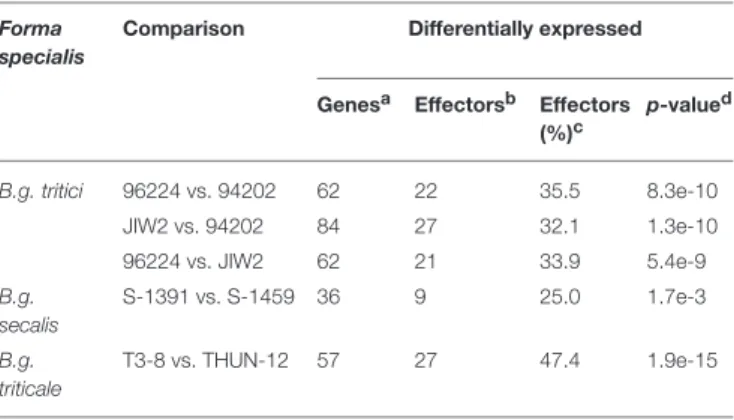
We then first compared gene expression between isolates of the samef.sp, using a threshold for differential expression of log2 fold change (Log2FC)>|1.5| and a false discovery rate (FDR)
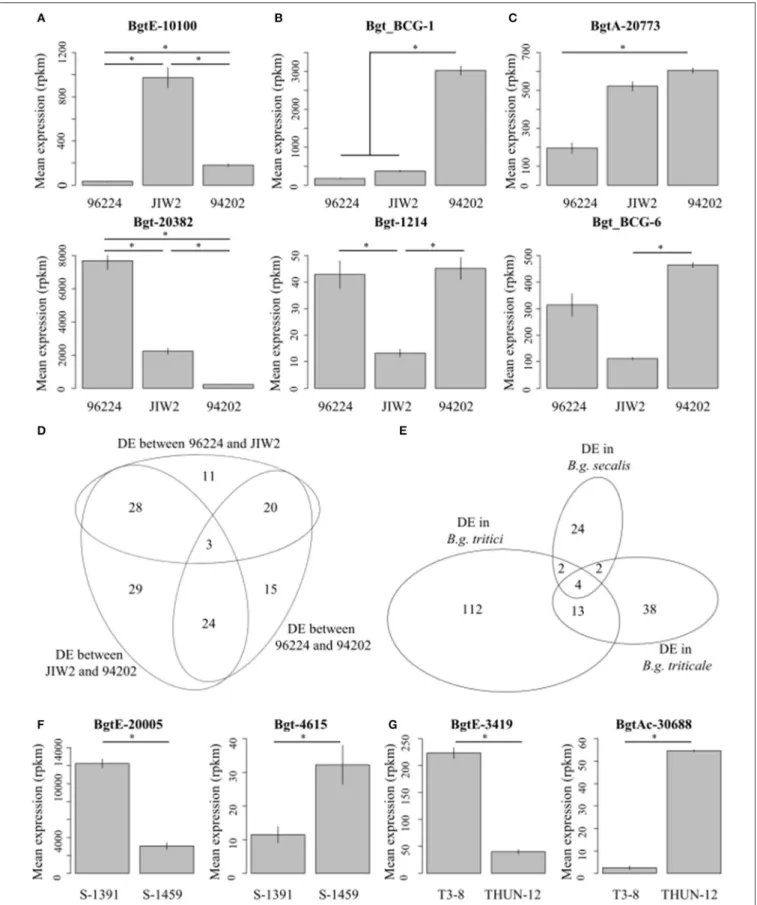
<0.01 (see section Materials and Methods). In wheat powdery mildew, we performed pairwise comparisons between the three isolates (96224 vs. 94202; 96224 vs. JIW2, and 94202 vs. JIW2), and found 130 differentially expressed (DE) genes (i.e., fulfilling the Log2FC and FDR criteria) with a significant enrichment for genes encoding putative effectors (39 genes, 30%) (Table 3). Of these, three genes showed an isolate-specific level of expression (Figures 5A,D) and all three encode for putative effectors: Bgt-20382is a member of theAvrPm3a2/f2family, andBgtE-10100
andBgtAc-30857are members of a functionally uncharacterized putative effector family containing 7 members inB.g. triticiand 2 inB.g. hordei.Bgt-20382andBgtE-10100are also part of the most HE genes.
Seventy-two genes (55.4%) were differentially expressed in one of the isolates as compared to the two others (e.g.,
Bgt_BCG-1 and Bgt-1214, Figures 5B,D). One prominent example in the latter group of DE genes is SvrPm3a1/f1(Syn.
Bgt_BCG-1) a putative effector gene involved in race specific adaptation of B.g. tritici to wheat cultivars containing the
Pm3 resistance gene (Bourras et al., 2015; Parlange et al., 2015). And finally 55 genes (42.3%) were differentially expressed between two isolates, while expression in the third isolate was intermediate and not significantly different from any of the two others (e.g.,BgtA-20773and Bgt_BCG-6;
Figures 5C,D).
TABLE 3 |Summary of differentially expressed genes between isolates of the sameforma specialis.
Forma specialis
Comparison Differentially expressed
Genesa Effectorsb Effectors (%)c p-valued B.g. tritici 96224 vs. 94202 62 22 35.5 8.3e-10 JIW2 vs. 94202 84 27 32.1 1.3e-10 96224 vs. JIW2 62 21 33.9 5.4e-9 B.g. secalis S-1391 vs. S-1459 36 9 25.0 1.7e-3 B.g. triticale T3-8 vs. THUN-12 57 27 47.4 1.9e-15
aTotal number of genes differentially expressed between pairs of isolates from the same forma specialis.bNumber of candidate effectors differentially expressed between isolates of the same forma specialis.cPercentage of candidate effectors among differentially expressed genes.dP-value of the Fisher’s exact test for enrichment in candidate effectors. A gene set is considered enriched in effectors if p-value<0.01.
Similar results were found when comparing gene expression in the two isolates ofB.g. secalis(36 DE genes), and the two ofB.g. triticale(57 DE genes), both showing a significant enrichment in DE putative effectors (25 and 47.4%, respectively) (Table 3,
Figures 5F,G). We have also applied all DE genes (a total of 195 genes from the three intra-forma specialiscomparative analyses) to GO annotation and protein domain prediction, and found no statistically significant enrichment for a specific GO category or protein function (see Supplementary Table 7, Supplementary Data Sheet 2). We also found little overlap in DE genes between wheat, rye, and triticale mildews as 89% (174 out of 195) were found to be differentially expressed only between isolates of the same forma specialis (Figure 5E). We also performed the same differential expression analyses between isolates using the three additional mapping strategies (Supplementary Table 3), and found very similar results irrespective of mapping stringency (see Supplementary Table 8).
FIGURE 5 |Intra-forma specialisgene differential gene expression. Selected examples of differentially expressed genes between isolates of the sameforma specialis are indicated forB.g. tritici(A–C),B.g. secalis(F), andB.g. triticale(G). *Indicate that the expression of the gene is significantly different between two isolates (comparisons are marked by horizontal lines).(A)Shows two example of genes that are differentially expressed between each pair of isolates.(B)Shows two
FIGURE 5 |examples of genes that are differentially expressed between one isolate and the two others.(C)Shows two examples of genes that are differentially expressed between two isolates but show intermediate and non-significantly different expression in the third isolate. Values indicate mean expression from three biological replicates plotted in reads per kilo base pairs per million reads (rpkm). The overlap between differentially expressed genes in the threeB.g. triticiisolates is depicted as a Venn diagram in(D). Similarly, the overlap between gene differentially expressed between isolates of eachforma specialisis depicted in(E). The number of overlapping genes is indicated.
Thus, our results indicate that DE genes between individual isolates are consistently enriched in candidate effectors irrespective of the forma specialis. In contrast to the core set of highly expressed genes, we found little overlap between wheat, rye, and triticale mildew based on differentially expressed genes. These results suggest there are distinctly different sets of candidate effector genes that are differentially regulated at early stages of the infection in aforma specialis-specific manner.
Candidate Effector Genes Are Responsible
for Most of the Differences in Gene
Expression between
Formae Speciales
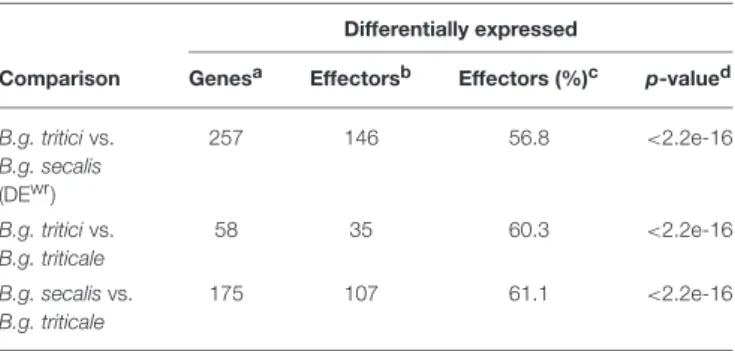
Our initial multidimensional scaling analysis indicated significant differences in gene expression between the three mildewff.spp, suggesting there is a substantial number of genes with a forma specialis-specific expression level. Therefore, we studied differential gene expression between the threeff.spp., and we were particularly interested in comparing gene expression in the hybridB.g. triticaleto that of the wheat and rye mildew donors. We used the same criteria described earlier in this work for defining the thresholds for differential expression between wheat, rye, and triticale mildews. In total we found 292 DE genes (hereafter referred to as DEff.spp) and most of these
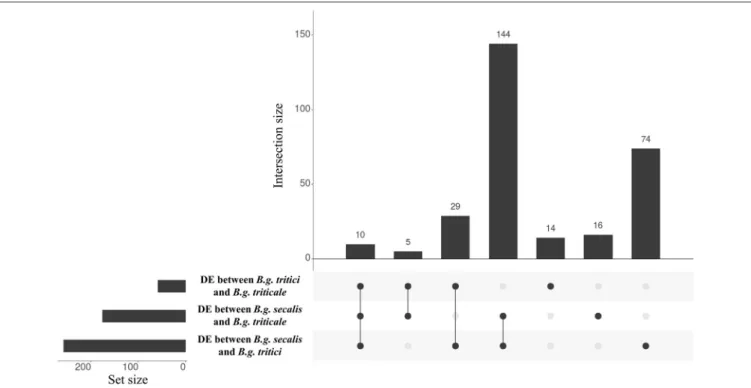
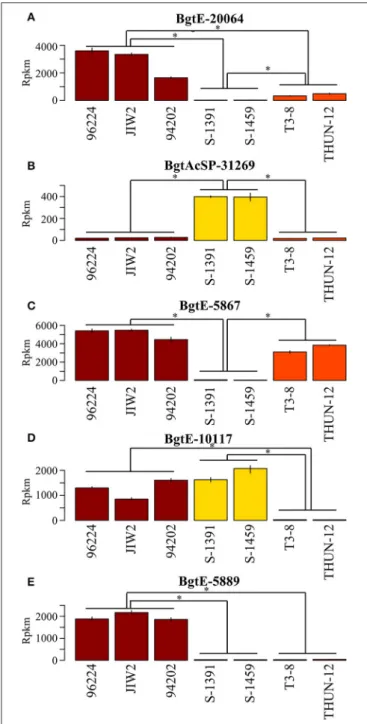
are found between B.g. tritici and B.g. secalis (257, hereafter called DEwr genes, 146 putative effectors, 56.8%). We found less differences between triticale and wheat mildews (58 DE genes, 35 putative effectors, 60.3%) as compared to the difference between triticale and rye mildews (175 DE genes, 107 putative effectors, 61.1%) (Table 4, Figure 6). Analyses performed with the mapping obtained using different stringencies gave very similar results, with 85–94% of the genes identified as DE being the same irrespective of the mapping strategy (see Supplementary Table 8). In all cases the identified DE genes were highly enriched in putative effectors. We found 10 genes that are DE between the threeformae speciales(Figure 7A), 144 genes that are DE betweenB.g. secalisand the two otherformae speciales(Figures 7B,C), only five genes being DE betweenB.g. triticaleand the two otherformae speciales(Figure 7D) and 29 genes that are differentially expressed between B.g. tritici and the two otherformae speciales(Figure 7E). Using the same GO and protein domain annotation approach described in previous sections, we found no statistically significant enrichment in any GO term or putative protein domains (see Supplementary Table 9, Supplementary Data Sheet 2). To further corroborate this enrichment of DEff.spp genes in candidate effectors, we
applied different thresholds of log2FC to the same RNAseq pipeline (Log2FC > 1, Log2FC > 2 and Log2FC > 2.5, see section Materials and Methods) and we consistently found a significant enrichment in putative effectors irrespective of the chosen Log2FC threshold (Supplementary Table 10). We then
TABLE 4 |Summary of the differentially expressed genes between wheat, rye, and triticale mildewformae speciales.
Differentially expressed
Comparison Genesa Effectorsb Effectors (%)c p-valued
B.g. triticivs. B.g. secalis (DEwr) 257 146 56.8 <2.2e-16 B.g. triticivs. B.g. triticale 58 35 60.3 <2.2e-16 B.g. secalisvs. B.g. triticale 175 107 61.1 <2.2e-16
aTotal number of genes differentially expressed.bNumber of differentially expressed candidate effectors.cPercentage of candidate effectors among differentially expressed genes.dP-value of the Fisher’s exact test for enrichment in candidate effectors. A gene set is considered enriched in effectors if p-value<0.01.
compared the most HE genes and DEff.sppgenes for gene content
and predicted protein function. We found that most of the genes are unique to one of the sets (seeFigure 8A) and that the two sets of genes encode for distinctly different protein functions. For the most HE genes we found that 34.7% encoded for proteins related to the secretome (i.e., putative effectors, non-effector secreted proteins, and proteins involved in secretion, see section Materials and Methods), while another 34.7% encoded for proteins related to ribosomal or mitochondrial functions (see
Figure 8B, Supplementary Table 11). In contrast, DEff.sppgenes
mainly encoded for proteins related to the secretome (62.4%) including a large proportion of putative effectors (56.9%) and only 6.2% were related to the ribosome or the mitochondrion (see Figure 8B, Supplementary Table 11). This indicates that differences between formae speciales are mainly found in the secretome.
Taken together, these results indicate that the expression in the hybridB.g. triticaleis more similar to that ofB.g. triticithan to
B.g. secalis, thus reflecting the hybrid genome composition, with higher proportions (>80%) being inherited from of theB.g. tritici
donor (Menardo et al., 2016). In addition, most of the differences in gene expression between wheat, rye, and triticale mildews are contributed by genes encoding putative secreted proteins (mainly putative effectors) and proteins involved in the secretory pathway. This suggests that host adaptation in mildews can be based on transcriptional reprogramming of the secretome and selective activation of effector genes in aforma specialis-specific manner.
Gene Expression in the Hybrid Triticale
Mildew Is Conserved with the Donor
As shown in the previous section, gene expression in the hybrid
FIGURE 6 |Intersection plots showing the overlap of genes differentially expressed betweenformae speciales. The horizontal histograms represent the number of differentially expressed (DE) genes in each comparison. Gene expression is more similar betweenB.g. triticiandB.g. triticaleas only 58 genes are differentially expressed between these twoformae speciales. The vertical histograms represent the number of genes contained in each group present in the overlaps indicated in the lower panel. The first vertical bar represent genes that are differentially expressed between the threeformae speciales.The three following vertical bars represent genes DE between oneforma specialisand the two others. Most of the genes are differentially expressed betweenB.g. secalisand the two otherformae speciales. The last three vertical bars represent genes that are differentially expressed between twoformae speciales.
with the genomic composition of triticale mildew (Menardo et al., 2016). Therefore, we further assessed to what extent gene expression in the two hybrid isolates is correlated to the sequence origin of the gene which can be either inherited from the wheat or rye mildews. Thus, we based our analysis on the 257 genes which are differentially expressed between rye and wheat mildews (see Supplementary Figure 4) as follows: (i) we classified gene expression levels of the 257 genes in the hybrid intoB.g. tritici -like or B.g. secalis-like, based on a the previously described thresholds for differential gene expression (see section Materials and Methods), (ii) we assessed the possible wheat or rye mildew origin of gene coding and promoter sequences in each of the two B.g. triticale isolates, based on sequence comparison and phylogenetic clustering (see section Materials and Methods), and (iii) we assessed to what extent gene expression levels in the hybrid can be correlated to the origin of the gene coding and/or promoter sequences.
In a first step, we were able to assign a B.g. tritici-like or
B.g. secalis-like expression for 188 and 196 out of the 257 DEwr genes in 12 and T3-8, respectively. In THUN-12, 146 genes showed a B.g. tritici-like expression, 42 genes had similar expression to B.g. secalis, and 15 showed a hybrid specific level of expression. Similarly, in T3-8, 144 genes had a B.g. tritici-like expression, 52 exhibited a B.g. secalis-like expression, and 11 showed a hybrid-specific expression level (Table 5, Supplementary Figure 5). For 54 genes in THUN-12,
and 50 in T3-8, the expression level was neither significantly different fromB.g. tritici, nor B.g. secalis(see section Materials and Methods), therefore they could not be assigned to either of theB.g. tritici-like orB.g. secalis-like expression groups.
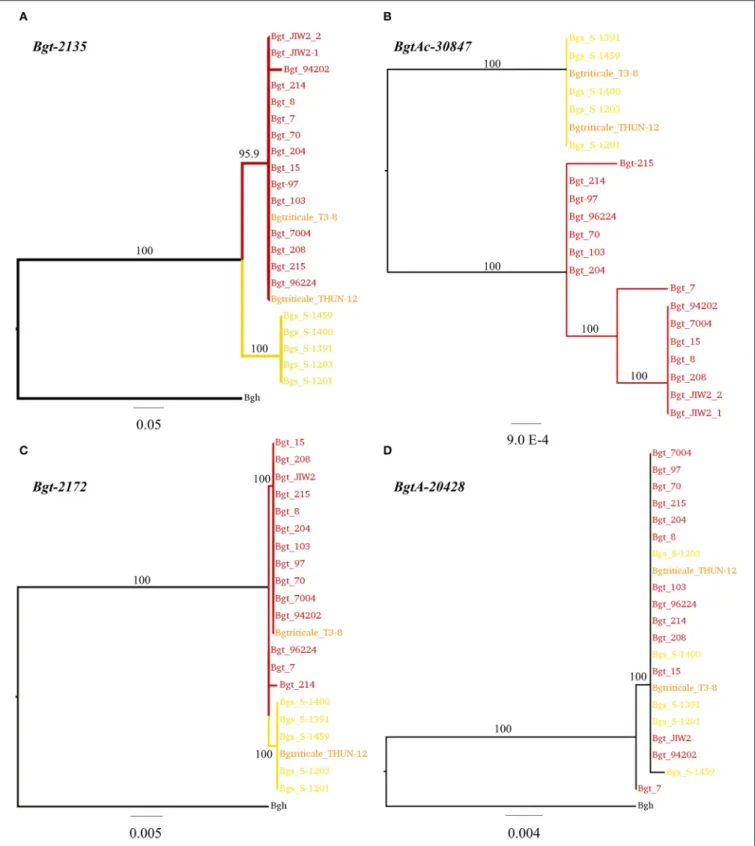
In a second step, we assessed the possible genomic origin of the 257 DEwr genes in THUN-12 and T3-8. We used a phylogenetic approach to identify clusters of highly similar sequences (see section Materials and Methods for detailed procedure) and sequence information from 22 mildew isolates including: the two B.g. triticale isolates THUN-12 and T3-8, 14 ofB.g. tritici (including 96224, 94202, and JIW2), 5 ofB.g. secalis(including S-1391 and S-1459), and the reference barley powdery mildew genome as an outgroup (see Supplementary Table 2 and section Materials and Methods) (Spanu et al., 2010; Wicker et al., 2013; Menardo et al., 2016). We were able to assign a distinct wheat or rye mildew genomic origin for 156 genes in THUN-12, and 157 genes in T3-8, out of the 257 DEwrgenes. In THUN-12, 133 genes originated fromB.g. tritici
(Figure 9A) and 23 fromB.g. secalis(seeFigures 9B,C), and the results in T3-8 are very similar with 132 genes originating from
B.g. tritici(Figures 9A,C) and 25 fromB.g. secalis(Figure 9B). For 101 genes in THUN-12 and 100 in T3-8, it was not possible to distinguish whichforma specialisthey originate from based on our phylogenetic analysis (see Figure 9D, Table 5, Supplementary Figure 6, and section Materials and Methods for detailed procedure).
FIGURE 7 |Genes differentially expressed betweenformae speciales. Selected examples of genes differentially expressed between theB.g. tritici (red),B.g. secalis(yellow) andB.g. triticale(orange)formae speciales. The mean expression of three biological replicates is plotted in reads per kilo base pairs per million reads (rpkm). *Indicate that the expression of the gene is significantly different between twoformae speciales(comparisons are marked by horizontal lines).(A)BgtE-20064is differentially expressed between the threeformae speciales.(B,C)BgtAcSP-31269andBgtE-5867are differentially expressed betweenB.g. secalisand the two otherformae speciales.(D)
BgtE-10117is differentially expressed betweenB.g. triticaleand the two other formae speciales.(E)BgtE-5889is differentially expressed betweenB.g. tritici and the two otherformae speciales.
In a third step, we assessed the possible wheat or rye mildew origin of the promoter sequences of the 257 DEwrgenes in THUN-12 and T3-8. We defined the promoter sequence
FIGURE 8 |Comparisons of the most highly expressed genes and differentially expressed genes betweenformae speciales.(A)Venn diagram showing the overlap between the most highly expressed genes (most HE genes) and the genes differentially expressed betweenformae speciales (DEff.spp
. ).(B)Bar plots showing functional annotation of the most HE genes,
DEff.spp
. genes, and the 16 genes identified as unambiguous cases of
non-parent of origin expression in the hybrid triticale mildew, based on conserved protein domain annotation, and subcellular localization prediction (see section Materials and Methods).
as the 1kb region upstream of the gene start, and used the same phylogenetic approach described above to classify those sequences based on their origin. We were able to assign a donor genome for 159 sequences from THUN-12 and 157 from T3-8. In THUN-12, 131 promoter sequences could be assigned toB.g. tritici and 28 to B.g. secalis. Similarly, in T3-8, 134 originated from the B.g. tritici donor genome and 23 fromB.g. secalis. Finally, we could not determine a genome of origin for 98 gene promoters in THUN-12 and 100 in T3-8 (Table 5).
TABLE 5 |Analysis of correlation between sequence origin and expression levels in theB.g. triticalehybrid of 257 genes differentially expressed between wheat and rye mildews.
Similar toB.g. triticia Similar toB.g. secalisb Unique toB.g. triticalec Undefinedd
THUN-12 T3-8 THUN-12 T3-8 THUN-12 T3-8 THUN-12 T3-8
Expression 146 (77.7%) 144 (73.5%) 42 (22.3%) 52 (26.5%) 15 11 54 50
Genomic sequence 133 (85.3%) 132 (84.1%) 23 (14.7%) 25 (15.9%) 101 100
Promoter sequence 131 (82.4%) 134 (85.5%) 28 (17.6%) 23 (14.6%) 98 100
aNumber of genes among the 257 selected gene (DEwr) subset showing similarity to B.g. tritici based on expression level, origin of the gene sequence, or origin of the promoter sequence.bNumber of genes among the 257 selected gene subset showing similarity to B.g. secalis based on the same criteria listed ina.cNumber of genes with an expression level unique to the hybrid B.g. triticale.dNumber of genes with undefined origin of expression or sequence. All numbers are given for both B.g. triticale isolates THUN-12 and T3-8 as well as a percentage of the 257 considered genes between brackets.
Based on the data obtained from the three approaches described above (i.e., expression level, origin of the coding sequence, and origin of the promoter sequence), we compared the composition of our subset of 257 DEwr genes to that of the genomes of the studied triticale isolates. For THUN-12, we found that 15% of the genes, and 18% of the promoters of the DEwr genes originated fromB.g. secalis, consistent with the overall proportion of the rye mildew genome in this isolate (17%,Menardo et al., 2016). Similarly, we found that 16% of the genes and 15% of the promoters in T3-8 originated fromB.g. secalis, which is also consistent with the overall proportion of the rye mildew genome in this isolate (13%,Menardo et al., 2016). However, on the gene expression level, we found that 22% of the DEwr genes in THUN-12, and 26% in T3-8 were expressed as in rye mildew, suggesting a bias toward a B.g. secalis-like gene regulation in the hybrid triticale mildew. In particular, we found 17 unambiguous cases where the origin of the gene did not correlate with its expression, and only three of these genes (Bgt_avrF2_20,Bgt-2135, andBgt-2708) were common to both triticale isolates (Table 6). Of these 17 cases, two genes for which the origin of the promoter sequences could not be assigned, had the coding sequence of B.g. secalisand an expression level of
B.g. tritici. The 15 remaining genes all had the coding sequence of B.g. triticiand an expression level similar to B.g. secalis. Of these 15 genes with aB.g. secalis-like expression, we were able to resolve a possible origin of the promoter for 9 cases. Of these, 8 had aB.g. triticipromoter inconsistent with theirB.g. secalis -like expression, and only one gene, Bgt_avrF2_20, had a B.g. secalis promoter consistent with its expression level (Table 6). These results suggest that the bias toward aB.g. secalis-like gene regulation in the hybrid is not due to an enrichment in genes inherited from the rye genome, but to wheat mildew inherited genes that are regulated like rye mildew genes. They also suggest that such non-parent of origin gene expression in the hybrid might be highly influenced by the genetic background since most of the identified instances in triticale mildew are isolate specific.
We found that 11 out of the 17 unambiguous cases where the origin of the genes did not correlate with expression encode candidate effectors. Interestingly, all 11 putative effectors encode wheat mildew genes that are expressed like rye genes, and all except one (Bgt_BCG-6) are downregulated in the hybrid triticale as compared to their expression in the wheat mildew
donor genome (Table 6). Of the 11 genes, two are members of the effector family encoding theB.g. tritici avirulence gene
AvrPm3a2/f2(includingBgt_avrF2_20), one is the direct homolog of the wheat mildewR gene suppressorSvrPm3a1/f1, and two additional ones (Bgt_BCG-5andBgt_BCG-6) are members of the
SvrPm3a1/f1effector family (Table 6). These results substantiate the hypothesis that mildew effectors, in particular those encoded withinAvrandSvrgene families, likely play an important role in host-adaptation. Furthermore, we postulate that these putative effectors are possible targets of immune receptors encoded by the rye genome or the rye sub-genome in the hybrid triticale host, thus explaining why these putative effectors are expressed to lower levels inB.g. secalisand B.g. triticaleas compared to
B.g. triticiduring compatible interactions with their respective adapted hosts.
To summarize, our results indicate that for most of the genes in the mildew hybrid, there is high level of conservation of gene regulation based on theB.g. tritici orB.g. secalis origin of the gene and the promoter sequences. However, we found a higher contribution ofB.g. secalisto gene regulation in the hybrid as compared to the overall proportions of the rye mildew genome in
B.g. triticale. We have also found a few but prominent examples of non-parent of origin expression of putative effector genes encoded within gene families commonly involved in cultivar adaptation in wheat mildew.
DISCUSSION
The Combination of Transcriptomics and
Genetic Diversity Data Allows Inter-Formae
speciales
Comparisons
In this study, we compared seven isolates from three formae speciales, namely wheat, rye, and triticale powdery mildews. The threeff.spp.cannot be distinguished based on morphological or cytological criteria. At the genomic level,B.g. secalisis relatively distant fromB.g. tritici, while theB.g. triticalegenome shows a hybrid architecture with segments originating from the wheat mildew donor and others from the rye mildew donor, with a very variable origin of the different segments in different isolates (Menardo et al., 2016). Many published RNAseq studies compared gene expression levels of the same fungal genotype under different conditions, at different times after infection, or
FIGURE 9 |Phylogenetic analysis of four genes differentially expressed between wheat and rye mildew based on 23Blumeria graminisgenomes. Selected examples ofB.g. triticalegenes for which phylogeny data was used to assign the wheat or rye mildew origin of the gene. The trees were inferred with nucleotide sequences with 10,000 bootstraps. The scale bar indicates a measures of expected substitution per site. Bootstrap values are indicated on the branches. In(A)the origin of the gene Bgt-2135was assigned asB.g. triticiin both triticale isolates T3-8 and THUN-12. In(B)the origin ofBgt-30847was assigned asB.g. secalisin both isolates. In(C)
the geneBgt-2172was classified as originating fromB.g. triticiin T3-8, andB.g. secalisin THUN-12. Finally, an example of a gene with undefined origin is depicted in
TABLE 6 |Analysis of correlation between sequence origin and expression levels in 17 unambiguous cases ofde novogene regulation in the hygrid triticale mildew.
Gene name Expressiona Up-/down-regulationb Genomic sequencec Promoter sequenced Isolatee Subcellular localizationf Effectorg Effector family/annotationh
1 Bgt_avrF2_20 B.g. secalis − B.g. tritici B.g. secalis THUN-12,
T3-8
Secretory pathway * AvrPm3a2/f2
2 Bgt-2135 B.g. secalis − B.g. tritici B.g. tritici THUN-12,
T3-8
Secretory pathway * −
3 Bgt-2708 B.g. secalis − B.g. tritici B.g. tritici THUN-12,
T3-8
Secretory pathway * −
4 Bgt_BCG-6 B.g. secalis + B.g. tritici B.g. tritici THUN-12 Secretory pathway * SvrPm3a1/f1
5 Bgt-3010 B.g. secalis + B.g. tritici B.g. tritici THUN-12 Sugar metabolism Mannitol
dehydrogenase C-terminal domain
6 BgtE-20100 B.g. secalis − B.g. tritici B.g. tritici THUN-12 Secretory pathway * 13
7 BgtAc-31565 B.g. secalis − B.g. tritici Undefined THUN-12 NA *
8 BgtASP-21288 B.g. secalis − B.g. tritici Undefined THUN-12 Membrane * Proteolipid membrane
potential modulator
9 Bgt_BCG-5 B.g. secalis − B.g. tritici B.g. tritici T3-8 Secretory pathway * SvrPm3a1/f1
10 Bgt-3045 B.g. secalis − B.g. tritici B.g. tritici T3-8 Membrane * MARVEL
domain-containing proteins
11 BgtE-20002 B.g. secalis − B.g. tritici B.g. tritici T3-8 Secretory pathway * AvrPm3a2/f2
12 Bgt_BCG-1 B.g. secalis − B.g. tritici Undefined T3-8 Secretory pathway SvrPm3a1/f1
13 BgtAcSP-31482 B.g. secalis − B.g. tritici Undefined T3-8 Secretory pathway * 9
14 BgtE-10129 B.g. secalis − B.g. tritici Undefined T3-8 Secretory pathway 56
15 BgtE-20051 B.g. secalis − B.g. tritici Undefined T3-8 Secretory pathway 13
16 Bgt-2172 B.g. tritici − B.g. secalis Undefined THUN-12 NA
17 Bgt-20216 B.g. tritici + B.g. secalis Undefined T3-8 NA Pseudogene
aClassification of gene regulation based on B.g. tritici or B.g. secalis-like expression levels (see text and section Materials and Methods).bClassification of gene expression levels based on upregulation (+) or downregulation (−) in the hybrid B.g. triticale as compared to B.g. tritici (genes 1–15) and to B.g. secalis (genes 16 and 17).cOrigin of the genomic sequence.dOrigin of the promoter sequence which was defined as the 1kb region upstream gene start (see section Materials and Methods).eTriticale isolates where each case of de novo regulation was found.fPrediction of subcellular localization using TargetP (REF target, see section Materials and Methods).gGenes encoding for candidate secreted effectors. hFunctional annotation based on effector gene families, or putative protein function of non-effector genes. For readability, if the expression, genomic sequence or promoter sequence of one gene is originating from B.g. tritici or from B.g. secalis, the corresponding cell has been highlighted in red or yellow respectively.
between compatible and incompatible interactions (Cantu et al., 2013; Hacquard et al., 2013; Kellner et al., 2014; Palma-Guerrero et al., 2016; Sonah et al., 2016). In our work, we used a reference genome-based approach allowing both intra- and inter-forma specialiscomparisons. Such comparisons of gene expression in different genotypes are challenging because the analysis is based on a reference genome while taking into account the variation in gene content between genotypes. In our case, the genomes of the wheat, rye, and triticale mildews are similar enough to allow the mapping of genomic and RNA sequencing reads on theB.g. triticireference. However, high levels of sequence polymorphism betweenformae speciales,including gene duplications and losses must be accounted for. To do so, we developed a series of analyses based on the available genetic diversity of the mildew genomes. First, we established a method for identifying genes affected by presence/absence polymorphisms based on genome sequence coverage that allowed us to identify genes from our reference genomes that are absent in otherff.spp. Second, the considerable sequence diversity allowed us to establish a phylogeny-based method to determine the gene content in the triticale mildew based on the wheat or rye mildew origin of the sequences. Thus, our work demonstrates ways of using the genetic diversity of
mildew isolates to resolve the genomic complexity of the mildew genomes for robust comparative transcriptome studies.
Our results suggest that many genes and putative effectors specific toB.g. secalisare missing from theB.g. triticireference genome and that the number of putative effectors inB.g. secalisis underestimated in our analyses. This would explain why we have systematically observed lower levels of enrichment in putative effector genes in both HE and DE gene sets from B.g. secalis
as compared to the other ff.spp. (Figure 3, Tables 2, 3). It is possible that a substantial number of putative effectors are yet to be annotated in the rye mildew genome, which will require the production of a B.g. secalis reference genome assembly. We propose that this can be now achieved using long read sequencing technologies such as PacBio Sequencing (Rhoads and Au, 2015). In addition, we also found that the most highly expressed putative effectors of rye mildew had overall lower expression levels than the ones from wheat or triticale mildews (95% quantile,Table 1). It is very likely thatB.g. secalis-specific and highly expressed putative effectors have no direct homolog in the reference genome and are absent from our analysis. Such subspecies-specific gene and sequence variation is reminiscent of previous studies inMagnaporthae oryzae(Liao et al., 2016),
rust fungi (Duplessis et al., 2011), and barley powdery mildew (Hacquard et al., 2013) who reported similar differences in the effector repertoire among different pathogen isolates, subspecies, or lineages, suggesting a role in cultivar and host adaptation.
Identification of a Core-Set of Highly
Expressed Candidate Effector Genes in
Wheat, Rye, and Triticale Mildews
In this study we identified a core-set of genes that are highly expressed in wheat, rye, and triticale mildews suggesting that there is a common mechanism of host infection among mildew
formae speciales. This hypothesis is further substantiated by the fact that the highly expressed genes are enriched in candidate effectors. It has been proposed that candidate effector genes expressed at early stage of infection are involved in suppressing host immunity, in particular PAMP-triggered immunity. In
Pseudomonas syringae, a bacterial pathogen that can infect a wide range of plant species, the majority of the encoded type III effectors have been shown to suppress plant immunity (Shan et al., 2008; Xiang et al., 2008; Guo et al., 2009). In barley powdery mildew, the putative effector BEC1054 was shown to be important for mildew virulence based on a reduction of 60% of the ability of the mildew to form haustoria after HIGS downregulation (Pliego et al., 2013). Also, BEC1054 was shown to target several barley proteins including a pathogenesis-related-5 protein isoform further substantiating its role in suppressing host immunity (Pennington et al., 2016b). Interestingly, we found 7 members of the BEC1054 family in the most HE genes, suggesting that they play an important role in virulence across several mildewformae speciales. Another prominent example of highly expressed effectors isSvrPm3a1/f1, the mildew encoded suppressor of the wheatPm3resistance gene (Bourras et al., 2015; Parlange et al., 2015), and the two knownB.g. triticiavirulence genesAvrPm2andAvrPm3a2/f2(Bourras et al., 2015; Praz et al.,
2017).
Thus, our results identified a set of highly expressed candidate effector genes from three mildew formae speciales, including prominent examples of bona fide effectors, plant immunity suppressors, and R gene avirulence targets. We propose that candidate effector genes that are highly expressed in different
formae speciales might share redundant functions in virulence based on targeting highly conserved proteins in the wheat, rye, and triticale host. These putative effectors might encode important virulence factors and yet uncharacterized AVR proteins, and we speculate that identification of their plant targets might provide new routes for achieving resistance.
Quantitative Differences in Gene
Expression Suggest Possible Role of
Candidate Effector Genes in Host
Adaptation
We found that the genes differentially expressed between isolates of the same forma specialisare enriched in candidate effectors. One prominent case in B.g. triticiisSvrPm3a1/f1 (Bgt_BCG-1), a gene involved in suppressing the wheat Pm3 race-specific resistance. It was shown that such suppression was based on
a combination of the specific SvrPm3a1/f1 allele and a high expression level (Bourras et al., 2015). InLeptosphaeria maculans, RNAi silencing of the avirulence geneAvrLm6resulted in gain of virulence of the pathogen toward oilseed rape cultivars encoding its cognateRgeneRlm6(Fudal et al., 2007). Here,SvrPm3a1/f1
andAvrLm6provide two relevant examples of how differences in effector gene expression can contribute to cultivar adaptation of plant pathogenic fungi. Therefore, we propose that the identified DE genes between isolates of wheat, rye, or triticale mildews, are likely involved in cultivar adaptation, and probably encode for AVRs, SVRs, and important factors for pathogen fitness. Here, quantitative differences in effector gene expression represent an additional level of polymorphism allowing the pathogen to keep important virulence factors that can be transcriptionally activated to suppress resistance and increase pathogen fitness (e.g., SVRs,
bona fide effectors), or inactivated to escape host recognition (e.g., AVRs).
Similarly, we found that the genes differentially expressed betweenformae specialesare also enriched in putative effectors suggesting they are involved in host adaptation in cereal mildews. InMagnaporthe oryzae, the role of effectors in host adaptation has been demonstrated based on significant differences in the effector complement between isolates specialized on japonica rice compared to those specialized on indica rice (Liao et al., 2016). In particular, indica adapted races of M. oryzae lacked several effectors including many encoding rice blast AVRs, with evidence suggesting that AVR-Pia in particular is acting as a host-specificity determinant in M. oryzae subspecies (Liao et al., 2016). Here, we propose that different levels of effector gene expression in different mildew formae speciales form an additional layer of regulation of host-specificity. Selective effector activation/inactivation at the transcriptional level in mildews will result in presence/absence variation of the effector at the protein level. Therefore, DE effectors betweenff.spp.can possibly act as host specificity determinants in a way that is similar to theM. oryzaesubspecies. Many of the DEff.spp.putative effectors encode for members of known mildewAvrand Svrfamilies, including
AvrPm3a2/f2, AvrPm2, Avr
a13, and SvrPm3a1/f1. Therefore, we
propose that host-adaptation in mildews can also be based on major resistance genes in the wheat, rye, and the triticale hosts. Indeed, previous work by Tosa using genetic crosses between mildewformae specialesshowed mendelian segregation for host adaptation in the pathogen suggesting a genetic control of host specificity similar to that ofAvr-R interactions (Tosa, 1989, 1992, 1994). It was also hypothesized that variation in pathogen effector repertoires, in particular those recognized by NLRs, is a driver of host adaptation in the pathogen ( Schulze-Lefert and Panstruga, 2011). Here, selective activation of Avr
andSvrgenes instead of presence/absence variation at the gene level allows mildewformae specialesto escape host recognition while keeping important factors for virulence on their adapted host. This hypothesis is substantiated by the fact that R genes from different cereal species can effectively recognizeAvrsacross mildewformae speciales. Indeed, it was demonstrated that the wheatPm2resistance gene recognizes theAvrPm2effector from
B.g. tritici, as well as its direct homolog from the non-adapted rye mildewforma specialis(BgsE-5845) (Praz et al., 2017).