More Constraints, Smaller Coresets:
Constrained Matrix Approximation of Sparse Big Data
Dan Feldman
Computer Science Department University of Haifa
Haifa, Israel [email protected]
Tamir Tassa
Dep. of Mathematics and Computer Science The Open University
Ra’anana, Israel [email protected]
ABSTRACT
We suggest a generic data reduction technique with provable guarantees for computing the low rank approximation of a matrix under some`z error, and constrained factorizations,
such as the Non-negative Matrix Factorization (NMF). Our main algorithm reduces a givenn×d matrix into a small,
ε-dependent, weighted subset C of its rows (known as a
coreset), whose size is independent of both n and d. We then prove that applying existing algorithms on the result-ing coreset can be turned into (1 +ε)-approximations for the original (large) input matrix. In particular, we provide the first linear time approximation scheme (LTAS) for the rank-one NMF.
The coresetCcan be computed in parallel and using only one pass over a possibly unbounded stream of row vectors. In this sense we improve the result in [4] (Best paper of STOC 2013). Moreover, sinceC is a subset of these rows, its construction time, as well as its sparsity (number of non-zeroes entries) and the sparsity of the resulting low rank approximation depend on the maximum sparsity of an input row, and not on the actual dimensiond. In this sense, we improve the result of Libery [21] (Best paper of KDD 2013) and answer affirmably, and in a more general setting, his open question of computing such a coreset.
We implemented our coreset and demonstrate it by turn-ing Matlab’s NMF off-line function that gets a matrix in the memory of a single machine, into a streaming algorithm that runs in parallel on 64 machines on Amazon’s cloud and re-turns sparse NMF factorization. Source code is provided for reproducing the experiments and integration with existing and future algorithms.
1.
INTRODUCTION
Matrix Factorization is a fundamental problem that was independently introduced in different contexts and applica-tions. In Latent Semantic Analysis (LSA) or Probabilistic LSA (PLSA), the rows of an input matrix A correspond to documents in a large corpus of data, its columns
corre-Permission to make digital or hard copies of all or part of this work for personal or classroom use is granted without fee provided that copies are not made or distributed for profit or commercial advantage and that copies bear this notice and the full cita-tion on the first page. Copyrights for components of this work owned by others than ACM must be honored. Abstracting with credit is permitted. To copy otherwise, or re-publish, to post on servers or to redistribute to lists, requires prior specific permission and/or a fee. Request permissions from [email protected].
KDD’15,August 10-13, 2015, Sydney, NSW, Australia.
c
2015 ACM. ISBN 978-1-4503-3664-2/15/08 ...$15.00.
DOI: http://dx.doi.org/10.1145/2783258.2783312.
spond to terms that may appear in those documents, and the (i, j)th entry inAdenotes the frequency of thejth term in theith document (or other nonnegative statistics like tf-idf). Similarly, in computer vision applications the (i, j)th entry inAmay represent the frequency of theith feature in thejth image, and in social networksA may be the adja-cency matrix of the graph.
An approximate k-ranked factorization such as the thin Singular Value Decomposition (SVD) ofAenables to extract the k most important topics that are represented in that data and, by thus, obtain a concise representation of the data. In nonnegative matrix approximation, each topic is a linear combination of terms (columns ofA), with only non-negative coefficients. Such techniques have been applied, for example, to image segmentation [20], information retrieval [15] and document clustering [26].
In this paper we deal with matrix factorization problems and theirconstrainedvariants. These problems can be de-scribed geometrically as computing a low-dimensional sub-spaceSthat minimizes the sum of distances in some power
z ≥ 1 to a given set P of n points in a d-dimensional Euclidean space, P
p∈Pdist(p, S)
z, where dist(p, S) :=
minx∈Skp−xk2. The input points are the rows of ann×d
matrixA, and their projections on the subspace are the low rank approximation.
1.1
Problem Statement
Optimal(k, z)-subspace. For a given matrixA∈Rn×d
and a pair of integersk, z ≥1, theoptimal (k, z)-subspace
ofAis thek-dimensional subspaceS∗ofRdthat minimizes
the sum of distances to the power ofz from the set of rows
P = {p1,· · ·, pn} of A, i.e., S∗ minimizes costz(P, S) := P
p∈P(dist(p, S)) z
. A (1 +ε)-approximation to this optimal (k, z)-subspace is ak-subspaceSthat minimizes costz(P, S),
up to a multiplicative factor of 1 +ε, costz(P, S)≤(1 +ε)costz(P, S
∗
).
Coreset. For a givenε >0, a (k, z, ε)-coresetC for the matrixAis a subset of scaled rows fromAsuch that using onlyC(withoutA) we can compute a (1 +ε)-approximation the optimal (k, z)-subspace ofA. In particular, ifCis small, we can apply a (possibly inefficient) algorithm onCto get a (1 +ε)-approximation for the optimal (k, z)-subspace ofA. Our main motivation is to compute such small coresets for obtaining the optimal subspace of A also under some additional constraints, as in the NMF problem.
Non-Negative Matrix Factorization (NMF).In one of the variants of the Non-Negative Matrix Factorization
problem we wish to project the rows ofAon a line`∗ that minimizes their sum of distances to this line, with the ad-ditional constraint that `∗ is spanned by a vectoru whose entries are non-negative, i.e,`∗= Sp(u) andu∈L≥0 where
L≥0=
n
(x1,· · ·, xd)∈Rd:x1,· · ·, xd≥0 o
is the non-negative orthant ofRd. If the rows ofAhave only
non-negative entries (as is common in many applications), then their projections on`∗will also be non-negative. This results in a factorization auT ∈
Rn×d that approximatesA
whereaanduare non-negative column vectors.
(L, k, z)-Subspace optimization. A natural
generaliza-tion of NMF is the (L, k, z)-subspace optimization problem: given a convex coneL inRd, one looks for ak-dimensional
subspace S∗L(P) that minimizes costz(P, S) over every k
-dimensional subspaceS that is spanned bykvectors in L. In the special case k = 1 we denote SL∗(P) by `
∗
L(P). A
(1 +ε)-approximationSto the optimal (L, k, z)-subspace is a subspace S that is spanned by k vectors inL such that costz(P, S)≤(1 +ε)costz(P, S∗).
1.2
Related Work
Coresets. Following a decade of research, coresets (i.e., subsets of rows from the input matrix) that approximate
any subspace in Rd were suggested in [6, 24] for sums of
distances to the power of z ≥ 1. However, their size is
|C|=O(dkO(z)/ε2), i.e, polynomial ind, which makes them
less suitable for common large matrices (documents-terms, images-features, and adjacency matrices of graphs) where
d ∼ n. The dependency on d is due to the complexity, known aspseudo-dimension, of this family of subspaces.
Our work here is based on these results, but we show how to remove thed factor by reducing the family of subspaces and using a post-processing algorithm for extracting the de-sired subspace from the coreset. For the casez = 2, a de-terministic coreset construction of size independent ofdwas very recently suggested in [11]. However, the construction is heavily tailored for this case of squared distances and SVD, unlike the above constructions and the construction in our paper.
To our knowledge, the only coreset for constrained factor-ization was given in [3] by Boutsidis and Drineas. They con-centrated on the regression problem of minimizingkAx−bk
over positive x∈ Rd. They used a coreset of size roughly
dlog(n)/ε2 to approximate this problem, and thus it is use-ful only if d n. In addition, the coreset is proved to approximate only the optimal solution, and it is not clear how to apply it for the parallel or streaming setting without the required guarantee for merging a pair of coresets.
It was proved in [23] that for L = Rd and every z ≥
1, the optimal (L, k, z)-subspace isspanned by poly(k,1/ε) input rows, using a non-constructive proof of existence. Our work generalizes this result to the constrained subspace case, and implies efficient constructions of these “spanning” sets. Other weaker versions of coresets appear in [7] in the context ofk-means clustering.
Sketches.Asketchin our context is a set of vectors inRd
that can be used to compute a (1 +ε)-approximation to the optimal subspace of a given matrix. Unlike coresets, if the input matrix is sparse, the sketch is in general not sparse.
A sketch of cardinality d that approximates the sum of squared distances (z = 2) for any subspace inRd can be
constructed with no approximation error (ε= 0) using thed
rows of the matrixDVT whereU DVT =Ais the thin SVD ofA. It was proved in [10] that taking the firstO(k/ε) rows ofDVT yields such a sketch. This sketch can be constructed
in both the streaming and parallel models by replacing ε
with 1/lognin the time and memory requirements. In [21] (Best paper of KDD 2013) the above lognfactor was removed from the streaming setting, as shown by the analysis of [13]. In [21, 13] the open question of whether we can construct such coresets (i.e., subsets of the input rows) of size independent ofdwas left. In this paper we answer this question affirmably, also forz≥1 and constrained op-timization.
Sketches forz6= 2 of size polynomial indwere suggested in [9, 5]. First sketch that can be constructed in input spar-sity time was suggested in [4] (Best paper of STOC 2013). However, the sketch is dense and thus not applicable for merge-reduce techniques, and can not be computed in par-allel or for streaming big data.
Non-negative Matrix Factorization (NMF).Unlike the optimal (unconstrained) subspace problem, Vavasis [25] has shown that for general values of k, NMF is NP-hard, even for z = 2 and L = L≥0. In fact, there are almost
no provable results in the study of the NMF problem. A notable exception is the paper by Arora et al. [1] which describes a solution under assumptions that may be hard to verify in practice and runs in time 2(log(1ε)
O(1)
)poly(n, d) where poly(n, d) is some implicit polynomial innanddfor
k= 1.
We suggest a PTAS that takes timeO(nd2)+O(d·21/εO(1)) for this case and makes no assumptions on the input. For the
casek >1 running the algorithm in [1] on our
correspond-ing coreset would improve their runncorrespond-ing time toO(nd2) for
constantskandε.
To our knowledge, all other papers that studied the NMF problem proposed heuristics for solving it based on greedy and rank-one downdating e.g. [2, 15, 16, 17, 18, 19, 20]. In the downdating approach, similarly to the SVD recur-sive algorithm for computing the (unconstrained)k-rank ap-proximation, existing heuristics solve the (L, k, z)-subspace optimization problem by applying a solution to the optimal (L,1, z)-subspace (line) inkiterations: one starts by solving the problem fork= 1, and using the obtained solution, the algorithm then proceeds to “update” the input matrix and then solve another 1-dimensional problem on the updated matrix.
All these off-line algorithms can now be applied on our small coresets to boost both their running time and perfor-mance. For example, these heuristics usually run a lot of iterations from an initial guess (seed) until they converge to a local minimum, and then repeat on other seeds for ob-taining possibly better local minima. Running them on the coresets will allow using more iterations and seeds in less time, which in turn might improve the quality of the result. We can also run such off-line algorithms on streaming data and in parallel, by applying them on the coresets for the data seen so far as explained in [10].
1.3
Our results
Coresets for low-rank approximation. We prove that for every given matrixA∈Rn×d, an error parameterε >0,
kO(z) ε log(
1
ε). In particular, unlike previous results, the size
of the coreset C is independent of the input matrix size,
d and n, and thus its sparsity depends on the maximum sparsity of each row and not on the size ofA. Such a result is currently known only for the special casez= 2 [11]. In order to extract the approximated optimal subspace ofAfrom the coresetC, one needs to compute the optimal subspaceS∗of
C. This subspace is not necessarily a good approximation to the optimal subspace of A. However, by applying our post-processing with C,S∗ andL =Rd as its input yields
the desired approximation (see Algorithm 1).
Coresets for constrained optimization. As in most of the existing algorithms for NMF (see related work), we use an algorithm for solving the case k = 1 in order to solve the more general (L, k, z)-subspace optimization for
anyk >1. We prove that any such algorithm that computes
a (1 +ε)-approximation for the (L,1, z)-subspace of a given matrixA, can be applied on our coresetC to obtain a (1 +
ε)-approximation ` to the optimal (L,1, z)-subspace of A. This property of the coreset holds simultaneously for every cone L of Rd. The (L,1, z)-subspace (line) ` is computed
by (i) applying the given approximation algorithm on the coresetCto get an output line`∗, and then(ii)rotate`∗for the given tuple (C, L, ε, `∗) using our post-processing that returns the final approximated line`; see Algorithm 1.
LTAS for constrained factorization. Unfortunately, althoughCis small, we could not find any polynomial time algorithm in the input that can provably compute the opti-mal subspace ofC or its approximation, even for the case of Non-Negative Matrix Factorization where k = 1 and
L = L≥0 . We thus design the first linear time
approx-imation algorithm (LTAS) for computing such a (1 +ε )-approximation ˜`to the optimal (L,1, z)-subspace, for any given coneLandz≥1. For the casez= 2 its running time isO(nd2) +O(d·21/εO(1)) when applied on our coreset.
Unlike previous results that apply only for the Frobenius norm (z = 2), and non-negativity constraints, our coreset and LTAS can be computed for a more general family of constraints and anyz≥1 to obtain a sparse approximation.
Streaming and parallel coreset construction. Via traditional map-reduce or merge-and-reduce techniques, our coresets can be computed using one pass over a possibly un-bounded stream of rows, and in parallel over M machines (e.g. GPU, network, smartphones or a cloud). The size of the coreset and the required memory, as well as the update time per point is similar to the off-line case, where εis re-placed byε/lognand nis the number of rows seen so far; see [14, 10] for details. Using M machines in parallel, the running time is reduced by a factor ofM.
Experimental results. We implement both our coreset construction algorithm and the post-processing algorithm using Matlab. We then demonstrate how to boost this na-tive off-line solver for NMF by applying it on our coreset and then using the post-processing algorithm on the resulting subspace to obtain an approximated solution for the original data. Note that we boost Matlab’s solver only for demon-stration: our coreset and post-processing algorithm can be applied on any existing or future heuristic that aims to com-pute approximation for a constrained factorization such as the NMF. Only the call to the Malab function should be replaced in our test code.
Although Matlab’s NMF solver does not support parallel or streaming computation, by combining it with our coreset
and the merge-and-reduce technique, we were able to com-pute the NMF of few datasets on 64 machines on Amazon cloud. On small datasets we obtained evenbetter approx-imation compared to its result on the original (complete) data. While this phenomenon can not happen for running optimal (exact) solution, it usually occurs in the context of coresets.
Open source code. An open source code can be found in [12] for reproducing the experiments and applying the coreset for boosting existing and future algorithms.
1.4
Overview and organization
In Section 2 we provide the necessary background on core-sets and give a birdseye view of our approach. In Section 3 we prove our main technical result: for the optimal con-strained line ((L,1, z)-subspace) that is spanned byL, there is always an approximated line that is spanned by few vec-tors in the union ofL and the input points. In Section 4 we show the coreset construction which is similar to previ-ous constructions except for the fact that its size is smaller and independent ofd, and it approximates the constrained optimal subspace and not every subspace. Using exhaustive search to compute the optimal solution from the coreset we then obtain the first LTAS for the NMF problem. In Sec-tion 5 we demonstrate the efficiency of our algorithm and evaluate the quality of the results that it issues by replacing the LTAS by existing NMF heuristic. We conclude in Sec-tion 6. Due to space limitaSec-tions, the proofs of most of the claims are omitted; they will be provided in the full version of this paper.
2.
CORESETS
2.1
A General Framework for Coresets
In this section we summarize our main technical result and the new approach for computing coresets for constrained optimization problems. It is based on the general framework for coreset constructions from [6]. That framework assumes that we have a set P of n items that is called the input set, a (usually infinite) set Q which is called the family of
queries, and a function dist that assigns every pairp ∈ P
andq∈Qa non-negative real number. For example, in the optimal (1,1)-subspace problem,P is a set ofnpoints inRd
(the rows of ann×dmatrix),Q is the set of lines inRd,
and dist(p, `) is the distance fromp∈P to the line`∈Q. Given an error parameterε∈(0,1), the main algorithm of that framework outputs a pair (S, w), called an ε-coreset, which consists of a subset S ⊆ P and a weight function w:S→[0,∞) over the points inSsuch that the following holds. For every queryq∈Q, the sum of distances fromP
toqis approximated by the sum of weighted distances from
Ctoq, up to 1±εfactor, i.e., (1−ε)X p∈P dist(p, q)≤X p∈S w(p)dist(p, q) ≤(1 +ε)X p∈P dist(p, q).
It is proved in [6] that such a coreset (S, w) can be con-structed by taking a non-uniform sample fromP, where each samples∈Sis chosen to bep∈P with probability that is proportional to itssensitivity (sometimes calledimportance
orleverage score) σ(p) := max q∈Q dist(p, q) P p0∈Pdist(p0, q) .
Intuitively, if there is a queryq∈Qwhere the distance from
pto q dominates the sum of distances, then it is more im-portant to selectpto the coreset. Of course, the sensitivity of a point is at most 1, but we hope that notall points are important. The assigned weight for a sampled points=pis inversely proportional toσ(p). It is then proved that given a probability of failure δ ∈ (0,1), this sampling procedure yields an ε-coreset (S, w) with probability at least 1−δ, where the size ofS is |S|=O(Σ2/ε2)(v+ log(1/δ)). Here, Σ :=P
p∈Pσ(p) is called thetotal sensitivity andvis called
the pseudo-dimension of the pair (P,Q) which represents the complexity of this pair in a VC dimension-type sense that is defined formally in [6]. Usually, (but not always) v
is the number of parameters needed to define a query. For example, the family of lines inRdhas pseudo-dimensiond;
indeed, every such line can be defined by O(d) parameters that represents its O(d) degrees of freedom (direction and translation from the origin).
2.2
Weak Coresets
To obtain a coreset for the optimal (k, z)-subspace prob-lem, we let P be the input set of n points in Rd, Q be
the set (family) of k-subspaces in Rd, and distz(p, X) =
minx∈Xkp−xkz, where p∈P andX ∈Q. It was proved
in [24] that the total sensitivity for this setting is indepen-dent of bothnandd(see proof of Theorem 4.1 for details), but its pseudo-dimension isO(d). Note that in order to com-pute an approximation to the optimal (k, z)-subspace for
P using the coreset, we only need that the optimal (k, z )-subspace for the coreset will be a good approximation to the optimal (k, z)-subspace forP. In this sense, the require-ment made in [24] that an ε-coreset must approximate all
subspaces inQis too strong.
In order to reduce the pseudo-dimension, a generalized version of a pseudo-dimension was suggested in [6]. It was used there to construct what is sometimes called a weak coreset [7, 8]. The resulting coresetC is weak in the sense that instead of approximatingevery query it approximates only a subset of queries Q(C) ⊆ Q that depends on the output coresetC. Thegeneralized pseudo-dimensionis then defined in [6] for such a function Q that assigns a subset
Q(S)⊆Qfor every subsetS⊆P.
2.3
Novel
approach:
more
constraints,
smaller coresets
Variants of weak coresets for subspace approximation were used in [8, 6]. However, the size of the coreset in [8] was ex-ponential in k, and, furthermore, the original input set P
was needed to extract the approximate subspace from the coreset. In [6] the coreset was based on recursively pro-jecting the points on their (k0, z)-optimal subspace, for all 1 ≤k0 ≤ k, and thus the output was a sketch (and not a subset ofP). In addition, those weak coresets can not be used to approximate the constrained optimal subspace, be-cause such an approximation may not be spanned by few input points.
To this end, we prove that a (1 +ε)-approximation to the constrained (L,1, z)-subspace is spanned by a small set which is not a subset of the input, but still depends on only
O(2O(z)/ε) input points and their projections on the cone
L that represents the constraints. This implies a general-ized pseudo-dimension of size independent ofdfor the con-strained (L, k, z)-subspace problem. Based on the previous subsection and the bound on the total sensitivity from [24, 6] we thus obtain a coreset constructionCof size independent ofd.
While the construction is very similar to this in [24, 6] (for “strong” coresets), we can not simply apply an existing approximation algorithm onC, since the optimal (L, k, z )-subspaceS∗ forC is not necessarily a good approximation to the optimal (L, k, z)-subspace forP. This is becauseS∗
may not be spanned by few points, i.e.,S∗6∈Q(C). Instead, we need to rotateS∗to obtain another subspace ˜Sthat is(i)
a member in the setQ(C) of queries that are approximated well inP, and(ii)approximates the optimal (k, z)-subspace
S∗ofC.
Indeed, our proof that there is a (1 +ε)-approximation to the constrained (L, k, z)-subspace is constructive. It gets as input an optimal subspaceS∗that was computed for the small coresetC, and carefully and iteratively rotates it in order to obtain a subspace ˜Sthat satisfies properties(i)and
(ii)above.
The subspaceS∗can be computed using exhaustive search onC, which yields the first PTAS for the rank-1 NMF prob-lem; See Theorem 4.2. Alternatively, we can apply existing heuristics to compute ak-subspaceSthat hopefully approx-imates the (L, k, z)-subspaceS∗, and then apply our post-processing rotation; see Theorem 4.3.
For simplicity, in the next sections we focus on coresets for the case z = 2. The generalizations forz 6= 2 can be obtained by using the results from [24] that bound the total sensitivity for these cases. The generalization of our post-processing algorithm forz6= 2 is also straightforward using the generalization of the triangle inequality to the weak tri-angle inequality (or H¨older inequality) as explained in the appendix of [23].
3.
CONSTRAINED OPTIMIZATION
The constraints on the approximating subspaces have a geometric representation: the approximating subspace must have a basis of vectors that belong to some convex coneL
inRd. A convex cone is a collection of half-lines inRdthat
start at the origin, which forms a convex subset ofRd; e.g.,
L≥0 is a convex cone, and the corresponding constrained
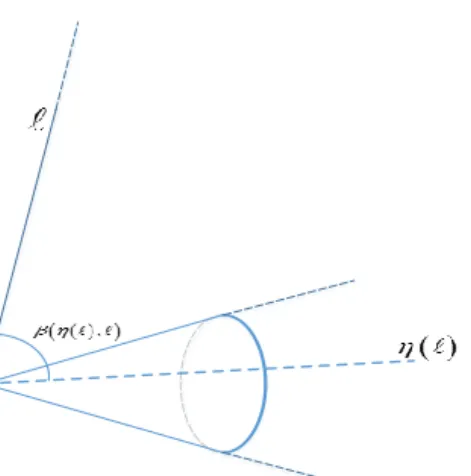
problem is NMF. See an illustration of a cone in Figure 1. LetLbe a convex cone,P be a set of points inRd,`∗
=
`∗L(P) be the solution to the (L,1,2)-subspace optimization
problem, andε >0. In this section we construct a PTAS for finding a line`that approximates`∗in the sense that
cost(P, `)≤(1 +ε)cost(P, `∗), (1) where hereinafter cost := costz for z = 2 (namely,
cost(P, `) =P
p∈P(dist(p, `)) 2).
First (Section 3.3) we show that any arbitrary line`∗(not necessarily `∗ = `∗L(P)) has a line ` that approximates it
in the sense of inequality (1) and is spanned by a sparse subset ofP; the construction of that sparse subset and of
`uses`∗ as an input. We then use this result in order to approximate the optimal line`∗=`∗L(P) even though it is
We begin with some preliminary discussions in Sections 3.1–3.2. In what follows when we speak of lines in Rd we
refer only to subspaces, namely lines that pass through the originoofRd.
3.1
Projection of lines
An important notion in our analysis is that of a projection of a line onto a convex cone.
Definition 3.1 (L-projection). For any two lines in
Rd, `1 and `2, ifα is the angle between them, β(`1, `2) :=
sinα. The function η(·) is called an L-projection if it gets a line `and returns a lineη(`)∈L, such thatβ(η(`),`ˆ)≤
β(`,`ˆ)for all`ˆ∈L.
See in Figure 1 an example of a line`, its projectionη(`) on the depicted cone, and the angle betweenη(`) and`, the sinus of which is denoted byβ(η(`), `).
Lemma 3.2. LetL be a convex cone. Letη(·) be a func-tion that gets a line`inRdand returns a line`0=η(`)∈L
that minimizesβ(`0, `)inL, where ties are broken arbitrar-ily. Thenη is anL-projection.
Figure 1: A cone and a projection of a line on the cone (Definition 3.1).
Lemma 3.2 can be used to compute anL-projectionηfor a given convex coneL. In what follows, we assume thatη(`) is computable in timeO(d) for any`inRd.
3.2
Centroid sets
The following definitions play a central role in our analysis that follows.
Definition 3.3. Let`and `0 be lines in Rd and let0<
ε ≤ 1. Denote by α and π−α the two angels between ` and`0. LetFα(`, `0, ε)(resp. Fπ−α(`, `0, ε)) denote the set of d1/εe+1lines inRdthat includes`and`0and partitions the
angleα(resp. π−α) tod1/εeequal parts. ThenG(`, `0, ε) :=
Fα(`, `0, ε)∪Fπ−α(`, `0, ε).
An illustration of the fan of lines G(`, `0, ε) is given in Figure 2.
Definition 3.4 (Centroid Set). Let Q = (q1,· · ·, qm) be a sequence of m points from Rd \ {o},
Figure 2: An illustration of the fan of lines defined in Definition 3.3.
L be a convex cone, η be an L-projection, and ε > 0. Set G1 = {Sp(q1)} and then, for every 1 ≤ i ≤ m − 1
define Gi+1 = S`
i∈GiG(η(`i),Sp(qi+1), ε). Then
Γ(Q, η, ε) :=S
`∈Gmη(`)is called a centroid set.
Lemma 3.5. The size of the set Γ(Q, η, ε) is O(εm1−1),
and the time to compute it isO( d εm−1).
3.3
Approximating an arbitrary line
`∗LetP be a finite set ofnpoints inRd\ {o},Lbe a convex
cone andη be an L-projection. Assume further that `∗ is any line inLand that 0< ε <1/2. AlgorithmRotateLine accepts inputs of the form (P, L, ε, `∗) and outputs a line`
which approximates`∗ in the sense of inequality (1). The line`belongs toLand it is contained in a centroid set (Def-inition 3.4) that could be described using a small (sparse) subset of points fromP, where the size of that subset does not depend onnnor ond(Theorem 3.7).
Algorithm 1RotateLine(P, L, ε, `∗)
Input: A set P = {p1,· · ·, pn} in Rd; a convex cone L,
ε∈(0,12), and a line`∗∈L.
Output: A line`∈L that approximates`∗in the sense of inequality (1), where`∈Γ(Q, η, ε2/216) for some sequence
Qof points fromP.
1: Setq1 to be a pointq∈P that minimizesβ(Sp(q), `∗).
2: Set`1:= Sp(q1).
3: ReturnImprove(P, L, ε, `∗, `1)
Algorithm 2Improve(P, L, ε, `∗, `i)
1: Set`:=η(`i).
2: if cost(P, `)≤(1 +ε)·cost(P, `∗)then
3: Return`. 4: end if
5: Compute a pointqi+1∈Psuch that dist(qi+1, `)>(1 + ε
3)·dist(qi+1, `
∗
).
6: Compute a line `i+1 ∈ G(`,Sp(qi+1), ε 2
216) such that
β(`i+1, `∗)≤(1−12ε)β(`, `∗).
7: ReturnImprove(P, L, ε, `∗, `i+1).
AlgorithmRotateLinecalls the recursive sub-algorithm Improve. The computations in Steps 5 and 6 of
Algo-rithmImproveare well defined. Indeed, if we reach Step 5, then cost(P, `)>(1 +ε)·cost(P, `∗). Therefore, there ex-ists at least one point qi+1 ∈ P for which dist(qi+1, `)2 >
(1 + ε)(dist(qi+1, `∗))2. Hence, dist(qi+1, `) > (1 +
ε)1/2dist(qi+1, `∗) >(1 + ε3)dist(qi+1, `∗), where the latter
inequality follows from our assumption thatε < 1
2. As for
Step 6, a line`i+1 as sought there is guaranteed to exist in
view of the next lemma.
Lemma 3.6. Let`0, `∗be two lines in Rd. Let0< ε≤1
andq∈Rd be such that
dist(q, `0)>(1 +ε)·dist(q, `∗). (2)
Then there exists a line ` ∈ G(`0,Sp(q), ε2/24) such that
β(`, `∗)≤(1−ε/4)·β(`0, `∗).
Theorem 3.7. Assume that Algorithm RotateLine is
applied on the input(P, L, ε, `∗). Then: (i) The algorithm stops after at most
m(ε) = log3ε log1−1ε 12 + 1 =O 1 εlog 1 ε (3)
recursive calls, and outputs a line`∈L.
(ii) The overall runtime of the algorithm is O(ndlog1ε
ε ) +
O(d
ε3log1ε).
(iii) cost(P, `)≤(1 +ε)·cost(P, `∗).
(iv) There exists a sequenceQof at mostm=m(ε)points fromP, such that`∈Γ(Q, η, ε2/216).
Proof of (i). Let us denoteα(`0) :=β(`0, `∗) for every line
`0 in Rd. Fix i, 1 ≤ i ≤ m, and consider the value of `
during theith recursive call of the algorithm. As implied by Step 1 ofImprove, we haveα(`) =α(η(`i)). Therefore, by
the properties ofη, see Definition 3.1, we haveα(`)≤α(`i).
By Step 6 of Improve we have α(`i+1) ≤ (1− 12ε)α(`).
Combining the last two inequalities yields α(`i+1) ≤ (1− ε 12)α(`i). Hence, by Eq. (3), α(`m)≤ 1− ε 12 m−1 α(`1)≤ ε 3α(`1). (4) We shall now prove that for every fixedp∈P, dist(p, `m)≤
(1 +ε
3)·dist(p, `
∗
). By the triangle inequality, dist(p, `m)≤dist(p, `∗) + dist(proj(p, `∗), `m)
= dist(p, `∗) +kproj(p, `∗)k ·α(`m) ≤dist(p, `∗) +kpk ·α(`m).
(5)
By the definition of `1 in Algorithm RotateLine, by the properties of ηas anL-projection, and by the choice ofq1,
we have
α(`1) =α(η(Sp(q1)))≤α(Sp(q1))≤α(Sp(p)). (6)
By (4) and (6), we infer that α(`m)≤εα(Sp(p))/3. Using
the last inequality with (5) yields dist(p, `m)≤dist(p, ` ∗ ) +kpk ·εα(Sp(p))/3 =1 +ε 3 ·dist(p, `∗). (7)
Squaring inequality (7) and summing overp∈P yields cost(P, `m) = X p∈P (dist(p, `m))2 ≤X p∈P 1 +ε 3 2 ·(dist(p, `∗))2<(1 +ε)·cost(P, `∗),
where the last inequality holds for all ε < 12. Hence, if AlgorithmImprovedid not stop before the mth recursive call, it would stop then. That concludes the proof of the first claim of the theorem. 2
3.4
Approximating
`∗=`∗L(P)In Section 3.3 we showed that every given line `∗ has an approximating line`that can be described by a sparse sub-set ofP. The construction of that sparse subset and of `
uses`∗ as an input. However, we wish to approximate the line `∗ = `∗L(P) which is not known upfront. The claims
of Theorem 3.7 enable us to overcome this problem. That theorem guarantees that`∗ has an approximating line`in
Γ(Q, η, ε2/216), whereQis some sequence of at mostm(Eq.
(3)) points fromP andηis anyL-projection. Hence, we in-fer that`can be found in the set of lines ˆΓ(P, η, ε) which is defined as follows.
Definition 3.8. Let P be a set of points inRd\ {o}, L
be a convex cone, η be an L-projection, and ε > 0. Then
ˆ
Γ(P, η, ε) := S
QΓ(Q, η, ε
2/216), where Γ is as defined in
Definition 3.4, and the union is taken over all sequences
Q= (q1, . . . , qm)of at mostm=m(ε) (see Eq. (3)) points
fromP.
Theorem 3.9. There exists a PTAS for `∗ = `∗L(P).
Specifically, a line that approximates`∗L(P) in the sense of
inequality (1) can be found in time O(d·poly(n)) for any constantε >0.
4.
CORESET CONSTRUCTION
Algorithm 3, which we present and analyze below, de-scribes how to construct a coreset C for the input set of pointsP and parametersε∈(0,1/2) andδ∈(0,1]. A gen-eralized version for distances to the power ofz≥1 and for
k≥1 is described in [24]. However, unlike [24], the size of
Cis independent ofd.
To that end, the algorithm first constructs a pair (S, w), whereSis a multiset of points fromP(namely, it is a subset ofP in which points may be repeated), and wis a weight function onS (Steps 1-12). Then, it converts the pair (S, w) into a set of pointsCinRd(Step 13). That set is called the
coreset.
The size ofCis bounded by the size ofS, which is shown in Step 7. That size depends on some sufficiently large con-stant,c0, that can be determined from the analysis in this
section and in the previous section. Our claims regarding the algorithm and the properties of the coresetC are sum-marized in Theorem 4.1
Theorem 4.1. Let P be a set of n points in Rd, ε ∈
(0,12), δ ∈ (0,1], L be a convex cone, and η be an L -projection. LetC be the set that Algorithm 3 outputs when applied on the input(P, ε;δ). Then the following hold:
(i) With probability at least1−δ, every line`∈ {`∗L(P)}∪
ˆ
Γ(C, η, ε)(Definition 3.8) satisfies
Algorithm 3Coreset(P, ε;δ)
Input: P ={p1,· · ·, pn} ⊂Rd,ε∈(0,1/2),δ∈(0,1]. Output: A setC of points inRd.
1: Use SVD to compute a line `∗ that minimizes cost(P, `) := P
p∈P(dist(p, `)) 2
over all lines ` in Rd
passing through the origino.
2: For everyp∈P: setp0 ∈ Rd to be the projection ofp
onto`∗. 3: Setµ:= 1 n P p∈Pp 0 . 4: For everyp∈P set
˜ mp:= 2(dist(p, `∗))2 P q∈P(dist(q, `∗))2 + 4kp 0− µk2 P q∈Pkq0−µk2 +16 n
5: For everyp∈P set Pr(pi) :=
˜ mp P q∈Pm˜q . 6: SetS:=∅. 7: Sett:= c0 ε3log 2
(1/ε) log(1/δ), wherec0 is a sufficiently
large constant (that can be determined from the proof of Theorem 4.1).
8: Repeatttimes:
9: Select a pointp∈P according to the probability distribution Pr(·). 10: S:=S∪ {p}. 11: Setw(p) := n tPr(p). 12: End Repeat 13: C:={p
j(p)w(p)p|p∈S}, wherej(p) is the number of times thatpappears inS.
14: ReturnC. wherecost(P, `) =P p∈P(dist(p, `)) 2. (ii) |C|=O 1 ε3log 2(1 ε) log( 1 δ) .
(iii) The runtime of Coreset is O(nd2) +
O(1 ε3log 2 (1 ε) log( 1 δ) logn).
Proof of (i) (sketch). The proof is based on [6, Theorem 4.1] that shows how to construct a set of size
O((v+ log(1/δ))·t2/ε2), (9) which is anε-coreset with probability at least 1−δ. Here,
vis the pseudo-dimension of the corresponding query space and t is its total sensitivity; see more details in Section 2. and full details in [6]. The total sensitivitytfor the family of all possiblek-dimensional subspaces ofRd, and for distances
to the power of z ist=O(kO(z)) for z ≥1. [24, Theorem 19].
The pseudo-dimension of this family isv=O(d) and core-sets of size linear in d that approximate all possible sub-spaces of Rd can be constructed by substitutingv =O(d)
and the value of t above in (9). The coreset construction of [24] is essentially the same as in Algorithm 3 (for the case
z= 2), except for the smaller size of the coreset that is out-put by our algorithm, which is independent of d. This is because our coreset aims to approximate only a constrained (smaller) subset of the family of lines, namely the lines in the centroid set Γ(Q, η, ε) (Definition 3.4). This subset has pseudo-dimensionvthat depends onεbut not ond, as fol-lows from Lemma 3.5. By Eq. (3), we conclude that the total sensitivity ist=O ε13log
2 1 ε
log 1δ
. 2
Applying exhaustive search on the small coreset yields a polynomial time approximation scheme:
Theorem 4.2. Let`∗=`∗L(P)be the line that minimizes
the sum of squared distances to the points ofP over every line ` in a convex cone L. Then, with probability at least
9/10, a line`such that
cost(P, `)≤(1 +ε)·cost(P, `∗), (10)
can be computed inO(nd2) +O(d·21/εO(1)).
More generally, instead of applying our PTAS, we can use any existing heuristic that aims to compute the optimal line
`∗. In our experimental results we show that this approach can work even without a provable guarantee for the heuris-tics, given the proof above for the reduction to coresets. If the chosen heuristic has an approximation guarantee, then we get similar guarantees on its outcome when applied on the coreset. This is stated in the following theorem.
Theorem 4.3. LetC:=Coreset(P, ε;δ) and let`0 be a
line that approximates the optimal solution of the coresetC, i.e.,`0≤(1 +ε)`L∗(C). Then, with probability at least1−δ,
cost(P, `0)≤(1 +ε)·`∗L(P).
5.
EXPERIMENTAL RESULTS
Hardware. We used Amazon EC2 AWS cloud service of 64 machines (workers) and its S3 storage support. The cho-sen machine type was Standard (cc2.8xlarge, 64 core). The service was run from a popular laptop Lenovo W520, CPU: Intel Core i7-3940XM, Memory: 32.0GB, DDR3-1600MHz SDRAM, Hard drive: 256GB 2.5“ (SATA3) Mobility Solid State Drive. Intel˝o vPro´Z)
Software. All the code was written in Matlab 2013b (64bit), with the support of Matlab GPU toolbox (for most of the basic linear algebra functions). As for NMF heuris-tics, we use the nnmf function of Matlab’s Statistics toolbox. This function supports mainly two heuristics: ’als’ (the de-fault) uses an alternating least-squares algorithm, and ’mult’ that uses a multiplicative update algorithm. The other pa-rameters of this function were assigned default values. The function returns a matrixH whose columns span a subspace of dimension at mostk.
Data. We used a public dataset from the UCI reposi-tory, called “YouTube Multiview Video Games Dataset” [22]. This dataset contains instances, each described by 91 feature types, with class information for exploring multiview topics. The number of records (rows) isn∼106and the number of
features (columns, dimension) isd= 91.
Experiment. The rows of the original dataset were par-titioned into batches on the local hard drive of our laptop computer. Then, an empty coreset tree was initialized in each worker on the cloud; see Fig. 3(a). The streaming was implemented by sending the batches one-by-one to the next worker on the cloud. This is done using a parallel execution of the command: “Send the ith batch to the ith worker” fori= 1,· · ·,64, which is implemented in Matlab using the command “spmd”. Each of the 64 workers then computes its coreset, and the “spmd” command returned an array of 64 coresets. The main process then recomputes a coreset for these 64 coresets locally on the laptop, and runs Matlab’s nnmf locally on the small coreset.
Evaluation. For comparison, we applied the experiment above also using uniform random sample T instead of our coresetS. In addition, we ran the nnmf function on the full original matrix A using a single computer. We then com-puted the sum of squared distances from the rowsAto the subspaces that are spanned by the corresponding output ma-tricesHT,HSandHA, after applying the appropriate
rota-tion. These sums are denoted by cost(A, HT), cost(A, HS),
and cost(A, HA) respectively.
The empirical approximation error of the resulting core-set S is then ε := cost(A, HS)/cost(A, HA)−1. Hence,
cost(A, HS) = (1+ε)cost(A, HA). Note that, since nnmf
im-plements heuristics, the value ofεmight be negative, which is indeed the case in Fig. 5(a) for the case of coresets. In this case the cost obtained by the coreset to the rows of A
is actuallysmaller than the cost of a run on the full matrix
A. Interestingly enough, we never got such a result by using uniform sampling.
We repeat the experiments for(i)uniform random sample (with replacement) instead of coresets, (ii)different values ofk,(iii)different heuristics implementation of nnmf: ’als’ (the default) uses an alternating least-squares algorithm, and ’mult’ uses a multiplicative update algorithm. (iv) syn-thetic input data (standard Gaussian noise)
Results on synthetic data. We show results for one of the coreset constructions on one arbitrary worker. As expected, the properties of the coresets look essentially the same for the other workers and the resulting set. In Fig 3(b) we show how the memory (RAM) used by the worker increases when we add more points to its coreset from the synthetic. These results are common to other coresets papers. The “zig-zag” corresponds to the number of coresets in the tree that each new point needs to update.
For example, the first point in a streaming tree is updated inO(1), however the 2ith point for some i ≥1 climbs up throughO(logi) levels in the tree, soO(logi) coresets need to be merged. The errorεreduces roughly polynomially on 1/εfor the synthetic data, as shown in Fig. 5(b).
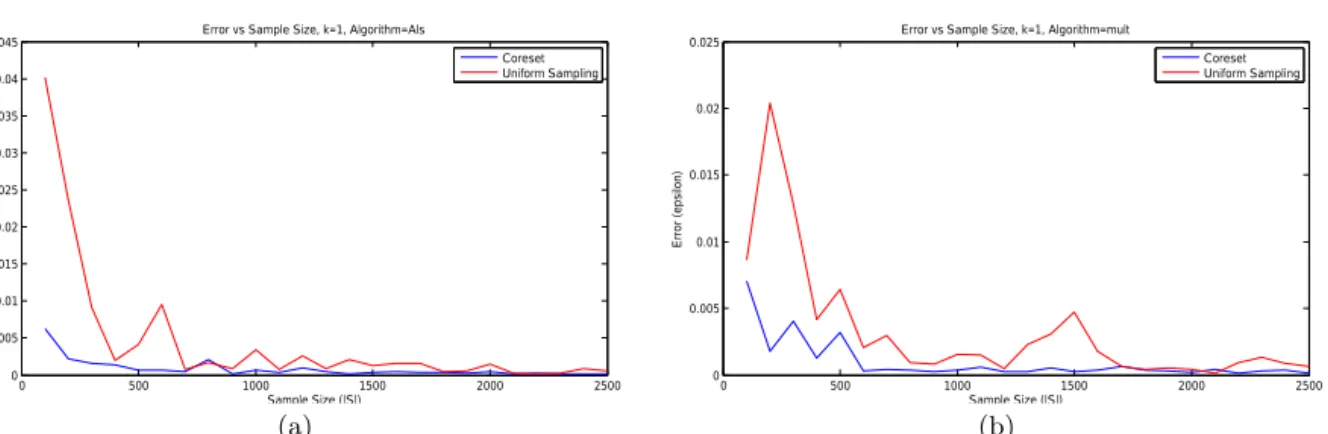
Results on the real dataset. Fig. 4 shows results for
k= 1 dimensional subspace (number of columns ofH). Note that(i)for small sample values the coreset already converges to zero. The error of the random sample is still very high and even increases with sample size for such values;(ii)the variance of the error seems to be much smaller for the coreset compared to the uniform sample;(iii)for large sample values (∼2500), the coreset error is essentially zero and the ratio compared to the uniform sample seems to be very high.
Fig. 5(a) shows results fork = 10. Similar results were obtained for other values ofk. The results on the coreset are almost always better than the uniform sample, on both of the nnmf algorithms. As noted above, for the casek= 10, the results on the coresets are sometimes better than the result on the original data (ε < 0). While we do not have a formal explanation, this is a common phenomena when running heuristics on coresets, although it cannot happened when computing optimal solutions. It seems that the heuris-tics compute local extreme points and sometimes converges to such “bad pitfalls” in the original data, while the core-set compressed the data and “cleaned” or smoothed a lot of these bad local extreme points.
6.
CONCLUSION
We presented in this study a scalable and provable algo-rithm for general problems in constrained low rank approx-imation. Our technique is based on two cornerstones: A constructive proof that an approximation to the constrained 1-subspace is spanned by few input points and constraints; and a method to extract from the Big Data input a small coreset on which we may apply this construction, in lieu of the original large input. We extended the scope of previous art by considering general constraints and general metrics. Our algorithms significantly boost existing techniques with respect to runtime, applicability to streaming data, and by being embarrassingly parallelizable. Our experimental re-sults indicate that coresets constitute a theoretical as well as a practical bridge that enables running traditional “small data” algorithms (which are typically off-line, non-parallel and sometimes inefficient) on modern Big Data. The prov-able guarantee which we offer is only with respect to the case where the approximating subspace is 1-dimensional. The extension of this algorithm to higher dimensions combines heuristical ingredients. An important goal for a future re-search is to devise a PTAS, or any other algorithm with a provable guarantee, also for the higher dimensional prob-lems. Another target of future research is to demonstrate the benefits of our proposed techniques in various applica-tions and settings.
7.
REFERENCES
[1] Sanjeev Arora, Rong Ge, Ravindran Kannan, and Ankur Moitra. Computing a nonnegative matrix factorization - provably. InSTOC, 2012.
[2] S. Bergmann, J. Ihmels, and N. Barkai. Iterative signature algorithm for the analysis of large-scale gene expression data.Physical Review E, 67:031902, 2003. [3] C. Boutsidis and P. Drineas. Random projections for the nonnegative least-squares problem.Linear Algebra and its Applications, 431:760–771, 2009.
[4] K. L. Clarkson and D. Woodruff. Low rank
approximation and regression in input sparsity time. InSTOC, 2013.
[5] P. Drineas, M. W. Mahoney, and S. Muthukrishnan. Sampling algorithms forl2regression and applications.
InSODA, 2006.
[6] D. Feldman and M. Langberg. A unified framework for approximating and clustering data. InSTOC, 2011. [7] D. Feldman, M. Monemizadeh, and C. Sohler. A
PTAS fork-means clustering based on weak coresets. InSoCG, 2007.
[8] D. Feldman, M. Monemizadeh, C. Sohler, and D. Woodruff. Coresets and sketches for high dimensional subspace approximation problems. In
SODA, 2010.
[9] D. Feldman, M. Monemizadeh, C. Sohler, and D. P. Woodruff. Coresets and sketches for high dimensional subspace approximation problems. InSODA, 2010. [10] D. Feldman, M. Schmidt, and C. Sohler. Turning big
data into tiny data: Constant-size coresets for
k-means, PCA and projective clustering. InSODA, 2013.
[11] D. Feldman, M. Volkov, and D. Rus. Dimensionality reduction of massive sparse datasets using coresets. Technical report, 2015.
[12] Dan Feldman. NNMF coreset code in matlab.
http://people.csail.mit.edu/dannyf/. Accessed: 2015-07-01.
[13] M. Ghashami, J. M. Liberty, E.and Phillips, and D. Woodruff. Frequent directions: Simple and deterministic matrix sketching.arXiv preprint arXiv:1501.01711, 2015.
[14] S. Har-Peled and S. Mazumdar. On coresets for
k-means andk-median clustering. InSTOC, 2004. [15] Thomas Hofmann. Probabilistic latent semantic
analysis. InUAI, 1999.
[16] S. Hyv¨onen, P. Miettinen, and E. Terzi. Interpretable nonnegative matrix decompositions. In KDD, 2008. [17] H. Kim and H. Park. Sparse non-negative matrix
factorizations via alternating non-negativity
constrained least squares for microarray data analysis.
Bioinformatics, 23:1495–1502, 2007.
[18] J. Kim and H. Park. Toward faster nonnegative matrix factorization: A new algorithm and comparisons. InICDM, 2008.
[19] Daniel D. Lee and H. Sebastian Seung. Learning the parts of objects by non-negative matrix factorization.
Nature, 401:788–791, 1999.
[20] Daniel D. Lee and H. Sebastian Seung. Algorithms for non-negative matrix factorization. InNIPS, 2000. [21] E. Liberty. Simple and deterministic matrix sketching.
InKDD, 2013.
[22] Omid Madani, Manfred Georg, and David A. Ross. On using nearly-independent feature families for high precision and confidence.Machine Learning,
92:457–477, 2013.
[23] N. Shyamalkumar and K. Varadarajan. Efficient subspace approximation algorithms. InSODA, 2007. [24] Kasturi Varadarajan and Xin Xiao. On the sensitivity
of shape fitting problems.arXiv preprint arXiv:1209.4893, 2012.
[25] Stephen A. Vavasis. On the complexity of nonnegative matrix factorization.SIAM Journal on Optimization, 20:1364–1377, 2009.
[26] Wei Xu, Xin Liu, and Yihong Gong. Document clustering based on non-negative matrix factorization. InSIGIR, 2003.
(a)Coresets Tree (b)Memory Used
Figure 3: (a) The input stream of points at the bottom is partitioned into odd and even subsets (green and pink). The odd subsets will be sent to the left worker and the even sets – to the right worker. Each worker maintains a merge-and-reduce tree of size roughly logarithmic in its input (blue frames). Each worker computes a single coreset for its tree and sends it to a central machine. The union of these two coresets forms a coreset for all the input points seen so far in the stream. (b) The memory that is used to save the coresets tree by each worker is only logarithmic in the input sizen, since at most one coreset is stored in each of the
logn levels. 0 500 1000 1500 2000 2500 0 0.005 0.01 0.015 0.02 0.025 0.03 0.035 0.04
0.045 Error vs Sample Size, k=1, Algorithm=Als
Error (epsilon) Sample Size (|S|) Coreset Uniform Sampling (a) 0 500 1000 1500 2000 2500 0 0.005 0.01 0.015 0.02
0.025 Error vs Sample Size, k=1, Algorithm=mult
Error (epsilon)
Sample Size (|S|)
Coreset Uniform Sampling
(b)
Figure 4: Approximation error ε of the input matrix A using the output subspace that was obtained from running Matlab’snnmf(S, k,0Algorithm0, Alg)function. HereSis either the coreset or uniform random sample,
k= 1, and Alg is the chosen Matlab’s heuristicals (left) or mult (right).
0 500 1000 1500 2000 2500 −0.04 −0.02 0 0.02 0.04 0.06 0.08 0.1 0.12
0.14 Error vs Sample Size, k=10
Error (epsilon)
Sample Size (|S|)
Coreset −− mult Coreset −− als Uniform Sample −− mult Uniform Sample −−als
(a) (b)
Figure 5: (a) Same as Figure 4, using k= 10 in both coreset construction and the call to nnmf. (b) Coreset empirical error on a fixed synthetic random Gaussian data and different coreset size.