
Performance Evaluation of Chaos Based IDMA
Scheme Using Joint Turbo Equalization Over
Frequency Selective Fading Channel
Aasheesh Shukla
1, Atul Bansal
1, Vishal Goyal
1, Karanveer
2, Vinay Kumar Deolia
1 1Department of Electronics and Communication, GLA University, Mathura, India-2814062Department of Electrical and Instrumentation, Thapar University, Patiala, India [email protected]
Abstract— This paper proposed the analysis of a new chaos
based interleave division multiple access (CB-IDMA) wireless communication system. It also proposed the use of joint turbo equalization to mitigate the effect of intersymbol interference (ISI) in deep faded frequency selective channel. In this study, the proposed CB-IDMA system used the chaotic Tent map for the design of a robust interleaver, which produces low correlation among the users and yields better bit error rate performance. The proposed structure combined the joint turbo equalization for the cancellation of ISI and multiple access interference (MAI), which was observed as the main impediment to successful IDMA communication over frequency selective multipath fading channel. Two types of frequency domain equalizers were considered for performance evaluation; zero forcing (ZF) and minimum mean square error (MMSE) equalizer. Simulation experiments were performed in MATLAB and the results demonstrated that the proposed CB-IDMA system with joint turbo equalization may be preferred in deep fading environment.
Index Terms— Chaos IDMA; Logistic Map; Tent Map
Interleaver; Turbo Equalization.
I. INTRODUCTION
High quality and high speed multimedia transmission is essential for future wireless communication. The basic blocks of wireless communication system is shown in Figure 1. One of the biggest challenges in the wireless communication system is the prominent impairment of the frequency selective fading channels. Researchers have cited the main reason for the impairment is the diversity against fading and cancellation of the worst case cell interference of different users. Additionally, the solution for this difficulty can be outlined as the interleave-division multiple access (IDMA) that uses chip-based interleavers for distinguishing the users and the bandwidth, that are dedicated to coding [1-4]. The interleavers are also utilized to deal with the error bursts. Further, it is argued that an efficient interleaver can improve the performance of iterative IDMA system.
On the other hand, recently the role of chaos has been manifested in spread spectrum communication systems [5-8]. It has been argued that the chaotic sequences offer many interesting properties subjected to computational complexity or storage requirement [9-10]. Apart from that, the chaotic sequences also exhibits the randomness, hence allowing the chaotic sequences to be utilized in the generation of robust interleavers for IDMA system. However, intersymbol interference (ISI) and multiple access interference (MAI) constitute the major impediments in the transmission over
frequency selective deep faded channel. Although ISI is well treated by equalization or detection, recovery of data from equalized symbols is achieved through decoding operation. Due to its complexity, both of these operations have been considered separately and substantial performance degradation is induced [11-14]. Accordingly, algorithms that perform the equalization and decoding operation on the same set of received data have been introduced. This process is popularly known as Turbo equalization and were first suggested in [8]. Li [9] proposed the joint operation of equalization and coding. Wang [19] also suggested the turbo equalization for satellite channels. Peng [20] suggested the
MMSE-based turbo equalization.
The main contribution of this paper is the use of the joint processing of equalization (MMSE-based) and decoding (Turbo equalization) in IDMA system, to minimize the bit error rate (BER) in deep faded channels without compromising the complexity. Secondly, the performance of modified Tent map interleaver based IDMA i.e. CB-IDMA is also compared with the random interleaver based IDMA to propose the superiority of CB-IDMA.
Figure 1: Basic building blocks of wireless communication system
The rest of the paper is organized as follows. The linear chaos based transmitter and receiver structure of IDMA are described in Section II. In section III, the modified Tent map interleaver design is discussed. Joint Turbo equalization is described in Section IV. Section V provides the set of simulation results and section VI concludes the paper.
II. THE PROPOSED CB-IDMASYSTEM MODEL WITH JOINT TURBO EQUALIZATION
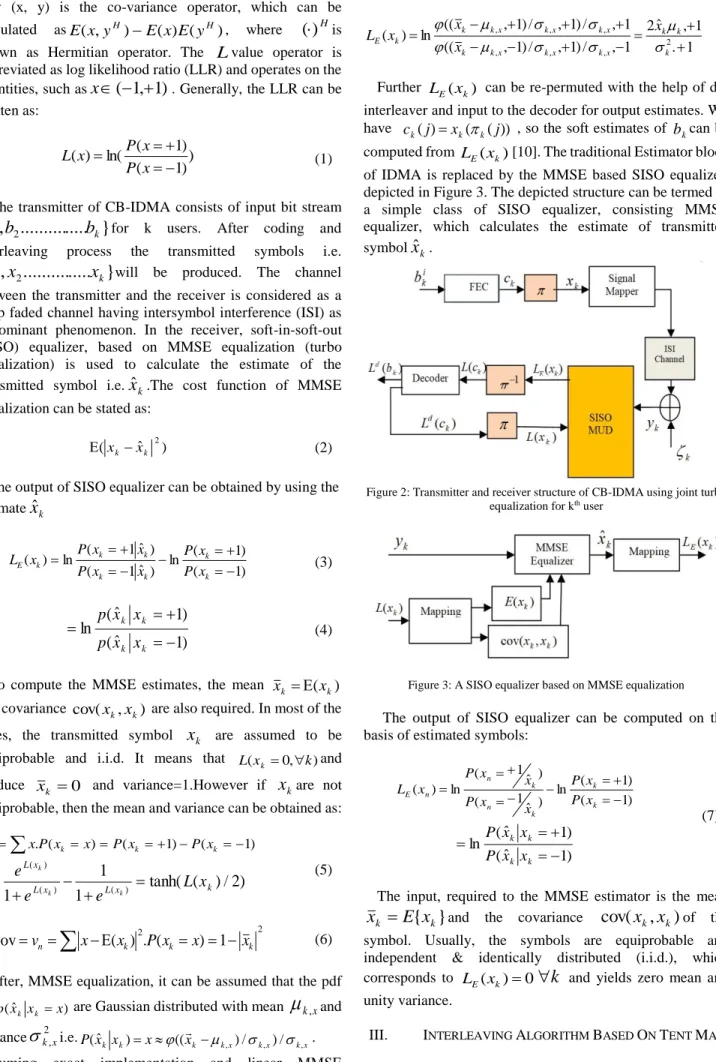
Figure 2 depicts the IDMA transmitter and the receiver structure with Turbo equalization. Before discussing the structure of CB-IDMA system along with Turbo equalization, some frequently used notations are elaborated. The operator
)
(
E
is known as expectation with respect to the joint probability density function (pdf) of transmitted symbolx
k.Data Estimate Data Transmitter ISI
Channel Receiver
Cov (x, y) is the co-variance operator, which can be calculated as ( , H) ( ) ( H) y E x E y x E − , where
(
)
Hisknown as Hermitian operator. The
L
value operator is abbreviated as log likelihood ratio (LLR) and operates on the quantities, such asx
(
−
1
,
+
1
)
. Generally, the LLR can be written as: ) ) 1 ( ) 1 ( ln( ) ( − = + = = x P x P x L (1)The transmitter of CB-IDMA consists of input bit stream
}
...
...
,
{
b
1b
2b
k for k users. After coding and interleaving process the transmitted symbols i.e.}
...
...
,
{
x
1x
2x
k will be produced. The channel between the transmitter and the receiver is considered as a deep faded channel having intersymbol interference (ISI) as a dominant phenomenon. In the receiver, soft-in-soft-out (SISO) equalizer, based on MMSE equalization (turbo equalization) is used to calculate the estimate of the transmitted symbol i.e.x
ˆ
k.The cost function of MMSE equalization can be stated as:) ˆ (xk−xk 2
(2)
The output of SISO equalizer can be obtained by using the estimate
x
ˆ
k ) 1 ( ) 1 ( ln ) ˆ 1 ( ) ˆ 1 ( ln ) ( − = + = − − = + = = k k k k k k k E x P x P x x P x x P x L (3))
1
ˆ
(
)
1
ˆ
(
ln
−
=
+
=
=
k k k kx
x
p
x
x
p
(4)To compute the MMSE estimates, the mean xk =(xk)
and covariance cov(xk,xk) are also required. In most of the cases, the transmitted symbol
x
k are assumed to be equiprobable and i.i.d. It means that L(xk =0,k)and produce xk =0 and variance=1.However ifx
kare not equiprobable, then the mean and variance can be obtained as:
= = =+ − =− = . ( k ) ( k 1) ( k 1) k xP x x P x P x x)
2
/
)
(
tanh(
1
1
1
( ) ( ) ) ( k x L x L x Lx
L
e
e
e
k k k=
+
−
+
=
(5) 2 21
)
(
.
)
(
cov
=
v
n=
x
−
x
kP
x
k=
x
=
−
x
k (6) After, MMSE equalization, it can be assumed that the pdf of p(xˆk xk =x) are Gaussian distributed with mean
k,xand variance
k2,xi.e.P(xˆk xk)=x((xk−k,x)/k,x)/k,x. Assuming exact implementation and linear MMSE equalization, the output LLR LE(xk)can be computed as1 . 1 , ˆ 2 1 , / ) 1 , / ) 1 , (( 1 , / ) 1 , / ) 1 , (( ln ) ( 2 , , , , , , + + = − + − − + + + − = k k k x k x k x k k x k x k x k k k E x x x x L
Further LE(xk) can be re-permuted with the help of de-interleaver and input to the decoder for output estimates. We have ck(j)=xk(
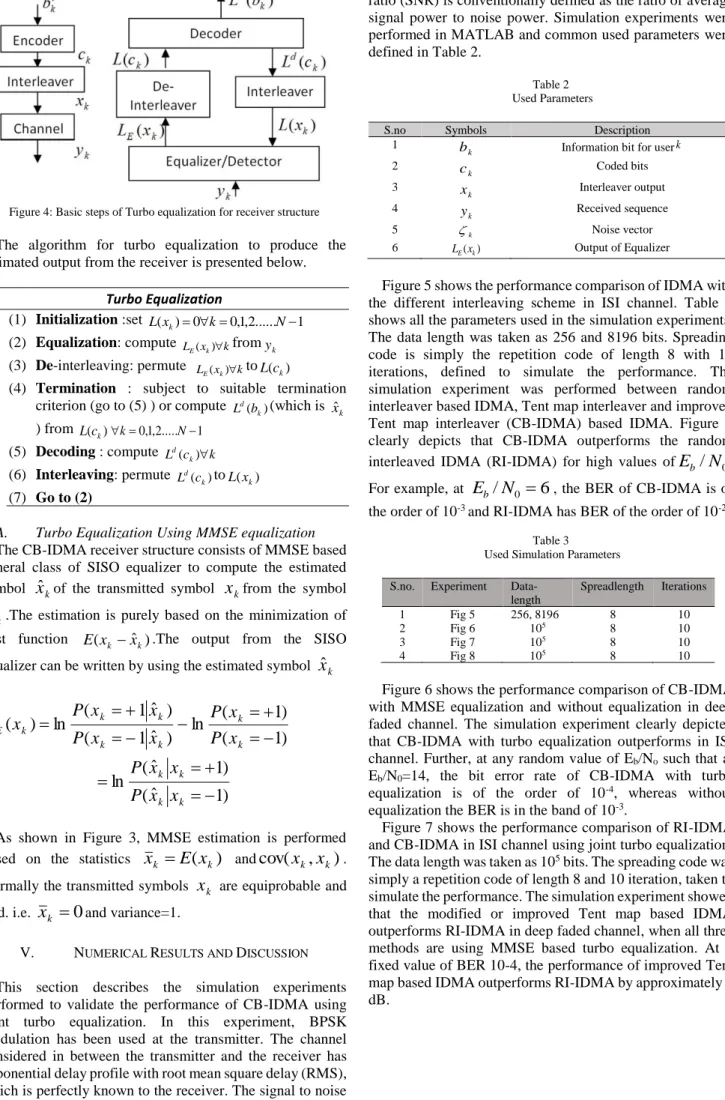
k(j)) , so the soft estimates of bkcan be computed from LE(xk)[10]. The traditional Estimator blockof IDMA is replaced by the MMSE based SISO equalizer, depicted in Figure 3. The depicted structure can be termed as a simple class of SISO equalizer, consisting MMSE equalizer, which calculates the estimate of transmitted symbol
x
ˆ
k.Figure 2: Transmitter and receiver structure of CB-IDMA using joint turbo equalization for kth user
Figure 3: A SISO equalizer based on MMSE equalization
The output of SISO equalizer can be computed on the basis of estimated symbols:
) 1 ( ) 1 ( ln ) ˆ 1 ( ) ˆ 1 ( ln ) ( − = + = − − = + = = k k k n k n n E x P x P x x P x x P x L ) 1 ˆ ( ) 1 ˆ ( ln − = + = = k k k k x x P x x P (7)
The input, required to the MMSE estimator is the mean
}
{
k kE
x
x
=
and the covariancecov(
x
k,
x
k)
of the symbol. Usually, the symbols are equiprobable and independent & identically distributed (i.i.d.), which corresponds to LE(xk)=0
k
and yields zero mean and unity variance.III. INTERLEAVING ALGORITHM BASED ON TENT MAP Most of the mobile wireless channels are bursty in nature; hence, the interleaving is the method to permute the
transmitted data sequence so as to randomize the error bursts. Random interleaver (RI) has been very popular and considered as the obvious part of IDMA. However, RI is not efficient in terms of storage requirement at the receiver and computational complexity. Consequently, there is a need for some advanced interleaver to compensate the limitation of RI. Here, the popular chaotic tent map is discussed and used for the generation of interleavers for IDMA [15].
A. Tent Map
Traditionally, the tent map can be described as;
− = 1 2 1 ), 1 ( 2 / 1 0 , ) ( x if x x if x x n n (8)
In the above equation,
is known as bifurcation meter, which confirms the chaotic region in the Tent map for the range of
(1, 2)
. However, some improvements also have been suggested to increase the degree of randomness, which is a desirable characteristic for an efficient interleaver. The improved and modified tent map has been suggested in [12] and can be written as: = − + = − = odd g x floor g x g x floor g even g x floor g g x floor g x x n n n n n n ) / ( , / ) ) 1 ) / ( ( ) / ( , / )) / ( ( ) (
In the equation of improved Tent map, the system states
x
n belongs to the range(0,1)
and the system parameter is taken asg
(
0
,
0
.
5
)
. Further,c
0 complexity analysis is used to measure the complexity of chaotic system. The larger the values ofc
0 means the higher the complexity of system and the higher the degree of randomness.
Table 1
Complexity (C0 values) Analysis of Tent Map and Improved Tent Map
System Parameter(g)
Tent Map (C0
values)
Improved Tent Map (C0 Values) (approx.) 0.1 0.0012 0.252 0.2 0.0012 0.254 0.3 0.0012 0.223 0.4 0.0012 0.209 0.5 0.0012 0.262
The system states that the improved Tent map have larger values of
c
0 values and randomness [12]. The improved Tent map also has larger values of Lyapunov exponents (L.E), which points towards a better chaotic region. With the above said reasons, it can be clearly stated that the improved tent can be a better choice for the generation of interleaver sequences. Thec
0values for different values of system parameterg
for classical Tent map and improved map are given in Table 1, which clearly depicts that the improved Tent map have different and largerc
0 values [16].Improved Tent Map Interleaver Algorithm
1 Initialization:(1,2], K= Interleaver length, g=0.4 2 Xk kthuser j = : X K k j 0 ,
= foot step, 3 k
k X0 0 = : the first element(k0k), j=0 and n=0 Main: 4 If floor (x /g) n ==even 5 Calculate k j X +1 6
k j k j+1 X +1 7 Now check - If kj+1 is in the set k
8 Increment j by 1 and repeat the main operation 9 Otherwise, k j k k 1 + 10 If floor (xn/g)== odd 11
k j k j+1 X +1 12
k j k k X +1 13 EndThe algorithm for proposed modified tent map interleaver above shows the method of generation of interleavers. In the algorithm, the first bifurcation parameter
is defined and then the initial system statex
0 is described. Further, with the help of system equation defined in (4), the sequencek
x
x
x
x
1 2 3...
is calculated. At the end of the algorithm, the redundant states have been eliminated to find interleaver vector.IV. TURBO EQUALIZATION
Iterative decoding algorithm and turbo codes have been popularly used in IDMA for the detection. However, the detection and decoding of information will be jointly protected by forwarding the error correction (FEC) over ISI channel: This process is often termed as Turbo equalization. The ability of Turbo equalization to have substantial gain improvement over separate equalization and decoding has already been validated in the previous research. The IDMA model, depicted in Figure 1 has incorporated the Turbo equalization algorithm for detection. Figure 2 shows the simple depiction of the steps of basic turbo equalization process, where
b
kiinput is bit stream, after the interleaving operation of the output informationy
kis generated. In the receiver side, the turbo equalization algorithm is utilized for the success of full detection. The extrinsic LLRsL
E(
x
k)
are given by: ) 1 ( ) 1 ( ln ) ( k k k k k E y x P y x P x L − = + = =Figure 4: Basic steps of Turbo equalization for receiver structure
The algorithm for turbo equalization to produce the estimated output from the receiver is presented below.
Turbo Equalization (1) Initialization :set L(xk)=0k=0,1,2...N−1 (2) Equalization: compute L x k k E( ) fromyk (3) De-interleaving: permute L x k k E( ) toL(ck)
(4) Termination : subject to suitable termination criterion (go to (5) ) or compute ( k)
d b L (which is xˆk ) from L(ck)k=0,1,2...N−1 (5) Decoding : compute Ld ck k ) ( (6) Interleaving: permute ( ) k d c L toL(xk) (7) Go to (2)
A. Turbo Equalization Using MMSE equalization The CB-IDMA receiver structure consists of MMSE based general class of SISO equalizer to compute the estimated symbol
x
ˆ
kof the transmitted symbolx
kfrom the symbolk
y
.The estimation is purely based on the minimization of cost function E(xk −xˆk).The output from the SISOequalizer can be written by using the estimated symbol
x
ˆ
k)
1
(
)
1
(
ln
)
ˆ
1
(
)
ˆ
1
(
ln
)
(
−
=
+
=
−
−
=
+
=
=
k k k k k k k Ex
P
x
P
x
x
P
x
x
P
x
L
)
1
ˆ
(
)
1
ˆ
(
ln
−
=
+
=
=
k k k kx
x
P
x
x
P
As shown in Figure 3, MMSE estimation is performed based on the statistics
x
k=
E
(
x
k)
andcov(
x
k,
x
k)
. Normally the transmitted symbolsx
k are equiprobable and i.i.d. i.e.x
k=
0
and variance=1.V. NUMERICAL RESULTS AND DISCUSSION This section describes the simulation experiments performed to validate the performance of CB-IDMA using joint turbo equalization. In this experiment, BPSK modulation has been used at the transmitter. The channel considered in between the transmitter and the receiver has exponential delay profile with root mean square delay (RMS), which is perfectly known to the receiver. The signal to noise
ratio (SNR) is conventionally defined as the ratio of average signal power to noise power. Simulation experiments were performed in MATLAB and common used parameters were defined in Table 2.
Table 2 Used Parameters
S.no Symbols Description
1
k
b Information bit for userk 2 k c Coded bits 3 k x Interleaver output 4 k y Received sequence 5 k Noise vector 6 LE(xk) Output of Equalizer
Figure 5 shows the performance comparison of IDMA with the different interleaving scheme in ISI channel. Table 3 shows all the parameters used in the simulation experiments. The data length was taken as 256 and 8196 bits. Spreading code is simply the repetition code of length 8 with 10 iterations, defined to simulate the performance. The simulation experiment was performed between random interleaver based IDMA, Tent map interleaver and improved Tent map interleaver (CB-IDMA) based IDMA. Figure 5 clearly depicts that CB-IDMA outperforms the random interleaved IDMA (RI-IDMA) for high values of
E
b/
N
0. For example, atE
b/
N
0=
6
, the BER of CB-IDMA is of the order of 10-3 and RI-IDMA has BER of the order of 10-2.Table 3
Used Simulation Parameters
S.no. Experiment Data-length Spreadlength Iterations 1 Fig 5 256, 8196 8 10 2 Fig 6 105 8 10 3 Fig 7 105 8 10 4 Fig 8 105 8 10
Figure 6 shows the performance comparison of CB-IDMA with MMSE equalization and without equalization in deep faded channel. The simulation experiment clearly depicted that CB-IDMA with turbo equalization outperforms in ISI channel. Further, at any random value of Eb/No such that at Eb/N0=14, the bit error rate of CB-IDMA with turbo equalization is of the order of 10-4, whereas without equalization the BER is in the band of 10-3.
Figure 7 shows the performance comparison of RI-IDMA and CB-IDMA in ISI channel using joint turbo equalization. The data length was taken as 105 bits. The spreading code was simply a repetition code of length 8 and 10 iteration, taken to simulate the performance. The simulation experiment showed that the modified or improved Tent map based IDMA outperforms RI-IDMA in deep faded channel, when all three methods are using MMSE based turbo equalization. At a fixed value of BER 10-4, the performance of improved Tent map based IDMA outperforms RI-IDMA by approximately 5 dB.
Figure 5: BER performance of modified tent map interleaver for data lengths 256, 8192, spread lengths=8, iteration=10
Figure 6: BER comparison of CB-IDMA with MMSE equalization and without equalization for data length=105, spread length=8, iteration=10
Hence, it is obvious that the proposed modified or improved Tent map based interleaver is optimally suited for IDMA. Further, Figure 8 shows the BER performance of proposed CB-IDMA system using the zero forcing (ZF) equalizer and MMSE equalizer. The data length was taken as 105 bits and the spread length was 4 bit-repetition code. The performance of CB-IDMA with MMSE equalization is better in comparison to CB-IDMA with ZF equalization. From Figure 8, it is clear that MMSE equalization schemes performs better than the least square or zero forcing based equalization by approximation of 2 dB.
Figure 7: BER performance of modified tent map interleaver using MMSE turbo Equalization
Figure 8: BER comparison of CB-IDMA for MMSE and ZF equalization for data length=105, spread length=8, iteration=10
VI. CONCLUSION
In this paper, an effective chaos based interleaving scheme is proposed for Interleave division multiple access. The proposed system (CB-IDMA) has a better BER performance in comparison to the traditional RI-IDMA system. Further, to compensate the effect of ISI, the joint Turbo equalization is proposed and MMSE algorithm is used for the purpose of equalization in the CB-IDMA receiver. Simulation results show noticeable performance improvement of the proposed system with joint turbo equalization over the conventional IDMA system without equalization. Future work may involve some more improvements and modifications in chaotic Tent map to make CB-IDMA iterative receiver less complex and suitable for future communication.
REFERENCES
[1] Kusume, Katsutoshi, Gerhard Bauch, Wolfgang Utschick, “IDMA vs. CDMA: Analysis and comparison of two multiple access schemes”.
IEEE Transactions on wireless communications vol 11, no.1, 2012, p. 78-87. DOI: 10.1109/TWC.2011.111211.100954
[2] Petržela, Jiří, Zdeněk Kolka, Stanislav Hanus. “Simple chaotic oscillator: from mathematical model to practical experiment”, Radio engineering, vol 15, no 1, 2006, p. 6-11.
[3] B. Akbil, G. Ferre And D. Aboustajdine, “The NLM Interleaver Design for IDMA system” in Proc of IEEE international conference on complex system, 2012, p. 1-5
[4] L. Shan, H. Qiang, J. Li, Z. Wang, “Chaotic optimization algorithm based on Tent map Control and Decision”, vol 20, no 2, 2005, p. 179– 182
[5] Yang H, Tang Wk, Chen G, Jiang Gp. “Multi-Carrier Chaos Shift Keying: System Design and Performance Analysis” IEEE Transactions on Circuits and Systems I: Regular Papers. 2017 Apr 3. DOI: 10.1109/TCSI.2017.2685344
[6] O. M. Kwon, J. H. Park, S. M. Lee, “Secure communication based on chaotic synchronization via interval time-varying delay feedback control”, Nonlinear Dynamics, vol 63, no 2, 2011, p.239–252
[7] Y. Cao, “A new hybrid chaotic map and its application on image encryption and hiding”, Mathematical Problems in Engineering, 2013, Article ID 728375
[8] C. Douillard et al., “Iterative correction of intersymbol interference:
Turbo equalization,” Eur. Trans. Telecommun., vol. 6, pp. 507–511, Sept.–Oct. 1995.
[9] S. Ariyavisitakul and Y. Li, “Joint coding and decision feedback equalization for broadband wireless channels,” IEEE J. Select. Areas Commun. vol. 16, pp. 1670–1678, Dec. 1998.
[10] Eisencraft, M., Fanganiello, R.D., Grzybowski, J.M.V., Soriano, D.C., Attux, R., Batista, A.M., Macau, E.E.N., Monteiro, L.H.A., Romano, J.M.T., Suyama, R. And Yoneyama, T, “Chaos-based communication systems in non-ideal channels”, Communications in Nonlinear Science and Numerical Simulation, vol 17, no 12, 2012, .4707-4718.
[11] F.J.Escribano, A. Wagemakers, M. A. F. Sanjuan, “Chaos-based Turbo systems in Fading channels” IEEE Transaction on circuits and systems, vol 61, no 2, 2014, p. 530-541. DOI: 10.1109/TCSI.2013.2278349
[12] L. Ping, L. Liu, K. Wu And W. K. Leung, “Interleave-Division Multiple-Access”, IEEE Transaction on Wireless Communication, vol 5, no 4, 2006, p. 938-947. DOI: 10.1109/TWC.2006.1618943
[13] Tuchler, M., Koetter, R. And Singer, A.C., “Turbo equalization: Principles and new results” IEEE transactions on communications, vol 50, no 5, 2002, p.754-767, DOI: 10.1109/TCOMM.2002.1006557
[14] Manoharan, Sangeetha, And Vidhyacharan Bhaskar “PN codes versus chaotic codes: Performance comparison in a Gaussian approximated wideband CDMA system over Weibull fading channels”, Journal of the Franklin Institute, vol 351, no 6, 2014, p 3378-3404, DOI: 10.1016/j.jfranklin.2014.03.007
[15] Liao, X. “Improved Tent Map and Its Applications in Image Encryption” International Journal of Security and Its Applications, vol 9, no 1, 2015, p, 25-34.
[16] Pupeza, Ioachim, Aleksandar Kavcic, Li Ping. “Efficient generation of interleavers for IDMA” in Proc of IEEE International Conference on Communications, 2006, pp. 1508-1513.
[17] Wu, K., Anwar, K. And Matsumoto, T.,”Joint turbo equalization and BICM-ID-based IDMA over frequency selective fading channels” In
International Symposium on Information Theory and its Applications (ISITA), 2014, pp. 502-506.
[18] Aasheesh Shukla, Vinay Kumar Deolia, “Performance analysis of modified tent map interleaver in IDMA systems”, Journal of Electrical Engineering, vol 68(4), 2017, ISSN 1335 – 3632
[19] Peng, S., Liu, A., Liu, X., Wang, K., & Liang, X. “MMSE Turbo Equalization and Detection for Multicarrier Faster-Than-Nyquist Signaling” IEEE Transactions on Vehicular Technology, 67(3), 2018, 2267-2275.
[20] Long, Z., Wang, H., Wu, N., & Kuang, J. “Turbo equalization based on joint Gaussian, SIC-MMSE and LMMSE for nonlinear satellite channels” Science China Information Sciences, 61(4), 2018, 042301.

![Ethyl 5,5 dichloro 3 (4 chlorophenyl) 3a methyl 4a phenyl 3a,4,4a,5 tetrahydro 3H aziridino[2,1 d][1,2,4]triazolo[4,3 a][1,5]benzodiazepine 1 carboxylate](data:image/gif;base64,R0lGODlhAQABAIAAAP///wAAACH5BAEAAAAALAAAAAABAAEAAAICRAEAOw==)