by
Andrew James McKinlay
Submitted in accordance with the requirements for the degree of Doctor of Philosophy.
The University of Leeds School of Computing
The candidate confirms that the work submitted is his own, except where work which has formed part of jointly-authored publications has been included. The con-tribution of the candidate and the other authors to this work has been explicitly in-dicated below. The candidate confirms that appropriate credit has been given within the thesis where reference has been made to the work of others.
• A. McKinlay and K. Markert. Modelling entity instantiations. InProceedings of the International Conference Recent Advances in Natural Language Processing 2011, pages 268–274. RANLP 2011 Organising Committee, 2011
Author contributions: Andrew McKinlay was principal author, performed all ex-periments and most of the analysis of results. Katja Markert provided general guid-ance, feedback and supervision as well as aiding with analysis of results.
Chapters based on this work: The parts of Chapters 3 and 4 which relate to intersentential entity instantiations.
• A. McKinlay and K. Markert. Recognising sets and their elements: Tree kernels for entity instantiation identification. InProceedings of the 10th International Confer-ence on Computational Semantics (IWCS 2013), 2013
Author contributions: Andrew McKinlay was principal author, performed all ex-periments and most of the analysis of results. Katja Markert provided general guid-ance, feedback and supervision as well as aiding with analysis of results.
Chapters based on this work: The parts of Chapters 3 and 4 which relate to intrasentential entity instantiations.
This copy has been supplied on the understanding that it is copyright material and that no quotation from the thesis may be published without proper acknowledge-ment.
c
2013 The University of Leeds and Andrew James McKinlay
The right of Andrew James McKinlay to be identified as Author of the work has been asserted by him in accordance with the Copyright, Designs and Patents Act 1988.
The problem of automatically extracting structured information from texts is an impor-tant, unsolved problem within the field of Natural Language Processing. The extraction of such information can facilitate activities such as the building of knowledge bases, au-tomatic summarisation and sentiment analysis. A human reader can easily discern the events described in a text, along with the participants and the relationships between them, but using a computer to automatically discover the same information is much more chal-lenging.
Particular focus has been given to extracting relations between the entities in a text, such as those representing geographical locations, personal and social relationships, and employment. In this thesis, we consider two closely related entity relationships, which are interesting, frequent and have not been tackled previously, which we refer to collectively asentity instantiations.
We define an entity instantiation as an entity relation in which a set of entities is introduced, and either a member or subset of this set is mentioned. In the example below, we see a set membership instantiation, between ‘several EU countries’ and ‘the UK’, along with a subset instantiation, between the same set and‘the low countries’.
Inflation has increased sharply inseveral EU countries.
Inthe UK, this has accompanied a drop in interest rates, but inthe low coun-triesrates have remained steady.
This thesis details the creation of the first corpus of entity instantiations. The final corpus consists of 4,521 instantiations, 2,118 of which are intersentential, and 2,403 of which are intrasentential, annotated over 75 Penn Treebank Wall Street Journal newswire texts. The subsequent annotation study shows high levels of inter-annotator agreement and our corpus study analyses the annotated entity instantiations in terms of their internal struc-ture, the distance between arguments and their syntactic relationship, finding a particu-larly strong link between syntactic parent-child relationships and sentence-internal entity instantiations.
To establish that the accurate automatic identification of entity instantiations is possi-ble, we develop the first instantiation identification algorithm, which uses a supervised machine learning approach. The feature set draws on surface, syntactic, contextual, salience and knowledge features to aid classification. We separately apply our classi-fier to intersentential and intrasentential entity instantiations and experiment with both balanced data, with a 50/50 positive/negative split, and the original unbalanced corpus. The classifier records highly significant performance increases over both unigram-based
In order to take advantage of the aforementioned link between syntax and intrasenten-tial entity instantiations, tree kernels were employed to learn directly from the syntactic parse trees which contain the two potential participants in an intrasentential instantiation. The tree kernel features perform similarly to the unstructured feature set, with a much shorter development time. Combining tree kernels with unstructured features gives fur-ther improvements over both the baselines, and eifur-ther method in isolation.
We also apply our entity instantiations to the difficult problem of implicit discourse relation classification, hypothesising that introducing features identifying the presence of an entity instantiation between the arguments of a discourse relation can improve clas-sification performance. Our experiments show that an entity instantiation is a strong indicator of the presence of an Expansion.Instantiation discourse relation. We create a binary Expansion.Instantiation classifier, based on the feature set detailed in Sporleder and Lascarides (2008), but augment it by adding entity instantiation features based on gold standard annotations. The classifier which includes entity instantiation data per-forms significantly better than the same classifier without entity instantiation data. We also experiment with the incorporation ofmachine-identified entity instantiations. How-ever, our entity instantiation classifier is not sufficiently accurate to impact on discourse relation classification.
First of all, I’d like to thank my supervisor, Dr Katja Markert. Getting to this point was
hard, and her support, insight and encouragement — in both carrot and stick form — were certainly necessary along the way. Her suggestions for ways round the many setbacks I encountered, and belief that all would work out right in the end, were invaluable in completing this thesis. There were plenty of times that I walked into her office for a meeting thoroughly fed up, and would come away with a plan, ideas and motivation.
Secondly, I’d like to thank my parents. Their love, support, generosity, not to mention their free board and lodgings, helped me immeasurably in completing of this thesis.
Thirdly, my huge, huge, huge thanks go to my girlfriend, Sarah. She has kept me fed, watered, motivated and sane over the last couple of years. I couldn’t have done it without her love and support. Here’s to being grown-ups soon!
I’d also like to thank my friends, even if most of your eyes did glaze over when I started talking about my research. Special thanks go to Chris Windsor, Phil Beedham, James Newsome, Mark Hartley and Ryan Ambrosen for providing welcome distractions and moral support over the years.
Finally, I’d like to take this opportunity to acknowledge anyone else who has helped me over the past four and a half years, including those people in the NLP group with whom I’ve discussed my work — particularly Amal Alsaif, Josiah Wang and Noushin Rezapour Asheghi. Thank you for you help.
1 Introduction 1
1.1 Problem Outline . . . 1
1.2 Importance of the Problem . . . 3
1.3 Problem Definition . . . 5
1.4 Research Questions and Hypotheses . . . 10
1.4.1 Research questions . . . 10 1.4.2 Hypotheses . . . 11 1.5 Contributions . . . 12 1.6 Thesis Overview . . . 13 2 Literature Review 15 2.1 Information Extraction . . . 15
2.1.1 Early information extraction . . . 17
2.1.2 Template filling . . . 17
2.1.3 Relation extraction . . . 24
2.1.3.1 Approaches using unstructured features . . . 27
2.1.3.2 Kernel approaches . . . 29
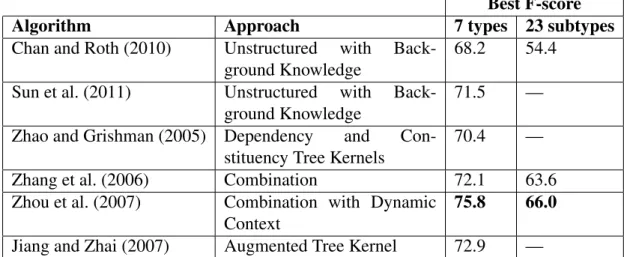
2.1.3.3 Comparison of research from Sections 2.1.3.1 and 2.1.3.2 32 2.1.3.4 Connection to entity instantiations . . . 32
2.1.4 Unsupervised relation extraction . . . 34
2.2 Context-independent Relation Extraction . . . 37
2.2.1 Minimally supervised relation extraction . . . 37
2.2.2 Minimally supervised set extraction . . . 42
2.2.3 Differentiating entity instantiations from context-independent re-lation extraction . . . 43
2.3 Bridging Anaphora . . . 44
2.3.1 Anaphora and bridging . . . 44
2.3.2 Linguistic bridging research . . . 46 vii
2.4 Conclusion . . . 50
3 Creating a Corpus of Entity Instantiations 51 3.1 Motivation . . . 51
3.2 Intuitive Definition and Examples . . . 53
3.2.1 Instantiation definition . . . 53
3.2.2 Variety in entity instantiations . . . 55
3.3 Exact Definition and Annotation Guidelines . . . 58
3.3.1 Annotation restrictions . . . 58
3.3.2 Definition of a mention . . . 60
3.3.2.1 Generic pronouns . . . 60
3.3.2.2 Idiomatic mentions . . . 60
3.3.2.3 Non-referential ‘it’ . . . 61
3.3.3 Specific annotation rules and special cases . . . 61
3.3.3.1 Generic mentions . . . 61
3.3.3.2 Indefinite pronouns . . . 62
3.3.3.3 Negated mentions . . . 62
3.3.3.4 Members implicitly excluded from sets . . . 62
3.3.3.5 Metonymic mentions . . . 63
3.3.3.6 Co-ordinations . . . 63
3.3.3.7 Nested mentions . . . 64
3.4 Potential Difficulties and Borderline Cases . . . 65
3.5 The Annotation Design and Process . . . 67
3.5.1 Choice of texts to annotate . . . 67
3.5.2 Pre-processing of noun phrases . . . 68
3.5.3 Classification of noun phrases into singular or plural . . . 69
3.5.4 Annotation tool . . . 72
3.5.4.1 Annotation tool requirements . . . 72
3.5.4.2 Annotation tool implementation . . . 73
3.6 Annotation Results . . . 74
3.6.1 Agreement study . . . 74
3.6.1.1 Intersentential agreement . . . 74
3.6.1.2 Intersentential disagreement analysis . . . 79
3.6.1.3 Intrasentential agreement study . . . 81 viii
3.8 Gold Standard Corpus . . . 84
3.8.1 Corpus dimensions . . . 84
3.8.2 Entity instantiation distribution . . . 86
3.8.3 Intrasentential analysis: syntactic arrangement of noun phrases . . 88
3.8.4 Intersentential analysis . . . 91
3.8.4.1 Ordering of and distance between noun phrases . . . . 91
3.8.4.2 Noun phrase categorisation . . . 94
3.9 Conclusion . . . 97
3.9.1 Summary . . . 97
3.9.2 Future work . . . 98
4 Machine Learning of Entity Instantiations 101 4.1 Feature Design . . . 101 4.1.1 Surface features . . . 102 4.1.1.1 N-grams . . . 102 4.1.1.2 Part-of-speech . . . 102 4.1.1.3 Head words . . . 102 4.1.1.4 Lemmas . . . 103
4.1.1.5 Head word lemmas . . . 103
4.1.1.6 Levenshtein’s distance . . . 103 4.1.1.7 Distance . . . 104 4.1.1.8 Ordering . . . 104 4.1.2 Salience features . . . 104 4.1.2.1 Grammatical role . . . 104 4.1.2.2 Mention count . . . 104 4.1.3 Syntactic features . . . 105 4.1.3.1 Syntactic parallelism . . . 105 4.1.3.2 Modification . . . 105 4.1.4 Context features . . . 105 4.1.4.1 Verb semantics . . . 105 4.1.4.2 Quotations . . . 106 4.1.4.3 Discourse relations . . . 106 4.1.5 Knowledge-based features . . . 107 4.1.5.1 WordNet . . . 108 ix
4.1.6 Full feature list . . . 109
4.2 Intrasentential Features — Tree Kernels . . . 112
4.2.1 Tree representation . . . 114
4.2.2 Tree kernel algorithms . . . 120
4.2.3 Application of tree kernels to intrasentential entity instantiations . 121 4.3 Experimental Setup . . . 126
4.4 Evaluation . . . 129
4.4.1 Evaluation measures . . . 129
4.4.2 Intrasentential evaluation . . . 132
4.4.2.1 Evaluation of flat feature performance on balanced data set . . . 132
4.4.2.2 Evaluation of tree kernel performance on balanced data set . . . 133
4.4.2.3 Evaluation of combination kernels on balanced data set 136 4.4.2.4 Evaluation of flat feature performance on unbalanced data set . . . 137
4.4.2.5 Evaluation of tree kernel performance on unbalanced data set . . . 138
4.4.2.6 Evaluation of combined kernel performance on unbal-anced data set . . . 138
4.4.2.7 Intrasentential summary results . . . 141
4.4.2.8 Error analysis . . . 141
4.4.3 Intersentential evaluation . . . 146
4.4.3.1 Evaluation of performance on balanced data set . . . . 146
4.4.3.2 Evaluation of performance on unbalanced data set . . . 147
4.4.3.3 Error analysis . . . 150 4.5 Conclusion . . . 155 4.6 Future Work . . . 156 4.6.1 Feature selection . . . 156 4.6.2 Additional features . . . 157 4.6.3 Kernel methods . . . 157
4.6.4 Machine learning techniques . . . 158 x
5.2 Background . . . 164
5.2.1 Theories of discourse . . . 164
5.2.2 Corpora . . . 166
5.2.3 Automatic approaches . . . 167
5.3 The Interaction between Discourse Relations and Entity Instantiations . . 172
5.3.1 Entity instantiation and discourse relation co-occurrence . . . 172
5.3.2 Annotating discourse relations for the presence of entity instanti-ations . . . 180
5.4 Baseline Discourse Relation Classification . . . 182
5.4.1 Feature set . . . 182
5.4.2 Full feature list . . . 184
5.4.3 Experimental set-up . . . 187
5.4.4 Results . . . 187
5.5 Discourse Relation Classification with Gold Standard Entity Instantiations 187 5.6 Discourse Relation Classification with Machine Identified Entity Instan-tiations . . . 189
5.6.1 Machine-identified entity instantiation features . . . 189
5.6.2 Results . . . 190 5.7 Conclusion . . . 191 5.7.1 Summary . . . 191 5.7.2 Future work . . . 192 6 Conclusion 193 6.1 Summary . . . 193 6.2 Impact of Limitations . . . 195 6.3 Future Work . . . 198 6.3.1 Corpus extensions . . . 198
6.3.2 Machine learning improvements . . . 200
6.3.3 Applications . . . 204
Bibliography 206
A Inter-sentential Annotation Scheme 233
B Intra-sentential Annotation Scheme 241
D Hierarchy of relations in the PDTB 257
2.1 An example paragraph which might be subject to slot filling. Taken from
Jurafsky and Martin (2009), pp 759. . . 18
2.2 An example of a filled template. Taken from Jurafsky and Martin (2009), pp 759. . . 18
2.3 An augmented parse tree from Miller et al. (1998). . . 27
2.4 The full dependency tree for the sentence containing the relation Protesters AT stations, as presented to the learner by Culotta and Sorensen (2004) . . 29
2.5 The shortest path dependency tree for the sentence considered in 2.4, as presented to the learner by Bunescu and Mooney (2005) . . . 30
2.6 A sentence parse tree with a SOCIAL.Other-Personal relation between partnersandworkers, and the path-enclosed tree for the relation. . . 31
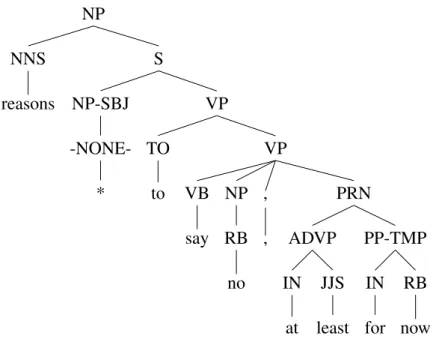
3.1 A constituency parse tree representation of the set noun phrase from Ex-ample 3.6. . . 55
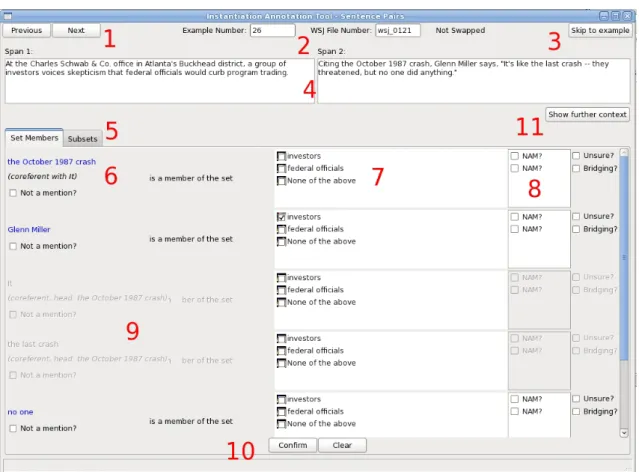
3.2 The completed annotation tool. . . 73
3.3 The annotation tool with numbered functions. . . 75
3.4 The annotation tool showing the Subset panel. . . 76
3.5 The Show Further Context function of the annotation tool. . . 77
3.6 The intrasentential annotation tool. . . 78
4.1 A vector of features, as presented to the ICSIBoost machine learner. . . . 112
4.2 An example of large sentence parse tree with a relatively local entity in-stantiation. . . 116
4.3 The five tree representations used in Zhang et al. (2006), based on the sen-tence “. . . provide benefits to 200 domestic partners of their own workers in New York”. “Partners” and “workers” are the two entities in question. . 117
4.4 The SPT representation of the sentence from Figure 4.3. . . 118
4.5 The SPET representation derived from Example 4.13. . . 119
4.6 The SPT representation derived from Example 4.13. . . 119 xiii
4.8 Example constituency parse trees of simple conjunctive phrases. . . 123
4.9 Example constituency parse trees comprising noun phrases with preposi-tional phrases. . . 124
4.10 Example constituency parse trees of nested sets. . . 125
4.11 A tree similar to those in Figure 4.9, but that does not represent an entity instantiation. . . 126
4.12 An example of a distant entity instantiation in a syntactically complex sentence, which is unlikely to be identified by tree kernel learning. . . 127
4.13 ROC curve: Set members . . . 151
4.14 ROC curve: Subsets . . . 151
6.1 A graphical representation of the instantiations in Example 6.5. . . 203
2.1 Details of the tasks of the Message Understanding Conferences . . . 19 2.2 Some example heuristics from Riloff (1993). . . 20 2.3 A summary of the highest scoring algorithms in MUCs 3–7, from
Chin-chor (1998) . . . 21 2.4 The list of ACE Event Types, reproduced from Grishman (2012) . . . 23 2.5 The full ACE-2004 relation schema, as described in Grishman (2012). . . 26 2.6 An overview of the RDR portions of each ACE evaluation. . . 26 2.7 Comparison of relation extraction results on the ACE-2003 corpus. . . 32 2.8 Comparison of relation extraction results on the ACE-2004 corpus. . . 33 2.9 Comparison of relation extraction results on corpora other than ACE-2003
and ACE-2004. . . 33 2.10 Example patterns from Hearst (1992) . . . 38 3.1 Positive and negative examples of textual entailment from Dagan et al.
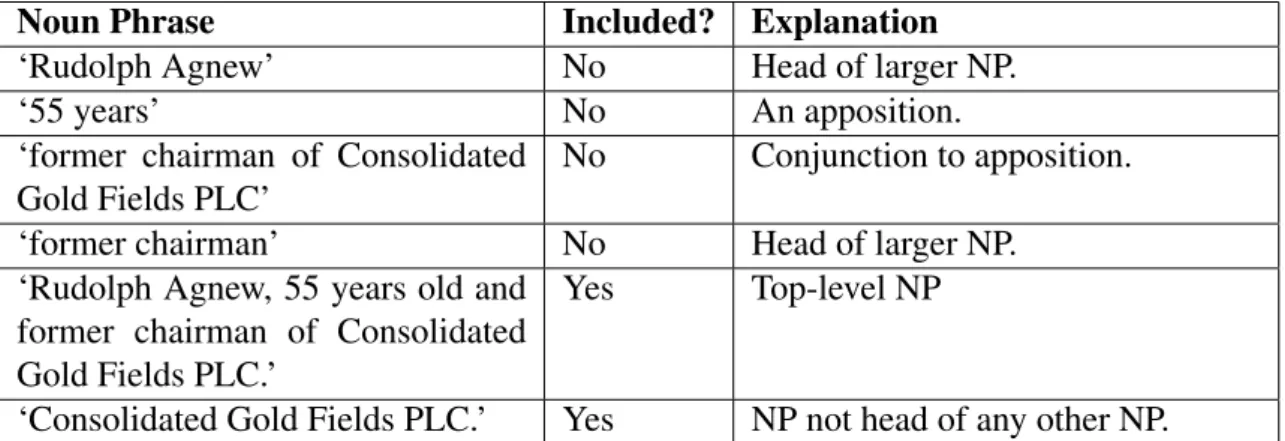
(2006). . . 52 3.2 Instantiations present in Example 3.17. . . 59 3.3 The NPs present in Example 3.52, and whether they are included after
pre-processing. . . 70 3.4 The NPs present in Example 3.53, and whether they are included after
pre-processing. . . 70 3.5 Results of the intersentential agreement study . . . 79 3.6 Results of the intersentential agreement study . . . 81 3.7 Frequency of intrasentential, adjacent intersentential and non-adjacent
in-tersentential entity instantiations in 3 sample texts . . . 83 3.8 Total corpus size in words, sentences and texts . . . 85 3.9 Distribution of text lengths in corpus by genre, measured in words. . . 86 3.10 Distribution of text lengths in corpus by genre, measured in sentences. . . 86 3.11 Frequency of entity instantiations in 75 texts . . . 86
by genre. . . 89
3.14 Distribution of intersentential entity instantiations in corpus per sentence pair, by genre. . . 90
3.15 Frequency of intersentential entity instantiations and non-instantiation NP pairs in 75 texts . . . 91
3.16 Frequency of intrasentential entity instantiations and non-instantiation NP pairs in 75 texts . . . 91
3.17 Frequency of syntactic relationships between NPs in intrasentential set member entity instantiations. . . 92
3.18 Frequency of syntactic relationships between NPs in intrasentential subset entity instantiations. . . 92
3.19 Ordering of NPs in intersentential set member entity instantiations . . . . 92
3.20 Ordering of NPs in intersentential subset entity instantiations . . . 93
3.21 Distribution of intersentential set member entity instantiations by nor-malised distance in words between noun phrases. . . 93
3.22 Distribution of intersentential subset entity instantiations by normalised distance in words between noun phrases. . . 93
3.23 Intersentential set member NP categorisation. . . 95
3.24 Intersentential subset NP categorisation. . . 95
3.25 Intersentential set member NP modification. . . 96
3.26 Intersentential subset NP modification. . . 96
3.27 Intersentential set member set NP types . . . 96
3.28 Intersentential subset set NP types . . . 97
4.2 Statistical analysis of the numerical features included in the full feature set. 113 4.3 Results from Zhang et al. (2006). . . 117
4.4 The size and distribution of intrasentential machine learning data sets. . . 128
4.5 The size and distribution of intersentential machine learning data sets. . . 128
4.6 Confusion matrix . . . 129
4.7 Classification with changing thresholds . . . 131
4.8 Results of the intrasentential classifier on the balanced data set — flat features . . . 134
4.9 Results of the intrasentential classifier on the balanced data set — tree kernels and combined kernels . . . 135
combination kernels . . . 140 4.12 Intrasentential Summary Results. . . 142 4.13 Breakdown of best performing intrasentential set member algorithm by
syntactic relationship. . . 143 4.14 Breakdown of best performing intrasentential subset algorithm by
syntac-tic relationship. . . 143 4.15 Results of the intersentential classifier on the balanced data set . . . 148 4.16 Results of the intersentential classifier on the original data set . . . 149 4.17 Breakdown of best performing intersentential set member algorithm by
set member NP type. . . 150 4.18 Breakdown of best performing intersentential subset algorithm by subset
NP type. . . 152 5.1 Distribution of discourse relations in 75 entity instantiation texts. . . 173 5.2 Entity instantiation and discourse relation co-occurrence: all
instantia-tions, all relations. . . 175 5.3 Entity instantiation and discourse relation co-occurrence: all relations,
inter vs intra breakdown. . . 176 5.4 Entity instantiation and discourse relation co-occurrence: all relations, set
member vs subset breakdown. . . 176 5.5 Entity instantiation and discourse relation co-occurrence: all relations,
implicit vs explicit breakdown. . . 177 5.6 Entity instantiation and discourse relation co-occurrence: implicit
rela-tions, inter vs intra breakdown. . . 178 5.7 Entity instantiation and discourse relation co-occurrence: implicit
rela-tions, set member vs subset breakdown. . . 178 5.8 Entity instantiation and discourse relation co-occurrence: implicit
rela-tions, relation type breakdown. . . 179 5.9 Entity instantiation and discourse relation co-occurrence:
Expansion.Instan-tiation . . . 180 5.10 Entity instantiation and discourse relation co-occurrence:
Expansion.Instan-tiation, inter vs intra breakdown. . . 181 5.11 Entity instantiation and discourse relation co-occurrence:
Expansion.Instan-tiation, set member vs subset breakdown. . . 181 xvii
5.15 Baseline classification of Expansion.Instantiation relations. . . 187 5.16 Classification of Expansion.Instantiation relations with gold standard
en-tity instantiation features. . . 188 5.17 Classification of Expansion.Instantiation relations with machine-identified
entity instantiation features. . . 191
Abbreviation Definition Explanation
ACE Automatic Content
Ex-traction
A set of shared IE tasks, including RE, Corefer-ence Resolution and Event Detection.
API Application
Program-ming Interface
A way of accessing a resource programmati-cally.
AUC Area Under Curve The area under an ROC curve.
GPE Geo-Political Entity A type of named entity, which represents na-tions, regions, or governments.
IE Information Extraction The task of extracting structured information from free text.
MUC Message
Understand-ing Conference
One of a series of IE conferences which ran from 1987–1997
NE Named Entity Text representing the name of a person or
or-ganisation, or a location.
NP Noun Phrase A phrase with a noun (or pronoun) as the head.
PDTB Penn Discourse
Tree-bank
Corpus of WSJ articles annotated with dis-course relations.
PMI Pointwise Mutual
In-formation
A measure of the similarity of two concepts.
POS Part-of-speech The lexical category of a word.
PTB Penn Treebank Corpus of WSJ articles annotated with POS and
syntax trees.
RE Relation Extraction The IE sub-problem of identifying binary
re-lationships between entities, such as Part-Of, Employed-ByorLocated-In.
ROC Reciever Operating
Characteristic
A method of displaying the performance of a classifier as its decision boundary is changed. It is a plot of the True Positive Rate against the False Positive Rate.
SVM Support Vector
Ma-chine
A type of machine learning classifier.
WSJ Wall Street Journal American financial newspaper.
Introduction
1.1
Problem Outline
This thesis is concerned with entity instantiations. An entity instantiation is an entity relationship in a text, where asetof entities is mentioned, and then amemberorsubset1
of this set is introduced. Example 1.1 shows a pair of sentences with the set in bold and set member in italics.2 Examples 1.2 and 1.3 show a pair of sentences with a set in bold and subset in italics3.
(1.1) a. Some European fundsrecently have skyrocketed. b. Spain Fundhas surged to a startling 120% premium.
(1.2) a. Bids totalling $515 millionwere submitted. b. Accepted offersranged from 8.38% to 8.395%
(1.3) a. In the aftermath of the downturnmany manufacturershave struggled. b. Those relying on foreign importshave had the most difficulty.
1When we refer to a subset, we mean apropersubset. We consider two equal sets to be coreferent, and
not participating in an Entity Instantiation.
2Examples 1.1, 1.2, 1.3, 1.5 and 1.12 are from the Penn Treebank Wall Street Journal Corpus (Marcus
et al., 1993).
3This convention of displaying the set in bold and the member or subset in italics is used throughout the
thesis.
(1.4) a. Footballersare vastly overpaid.
b. Manchester United payWayne Rooney £200,000 per week.
The recognition of entity instantiations can often be difficult. Entity instantiations occur in a variety of forms. Participating noun phrases (NPs) include common nouns, pronouns and proper nouns and can also have missing head nouns (see Example 1.3). The participating NPs can also fulfil various grammatical roles in a sentence. Examples 1.1, 1.2 and 1.6 show entity instantiations where both the set and member are subjects of their respective sentences, in contrast to Example 1.4 (between a subject and direct object), and Example 1.5 (between nested NPs in a more complex sentence).
The two participants in an entity instantiation can have word overlap (see Exam-ple 1.1) or synonymous head nouns (see ExamExam-ple 1.2), but are often not related in such a simple manner. For instance, in Example 1.4, knowledge that Wayne Rooney is a foot-baller is helpful in identifying the entity instantiation. Additionally, accurate recognition of an entity instantiation often needs contextual knowledge. In Examples 1.6 and 1.7, the contextual information about the attitudes of the workers is necessary to establish whether an entity instantiation exists.
(1.5) a. Already, scientists are developing tests based onthe newly identified genes
that, for the first time, can predict whether an otherwise healthy individual is likely to get cancer.
b. “It’s a super-exciting set of discoveries,” says Bert Vogelstein, a Johns Hop-kins University researcher who has just founda gene pivotal to the triggering of colon cancer.
(1.6) a. Some workersare opposed to strike action.
b. John Smithfears that a strike could damage the industry’s public perception.
(1.7) a. Some workersare opposed to strike action.
b. David Jones, however, is willing to put his job on the line for the cause. (Not an instantiation.)
The problem of identifying entity instantiations is untackled. The problem is related to Relation Extraction (RE), which is the discovery of semantic relations between pairs of entities. Much of the work in this field is connected to the Message Understanding Conferences (MUC, 1987-1998) and the NIST Automatic Content Extraction programs (ACE, 2000-2005), both of which provide annotated corpora of semantic relations. Entity
instantiations are not considered in the MUC and ACE annotation schemes, or any other semantic relation annotation scheme. MUC and ACE consider relationships between dif-ferent types of entity, such as those between persons and locations or organisations and persons rather than the sets and instances of entities of the same type that we consider. The differences and similarities between entity instantiations and relation extraction, as well as the wider problem of Information Extraction, are discussed in Section 2.1.
The dependence on the surrounding context to establish the presence of an instan-tiation makes the problem distinct from that of harvesting hyponyms or other relations from large corpora or the World Wide Web (Hearst, 1992; Pantel and Pennacchiotti, 2006; Mintz et al., 2009). The relationships discovered in this way are largely context-independent. For example, relationships such as‘a dog is a type of animal’or‘Microsoft is a company’ are truths that are unaffected by textual context. We further discuss this work and its links with entity instantiations in Section 2.2.
The problem is also related to, but distinct from, bridging. Bridging is the problem of establishing non-coreferent anaphoric entity relationships such as meronymy, where the relationship is necessary for the interpretation of the anaphor (Clark, 1975; Prince, 1981). For instance, in example 1.3 the subset‘Those relying on foreign imports’requires knowledge of the set‘manufacturers’to be understood. A large proportion of entities that participate in entity instantiations do not rely on an antecedent to be interpreted.
In this thesis, we explore the problem of entity instantiations, firstly from the per-spective of human annotation and subsequently from the perper-spective of automatic identi-fication. We present an annotated corpus of entity instantiations, containing 4521 instan-tiations annotated both intrasententially and between adjacent sentences, over 75 texts. We then use this corpus to train an automatic entity instantiation identifiers for inter- and intrasentential instantiations. We finally utilise our automatic instantiation identifier as part of a system for classifying Expansion.Instantiation discourse relations in the Penn Discourse Treebank (PDTB) (Prasad et al., 2008).
1.2
Importance of the Problem
Entity instantiations are important. Generally, knowledge of the relationship between two entities or sets of entities can help to supplement our knowledge about either participant. In Example 1.8, the Entity Instantiation between ‘several EU countries’ and ‘the UK’
gives us the knowledge that not only are interest rates dropping in the UK, but inflation is rising as well.
(1.8) a. Inflation has increased sharply inseveral EU countries. b. Inthe UK, this has accompanied a drop in interest rates.
In addition to this property, entity instantiations have the potential to be important for a number of applications, which are detailed below.
Knowledge extraction. Knowledge extraction is the process of automatically extract-ing structured knowledge from both unstructured and structured data. The goal is to create some sort of schema to represent the data, such as anontology. An ontology is a hierar-chical organisation of concepts which captures subset and superset relationships between the concepts (Jurafsky and Martin, 2009).
In this thesis we develop techniques for identifying set membership and subset re-lations in text. Although our definition of entity instantiations includes complex noun phrases and context-dependent relationships rather than the more concrete facts repre-sented in a typical ontology, the identification of entity instantiations could serve as an important pre-processing step in ontology construction.
Discourse relations. In text, clauses and sentences do not exist as isolated units but instead are connected by relations. Thesediscourse relationsrepresent relationships such as cause, contrast, restatement and condition.
Discourse relations are often signalled by aconnective, a word or phrase which makes clear the relationship. For example, the connectivebutusually signals a contrast,because
usually signals a cause andif signals a condition. Often, relations are not signalled by a connective, but are instead understoodimplicitly. Example 1.9 shows an example of an implicit causal discourse relation.
(1.9) a. John had no room for desert. b. He’d eaten far too much already.
Whilst, due to the unambiguous nature of many connectives, explicit discourse rela-tion classificarela-tion can be performed with high accuracy (Pitler et al., 2008), the classifi-cation of implicit discourse relations remains a challenging task (Pitler et al., 2009; Lin et al., 2009; Zhou et al., 2010; Louis et al., 2010b; Park and Cardie, 2012; Wang et al., 2010). An understanding of the entity relationships within and between the arguments of an implicit discourse relation, including entity instantiations, could improve classifi-cation accuracy. In particular, the discourse relation Expansion.Instantiation from the PDTB scheme of discourse relations has a strong connection with entity instantiations,
which we explore in detail in Chapter 5. Example 1.10 shows an example of an Expan-sion.Instantiation discourse relation which co-occurs with an entity instantiation.
(1.10) a. Attempts to produce “pan-European” TV programs have generally re-sulted in disappointment.
b. The Eurovision Song Contest, one such program, has been described as the world’s most boring TV show.
Sentiment analysis. Sentiment analysis is the sub-field of Natural Language Processing (NLP) concerned with automatically detecting and classifying sentiment and opinions in texts. Entity instantiations could aid the interpretation of sentiment. For instance, in Example 1.4 the second sentence considered in isolation does not carry any sentiment. However, the author’s thoughts about the pay of Wayne Rooney can be inferred from the negative sentiment of the first sentence and the entity instantiation between the two sentences.
Summarisation. Entity instantiations could be used to improve techniques for the au-tomatic summarisation of texts. We suggest that, in general, sentences which contain a number of sets may be more useful in a summary than those which contain mostly set members and subsets. Example 1.11 shows a set-dense first sentence which would be use-ful in a summary, and a member/subset dense second sentence which may be excluded from a summary.
(1.11) a. Several other Japanese companies and regional governments have sent aid to San Francisco.
b. Sumitomo Bank donated $500,000, Tokyo prefecture $15,000 and the city of Osaka $10,000.
1.3
Problem Definition
In this Section, we discuss the connection between entity instantiations and other related natural language processing problems, and make clear the limitations of our study.
Focus on set membership and subsets. There are a number of set relationships that could have been considered as part of this thesis, including set identity, set-complement relationships, co-set-membership or set disjointness. Examples 1.12, 1.13 , 1.14 and 1.15 show these relationships respectively, with participating phrases underlined.
(1.12) Program traders are fond of predicting that if they are blocked in the U.S., they will simply emigrate to foreign stock markets.
(1.13) The ordinance, in Moon Township, prohibits locating a group home for the handi-capped within a mile of another such facility.4
(1.14) a. Bradford City’s players have excelled this season.
b. The performances turned in by Gary Jones and James Hanson means they are attracting the attention of bigger clubs.
(1.15) a. English defenders have a tendency to hit the ball high and long towards the striker.
b. In contrast, Spanish defenders prefer to pass short to a deep-lying midfielder. Set identity and set complement relationships have already been researched as part of the study of coreference (ACE, 2000-2005; Weischedel et al., 2011) and as part of work relating to comparative anaphora (Modjeska, 2000, 2004; Markert and Nissim, 2005), respectively. We therefore chose two relationships that had not been previously examined in depth — set membership and subsethood.
A further reason for selecting set membership and subsethood relationships was the challenge in identifying them. The variety in the internal structure of the participant NPs, the variety in their distribution and their overlap with other phenomena, such as metonymy and pronominal anaphora, means that no simple rules can adequately identify entity instantiations, and instead a machine learning approach is required. The complexity of these relationships means that the consideration of additional relationships is beyond the scope of this PhD.
We also consider entity instantiations important for a number of applications, includ-ing those listed in Section 1.2. Set membership and subset relationships are particularly important for the identification of the discourse relation Expansion.Instantiation, which we tackle in Chapter 5.
Anaphoric and non-anaphoric entity instantiations. An anaphor is a reference to an entity previously introduced in the discourse, known as theantecedent(Mitkov, 1999). Often, anaphora are pronouns. Example 1.16 shows a pair of sentences with two anaphoric references;Heis an anaphoric reference to the antecedentJohn, andit refers back toan apple.
(1.16) a. John ate an apple.
b. He thought it was very tasty.
Pronominal anaphora resolution — the problem of establishing which antecedent a pronoun refers to — is a well studied problem (Hobbs, 1978; Brennan et al., 1987; Lap-pin and Leass, 1994; Soon et al., 2001; Yang et al., 2003,inter alia). However, other sorts of anaphora, such as those that do not co-refer with their antecedent but can instead be in-ferred from it, are less well researched. These sort of anaphora are rein-ferred to asbridging
anaphora, because often the reader is required to ‘bridge’ the gap between the anaphor and the antecedent based on some inference or prior knowledge. Example 1.17 shows a sentence, taken from Jurafsky and Martin (2009), which has two bridging anaphora; a doorandthe engine, which the reader infers are parts of the previously mentioned1961 Ford Falcon.
(1.17) I almost boughta 1961 Ford Falcontoday, buta doorhad a dent andthe engine
seemed noisy.
Bridging anaphora can also be connected to their antecedent by set membership, as in this example from Clark (1975):
(1.18) I mettwo peopleyesterday.The womantold me a story.
Anaphoric set members and subsets have been covered partially in the study of bridg-ing anaphora. At least three corpora have annotated them, but each corpora’s treatment has shortcomings. Firstly, theGNOME corpus (Poesio, 2003) includes categories for set
membership and subset bridging, but agreement on the annotation of bridging relations is poor (22%), and only 581 examples are annotated. Secondly, Nissim et al. (2004)’s Switchboard corpus includes a set membership category, which consists of set member-ship, subsets and co-set-members (two members of a common set). However, the anno-tation of set membership has a number of restrictions, including that it can only be used if anaphor and antecedent have either the same head, a synonymous head or are part of a hyponym relation encoded in WordNet. Additionally, the antecedent of each anaphor is not marked. Finally, Markert et al. (2012)’s corpus does not include a separate set mem-bership or subset category, but rather has one category for all bridging anaphora. Their corpus is also relatively small, containing a total of 663 bridging references, of which only a small subset are bridged via set membership or subset relationships.
To our knowledge, no prior study has considered non-anaphoric entity instantiations. Relation extraction annotation schemes, such as those that formed part of ACE and MUC,
focus on relations that describe personal and social relationships, physical locations, em-ployment and affiliation, rather than considering set membership or subsets. We fully discuss the distinctions between this work and our own in Section 2.1.3.
Our study encompasses both anaphoric set membership and subset relationships,and
cases where the set member or subset does not require the set to be interpreted. Our motivation is the discovery of set members and subsets in general. The anaphoricity of the relationship may be important in some applications, such as generating prosodic markings (Baumann and Riester, 2011). However, we expect that for several other future applications, such as discourse relation classification, knowledge extraction and sentiment analysis, the realisation of the relationship is unlikely to be of consequence. We therefore do not consider the anaphoricity of the relationship as part of either our annotation study or machine learning experiments.
Our work does not directly contribute to the anaphoric interpretation literature, be-cause we do not focus specifically on anaphoric relationships. Making the distinction between anaphoric and non-anaphoric entity instantiations would be a useful extension to the work of this thesis, and this could be achieved, at least in part, by applying a va-riety of heuristics. For example, all NPs with proper noun heads are non-anaphoric, as are intrasentential instantiations where the set member or subset is nested within the set. A further, fuller discussion of the connection between entity instantiations and bridging anaphora can be found in Section 2.3.
Our decision to conflate anaphoric and non-anaphoric relationships of the same type is methodologically similar to the study ofcoreference. In coreference, pronominal identity anaphora as well as non-anaphoric expressions which refer to the same entity are tackled together, as in our study. This approach is not without its drawbacks — the relationship being studied might not be considered a linguistic phenomenon in its own right in the way that anaphora are, but because both convey the same relationship — identity — and a knowledge of this relationship is useful for a range of applications, the conflation of the anaphoric and non-anaphoric relationships is sensible.
Distance restriction. In this thesis, we limit annotation of entity instantiations to those occurring within a sentence or between adjacent sentences. Annotating entity instantia-tions without distance restricinstantia-tions is very difficult — one must compare a potential set member or subset to every potential set in the document, and designing an annotation process that allows for reliable and replicable annotation in this scenario would be
chal-lenging5. It is worth noting, however, that coreference annotation schemes also consider distant relationships and require the comparison of many mentions in a lengthy text.
Restricting the annotation to anaphoric cases may have made a distance restriction unnecessary, because bridging anaphora are a relatively local phenomenon — Hou et al. (2013) report that 71% of the antecedents in their corpus are within two prior sentences of the anaphor. However, we were motivated to include non-anaphoric entity instantiations because they too convey important relationships that are useful for a range of applications. Our decision to restrict annotation to adjacent sentences, as opposed to within a single paragraph or within the two preceding sentences, is partially motivated by the fact that im-plicit discourse relations in the PDTB are also only annotated between adjacent sentences. Of course, implicit discourse relations canexistbetween non-adjacent sentences, regard-less of the fact thatannotation is restricted to between adjacent sentences in the PDTB. Currently, the PDTB, complete with this restriction, is the largest annotated corpus of discourse relations available, and so our annotation restriction allows us to consider the implicit relations in this important resource. Other discourse relation frameworks, such as Rhetorical Structure Theory (RST) and the framework used by the Discourse Graphbank (Wolf and Gibson, 2005), do not limit their annotation in this way.6
We demonstrate in Chapter 5 that entity instantiations are useful in the discovery of one implicit discourse relation, and the decision to annotate between adjacent sentence should allow further exploration of the connection between discourse relations in the PDTB and entity instantiations in future.
Limitations on participating noun phrases. There are four possible NPs involved in entity instantiations: the set in a set member entity instantiation, the member in a set member entity instantiation, the superset in a subset entity instantiation and the subset in a subset entity instantiation. Other than ensuring that the member in a set member entity instantiation is singular, and that the other three possible NPs are plural, we place very few restrictions on the NPs involved. Unlike relation extraction schemes, we do not limit the participants to entities of fixed types, and we do not place any limitation on the form of the NPs — pronouns, proper names, demonstratives, quantified NPs, definite descriptions and so on are all annotated as long as they are participating in a set member or subset
5See Section 3.7 for a the results of a short annotation annotation study in which the distance restrictions
are removed.
6Whilst RST and the Discourse Graphbank do not limit their annotations to between adjacent sentences,
the building blocks of their annotation are small discourse segments (usually clauses) which cannot overlap and cover the whole text. This definition of discourse segments means that towards the bottom of the discourse tree/graph there are many sentence-internal relations, which entity instantiations as annotated in this thesis could help disambiguate.
relation.
We limit sets to plural NPs and members to singular NPs using the algorithm outlined in Section 3.5.3. We enforce this restriction to avoid marking relations other than entity instantiations, such as part-of, employment or location, and also to avoid situations where the set is in some way more than a simple grouping of entities, such as ‘the EU’ or
‘Manchester United’.
In order to streamline the annotation process, we automatically remove NPs which, by their nature, can never be in an instantiation, such as adverbial NPs, NPs that are children of adverbial phrases and existential ‘there’ phrases. We also remove NPs that are not the largest NP that describes a certain concept, such as appositions, conjunctions of appositions, and NPs that are the head of a larger NP modified by prepositional phrases. This process is described in further detail in Section 3.5.2.
As part of the annotation process, annotators are asked to mark generic uses of ‘we’
and‘you’, references to the reader, non-referential uses of‘it’and idiomatic NPs with no literal meaning as non-mentions. They are also required to refrain from marking negated mentions, indefinite pronouns such as‘either, each’and‘any’, and singular generic NPs as instantiations. The motivation for these exclusions to avoid situations, such as those in Examples 1.19 and 1.20 below, where the set membership or subset relation is unclear. (1.19) a. John Smith and John Doeare competing for the contract.
b. Eithercould clinch it.
(1.20) a. John, Mary and James just sat and watched. b. Not one of themdared intervene.
The limitations on participating noun phrases are discussed further in Section 3.3.1.
1.4
Research Questions and Hypotheses
1.4.1
Research questions
In this thesis, we aim to explore a variety of research questions, grouped into three main categories: human identification of entity instantiations, machine identification of entity instantiations and applications of entity instantiations.
Human identification and corpus study. Firstly, we wish to establish more clearly the nature of the phenomenon. How often do they occur in texts? Can they be identified
reliably by humans? Are there common lexical or syntactic patterns that indicate them? Are there patterns in the internal structure of a noun phrase which make it more likely to be part of an instantiation?
Machine identification. Secondly, assuming that humans can reliably identify instan-tiations, we wish to explore the possibility of using computational methods for automatic identification of instantiations. Can a computer identify instantiations with a reasonable degree of accuracy? Can a supervised machine learning approach be used to identify entity instantiations?
If we employ a machine learning approach, what sort of features will best represent potential instantiations to the learner? Is there a way of incorporating world knowledge? Might we learn directly from structured data such as syntactic parse trees and dependency structures? Do different types of instantiation (i.e. set membership, subset, intrasentential, intersentential) behave similarly enough to be considered a single task, or is it best to treat each individually?
Applications. Finally, we wish to consider the connections between entity instantia-tions and other natural-language phenomena. How do entity instantiainstantia-tions interact with discourse-level phenomena, such as discourse relations? Might knowledge of entity in-stantiations aid the classification of discourse relations?
1.4.2
Hypotheses
We make a number of specific hypotheses related to the research questions detailed in Section 1.4.1. These hypotheses are described below.
Our most significant hypothesis is that, in this thesis, we introduce a novel, untackled research problem — entity instantiations. We supplement this with the hypothesis that our formulation of entity instantiations makes it a well defined problem, and that one may develop an annotation schema and reliably annotate the phenomenon in text.
Secondly, we hypothesise that a machine learning approach can be used to automat-ically identify entity instantiations from texts. Specifautomat-ically, we hypothesise that a super-vised machine learning method can classify potential instantiations as positive or neg-ative examples of the phenomenon. Based upon this hypothesis, we have several sub-hypotheses related to the machine interpretation of instantiations:
2. The salience of the two potential participants in an instantiation in the text is an indicator of the presence of an instantiation.
3. Features which use world knowledge to discover established links between noun phrases are useful for entity instantiation classification.
4. Knowledge of the syntactic relationship between the two participants in an entity instantiation aids classification. We hypothesise that this knowledge is especially relevant for intrasentential instantiations, where the two participants are part of the same syntactic parse tree.
Finally, we hypothesise that there is a strong link between entity instantiations and discourse relations, particularly the Expansion.Instantiation discourse relation. We hy-pothesise that knowledge of entity instantiations can improve the classification of Expan-sion.Instantiationdiscourse relations.
1.5
Contributions
The main contributions presented in this thesis are summarised below.
The creation of the first, reliably annotated, corpus of entity instantiations. We an-notate examples of instantiations between adjacent sentences and within single sentences, over 75 Penn Treebank Wall Street Journal texts. This leads to the identification of 2118 intersentential instantiations, composed of 1477 set membership instantiations and 641 subset instantiations, and 2403 intrasentential instantiation composed of 1538 set mem-bership instantiations and 865 subset instantiations.
We measure the agreement of two annotators over 5 randomly selected intersentential texts, and further 5 randomly selected intrasentential texts. We achieve agreement of
κ =0.65 and κ=0.75 for inter- and intrasentential instantiations respectively. We also
perform a corpus study, analysing the annotated entity instantiations in terms of their internal structure, the distance between arguments and their syntactic relationship.
The first automatic instantiation identifier. We create the first instantiation identifi-cation algorithm, using a supervised machine learning approach. Our feature set draws on surface, syntactic, contextual, salience and knowledge features to aid classification. We separately apply our classifier to intersentential and intrasentential entity instantia-tions and experiment with both balanced data, with a 50/50 positive/negative split, and
the original unbalanced corpus. We record highly significant performance increases over both unigram-based and majority baselines on the balanced data, and also on the original distribution of intrasentential instantiations.
The application of tree kernels to the problem of intrasentential instantiation iden-tification. We use tree kernels to learn directly from the syntactic parse trees which contain the two potential participants in an intrasentential instantiation. We employ two tree kernels — the Shortest Path Tree (SPT) and the Shortest Path Enclosed Tree (SPET). These tree kernel features perform similarly to the flat feature set, with a much shorter development time. Combining tree kernels with flat features gives further improvements over both a unigram-based and a majority baseline and either method in isolation.
The first correlation study demonstrating a clear link between the presence of an entity instantiation and the Expansion.Instantiation discourse relation. We anno-tate 491Expansion.Instantiationdiscourse relations and 509 randomly selected other dis-course relations for the presence of entity instantiations. The 491 Expansion.Instantiation relations contained 642 entity instantiations, the other 500 relations contained 233 — a highly significant difference in proportion.
The first discourse relation classifier to incorporate entity instantiation data. We create a binary Expansion.Instantiation discourse relation classifier, based on the feature set detailed in Sporleder and Lascarides (2008), but augment it by adding features which indicate the presence of entity instantiations between the two arguments of the discourse relation, based on gold standard annotations. The classifier which includes entity instanti-ation data performs significantly better than the same classifier without entity instantiinstanti-ation data. We also experiment with the incorporation of machine-identified entity instantia-tions. However, our entity instantiation classifier is not sufficiently accurate to impact on discourse relation classification.
1.6
Thesis Overview
This rest of this thesis is structured as follows:
Chapter 2 reviews literature from related research domains, namely Information Ex-traction, Context-independent Relation Extraction and Bridging Anaphora. We establish the important differences between these fields and the work of this thesis, as well as iden-tifying approaches that may be applicable to our problem.
Chapter 3 details the creation of our corpus of entity instantiations. We detail our motivation, and further define the problem. We describe our annotation principles and methodology. The results of our agreement study are presented, along with a statistical analysis of our final, gold standard corpus.
Chapter 4 presents our supervised machine learning approaches to the automatic iden-tification of entity instantiations. We develop a feature set which is applied to both inter-and intrasentential instantiations. This feature set is augmented by tree kernels for in-trasentential entity instantiations, which allow learning directly from syntactic parse trees representing potential instantiations. We evaluate our learners on both the original corpus, andbalanced data sets containing identical numbers of positive and negative examples. We attain highly significant improvements over our baseline on both original and balanced data sets for intrasentential instantiations, and on the balanced set for intersentential in-stantiations.
Chapter 5 explores the connection between entity instantiations and discourse rela-tions. We review relevant literature regarding the automatic classification of discourse relations. We then examine the connection between entity instantiations and a specific discourse relation, Expansion.Instantiation, in detail. Encouraged by the close correla-tion between entity instantiacorrela-tions and the Expansion.Instantiacorrela-tion discourse relacorrela-tion, we leverage gold-standard annotations of entity instantiations to aid in the classification of Expansion.Instantiation relations, gaining significant improvements over a strong base-line. We experiment with including machine-learned instantiations as a feature for dis-course relation classification.
Chapter 6 provides a conclusion for the thesis. We summarise and reflect on the results of the thesis, and discuss potential future research in this area.
Literature Review
Our work is closely related to the fields of information extraction (IE), and context-independent relation extraction. It also partially overlaps with the resolution of bridging anaphora. We summarise the historical development and detail the current state-of-the-art of these fields, and also describe how entity instantiations relate to them. We focus on key papers and methodologically similar work to our own, as well as highlighting the particular approaches that inspired our work in the remainder of this thesis.
2.1
Information Extraction
Information extraction is the process of extracting semantic information from natural lan-guage in context. Broadly, this semantic information traditionally falls into one of 4 categories, namely:
1. The recognition of named entities, and their classification into semantic types, such asPerson, OrganisationorLocation. (Grishman and Sundheim, 1996; Miller et al., 1999; Ratinov and Roth, 2009).
2. The detection and classification of semantic relationships between entities, such as
Part-Of, Employed-By, Located-In. This is referred to as relation extraction (RE).
3. The interpretation of temporal expressions, and the extraction of data related to the temporal ordering of events within a text (Lascarides and Asher, 1993; Pustejovsky
et al., 2003; Lapata and Lascarides, 2004; Mani et al., 2006).
4. Template filling tasks which involve extracting pre-specified types of information about a given event. For example aManagement Successionevent may have fields which represent the company involved, the management position in question, and the incoming and outgoing individual. These more complex tasks involve elements of Tasks 1 and 2.
Task 4 forms an important part of the historical context of IE, and is discussed in Section 2.1.2. Tasks 1 and 3 are not discussed in this thesis, as they are not directly relevant to our work.
Our work is most closely related to Task 2, relation extraction, which we discuss at length in Section 2.1.3.
RE and the detection of entity instantiations are similar tasks; they are both prob-lems involving the discovery of binary semantic relations in context. However, there is a fundamental principled difference — we do not restrict the participants to mentions of entities representing concrete, real-world objects, but instead consider heterogeneous noun phrases. Despite this important distinction, the similarities mean than many of the methods used are relevant to our work and therefore worthy of discussion.
An additional difference between entity instantiations and RE is the scope of the con-text considered. Whilst the evidence for an entity instantiation can be drawn from any-where in the document or from existing world knowledge, RE schemes generally restrict the scope of their relations to within a sentence. The excerpt below from the ACE 2005 annotation manual1illustrates this point.
“We will only tag Relations between entity mentions when the relationship is explicitly referenced in the sentence that contains the two mentions. Even if there is a relationship between two entities in the real world (or elsewhere in the document), there must be evidence for that relationship in the local context where it is tagged.”
(ACE English Annotation Guidelines for Relations, v. 5.8.3. LDC, b, p. 5) Additionally, we note that set membership and subset relations have not been an-notated as part of the RE corpora which formed part of the important MUC and ACE programs, nor have any machine efforts been made to identify the phenomena.
SemEval-2 had a shared task,Multi-Way Classification of Semantic Relations Between Pairs of Nominals(Hendrickx et al., 2010), which does include aMember-Collection re-lation. However, their task also differs from ours in at least three ways. Firstly, and in
contrast to the general IE RE paradigm, they only consider relations which exist only be-tween base NPs with common noun heads — named entities and pronouns are excluded. Secondly, and similarly to ACE/MUC, they do not mark relations which rely on discourse knowledge and restrict annotations to sentence internal relations. Finally, rather than an-notating full texts they focus on single sentences extracted from web searches.
Our work is distinct from prior information extraction work, and as far as we are aware, entirely novel.
2.1.1
Early information extraction
One of the earliest IE systems was FRUMP — the Fast Reading Understanding and Mem-ory Program (DeJong, 1979), which processed newswire texts. FRUMP matches a text with a relevant hand-coded ‘sketchy script’, which is then used to parse the text into a de-scription of the events which occurred. The author attributed the success of the system to not trying to represent each text in some intermediate form — such as a discourse parse, simplified English or a collection of conceptual primitives — but instead developing an architecture based on making and substantiating predictions about what might happen next in the text.
Two other early rule based systems used key word matching to extract information. Zarri (1983) use a hand-coded system to automatically extract details about a person’s life story from historical French texts, using verbal keywords. Cowie (1983) use hand-coded rules, written in Prolog, to extract plant attributes from plant descriptions. The system uses a dictionary to match possible descriptive terms in conjunction with some specially coded rules.
2.1.2
Template filling
After the somewhat disparate early IE research, the next phase of IE research centered around the Message Understanding Conferences (MUC) (MUC, 1987-1998). These con-ferences provided a shared task and data, and uniform evaluation metrics for IE. This reduced the complexity in comparing algorithms, and provided a focus for new research.
Each conference had one or more topics (e.g. Military Fleet Operations, Latin Amer-ican Terrorist Activities, Corporate Joint Ventures), and the task wastemplate filling.
Template filling tasks involve filling set slots in a template with information extracted from the text. For example, Figure 2.1 might result in a filled template for the event of a Fare-Raise Attempt such as the one in Figure 2.2. Each slot in the template has a constraint as to its semantic type — the Lead Airline and Follower slots must be filled by
Citing high fuel prices, United Airlines said Friday it has increased fares by $6 per round trip on flights to some cities also served by lower-cost carriers. American Airlines, a unit of AMR Corp., immediately matched the move, spokesman Time Wagner said. United, a unit of UAL Corp., said the increase took effect Thursday and applies to most routes where it competes against discount carriers, such as Chicago to Dallas and Denver to San Francisco.
Figure 2.1: An example paragraph which might be subject to slot filling. Taken from Jurafsky and Martin (2009), pp 759.
Fare-Raise Attempt: Lead Airline: United Airlines Amount: $6
Effective Date: 2006-10-26 Follower: American Airlines
Figure 2.2: An example of a filled template. Taken from Jurafsky and Martin (2009), pp 759.
an Airline company, the Amount slot must be a monetary value and the Effective Date must be a date.
Accomplishing this task involves identifying the relevant named entities (Task 1 from Section 2.1), identifying relationships between them (Task 2 from Section 2.1 and dis-cussed at length in Section 2.1.3), and consolidating this information into a correctly filled template.
We detail the task, corpus size and example templates for each MUC conference in Table 2.12. The first conference was essentially exploratory, and thus no data is available. MUC-5 offered tasks in languages other than English and MUC-7 offered other tasks in addition to template filling, both of which are excluded from our summary table.
Rule-based approaches. Early approaches to the template filling task varied. The sys-tems developed involved complex architectures, made up of many small processing and parsing steps. Hobbs (1993) describes the generic architecture that had evolved by the end of MUC-4, which comprised a pipeline approach composed of modules representing many now standard NLP tasks, such as tokenisation, parsing and coreference resolution.
Each of the modules in these systems often depended heavily on hand-constructed
2The data in this Table was collated from the following sources: Hirschman (1991); Gaizauskas and
# T exts Confer ence T ext sour ce T ask T raining T esting # T emplate Slots MUCK Na vy Operational Reports Ship sightings and eng agements N/A N/A N/A MUCK-II Na vy Operational Reports Ship sightings and eng agements 105 5 10 MUC-3 Ne wswire Latin American terrorist attacks 1,300 100 18 MUC-4 Ne wswire Latin American terrorist attacks 1,300 400 24 MUC-5 Ne wswire Joint v entures 1,000 582 47, o v er 11 templates. MUC-5 Ne wswire Microelectronics 1,000 400 47, o v er 11 templates. MUC-6 Ne wswire Management Succession 100 100 20 MUC-7 Ne wswire Rock et Launches 100 100 7 slots, including 2 relational objects (VEHICLE INFO, P A Y -LO AD INFO) T able 2.1: Details of the tasks of the Message Understanding Conferences
Example heuristic Example phrase that matches heuristic <Subject>Passive Verb <Victim>was murdered
Gerund<Direct Object> Killing<victim>
Verb Infinitive<Direct Object> Threatened to<victim>
Table 2.2: Some example heuristics from Riloff (1993).
rules, and many person-hours of work were required to adapt the system to a particular domain. The internal mechanisms of the modules dealing with parsing and semantics differed; some relied on finite state automata (Appelt et al., 1993), some worked with full syntactic parses of the text (Grishman et al., 1991; Montgomery et al., 1992), and others concentrated on partial parses (Ayuso et al., 1992).
Frame-based approaches. Another common approach to the MUC task was to use
framesto fill templates. The CIRCUS system (Lehnert, 1991), used a hand-created dic-tionary of frames. For instance, given the wordbombed, and the fact that the verb occurs in an active rather than passive voice, the system will use syntactic rules to assign the sub-ject of the verb to be thebomberand the direct object of the verb to be thebombed. GE’s NLTOOLSET (Krupka et al., 1991) employed a similar system which combined frames with top-down and bottom-up searches. Both systems scored competitively, achieving a precision and recall of 38%/51% and 46%/42% respectively in MUC-3.
Clearly, creating these frames can be very time consuming — it is estimated in Riloff (1993) that the dictionary of frames from Lehnert et al. (1993) took approximately 1,500 person-hours to construct. The author of Riloff (1993) proposes a method of automatically generating the dictionary of frames, using heuristics such as the ones listed in Table 2.2. These automatically generated rules achieve 98% of the performance of the hand-crafted rules over 200 texts.
The CIRCUS system with automatically generated frames competed in MUC-4 (Lehn-ert et al., 1992) and MUC-5 (Lehn(Lehn-ert et al., 1993). It scored well in MUC-4 (precision and recall of 47% and 57% in TST-3, MUC-4’s first test run TST-3, but less so in MUC-5 with an F-score of just 35.18.
Similarly, Cardie (1993) uses a relatively small (120 texts) training set to automatically generate frames for unseen words in a financial corpus. Ak-nearest neighbour algorithm is used to predict the part-of-speech, semantic class (e.g. entity, facility, location, etc.) and concept (e.g. tie-up, total-capitalization, ownership-%). The algorithm performs significantly better (p=0.01) than two baselines; one which selects the majority class and one which selects randomly. Other work adopting a machine-learning approach to
Conference Highest performance
MUC-3 R<50%, P<70%
MUC-4 F<56%
MUC-5 Joint Ventures F<53%, Microelectronics F<50%
MUC-6 F<57%
MUC-7 F<51%
Table 2.3: A summary of the highest scoring algorithms in MUCs 3–7, from Chinchor (1998)
automatically construct patterns/frames/templates for the template filling task includes Soderland et al. (1995), Kim and Moldovan (1995) and Huffman (1996).
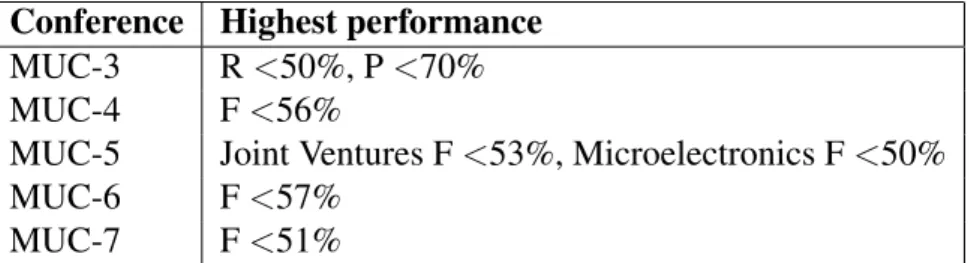
Summary of MUC competition systems. At this point, we note that template filling is a challenging task, and none of the techniques used at the time achieved high levels of precision and recall. In Chinchor (1998), the author provides an overview of scores of the best performing systems in MUC-3 to MUC-7, which we reproduce as Table 2.3.
Template filling with machine learning, using MUC and other corpora. Template filling research did not end with the conclusion of the MUC series, and subsequently, authors began to experiment with machine learning systems for the task.
For example, Collins and Miller (1998) implement a Probabilistic Context Free Gram-mar (PCFG) to identify the incoming person (IN), the indicating verb (IND) and the post (POST) in MUC-6 management succession events. The tree structures for the training data are automatically constructed based on annotations of IN, IND and POST in the texts. The algorithm scores a Precision of 80.6% and a Recall of 74.6% after being trained on 563 sentences and tested on 356.
Both Freitag (1998) and Freitag and McCallum (2000) train separate learners for each slot in a template. In Freitag (1998) the author appliesSRV, a supervised learner which uses a top-down greedy rule search, combined with features representing grammatical links, WordNet paths, words and part-of-speech. In Freitag and McCallum (2000) a Hid-den Markov Model (HMM) is applied, scoring an average F-Score of 57.2 over 8 slot types, such as the speaker of a seminar announcement event and the deadline in a Call-for-Papers conference announcement.
Following the same methodology of training a learner per slot, Chieu et al. (2003) use a variety of syntactic parse tree derived features, including related verbs, whether the NP is an agent or a patient, the head word of the NP and the NE class of the NP, to learn
template filling for the MUC-4 task. They experiment with 4 supervised machine learning classifiers; Maximum Entropy, Support Vector Machine, Na¨ıve Bayes and Decision Tree. The Maximum Entropy classifier performed best, with an F-Score of 48 on MUC-4’s first test data set, a performance which would have placed them 4th in the original evaluation. More recently, Patwardhan and Riloff (2009) employed a different strategy, which uses two different learners in conjunction for MUC-4 template filling. The first learner decides whether the sentence is describing a relevant event, and the second learner decides which NPs are plausible slot fillers if the sentence is relevant. This approach beats the baseline in 3 out of 5 slots;Individual Perpetrator,VictimandWeapon, with F-Scores for these slots of 55, 56 and 55 respectively.
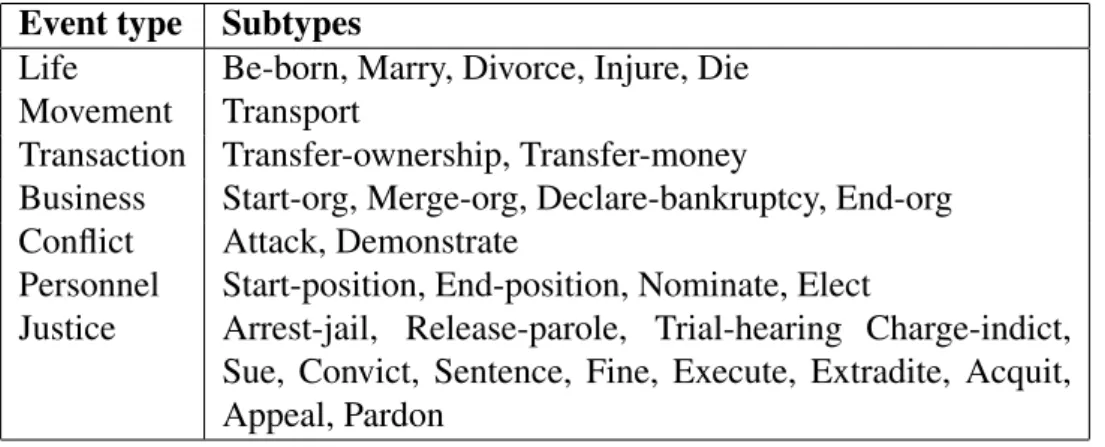
ACE event detection. The NIST Automatic Content Extraction (ACE) program, a joint IE evaluation that ran from 1999–2008, also provided a similar task to template filling — Event Detection and Characterisation (EDC). This task was introduced in the ACE 2005 evaluation. Rather than the MUC scenario templates, which were highly topic specific, the ACE events were intended to be events which are common in a wide variety of news stories. The list of possible events, from Grishman (2012), is displayed in Table 2.4. Each event has between 2 and 7 slots to fill, compared to the large numbers of slots required in some of the MUC scenario templates.
We also note that ACE EDC events are restricted in scope to a single sentence: “The first step in annota