arXiv:1605.09080v5 [cs.LG] 13 Nov 2016
Forough Arabshahi† Animashree Anandkumar
University of California Irvine University of California Irvine
Abstract
In this paper we propose guaranteed spec-tral methods for learning a broad range of topic models, which generalize the popular Latent Dirichlet Allocation (LDA). We over-come the limitation of LDA to incorporate ar-bitrary topic correlations, by assuming that the hidden topic proportions are drawn from a flexible class of Normalized Infinitely Divis-ible (NID) distributions. NID distributions are generated through the process of normal-izing a family of independent Infinitely Di-visible (ID) random variables. The Dirichlet distribution is a special case obtained by nor-malizing a set of Gamma random variables. We prove that this flexible topic model class can be learnt via spectral methods using only moments up to the third order, with (low or-der) polynomial sample and computational complexity. The proof is based on a key new technique derived here that allows us to diag-onalize the moments of the NID distribution through an efficient procedure that requires evaluating only univariate integrals, despite the fact that we are handling high dimen-sional multivariate moments. In order to as-sess the performance of our proposed Latent NID topic model, we use two real datasets of articles collected from New York Times and Pubmed. Our experiments yield improved perplexity on both datasets compared with the baseline.
Keywords: Latent variable models, spectral meth-ods, tensor decomposition, moment matching, in-finitely divisible, Lévy processes.
1
Introduction
Topic models are a popular class of exchangeable latent variable models for document categorization. The goal is to uncover hidden topics based on the distribution of word occurrences in a document corpus. Topic mod-els areadmixture models, which go beyond the usual mixture model that allows for only one hidden topic to be present in each document. In contrast, topic mod-els incorporate multiple topics in each document. It is assumed that each document has a latent proportions of different topics, and the observed words are drawn in a conditionally independent manner, given the set of topics.
Latent Dirichlet Allocation (LDA) is the most pop-ular topic model [8], in which the topic proportions are drawn from the Dirichlet distribution. While LDA has widespread applications, it is limited by the choice of the Dirichlet distribution. Notably, Dirichlet distri-bution can only model negative correlations [6], and thus, is unable to incorporate arbitrary correlations among the topics that may be present in different doc-ument corpora. Another drawback is that the ele-ments with similar means need to have similar vari-ances. While there have been previous attempt to go beyond the Dirichlet distribution, e.g. [7, 21], their cor-relation structures are still limited, learning these mod-els is usually difficult and no guaranteed algorithms exist. Furthermore, As discussed in [20], the correla-tion structure considered in [7], gives rise to spurious correlations resulting in a better perplexity on the held-out set even when the recovered topics are less inter-pretable. The work of [5] provides a provably correct algorithm for learning topic models that also allow for certain correlations among the topics, however, it re-quires “anchor word” separability assumptions for the proof of correctness.
In this work, we consider a flexible class of topic mod-els, and propose guaranteed and efficient algorithms for learning them. We employ the class of Normalized Infinitely Divisible (NID) distributions to model the topic proportions [10, 18]. These are a class of distri-butions on the simplex, formed by normalizing a set of
independent draws from a family of positive Infinitely Divisible (ID) distributions. The draws from an ID distribution can be represented as a sum of an arbi-trary number of i.i.d. random variables. The concept of infinite divisibility was introduced in 1929 by Bruno de Finetti, and the most fundamental results were de-veloped by Kolmogorov, Lévy and Khintchine in the 1930s. The idea of using normalized random probabil-ity measures with independent increments have also been used in the context of non-parametric models to go beyond the Dirichlet Process [17].
The Gamma distribution is an example of an ID dis-tribution, and the Dirichlet distribution is obtained by normalizing a set of independent draws from Gamma distributions. We show that the class of NID topic models significantly generalize the LDA model: they can incorporate both positive and negative correla-tions among the topics and they involve additional parameters to vary the variance and higher order mo-ments, while fixing the mean.
There are mainly three categories of algorithms for learning topic models, viz., variational inference [7, 8], Gibbs sampling [9, 11, 19], and spectral methods [2, 22]. Among them, spectral methods have gained in-creasing prominence over the last few years, due to their efficiency and guaranteed learnability. In this pa-per, we develop novel spectral methods for learning latent NID topic models.
Spectral methods have previously been proposed for learning LDA [2], and in addition, other latent vari-able models such as Independent Component Analysis (ICA), Hidden Markov Models (HMM) and mixtures of ranking distributions [3]. The idea is to learn the pa-rameters based on spectral decomposition of low order moment tensors (third or fourth order). Efficient algo-rithms for tensor decomposition have been proposed before [3], and implies consistent learning with (low order) polynomial computational and sample complex-ity.
The main difficulty in extending spectral methods to the more general class of NID topic models is the pres-ence of arbitrary correlations among the hidden topics which need to be “untangled”. For instance, take the case of a single topic model (i.e. each document has only one topic); here, the third order moment, which is the co-occurrence tensor of word triplets, has a CAN-DECOMP/PARAFAC (CP) decomposition, and com-puting the decomposition yields an estimate of the topic-word matrix. In contrast, for the LDA model, such a tensor decomposition is obtained by a combina-tion of moments up to the third order. In other words, the moments of the LDA model need to be appropri-ately “centered” in order to have the tensor
decompo-sition form.
Finding such a moment combination has so far been an “art form”, since it is based on explicit manipulation of the moments of the hidden topic distribution. So far, there is no principled mechanism to automatically find the moment combination with the CP decomposi-tion form. For arbitrary topic models, however, find-ing such a combination may not even be possible. In general, one requires all the higher order moments for learning.
In this work, we show that surprisingly, for the flexible class of NID topic models, moments up to third order suffice for learning, and we provide an efficient algo-rithm for computing the coefficients to combine the moments. The algorithm is based on computation of a univariate integral, that involves the Levy measure of the underlying ID distribution. The integral can be computed efficiently through numerical integration since it is only univariate, and has no dependence on the topic or word dimensions. Intriguingly, this can be accomplished, even when there exists no closed form probability density functions (pdf) for the NID vari-ables.
The paper is organized as follows. In Section 2, we pro-pose our “Latent Normalized Infinitely Divisible Topic Models” and present its generative process. We dedi-cate Section 3 to the properties of NID distributions and indicate how they overcome the drawbacks of the Dirichlet distribution and other distributions on the simplex. In Section 4 we present our efficient learning algorithm with guaranteed convergence for the pro-posed topic model based on spectral decomposition. Finally, we conclude the paper in Section 6.
2
Latent Normalized Infinitely
Divisible Topic Models
Topic models incorporate relationships between words x1,x2. . .∈Rd and a set ofkhidden topics. We
repre-sent the wordsxiusing one-hot encoding, i.e. xi =ej if thejth
word in the vocabulary occurs, andej is the standard basis vector. The proportions of topics in a document is represented by vectorh∈Rk. We assume that his drawn from an NID distribution.
The detailed generative process of a latent NID topic model for each document is as follows
1. Drawk independent variables,z1, z2, . . . , zk from
a family of ID distributions. 2. Sethto(z1 Z, . . . , zk Z)whereZ= P i∈[k]zi.
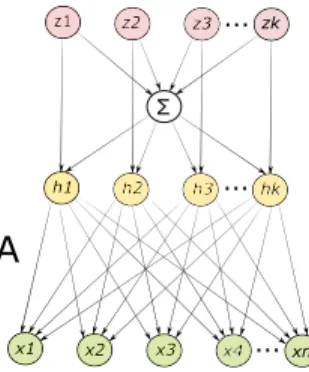
z1 z2 z3 zk h1 h2 h3 hk x1 x2 x3 x4 xn
A
... ... ...Figure 1: Graphical Model Representation of the La-tent NID Topic Model. z1, z2, . . . , zk are a
collec-tion of independent Infinitely Divisible positive vari-ables that are characterized by the collection of their corresponding Lévy measures α1ν, α2ν, . . . , αkν And
h1, h2. . . , hk are the resulting NID variables
represent-ing topic proportions in a document of length N with wordsx1, . . . , xN
(a) Choose a topic ζi ∼Multi(h)and represent
it with one-hot encoding.
(b) Choose a wordxi vector as a standard basis vector with probability
E(xi|ζi) =Aζi, (1) conditioned on the drawn topic ζi, andA∈
Rd×k is the topic-word matrix. From (1), we also have
E(xi|h) =E[E(xi|h, ζi)] =E(xi|ζi)E(ζi|h) =Ah. (2) When theziis drawn from the Gamma(αi,1)
distribu-tion, we obtain the Dir(α)distribution for the hidden
vectorh= (h1, . . . , hk), and the LDA model through the above generative process.
Our goal is to recover the topic-word matrix Agiven the document collection. In the following section we introduce the class of NID distribution and discuss its properties.
3
Properties of NID distributions
NID distributions are a flexible class of distributions on the simplex and have been applied in a range of do-mains. This includes hierarchical mixture modeling with Normalized Inverse-Gaussian distribution [16], and modeling overdispersion with the normalized tem-pered stable distribution [14], both of which are exam-ples of NID distributions. For more applications, see [10]. Let us first define the concept of infinite divisi-bility and present the properties of an ID distribution, and then consider the NID distributions.3.1 Infinitely Divisible Distributions
If random variable z has an Infinitely Divisible (ID) distribution, then for any n ∈ N there exists a col-lection of i.i.d random variables y1, . . . , yn such that
z=d y1+· · ·+yn. In other words, an Infinitely
Divisi-ble distribution can be expressed as the sum of an ar-bitrary number of independent identically distributed random variables.
The Poisson distribution, compound Poisson, the neg-ative binomial distribution, Gamma distribution, and the trivially degenerate distribution are examples of Infinitely Divisible distributions; as are the normal distribution, Cauchy distribution, and all other mem-bers of the stable distribution family. The Student’s t-distribution is also another example of Infinitely Di-visible distributions. The uniform distribution and the binomial distribution are not infinitely divisible, as are all distributions with bounded (finite) support. The special decomposition form of ID distributions makes them natural choices for certain models or ap-plications. E.g. a compound Poisson distribution is a Poisson sum of IID random variables. The discrete compound Poisson distribution, also known as the stut-tering Poisson distribution, can model batch arrivals (such as in a bulk queue [1]) and can incorporate Pois-son mixtures.
In the sequel, we limit the discussion to ID distribu-tions onR+in order to ensure that the Normalized ID variables are on the simplex. Let us now present how ID distributions can be characterized.
Lévy measure: A σ-finite Borel measure ν on R+ is called a Lévy measure if R∞
0 min(1, x)ν(dx) < ∞.
According to the Lévy-Khintchine representation given below, the Lévy measure uniquely characterizes an ID distribution along with a constant scaleτ. This implies that every Infinitely Divisible distribution corresponds to a Lévy process, which is a stochastic process with independent increments.
Lévy-Khintchine representation [Theorem 16.14 [13]] LetM1(Λ)and Mσ(Λ)indicate the set of
prob-ability measures and the set of σ-finite measures on a non-empty set Λ, respectively. Letµ ∈ M1([0,∞))
and let Ψ(u) = −log∞R
0
e−uzd(µ) be the log-Laplace
transform of µ. Thenµ is Infinitely Divisible, if and only if there exists a τ ≥ 0 and a σ-finite measure ν ∈ Mσ((0,∞))with
∞ Z
0
such that Ψ(u) =τ u+ ∞ Z 0 (1−e−uz)ν(dz) for u ≥0, (4)
In this case the pair(τ, ν)is unique,νis called the Lévy measure ofµandτ is called the deterministic part. It can be shown that τ=sup{z≥0 :µ([0, z)) = 0}. In particular, let Φzi(u) = E[e ιuzi] = ∞ R 0 eιuzif(z i)dzi
indicate the characteristic function of an Infinitely Di-visible random variable zi with pdf f(zi) and
corre-sponding pair (τi, νi), where ι is the imaginary unit.
Based on the Lévy-Khintchine representation it holds that Φzi(ιu) = E[e− uzi] = e−Ψi(u) where Ψ i(u) = τiu+ ∞ R 0 (1−e−uz)ν
i(dz)is typically referred to as the
Laplace exponent ofzi. This implies that the Laplace
exponent of an ID variable is also completely charac-terized by pair (τi, νi). It holds for ID variables that
ifνi is a well-defined Lévy measure, so isαiνi for any
αi > 0, which indicates that αiΨi(u) is also a
well-defined Laplace exponent of an ID variable.
3.2 Normalized Infinitely Divisible Distributions
As defined in [10], a Normalized Infinitely Divisible (NID) random variable is a random variable that is formed by normalizing independent draws of strictly positive (not necessarily coinciding) Infinitely Divisi-ble distributions. More specifically, let z1, . . . , zk be
a set of independent strictly positive Infinitely Divisi-ble random variaDivisi-bles and Z =z1+· · ·+zk. An NID
distribution is defined as the distribution of the ran-dom vector h = (h1, . . . , hk) := (z1
Z, . . . , zk
Z) on the
(k−1)-dimensional simplex, denoted as ∆k−1. The
strict positivity assumption implies that h is on the simplex [10, 18].
Let[k]denote Natural numbers1, . . . , k. As stated by the Lévy-Khintchine theorem, a collection of ID posi-tive variableszi fori∈[k]is completely characterized
by the collection of the corresponding Lévy measures ν1, . . . , νk. It was shown in [18] that this also holds for
the normalized variables hi fori∈[k].
In this paper, we assume that the ID variables z1, . . . , zk are drawn independently from ID
distribu-tions that are characterized with the corresponding collection of Lévy measuresαiν, . . . , αkν, respectively.
Which in turn translates respectively to variables with Laplace exponents α1Ψ(u), . . . , αkΨ(u). Variables αi
will allow the distribution to vary in the interior of the simplex, providing the asymmetry needed to model latent models. The homogeneity assumption on the
Lévy measure or the Laplace exponent provides the structure needed for guaranteed learning (Theorem 1). The overall graphical model representation is shown in Figure 1
If the original ID variables zi have probability
den-sities fi for all i ∈ [k], then the distribution of
vector h, where hk = 1 −P i∈[k−1]hi is, f(h) = ∞ R 0 Q i∈[k]
fi(hiZ)Zk−1dZ.There are only three members
of the NID class that have closed form densities namely, the Gamma distribution, Gamma(αi, λ), the Inverse
Gaussian distribution, IG(αi, λ), and the 1/2-stable
distribution St(γ, β, αi, µ) with γ = 1/2. µ = 1 and
β = 1to ensure positive support for the Stable distri-bution. As noted earlier, Gamma(αi,1)reduces to the
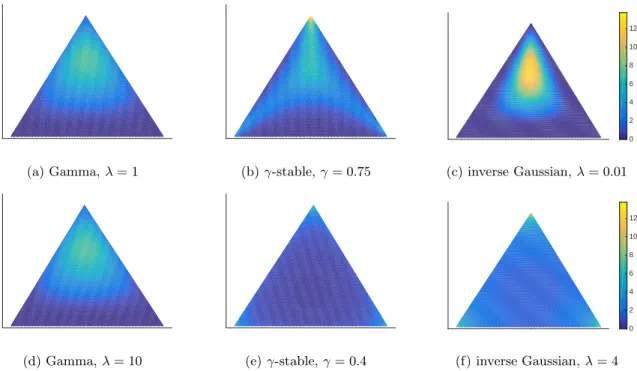
Dirichlet distribution. An interested reader is referred to [10, 18] for the closed form of each distribution. Figure 2 depicts the heatmap of the density of these distributions on the probability simplex for different value of their parameters. Note that all the distribu-tions have the sameαparameter and hence, the same mean values. However, their concentration properties are widely varying, showing that the NID class can in-corporate variations in higher order moments through additional parameters.
Gamma ID distribution: When the ID distribution is Gamma with parameters(αi,1), we have the
Dirich-let distribution as the resulting NID distribution. The Laplace exponent for this distribution will, therefore, be Ψi(u) =αiln(1 +u).
γ-stable ID distribution: The variables are drawn from the positive stable distribution St(γ, β, αi, µ)
with µ = 0, β = 1 and γ < 1 which ensures that the distribution is on R+. The Laplace exponent of this distribution isΨi(u) =αiΓ(1−
γ)
√
2πγ u
γ.Note that the
γ-stable distribution can be represented in closed form forγ=1
2.
Inverse Gaussian ID distribution: The random variables are drawn from the Inverse-Gaussian (IG) distribution IG(αi, λ). The Laplace exponent of this
distribution isΨi(u) =αi
√
2u+λ2−λ .
Note: The Dirichlet distribution, the 1/2-Stable dis-tribution and the Inverse Gaussian disdis-tribution are all special cases of the generalized Inverse Gaussian dis-tribution [10].
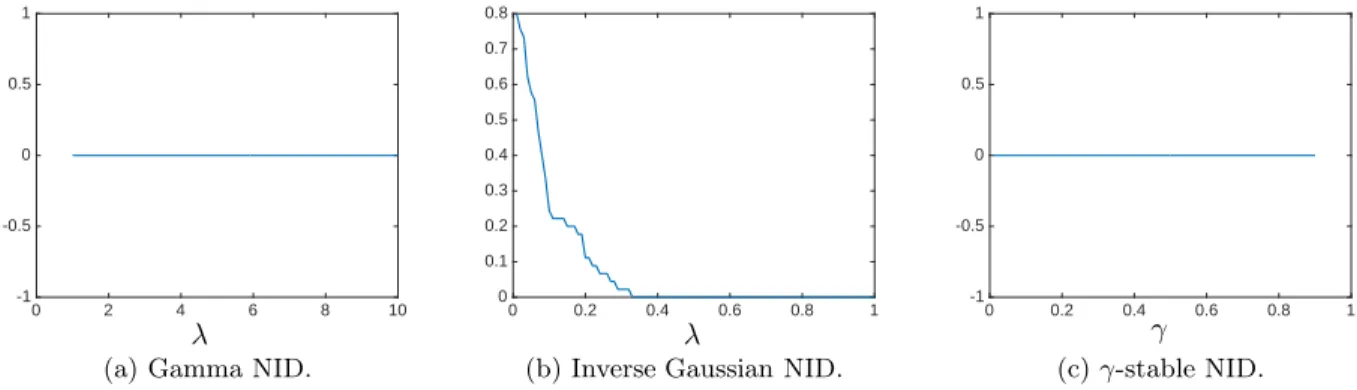
As mentioned earlier, the class of NID distributions is capable of modeling positive and negative correlations among the topics. This property is depicted in Figure 3. These figures show the proportion of positively cor-related topics for the three presented distributions. As
(a) Gamma,λ= 1 (b)γ-stable,γ= 0.75 0 2 4 6 8 10 12 (c) inverse Gaussian,λ= 0.01
(d) Gamma, λ= 10 (e)γ-stable,γ= 0.4
0 2 4 6 8 10 12 (f) inverse Gaussian,λ= 4
Figure 2: Heat map of the pdf of three examples of the NID class that have closed form with respect to their parameters. All the figures have α= (2,2,4). For the Inverse Gaussian the distribution moves from the center to the vertices of the simplex asλgoes from0to∞with fixedαand for theγ-stable we have the same behavior
whenγchanges from1to 0with fixedα.
we can see the Inverse Gaussian NID distribution can capture both positive and negative correlations.
4
Learning NID Topic Models
through Spectral Methods
In this section we will show how the form of the mo-ments of NID distributions enable efficient learning of this flexible class.
In order to be able to guarantee efficient learning us-ing higher order moments, the moments need to have a very specific structure. Namely, the moment of the underlying distribution of hneeds to form a diagonal tensor. If the components ofhwhere indeed indepen-dent, this is obtained through the cumulant tensor. On the other hand, for LDA, it has been shown by Anand-kumar et. al. [2] that a linear combination of moments of up to third order of h forms a diagonal tensor for the Dirichlet distribution. Below, we extend the result to the more general class of NID distributions.
4.1 Consistency of Learning through Moment Matching
Assumption 1 ID random variables zi for i ∈ [k]
are said to be partially homogeneousif they share the same Lévy measure. This implies that the
correspond-ing Laplace exponent of variable ziis givenαiΨ(u)for
some αi ∈ R+, and Ψ(u) is the Laplace exponent of
the common Lévy measure.
Under the above assumption, we prove guaranteed learning of NID models through spectral methods. This is based on the following moment forms for NID models, which admit a CP tensor decomposition. The components of the decomposition will be the columns of the topic-word matrix: A:= [a1|a2|. . .|ak]. Define Ω(m, n, p) = ∞ Z 0 um d n dunΨ(u) d duΨ(u) p e−α0Ψ(u)du, (5) whereΨ(u)is the Laplace exponent of the NID distri-bution and α0=Pi∈[k]αi.
Theorem 1 (Moment Forms for NID models)
Let M2 and M3 be respectively the following matrix
and tensor constructed from the following moments of the data,
M2=E[x1⊗x2] +v·E[x1]⊗E[x2], (6) M3=E[x1⊗x2⊗x3] +v2·E[x1]⊗E[x2]⊗E[x3]
+v1·E[x1⊗x2]⊗E[x3]+
0 2 4 6 8 10 -1 -0.5 0 0.5 1 PSfrag replacements λ
(a) Gamma NID.
0 0.2 0.4 0.6 0.8 1 0 0.1 0.2 0.3 0.4 0.5 0.6 0.7 0.8 PSfrag replacements λ
(b) Inverse Gaussian NID.
0 0.2 0.4 0.6 0.8 1 -1 -0.5 0 0.5 1 PSfrag replacements γ (c)γ-stable NID.
Figure 3: Proportion of positively correlated elements of special cases of an NID distribution with 10 el-ements with respect to the parameter of the Laplace exponent for a fixed randomly drawn vector α = [0.77,0.70,0.97,0.46,0.02,0.44,0.90,0.33,0.97,0.45]. E[x1⊗E[x2]⊗x3] (7) (8) where, v= Ω(1,1,1) Ω(0,1,0)2 , v1=− Ω(2,2,1) 2Ω(1,2,0)Ω(0,1,0), (9) v2= − 0.5Ω(2,1,2) + 3v1Ω(1,1,1)Ω(0,1,0) Ω(0,1,0)3 , (10)
Then given Assumption 1,
M2= X j∈[k] κj(aj⊗aj), M3= X j∈[k] λj(aj⊗aj⊗aj). (11)
for a set of κj’s and λj’s which are a function of the
parameters of the distribution.
Remark 1: efficient computation of v, v1 and v2:
What makes Theorem 1 specially intriguing is the fact that weightsv,v1andv2can be computed through
uni-variate integration, which can be computed efficiently, regardless of the dimensionality of the problem.
Remark 2: investigation of special cases When the ID distribution is Gamma with parameters(αi,1),
we have the Dirichlet distribution as the resulting NID distribution. Weights v1 andv2 reduce to the results
of Anandkumar et. al. [2] for the Gamma(αi,1)
distri-bution, which arev1 =−αα0+20 andv2 = 2α
2 0
(α0+2)(α0+1). When the variables are drawn from the positive stable distributionSt(1/2, β, αi, µ)weightsv1andv2in
The-orem 1 can be represented in closed form asv1=−14
andv2=−58.
It is hard to find closed form representation of the weights for other stable distributions and the Inverse
Gaussian distribution. Therefore, we give the form of the weights with respect to the parameters of each dis-tribution in Figure 4. As it can be seen in Figures 2e and 5b, as γ increases, the distribution gets more centralized on the simplex. Therefore, as depicted in Figure 4a the weight becomes more negative to com-pensate for it. The same holds in Figure 4b.
The above result immediately implies guaranteed learning for non-degenerate topic-word matrixA.
Assumption 2 Topic-word matrixA∈Rd×k has
lin-early independent columns and the parameters αi>0.
Corollary 1 (Guaranteed Learning of NID
Topic Models using Spectral Methods) Given
empirical versions of momentsM2 andM3in (6)and (7), using tensor decomposition algorithm from [3], un-der the above assumption, we can consistently estimate topic-word matrix A and parameters α with polyno-mial computational and sample complexity.
The overall procedure is given in Algorithm 1.
Remark 3: third order moments suffice For the flexible class of latent NID topic models, only moments up to the third order suffice for efficient learning.
Remark 4: Sample Complexity Following [2], Al-gorithm 1 can recover matrix A under Assumption 2 with polynomial sample complexity.
Remark 5: Implementation Efficiency In order to make the implementation efficient we use the dis-cussion in [3]. Specifically, as mentioned in [3], we can find a whitening transformation from matrixM2that lowers the data dimension from the vocabulary space to the topic space. We then use the same whitening transformation to go back to the original space and recover the parameters of the model.
0 0.2 0.4 0.6 0.8 1 -0.5 -0.45 -0.4 -0.35 -0.3 -0.25 -0.2 -0.15 -0.1 PSfrag replacements v1 γ
(a) Weightv1of theorem 1 for a Stable ID distribution St(γ, β, αi, µ)withµ= 0,β= 1,γ <1andαi>0vs. γfor α0= 1 0 10 20 30 40 -0.11 -0.1 -0.09 -0.08 -0.07 -0.06 -0.05 -0.04 -0.03 PSfrag replacements v1 λ
(b) Weight v1 of theorem 1 for an Inverse Gaussian
distributionIG(αi, λ)vs. λ >0andαi≥0for α0= 1
Figure 4: Weightv1 for two different examples of the
NID distribution. Weights v and v2 in the theorem
have similar behavior w.r.p the parameters.
Algorithm 1Parameter Learning
Require: Chosen NID distribution and hidden dimen-sionk
Ensure: Parameters of NID distributionαand
topic-word matrixA
1: Estimate empirical moments Eˆ(x1 ⊗ x2 ⊗ x3) ,Eˆ(x1⊗x2)andEˆ(x1).
2: Compute weightsv, v1 and v2 in (9) and (10) for
the given NID distribution by numerical integra-tion.
3: Estimate tensorsM2 andM3in (6) and (7) . 4: Decompose tensorM3 into its rank-1components
using the algorithm in [3] that requiresM2. 5: Return columns of A as the components of the
decomposition.
Overview of the proof of Theorem 1 We begin the proof by forming the following second order and third order tensors using the moments of the NID dis-tribution given in Lemma 1.
M(2h)=E(h⊗h) +vE(h)⊗E(h), (12) M(3h)=E(h⊗h⊗h) +v2E(h)⊗E(h)⊗E(h)
+v1E(h⊗h)⊗E(h)
+v1E(h⊗E(h)⊗h)
+v1E(h)⊗E(h⊗h) (13)
Weights v, v1 and v2 are as in Equations (9) and
(10). They are computed by setting the off-diagonal entries of matrix M(2h) in Equation 12 and M(3h) in Equation 13 to 0. Due to the homogeneity assump-tion, all the off-diagonal entries can be simultaneously made to vanish with these choices of coefficients for v, v1 and v2. We obtain M(2h) = P i∈[k]κ′ie⊗ 2 i and M(3h) =P i∈[k]λ′ie⊗ 3
i where ei’s are the standard
ba-sis vectors, and this implies they are diagonal tensors. Due to this fact and the exchangeability of the words given topics according to (2), Equations 11 follow. The exact forms of v, v1 and v2 are obtained by the
following moment forms for NID distributions.
Lemma 1 ([18]) The moments of NID variables
h1, . . . hk satisfy E(hr1 1 h r2 2 . . . h rk k ) = 1 Γ(r) ∞ Z 0 ur−1e−α0Ψ(u) Y j∈[k] Bj rjdu, (14) where r = P
i∈[k]ri and Bjrj can be written in terms
of the partial Bell polynomial as
Bir=Br(−αiΨ(1)(u), . . . ,−αiΨ(r)(u)), (15)
in which Ψ(l)(u) is the l-th derivative of Ψ(u) with
respect to u.
5
Experiments
In this section we apply our proposed latent NID topic modeling algorithm to New York Times and Pubmed articles [15]. The New York Times dataset contains about 300,000documents and the pubmed data con-tains around8million documents. The vocabulary size for both the datasets are around100,000.
Hyperparameter Tuning In practice, we can tune for hyperparameters to compute the best fitting v, v1
and v2. Therefore, we will not limit ourselves
to a single parametric NID family. We learn the weights during the learning process and employ a non-parametric estimation of the Lévy-Khintchine repre-sentation through the univariate integrals of Equations
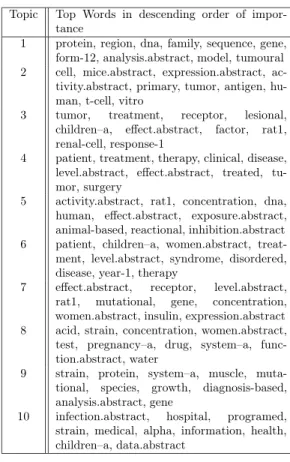
Table 1: Top 10 Words for Pubmed, K = 10
Topic Top Words in descending order of impor-tance
1 protein, region, dna, family, sequence, gene, form-12, analysis.abstract, model, tumoural 2 cell, mice.abstract, expression.abstract,
ac-tivity.abstract, primary, tumor, antigen, hu-man, t-cell, vitro
3 tumor, treatment, receptor, lesional, children–a, effect.abstract, factor, rat1, renal-cell, response-1
4 patient, treatment, therapy, clinical, disease, level.abstract, effect.abstract, treated, tu-mor, surgery
5 activity.abstract, rat1, concentration, dna, human, effect.abstract, exposure.abstract, animal-based, reactional, inhibition.abstract 6 patient, children–a, women.abstract, treat-ment, level.abstract, syndrome, disordered, disease, year-1, therapy
7 effect.abstract, receptor, level.abstract, rat1, mutational, gene, concentration, women.abstract, insulin, expression.abstract 8 acid, strain, concentration, women.abstract, test, pregnancy–a, drug, system–a, func-tion.abstract, water
9 strain, protein, system–a, muscle, muta-tional, species, growth, diagnosis-based, analysis.abstract, gene
10 infection.abstract, hospital, programed, strain, medical, alpha, information, health, children–a, data.abstract
9 and 10. Due to the one-dimensional nature of the integrations, a small number of parameters will suf-fice for good performance. The following paragraph describes the process in more detail.
We first split the data into train and test sets randomly. We then use the train data to learn the model parame-ters,αi’s and the columns of the topic-word matrixA,
as well as the weightsv,v1andv2 in Equations 6 and
7, respectively. We do so by finding the best low rank approximation of tensorM3that minimizes the Frobe-nius Norm difference between the right-hand-side of Equation 7 and its low rank approximation. The re-covered components are the columns of the topic-word matrix and the parameters αi are recovered from the
decomposition weights. Once we find the best v, v1
and v2 we use the test data to find the best NID
dis-tribution described by the weights such that the likeli-hood of the test data is maximized under that choice of NID distribution.
Results: We compare our proposed latent NID topic model with the spectral LDA method [2]. It has been shown in [12] that spectral LDA is more effi-cient and achieves better perplexity compared to the conventional LDA [8]. Table 2 provides a sketch of the top words per topics recovered by our latent NID topic model on the New Yowk times dataset and
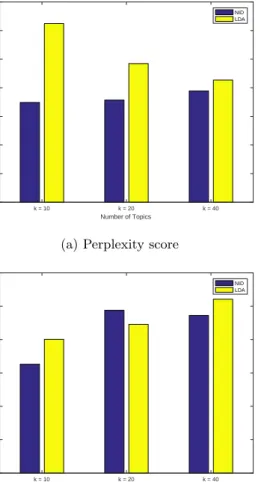
Ta-ble 1 shows the top words recovered from the pubmed dataset. We have also provided the the top words re-covered by LDA for the New York times dataset for comparison purposes in Table 6 in the appendix. Be-sides from the top words, we also present the shared words among the recovered topics for the New York Times dataset in Table 5. The presence of words such as “tonight”, “question” and “fall” among these words makes a lot of sense since they are general words that are not usually indicative of any specific topic. We use the well-known likelihood perplexity measure [8] to evaluate the generalization performance of our proposed topic modeling algorithm as well as the Point-wise Mutual Information (PMI) score [4] to assess the coherence of the recovered topics. Perplexity is defined as the inverse of the geometric mean per-word of the estimated likelihood. We refer to our proposed method asN IDand compare it againstLDA[2] where the dis-tribution of the hidden space is fixed to be Dirichlet. It should be noted that lower perplexity indicates better generalization performance and higher PMI indicated better topic coherence. Figure 5 shows the perplexity and PMI score for the NID and LDA methods across different number of topics for the New York Times dataset. Similar comparisons including the Pubmed dataset results are also provided in Tables 3 and 4. The results suggest that if we allow the corpus to choose the best underlying topic distribution, we can get better generalization performance as well as topic coherence on the held-out set compared to fixing the underlying distribution to Dirichlet. The improved perplexity of our proposed method is indicative of correlations in the underlying documents that are not captured by the Dirichlet distribution. Thus, latent NID topic mod-els are capable of successfully capturing correlations within topics while providing guarantees for exact re-covery and efficient learning as proven in Section 4. Last but not least, the naive Variational Inference im-plementation of [8] 1
, does not scale to the current datasets used in this paper. The naive implementa-tion of the spectral LDA, however, takes only about a minute to run on the NYtimes dataset and about 15 minutes to run on the Pubmed dataset. It is, therefore, of great importance to have a class of models that can be learned using spectral methods mainly because of their inherent scalability, ease of implementation and statistical guarantees. As we show in this paper, la-tent NID topic models are such a class of models. The correlated topic model framework of [7] also uses Varia-tional Inference to perform learning and it is limited to the logit-normal distribution. latent NID topic models are not only scalable, but are also capable of modeling arbitrary correlations without requiring a fixed prior
1
Table 2: NID Top 10 Words for NYtimes, K = 20 Topic Top Words in descending order of importance
1 seeded, soldier, firestone, bobby-braswell, michigan-state, actresses, gary-william, preview, school-district, netanyahu
2 diane, question, newspaper, copy, fall, held, tonight, send, guard, slugged
3 abides, acclimate, acetate, alderman, analogues, annexing, ansar, antitax, antitobacco, argyle 4 percent, school, quarter, company, taliban, high, stock, race, companies, john-mccain
5 test, deal, contract, tiger-wood, question, houston-chronicle, copy, won, seattle-post-intelligencer ,tax 6 tonight, diane, question, newspaper, file, copy, fall, slugged, onlytest, xxx
7 company, com, market, stock, won, los-angeles-daily-new, business, eastern, web, commentary 8 abides, acclimate, acetate, alderman, analogues, annexing, ansar, antitax, antitobacco, argyle 9 company, game, run, los-angeles-daily-new, percent, team, season, stock, companies, games
10 working-girl, abides, acclimate, acetate, alderman, analogues, annexing, ansar, antitax, antitobacco 11 diane, newspaper, fall, tonight, question, held, copy, bush, slugged, police
12 hurricanes, policies, surgery, productivity, courageous, emergency, singapore, orange-bowl, regarding, telecast
13 abides, acclimate, acetate, alderman, analogues, annexing, ansar, antitax, antitobacco, argyle 14 company, com, won, stock, market, eastern, commentary, business, web, deal
15 company, stock, market, business, investor, technology, analyst, cash, sell, executives 16 tonight, question, diane, file, newspaper, copy, fall, slugged, onlytest, xxx
17 defense, held, children, fight, assistant, surgery, michael-bloomberg, worker, bird, omar 18 percent, company, stock, companies, quarter, school, market, analyst, high, corp
19 school, student, yard, released, guard, premature, teacher, touchdown, publication, leader 20 school, percent, student, yard, high, taliban, flight, air, afghanistan, plan
Table 3: Perplexity comparison accross different datasets
Dataset NYtimes Pubmed
NID 3.5702e+03 4.0771e+03 LDA 4.8464e+ 03 4.3702e+ 03
Table 4: PMI comparison accross different datasets Dataset NYtimes Pubmed
NID 0.2439 0.3080 LDA 0.2362 0.4487
distribution on the topic space.
6
Conclusion
In this paper we introduce the new class of Latent Nor-malized Infinitely Divisible (NID) topic models that generalize previously proposed topic models such as LDA. We provide guaranteed efficient learning for this class of distributions using spectral methods through untangling the dependence of the hidden topics. We provide evidence that our proposed NID topic model overcomes the shortcomings of the Dirichlet distribu-tion by allowing for both positive and negative corre-lations among the topics. In the end we use two real world datasets to validate our claims in practice.The
Table 5: 10 Shared words: New York times dataset
Shared Words boston-globe, tonight, question, newspaper, spot, percent, file, diane, copy, fall
improved likelihood perplexity score indicates that if we allow the model to pick the underlying distribution we will get better generalization results.
References
[1] RM Adelson. Compound poisson distributions.
OR, 17(1):73–75, 1966.
[2] Anima Anandkumar, Yi-kai Liu, Daniel J Hsu, Dean P Foster, and Sham M Kakade. A spectral algorithm for latent dirichlet allocation. In Ad-vances in Neural Information Processing Systems, pages 917–925, 2012.
[3] Animashree Anandkumar, Rong Ge, Daniel Hsu, Sham M Kakade, and Matus Telgarsky. Tensor decompositions for learning latent variable mod-els. The Journal of Machine Learning Research, 15(1):2773–2832, 2014.
[4] Animashree Anandkumar, Ragupathyraj Vallu-van, et al. Learning loopy graphical models with latent variables: Efficient methods and guaran-tees. The Annals of Statistics, 41(2):401–435, 2013.
k = 10 k = 20 k = 40 Number of Topics 0 1000 2000 3000 4000 5000 6000 7000 Perplexity NID LDA
(a) Perplexity score
k = 10 k = 20 k = 40 Number of Topics 0 0.05 0.1 0.15 0.2 0.25 0.3 PMI NID LDA
(b) Pointwise Mutual Information (PMI)
Figure 5: Perplexity and PMI score for the NYtimes dataset across different number of topics
[5] Sanjeev Arora, Rong Ge, Yonatan Halpern, David M Mimno, Ankur Moitra, David Sontag, Yichen Wu, and Michael Zhu. A practical algo-rithm for topic modeling with provable guaran-tees. In ICML (2), pages 280–288, 2013.
[6] Ali Shojaee Bakhtiari and Nizar Bouguila. Online learning for two novel latent topic models. In In-formation and Communication Technology, pages 286–295. Springer, 2014.
[7] David Blei and John Lafferty. Correlated topic models. Advances in neural information process-ing systems, 18:147, 2006.
[8] David M Blei, Andrew Y Ng, and Michael I Jor-dan. Latent dirichlet allocation. the Journal of machine Learning research, 3:993–1022, 2003. [9] Jianfei Chen, Jun Zhu, Zi Wang, Xun Zheng, and
Bo Zhang. Scalable inference for logistic-normal topic models. InAdvances in Neural Information Processing Systems, pages 2445–2453, 2013.
[10] Stefano Favaro, Georgia Hadjicharalambous, and Igor Prünster. On a class of distributions on the simplex. Journal of Statistical Planning and In-ference, 141(9):2987–3004, 2011.
[11] Thomas L Griffiths and Mark Steyvers. Find-ing scientific topics. Proceedings of the Na-tional Academy of Sciences, 101(suppl 1):5228– 5235, 2004.
[12] Furong Huang. Discovery of latent factors in high-dimensional data using tensor methods. arXiv preprint arXiv:1606.03212, 2016.
[13] Achim Klenke. Infinitely divisible distributions. In Probability Theory, pages 331–349. Springer, 2014.
[14] Michalis Kolossiatis, Jim E Griffin, and Mark FJ Steel. Modeling overdispersion with the nor-malized tempered stable distribution. Compu-tational Statistics & Data Analysis, 55(7):2288– 2301, 2011.
[15] M. Lichman. UCI machine learning repository, 2013.
[16] Antonio Lijoi, Ramsés H Mena, and Igor Prün-ster. Hierarchical mixture modeling with normal-ized inverse-gaussian priors. Journal of the Amer-ican Statistical Association, 100(472):1278–1291, 2005.
[17] Antonio Lijoi and Igor Prünster. Models beyond the dirichlet process. Bayesian nonparametrics, 28:80, 2010.
[18] Francesca Mangili and Alessio Benavoli. New prior near-ignorance models on the simplex. In-ternational Journal of Approximate Reasoning, 56:278–306, 2015.
[19] David Mimno, Hanna M Wallach, and Andrew McCallum. Gibbs sampling for logistic normal topic models with graph-based priors. 2008. [20] Alexandre Passos, Hanna M Wallach, and
An-drew McCallum. Correlations and anticorrela-tions in lda inference. 2011.
[21] Issei Sato and Hiroshi Nakagawa. Topic models with power-law using pitman-yor process. In Pro-ceedings of the 16th ACM SIGKDD international conference on Knowledge discovery and data min-ing, pages 673–682. ACM, 2010.
[22] Hsiao-Yu Tung and Alex J Smola. Spectral meth-ods for indian buffet process inference. In Ad-vances in Neural Information Processing Systems, pages 1484–1492, 2014.
Appendix
Proof of Theorem 1 Proof: The moment form
of Lemma 1 can be represented as [18], E(hr1 1 h r2 2 . . . h rn n ) = 1 Γ(r) ∞ Z 0 ur−1e− k P i=n+1 Ψi(u) Y j∈[n] (−1)rj d rj durje −Ψj(u)du. (16) We use the above general form of the moments to com-pute and diagonalize the following moment tensors,
M(2h)=E(h⊗h) +ηE(h)⊗E(h), (17) M(3h)=E(h⊗h⊗h) +η1E(h⊗h)⊗E(h) +η2E(h⊗E(h)⊗h) +η3E(h)⊗E(h⊗h) +η4E(h)⊗E(h)⊗E(h). (18)
Setting the off-diagonal entries of Equations (17) and (18) to0 and get the following set of equations
E(hihj) +ηE(hi)E(hj) = 0 for i6=j, (19) E(hihjhl) +η1E(hihj)E(hl) +η2E(hihl)E(hj) +η3E(hjhl)E(hi) +η4E(hi)E(hj)E(hl) = 0 for i6=j6=l= 0, (20) E(h2ihl) +η1E(h2i)E(hl) +η2E(hihl)E(hi) +η3E(hihl)E(hi) +η4E(hi)E(hi)E(hl) = 0 for i6=l. (21)
Writing the moments using Equation (16), assuming
Φi(u) =αiΨ(u), we get the following weights by some
simple algebraic manipulations,
η = ∞ R 0 ue−α0Ψ(u) d duΨ(u) 2 du R∞ 0 e−α0Ψ(u) d duΨ(u)du 2 (22) η1=η2=η3 =− 1 2 ∞ R 0 u2e−α0Ψ(u) d2 du2Ψ(u)dduΨ(u)du ∞ R 0 ue−α0Ψ(u) d2 du2Ψ(u)du ∞ R 0 e−α0Ψ(u) d duΨ(u)du (23) η4= f(ψ(u)) ∞R 0 e−α0Ψ(u) d duΨ(u)du 3 (24) Where f(ψ(u)) =−12 ∞ Z 0 u2e−α0Ψ(u) d duΨ(u) 3 du + (η1+η2+η3) ∞ Z 0 ue−α0Ψ(u) d duΨ(u) 2 du · ∞ Z 0 e−α0Ψ(u) d duΨ(u)du (25)
Setting v = η, v1 = η1 = η2 = η3 and v2 = η4 and
defining Ω(m, n, p) := ∞ Z 0 um dn dunΨ(u) d duΨ(u) p e−α0Ψ(u)du, (26) the set of weightsv,v1andv2have the following form,
v= Ω(1,1,1) Ω(0,1,0)2 , (27) v1=− Ω(2,2,1) 2Ω(1,2,0)Ω(0,1,0), (28) v2= − 0.5Ω(2,1,2) + 3v1Ω(1,1,1)Ω(0,1,0) Ω(0,1,0)3 . (29) (30) Weightsv,v1andv2ensure that moment tensorsM(2h)
and M(3h) form diagonal tensors. Therefore they can be represented as, M(2h)= X i∈[k] κie⊗i 2, (31) M(h) 3 = X i∈[k] λie⊗i3, (32) where, κi=E[h2i] +vE[hi]2, (33) λi=E[h3i] + 3v1 E[h2i]E[hi] +v2 E[hi]3 . (34)
The exchangeability assumption on the word space gives,
E[x1] =E E[x1|h]=AE(h), (35)
E[x1⊗x2] =E E[x1⊗x2|h]
=AE(h⊗h)A⊤, (36)
Table 6: LDA Top 10 Words for NYtimes, K = 20 Topic Top Words in descending order of importance
1 newspaper, question, copy, fall, diane, chante-lagon, kill, mandatory, drug, patient
2 held, guard, send, publication, released, advisory, premature, attn-editor, undatelined, washington-datelined
3 los-angeles-daily-new, slugged, com, xxx, www, x-x-x, web, information, site, eastern 4 million, shares, offering, boston-globe, debt, public, initial, player, bill, contract 5 onlytest, point, tax, case, court, lawyer, police, minutes, death, shot
6 held, released, publication, guard, advisory, premature, send, attn-editor, undatelined, washington-datelined
7 com, information, www, web, eastern, daily, commentary, business, separate, marked 8 boston-globe, spot, file, killed, tonight, women, earlier, article, george-bush, incorrectly 9 million, shares, offering, debt, public, initial, player, contract, bond, revenue
10 boston-globe, spot, file, held, killed, attn-editor, earlier, article, court, women 11 percent, market, stock, point, quarter, economy, rate, women, growth, companies 12 boston-globe, spot, file, tonight, killed, earlier, article, women, incorrectly, news-feature
13 held, guard, publication, released, send, advisory, premature, attn-editor, undatelined, washington-datelined
14 los-angeles-daily-new, slugged, xxx, new-york, x-x-x, fund, bush, goal, king, evening 15 tonight, copy, question, diane, fall, newspaper, russia, terrorist, russian, black
16 slugged, los-angeles-daily-new, xxx, new-york, x-x-x, bush, run, school, inning, student 17 onlytest, file, film, onlyendpar, movie, new-york, seattle-pi, los-angeles, sport, patient 18 los-angeles-daily-new, slugged, xxx, x-x-x, student, inning, send, program, enron, game 19 los-angeles-daily-new, slugged, xxx, new-york, x-x-x, fund, evening, program, student, enron
20 test, houston-chronicle, hearst-news-service, seattle-post-intelligencer, ignore, patient, kansas-city, yard, race, doctor
E[x1⊗x2⊗x3] =E E[x1⊗x2⊗x3|h] =E[h⊗h⊗h](A,A,A). (37) Therefore, M2=AM(2h)A⊤= X j∈[k] κj(aj⊗aj), (38) M3=M(h) 3 (A,A,A) = X j∈[k] λj(aj⊗aj⊗aj) (39) ✷