Procedia Engineering 127 ( 2015 ) 645 – 651
1877-7058 © 2015 The Authors. Published by Elsevier Ltd. This is an open access article under the CC BY-NC-ND license (http://creativecommons.org/licenses/by-nc-nd/4.0/).
Peer-review under responsibility of the organizing committee of ICCHMT – 2015 doi: 10.1016/j.proeng.2015.11.356
ScienceDirect
International Conference on Computational Heat and Mass Transfer-2015
Mixed Convective Flow of a Powell-Eyring Fluid Over a Non-linear
Stretching Surface With Thermal Di
ff
usion and Di
ff
usion Thermo
Satyaban Panigrahi
a,b,∗, Motahar Reza
b, Akshya Kumar Mishra
a,baDepartment of Mathematics, National Institute of Science and Technology, Berhampur -761008, India bDepartment of Mathematics, Berhampur University, Bhanja Bihar, Berhampur -760007, India
Abstract
The effect of thermal diffusion (Soret) and diffusion thermo (Dufour) on the heat and mass transfer characteristic in the mixed convective boundary layer flow of Powell-Erying fluid over a nonlinear stretching surface is investigated. Homotopy Analysis Method is applied to obtain an approximate analytic solution for the velocity, temperature and concentration distribution. The effects of non-Newtonian fluid parametersandδon the flow, heat and mass transfer are investigated and discussed. It has been found that due to nonlinear stretching of surface and the presence of buoyancy, the Soret number and Dufour number enhance the concentration and temperature in the boundary layer respectively.
c
2015 The Authors. Published by Elsevier Ltd.
Peer-review under responsibility of the organizing committee of ICCHMT – 2015.
Keywords: Homotopy analysis method; Powell-Eyring fluid; nonlinear stretching.
1. Introduction
The study of the boundary layer flow of non-Newtonian fluids on a stretching surface has become a popular research area for its commercial importance. Such fluid flows unremarkably appears in several technological process industries, for example, the continuous stretching of plastic films, coal-oil slurries, metal spinning, metal extrusion, continuous casting, glass blowing, extrusion of a polymer sheet from die etc. Over the last decades, several researchers have investigated the flow analysis of non-Newtonian fluids [1–4]. However, the relationship between the shear stress and rate of strain in such Newtonian fluids are very complicated. There are no single constitutive equations of non-Newtonian fluid to describe all the characteristic of the complex rheological fluids. Powell-Erying fluid models [5] is one of the non-Newtonian fluid which has distinct advantages over other Newtonian fluid as it behaves like viscous fluid in higher shear stress. Here we present some of the previous work concern with the Powell-Eyring fluid. Hayat [6] studied the heat transfer characteristic in a Powell-Erying fluid flow over a moving surface. The boundary layer flow of the Powell-Eyring fluid over a linearly stretching sheet was analyzed by Javed [7]. The flow and heat transfer of Powell-Eyring fluid over a moving surface was examined by Jalil [8]. Malik [9] gave an analytic solution for the steady flow of a Powell-Erying fluid due to a stretching cylinder with temperature dependent variable viscosity.
∗Corresponding author.
E-mail address:[email protected]
© 2015 The Authors. Published by Elsevier Ltd. This is an open access article under the CC BY-NC-ND license (http://creativecommons.org/licenses/by-nc-nd/4.0/).
Recently Rosca [10] investigated the momentum and heat transfer of a Powell-Eyring fluid past over a shrinking porous semi-infinite plate.
The effect of heat and mass transfer in dynamics of fluid flows is an interesting recent area of research recently. These effects are turned over during study of power industry problem like nuclear waste disposal, energy transfer in a wet cooling tower, geothermal energy process etc. It is well known that the energy fluxes are yielded not only by the temperature gradients but also by the concentration gradients. If the energy fluxes (heat transfer) are made by concentration gradients, this phenomenon is called the diffusion-thermo or Duffer effect. On the other hand, mass fluxes are made by temperature gradients is called Soret or thermal diffusion effect. Recently the effects of Soret and Dufour are considered to investigate the various interesting problems [11–14].
The purpose of the current studies to analysis the effect of thermal diffusion and diffusion thermo on the flow of Powell-Erying fluid over nonlinear stretching surface. The governing partial equations are reduced into nonlinear or-dinary differential equations by suitable similarity transformation. Homotopy analysis method is applied to obtain the analytic solution for velocity, temperature and concentration distributions. Graphical results are analyzed physically for different values of interesting parameters.
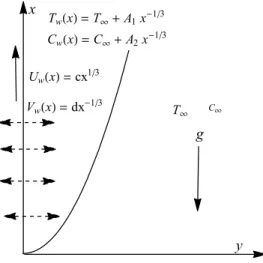
2. Flow Analysis T¶ g y x UwHxL=cx1ê3 VwHxL=dx-1ê3 CwHxL=C¶+A2x-1ê3 TwHxL=T¶+A1x-1ê3 C
Fig. 1. Physical sketch of the problem
Consider the laminar mixed convective flow of a non-Newtonian fluid obeying Powell-Eyring model over a non linear stretching permeable surface. For the flow problem, let the x-axis be taken along the surface andy-axis be normal to it. Two equal and opposite forces are applied along the x-axis, so that the wall is stretched nonlinearly keeping the origin fixed. In this situation under the usual boundary layer approximation, the continuity, momentum, concentration and energy equations are reduced to the following equations:
∂u ∂x+ ∂v ∂y =0, (1) u∂u ∂x+v ∂u ∂y = 1 ρ ∂τxy ∂y +gβT(T−T∞)+gβC(C−C∞), (2) u∂T ∂x +v ∂T ∂y = κ ρCP ∂2T ∂y2 + DMKT CSCP ∂2C ∂y2, (3)
u∂C ∂x +v ∂C ∂y =DM ∂2C ∂y2 + DMKT TM ∂2T ∂y2. (4)
Here (u,v) are the velocity components,T is the fluid temperature andCis the concentration. Furthermore,ρand κare the density and thermal conductivity of the fluid, respectively. AlsoCP,DM,TM, KT andCS stands for the specific heat at constant pressure, the coefficient of mass diffusivity, the mean fluid temperature, thermal diffusion ratio, the concentration susceptibility, respectively. The shear stress componentτxyfor the Powell-Eyring fluid having the dynamic viscosityμ, material parametersβandγis given by [8]
τxy=μ∂∂u y+ 1 βsinh−1 1 γ ∂u ∂y . (5)
The stretching velocityUw, the succussion velocity Vw, the wall temperatureTw, the wall concentrationCw are considered as
Uw=cx1/3, Vw=dx−1/3, Tw=T∞+A1x−1/3, Cw=C∞+A2x−1/3. (6) Herec,d,A1,A2are prescribed constants. Therefore, the boundary conditions to the problem are reduced to
u=Uw(x)=cx1/3, v=Vw(x)=dx−1/3, T =Tw(x)=T∞+A1x−1/3,C=Cw(x)=C∞+A2x−1/3 aty=0,(7)
u→0, T →T∞andC→C∞ asy→ ∞. (8)
On substituting the similarity transformation [15] η=y 2cx−2/3 3ν , ψ= f(η) 3cνx4/3 2 , θ=θ(η), φ=φ(η), (9)
in (2), (3) and (4), we get the following transformed equations: (1+)f+f f−1 2f 2−δ 3 f f2+3 2λ1θ+ 3 2λ2φ=0, (10) 1 Prθ +Duφ+fθ+1 2f θ=0, (11) 1 S cφ +Srθ+fφ+1 2f φ=0. (12)
The boundary conditions become:
f(0)= fw, f(0)=1, θ(0)=1, φ(0)=1, f(∞)=0, θ(∞)=0, φ(∞)=0. (13) HereSr = DTMMKAT2Aν1 is the Soret number, Du = CDSMCKPTAA12νis the Dufour number,λ1 = A1cg2βT is the mixed convection
parameter,λ2= A2cg2βC is the solutal buoyancy parameter, fw=d
3
2νcis the suction or blowing parameter,Pr= ρνCp
κ is the Prandtl number,S c= Dν
M is the Schmidt number. = 1
ρβγν, andδ= c
3
γ2ν are the fluid parameters.The physical
quantities of engineering interest for the present problem are the skin friction coefficientCf, the local Nusselt number
Nuxand the local Sherwood numberS hx, which are defined as
Cf = ν U2(x) ∂ u ∂y y=0, Nux= x (Tw−T∞) ∂ T ∂y y=0, S hx= x (Cw−C∞) ∂ C ∂y y=0. (14) On substituting (14) in Eqs. (10), (11) and (12) we obtain
Re1x/2Cf =(1+)f(0)− 6δf
3(0), Re−1/2
x Nux=−θ(0), Rex−1/2S hx=−φ(0). (15)
3. Results And Discussion
To analyze the flow, heat and mass transfer behavior inside the boundary layer, Eqs. (10), (11) and (12) are solved analytically by Homotopy Analysis Method [16]. For the convergence of the HAM series solution, we plot the curves ofhf,hθandhφin Fig.2 for fw==δ=λ1=λ2=Sr =Du=0,Pr=0.72,S c=0.5. The admissible ranges ofhf,
hθandhφare−0.8≤hf ≤ −0.4 ,−1.0≤hθ≤ −0.4 and−0.8≤hφ≤ −0.2.
Fig. 2.hf,hθandhφcurve for 10th-order HAM approximation
Fig. 3. Variation off(η) for different values ofλ1. Fig. 4. Variation off(η) for different values ofλ2.
Figures 3-6 display the effects of thermal buoyancy and concentration buoyancy on the velocity, temperature and concentration distribution in the boundary layer (forSr = Du = 0.2 , fw = 0.1 , Pr = 0.72,S c = 0.5) . It can be seen from Fig.3 and Fig.4 that the fluid velocity increases whenλ1orλ2increases. It has been observed that if the opposing flow increases, f(η) becomes negative in the outer part of the velocity boundary layer, and this situation is valid as the buoyancy force acts on the opposite direction of the stretching motion of the surface. The fluid flow near the vertical surface is proportional to the upward stretching motion of the surface, which is opposed by the negative buoyancy force. The temperature of the fluid inside the boundary layer decreases with the increase in the value ofλ1 (see figure 5). Similarly, figure 6 shows that the concentration of the fluid near to the plate decreases with increase in the value ofλ2.
Fig. 5. Variation ofθ(η) for different values ofλ1. Fig. 6. Variation ofφ(η) for different values ofλ2.
Fig. 7. Variation ofθ(η) for different values ofDu. Fig. 8. Variation ofφ(η) for different values ofSr.
Figures 7 and 8 represent the effect ofDuandSron temperature and concentration profile. It can be observed from Fig.7 that the temperature increases with increase in the value ofDu. The increase in the value of concentration with increased value ofSrcan be predicted from Fig.8.
The effects of the fluid parameterandδon the velocity temperature and concentration withλ1=λ2=Sr=Du= 0.2 when fw = 0.1 , Pr = 0.72,S c = 0.5, are shown in Figs. 9-12. It can be observed that whenincreases, the velocity increases and the temperature and concentration decreases inside the boundary layer. It can be seen that the velocity decreases while the temperature and concentration increases with the increase inδ.
4. Conclusion
The Soret and Douffer effect on the heat and mass transfer of a purely viscous non-Newtonian Powell-Eyring fluid flow over a non linear stretching in the presence of thermal buoyancy and concentration buoyancy has been analyzed. The transformed nonlinear ordinary differential equations are solved by using Homotopy Analysis Method. The following important observations can be noted as:
Fig. 9. Variation off(η) for different values of. Fig. 10. Variation ofθ(η) for different values of.
Fig. 11. Variation ofφ(η) for different values of. Fig. 12. Variation off(η) for different values ofδ.
• Increase in buoyancy leads to increase in velocity and decrease in temperature and concentration.
• Increase in, velocity increases but temperature and concentration decreases.
• Increase inδhas opposite effect on velocity temperature and concentration profile as compare to.
• The temperature increases with increase in the value ofDu.
• The increase in the value ofSrleads to increase in concentration.
Acknowledgements
The authors are thankful to the referees for their critical comments which help in improving the presentation of the paper. The first author acknowledges the facilities and support provided by the National Institute of Science and Technology, Berhampur.
References
[1] W.C. Tan, T. Masuoka, Stokes problem for a second grade fluid in a porous half space with heated boundary, Int. J. Non-linear Mech. 40 (2005) 515-522.
[2] C. Fetecau, J. Zierep, R. Bohning, C. Fetecauc, On the energetic balance for the ?ow of an Oldroyd-B fluid due to a flat plate subject to a time-dependent shear stress, Comput. Math. Appl. 60 (2010) 74-82.
[3] T. Hayat, Z. Abbas, I. Pop, S. Asghar, Effects of radiation and magnetic field on the mixed convection stagnation-point flow over a vertical stretching sheet in a porous medium, Int. J. Heat Mass Transfer 53 (2010) 466-474.
[4] A. Ishak, R. Nazar, N. Amin, D. Filip, I. Pop, Mixed convection of the stagnation-point flow towards a stretching vertical permeable sheet, Malay. J. Math. Sci. 2(2007) 217-226.
[5] R. E. Powell, H. Eyring, Mechanism for relaxation theory of viscosity, Nature 154 (1944) 427-428.
[6] T. Hayat, Z. Iqbal, M. Qasim, S. Obaidat, Steady flow of an Eyring Powell fluid over a moving surface with convective boundary conditions, Int. J. Heat MassTransfer 55 (2012) 1817-1822.
[7] T. Javed, N. Ali, Z. Abbas, M. Sajid, Flow of an Eyring-Powell Non-Newtonian Fluid over a Stretching Sheet Chemical Engineering Commu-nications 200 (2013) 327-336.
[8] M. Jalil, S. Asghar, S. M. Imran, Self similar solutions for the flow and heat transfer of Powell-Eyring fluid over a moving surface in a parallel free stream, International Journal of Heat and Mass Transfer 65 (2013) 73-79.
[9] M. Y. Malik, A. Hussain, S. Nadeem, Boundary layerflow of an Eyring-Powell model fluid due to a stretching cylinder with variable viscosity, Scientia Iranica B 20 (2013),313-321.
[10] A. V. Rosca, I. Pop, Flow and heat transfer of Powell-Eyring fluid over a shrinking surface in a parallel free stream, International Journal of Heat and Mass Transfer 71 (2014) 321-327.
[11] C.Y. Cheng, Soret and Dufour effects on free convection boundary layers over an inclined wavy, International Communications in Heat and Mass Transfer 38 (2011) 1050-1055.
[12] S.A. Shehzad, F.E. Alsaadi, S.J. Monaquel, T. Hayat, Soret and Dufour effects on the stagnation point flow of Jeffrey fluid with convective boundary condition, Eur. Phys. J. Plus 128 (2013) 1-15.
[13] M. Qasim, Soret and Dufour effects on the flow of an Erying-Powell fluidover a flat plate with convective boundary condition, Eur. Phys. J. Plus 129 (2014) 1-7.
[14] T. Hayat, H. Yasmin, M. A. Yami, Soret and Dufour effects in peristaltic transport of physiological fluids with chemical reaction: A mathemat-ical analysis, Computers and Fluids 89 (2014) 242-253
[15] S. Panigrahi, M. Reza, A. K. Mishra, MHD effect of mixed convection boundary-layer flow of Powell-Eyring fluid past nonlinear stretching surface, Applied Mathematics and Mechanics 35 (2014), 1525-1540.