Policy Research Working Paper
5450
Subnational Taxation in Developing Countries
A Review of the Literature
Richard M. Bird
The World Bank
Poverty Reduction and Economic Management Network
Economic Policy and Debt Department
October 2010
Public Disclosure Authorized
Public Disclosure Authorized
Public Disclosure Authorized
Abstract
The Policy Research Working Paper Series disseminates the findings of work in progress to encourage the exchange of ideas about development issues. An objective of the series is to get the findings out quickly, even if the presentations are less than fully polished. The papers carry the names of the authors and should be cited accordingly. The findings, interpretations, and conclusions expressed in this paper are entirely those of the authors. They do not necessarily represent the views of the International Bank for Reconstruction and Development/World Bank and its affiliated organizations, or those of the Executive Directors of the World Bank or the governments they represent.
This paper reviews the literature on tax assignment in decentralized countries. Ideally, own-source revenues should be sufficient to enable at least the richest subnational governments to finance from their own resources all locally-provided services that primarily benefit local residents. Subnational taxes should also not unduly distort the allocation of resources. Most importantly, to the extent possible subnational governments should be accountable at the margin for financing the expenditures for which they are responsible. Although reality in most countries inevitably falls far short of these ideals, nonetheless there are several taxes that subnational governments in developing countries could use to help ensure that decentralization yields
This paper—a product of the Economic Policy and Debt Department, Poverty Reduction and Economic Management Network—is part of a larger effort in the department to develop knowledge products on subnational finance and fiscal reforms. Policy Research Working Papers are also posted on the Web at http://econ.worldbank.org. The author may be contacted at [email protected].
more of the benefits it appears to promise in theory. At the local level, such taxes include property taxes and, especially for larger cities, perhaps also a limited and well-designed local business tax. At the regional level, in addition to taxes on vehicles, governments in some countries may be able to utilize any or all of the following—a payroll tax; a simple surcharge on the central personal income tax; and a sales tax, in some cases perhaps taking the form of a well-designed regional value-added tax. The “best” package for any particular country or subnational government is likely to be not only context-specific and path-dependent, but also highly sensitive to the balance struck between different political and economic factors and interests.
Subnational Taxation in Developing Countries:
A Review of the Literature
Richard M. Bird
University of Toronto
The World Bank
Poverty Reduction and Economic Management Network Economic Policy and Debt Department
1. Introduction ... 1
2. Tax Assignment: The Standard Model ... 3
2.1. Rules for Tax Assignment ... 3
2.2. What is a “Subnational” Tax? ... 6
3. The “Second-Generation” Assignment Model ... 8
3.1. The Key Points ... 8
3.2. Tax Assignment in Practice... 9
3.3. Normative Rules on Tax Assignment ... 12
4. Other Issues Related to Tax Decentralization ... 14
4.1. The Capacity Issue ... 15
4.2. The Equalization Issue ... 16
4.3. The Revenue Issue ... 17
4.4. The Stabilization Issue ... 18
4.5. The Development Issue ... 19
4.6. The Accountability Issue ... 20
5. What Taxes for Subnational Government? ... 21
5.1. A Policy Choice Matrix ... 22
5.2. The Heart of the Matter ... 23
6. An Appraisal of Potential Subnational Taxes ... 27
6.1. Property Taxes... 28
6.2. Excise Taxes ... 33
6.3. Personal Income Taxes ... 34
6.4. Payroll Taxes ... 36
6.5. General Consumption Taxes ... 37
6.6. Business Taxes ... 39
7. Conclusion ... 43
References ... 46
Tables
Table 1: Tax Assignment in a Federal State: The Standard Approach ... 4
Table 2: Share of Central and Subnational Taxes, Selected Countries and Years (percent) ... 11
Table 3: A Policy Matrix for Subnational Taxes ... 24
1.
Introduction
This paper reviews the literature on revenue assignment to see what theory suggests are the best taxes for subnational -- regional and local -- governments in developing
countries.2 In practice, however, which level of government should tax what in any particular country depends to a considerable extent on how some other key aspects of intergovernmental finance are structured. For example, an important (and logically prior) question is that of expenditure assignment—which level of government should do what?3 If the appropriate expenditure role for subnational governments is simply to provide a few minor local services and perhaps to act as delivery agents for nationally determined public expenditures, the revenue assignment question turns out to be relatively simple. However, if subnational governments are expected to deliver important (and costly) public services and have some discretion in deciding how and to what extent they do so, determining the appropriate revenue assignment is much more difficult as is discussed later in this paper.
In many countries, the expenditure tasks devolved to subnational governments substantially exceed their capacity to raise revenues from sources under their own control. Such governments must therefore depend on intergovernmental fiscal transfers (including revenue sharing arrangements under which they receive a share of central taxes) to close the resulting fiscal gap (vertical imbalance). In addition, when any significant taxing power is devolved to subnational governments, existing differences in needs and capacities between different governmental units at the same level of
government are invariably exacerbated, thus creating a potential problem of equalization (horizontal imbalance). The existence of such imbalances means that one cannot design an appropriate system of subnational taxation without simultaneously designing an appropriate system of intergovernmental transfers. However, we do not discuss this important question further in the present paper.4
1
The author is Professor Emeritus at Rotman School of Management, University of Toronto. The author is grateful to Lili Liu and Eduardo Ley, Lead Economist of Economic Policy and Debt Department, World Bank for helpful comments on an earlier version of this paper, although he is solely responsible for its contents. The findings, interpretations, and conclusions expressed in this paper are entirely those of the author. They do not necessarily represent the views of the International Bank for Reconstruction and Development/World Bank and its affiliated organizations, or those of the Executive Directors of the World Bank or the governments they represent.
2
Of course, this question is important in all countries, particularly federal countries: see, for example, the detailed examination of subnational taxation in Australia in Bird and Smart (2010).
3
See the interesting treatment of the sequencing of decentralization decisions in Bahl and Martinez-Vazquez (2006a).
4
The interdependence of transfers and subnational taxes is discussed further in Bird and Smart (2002) and Smart and Bird (2009a). In principle, many other aspects related to intergovernmental finance also need to be considered in designing and implementing an appropriate subnational tax system for any particular country. For example, one issue that has received considerable attention in recent years is how best to regulate subnational borrowing and to deal with the various macroeconomic and allocative problems that may arise from subnational insolvency (Canuto and Liu 2010, Liu and Weibel 2008, 2009). Another
Even within the limited range of issues discussed in this paper, it is difficult to draw definitive conclusions about the “ideal” subnational tax system for any particular country. To do so one must take into account not only the normal public finance trio of goals --efficiency (allocation), equity (distribution), and stabilization -- but also the extent to which economic growth is emphasized as a policy goal as well as such nebulous but politically resonant factors as regional balance and the maintenance of national unity and political stability. In addition, of course, policy change in any country must start from the existing situation. Existing fiscal institutions usually reflect the results of an accretionary process of policy change over time, and the inertia inherent in such institutions must not be underestimated. To understand, let alone to resolve, the intergovernmental fiscal puzzle in any country thus requires substantial institutional as well as analytical knowledge. In part for this reason, international comparisons of intergovernmental financial arrangements are both difficult to make and hard to interpret once made.5
Nonetheless, in circumstances in which the fiscal systems of most developing countries are subjected to increasing challenges both nationally and internationally, it is important to get subnational taxation right. The expanded importance of trade and international capital flows has increased the sensitivity of important tax bases to fiscal differentials, including those at the subnational level. The current financial crisis issue has accentuated this issue in many countries. Over a longer time horizon, both climate and demographic changes pose new challenges that seem likely to require new fiscal initiatives in many countries. As yet, relatively little thought has been given to the implications of these challenges for subnational governments in emerging countries. Already, however, it is apparent in some countries that globablization has interacted with domestic political and economic changes to create or exacerbate regional stresses -- stresses that may both impact on and be influenced by intergovernmental fiscal arrangements,6
Such issues are especially important in countries, like most large emerging countries, in which important public sector services are provided by subnational governments. How revenues are raised and distributed among and between governments at different levels is thus especially important in large countries. The political importance of
intergovernmental fiscal relations is obvious, and who controls the finances is often as important as who controls the legal use of force.7 The economic importance of
intergovernmental finance is equally critical in view of the role played in development by relevant issue in many countries is the relevant role and structure of public-private partnerships and other possible ways in financing the substantial fraction of infrastructure that is often the responsibility of subnational governments. Such questions are not treated further in the present paper; however, an earlier broader discussion of the connections between many of these issues in the context of Latin America may be found in Bird (2001a).
5
For a recent discussion of this point with respect to developed federal countries, see Bird and Smart (2010).
6
See, for examples, the case studies in Bird and Ebel (2007) as well as the review of the empirical literature in Bird, Vaillancourt and Roy-Cesar (2009).
7
The historical importance of the "Cash Nexus" in the growth of state power is set out clearly in Ferguson (2001). See also the related argument with respect to the link between the control of money and the control of force in the development of federalism in Latin America in Diaz-Cayeros (2006), and the discussion in Brautigam, Fjeldstad, and Moore (2007) of how the design and implementation of subnational taxation may influence and affect the development of “social capital” and the legitimacy of public institutions.
governmental institutions and by public sector investment in physical and human infrastructure in development.8
How regional and local governments are financed thus directly affects the well-being of billions of people around the world. This paper looks at what theory has to tell us about which taxes should be assigned to such governments. This paper focuses solely on general taxes and not on revenues that are presumably offset by direct benefits received by those who pay them. Section 2 describes the rather limited role prescribed for such taxes by the standard theoretical literature on fiscal federalism. Section 3 reconsiders this question in light of an expanded theoretical framework that has come to be called
"second-generation fiscal federalism."9 Following a brief discussion in Section 4 of several other issues relevant to tax decentralization, Section 5 provides an overview of what an appropriate subnational tax system might look like. Section 6 then considers in more detail the major taxes that appear suitable for subnational governments in emerging countries in theory. Section 7 concludes.
2.
Tax Assignment: The Standard Model
"Who should tax, where, and what?" is how Richard Musgrave (1983) once characterized the question of tax assignment in a multilevel government.10 The answer, at least in theory, has long seemed to be clear to most economists.
2.1. Rules for Tax Assignment
As Oates (1996) summarizes the position, standard fiscal federalism theory suggests essentially three rules with respect to the taxes that should be assigned to subnational governments:
(1) Lower levels of government should, as much as possible, rely on benefit taxation of such mobile economic units as households and mobile factors of production.
8
Interestingly, Cantarero and Perez Gonzalez (2009) suggest a connection between the degree of revenue decentralization and regional economic growth in Spain, although no significant connection between expenditure decentralization and growth was found. The importance of infrastructure to economic growth continues to be vigorously discussed in the literature: for two recent contributions, see Straub, Vellutini, and Warlters (2008) and Seethepalli, Bramati, and Veredas (2008). The World Bank’s governance data base (http://info.worldbank.org/governance/wgi/index.asp) has been used in countless studies to show the importance of government institutions in affecting policy outcomes, including fiscal outcomes: for one example, see Bird, Martinez-Vazquez and Torgler (2008).
9
Oates (2008) distinguishes two strands of the second-generation literature. However, this distinction is ignored here since both strands emphasize the two common elements missing from the standard fiscal federalism model that are stressed in the present paper -- the treatment of politicians and officials as having their own objectives and the need to pay close attention to the political and fiscal environments within which these agents operate.
10
(2) To the extent that non-benefit taxes on mobile economic units are required -- for example, for redistributive purposes -- only higher levels of government should impose them.
(3) If any non-benefit taxes are imposed by lower levels of government, they should be levied only on tax bases that are relatively immobile across local jurisdictions.
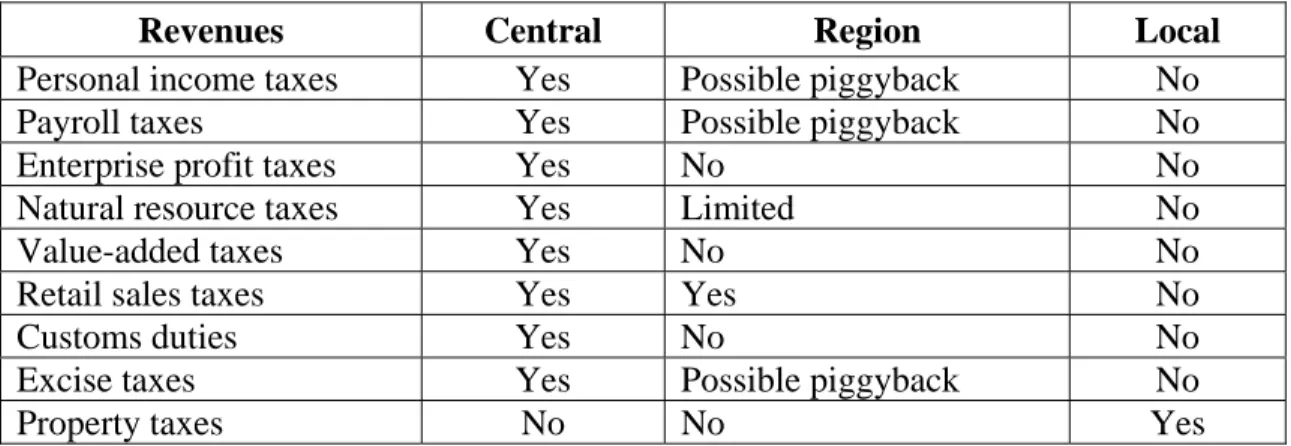
Table 1 summarizes the tax assignment to different levels of government that may be derived on the basis of these rules.11
Table 1: Tax Assignment in a Federal State: The Standard Approach
Revenues Central Region Local
Personal income taxes Yes Possible piggyback No
Payroll taxes Yes Possible piggyback No
Enterprise profit taxes Yes No No
Natural resource taxes Yes Limited No
Value-added taxes Yes No No
Retail sales taxes Yes Yes No
Customs duties Yes No No
Excise taxes Yes Possible piggyback No
Property taxes No No Yes
The theoretical public finance literature emanating from Musgrave (1959) and Oates (1972) thus suggests a system in which subnational (regional and local) governments, even if they have substantial control over expenditures, will levy few taxes. The principal reason for this outcome is because subnational governments are essentially viewed in this literature as little more than decentralized service providers with the
strictly allocative role of providing sub-central public goods. Furthermore, in the absence of tax differentials, individuals and firms are assumed to make sensible consumption and investment decisions. As a result, subnational taxation of such potentially mobile tax bases as consumption, trade, labor and capital will as a rule be economically distorting and hence reduce national well-being.12 At most, as Table 1 suggests, local governments may be allowed to impose taxes on land and property in addition to user charges.
Interestingly, this is precisely the local finance model that one sees in most English-speaking countries, other than the United States (Bird and Slack 2004). In addition, the literature suggests that regional governments may be permitted to impose retail (final-stage) sales taxes and a few excises as well as to “piggy-back” -- that is, impose
11
This table (adapted from one in Bird and Smart 2010) synthesizes previous summaries of the literature in McLure (1983a), Shah (1994), Martinez-Vazquez, Rider and Wallace (2008), and Bird (2009). For a much more detailed table along somewhat similar lines, see Shah (1994). User charges are also a suitable source of revenue role for subnational governments (Bird 2001b) but this interesting subject is not further discussed here.
12
There may of course be some exceptions, as when direct expenditure benefits are offset by well-designed user charges) or when (as with well-designed environmental taxes) negative externalities are reduced, but these possibilities are for the most ignored in the present paper.
surcharges -- on centrally-imposed personal income or payroll taxes.
Many additional reasons for similarly limiting subnational taxation may be found in the literature, such as the need for countries to maintain an "integrated economic space" (Ter-Minassian 1997a) and to avoid "tax wars" and revenue erosion (“the race to the bottom”) in the face of fiscally-induced locational distortions. Other reasons mentioned include the need to achieve redistributive equity within countries as a whole (Musgrave 1983) and the desirability of achieving economies of scale in tax administration (Vehorn and Ahmad 1997). When weighted additionally by such factors as visibility (accountability), stability, and "evenness" (Norregaard, 1997), such assessments of tax assignment almost invariably favor central over subnational taxation.13 For example, the standard literature suggests that only central (national) governments should impose a corporate income tax (CIT) (McLure 1983b), tax unevenly distributed natural resources (Mieszkowski 1983), levy a progressive personal income tax (PIT) (Musgrave 1983), or impose a VAT (Norregaard 1997).
More recent authors generally continue to emphasize that each level of government should be assigned taxes that are as closely related as possible to the benefits derived from spending them. Often, however, they also note that "if fiscal decentralization is to be a reality, subnational governments must control their own sources of revenue
(Martinez-Vazquez, McLure, and Vaillancourt 2006, 21)." Unfortunately, as discussed in Section 3 of the present paper, it is not easy to satisfy both of these conditions. Still, the overall conclusion is clear: the standard model of tax assignment in a multi-tier
governmental structure essentially assigns no productive taxes to subnational governments. Local governments are left with little but property tax. Regional governments may at most be allotted a few excises, perhaps some access to payroll or personal income taxes and, more arguably, some limited access to general consumption taxes.
These are fairly slim pickings. Moreover, in many countries not even this much is left on the subnational tax table in practice, for a number of reasons:
The personal income tax (PIT) is often simply taken off the table by those who think that the income tax should be retained entirely by the central government, for instance to help achieve its designated stabilization and redistributional goals. Even if regions do have access in principle to the option of levying surcharges on the central PIT base, in most developing countries even the national government seldom secures much revenue from the PIT (Bird and Zolt 2005) so there is little PIT base on which to impose a surcharge.
Since in many countries payroll taxes are allocated to social security finance, they are seldom considered to be available for general tax finance at any level of government.
13
“Evenness" in the sense of treating all citizens of a country uniformly is often assumed, implicitly or explicitly, to be an essential component of an adequate national tax system in either economic or political terms: as Oates (2008) discusses, however, this is neither a simple nor a persuasive criterion.
In the conventional approach, the only acceptable regional consumption tax is generally thought to be a simple single-stage (preferably retail) sales tax (RST) levied directly on final (resident) consumers, along with perhaps a few excise taxes (Martinez- Vazquez, Rider and Wallace 2008). The virtually worldwide replacement of single-stage sales taxes by multi-stage value-added taxes (VATs) in recent years (Bird and Gendron 2007) thus implies that regional governments have largely been squeezed out of this tax field also.
Finally, in most countries considerable restrictions are imposed on the extent to which states can tax natural resources -- in part because of concerns with interjurisdictional fiscal equity (natural resources are never equally distributed across the national territory), in part because of conflicting ‘entitlement’
arguments, and in part for stabilization reasons. Who gets how much and in what form from natural resource taxation is always and everywhere a highly
controversial, political and context-dependent matter. Although this issue is important in a number of countries it is too complex to be further discussed here.14
Unfortunately, the usual data sources on governmental finance seldom make clear how much tax ‘freedom’ subnational governments really have. In 2006, for instance, IMF (2008) shows that subnational taxes as a share of total taxes are roughly the same in Canada (52.9%) and China (51.8%). In fact, however, it can be argued that subnational tax power is stronger in Canada -- even in those provinces in which subnational
governments themselves collect hardly any of their taxes – than it is in China.15 Since this point is critical to understanding the key argument of the present paper, it is developed further in Section 2.2.
2.2. What Is a “Subnational” Tax?
In principle, a “totally” subnational tax may be defined as one that satisfies five distinct conditions:
(1) Subnational governments can decide whether to levy the tax or not. (2) They can also determine the precise base of the tax.
(3) They can decide the tax rate.
(4) They administer (assess, collect, enforce) the tax. (5) They get to keep all the revenue they collect.
In the real world, however, many so-called subnational taxes possess only one or two of these characteristics, with the result that the "ownership" of particular taxes may be unclear.16
14
For recent treatments of issues with respect to the assignment of natural resource revenues, see Brosio (2006), Collier and Hoeffler (2005) and Davis, Ossowski and Fedelino (2003).
15
Revenues from land assets and financing are substantial own financing sources for subnationall governments in China (Peterson and Kaganova 2010). Non-tax revenues are not dealt with in this paper. 16
See OECD (1999) for a pioneering discussion of this problem and detailed evidence of the difficulty of classifying many taxes along these various dimensions even in developed countries; a recent update of this discussion may be found in Blochliger and Rabesona (2009).
In Argentina, for example, although a share of the proceeds of many central taxes accrues to the provinces, the rates (and bases) of these taxes are determined by the national government, which also assesses and collects them. In many other countries also, what are frequently referred to in common discourse (as well as statistical classification) as “subnational taxes” are similarly examples of tax sharing – the allocation of shares of (some or all) central taxes to subnational governments. As a rule there is little that is ‘subnational’ about such taxes – apart, of course, from the important fact that subnational governments can spend the revenue. For the most part, these are essentially central taxes that are distributed (in whole or part) to subnational governments. This interpretation is particularly plausible when, as is often the case, there is little connection between the amount transferred is determined by a formula that has no link to the amount collected locally (as in Germany and Morocco). However, it also holds to a substantial extent even when revenues are distributed on the basis of their point of collection. Most so-called tax sharing is thus simply an alternative way to determine the amount of an
intergovernmental transfer and does not constitute subnational taxation in any meaningful sense.17
In other countries, however, what may seem from most perspectives to be a central tax coupled with a related transfer program may really be a subnational tax. Suppose, for example, that a subnational government has the ability (a) to decide whether or not to impose a particular tax, (b) to determine the tax base (perhaps within some limits), (c) to set the tax rate (again perhaps within some limits), and (d) it also receives all the
revenues. Under these conditions, even if the tax is imposed on a tax base on which the central government levies its own tax and it is collected by the central government along with its own tax, it is still a subnational tax. So far as the subnational government is concerned the central government is simply acting as its administrative agent in collecting what is essentially a subnational tax.
Much of Canada’s extensively decentralized tax system operates in exactly this way, for example. Provincial personal income taxes are collected by the federal government in most provinces. In some provinces, provincial corporate income taxes and sales taxes are also collected by the federal government. Nonetheless -- subject to the important
limitation that the bases on which these provincial taxes are imposed for reasons of administrative simplicity must be essentially the same as the base of the corresponding federal tax – all these taxes are clearly provincial taxes. The provinces decide if they want to impose the tax; they also determine (within some limits) its rates; and of course they receive all the revenues. Moreover, if they wish to do so, they also have the option of imposing and collecting all these taxes themselves, as indeed one province (Québec) does. In effect, most Canadian provinces have simply contracted for the services of the
17
To illustrate the issue, when Australia introduced a GST (VAT) in 2000, the OECD and others initially classified this tax as subnational (state) because all of its proceeds went to the states. Subsequently, however, the tax was reclassified as a central tax because its only subnational aspect is who gets the revenue -- and even that is determined by a central government formula. For a recent OECD discussion of the classification problems with tax sharing arrangements, see Blochliger and Petzold (2009b).
central government as a collection agent, and -- except perhaps in the narrowest accounting sense -- there is no intergovernmental transfer of revenues at all.18
The key point to grasp from this discussion is that by far the most critical aspect of sub-national taxing power is who is politically responsible for setting the tax rate.19 The potential accountability virtues of subnational taxation depend on local and regional governments having the authority to decide how much revenue they raise and being openly responsible to their own citizens for doing so. What matters for accountability is not so much who gets the revenue or who administers the taxes but who bears the political responsibility for them, and the simplest and clearest evidence of accountability in this sense is who determines tax rates.
3.
The “Second-Generation” Assignment Model
In part in reaction to the inadequacies of the standard fiscal federalism model, over the last decade what has been called a ‘second-generation’ fiscal federalism model has begun to emerge (Oates 2008; Weingast 2006). As Ambrosiano and Bordignon (2006) correctly note, no clear optimal tax assignment to different levels of government emerges from this literature either. However, a key relevant point that does emerge is that there is a
surprisingly strong case for a significant degree of tax autonomy at the subnational level, both local and regional. This second-generation approach to this issue, which focuses on the dynamic effect of incentives, may perhaps be seen as beginning with the basic statement of the principle of ‘fiscal equivalence’ in Olson (1969) – though it may also equally be traced back to such common sayings as "every tub on its own bottom" and "match revenue and expenditure responsibilities."
3.1. Key Points
Essentially, the argument is that regional governments are more likely and able to allocate and control their expenditures efficiently and effectively if they also control their own revenues. One key rule is simply that “tax assignment should follow expenditure responsibilities” (Warren 2006, 49). The appropriate way to assign taxes in any country thus depends on how spending responsibilities have been assigned. If regional
governments, like local governments, are responsible (to exaggerate a bit) only for sweeping the streets and picking up the garbage, then user fees and some sort of low-rate general local tax such as a uniform tax on real property will likely suffice. In these circumstances, the prescription for a centralized tax system that emerges from the conventional fiscal federalism model yields seems correct. On the other hand, if, as is true in some countries, regional governments are responsible for such expensive (and
18
For discussion of how the Canadian system evolved with respect to income taxes, see Bird and
Vaillancourt (2006), and for discussion of how it currently operates with respect to sales taxes, see Bird and Gendron (2009).
19
Until recently the Canadian case was not pure in this respect because the agreement under which the federal government collected provincial sales taxes requiree that all the provinces for which it performs such collections must impose the same tax rate. However, there is no technical reason for this requirement (Smart and Bird 2007) and since July 2010 tow provinces (British Columbia and Nova Scotia) impose different rates. (Rate uniformity has never existed with respect to income taxes.)
usually expanding) social services as health or education, this conventional prescription is unlikely to produce sustainable results. If regions are to carry out big expenditure
functions responsibly, they generally need access to big revenues for which they are clearly politically accountable.20
In addition, regardless of the scope of subnational taxation, the second-generation fiscal federalism literature tells us that what is most important is that subnational governments should control the effective tax rate at the margin, preferably through the power to determine the nominal (politically visible) rate. As McLure (2000a) emphasizes, what “control” in this sense requires is that subnational governments are able to affect the volume of revenues significantly at the margin through their own policy choices. In the interests of transparency, the best way to do so is probably by imposing their own tax rates. If governments at any level are to be expected to act responsibly and in the interests of their residents they need to face a ‘hard budget constraint.’21 That is, they should be able to increase or decrease spending in any budget period only by increasing or decreasing their revenues in such a way that they are publicly responsible for the consequences of their actions. Of course, even if this condition is satisfied in reality governments may not in fact be held politically accountable. Governments at all levels tend to shift the blame for unpleasant action to external factors -- including the actions (or inaction) of other governments. With more explicit subnational taxes that actually touch their pockets directly, however, there should be both more incentive and more
opportunity for citizens to figure out what is going on – and, at least in a system with accountability, perhaps even to do something about it.22
3.2. Tax Assignment in Practice
Table 2 illustrates the patterns of tax assignment found in a number of emerging countries around the world as well as, for comparison, in a number of developed federal countries. On average, central governments in the emerging country group included in Table 2 are slightly more important as taxers (71.6%) than they are in the group of developed federal countries included in the table (69.8%). Central governments in large emerging countries also receive a slightly greater share of income taxes (62.6% compared to 60.4% for the
20
Note that this argument does not preclude a significant national government role in both financing and guiding -- for example, through minimum or national standards -- policy in such areas of national interest as education, even when the service is delivered entirely by regional and local governments. However, this important issue is not discussed further here.
21
For discussions of the hard budget constraint, see Rodden, Eskeland, and Litvack (2003) and Liu and Waibel (2008, 2009). Intergovernmental transfers should also be designed with this principle in mind: that is, unless it is explicitly intended to alter subnational spending decisions in the national interest (e.g. by taking externalities into account) such transfers should both pre-determined (fixed in advance for the budget period) and unconditional (Bird and Smart 2002).
22
Another important aspect when it comes to revenue assignment – though one that is not further
developed in this paper -- is that governments are run by people who to a considerable extent decide which taxes should be imposed in terms of a political rather than an economic calculus (Hettich and Winer 1999). Competition for tax base may, for instance, affect political decision-making regarding taxation not so much through its effects on resource allocation but rather in terms of the extent to which it is perceived to affect the probability of being reelected.
developed federal countries) as well as considerably higher shares of consumption taxes (72.8% compared to 59.4%) and especially taxes on property (24.4% compared to 7.4%). India and South Africa collect 100% of income taxes centrally, for example; among developed federal countries, only Australia does. In all the developed federal countries except Switzerland most or all taxes on property are collected by subnational (and usually local) governments. However, only in China, Russia, and Ukraine among the emerging countries included in Table 2 does the central government collect less than 10% of such taxes. Numbers like those just cited may be interesting: however, on the whole they probably conceal more than they reveal. Indeed, perhaps the most important lesson to take from Table 2 is simply that there is wide variation in the allocation of tax bases by level of government in different countries around the world. Perhaps the main conclusion one can draw from such data is simply that countries have a wide range of choice when it comes to subnational taxation.
In most emerging countries -- other than the few like Brazil and India that have effective federal constitutions -- the taxes that are assigned to lower governments are generally determined at the discretion of higher-level governments. It is not uncommon for such taxes to fall into one of three categories:
Taxes (and user fees) that too small to bother with --the minor nuisance taxes on dogs, billboards, and the like that are so often found at the local level.
Taxes difficult or costly for central governments to administer, especially if they are potentially politically challenging -- such as the property tax.
Taxes that may, so to speak, slip between the cracks – such as the technically rather bad local business taxes found in a number of countries.
This list actually describes fairly accurately what one sees around the developing world in the way of local taxation (Habitat 1996).
At the regional level, however, the picture is less clear. Regional, state or provincial governments (second tier) are more politically powerful than local governments from the perspective of the central government, if only because they may more easily serve as a base for aspiring competitors at the national political level. It is thus not surprising that what one usually finds in the way of regional taxation is essentially what political “equilibrium” seems to require (Diaz-Cayeros 2006). Countries where regional, state or provincial governments have significant political power and hence some decision-making autonomy (such as Canada and Brazil) tend to be countries in which such governments have access to major tax bases. On the other hand, countries in which central
governments essentially have dominant power (such as Japan) tend to have regional governments that are highly dependent on
Table 2: Share of Central and Subnational Taxes, Selected Countries and Years (percent)
Country and year Total tax revenues Taxes on income Taxes on property Domestic taxes on goods and services %Central %State %Local %Central %State %Local %Central %State %Local %Central %State %Local
*Germany 1998 70.7 22.0 7.3 43.4 36.6 20.0 0.8 48.6 50.6 62.8 37.0 0.2 *Spain 1997 83.0 7.5 9.4 85.7 8.7 5.7 2.8 52.4 44.7 78.5 5.4 16.0 Ukraine 2001 74.3 0.0 25.7 35.6 0.0 64.4 0.0 0.0 0.0 80.5 0.0 19.5 *Canada 1999 52.5 38.5 9.0 63.5 36.5 0.0 0.0 21.1 78.9 41.0 59.0 0.1 *Russia 2001 69.7 0.0 30.3 27.6 0.0 72.4 5.2 0.0 94.8 82.7 0.0 17.3 *South Africa 1998 92.8 0.5 6.7 100.0 0.0 0.0 21.7 0.0 78.3 98.6 1.4 0.0 *Switzerland 2000 66.0 20.0 14.0 30.3 39.1 30.7 30.9 42.8 26.3 92.2 7.6 0.2 *Australia 1999 77.4 19.3 3.3 100.0 0.0 0.0 0.0 63.6 36.3 66.2 33.8 0.0 *United States 2001 69.3 19.1 11.6 83.0 15.5 1.5 10.0 8.0 82.0 15.7 67.6 16.8 *Argentina 2001 59.7 40.3 0.0 50.5 49.5 0.0 54.4 45.6 0.0 94.6 5.4 0.0 *India 1999 62.6 37.4 0.0 100.0 0.0 0.0 14.9 85.1 0.0 41.5 58.5 0.0 China 1999 45.0 55.0 0.0 24.4 75.6 0.0 0.0 100.0 0.0 55.7 44.3 0.0 Indonesia 1999 97.1 2.9 0.0 100.0 0.0 0.0 74.9 25.1 0.0 95.9 4.1 0.0
Note:*indicates a federal country. Data for the emerging country group are shown in italics.
Source: As calculated fromInternational Monetary Fund (2002) by Martinez-Vazquez, McLure, and Vaillancourt (2006). Countries are listed in order of tax-to-GDP ratio (as based on a variety of sources and in some instances for a later year than the detailed tax data included in this table).
central transfers. Countries in transition from one political balance to another (such as Spain and Russia) have gone in different directions from time to time, sometimes moving towards more and sometimes towards less subnational fiscal autonomy.23 This political economy perspective provides no normative guidance as to what should be done, but sometimes it may help explain why whatever it is has been done.
3.3. Normative Rules on Tax Assignment
The major normative rules found in the conventional fiscal federalism literature were set out earlier in Section 2.1. A reductionist statement of the guidance to tax assignment that emerges from the standard literature is more or less that the central government not only gets all the big taxes but also determines which remnants of the tax system – essentially those that fall least on mobile bases -- should be given to subnational governments. A very different normative assignment rule was suggested by Brennan and Buchanan (1980) in their Leviathan model. As they observe, the conventional model of fiscal federalism can be interpreted as a revenue-maximizing model (subject to efficiency and, perhaps, equity constraints). However, since the objective in Brennan and Buchanan (1980) is to limit the grasp of the government leviathan rather than to extend it, they argue that subnational taxes should be imposed on mobile factors so that
intergovernmental competition for tax base would lead to lower tax rates and hence smaller governments. In this view, to paraphrase McLure (1986), what's good for the private goose is good for the public gander; that is, competition is seen to be as healthy and beneficial between governments as between private economic agents.24 As Breton (1996) demonstrates, however, in reality governments are usually both more competitive and less monolithic (and monopolistic) leviathans than Brennan and Buchanan (1980) assume. While there is much still to be learned about intergovernmental competition between governments at the same level (horizontal competition) as well as between governments at different levels (vertical competition), in the context of tax assignment it seems fair to conclude that there is no great analytical or empirical support for either extreme position in this debate.25
From a subnational perspective the outcome of the discussion of tax assignment in the second-generation literature is somewhat less bleak than either of the rules just discussed. Perhaps the most useful practical formulation of the normative approach suggested in the second-generation literature is that of McLure (2000a). As discussed in Section 3.1, that literature emphasizes the need for subnational governments to control their own revenues in order to ensure effective decentralized control of spending.26 However, all that is
23
Of course, the same is true in for example Australia and Canada (Winer, 2000). 24
It should be emphasized that McLure (1986) does not recommend that subnational government should
tax mobile factors; but he does note that if such governments do so, then competition might have beneficial effects in some circumstances.
25
For surveys of the ever-growing tax competition literature from different perspectives, see Breton (2006), Salmon (2006), Wilson and Wildasin (2004), and Afonso, Ferreira, and Varsano (2002).
26
Although the point is not further discussed here, it may also be argued that such subnational control over revenues may also be helpful for stabilization purposes, for example in restraining excessive subnational
required for such control is for subnational governments to be able to affect the volume of revenues significantly at the margin through their own policy choices, in particular by choosing tax rates.
Bird (1993) suggests that it would also be a good practice if subnational taxes provided sufficient revenue for at least the richest subnational units to be essentially fiscally autonomous in the sense of being able to raise sufficient revenue through taxes (and revenue instruments like user charges) that they control to cover the expenditures for which they are directly responsible. However, by far the most important tax assignment rule emerging from the recent literature on fiscal decentralization is that for subnational governments to face the incentives needed to ensure that they will act in as fiscally responsible a manner as possible, they must be able to increase or decrease their revenues by means that make them publicly responsible for the consequences of their actions.27 In summary, the second-generation approach to tax assignment sketched above suggests two useful, though general, normative guidelines for tax assignment:
First, financing should follow function in the sense that the importance of the tax assignment problem in any country depends very much on the assignment of spending responsibilities. If local governments do not do much, they do not need much in the way of taxation. A property tax (plus user charges) as prescribed by the standard model, seems fine in such cases. On the other hand, if subnational governments are responsible for health or education or both, the pressure on subnational revenues is obviously greater, and the conventional prescription is less likely to produce sustainable results. Careful context-specific-- and often path-dependent -- analysis of what taxes can and should be levied at the
subnational level is then required for each country, particularly with respect to the more politically salient regional governments. If a country wants big expenditure responsibilities to be carried out responsibly by subnational governments then
borrowing: see Von Hagen and Eichengreen (1996), Rodden, Eskeland, and Litvack (2003), and Boadway and Shah (2009).
27
This argument implies that transfers made by higher levels of government to poorer subnational units for such (egalitarian and/or efficiency) reasons as e.g. permitting regional governments to provide similar levels of public services should be inframarginal (that is, unconditional) so that all subnational
governments, rich and poor alike, face the full marginal tax price of the spending decisions for which they are responsible. Only when this is the case can the hard budget constraint that experience suggests is critical to the establishment of sustainable good intergovernmental fiscal and financial policy be achieved (Rodden, Eskeland, and Litvack 2003). Of course, to the extent that subnational expenditures give rise to
interjurisdictional spillovers or when subnational governments act as delivery agents for nationally-set policies, some conditional transfers even to the richest jurisdictions may be warranted (Bird and Smart 2002). Although the issue of the appropriate design of transfer systems is not further explored here, in some important ways – as Smart and Bird (2009a) discuss in detail – subnational taxes and central transfers to subnational governments need to be designed to fit together properly. Much the same might be said with respect to subnational borrowing powers (Canuto and Liu 2010, Liu and Waibel 2008, 2009), although this issue too is not discussed further in this paper.
those governments usually need access to some significant revenues for which they are clearly politically responsible.28
Secondly, subnational governments should have the ability (and responsibility) to determine their "own-source" revenues at the margin in a manner that is both politically and economically meaningful. In some countries subnational
governments already have sufficient revenue to finance their expenditures without recourse to unwarranted borrowing or other undesirable expedients. However, if these governments are unable to choose which taxes they levy, what the tax bases are, what tax rates are imposed, or how intensively taxes are enforced, they have no real control at all over their revenues and hence no taxing power at the margin. Of the policy choices mentioned, by far the most important in most countries from the perspective of fostering efficient, effective, accountable and sustainable
decentralization is for subnational governments to have at least some degree of control over the tax rates imposed in their name.
4.
Other Issues Related to Tax Decentralization
Section 3 suggests that there is almost always a good prima facie case for decentralizing at least some taxing authority to subnational governments. Nonetheless, not many developing countries have as yet done so to any significant extent. Indeed, who should levy what taxes and how effectively they can do so has often been the focus of major political discussions, particularly in large countries with extensive and complex systems of subnational government. All four formally federal countries in Latin America, for example, have a long history of evolution and debates over this question, and the current very different state of affairs in different countries, ranging from virtually complete centralization in Venezuela to very considerable decentralization in Brazil, with
Argentina and Mexico somewhere in between, reflects this history (Diaz-Cayeros 2006). Many other countries, even when not formally federal, have similar histories of periodic changes from more to less decentralist fiscal systems. 29
Such vicissitudes are only to be expected because the correct revenue assignment in a multi-level government structure (whether formally federal or not) is not only usually controversial in practice but also not all that clear in principle. We discuss in this section a number of other issues that sometimes come up when the question of devolving more taxing powers to subnational governments is discussed.
28
In addition to the implications for transfer policy discussed in the previous note, to avoid possible misunderstanding, it should be emphasized again that this argument does not in any way preclude a significant national government role in both financing and guiding policy -- for example, through minimum or national standards -- in such areas of national interest as education, even when the service is delivered entirely by subnational governments. Further discussion of this topic would be more appropriate in the context of the treatment of intergovernmental transfers -- see, for example, Bird and Fiszbein (1998) – than in a paper focusing on subnational taxation.
29
For example, Colombia, which is not a federal country (essentially because the federalists lost the civil war at the end of the 19th century), has in recent years nonetheless become much more decentralized (Acosta and Bird 2006).
4.1. The Capacity Issue
One issue is simply that the central government can collect most taxes more effectively and efficiently than can subnational governments. It can do so not only because of economies of scale but also because its jurisdictional span is wider so that it is inherently more able than smaller subnational jurisdictions to identify, assess, and enforce taxes on mobile tax bases such as income and sales. In addition, the central government in most countries obviously has more, and usually better-qualified, administrative capacity at its disposal than is true for most (if not all) smaller subnational governments. These arguments are usually valid to a considerable extent. However, they are not necessarily conclusive.
For example, the case for centralizing taxation because of the inherently greater capacity of the central government to administer taxes on mobile tax bases may largely be dealt with by allowing subnational governments to impose surcharges on central taxes.
However, few (if any) developing countries have followed this path. One reason may be because central governments in most emerging countries are so hard-pressed for revenues that they are understandably reluctant to give subnational governments direct access to their revenue bases. Another reason may be because they consider it to be technically infeasible or economically undesirable to do so. This argument, however, seems to be neither theoretically nor empirically supportable. As we discuss further in Section 6 below, it is clearly technically possible for subnational governments to “piggyback” on some national taxes to some extent, subject to certain restrictions. Indeed, with certain restrictions to prevent undesirable tax competition between jurisdictions, allowing subnational governments to impose such surcharges may sometimes be the best way to satisfy the normative conditions for good tax assignment set out in Section 3.3.
Similarly, a common rationalization for not devolving taxes to subnational governments is that they are incapable of administering them effectively. As just mentioned, this point is misconceived to some extent since some of the potentially most important subnational taxes may in many instances be administered by the central government with no loss of local accountability. Nonetheless, there certainly are some taxes – such as the property tax -- that probably should be administered at least to some extent directly by local governments. One reason is simply because the central government is unlikely to be interested in delving into all the intricacies of local taxation in a wide variety of
jurisdictions all over the country. Local administrators are likely to have better and more detailed information about the real distribution of the tax base in their jurisdiction than do those far away in the capital city. In some instances even poor local administrators may be better than technically superior and better qualified -- but uninformed and remote -- central administrators in providing local residents with services that they actually desire and are willing to pay for. For example, the power of local information was
demonstrated by the improved outcomes observed when more authority over education spending was devolved to local levels in governments in Madhya Pradesh (MP) state in India (McCarten and Vyasulu 2004). Improved outputs are even more likely when – unlike the case of MP -- local taxpayers actually have to pay for a significant fraction of
the cost.30 Finally, local communities around the world have learned through experience that it is seldom wise to rely on the uncertain mercy of decision-makers in distant capitals to ensure either that local taxes are collected as they should be or that transfers needed to pay for necessary local expenditures arrive on time (Mikesell 2007). For different reasons, both local and central governments may thus prefer to have at least some taxes administered locally.
Of course, it would be irresponsible for any central government to devolve
responsibilities to unprepared subnational governments without some form of support system to enable such governments to equip themselves to handle the new responsibilities properly. However, it seems to be too easy for those at the top in some countries to forget this and to underestimate the potential ability of local administrators to do a better job than they appear to have done in most countries in the past. If better performance is valued and rewarded, and if pathways to improving capability and capacity are made available, there is no a priori reason to assume that people will not respond positively. Indeed, it is not hard to find instances of such positive local responses when
decentralization expenditures and revenues are appropriately designed.31
When local capacity is currently inadequate, it may sometimes be advisable to phase in any devolution of taxing power to subnational governments. This may be done in several ways. For example, it may be appropriate to devolve power asymmetrically – say, first to the larger regional (and perhaps metropolitan) governments -- or perhaps simply to devolve more power to those governments than for those responsible for smaller jurisdictions. Alternatively, it may perhaps be advisable to require governments at all levels to achieve certain levels of competence before giving them more independent taxing powers. If the latter path is chosen, the central role of the central government in ensuring that decentralization works is especially clear since central support for local capacity-building is likely to prove an essential component of this approach. A third approach may be to “pilot” any devolution by trying it out first in a region in which it is likely to be successful and then to “learn by doing” in this case before rolling out the approach on a nation-wide basis. Developing an appropriate strategy and approach to effectively plan and implement tax decentralization is an important and often complex task. But the fact that it may not always be easy to do it right is not in itself a reason for failing to empower subnational governments with sufficient tax authority to do their job properly.
4.2. The Equalization Issue
The potential tax bases available to subnational governments usually vary widely from jurisdiction to jurisdiction. The result is what is often called horizontal imbalance in the sense that governments at the same jurisdictional level may have very different resource
30
See Fiszbein (1997) and especially Faguet (2003) for some empirical evidence of this proposition; for an interesting recent experimental demonstration, see Wahl, Meuhlbacher, and Kirchler (2010).
31
In addition to the papers cited in the previous note, consider also the earlier experience in Colombia discussed in Bird (1990).
bases with which to finance public services.32 Even if the vertical imbalance between different levels of government is resolved by adjusting revenue assignments (as suggested in Section 3.3) to the point at which for the subnational units with the richest tax bases, there was no longer any imbalance, any decentralization of taxing powers inevitably worsens the horizontal imbalance between units at the same level. Those who have more to tax are obviously made much better off by tax decentralization than those less favored. Consequently, in countries in which interjurisdictional disparities are of policy concern more decentralized taxes often require increased balancing transfers to poorer regions unless regional inequality is to be exacerbated.33 This issue has, for example, been a major policy focus in China in recent years (Bahl and Martinez-Vazquez 2006b).
One may rightly be concerned with the prospect that tax decentralization will likely give more to those who already have most. Large cities, for example, are more likely to benefit than poor rural localities because they have both a larger tax base and a better chance of developing the administrative capacity to collect their own taxes. Rich coastal provinces will gain more than poor interior regions. The correct response, however, is not to deny those who are able to do so the chance – indeed, the responsibility – to help themselves more by taxing more but rather to design the intergovernmental transfer system properly to ensure that poorer regions and localities, while being encouraged to do as much for themselves as they can, do not fall behind too far. In other words, those concerned with equalization should focus more on getting the transfer system “right” from this perspective rather than, in effect, ensuring that the subnational tax system is “wrong” by denying those subnational governments that can and should tax themselves more the ability and responsibility to do so.
4.3. The Revenue Issue
It was noted in passing above that one reason many countries have been reluctant to concede more taxing power to subnational governments is that central governments are understandably concerned with their own revenue positions. As Bahl and Bird (2008) note, however, it is also possible that fiscal decentralization, if successfully implemented, may increase rather than reduce total revenue mobilization. Central governments in developing countries usually rely on a combination of income and consumption taxes. In most such countries, however, these taxes properly have a high entry threshold.34 For this and other reasons, in many countries small firms, most individuals, and many owners of immovable property are largely left out of the tax base. Even if this is done not by design
32
For a more detailed discussion of both horizontal and vertical imbalance, as well as estimates of both for developed federal countries, see Bird and Tarasov (2004).
33.
Note, however, that at root the ‘need’ for transfers is determined by the political aims and institutions of each country and not by any abstract ‘optimality’ calculus. As May (1969) argues, the "taste" for regional equalization may and does vary greatly from country to country. Among developed federal countries, for example, compare the explicit interregional redistributive grants of Canada and even more so Germany and Australia with the much less equalizing systems of Switzerland and the United States (Bird 1986).
34
Keen and Mintz (2004) suggest that the VAT threshold is too low in most developing countries. On the other hand, because excluding businesses from VAT means that they are unable to obtain credit for tax imposed on their inputs, those concerned with the development of micro and small enterprises may tend to favor lowering tax thresholds rather than raising them (World Bank 2007).
it may occur as a result of inadequate enforcement as these groups in effect opt to take themselves out of the tax base by hiding in the informal economy (Alm, Martinez-Vazquez and Wallace 2004). At least in some situations, subnational governments may have the potential – and, provided the intergovernmental system is properly designed, the incentive -- to try to reach this part of the tax base in ways that the central government cannot. If so, increased subnational government tax revenues need not come at the expense of reduced central revenues. Indeed, the latter might conceivably even gain if increased subnational revenue mobilization reduces the need for central transfers to subnational governments. 35
There is at least some small-scale evidence in support of this optimistic view (Bahl and Wallace 2005). In some countries, subnational governments, especially at the local level, do seem to have broadened the tax base somewhat through a variety of tax and related non-tax measures such as levies on the sales of assets of firms, licenses to operate, betterment charges and various forms of property taxation. Subnational governments may have a comparative advantage when it comes to such levies. Often, for instance, local governments oversee licensing and regulatory activities and track property
ownership and land-based transactions for a variety of reasons.36 They thus have ample opportunity to identify businesses in the community and to gain some knowledge about their assets and scale of operation. Moreover, because the potential revenue is much more important for them in relative terms local governments presumably have more incentive to carry out such activities than do national governments. However, such local levies (and regulation) on business may create high compliance costs and a significant barrier to new business activities (World Bank 2007, 2009).
4.4. The Stabilization Issue
Central governments may be reluctant to give too much discretion to subnational governments for other reasons as well. One such reason is the fear of losing
macroeconomic control.37 Subnational governments may, for example, borrow recklessly -- even to the point of causing major macroeconomic imbalances, as notoriously occurred in some Latin American countries in the 1990s (Dillinger, Perry and Webb 2003).
However, as von Hagen and Eichengreen (1996) note, countries in which subnational governments do not have adequate own-source revenues seem more prone to stabilization
35
Offsetting any such possible gains, however, some argue that decentralization may end up wasting resources both through duplicating central services and especially by increasing the chance of corruption. Given that more governments are involved, there may indeed be more instances of corruption, but it is far from clear that decentralization increases the loss of public revenues owing to corruption: a few big bites at the center may easily outweigh a thousand little nibbles on the periphery. Empirical work on the
relationship between decentralization and corruption is extensive but inconclusive. Fisman and Gatti (2002), for example, find that corruption is lower in more decentralized countries; Treisman (2000) finds corruption to be higher in federal than in unitary countries. For a useful review of this extensive literature, see Martinez-Vazquez, Arze del Granado, and Boex (2007).
36
A possible way to alleviate such problems is discussed in Section 6.6 below. 37
See Tanzi (1996) as well as the more balanced treatment of the potential macro impact of
decentralization in Boadway and Shah (2009). Rodden, Eskeland and Litvack (2003) provide a number of interesting case studies of the links between subnational finance and stabilization problems in Brazil, India and China, among other countries.
problems associated with decentralization than countries in which an increased degree of reliance on own-source taxes imposes a degree of fiscal discipline on subnational
governments In particular, unless great care is devoted to ensuring that transfers have no effects on spending at the margin, heavy reliance on intergovernmental transfers – still the prevalent reality in most developing countries – almost invariably reduces the incentives for good fiscal behavior facing subnational decision makers.38 An important distinction between “bad” and “good” decentralization is that the latter requires
subnational governments to finance a greater share of their spending from own sources, thus driving up the politically visible tax price of public services and reducing the upward pressure on subnational government expenditures that is often at the root of any
macroeconomic problems associated with decentralization. 4.5. The Development Issue
Another reason central governments may be reluctant to devolve meaningful taxing power to subnational governments may be their concern for economic development. Fiscal decentralization may shift resources from central governments that have higher rates of capital spending to regional and local governments that spend relatively more on consumption goods and services. If the result is a lower overall rate of spending on infrastructure, national growth could be harmed. Fiscal decentralization may also lead to a shift in the composition of public capital investments because national priorities for capital investment are unlikely to be the same as those of subnational governments. Although local investment decisions may be better for local people than central decisions (Fiszbein 1997), circumstances and outcomes may be very different with respect to large-scale, cross-jurisdictional decisions particularly in networked systems like transportation and power (World Bank 1994). On the other hand, if subnational governments have the power to reap at least some of the gains of economic growth directly through taxes (or other sources of revenue, such as fees and land sales), they will presumably be
encouraged to follow more “market-oriented” policies and thus to foster rather than retard economic growth. If the economy grows substantially faster than would otherwise have been the case, the costs arising from such policies as inefficient tax competition between jurisdictions or inadequate or inequitable service provision to residents (as distinct from businesses) may be more than offset. As yet, however, we know far too little about the connection between taxation and growth in general to reach any definitive conclusions about the effects of various forms and degrees of tax decentralization on growth and development.39
38
This comment applies, of course, only to transfers that are not specifically intended to influence local spending decisions in particular directions: for analysis of the different purposes and hence different designs appropriate for different kinds of transfers see, for example, the discussion of the Colombian case in World Bank (1996) and the theoretical discussion in Smart and Bird (2009a).
39
For a recent OECD review of the literature on taxation and growth, see Myles (2009) as well as the recent stimulating paper by Gordon (2009). The empirical jury is also still out with respect to the effects of fiscal decentralization on growth: see, for example, the recent meta-analysis by Yeung (2009) as well as the interesting case study by Cantero and Perez Gonzalez (2009)
4.6. The Accountability Issue
None of the issues discussed above has a clear enough resolution in either theory or practice to lead to a clear recommendation one way or the other with respect to the appropriate degree or structure of subnational taxation in any country. However, one thing does seem clear. In every case, the discussion suggests that the results of fiscal decentralization are more likely to be beneficial if the general rules for tax assignment outlined in Section 3.3 are heeded. The key is accountability. As Olson (1969) argued, local residents are more likely to hold officials accountable if local public services are financed to a significant extent from locally imposed taxes and charges as opposed to central government transfers. People care much more about how their "own money" is spent than they do about the efficiency with which "other people's money" -- such as transfers -- is used. What this implies is that ideally subnational taxes must be both visible to voters and large enough to impose a noticeable burden. Moreover, that burden must not be easily exportable to residents outside the jurisdiction.40 The minor levies and nuisance taxes found at the local level in many developing countries do not measure up to most of these requirements.
If fiscal decentralization is to work properly, subnational governments must thus have both the authority to impose adequate and noticeable taxes and the incentive to act correctly – as well as (as discussed in Section 4.1) the capacity to do so. Ideally, for example, such governments should have the power to control their spending (and
employees) at least at the margin. That is, if they increase spending local residents must know that they will pay and if they reduce taxes, local residents must equally be aware that the public services they receive are going to diminish. Similarly, local residents must also have some power to control and influence their governments (usually through
elections but also through voicing public complaints without fear of reprisal). Moreover, for any of these “error correction mechanisms” to function properly, sufficiently accurate information must be available so that subnational governments know what they are doing and so that their constituents can evaluate their fiscal decisions (Bird 2000).
Unfortunately, in many developing countries such conditions are seldom fully satisfied, and to the extent they are not fiscal decentralization in practice may not live up to its conceptual promise.
Significant tax assignment to subnational governments is not uncommon in developed countries (OECD 1999). The subnational tax share in total taxes in developing countries is on average only about half that in industrialized countries -- 10 percent compared to 20 percent. These figures have changed little in the last 30 years (Bahl and Wallace 2005). Most subnational government expenditures in developing countries are financed through transfers. Even those taxes that are passed down are often costly and difficult to administer. For example, Pakistan gives its provincial governments the right to tax agricultural income, the consumption of services and property transfers. The result is a level of subnational government tax revenue that is less than one percent of GDP (Bahl, Wallace and Cyan 2008). Subnational governments in many developing countries
40
Since local politicians will obviously prefer invisible taxes that are shifted to nonresidents, some constraints on local tax freedom are thus generally desirable, as discussed later in this paper.