RLG Partnership Shared Print Collections Working Group
Shared Print Policy Review Report
Constance Malpas
Program Officer
OCLC Research
Shared Print Policy Review Report Constance Malpas, for OCLC Research
© 2009 OCLC Online Computer Library Center, Inc. All rights reserved
January 2009 OCLC Research
Dublin, Ohio 43017 USA www.oclc.org
ISBN: 1-55653-410-8 (978-1-55653-410-2) OCLC (WorldCat): 298819709
Please direct correspondence to: Constance Malpas
Program Officer
Suggested citation:
Malpas, Constance. 2009. Shared Print Policy Review Report. Report produced by OCLC Research. Published online at: www.oclc.org/programs/reports/2009-03.pdf
Contents
Executive summary... 5
Methodology ... 6
Limitations of this study. ... 7
Summary of findings ... 8
Document and project status... 8
Governance ... 8
Selection ... 9
Cataloging ... 9
Collection management... 9
Access... 10
Implications for cooperative print management... 10
Conclusion. ... 12
Suggested areas for futher work ... 13
Appendix I: Review template ... 14
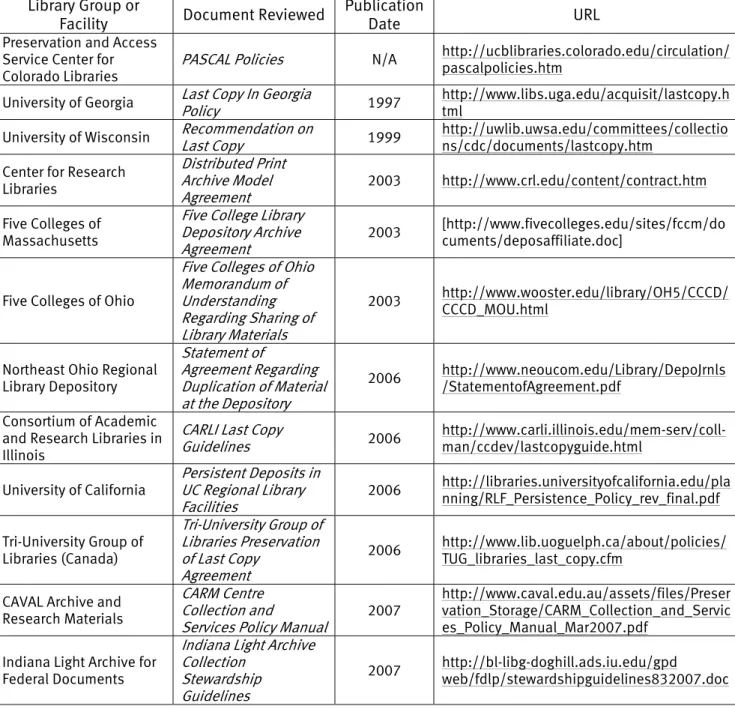
Appendix II: Shared print policies compiled for review... 17
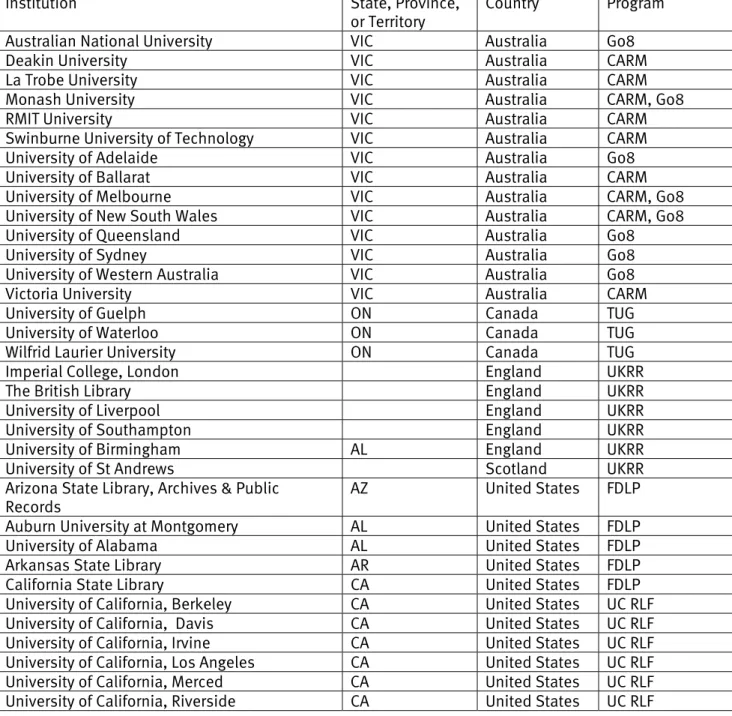
Appendix III: Institutions participating in selected shared print agreements ... 19
Tables
Table A-1: Shared print policies compiled for review... 17 Table A-2. Institutions participating in selected shared print agreements ... 19
Executive summary
A review of selected policy documents related to collaborative management of library print collections was undertaken by the RLG Shared Print Working Group in early 2008, with the goal of identifying common elements that might form the basis of a policy framework based on pragmatic examples of inter-institutional cooperation.
This work was undertaken as part of a larger program of activities intended to support libraries— especially research libraries—that seek to manage the long-term costs of preserving and providing access to heritage collections through new forms of organizational cooperation and collective action. This program of work is led by the RLG Partnership, in collaboration with OCLC Research, under the general rubric of Managing the Collective Collection.1
While other studies have explored the motivations, intent and institutional practices associated with library print collection sharing,2
our more narrowly-scoped exercise focused instead on a close reading of the joint agreements that memorialize shared intent by formalizing institutional commitments and terms in writing. Following on a previous study3
that examined current practices in the off-site storage of library collections and identified opportunities for deeper collaboration within and across shared print archives, our policy review project was intended to measure the gap between principled statements of community interest and the binding partnership agreements that put those commitments to the test.
Our findings are suggestive rather than conclusive. They indicate that in at least some areas, consensus is emerging around the core requirements for a policy framework governing inter-institutional management of library print resources. We learned that entering into a shared print agreement is not as difficult as we expected it would be, provided that the agreement covers a few basic elements. These elements are:
• An explicit assurance that materials contributed to a shared collection will be retained. This creates an incentive to participate by creating an opportunity for strategic de-duplication of redundant local holdings at some institutions, while raising the visibility and value of print archiving commitments at others.
• An escape clause enabling participants to recall contributed materials without rescinding their commitment to the partnership. This allows institutions to retain their autonomy while continuing to benefit from shared access and preservation guarantees.
• A commitment to provide access—though not necessarily preferential access—to shared collections. This assures participants that the shared collection can effectively replace locally held inventory without negatively impacting student and faculty expectations of guaranteed access to holdings acquired on their behalf.
Additional terms may increase confidence in the participation value under certain circumstances but are not evidently essential to endorsement.
Based on these findings we conclude that, by incorporating key elements from existing policies, libraries interested in developing shared print agreements can move forward in this direction without undue delay or hesitation, confident in the knowledge that other research institutions have embraced and successfully enacted cooperative management schemes.
Methodology
Members of the RLG Shared Print Working Group were asked to identify and submit copies of publicly available policy and guidance documents for single, shared and last copy print preservation initiatives from a broad range of national and institutional contexts. A total of eighteen documents ranging from brief statements of principle to procedural guidelines and formal Memoranda of Understanding were compiled for review. Most of these were found online on publicly accessible Web sites; a few draft documents were shared privately with the working group by interested library consortiums. A third of the documentation was provided by members of the working group who are actively engaged in cooperative print management projects. The policy document collection was made available to members of the working group in a collaborative online workspace where reviews and analysis could be shared in a Wiki-like environment. Documents in the collection ranged in from a single-sheet summary of principles to a detailed manual of several hundred pages.
In selecting documents for review, the working group focused primarily on agreements for collection-sharing that expressed or implied a joint commitment to retention of items in the shared collection. Thus, reciprocal borrowing schemes and joint purchasing agreements were deemed out of scope, as was group or consortium licensing of electronic materials. While each of these practices embodies some form of collective management, we were especially interested to discover what emergent standards exist for joint management of legacy print collections, as these represent a significant balance-sheet asset for many research institutions and are therefore subject to ownership claims that can cause inter-institutional agreements to founder.
A subcommittee was formed to draft a review template that would enable comparisons to be made across this body of documents, with the aim of identifying both common requirements and divergent practices. After several iterations, a model template was produced and tested by
subcommittee members against two different policy documents to ensure that it was sufficiently generic to accommodate disparate policy formulations and also specific enough to allow for some tabulation of results. A copy of the review template is included as Appendix I.
Documents were assigned for review to members of the subcommittee, with the understanding that institutions that were party to a given agreement or policy would not review their own documentation. This strategy was intended to limit the degree to which a tacit understanding of intent might influence a review; the review process was expressly focused on explicit requirements and expectations documented and embedded in the agreements and guidelines. The goal was to identify common requirements as well as areas of divergent practice, to reveal the degree to which community consensus has emerged and been formally encapsulated in cooperative agreements. Reviews varied in length and degree of detail; most were about four pages in length. Separate sections of each addressed policy elements related to Governance, Selection, Collection Management, Cataloging, and Access. The date of publication, document status (draft or approved) and implementation level (pilot or full) were noted whenever possible.
Findings in this report are based on a tabulation of the sixteen completed reviews that were available for analysis on 20 June 2008.
Members of the policy review subcommittee included Lizanne Payne (Washington Research Libraries Consortium), Jeanne Richardson (Arizona State University), Judy Ruttenberg (Triangle Research Libraries Network), Emily Stambaugh (California Digital Library), Melissa Trevvett (Center for Research Libraries), Sarah Watstein (University of California, Los Angeles) and Nicola Wright (London School of Economics; former project manager of the UK Research Reserve at the Imperial College of London) and Constance Malpas (RLG/OCLC).
Specific policy documents and library cooperatives covered by this review are identified in Appendix II.
Limitations of this study
Because we focused on publicly available documents, the policies under review were more likely to represent approved, rather than draft, agreements. This selection bias means our results are not representative of policies still being negotiated, which may include some exploring novel forms of ownership or more expansive views of networked collection-sharing. In addition, certain procedural details with significant policy implications (e.g., cataloging specifications, service-level guarantees for document supply) are likely to have been documented in local operating guidelines to which we did not have direct access. It is worth remarking on the fact that few of policies we examined
explicitly addressed the impact of changed collection management models on local operational workflows in cataloging, record maintenance or document delivery.
Summary of findings
Document and project status
Three-quarters of the documents in the policy collection represent information that was publicly accessible, if not always easily discoverable, on the Internet between March and June 2008. The documents under review were typically recent publications; the oldest dated from 1997 and the most recent from 2008. The median age (in 2008) of documents in the collection was two years. Nearly all (90%) were approved versions, although the level of administrative approval was not always evident. Virtually all of the policies had been implemented to some degree; about a fifth of the projects were in pilot or test stage.
Governance
Taken collectively, the eighteen policies selected for review reflect management strategies at more than one hundred institutions in Australia, Canada, the United States and the United Kingdom.4
With one exception (the US Federal Depository Library Program), the individual policies applied to groups of fewer than ten libraries; the median size of group governed by a collection-sharing agreement was about six institutions.5
Several institutions in the sample participate in more than one distributed print preservation initiative.6
Most (80%) of the groups engaged in formal collection-sharing projects had a pre-existing consortium arrangement in place. Despite (or perhaps because of) these established reciprocal arrangements, only half of the agreements identify a governing body for the shared collection.7
More than 60% of the documents stipulate that ownership of collections contributed to the pooled resource is retained by the contributing library. A significant proportion (80%) of the policies under review include an explicit retention commitment; most stipulate that contributed collections will be retained for a decade or more and roughly half (53%) include an individual or collective commitment to permanent retention of at least some shared materials. Half (50%) of these commitments are bound by a legal agreement. Only a third of the documents reviewed establish or invoke a formal business arrangement amongst the participating libraries to ensure sustainability of the print archiving effort. However, more than 40% include an explicit exit strategy describing how shared collections will be managed in the event that a contributing library withdraws from the agreement. Most of the policies (75%) allow for specific exemptions to the collection sharing agreement, enabling participants to identify holdings that will not be governed by the preservation and access guarantees.
Selection
Most of the policies reviewed (73%) apply to both monographic and serial titles; about half (53%) are limited to retrospective holdings. About half of the collection-sharing regimes reviewed prohibit duplication in contributed content; however, less than a third include an explicit definition of duplication or identify a benchmark (e.g., group or regional holdings; a national or international union list) against which it is to be measured. About two-thirds of the policies include a provision for systematic condition assessment of collections covered by the cooperative preservation and access guarantees. However, as noted below (see Collection Management), less than half of the agreements stipulated that the conditions of collections or facilities are subject to audit.
Cataloging
Perhaps because descriptive practices are relegated to procedural guidelines, the documents under review were notably silent on expectations for recording and disclosing the distinctive preservation and access attributes of single or shared copy collections to audiences beyond those directly participating in the group. About half of the policies stipulate that the special retention and/or shared access status of documents covered by the agreement should be systematically registered; less than 20% specify a location in the MARC21 bibliographic or local holdings record where this information is to be recorded. Only a quarter of the policies reviewed mandate disclosure of the retention or shared access status in regional, national or international union lists.
This last finding has important implications for collection-sharing efforts that seek to achieve significant scale or impact on system-wide economies. More effective and systematic disclosure of retention commitments, in particular, might produce significant network effects by enabling anonymous participation in collection-sharing initiatives, generating secondary benefits for the entire library community.8
For example, an institution not directly participating in a single and shared copy initiative might well choose to manage local holdings differently if the permanent retention status of other collections were widely known.
Collection management
Only a quarter of the policies in our sample included specific environmental conditions or physical arrangement requirements and less than half included a provision for periodic audits. More than half (63%) of the agreements allow for conditional withdrawal of items contributed to the shared collection, typically when holdings are recalled to a campus library from a consolidated storage facility. Almost 40% of the policies authorize permanent withdrawal of titles in the shared collection, mostly associated with strategic de-duplication of journal holdings but sometimes justified by absence of demand or excessive preservation costs. Less than 20% of the policies include details
on how de-duplicated titles in the shared collection should be reflected in contributor volume counts. In at least some cases (notably the UK and Australian exemplars), this may reflect differences in the way institutional volume counts are used in national ranking schemes; in circumstances where locally-owned library assets are not considered a measure of institutional excellence, the incentives to count (and the need to specify what may be counted) are fewer.
Access
Our review focused primarily on the preservation expectations and requirements expressed in shared print agreements rather than specific end user (reader or researcher) service level guarantees. We did examine the policies in the sample for explicit conditions on access to shared collections, whether consolidated in a single facility or distributed across multiple sites. In virtually all cases, access to the shared print collections under review is subject to prevailing inter-lending agreements, with some restrictions on conditions of use (e.g., on-site use only for non-circulating materials). This suggests that library collaborations focused on shared collection building are not, as might be supposed, creating a new landscape of ‘private gardens’ where direct contributors might benefit at the expense of other institutions. This would be the case if, for example, a non-contributing library were denied access to the “club good” created by a shared collection agreement.
It remains to be seen if this reliance on prevailing access policies can be sustained on a large scale, should aggregate demand for resources concentrated in the hands of a few institutions (or groups of institutions) increase substantially. Mass digitization is likely to play a role here, as the availability of digital surrogates may increase the visibility of print holdings, exposing them to newly interested audiences which may not have access to the online content and may lack the institutional credentials that would otherwise entitle them to use the library-owned print version. Until the conditions of access to digital surrogates (especially in-copyright material) are better understood and more widely shared, it is difficult to predict how patterns of demand for print holdings are likely to change, or what changes to traditional inter-lending and document supply agreements may be required.
Implications for cooperative print management
While limited in scope, our review revealed remarkable consistency in shared print policy frameworks, suggesting that some aspects of collaborative collection management have achieved community consensus. Thus, it may be inferred that certain recurring elements—an explicit (not tacit) retention commitment and explicit terms under which committed titles may be recalled or temporarily withdrawn by the contributing library—have emerged as core requirements for inter-institutional agreements that go beyond expanding access to “virtually shared” collections.
It is reasonable to suppose that these two critical requirements respond to a shared need for clarity regarding the relative risks (e.g., loss of autonomy as reliance on partner collections increases) and benefits (increased discretion in use of local collection budgets) of participation in an agreement that creates deep and durable institutional dependencies. The fact that retention commitments, which are so often guaranteed by a gesture to the institutional mandate of research institutions, find clear expression in these cooperative agreements suggests that at least some libraries are prepared to challenge existing models of collection ownership by assuming new risks and accepting new responsibilities. The conditions of undertaking such risks, it seems, require that certain exemptions (like temporary recalls on contributed collections) be tolerated and even inscribed in the official terms of engagement.
If the recurrence of certain terms or requirements in these documents suggests emerging consensus on some key policy elements, the relative infrequency of other seemingly important conditions (like a robust assurance that environmental controls are adequate to long-term preservation needs) appears to confirm that the thresholds for achieving a joint collection management agreement may be lower than previously thought. Some years ago, a carefully considered effort to identify requirements for a model agreement for distributed print archiving resulted in a sound and comprehensive policy template that addressed a broad range of preservation and access goals, including external validation of environmental controls at participating repositories.9
Yet, while several research institutions were prepared to endorse the agreement as participants (a reasonable measure of the model’s success), the fact that many more institutions have readily adopted and implemented collection-sharing policies that require far less, merits some attention.
In some cases, the apparent absence of consensus or commonly perceived need (as embodied in specific policy requirements) may reflect satisfaction—or at least a hesitation to tinker—with tacit understandings of institutional and community responsibility. Thus, the fact that few of the agreements reviewed here identify an official governing body or entity with ultimate responsibility for a shared collection may indicate that libraries are prepared to rely on relatively weak legal guarantees backed by a conviction that community norms will prevent contributors from breaching what is, in essence, a social contract. Similarly, reliance on prevailing inter-lending and document supply schemes for access to shared collections may be justifiable if one assumes that aggregate demand will not increase substantially. Institutions are likely to tolerate a certain amount of ambiguity in partnership agreements until the risks of mutual dependence are known.
A handful of seemingly critical gaps in the policies considered here remain. Chief among these is the absence of guidance on effective disclosure of local retention and access commitments, which might otherwise generate valuable network effects by enabling libraries outside the collection-sharing partnership to manage local holdings more efficiently.
Conclusion
In summary, our study suggests that libraries interested in adopting cooperative print management regimes on a limited scale, typically determined by geographic proximity, can do so with relative ease, provided certain core elements are included in a formal collection-sharing agreement. Based on a review of existing policies, three critical components were identified as necessary to securing an inter-institutional accord on print collection management:
1. An explicit retention commitment (regardless of duration) for titles committed to the shared archive;
2. Identification of conditions under which materials may be recalled or temporarily withdrawn from the archive;
3. Definition of terms: duplication, withdrawal, what constitutes reasonable effort to replace lost or missing items, etc.
In addition to these minimum requirements, the committee concluded that several other elements should be addressed in any shared print agreement that intends to affect collection management practices in the wider library community. Regional agreements to manage print collections as a shared resource can have a transformative effect on system-wide library operations if they are undertaken with a clear view of the deeply inter-dependent collections economy and the need for programmatic disclosure of institutional commitments.
Cooperative agreements that are intended to achieve or to enable truly transformative change in the way library print collections are managed should include:
• A business model that acknowledges the changing value of library print resources in the current information environment;
• An explicit acknowledgment that effective disclosure of library holdings and retention commitments is necessary to support distributed management of print archives; and
• A commitment to capture, retain and share item-level condition information so that the preservation quality of print archives may be better judged.
At the close of this project, members of the committee expressed a shared interest in mobilizing the academic and research library community to participate in distributed print archiving projects and, more importantly, integrate shared print management models within regular collection management
workflows. Library print collections continue to play an important role in research and scholarly practice; however, their value to the academic enterprise is less as a locally-owned asset than as a pooled resource. Research institutions have a unique opportunity to refashion the collections economy by formalizing regional and supra-regional agreements for shared management of print resources, thereby releasing library resources for redeployment in locally specific, value-generating roles. As this report suggests, a certain number of elements have emerged as core requirements for shared print policies, providing a solid foundation upon which interested institutions can build and improve.
Suggested areas for further work
The present report summarizes the outcomes of a study of extant policy documentation related to cooperative management of library print collections. Additional work is needed to further advance our understanding of the costs and benefits of shared print management models and to characterize the obstacles to widespread adoption of genuinely cooperative collection management regimes. The committee considered a range of projects that might profitably be pursued by institutions and organizations interested in advancing this work.
First, a guidance document could be created to identify key considerations to be addressed when drafting or revising a shared print policy for specific local aims and circumstances, including case studies of a variety of models (centralized holdings with a distributed delivery infrastructure; decentralized holdings and delivery infrastructure; centralized holdings and delivery etc.) and motivations (rationalization of regional holdings; preservation of at-risk titles). Second, an investigation of how specific shared print policies have been implemented, with what measure of success and at what local cost, might be undertaken. Third, key obstacles to the practical implementation (as distinct from official endorsement) of shared print policies might be explored. Fourth, more attention could be given to service level guarantees for access and end-user awareness and expectations of shared collections. Fifth, policy requirements for cooperative acquisition of print resources “at scale” could be explored. And finally, the risks and benefits of concentrating preservation assets in public and/or private institutions should be considered, since the durability of preservation mandates and the extent of access commitments differs in each circumstance.
Appendix I
Review template
Shared Print Collection Policy: {Consortium name} Status
Policy document title: Date of publication/revision: Draft or Approved?
Implemented? Yes/No [details] Governance
Number of libraries participating: (e.g. 4 of 7 libraries in consortium) Participating libraries (list)
Pre-existing consortium relationship? Yes/No
[Details – for example does this group exist for purposes other than distributed archiving of documents?]
Who owns the shared material?
If collectively owned, who makes collection management decisions? Is a governing body for the shared collection identified?
Are contributing/participating institutions required to sign a legal agreement binding them to the provisions of the collection sharing/preservation arrangement? Yes/No
Do contributors to the shared collection participate in (or benefit from) any related business arrangement? e.g., direct payments to a governing body; transfer payments amongst participants, revenue sharing from inter-lending to non-contributors?
Is there a business model in place or under consideration to maintain the shared collection? Compensation, participation fees, funding formula?
Does policy include an explicit retention commitment? Term of retention commitment:
Any explicit provisions made for parties (institutions) that choose to exit the collection sharing agreement?
Exemptions to shared access/permanent retention allowed? Selection
What is the process/criteria by which an item or collection is brought within the collection sharing agreement? E.g. upon transfer to a shared storage facility or through disclosure of individual institutional intent
Collection sharing applies to storage holdings only, campus/on-site library collections, both? Is duplication in holdings (whether centralized or distributed) permitted?
[Details go here.]
Includes explicit definition of ‘duplication’ (work level, edition level, format-specific definitions)? [Yes/No]
[Details go here.]
Duplication is measured across group holdings in consortium/WorldCat/other Applies to serial and/or monographic holdings.
Applies to prospective/retrospective holdings only.
Cataloging
Specifies how and where shared/retained item status will be recorded?
Specifies where commitment will be reflected in MARC21 bibliographic or holdings record? Specifies that commitment will be reflected in union lists beyond contributing libraries? Collection management
Are any specific environmental conditions required of retention partners, whether centralized or distributed?
Any specific requirements (or commitments) made vis à vis shelving and storage arrangements (closed access, open stacks, remote facility)?
Any provision for audits of inventory or environmental conditions?
Includes explicit conditions on recalls/withdrawals by contributing members?
Is material ever selected from the shared collection? Under what circumstances? (e.g. de-duplication; digitisation and disposal of original)
Includes provision for how de-duplicated titles may be counted by contributing/participating libraries?
Access
Conditions of access to items in shared collection: [Available to all borrowers under prevailing ILL / limited to contributing members / subscription model]
Do contributing members benefit from priority access to shared collection? More information about this group / facility / policy:
[link to documentation available online]
Appendix II
Table A-1: Shared print policies compiled for review
Library Group or
Facility Document Reviewed
Publication
Date URL
Preservation and Access Service Center for Colorado Libraries
PASCAL Policies N/A http://ucblibraries.colorado.edu/circulation/
pascalpolicies.htm University of Georgia Last Copy In Georgia
Policy 1997
http://www.libs.uga.edu/acquisit/lastcopy.h tml
University of Wisconsin Recommendation on
Last Copy 1999
http://uwlib.uwsa.edu/committees/collectio ns/cdc/documents/lastcopy.htm
Center for Research Libraries Distributed Print Archive Model Agreement 2003 http://www.crl.edu/content/contract.htm Five Colleges of Massachusetts
Five College Library Depository Archive Agreement
2003 [http://www.fivecolleges.edu/sites/fccm/do cuments/deposaffiliate.doc]
Five Colleges of Ohio
Five Colleges of Ohio Memorandum of Understanding Regarding Sharing of Library Materials 2003 http://www.wooster.edu/library/OH5/CCCD/ CCCD_MOU.html
Northeast Ohio Regional Library Depository Statement of Agreement Regarding Duplication of Material at the Depository 2006 http://www.neoucom.edu/Library/DepoJrnls /StatementofAgreement.pdf Consortium of Academic
and Research Libraries in Illinois
CARLI Last Copy
Guidelines 2006 http://www.carli.illinois.edu/mem-serv/coll-man/ccdev/lastcopyguide.html University of California Persistent Deposits in UC Regional Library Facilities 2006 http://libraries.universityofcalifornia.edu/pla nning/RLF_Persistence_Policy_rev_final.pdf Tri-University Group of Libraries (Canada) Tri-University Group of Libraries Preservation of Last Copy Agreement 2006 http://www.lib.uoguelph.ca/about/policies/ TUG_libraries_last_copy.cfm
CAVAL Archive and Research Materials
CARM Centre Collection and
Services Policy Manual
2007
http://www.caval.edu.au/assets/files/Preser vation_Storage/CARM_Collection_and_Servic es_Policy_Manual_Mar2007.pdf
Indiana Light Archive for Federal Documents
Indiana Light Archive Collection
Stewardship Guidelines
2007 http://bl-libg-doghill.ads.iu.edu/gpd web/fdlp/stewardshipguidelines832007.doc
Library Group or
Facility Document Reviewed
Publication
Date URL
UK Research Reserve UK Research Reserve
Retention Agreement 2007 N/A as of June 2008
Chesapeake Information and Research Library Alliance
CIRLA Distributed Print Preservation Pilot Project
2007 N/A as of June 2008
Group of Eight (Australia)
Memorandum of Understanding Regarding Last Copy Collection Retention
2007 N/A as of June 2008
Virtual Academic Library Environment of New Jersey
VALE Last Copy
Guidelines 2008
http://netdrive.montclair.edu/~mallerym/VA LELastCopyGuidelines.html
Washington Research Library Consortium
WRLC Off Site Storage Policies: Shared Copy Policy
2008 http://www.wrlc.org/offsite/storpolicies.htm l
US Federal Depository
Library Program FDLP Handbook 2008
http://www.fdlp.gov/repository/complete-
Appendix III
Table A-2: Institutions participating in selected shared print agreements
Institution State, Province,
or Territory
Country Program
Australian National University VIC Australia Go8
Deakin University VIC Australia CARM
La Trobe University VIC Australia CARM
Monash University VIC Australia CARM, Go8
RMIT University VIC Australia CARM
Swinburne University of Technology VIC Australia CARM
University of Adelaide VIC Australia Go8
University of Ballarat VIC Australia CARM
University of Melbourne VIC Australia CARM, Go8
University of New South Wales VIC Australia CARM, Go8
University of Queensland VIC Australia Go8
University of Sydney VIC Australia Go8
University of Western Australia VIC Australia Go8
Victoria University VIC Australia CARM
University of Guelph ON Canada TUG
University of Waterloo ON Canada TUG
Wilfrid Laurier University ON Canada TUG
Imperial College, London England UKRR
The British Library England UKRR
University of Liverpool England UKRR
University of Southampton England UKRR
University of Birmingham AL England UKRR
University of St Andrews Scotland UKRR
Arizona State Library, Archives & Public Records
AZ United States FDLP
Auburn University at Montgomery AL United States FDLP
University of Alabama AL United States FDLP
Arkansas State Library AR United States FDLP
California State Library CA United States FDLP
University of California, Berkeley CA United States UC RLF University of California, Davis CA United States UC RLF University of California, Irvine CA United States UC RLF University of California, Los Angeles CA United States UC RLF University of California, Merced CA United States UC RLF University of California, Riverside CA United States UC RLF
Institution State, Province, or Territory
Country Program University of California, San Diego CA United States UC RLF
University of California, San Francisco CA United States UC RLF University of California, Santa Barbara CA United States UC RLF University of California, Santa Cruz CA United States UC RLF
Auraria Library CO United States PASCAL
Denison Memorial Library CO United States PASCAL
Denver Public Library CO United States FDLP
University of Colorado, Boulder CO United States FDLP; PASCAL
University of Denver CO United States PASCAL
Connecticut State Library CT United States FDLP
American University DC United States WRLC
Catholic University of America DC United States WRLC
Gallaudet University DC United States WRLC
Georgetown University DC United States WRLC
Howard University DC United States CIRLA
Marymount University DC United States WRLC
The George Washington University DC United States CIRLA, WRLC
University of Delaware DE United States CIRLA
University of Florida FL United States FDLP
University of Georgia GA United States FDLP; Georgia
State Last Copy
University of Hawai’i at Manoa HI United States FDLP
University of Iowa IA United States FDLP
University of Idaho ID United States FDLP
Illinois State Library IL United States FDLP
Indiana State Library IN United States FDLP
University of Kansas KS United States FDLP
University of Kentucky KY United States FDLP
Louisiana State University, Baton Rouge LA United States FDLP
Louisiana Tech University LA United States FDLP
Amherst College MA United States FCLD
Boston Public Library MA United States FDLP
Hampshire College MA United States FCLD
Mount Holyoke College MA United States FCLD
Smith College MA United States FCLD
University of Massachusetts, Amherst MA United States FCLD
The Johns Hopkins University MD United States CIRLA
University of Maryland MD United States CIRLA, FDLP
University of Maine, Orono ME United States FDLP
Michigan Dept. of History, Arts & Libraries MI United States FDLP
Michigan State University MI United States CRL DPA
University of Minnesota MN United States FDLP
University of Missouri, Columbia MO United States FDLP
Institution State, Province, or Territory
Country Program
University of Montana MT United States FDLP
University of North Carolina at Chapel Hill NC United States FDLP
North Dakota State University ND United States FDLP
University of North Dakota ND United States FDLP
University of Nebraska, Lincoln NE United States FDLP
Montclair State University NJ United States VALE
Newark Public Library NJ United States FDLP
Rutgers University NJ United States VALE
William Paterson University NJ United States VALE
New Mexico State Library NM United States FDLP
University of New Mexico NM United States FDLP
University of Nevada, Reno NV United States FDLP
New York State Library NY United States FDLP
Clemson University OH United States FDLP
Cleveland State University OH United States NE Ohio
Depository
College of Wooster OH United States CONSORT
Denison University OH United States CONSORT
Kent State University OH United States NE Ohio
Depository
Kenyon College OH United States CONSORT
Northeastern Ohio Universities College of Medicine and College of Pharmacology
OH United States NE Ohio
Depository
Oberlin College OH United States CONSORT
Ohio Wesleyan University OH United States CONSORT
State Library of Ohio OH United States FDLP
University of Akron OH United States NE Ohio
Depository
Youngstown State University OH United States NE Ohio
Depository Oklahoma Department of Libraries OK United States FDLP
Oklahoma State University OK United States FDLP
Oregon State Library OR United States FDLP
State Library of Pennsylvania PA United States FDLP
University of South Carolina, Columbia SC United States FDLP
University of Memphis TN United States FDLP
Texas State Library & Archives Commission TX United States FDLP
Texas Tech University TX United States FDLP
Utah State University UT United States FDLP
University of Virginia VA United States FDLP
Washington State Library WA United States FDLP
Milwaukee Public Library WI United States FDLP
University of Wisconsin, Madison WI United States FDLP
West Virginia University WV United States FDLP
Notes
1Activities under this rubric are organized into four discrete programs: Shared Print Collections, Harmonizing Digitization, Data-mining for Management Intelligence, and Collection-Sharing Beyond Libraries. The present study belongs to the first of these. Current activities in each of these programs are described here: www.oclc.org/programs/ourwork/collectivecoll/default.htm
2
See for example: Bernard F. Reilly, Jr. and Barbara DesRosiers, Center for Research Libraries. 2003. Developing Print Repositories: Models for Shared Preservation and Access. (CLIR Publication 117); Judy Luther, Linda Bills, Amy McColl, Norm Medeiros, Amy Morrison, Eric Pumroy, and Peggy Seiden. 2003. Library Buildings and the Building of a Collaborative Research Collection at the Tri-College Library Consortium. Report to The Andrew W. Mellon Foundation. (CLIR Publication 115); Penti Vattulainen. 2004. “National repository initiatives in Europe” Library Collections, Acquisitions, and Technical Services Volume 28, Issue 1, Spring 2004, pp. 39-50; John Fielden, Colin Harris, Helen Hayes, Allan Schofield. 2005. “Optimising Storage and Access in UK Research Libraries” New Review of Academic Librarianship, Volume 11, Number 2, November 2005, pp. 97-152; and Jim Agee and Sarah Naper. “Off-site storage: an analysis” Collection Building Volume 26, Issue 1, 2007. pp. 20-25.
3
Lizanne Payne. 2007. Library Storage Facilities and the Future of Print Collections in North. America. Report commissioned by OCLC Programs and Research. Published online at: www.oclc.org/programs/publications/reports/2007-01.pdf
4
If one includes institutions serving as selective depositories in the US Federal Depository Library Program, that number rises to more than a thousand. Because our review focused primarily on collection sharing initiatives with a strong preservation component, we were generally concerned with the legal mandates that pertain to regional (but not selective) depositories.
5
The review template did not capture information about how (or if) new partner libraries can join existing collection-sharing groups. In retrospect, this information seems critical to understanding how collectively-managed legacy (retrospective) collections might grow over time. We need to understand both how regional collectivities might within a larger network and how individual collection-sharing initiatives can expand to accommodate new members.
6
Those institutions include the University of Maryland (CIRLA last copy and FDLP programs), the University of Georgia (FDLP and state-wide last copy preservation program) , the University of Colorado at Boulder (FDLP and the PASCAL shared collection); Monash University, the University of Melbourne and the University of New South Wales all contribute to both the CAVAL shared collection and the Group of Eight single copy program.
7
It may be assumed that governance of a consortium-created collection is a responsibility inherited by the governing body of the respective consortium, especially when no other group is named. Not every library consortium has a formal governance document or administrative structure, however, so tacit assumptions about whom is ultimately responsible for shared collections may not hold up under certain challenges, e.g. dissolution of the consortium or withdrawal of a member who has contributed collections to a pooled resource.
8
Anonymous participation is a form of indirect engagement that allows the participant to contribute to and benefit from shared workflows without “signing on” as an explicit partner. In the online environment, anonymous participation enables entities (organizations, institutions) to interoperate more smoothly by eliminating the need for individual self-identification. The library community has long benefited from a specific form of anonymous participation in cooperative cataloging; union catalogs enable individual institutions to manage local collections as part of a larger system without requiring individually negotiated collection- or data-sharing agreements.
9
The Center for Research Libraries (CRL) developed such a model agreement as part of a Mellon-funded project to investigate the feasibility of developing a distributed print archive of JSTOR back-files. Four institutions, including Michigan State University, the University of Illinois at Urbana-Champaign and Yale University accepted the terms of the agreement. Although the CRL program was ultimately implemented at only just one of these institutions, the model agreement continues to be used in an adapted form by other library groups, including the Orbis Cascade Alliance.