Exploit the Unknown Gradually: One-Shot Video-Based Person
Re-Identification by Stepwise Learning
Yu Wu
1,2, Yutian Lin
2, Xuanyi Dong
2, Yan Yan
2, Wanli Ouyang
3, Yi Yang
1,2∗ 1SUSTech-UTS Joint Centre of CIS, Southern China University of Science and Technology
2University of Technology Sydney
3The University of Sydney
[email protected]; [email protected]Abstract
We focus on the one-shot learning for video-based person re-Identification (re-ID). Unlabeled tracklets for the person re-ID tasks can be easily obtained by pre-processing, such as pedestrian detection and tracking. In this paper, we propose an approach to exploiting unla-beled tracklets by gradually but steadily improving the dis-criminative capability of the Convolutional Neural Network (CNN) feature representation via stepwise learning. We first initialize a CNN model using one labeled tracklet for each identity. Then we update the CNN model by the following two steps iteratively: 1. sample a few candidates with most reliable pseudo labels from unlabeled tracklets; 2. update the CNN model according to the selected data. Instead of the static sampling strategy applied in existing works, we propose a progressive sampling method to increase the number of the selected pseudo-labeled candidates step by step. We systematically investigate the way how we should select pseudo-labeled tracklets into the training set to make the best use of them. Notably, the rank-1 accuracy of our method outperforms the state-of-the-art method by 21.46 points (absolute, i.e., 62.67% vs. 41.21%) on the MARS dataset, and 16.53 points on the DukeMTMC-VideoReID dataset1.
1. Introduction
Person re-identification (re-ID) aims at spotting the person-of-interest from different cameras. In recent years, person re-ID on the large-scale video data, such as surveil-lance videos, has attracted significant attention [10,20,28, 32,35]. Most proposed approaches rely on the fully anno-tated data,i.e., the identity labels of all the tracklets from multiple cross-view cameras. However, it is impractical to annotate very large-scale surveillance videos due to the
∗Corresponding author.
1The code is publicly available at:https://yu-wu.net
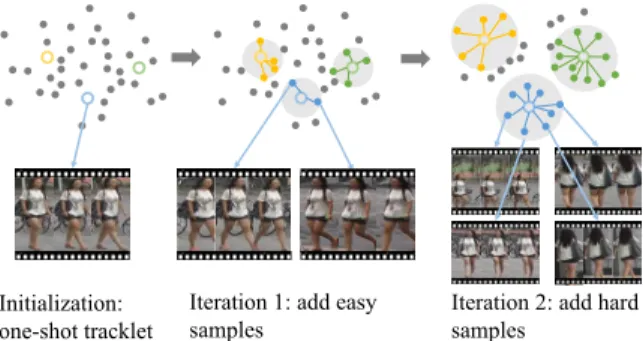
Initialization: one-shot tracklet
Iteration 1: add easy samples
Iteration 2: add hard samples
Figure 1. An illustration of the unlabeled data sampling procedure in the feature space. The hollow point and solid point denote the labeled tracklet and unlabeled tracklet, respectively. The pseudo label of each unlabeled tracklet is assigned by its nearest labeled neighbor (indicated by the colored line). Different colors represent different identities. Samples in the shade will be incorporated into training. We adopt the easy and reliable pseudo-labeled tracklets for updating at the beginning and difficult ones in subsequence.
dramatically increasing cost. Therefore, semi-supervised methods [21, 34] are of particular interest. This work mainly focuses on the one-shot setting, in which only one tracklet is labeled for each identity.
The key challenge for the one-shot video-based person re-ID is the label estimation for the abundant unlabeled tracklets [7, 34]. A typical approach is to generate the pseudo labels for the unlabeled data at first. The initial la-beled data and some selected pseudo-lala-beled data are con-sidered as an enlarged training set. Lastly, this new training set is adopted to train the re-ID model.
Most existing methods employ a static strategy to deter-mine the quantity of selected pseudo-labeled data for fur-ther training. For example, Fanet al. [7] and Yeet al. [34] compare the prediction confidences of pseudo-labeled sam-ples with apre-definedthreshold. The samples with higher confidence over the fixed threshold are then selected for the subsequent training. During iterations, these algorithms
se-lect a fixed and large number of pseudo-labeled data from beginning to end. However, it is inappropriate to keep the threshold fixed in the one-shot setting. In this case, the ini-tial model may be not robust due to the very few training samples. Only a few of pseudo-label predictions are reli-able and accurate at the initial stage. If one still selects the same number of data as that in the later stages, it will in-evitably involve many unreliable predictions. Updating the model with excessive not-yet-reliable data would hinder the subsequent improvement of the model.
In this paper, to better exploit the unlabeled data in one-shot video-based person re-ID, we propose the stepwise learning methodEUG(Exploit the UnknownGradually). Initially, a CNN model is trained on the one-shot labeled tracklet. EUG then iteratively updates the CNN by two steps, the label estimation step and the model update step. In the first step, EUG generates the pseudo labels for unla-beled tracklets, and selects some of pseudo-launla-beled tracklets for training according to the prediction reliability. The se-lected subset is continuously enlarged during iterations ac-cording to a sampling strategy. In the second step, EUG re-trains the CNN model on both the labeled data and the sampled pseudo-labeled subset. Particularly, as illustrated in Figure1, EUG starts with a small-size subset of pseudo-labeled tracklets, which includes only the most reliable and easiest ones. In the subsequent stages, it gradually selects a growing number of pseudo-labeled tracklets to incorpo-rate more difficult and diverse data. This is different from existing methods [21,34].
To characterize the proposed progressive approach in one-shot person re-ID, we intensively investigate two sig-nificant aspects,i.e., how the progressive sampling strategy benefits the label estimation and which sampling criterion is effective for the confidence estimation in person re-ID. For the first aspect, we find that if we enlarge the sam-pled subset of pseudo-labeled data in a more conservative way (at a slower speed), the model achieves a better per-formance. If we enlarge the subset in a more aggressive way (at a faster speed), the model achieves a worse perfor-mance. Note that the previous static sampling strategy can be viewed as an extremely aggressive manner. For the sec-ond aspect, we investigate the gap between the classifica-tion measures and retrieval evaluaclassifica-tion metrics. We find that the sampling criteria highly affect the performance of the proposed method. Instead of the classification measures, a distance-based sampling criterion for the reliability estima-tion may yield promising performance in person re-ID.
Our contributions are summarized as follows:
• We propose a progressive method for one-shot video-based person re-ID to better exploit the unlabeled tracklets. This method adopts a dynamic sampling strategy to uncover the unlabeled data. We start with reliable samples and gradually include diverse ones,
which significantly makes the model robust.
• We apply a distance-based sampling criterion for la-bel estimation and candidates selection to remarkably improve the performance of label estimation.
• Our method achieves surprisingly superior perfor-mance on the one-shot setting, outperforming the state-of-the-art by 21.46 points (absolute) on MARS and 16.53 points (absolute) on DukeMTMC-VideoReID.
2. Related Works
Extensive works have been reported to address the video-based person re-ID problem. One simple solution is using image-based re-ID methods, and obtaining video represen-tations by pooling the frame features [10,16,20].
Supervised Video-based Person Re-ID. Recently, a number of deep learning methods are developed [24,29,32, 35,39,40]. The typical architecture is to combine CNN and RNN to learn a video representation or the similarity score. In [40], temporal attention information and spatial recur-rent information are used to explore contextual representa-tion. Another commonly used architecture is the Siamese network architecture [18,29,32], which also achieve rea-sonably good performance.
Semi-Supervised Video-based Person Re-ID. Most works of semi-supervised person re-ID are based on image [1,8,19,22]. The approaches of these works include dic-tionary learning, graph matching, metric learning,etc. To the best of our knowledge, there are three works aiming at solving the semi-supervised video-based re-ID task. Zhuet al. [41] proposed a semi-supervised cross-view projection-based dictionary learning (SCPDL) approach. A limitation is that this approach is only suitable for datasets that only captured by two cameras.
There are two recent works designed for one-shot video re-ID task [21, 34]. Although [21,34] claim them as un-supervisedmethods, they areone-shotmethods in experi-ments, as they require at least one labeled tracklet for each identity. They assume that the tracklets are obtained by tracking, and this process is automatic and unsupervised. Different tracklets from one camera with a long-time inter-val are assumed representing different identities. However, to conduct experiments in existing datasets, both methods require the annotation of at least a sample for each iden-tity. To be more rigorous, we take this problem as a one-shot task. Yeet al. [34] propose a dynamic graph matching (DGM) method, which iteratively updates the image graph and the label estimation to learn a better feature space with intermediate estimated labels. Liu et al. [21] update the classifier with K-reciprocal Nearest Neighbors (KNN) in the gallery set, and refine the nearest neighbors by apply negative sample mining with KNN in the query set. While
graph-based semi-supervised learning [33] could possibly be adopted for one-shot person Re-ID, it is time-consuming to solve a linear system for each query.
Progressive Paradigm. Curriculum Learning (CL) is proposed in [2], which progressively obtains knowledge from easy to hard samples in a pre-defined scheme. Ku-maret al. [15] propose Self-Paced Learning (SPL) which takes curriculum learning as a regularization term to up-date the model automatically. The self-paced paradigm is theoretically analyzed in [13, 23]. Some works manage to apply the progressive paradigm in the computer vision area [5, 6,27]. We are inspired by these progressive al-gorithms. Compared with the existing SPL and CL algo-rithms, we incorporated the retrieval measures (the distance in feature space) into the learning mechanism, which well fits the evaluation metric for person re-ID. Moreover, most previous SPL and CL works mainly focus on the supervised and semi-supervised task. Few are used in the one-shot learning setting.
3. The Progressive Model
3.1. Preliminaries
We first introduce the necessary notations. Let L = {(x1, y1), ...,(xnl, ynl)}be the labeled dataset, and U =
{(xnl+1), ...,(xnl+nu)}be the unlabeled dataset, wherexi andyidenotes thei-th tracklet data and its identity label, re-spectively. We thus have|L|=nland|U|=nuwhere|·|is the cardinality of a set. Following recent works [7,17,38], we take the training process as an identity classification task. For training on the labeled dataset, we have the fol-lowing objective function:
min θ,w nl X i=1 `(f(w;φ(θ;xi)), yi), (1)
whereφis an embedding function, parameterized byθ, to extract the feature from the data xi. CNN models [3, 4, 9,11, 30, 31] are usually used as the functionφ. f is a function, parameterized byw, to classifier the embedded featureφ(θ;xi)into ak-dimension confidence estimation, in whichkis the number of identities.`denotes the suffered loss on the label predictionf(w;φ(θ;xi))and its ground truth identity labelyi.
To exploit abundant unlabeled tracklets with pseudo la-bels, we consider the following objective function in the one-shot re-ID problem:
min θ,w,si,ˆyi nl X i=1 `(f(w;φ(θ;xi), yi))+ nlX+nu i=nl+1 si`(f(w;φ(θ;xi),yiˆ)), (2)
whereyiˆ denotes the machine generated pseudo labels for thei-th unlabeled data.si2 {0,1}is the selection indicator for the unlabeled samplexi, which determine whether the suffered loss of pseudo-labeled data(xi,yiˆ)is adopted in optimizing. We usesto indicate the vertical concatenation of allsi.
In the evaluation stage, for both of query data and gallery data, we only useφ(θ;·)to embed each tracklet into the fea-ture space. The query result is the ranking list of all gallery data according to the Euclidean Distance between the query data and each gallery data, i.e., ||φ(θ;xq)−φ(θ;xg)||2, wherexq andxg denote the query tracklet and the gallery tracklet, respectively.
3.2. Framework Overview
In this work, we propose a stepwise learning method to exploit the unlabeled data gradually and steadily. We adopt an alternative algorithm to solve the Eq. (2). Specifically, we first optimizeθandw, and then optimizeyˆands,i.e., the model updating and the label estimating.
LetS denote the set of selected pseudo-labeled candi-dates. We can obtainSby:
S ={(xi,yiˆ)|si= 1, nl+ 1inl+nu}. (3)
Our approach first trains an initial model on the labeled data
L, and then the initial model is applied to predict pseudo la-belsyˆon the unlabeled data. In subsequence, according to a label reliability evaluation criterion, we generate the se-lection indicatorssin order to obtain the candidates setS
via Eq. (3). In the model update step, the setSalong with the initial labeled setLis regarded as the new training set
D,i.e.,D =L [ S. The setDwill be utilized to re-train
the model so as to make the model more robust. During training iterations, the candidates setS in each step is en-larged continuously. In this way, we can progressively learn a more stable model.
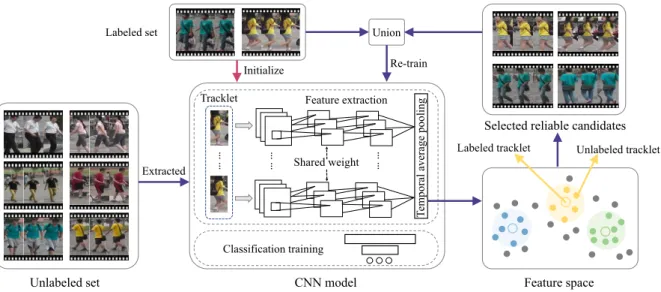
To be specific, for our progressive strategy EUG, we adopt an end-to-end CNN model with temporal average pooling (ETAP-Net) as the feature embedding functionφ. The ETAP-Net is an adaption of ResNet-50 architecture for video inputs, where we add a fully-connected layer and a temporal average pooling layer before the classification layer. As shown in Figure2, for each tracklet, all frames are processed to obtain frame-level feature embedding. The frame features within a tracklet are then element-wise aver-aged as the tracklet feature representation by the temporal average pooling layer. In the label estimation step, for each unlabeled video tracklet, the pseudo label is assigned by the identity label of its nearest labeled neighbor in the tracklet feature space. The distance between them is considered as the dissimilarity cost, which is used to measure the reliabil-ity of its pseudo label.
Re-train Feature space CNN model T empo ral averag e po oli ng Shared weight Tracklet Feature extraction
Classification training
Unlabeled set
Labeled set
Selected reliable candidates
Labeled tracklet Union Unlabeled tracklet … … Initialize … … … … Extracted
Figure 2. Overview of the framework. Different colors represent different identity samples. The CNN model is initially trained on the labeled one-shot data. For each iteration, we (1) select the unlabeled samples with reliable pseudo labels according to the distance in feature space and (2) update the CNN model by the labeled data and the selected candidates. We gradually enlarge the candidates set to incorporating more difficult and diverse tracklets. For a tracklet, each frame feature is first extracted by the CNN model and then temporally averaged as the tracklet feature. We take the training process as an identity classification task, and regard the evaluation as a retrieval problem on the features of the test tracklets.
3.3. Progressive and Effective Sampling Strategy
It is crucial to obtain the appropriately selected candi-dates S to exploit the unlabeled data. In this procedure, two significant aspects are mainly considered: First, how to ensure the reliability of selected pseudo-labeled samples? Second, what is an effective sampling criterion on the unla-beled data for one-shot person re-ID?Discussion on Sampling Strategy. The reliability of pseudo labels originates from two main challenges in the one-shot learning setting. (1) the initial labeled data are too few to depict the detailed underlying distribution. (2) learn-ing a CNN model on a not-yet-reliable trainlearn-ing set may not improve the re-ID performance. The interplay of these two factors hinders the further performance improving. There-fore, it is irrational to incorporate excessive pseudo-labeled data into training at the initial iteration.
Discussion on Sampling Criterion.The previous works sample the unlabeled data from confident to uncertain ones according to the classification loss [5,6,27]. However, the loss from classification prediction does not well fit the re-trieval evaluation. Moreover, it is far away to train a robust identity classifier in the one-shot setting, where each class has only one sample for training. The classifier may eas-ily over-fit the one-shot labeled data and may not learn the intrinsic distinction in classification. Therefore, the classifi-cation prediction may be not reliable on an unseen sample.
Our Stepwise Solution. To address aforementioned two problems, we propose (1) a dynamic sampling scheme, which progressively increases the number of selected pseudo-labeled samples; (2) an effective sampling criterion, which takes the distance in the feature space as a measure of reliability.
The proposed dynamic sampling scheme steadily in-creases the size of selected candidates set |S|during iter-ations. It starts with a small proportion of pseudo-labeled data at the beginning stages, and then incorporates more di-verse samples in the following stages. As the training iter-ation goes, the reliability of pseudo labels grows steadily, because the re-ID model becomes more robust and discrim-inative. Therefore, more pseudo-labeled candidates can be adopted into training.
For sampling criterion, instead of classification predic-tion, we adopt the Nearest Neighbors (NN) classifier for the label estimation. For the one-shot setting, the NN classi-fier in the feature space may be a better choice, since sim-ilar input data always have simsim-ilar feature representations. The NN classifier assigned the label of each unlabeled data by its nearest labeled neighbor in feature space. We define the confidence of label estimation as the distance between the unlabeled data and its nearest labeled neighbor. For the candidates selection, we select some of top reliable pseudo-labeled data according to their label estimation confidence.
Algorithm 1Exploit the Unknown Gradually
Input: Labeled dataL, unlabeled dataU, enlarging factor p2(0,1), initialized CNN modelθ0.
Output: The best CNN modelθ∗.
1: Initialize the selected pseudo-labeled data S0 ;, sampling sizem1 p·nu, iteration stept 0, best validation performanceV∗ 0
2: whilemt+1 |U|do
3: t t+ 1
4: Update training set:Dt L [ St−1 5: Train the CNN model(θt,wt)based onDt. 6: Generate the selection indicatorsstvia Eq. (5) 7: UpdateStbased onstvia Eq. (3)
8: Update the sampling number:mt+1 mt+p·nu 9: end while
10: fori 1toTdo
11: Evaluateθion the validation set!performanceVi 12: ifVi> V∗then
13: V∗,θ∗ Vi,θi 14: end if
15: end for
More formally, we define thedissimilarity costfor each unlabeled dataxi2 Uas:
d(θ;xi) = min
xl∈L
||φ(θ;xi)−φ(θ;xl)||2, (4)
The cost is the minimuml2distance between the unlabeled dataxi and an arbitrary labeled data xl 2 L in the fea-ture space parameterized by θ. The dissimilarity cost is considered as the criterion for measuring the confidence of pseudo-labeled data. For the candidates selection, at the it-eration stept, we sample the pseudo-labeled candidates into training by setting the selection indicatorstas follows:
st= arg min
||s||0=mt
nlX+nu i=nl+1
sid(θ;xi), (5) where themt denotes the size of selected pseudo-labeled set. As the iteration steptincreases, we enlarge the size of sampled pseudo-labeled data by setmt =mt−1+p·nu. p2(0,1)is theenlarging factorwhich indicates the speed of enlarging the candidates set during iterations. Eq. (5) se-lects the topmt nearest unlabeled data for all the labeled data at the iteration stept. As described in Algorithm1, we evaluate the modelφ(θt;·)on the validation set at each iter-ation step and output the best model. In the one-shot experi-ment, we take another video-based person re-ID training set as the validation set.
How to find a proper enlarging factorp? An aggres-sivechoice is to setpto a very large value, which urgesmt to increase rapidly. As a result, the sampled pseudo-labeled candidates may not be reliable enough to train a robust CNN model. A conservativeoption is to setpto a very small
value, which meansmtprogressively enlarges with a small change in each step. This option tends to result in a very stable increase in the performance and a promising perfor-mance in the end. The disadvantage is that it may require an excessive number of stages to touch great performance.
4. Experiments
4.1. Datasets and Settings
The MARS dataset [36] is the largest video dataset for the person re-identification task captured in a univer-sity campus. The dataset contains 17,503 tracklets for 1,261 identities and 3,248 distractor tracklets, which are captured by six cameras. This dataset is split into 625 identities for training and 636 identities for testing. Every identity in the training set has 13 video tracklets on average and 816 frames on average. The bounding boxes are detected and tracked using the Deformable Part Model (DPM) and GMMCP tracker.
The DukeMTMC dataset[26] is a large-scale dataset aiming for multi-camera tracking. This dataset was cap-tured in outdoor scenes with noisy background and suffers from illumination, pose, and viewpoint change and occlu-sions. To conduct our experiment, here we use a subset of DukeMTMC as theDukeMTMC-VideoReID2dataset specially for video-based re-ID. Since this dataset is man-ual annotated, each identity only has one tracklet under a camera. We crop pedestrian images from the videos for 12 frames every second to generate a tracklet. The dataset is split following the protocol in [37],i.e., 702 identities for training, 702 identities for testing, and 408 identities as the distractors. Totally, we generate 369,656 frames of 2,196 tracklets for training, and 445,764 frames of 2,636 tracklets for testing and distractors.
Evaluation Metrics. We use the Cumulative Matching Characteristic (CMC) curve and the mean average precision (mAP) to evaluate the performance of each method. For each query, its average precision (AP) is computed from its precision-recall curve. The mAP is calculated as the mean value of average precisions across all queries. We report the Rank-1, Rank-5, Rank-20 scores to represent the CMC curve. These CMC scores reflect the retrieval precision, while the mAP reflects the recall.
Experiment Setting.For one-shot experiments, we use the same protocol as [21]. In both datasets, we randomly choose one tracklet in camera 1 for each identity as initial-ization. If there is no tracklet recorded by camera 1 for one identity, we randomly select one tracklet in the next camera to make sure each identity has one video tracklet for initial-ization. Note that as discussed in Section2, [21,34] are the same one-shot setting in experiments.
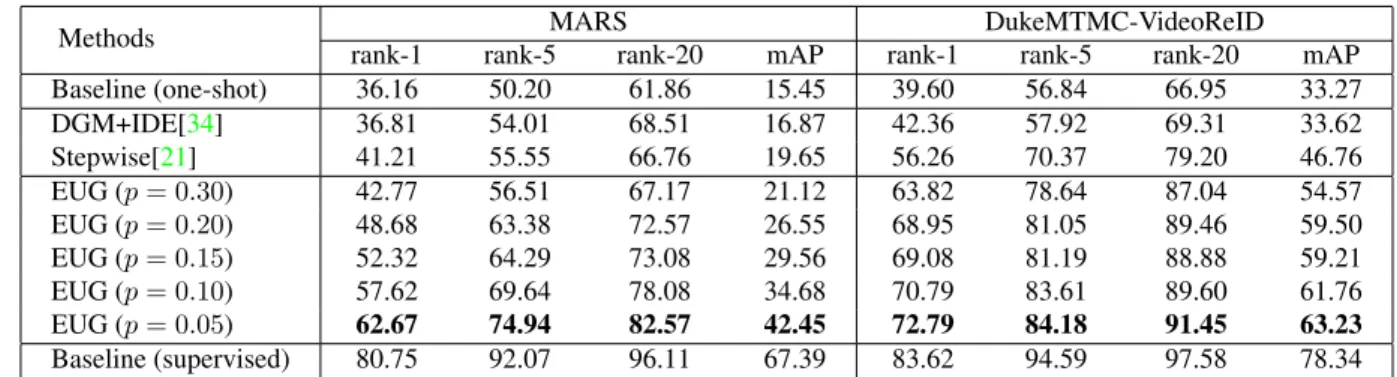
Methods MARS DukeMTMC-VideoReID rank-1 rank-5 rank-20 mAP rank-1 rank-5 rank-20 mAP Baseline (one-shot) 36.16 50.20 61.86 15.45 39.60 56.84 66.95 33.27 DGM+IDE[34] 36.81 54.01 68.51 16.87 42.36 57.92 69.31 33.62 Stepwise[21] 41.21 55.55 66.76 19.65 56.26 70.37 79.20 46.76 EUG (p= 0.30) 42.77 56.51 67.17 21.12 63.82 78.64 87.04 54.57 EUG (p= 0.20) 48.68 63.38 72.57 26.55 68.95 81.05 89.46 59.50 EUG (p= 0.15) 52.32 64.29 73.08 29.56 69.08 81.19 88.88 59.21 EUG (p= 0.10) 57.62 69.64 78.08 34.68 70.79 83.61 89.60 61.76 EUG (p= 0.05) 62.67 74.94 82.57 42.45 72.79 84.18 91.45 63.23 Baseline (supervised) 80.75 92.07 96.11 67.39 83.62 94.59 97.58 78.34
Table 1. Comparison with the state-of-the-art methods on MARS and DukeMTMC-VideoReID. All the methods are conducted based on the same backbone model ETAP-Net. Baseline (one-shot) is the initial model trained on one-shot labeled data. pis the enlarging factor
that indicates the enlarging speed of the sampled subset. At the bottom we provide the Baseline (supervised) result as a upper bound where 100% training data are labeled.
Implementation Details. We use PyTorch [25] for all experiments. As discussed in Section3.2, we take ETAP-Net as our basic CNN model for training on video-based re-ID. In experiments, we take ImageNet [14] pre-trained ResNet-50 model with last classification layer removed as the initialization of ETAP-Net. For training as a classifi-cation task for each identity, an additional fully-connected layer with batch normalization [12] and a classification layer are appended at the end of the model. The parame-ters of the first three residual blocks of ResNet-50 are kept fixed in training to save GPU memory and boost iterations. In training, we randomly sample 16 frames as the input for each tracklet. In label estimation and evaluation steps, all the frames are processed by the CNN model to get the rep-resentations for each tracklet, which are furtherl2 normal-ized and used to calculate the Euclidean distance. We adopt the stochastic gradient descent (SGD) with momentum 0.5 and weight decay 0.0005 to optimize the parameters for 70 epochs with batch size 16 in each iteration. The overall learning rate is initialized to 0.1 and changed to 0.01 in the last 15 epochs.
4.2. Comparison with the State-of-the-Art Methods
We compare our method to DGM [34] and Stepwise [21] on the one-shot task. Note that although [21, 34] claim them asunsupervised methods, they are actuallyone-shotmethods in experiments, because they require at least one labeled tracklet for each identity. Since the performances of both works were reported based on hand-crafted features, to make a fair comparison, we reproduce their methods us-ing the same backbone model ETAP-Net (ResNet-50) as ours. The re-ID performance on MARS and DukeMTMC-VideoRe-ID are summarized in Table 1. On the MARS dataset, we achieve surprising result with rank-1 accuracy 62.67%, mAP 42.45% with enlarging factor 0.05, which greatly outperform the state-of-the-art result by 21.46 points
and 22.8 points (absolute), respectively. The great perfor-mance gap between [21,34] and ours is due to the excessive not-yet-reliable pseudo-labeled data incorporated at the first iteration. The estimation errors are accumulated during it-erations and thus limit the further enhancement.
Moreover, Baseline (one-shot) and Baseline (supervised) are our initial model and the upper bound model, respec-tively. Baseline (one-shot) takes only the one-shot labeled data as the training set and do not exploit the unlabeled data. Baseline (supervised) is conducted on the fully super-vised setting that all tracklets in the dataset are labeled and adopted in training. Specifically, we achieve 26.51 points and 33.19 points rank-1 improvements over the Baseline (one-shot) on MARS and DukeMTMC-VideoReID, respec-tively.
4.3. Algorithm Analysis
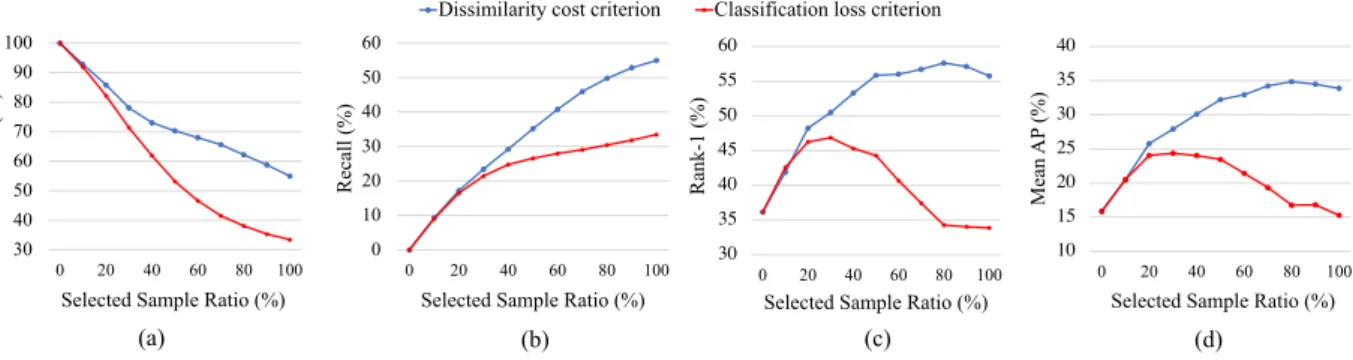
Analysis on the sampling criteria. As mentioned in Section 3.3, some previous works such as SPL take the classification loss as the criterion. The label estimation and evaluation performances of sampling by classification loss and by dissimilarity cost are illustrated in Figure3and Table 2. From the figure, we observe the huge performance gaps for both label estimation and evaluation. The label estima-tions of both criteria achieve similar and high precision at the beginning stage. However, the label estimation accuracy gap between two criteria gradually enlarges. As a result, the performance of the classification loss criterion is only enhanced to a limited extent and drops quickly in the sub-sequence. Table 2shows the evaluation performance dif-ferences of the two criteria with different enlarging factors. With the same enlarging factor, the criterion of sampling by dissimilarity cost always leads to the superior performance. When the enlarging factor is set to 0.05, the best rank-1 ac-curacy on evaluation for classification loss and dissimilarity cost is 48.33% and 62.67%, respectively.
30 35 40 45 50 55 60 0 20 40 60 80 100 Rank -1 (%)
Selected Sample Ratio (%) Dissimilarity cost criterion Classification loss criterion
0 10 20 30 40 50 60 0 20 40 60 80 100 Recall (%)
Selected Sample Ratio (%)
(a) (b) (c) (d) 10 15 20 25 30 35 40 0 20 40 60 80 100 Mean AP (%)
Selected Sample Ratio (%)
30 40 50 60 70 80 90 100 0 20 40 60 80 100 Precision (%)
Selected Sample Ratio (%)
Figure 3. Comparison with two sampling criteria on MARS when the Enlarging Factorp = 0.1. (a) and (b): Precision and recall of
the pseudo label prediction of selected pseudo-labeled candidates during iterations with different sampling criteria. (c) and (d): Rank-1 accuracy and mAP of person re-ID on the evaluation set during iterations with different sampling criteria. The x-axis stands for the percentage of selected data from entire unlabeled data for updating. Each solid point indicates an iteration step.
Enlarging Factor Criteria rank-1 rank-5 mAP
p= 0.05 Classification 48.33 62.67 25.35 Dissimilarity 62.67 74.94 42.45 p= 0.10 Classification 46.86 60.25 24.23 Dissimilarity 57.62 69.64 34.68 p= 0.15 Classification 46.53 60.12 24.03 Dissimilarity 52.32 64.29 29.56 p= 0.20 Classification 45.91 59.95 23.56 Dissimilarity 48.68 63.38 26.55 p= 0.30 Classification 41.86 56.01 20.24 Dissimilarity 42.77 56.51 21.12 Table 2. Comparison of the two criteria on MARS. The ”Classi-fication” and ”Dissimilarity” denotes the EUG methods with the classification loss criterion and the dissimilarity cost criterion, re-spectively. Note for that with the same enlarging factors, the dis-similarity cost criterion always lead to a superior performance.
Analysis over iterations. Figure4illustrates the label estimation performance and evaluation performance over iterations. At the initial iteration, the precision of pseudo label for the selected subset (blue line) is relatively high, since EUG only adopts a few of most reliable samples. In later stages, as EUG gradually incorporates more difficult and diverse samples, the precision drops along with the re-call (red line) rising. In spite of the descending of preci-sion, the F-score of label estimation (green line) continuous increases. Throughout iterations, the precision of pseudo label estimation for all the unlabeled data (orange line) con-stantly increases from 29.8% to 54.96%, which indicates the model grows robust steadily. At the last few iterations, the evaluation performance stops to increase, because the gain of adding new samples is offset by the loss of exces-sive pseudo label errors.
Analysis on the enlarging factor. For the iteration t, t⇤ppercent of unlabeled tracklets with reliable pseudo la-bels are sampled for updating the model. The effectiveness
0 20 40 60 80 100 0 1 2 3 4 5 6 7 8 9 10 V alue (%) Number of iteration
Prec-S(%) Recall-S (%) Prec-All (%)
F-Score (%) mAP-Eval (%)
54.96 33.87
Figure 4. The label estimation performance with the enlarging fac-tor = 0.1 over iterations on MARS. ”Prec-S”, ”Recall-S” and ”F-Score” denote the label estimation precision, recall and F-score for theselected pseudo-labeled candidates. ”Prec-All” denotes the overall label estimation precision forallthe unlabeled data. ”mAP-Eval” represents the mAP performance of the evaluation on the test set. Note that on all the unlabeled data the overall label estimation accuracy is constantly increasing, which indicates the model learns much information throughout iterations.
of enlarging factor pis shown in Figure5. Two conclu-sions can be inferred: First, the model always achieves a better performance if we enlarge the selected set at a slower speed. The huge gaps among the five curves show that the great impact of the enlarging factor. Second, we observe that the gaps among the five curves are relatively small in the first several iterations and gradually enlarge in the later iterations. It shows the estimation errors are accumulated during iterations. This is because that the performance of the trained CNN model highly depends on the reliability of the training set. As a result, the evaluation performances appear obvious different in the last few iterations.
15 20 25 30 35 40 45 0 25 50 75 100 MeanAP (%)
Selected Sample Ratio (%)
35 40 45 50 55 60 65 0 25 50 75 100 Rank -1 (%)
Selected Sample Ratio (%)
EF=0.05 EF=0.1 EF=0.15 EF=0.2 EF=0.3 30 40 50 60 70 80 90 100 0 25 50 75 100 Precision (%)
Selected Sample Ratio (%)
(a) (b) 0 10 20 30 40 50 60 70 0 25 50 75 100 Recall (%)
Selected Sample Ratio (%)
(c) (d) 62.67 57.62 52.32 48.68 42.77 42.45 34.86 256 2 55 212 6 47 6 47
Figure 5. Comparison with different value of enlarging factor on MARS. (a) and (b) : Precision and recall of the pseudo label prediction of selected candidates with different enlarging factors. (c) and (d) : Rank-1 and mAP of person re-ID on the evaluation set with different enlarging factors. ”EF” denotes the enlarging factor. The x-axis stands for the ratio of selected data from entire unlabeled data for updating. Each solid point indicates an iteration step. Note for that the lower enlarging factor is beneficial for improving performance.
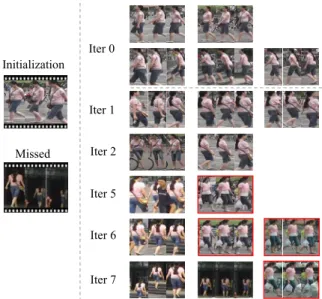
Initialization Missed Iter0 Iter1 Iter 2 Iter5 Iter6 Iter7
Figure 6. The selected pseudo-labeled tracklets for an identity ex-ample on MARS with the enlarging factorp = 0.1. Error
esti-mated samples are in red rectangles. All the tracklets incorporated in the former iterations are naturally selected by later ones. For this identity, one tracklet is missed, and four false samples are se-lected. Observe that the tracklet selected is easy and reliable at the beginning stage and difficult and diverse in the later stage.
4.4. Visualization
We visualize the selected samples for an identity dur-ing iterations in Figure6. Since the initial tracklets is cap-tured from the side view of the pedestrian, the two unlabeled tracklets captured from the same side are easily selected in iteration 0. In iteration 1 and 2, some tracklets in the be-hind or front view of the pedestrian are selected. The above tracklets are relatively easier for sampling. Further, in
it-eration 5 and 6, video tracklets suffering from obstructing and color variance are sampled. In iteration 7, samples with pedestrian of small size and dark background are selected. It’s clear that the samples are selected from easy to hard, from similar to diverse. Note that there is no tracklet se-lected for this identity in iteration 3 and 4, which indicates the huge difficulty gap. There are also four mismatches in iteration 5, 6, and 7, in which the pedestrian is very similar to the ground truth identity, with the same pink shirt, gray pants, and long hair.
5. Conclusion
Label estimation for unlabeled tracklets is crucial for one-shot person re-ID. The challenge in the one-shot set-ting is that the pseudo labels are not reliable enough, which prevents the trained model from improving robust. To solve this problem, we propose a dynamic sampling strategy to start with easy and reliable unlabeled samples and gradu-ally incorporating diverse tracklets for updating the model. We found that if we enlarge the selected set at a slower speed, the model achieves a better performance. In addi-tion, we present a sampling criterion to remarkably improv-ing the performance of label estimation. Our method sur-passes the state-of-the-art method by 21.46 points (abso-lute) in rank-1 accuracy on MARS, and 16.53 points (ab-solute) on DukeMTMC-VideoReID. In sum, the proposed method is effective in exploiting the unlabeled data and re-ducing the annotation work load for one-shot video-based person re-ID.
Acknowledgment.Yi Yang is the recipient of a Google Faculty Research Award. Wanli Ouyang is supported by SenseTime Group Limited. We acknowledge the Data to Decisions CRC (D2D CRC) and the Cooperative Research Centers Programme for funding this research.
References
[1] S. Bak and P. Carr. One-shot metric learning for person re-identification. InCVPR, 2017.2
[2] Y. Bengio, J. Louradour, R. Collobert, and J. Weston. Cur-riculum learning. InICML, 2009.3
[3] W. Deng, L. Zheng, Q. Ye, G. Kang, Y. Yang, and J. Jiao. Image-image domain adaptation with preserved self-similarity and domain-dissimilarity for person re-identification. InCVPR, 2018.3
[4] X. Dong, J. Huang, Y. Yang, and S. Yan. More is less: A more complicated network with less inference complexity. InCVPR, 2017.3
[5] X. Dong, D. Meng, F. Ma, and Y. Yang. A dual-network progressive approach to weakly supervised object detection. InACM Multimedia, 2017.3,4
[6] H. Fan, X. Chang, D. Cheng, Y. Yang, D. Xu, and A. G. Hauptmann. Complex event detection by identifying reliable shots from untrimmed videos. InICCV, 2017.3,4
[7] H. Fan, L. Zheng, and Y. Yang. Unsupervised person re-identification: Clustering and fine-tuning. arXiv preprint arXiv:1705.10444, 2017.1,3
[8] D. Figueira, L. Bazzani, H. Q. Minh, M. Cristani, A. Bernardino, and V. Murino. Semi-supervised multi-feature learning for person re-identification. InAVSS, 2013.
2
[9] K. He, X. Zhang, S. Ren, and J. Sun. Deep residual learning for image recognition. InCVPR, 2016.3
[10] A. Hermans, L. Beyer, and B. Leibe. In defense of the triplet loss for person re-identification. arXiv preprint arXiv:1703.07737, 2017.1,2
[11] G. Huang, Z. Liu, K. Q. Weinberger, and L. van der Maaten. Densely connected convolutional networks. InCVPR, 2017.
3
[12] S. Ioffe and C. Szegedy. Batch normalization: Accelerating deep network training by reducing internal covariate shift. In
ICML, 2015.6
[13] L. Jiang, D. Meng, S.-I. Yu, Z. Lan, S. Shan, and A. Haupt-mann. Self-paced learning with diversity. InNIPS, 2014.
3
[14] A. Krizhevsky, I. Sutskever, and G. E. Hinton. Imagenet classification with deep convolutional neural networks. In
NIPS, pages 1097–1105, 2012.6
[15] M. P. Kumar, B. Packer, and D. Koller. Self-paced learning for latent variable models. InNIPS, 2010.3
[16] D. Li, X. Chen, Z. Zhang, and K. Huang. Learning deep context-aware features over body and latent parts for person re-identification. InCVPR, 2017.2
[17] Y. Lin, L. Zheng, and W. Y. a. Y. Y. Zheng, Zhedong and. Improving person re-identification by attribute and identity learning.arXiv preprint arXiv:1703.07220, 2017.3
[18] H. Liu, Z. Jie, K. Jayashree, M. Qi, J. Jiang, S. Yan, and J. Feng. Video-based person re-identification with accumu-lative motion context. IEEE Transactions on Circuits and Systems for Video Technology, PP(99):1–1, 2017.2
[19] X. Liu, M. Song, D. Tao, X. Zhou, C. Chen, and J. Bu. Semi-supervised coupled dictionary learning for person re-identification. InICCV, 2014.2
[20] Y. Liu, J. Yan, and W. Ouyang. Quality aware network for set to set recognition.CVPR, 2017.1,2
[21] Z. Liu, D. Wang, and H. Lu. Stepwise metric promotion for unsupervised video person re-identification. InICCV, 2017.
1,2,5,6
[22] A. J. Ma and P. Li. Semi-supervised ranking for re-identification with few labeled image pairs. InACCV, 2014.
2
[23] F. Ma, D. Meng, Q. Xie, Z. Li, and X. Dong. Self-paced co-training. InICML, 2017.3
[24] N. McLaughlin, J. Martinez del Rincon, and P. Miller. Re-current convolutional network for video-based person re-identification. InCVPR, 2016.2
[25] A. Paszke, S. Gross, S. Chintala, G. Chanan, E. Yang, Z. De-Vito, Z. Lin, A. Desmaison, L. Antiga, and A. Lerer. Auto-matic differentiation in PyTorch. InNIPS-W, 2017.6
[26] E. Ristani, F. Solera, R. Zou, R. Cucchiara, and C. Tomasi. Performance measures and a data set for target, multi-camera tracking. InECCV, 2016.5
[27] H. Shen, S.-I. Yu, Y. Yang, D. Meng, and A. Hauptmann. Unsupervised video adaptation for parsing human motion. InECCV, 2014.3,4
[28] T. Wang, S. Gong, X. Zhu, and S. Wang. Person re-identification by discriminative selection in video ranking.
IEEE Transactions on Pattern Analysis and Machine Intelli-gence, 38(12):2501–2514, Dec 2016.1
[29] L. Wu, C. Shen, and A. v. d. Hengel. Deep recurrent con-volutional networks for video-based person re-identification: an end-to-end approach. arXiv preprint arXiv:1606.01609, 2016.2
[30] T. Xiao, H. Li, W. Ouyang, and X. Wang. Learning deep fea-ture representations with domain guided dropout for person re-identification. InCVPR. IEEE, 2016.3
[31] S. Xie, R. Girshick, P. Doll´ar, Z. Tu, and K. He. Aggregated residual transformations for deep neural networks. InCVPR, 2017.3
[32] S. Xu, Y. Cheng, K. Gu, Y. Yang, S. Chang, and P. Zhou. Jointly attentive spatial-temporal pooling networks for video-based person re-identification.ICCV, 2017.1,2
[33] Y. Yang, F. Nie, D. Xu, J. Luo, Y. Zhuang, and Y. Pan. A mul-timedia retrieval framework based on semi-supervised rank-ing and relevance feedback. IEEE Transactions on Pattern Analysis and Machine Intelligence, 34(4):723–742, 2012.3
[34] M. Ye, A. J. Ma, L. Zheng, J. Li, and P. C. Yuen. Dynamic la-bel graph matching for unsupervised video re-identification.
ICCV, 2017.1,2,5,6
[35] W. Zhang, S. Hu, and K. Liu. Learning compact appear-ance representation for video-based person re-identification.
arXiv preprint arXiv:1702.06294, 2017.1,2
[36] L. Zheng, Z. Bie, Y. Sun, J. Wang, C. Su, S. Wang, and Q. Tian. Mars: A video benchmark for large-scale person re-identification. InECCV, 2016.5
[37] Z. Zheng, L. Zheng, and Y. Yang. Unlabeled samples gener-ated by gan improve the person re-identification baseline in vitro. InICCV, 2017.5
[38] Z. Zhong, L. Zheng, D. Cao, and S. Li. Re-ranking person re-identification with k-reciprocal encoding. InCVPR, 2017.
[39] Z. Zhong, L. Zheng, Z. Zheng, S. Li, and Y. Yang. Camera style adaptation for person re-identification. InCVPR, 2018.
2
[40] Z. Zhou, Y. Huang, W. Wang, L. Wang, and T. Tan. See the forest for the trees: Joint spatial and temporal recurrent neural networks for video-based person re-identification. In
CVPR, 2017.2
[41] X. Zhu, X. Y. Jing, L. Yang, X. You, D. Chen, G. Gao, and Y. Wang. Semi-supervised cross-view projection-based dictionary learning for video-based person re-identification.
IEEE Transactions on Circuits and Systems for Video Tech-nology, PP(99):1–1, 2017.2