MOBILE ECG ACQUISITION DEVICE FOR EARLY DIAGNOSIS BASED ON PAN-TOMPKINS ALGORITHM
NUR IZYAN BINTI KHAIRUZZAMAN
MOBILE ECG ACQUISITION DEVICE FOR EARLY DIAGNOSIS BASED ON PAN-TOMPKINS ALGORITHM
NUR IZYAN BINTI KHAIRUZZAMAN
A project report submitted in partial fulfilment of the requirements for the award of the degree of
Master of Engineering (Computer and Microelectronics Systems)
Faculty of Electrical Engineering Universiti Teknologi Malaysia
iii
Specially dedicated
to my supervisor and family who encouraged me throughout my journey of
iv
ACKNOWLEDGEMENT
In the name of Allah, The Most Merciful and The Most Beneficent.
All praise to Allah, the Almighty, and the Benevolent for His blessing and guidance for giving me inspiration to begin this project and give me good health when doing the research to complete this project. Lots of people have contributed their ideas towards the completion of this project. First of all, thank you to my supervisor, Dr. Mohd Afzan Bin Othman for guidance, supports, motivation, suggestions and critics. I would like to express my gratitude to my panels, Assoc. Prof. Dr. Nasrul Humaimi Bin Mahmood, Dr. Mohd Azhar Bin Abdul Razak and Assoc. Prof. Dr. Rubita Binti Sudirman, for their willingness to spend time to consult, advise and give comments through completing this project. Without their continued support and interest, this thesis would not have been the same as presented here. I am also indebted to Faculty of Electrical Engineering, Universiti Teknologi Malaysia for providing the facilities and contribution for development of this project. I also should be grateful to my parents for their supports and encouragement. Last but not least, I would like to extend my appreciation to my friends for their contribution and whoever involved directly or indirectly throughout completing this project.
v
ABSTRACT
In recent years, the usage of mobile electrocardiogram (ECG) devices has drawn much attention not only to in house patients but to home patients as well. The devices are truly useful for cardiac patients who need continuous monitoring while they are engaged in daily activities. The portable ECG devices particularly facilitate real time ECG recording and analysis for further examination by the doctors. This project focuses on implementing a mobile ECG acquisition device using Arduino UNO, Bluetooth HC-05 and AD8232 Heart Rate Monitor. Pan-Tompkins algorithm is used for QRS complex detection in order to classify the ECG signals either as normal or abnormal that is useful for early diagnosis. The goal of interest is to obtain a correct detection of QRS complex with high accuracy. Thus, the Pan-Tompkins algorithm is suitable as it is a well-known, simple yet efficient method in detecting QRS complexes accurately. The device acquires a Bluetooth technology to send raw data of ECG signal to Android smartphone. The ECG signals are displayed on the mobile interface and then the ECG signal analysis will be carried out by developing the Java-based Android application. The application will offer ECG processing techniques including R-R interval and QRS duration parameter extraction analysis. This device provides three ECG electrodes using Lead II placement for recording. The traces of the ECG leads are then plotted by the app. After that, the ECG data are saved as text files in the phone storage. The users also can view their history records of the previous ECG recording. The mobile app can capture and plot the incoming ECG signals from the remote device. The results shown that for a normal ECG signals, it will have the following parameters; heart rate of 60 to 100 beats per second, R-R interval duration of 0.4s to 1.2s, and QRS duration of 0.06s to 0.10s; else it will considered as abnormal signal.
vi
ABSTRAK
Dalam tahun-tahun kebelakangan ini, penggunaan alat elektrokardiogram mudah alih (ECG) telah menarik perhatian bukan sahaja kepada pesakit di hospital tetapi juga untuk pesakit di rumah. Peranti ini benar-benar berguna untuk pesakit jantung yang memerlukan pemantauan berterusan semasa mereka terlibat dalam aktiviti harian. Peranti ECG mudah alih ini terutamanya akan memudahkan rakaman dan analisis ECG pada waktu sebenar untuk pemeriksaan lanjut oleh doktor. Projek ini memberi tumpuan kepada pelaksanaan peranti pemerolehan ECG mudah alih menggunakan Arduino UNO, Bluetooth HC-05 dan AD8232 Heart Rate Monitor. Algoritma Pan-Tompkins digunakan untuk pengesanan kompleks QRS untuk mengklasifikasikan isyarat ECG sama ada normal atau tidak normal yang berguna untuk diagnosis awal. Matlamat yang menarik adalah untuk mendapatkan pengesanan QRS yang betul dengan ketepatan yang tinggi. Oleh itu, algoritma Pan-Tompkins sesuai kerana ia merupakan satu kaedah yang mudah dikenal dan mudah dalam mengesan kompleks QRS dengan tepat. Peranti ini menggunakan teknologi Bluetooth untuk menghantar data ECG yang belum diproses kepada telefon pintar Android. Isyarat ECG dipaparkan pada skrin mudah alih dan kemudian analisis isyarat ECG akan dijalankan dengan membangunkan aplikasi Android berasaskan Java. Aplikasi ini menawarkan teknik pemprosesan ECG termasuk analisis pengekstrakan parameter selang masa R-R dan tempoh masa QRS. Peranti ini menyediakan tiga elektrod ECG menggunakan penempatan Lead II untuk rakaman. Jejak isyarat ECG kemudiannya dilukis oleh aplikasi tersebut. Selepas itu, data ECG disimpan dalam bentuk fail teks dalam storan telefon. Para pengguna juga boleh melihat rekod rakaman ECG terdahulu mereka. Aplikasi mudah alih ini boleh menangkap isyarat ECG yang sedang masuk dari peranti jauh. Hasil penyelidikan ini menunjukkan bahawa untuk isyarat ECG yang normal, ia akan mempunyai parameter berikut; denyut jantung 60 hingga 100 denyutan sesaat, tempoh selang masa R-R sebanyak 0.4 saat hingga 1.2 saat, dan tempoh QRS sebanyak 0.06 saat hingga 0.10 saat; selain daripada itu ia akan dianggap sebagai isyarat yang tidak normal.
vii
TABLE OF CONTENTS
CHAPTER TITLE PAGE
DECLARATION ii
DEDICATION iii
ACKNOWLEDGEMENT iv
ABSTRACT v
ABSTRAK vi
TABLE OF CONTENTS vii
LIST OF TABLES x
LIST OF FIGURES xi
LIST OF ABBREVIATIONS xiv
LIST OF SYMBOLS xv
LIST OF APPENDICES xvi
1 INTRODUCTION 1.1 Introduction 1.2 Problem Statement 1.3 Research Objectives 1.4 Research Scope 1.5 Research Overview 1.6 Thesis Outline 1 1 2 2 3 3 3
viii 2 3 4 LITERATURE REVIEW 2.1 Introduction 2.2 Human Heart 2.3 Leads Configuration 2.4 ECG Waveform 2.5 Related Works RESEARCH METHODOLOGY 3.1 Introduction
3.2 Research Flow Process 3.3 Equipments
3.4 Methodology
3.4.1 Hardware Configuration 3.4.2 Android App Development 3.4.3 Pan-Tompkins Algorithm
RESULTS AND DISCUSSION
4.1 Introduction
4.2 Arduino-based ECG Device 4.3 Android App
4.3.1 Capture ECG Signal 4.3.2 Analysis of ECG Signal 4.4 Comparison using MATLAB 4.4.1 Normal ECG Signal 4.4.2 Abnormal ECG Signal 4.5 Discussion 6 6 6 8 10 12 17 17 17 18 20 20 23 24 28 28 28 29 29 31 32 32 37 42
ix
5 CONCLUSION AND RECOMMENDATION
5.1 Introduction 5.2 Conclusion
5.3 Problem and Limitation
5.4 Recommendation for Future Work
45 45 45 46 46 REFERENCES 47 Appendices A-B 49-86
x LIST OF TABLES TABLE NO. 1.1 1.2 2.1 2.2 2.3 3.1 3.2 3.3 TITLE
Gannt chart for Master Project I Gannt chart for Master Project II Normal amplitude of ECG parameters
Normal duration or interval of ECG parameters Summary on the related works
Technical specifications for Arduino UNO R3 Bluetooth HC-05 pin configuration
Heart Rate Monitor AD8232 pin configuration
PAGE 4 5 11 12 15 19 21 22
xi LIST OF FIGURES FIGURE NO. 2.1 2.2 2.3 2.4 2.5 3.1 3.2 3.3 3.4 3.5 3.6 3.7 3.8 3.9 3.10 4.1 4.2 TITLE
Chambers of the heart
Correlation between ECG wave to the electrical events in heart
Morphology of the curve for leads I, II and III Lead II electrodes placement
ECG segments and time intervals Flow of the project
Arduino UNO R3
AD8232 Single Lead Heart Rate Monitor Bluetooth Module HC-05
Wire connection between Bluetooth HC-05 and Arduino UNO
Wire connection between Heart Rate Monitor and Arduino UNO
Arduino program code Navigation drawer of the app
Block diagram of Pan-Tompkins algorithm
Relationship between QRS complex and moving window integration waveform
Mobile ECG device
Process to capture ECG signals
PAGE 7 8 9 10 11 18 19 19 20 21 22 23 24 25 27 28 29
xii 4.3 4.4 4.5 4.6 4.7 4.8 4.9 4.10 4.11 4.12 4.13 4.14 4.15 4.16 4.17 4.18 4.19 4.20 4.21 4.22 4.23
Example of real-time ECG signals
Missing data during the transmission process Process to do first analysis in Android app Second analysis in Android app
Normal ECG signals for subject 16265 after applying Pan-Tompkins algorithm
Result for subject 16265 from Android app
Number of R peaks and R peak amplitude detected for subject 16265
Comparison of R-R interval durations for subject 16265 Comparison of QRS durations for subject 16265
Normal ECG signals for subject 16420 after applying Pan-Tompkins algorithm
Number of R peaks and R peak amplitude detected for subject 16420
Result for subject 16420 from Android app
Comparison of R-R interval durations for subject 16420 Comparison of QRS durations for subject 16420
Abnormal ECG signals for subject 800 after applying Pan-Tompkins algorithm
Number of R peaks and R peak amplitude detected for subject 800
Result for subject 800 from Android app
Comparison of R-R interval durations for subject 800 Comparison of QRS durations for subject 800
Abnormal ECG signals for subject 802 after applying Pan-Tompkins algorithm
Number of R peaks and R peak amplitude detected for subject 802 30 30 31 32 33 33 34 34 35 35 36 36 37 37 38 38 39 39 40 40 41
xiii
4.24 4.25 4.26
Result for subject 802 from Android app
Comparison of R-R interval durations for subject 802 Comparison of QRS durations for subject 802
41 42 42
xiv
LIST OF ABBREVIATIONS
APP - AliveECG Application
BIH - Boston's Beth Israel Hospital
bpm - beats per minute
CVD - Cardiovascular Disease
CWT - Continuous Wavelet Transform
DC - Direct Current
ECG - Electrocardiogram EDR - Enhanced Data Rate
EEPROM - Electrically Erasable Programmable Read-Only Memory
I/O - Input/Output
ICSP - In-Circuit Serial Programming
IDE - Integrated Development Environment
LA - Left Arm
LED - Light Emitting Diode
LL - Left Leg
PWM - Pulse Width Modulation PWM - Pulse Width Modulation
RA - Right Arm
RL - Right Leg
RX - Receiver
SCD - Sudden Cardiac Death SPP - Serial Port Protocol
SRAM - Static Random-Access Memory
TX - Transmitter
UI - User Interface
xv
LIST OF SYMBOLS
GHz - Giga hertz
KB - kilo Byte
mA - milli Ampere
Mbps - Megabits per second
MHz - Mega hertz mmHg - millimeter of mercury ms - milli second mV - milli Volt s - second V - Volt
xvi
LIST OF APPENDICES
APPENDIX TITLE PAGE
A B
MATLAB Code for Pan-Tompkins Algorithm JAVA Source Code for Android App
49 57
CHAPTER 1
INTRODUCTION
Introduction 1.1
A human heart is built up of myogenic muscular organ and contracting repeatedly in a structured rhythm and pumps blood through the blood vessels of the circulatory system. The heart is located in the middle part of the chest which is between the lungs.
Diseases related to the heart is known as cardiovascular diseases (CVDs) in which these are the number one cause of death worldwide. In other words, more people die annually from CVDs than from any other causes. An estimated 17.7 million people died from CVDs in 2015, representing 31 percent of all global deaths [1]. An estimated 7.4 million of these deaths were due to coronary heart disease and 6.7 million were due to stroke [1]. In United States, Sudden Cardiac Death (SCD) has caused about 325,000 adult deaths each year and it contribute to the largest cause of the death [2]. Arrhythmias are the main cause of the SCD. Arrhythmia is the condition in which the heart has abnormal heart rhythms. Furthermore, ventricular fibrillation is known as the most common life-threatening arrhythmia. The heart is unable to pump blood when this disease occurs and it will lead to death within few minutes if not treated. In Malaysia, from the last ten years in 2005 to 2014, ischemic heart diseases remain as a major cause of death. The number of deaths due to ischemic heart diseases have the highest percentage in Malaysia in 2014 which is 13.5 percent of other causes [3].
2
Therefore, continuous and self-monitoring of heart is beneficial to ensure healthy condition of heart. An early diagnosis of the heart might save many people before it threatens our life. Hence, a mobile ECG device is truly useful and convenient for cardiac patients for continuous monitoring while they are engaged in daily activities. For 2017, the number of smartphone users in Malaysia is estimated to reach 19.9 million. Meanwhile, in 2016, Android accounted for more than 80 percent of all smartphone sales to end users worldwide. This is a good opportunity to attract people to integrate mobile usage with healthcare applications instead of just having social connections all over the world.
Problem Statement 1.2
This research is useful for home patients to monitor their heart condition without having to consult a doctor. If an abnormal heart condition is detected, only then they need to personally consult a doctor before it getting worse. Thus, the self-monitoring of the heart should provide convenient use of the ECG device such as mobile-friendly and provides data storage in smartphone to facilitate real time ECG recording and analysis for further examination by the doctors. Thus, a simple yet efficient method is required to detect QRS complex accurately which is using the Pan-Tompkins algorithm.
Research Objectives 1.3
The objectives of this study are:
to implement a mobile ECG acquisition device based on Arduino. to detect QRS waves using Pan-Tompkins algorithm.
to classify the ECG based on determination of number of R peaks, R-R interval and QRS duration.
3
Research Scope 1.4
The scope of this study covers the hardware implementation using Arduino UNO integrates with the Heart Monitor AD8232 and Bluetooth module HC-05. The hardware will capture raw ECG signals and provides data transfer to smartphone via Bluetooth. Next, the signal pre-processing and QRS waves detection will be performed using Pan-Tompkins algorithm. After that, the parameters extraction including number of R peaks, R-R interval duration and QRS duration are performed to classify whether the ECG signals are normal or abnormal.
Research Overview 1.5
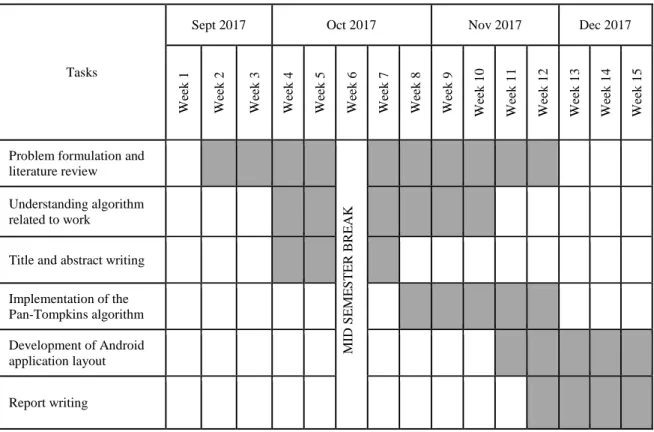
Table 1.1 and 1.2 shows the Gannt chart of master project part I and part II respectively. The research started with problem formulation and literature review on related works in this field. The main focus on project part I is to identify suitable algorithm to perform the ECG parameter extraction. Then, the algorithm will be tested using MATLAB to know its functionality. Another focus of project part I is the development of Android application layout using Android Studio IDE.
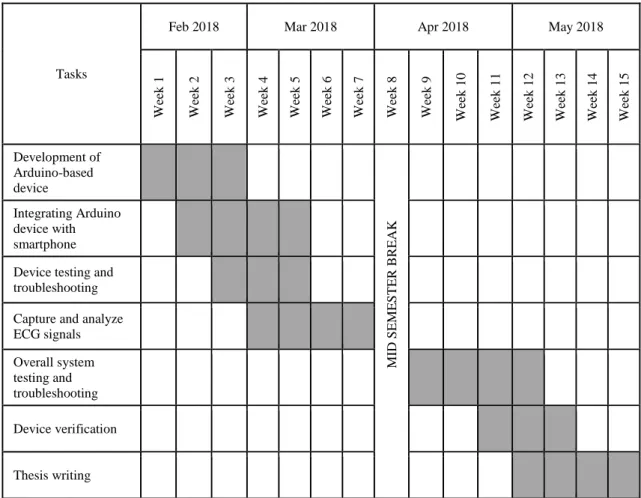
During project part II, it will focus on implementing the mobile ECG device based on Arduino and integration of the device to the smartphone via Bluetooth. After that, the device testing, verification and troubleshooting procedures need to be performed to ensure its functionality.
Thesis Outline 1.6
The thesis is organized into five chapters. Chapter one includes the introduction of the project, problem statement, research objectives, research scope, research overview and thesis outline.
4
Chapter two covers the literature review that is related to the project which includes the anatomy of human heart, leads configuration, ECG waveform and the related works for this project.
Chapter three comprises of the materials used in this project, and the methodology includes the hardware configuration, Android app development, Pan-Tompkins algorithm and research flow process.
Chapter four consists of the results of the research and discussion. The results are divided into three, which are the hardware part which is the Arduino-based ECG device, the Android app, and the comparison using MATLAB analysis for normal and abnormal ECG signal.
Chapter five highlights conclusion of the overall project, problems encountered limitations of the project and also recommendations for future works for further improvement.
Table 1.1 Gannt chart for Master Project I
Tasks
Sept 2017 Oct 2017 Nov 2017 Dec 2017
Wee k 1 Wee k 2 Wee k 3 Wee k 4 Wee k 5 Wee k 6 Wee k 7 Wee k 8 W ee k 9 Wee k 10 Wee k 11 Wee k 12 Wee k 13 Wee k 14 Wee k 15
Problem formulation and literature review M ID S EM E S TE R BREAK Understanding algorithm related to work
Title and abstract writing
Implementation of the Pan-Tompkins algorithm
Development of Android application layout
5
Table 1.2 Gannt chart for Master Project II
Tasks
Feb 2018 Mar 2018 Apr 2018 May 2018
Wee k 1 Wee k 2 Wee k 3 Wee k 4 Wee k 5 Wee k 6 Wee k 7 Wee k 8 Wee k 9 Wee k 10 Wee k 11 Wee k 12 Wee k 13 Wee k 14 W eek 15 Development of Arduino-based device M ID S EM E S TE R BREAK Integrating Arduino device with smartphone
Device testing and troubleshooting
Capture and analyze ECG signals Overall system testing and troubleshooting Device verification Thesis writing
47
REFERENCES
1. Cardiovascular disease. Retrieved on November 1, 2017, from http://www.who.int/cardiovascular_diseases/en/.
2. Sudden Cardiac Death (Sudden Cardiac Arrest). Retrieved on October 15, 2017, from https://my.clevelandclinic.org/health/diseases/17522-sudden-cardiac-death-sudden-cardiac-arrest.
3. Department of Statistics, Malaysia. (2016). Statistics on Causes of Death, Malaysia, 2014, Retrieved on October 10, 2017, from
https://www.dosm.gov.my/.
4. Sachin Singh, N.G.N. (2010). Pattern analysis of different ECG signal using Pan-Tompkin’s algorithm. International Journal on Computer Science and Engineering. 02(07), 2502-2505.
5. Luz, E.J.d.S., et al. (2016). ECG-based heartbeat classification for arrhythmia detection: A survey. Computer Methods and Programs in Biomedicine. 127(Supplement C), 144-164.
6. Patro, K.K. and P.R. Kumar. (2017). Effective Feature Extraction of ECG for Biometric Application. Procedia Computer Science. 115(Supplement C), 296-306.
7. Yeh, Y.-C. and W.-J. Wang. (2008). QRS complexes detection for ECG signal: The Difference Operation Method. Computer Methods and Programs in Biomedicine. 91(3), 245-254.
8. Vijjaya, V., K.K. Rao, and P. Sahrudai. (2012). Identification of Sudden Cardiac Arrest Using the Pan-Tompkins Algorithm. 2012 UKSim 14th International Conference on Computer Modelling and Simulation.
9. Shufni, S.A. and M.Y. Mashor. (2015). ECG signals classification based on discrete wavelet transform, time domain and frequency domain features. 2015 2nd International Conference on Biomedical Engineering (ICoBE). 10. Vastarouchas, C., S. Kapoulea, and C. Psychalinos. (2016). ECG signal
48
2016 IEEE International Conference on Electronics, Circuits and Systems (ICECS).
11. Dohare, A.K., V. Kumar, and R. Kumar. (2014). An efficient new method for the detection of QRS in electrocardiogram. Computers & Electrical
Engineering. 40(5), 1717-1730.
12. Nahiyan, K.M.T. and A. Al-Amin. (2016). Acceptable ECG trace selection based on Pan-Tompkins algorithm. 2016 5th International Conference on Informatics, Electronics and Vision (ICIEV).
13. Amiri, A.M., Abhinav, and M. Kunal. (2015). m-QRS: An efficient QRS detection algorithm for mobile health applications. 2015 17th International Conference on E-health Networking, Application & Services (HealthCom). 14. Shebi Ahammed, S. and B.C. Pillai. (2013). Design of Wi-Fi Based Mobile
Electrocardiogram Monitoring System on Concerto Platform. Procedia Engineering, 64(Supplement C), 65-73.
15. Baquero, G.A., et al. (2015). Surface 12 lead electrocardiogram recordings using smart phone technology. Journal of Electrocardiology, 48(1), 1-7. 16. Sathyapriya, L., L. Murali, and T. Manigandan. (2014). Analysis and
detection R-peak detection using Modified Pan-Tompkins algorithm. 2014 IEEE International Conference on Advanced Communications, Control and Computing Technologies.
17. Bayasi, N., et al. (2014). 65-nm ASIC implementation of QRS detector based on Pan and Tompkins algorithm. 2014 10th International Conference on Innovations in Information Technology (IIT).
18. Guzik, P. and M. Malik. (2016) ECG by mobile technologies. Journal of Electrocardiology, 49(6), 894-901.
19. R. Kavitha, T.C., (2014). A Study on ECG Signal Classification Techniques. International Journal of Computer Applications, 86(14), 9-14.
20. Arzeno, N.M., Z.D. Deng, and C.S. Poon. (2008). Analysis of First-Derivative Based QRS Detection Algorithms. IEEE Transactions on Biomedical Engineering, 55(2), 478-484.