Journal of Computer Science Research
http://ojs.bilpublishing.com/index.php/jcsr
ARTICLE
Evaluating Word Similarity Measure of Embeddings Through Binary
Classification
A. Aziz Altowayan Lixin Tao
*Computer Science Department, Pace University, New York, United States
ARTICLE INFO ABSTRACT
Article history
Received: 29 September 2019 Accepted: 24 October 2019
Published Online: 20 November 2019
We consider the following problem: given neural language models (em-beddings) each of which is trained on an unknown data set, how can we determine which model would provide a better result when used for
feature representation in a downstream task such as text classification or
entity recognition? In this paper, we assess the word similarity measure through analyzing its impact on word embeddings learned from various
datasets and how they perform in a simple classification task. Word rep -resentations were learned and assessed under the same conditions. For training word vectors, we used the implementation of Continuous Bag of Words described in [1]. To assess the quality of the vectors, we applied
the analogy questions test for word similarity described in the same paper. Further, to measure the retrieval rate of an embedding model, we introduced a new metric (Average Retrieval Error) which measures the percentage of missing words in the model. We observe that scoring a high accuracy of syntactic and semantic similarities between word pairs is not an indicator of better classification results. This observation can
be justified by the fact that a domain-specific corpus contributes to the
performance better than a general-purpose corpus. For reproducibility, we release our experiments scripts and results.**
Keywords: Word embeddings Embeddings evaluation Binary classification Word2vec *Corresponding Author: Lixin Tao,
Computer Science Department, Pace University, New York, United States; Email: [email protected]
** https://github.com/iamaziz/embed-eval
1. Introduction
L
anguage modeling is the crux of the problem in Natural Language Processing (NLP). Recently, neural language models have outperformed the tra-ditional language model approaches such as n-gram. The superiority of the neural methods lies in their capability to overcome the curse of the dimensionality problem while, simultaneously, capturing different similarities between words [2].Neural language models learn distributed represen-tations for each word in the form of
real-numbers-val-ue vectors, which allow similar words to have similar vectors. Such sharing is an important characteristic that enables the model to treat related words similarly and, hence, gives the model the ability to generalize. These word representations are usually known simply as Word Embeddings.
Nowadays, word embedding is the standard approach for feature representation in many NLP tasks. Traditional feature representation methods, such as bag-of-words and Term Frequency Inverse Document Frequency (TFIDF), rely on hand-crafted feature extractor and are time-con-suming and domain-specific. Hence, embedding based
techniques provide a better alternative for automating many tasks in language modeling and NLP.
Among these techniques context-predicting semantic vectors have distinctly proven their superiority to the count-based ones [3]. While count-based vectors are more
about the frequency of the word, context-based vectors make more emphasis on the word and its context.
Popular word vector learning methods are introduced in [1,4,5] and have gained great attention since then. From
these methods, learning continuous word embeddings us-ing skip-gram and negative samplus-ing is the most common approach for building word vectors [6]. This method was
introduced and described in [1].
However, since vector training occurs in an unsuper-vised fashion, there is no accurate way to estimate the quality of the vector representations objectively. Several extrinsic and intrinsic evaluation methods have been dis-cussed in [7]. However, at the time of this writing, there
is still no reliable method for comparing the quality of different embedding models. So, this is still an open ques-tion. Commonly, the quality can be assessed using the word similarity task, which is a test with a set of similarity analogy questions [1].
Nevertheless, with the current word similarity evalua-tion method, word similarity accuracy and having more vocabulary in the model do not result in better perfor-mance in the downstream task.
From experiments, we show that scoring well on word similarity measure questions does not imply better per-formance in the downstream task. Our findings are in line with the observations of [8]. Therefore, we observe that the
accuracy of word similarity measure is not, necessarily, an indicator for the usefulness of the word embedding model. In this paper, we explain and justify this claim based on the observation of our experimentation results.
For instance, we show that the GoogleNews embedding model has the following two advantages over the IMDB model. First, it scores better results in word similarity accuracy (74.26%) in comparison to IMDB’s (23.71%); second, GoogleNews contains 3 million vocabulary words while IMDB contains around 19,000. Despite these ad-vantages of GoogleNews, the classifiers’ performance was worse with GoogleNews than with IMDB.
The rest of the paper is structured into the following parts: related work, our experiments, discussion, future work, and finally, the conclusion.
2. Related Work
We approached related work in the following manner: first, we investigated what it takes to build quality em
-We then analyzed similar work for evaluating word embeddings using extrinsic and intrinsic methods. We also reviewed the available current work on building domain-specific embeddings. And finally, we look into work that focuses on the syntactic and semantic similari-ties between words.
Training elements such as the model, the corpus, and the parameters have been analyzed in detail in [9]. They
observed that the corpus domain is more important than its size. This explains our results where the smaller do-main-specific corpus (IMDB) achieved better results than the much larger general-purpose corpus (Google-News).
We reviewed papers on evaluating word vectors’ quali-ty and model accuracies. Existing evaluation methods fall into two types: intrinsic and extrinsic evaluation. In the intrinsic evaluation, the goal is to directly assess the qual-ity of word vectors in hopes that it will reflect on the per -formance of the downstream tasks. So, synthetic metrics are proposed to test the semantic and syntactic similarities between words.
For example, a pre-selected set of query terms is used to estimate words’ relationships. Each query denotes two pairs of “analogically” similar words. For example, relat-ing big to bigger in the same way as small to smaller is called “syntactic similarity”, while relating Tokyo to Japan
in the same way as London to England is called “semantic similarity”. Then, such queries can take the form of ques-tions, for instance, “What is the word similar to small in the same sense as bigger is similar to big?”. To query the model, a question is formulated in an algebraic expression as follows: answer = vector(“bigger”) - vector(“big”) + vector(“small”). This method was first proposed in [1];
and published with a set of around 20 thousand syntactic/ semantic questions. It is fast and computationally inex-pensive, however, there are problems associated with this technique [8]. Further, other evaluation techniques have
been proposed to reduce bias [10]. In such methods, they
directly compare embeddings with respect to specific que -ries.
While in the extrinsic evaluation, we indirectly evalu-ate word embeddings. In other words, we use the embed-dings as input features to a downstream task and measure the performance metrics specified to that task [10]. For
instance, when the task is text classification, we would use the embeddings to represent words in the text. In some approaches, they applied extrinsic evaluations to learn task-specific embeddings [11].
Finally, a thorough investigation and survey cover-ing the current evaluation methods have been discussed in [7].
3. Building Word Embeddings
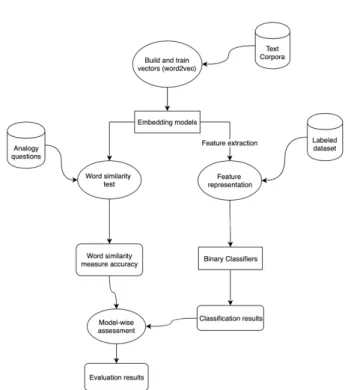
3.1 Data Collection and ExplorationFigure 1. The approach design and workflow In this section, we describe the data sources and texts we used for training the embedding models. We start-ed with two well-known corpora. The first one is text8, a standard corpus used in NLP community which has around 100MB of cleaned English text of a Wikipedia dump from 2006, and the second one is the Large Movie Review Dataset (or IMDB). IMDB contains 100 thousand movie reviews prepared for sentiment classification prob -lems. Later on, we will use this same dataset in our clas-sification experiment; we are aware this may cause bias in the datasets, further discussion to follow later.
As a way to augment our data, we created a new hybrid corpus by concatenating the above two corpora; we call it
text8-imdb. This allows us to compare the results of two models and their hybrid to see how they may affect one another. Later on, in the classification section, we will see that imdb achieved the best among the three. This is a bit surprising, because its average retrieval error (1.46) was higher than that of text8-imdb (0.99); though it still achieved better results.
For additional insights about the data, we explored each corpus for statistical information “meta-data” such as number of the unique words, the total count of characters, and the total count of words. See Table 1 for more details on these metrics.
Table 1. Statistics of the training text (corpus)
Corpus char count word count unique words
imdb 125,882,839 23,573,192 144,841
text8 100,000,000 17,005,207 253,854
We also wanted to get a better sense of the characters’ usage and their frequency in each corpus. Figure 2 illus-trates some visualization of the usages. It shows the fre-quency of the 26 English letters usage in each of the three corpora.
Figure 2. Letters frequencies as they appear in text8 and IMDB
3.2 Model Training and Parameters
Following [1] approach for learning vector
representa-tions of words, we trained three models using three var-ious corpora. In the first one, we merged the entire set of 100,000 movie reviews [12] into one big text file, we
will refer to the vectors “model” generated from this text as imdb. And for the second model, as mentioned in the previous section, we used a 100 MB of cleaned Wikipe-dia English text known as text8, we will call the model from this corpus: text8. The third “hybrid” model is the combination of the two above files (as one big text file). We refer to this model as imdb-text8. The fourth model, in our experiment, is GoogleNews. A pre-trained model published in [1].
With the exception of GoogleNews, all the models were trained using CBOW architecture with the same hy-per-parameters. We used the original (C language) imple-mentation of word2vec toolkit. After compiling and build-ing the software locally, we use the followbuild-ing command to train the models:
$ ./word2vec -train $CORPUS \ -output $OUT \ -cbow 1 \ -size 300 \ -window 10 \ -negative 25 \ -hs 0 \ -sample 1e-4 \ -threads 20 \
-binary 1 \ -iter 15 3.3 Exploring Models
After we built the models, we decided to evaluate their response to the analogy question test sets. Table 2 below displays the number of the learned “vectorized” vocab-ulary in each model. The table also shows the number of questions seen in the model, along with their average similarity accuracy. These results were obtained based on
$ ./word2vec/compute-accuracy
script in the same toolkit. For faster approximate evaluation, we used the recommended threshold of 30,000 to reduce vocabu-lary.Table 2. Embedding vectors compared
Embeddings # vocab. dim. # quest. seen avg. sim. acc.
imdb 53,195 300 10,505 33.41%
text8 71,291 300 12,268 53.60%
imdb-text8 94,158 300 12,448 59.89%
GoogleNews 3M 300 13,190 76.85%
3.4 Determining Models Accuracy
To conduct a fair comparison between models, we intro-duce the Average Retrieval Error “AVG_ERR” as a way to estimate the vectors’ availability in the given model. It is the total number of missed words (i.e. words that que-ried but not available in the embedding model) over the
total words queried. See formula 1 below:
∑
in
=1Q t r
n
(
i− i)
Where, Q is a query to the model which returns the vectors for a set of given tokens (words), is the total num-ber of the queries made, t is the number of tokens in query
i , and r is the number of retrieved (found) vectors for query i.
For simplicity, we can rewrite as:
Avg.Retrieval Error=
∑
i nn=1 mi
And m is the number of missed (not found) vectors for query i.
In Figure 3, we show the number and percentage of analogy questions seen in the model (with a threshold of 30K) for word similarity task.
Figure 3. Embeddings results on the word analogy task (out of the total 19544 questions), figure a. is the number
of questions seen and figure b. is the percentage of the questions seen
We also recorded the accuracy for each topic of the 14 question type categories. Instead of using a huge table with many numbers, we decided to illustrate the result in figure 4 to quickly grasp the topics’ results.
Figure 4. Results on the topics accuracy from word analo-gy task
Finally, in figure 5, we show the overall accuracy re-sults for every model; such as the average score for all topics and density of topics’ results.
Figure 5. Accumulative results (14 topics) on the word analogy task for each embeddings. a) boxplot for the range of topics’ result b) the density of topics' scores, and c)
Despite the scored word similarity accuracy of the IMDB model, its classification result is quite impressive. We will see that in the next section; where the learned word representations reflect a great deal of the actual se -mantics.
4. Applying Embedding Models for Binary
Classification
In this section we evaluate the performance of each em-bedding model in a downstream task. Our task is a simple binary classification for sentiment analysis problem.
4.1 Supervised Training Dataset
To train the sentiment classifiers, we used the popular benchmark IMDB-50K movie reviews dataset. It was in-troduced by [12], and available to download. The dataset,
which was prepared specially for binary sentiment clas-sification, contains 25K highly polar movie reviews for training and 25K for testing. The sentiment of reviews is balanced in both data sets, i.e. one half is positive, and the other half is negative.
Additionally, IMDB has another unlabeled dataset contains 50K reviews which we used in training our word2vec models. This dataset, however, was not used for training the binary classifiers.
4.2 Representing Reviews
After preprocessing the review text, the vector represen-tation of each token “word” is then retrieved by querying the embedding model. If a token is not found in the em-beddings’ vocabulary, its representation will be ignored. That’s where the concept of Average Retrieval Error
comes from. The more tokens missed, the higher the average error will be. When all the review’s tokens are processed, the review then will be represented as a fixed size feature vector by averaging the representations of all tokens.
4.3 Training Classifiers Results
We trained five simple binary classification algorithms Perceptron, Support Vector Machines, Stochastic Gradient Descent, Logistic Regression, and Random Forest. We used the built-in implementations of these algorithms pro-vided by the scientific toolkit library “scikit-learn”. As for parameters tuning, we applied the default parameters in scikit-learn.
To know the complete set of parameters for each clas-sifier, one can refer to the log file we included with our project code.
In table 3, we show the performance of each classifier with each of the respective four embedding models.
Table 3. Vocabulary Size, Average Retrieval Errors, and Classifiers Performance with each model Model Vocab. AVG_ERR Percept. SVM SGD LogReg RForest
imdb 53,195 1.46 84.29% 89.20% 86.49% 89.19% 84.39% text8 71,291 4.62 76.62% 81.17% 75.44% 81.22% 73.88% imdb-text8 94,158 0.99 80.11% 89.12% 85.50% 89.08% 83.96% Google-News 3,000,000 28.04 78.94% 86.14% 82.89% 86.08% 80.16%
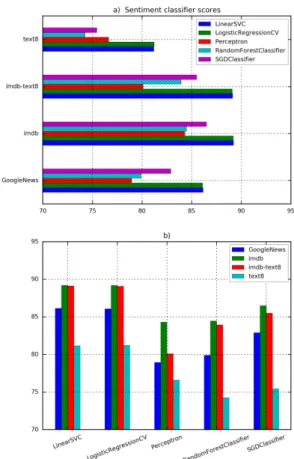
See figure 6 for a better visual comparison of the scores. We can see that the classifiers scored better with IMDB embedding model, despite that GoogleNews model has better accuracy in term of analogy query test. We can also notice that IMDB is still better than its hybrid model text8-imdb which intuitively should enrich the model’s representation capacity by adding more vocabulary (which can be verified by inspected the average retrieval error decrease from imdb to text8-imdb). Reducing AVG_ERR did not improve the classifiers; but on the contrary, com -bining text8 degrades imdb’s performance.
Figure 6. Sentiment classifiers score with each embed -dings. a) embedding models wise results, and b) classifiers
Avoiding bias in IMDB
The training and testing datasets are initially the same corpus that we use to generate imdb embeddings. Thus, and to make sure that our testing is not biased, we used another sentiment dataset (i.e. other than IMDB reviews) to test the performance of the classifier. The dataset con -tains 7086 labeled (positive/negative) training sentences and 33052 unlabeled sentences provided for prediction problems. We used the training data for testing our clas-sifiers, as we were not able to acquire the actual labels of prediction set. As expected, the highest scores of the clas-sifiers still achieved with imdb embeddings.
5. Discussion: Results summary
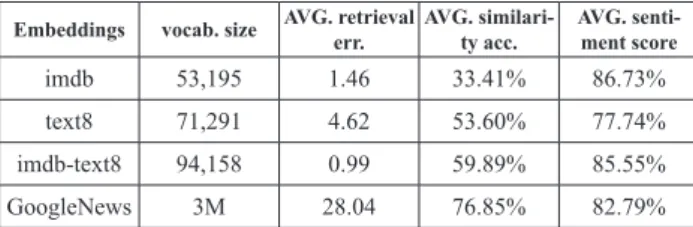
To summarize and aggregate all the results and scores together in one place. We took the average score of all classifiers achieved with each embedding model. These aggregates are displayed in table 4.
Table 4. Summary on the final results for embedding models’ accuracy and classification performance
Embeddings vocab. size AVG. retrieval err. AVG. similari-ty acc. AVG. senti-ment score
imdb 53,195 1.46 33.41% 86.73%
text8 71,291 4.62 53.60% 77.74%
imdb-text8 94,158 0.99 59.89% 85.55%
GoogleNews 3M 28.04 76.85% 82.79%
5.1 Model Accuracy and Classifiers Performance Why IMDB word embedding model is better than Google-News embedding? Learning task-specific vectors through fine-tuning offers further gain in performance. See static vs. non-static representation (section 4.2 of CNN sentence classification [13]).
So, for example, you’d expect words like “amazing” and “awful” to be very far apart whereas in word2vec they’d probably be closer because they can appear in sim-ilar contexts.
In the accuracy evaluation, IMDB model scored 22.94% on the 8182 test cases found (out of the 19544 test cases); while the GoogleNews model scored 74.26% on the 7614 test cases found. Although IMDB model scored less, the sentiment classifiers performed better with it in comparison to the other model.
5.2 Improving Classifiers’ Performance
Although we were not concerned with improving the overall performance of the classifiers, there are several things to consider that can improve the classifiers’ results.
For example, one can apply the ensemble approach, described in [14], that combine multiple baseline models
rather than relying on a single model. Further improve-ment might be introduced by describing the review feature differently, instead of averaging the vectors [15].
Also, while training the vectors, careful choice and tuning of the hyper-parameters could bring much gain to the model accuracy [16]. Finally, one may consider words
dependency instead of relying solely on linear contexts [17].
5.3 Missing Data
When a given token (of a sentence) is not available in the embedding model, its vector value is ignored. However, it is counted toward the sentence length when we take the overall average. Can we do something else about this? e.g. 1) substitute (compute) its value as the average of other tokens in the same review, or 2) do not count it in review length, or 3) apply other known techniques for handling NaN values.
5.5 Average Retrieval Error
After comparing the models' sensitivity to the average retrieval error, we noticed that word retrieval in a model does not affect the overall performance. Possibly, one way to enrich this metric is by introducing word-wise weights. For example, common words can have low weight while the less common ones can have higher weight.
5.6 Extending This Work
We can think of three possible ways to further extend this work. Firstly, expand the models range for broader comparison. For instance, one can integrate more (other) pre-trained models such as GloVe, ELMo, BERT to use in both experiments; embedding quality assessment, and binary classifiers. Secondly, and to enrich the procedure of classification comparison, one can try another approach to aggregating the sentence features (other than averaging vectors for sentence representations). Finally, in this work, we introduced the Average Retrieval Error “AVG_ERR”. We think this measure can be further improved by add-ing weights to words in the sentences. For example, stop words, and common vocabulary can have less weight than those that are more specific.
6. Conclusion
We discussed the problem of choosing between multiple word embedding models. To this end, we made the fol-lowing contributions. We built and trained three different embeddings models based on published data sets. We, then, implemented two types of evaluation methods on the
models. For the intrinsic evaluation, we applied the word similarity measure method; while we did the extrinsic evaluations through a binary classification problem. We presented the results of performance comparisons over four different embedding models. We also introduced a metric for measuring the model’s retrieval rate to the number of queries made. For reproducibility, we released the models, data, and scripts used in our experiments.
We have shown that scoring high accuracy in the Word Similarity Measure test does not imply better performance in the downstream task. In other words, if a model A
achieves a higher score than model B in the analogy ques-tion test, this does not mean A will perform better than B
in a downstream task. This finding is in line with observa -tions from related work. We also observed that the mod-el’s coverage of vocabulary (i.e. vocabulary size) is not as essential as containing a domain-specific dictionary.
References
[1] Tomas Mikolov, Kai Chen, Greg Corrado, and Jef-frey Dean. Efficient estimation of word representa -tions in vector space. arXiv.org, 2013.
[2] Goodfellow, Yoshua Bengio, and Aaron Courville. Deep Learning. MIT Press, 2016. http://www.deep-learningbook.org
[3] Marco Baroni, Georgiana Dinu, and Germ’an Kru-szewski. Don’t count, predict! a systematic compari-son of context-counting vs. contextpredicting seman-tic vectors. In ACL, 2014, (1): 238–247.
[4] Jeffrey Pennington, Richard Socher, and Christopher D Manning. Glove: Global vectors for word repre-sentation. EMNLP, 2014: 1532–1543.
[5] Christopher D Manning. Computational linguistics and deep learning. COLING, 2015, 41(4): 701–707. [6] Wang Ling, Chris Dyer, Alan W Black, and Isabel
Trancoso. Two/too simple adaptations of word2vec for syntax problems. In Proceedings of the 2015 Conference of the North American Chapter of the Association for Computational Linguistics: Human Language Technologies, 2015: 1299–1304.
[7] Amir Bakarov. A survey of word embeddings eval-uation methods. arXiv preprint arXiv:1801.09536, 2018.
[8] Manaal Faruqui, Yulia Tsvetkov, Pushpendre
Ras-togi, and Chris Dyer. Problems with evaluation of word embeddings using word similarity tasks. arXiv preprint arXiv:1605.02276, 2016.
[9] Siwei Lai, Kang Liu, Shizhu He, and Jun Zhao. How to generate a good word embedding. IEEE Intelligent Systems, 2016, 31(6): 5–14.
[10] Tobias Schnabel, Igor Labutov, David Mimno, and Thorsten Joachims. Evaluation methods for unsuper-vised word embeddings. In Proceedings of the 2015 Conference on Empirical Methods in Natural Lan-guage Processing, 2015: 298–307.
[11] Duyu Tang, Furu Wei, Nan Yang, Ming Zhou, Ting Liu, and Bing Qin. Learning sentimentspecific word embedding for twitter sentiment classification. In Proceedings of the 52nd Annual Meeting of the As-sociation for Computational Linguistics, 2014, 1: Long Papers: 1555–1565.
[12] Andrew L Maas, Raymond E Daly, Peter T Pham, Dan Huang, Andrew Y Ng, and Christopher Potts. Learning word vectors for sentiment analysis. In Proceedings of the 49th annual meeting of the associ-ation for computassoci-ational linguistics: Human language technologies. Association for Computational Linguis-tics, 2011, 1: 142-150.
[13] Yoon Kim. Convolutional neural networks for sen-tence classification. arXiv preprint arXiv:1408.5882, 2014.
[14] Gr’egoire Mesnil, Tomas Mikolov, Marc’Aurelio Ranzato, and Yoshua Bengio. Ensemble of gener-ative and discrimingener-ative techniques for sentiment analysis of movie reviews. AAAI Spring Symposium AI Technologies for Homeland Security 200591-98, cs.CL, 2014.
[15] R’emi Lebret and Ronan Collobert. The sum of its parts: Joint learning of word and phrase repre-sentations with autoencoders. arXiv preprint arX-iv:1506.05703, 2015.
[16] Omer Levy, Yoav Goldberg, and Ido Dagan. Improv-ing distributional similarity with lessons learned from word embeddings. Transactions of the Association for Computational Linguistics, 2015, 3(0): 211–225. [17] Edward Grefenstette, Phil Blunsom, Nando de
Freit-as, and Karl Moritz Hermann. A deep architecture for semantic parsing. arXiv preprint arXiv:1404.7296, 2014.