A Process for Selecting Automated Testing
Tools
by John Watkins
UK Technical Support Rational Software
Let's have a show of hands: How many of you feel you have all the time, money, and resources you need to test your software? How many of you are relaxing your
requirements for software quality? Does anyone out there have unlimited time for
testing? And who feels confident they can develop defect-free software? All those who put their hands up can stop reading this article now! As for the rest of us -- the majority of folks who develop
software -- we have to face the fact that we are under intense pressure to deliver software of ever-increasing quality within ever-shorter
development and testing timescales. What can we do?
First, we can leverage improvements in the management of testing and the testing process to make testing as effective and efficient as possible. We can also use automated software testing tools to improve quality and cut back on the time, effort, and costs involved in testing. But to identify and purchase the right testing tools for our respective organizations, we have to expend precious time, money, and staff resources. How can we afford to do this when we're already so painfully short on these things?
Let me assure you: You are not the first or only software developer to face this dilemma, and the situation is not hopeless. This article describes a process you can use to simplify the selection of an automated tool that matches your own particular testing requirements.1 The process is based
on a number of sources, including work I have conducted on behalf of numerous clients as well as a vast body of feedback from organizations
http://www.therationaledge.com/content/apr_01/t_testtools_jw.html Copyright Rational Software 2001
engaged in evaluating software testing tools. Briefly, we will discuss:
● Whether you really need an automated testing tool
● Why it is necessary to perform a formal evaluation
● The process of identifying and documenting your testing requirements
● How to research the market and generate a short-list of tools
● Why you should invite suppliers in for presentations
● The role of product evaluation in selecting the right tool
● Post-evaluation activities
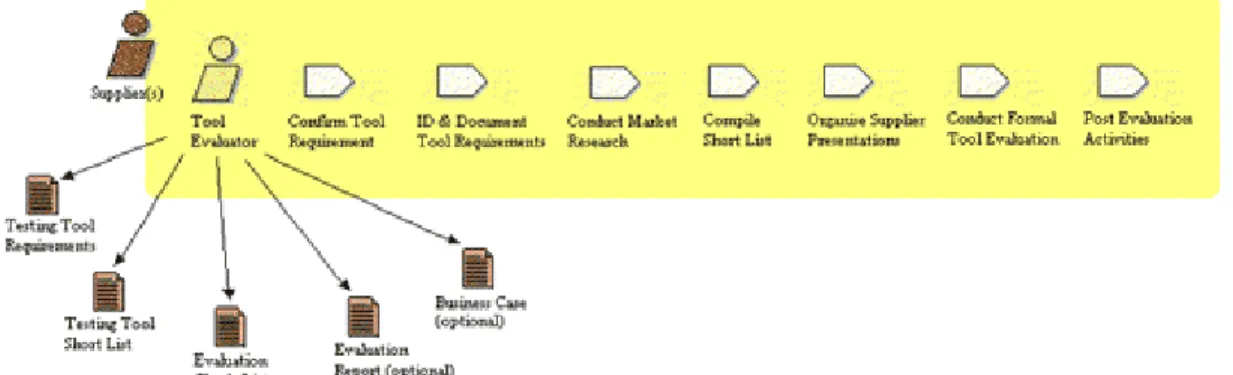
Figure 1 provides a "road map" of this process, showing the stakeholders, the activities that need to be performed, and the artifacts that need to be created. The notation follows Philippe Kruchten's specifications for the Rational Unified Process.2
Figure 1
Click here to view full size graphic.
Do You Really Need An Automated Testing Tool?
Undoubtedly, you have some issues with your current approach to testing, but do you really need a testing tool? Before rushing out to buy one, you should first consider the following:
● Tools cost money -- money that might be spent more effectively. For example, could an investment in training help address your testing problems?
● Are you managing your approach to testing efficiently? Could better management techniques be a solution?
● Could adopting an effective development and testing process (such as the one outlined in the Rational Unified Process) be of benefit?
● If you have a short-term or infrequent requirement for testing, would it be more cost-effective to outsource the testing?
Another caution: Do not even think of rushing out to buy a testing tool if your project is in crisis. Wait until you can devote the time and effort required to introduce a new tool properly -- and expect to use it a few times before you see any real productivity gains.3 There are genuine
benefits to be gained by using these tools -- but only through a planned and managed introduction, and through continued use and re-use of the test suite that you will develop.
So when should you use an automated testing tool? Such products are particularly appropriate if you have:
● Frequent builds and releases of the software you are testing
● A requirement for thorough regression testing, and particularly for business critical, safety critical, and secure or confidential software systems
● Software involving complex graphical user interfaces
● A requirement for rigorous, thorough, and repeatable testing
● A need to deliver the software across many different platforms
● A need to reduce timescales, effort, and cost
● A requirement to perform more testing within shorter timeframes If you have one or more of the above requirements, then you should investigate what benefits you could gain from testing tool use.
Why Follow a Formal Selection Process?
Most suppliers will tell you that their tool is clearly the best, is incredibly easy to use, and will of course solve all your testing problems. The reality is that you have a unique set of requirements, and you must make sure that any tool you select satisfies those requirements.
Furthermore, many suppliers will insist that you should buy their tool because it is the market-leading product and therefore must be the best. Be careful not to rely on such claims. What is important is that the tool match your specific testing requirements. EXE Magazine recently
commissioned a study that showed that the top five issues for tool purchasers were: reliability of the tool, good match to requirements, adequate performance, ease of use, and good documentation. Market leadership was ranked as the least important issue, in fifteenth place! The bottom line is that adopting a tool requires a significant investment in time, effort, and money. Before committing your organization and its resources, you should assure yourself that the tool you choose will match your testing requirements. To do this, you should adopt a formal process for identifying the right tool and be able to demonstrate its rigor to your managers and colleagues.
Identify and Document Your Testing Tool
Requirements
During the process of determining whether you need a tool, you must consider your specific testing requirements for such a tool. For example:
● The tool must support functional testing and regression testing
● Process support must be available for the tool
● The tool must seamlessly integrate with other development tools Make sure that you document your specific requirements; they will be used later. As you compile your set of requirements, try to determine just how important each one is and assign it a weight to indicate its
significance. Most organizations use a simple, three-category approach: "Essential," "Important," and "Desirable."
Maintain the requirements information as a live document; you are almost certain to add requirements as the evaluation process continues and to relax or strengthen the weightings of existing requirements.4
All right. Armed with your documented testing tool requirements, you are now ready to do some market research.
Conduct Market Research and Compile a Short-List
of Tools
The next task in the evaluation process is to identify those testing tools that most closely match your requirements. This is a two-step activity:
● First, identify a collection of candidate tools that loosely match your high-level, or "Essential," requirements.
● Second, review the candidate tools more rigorously to reject those products that fail to match your "Essential" and "Important"
requirements. This may involve contacting the supplier, obtaining product brochures, and visiting the supplier Web site.
To identify the candidate tools, you can use many sources of information, including:
● Testing trade magazines (such as The Professional Tester)
● Special interest group meetings (such as the British Computer
Society Specialist Interest Group in Software Testing [BCS SIGiST] group)
● Testing exhibitions, tools fairs, and conferences (such as QBIT's Testing Week)
● Analyst publications (such as those produced by IDC, Gartner, Ovum, and other consulting firms)
● The Web
The output from this task will be a short-list of tools and contact details for their suppliers. Ultimately, you should narrow your list to just two tools, which you can then investigate in greater detail.
Invite Suppliers to Give Presentations
Once you have your short-list, it is time to determine which tool best matches your requirements as a prelude to formally evaluating that tool. A particularly effective strategy for making this determination is to ask suppliers to do presentations for the tools on your short list. Contact the suppliers and outline your requirements. Or consider giving them a copy of the requirements; trustworthy companies will quickly let you know
whether there is a good match and thus avoid wasting both your time and theirs.
Propose that the supplier organize a presentation of their tool based on your particular requirements, and consider providing them with a copy or sample of your application so they can use it -- rather than some demo application -- for their presentation. Then, prepare for the presentation by reviewing your requirements and formulating questions for the supplier. It may also be beneficial to send the supplier an agenda that describes what you expect to see.
During the presentation, make sure you take notes documenting the progress of the event, the answers to questions you ask, and any further questions that are raised. Do not be afraid to press the suppliers if they seem to be skipping over some aspect of the tool or fail to answer any of your questions adequately. Their reticence may be quite innocent, but it may also be a tip-off to a weakness or limitation of the tool. Finally, remember that you are in charge, but be a good host, too: you may end up working with these people if you purchase their tool!
If you have short-listed two suppliers, it can be very effective to see them both on the same day (one in the morning and one in the afternoon). Plan to review results immediately after the presentations, when both are fresh in your mind. Evaluate how well the tools met your requirements, and determine if you have further questions or need clarification on anything from the supplier. If you do have further questions, then document them and provide them to the supplier.
When you get the answers to your questions, you should have enough information to select one of the short-listed tools for formal evaluation. Or, if your organization has sufficient time, resources, and funds, you may want to conduct a formal evaluation of both tools on your list.
Formally Evaluate the Tool of Choice
After selecting the tool you believe most closely matches your
to demonstrate that it will be able to satisfy your requirements in practice (that is, in your test environment and with your software). This exercise is often referred to as a "Proof of Concept."
Contact the supplier and ask for an evaluation copy of the tool. Most suppliers will provide you with a full working copy of the product, which is typically licensed for 30 days. Ask what support is available to you during the evaluation period. (Will the supplier provide assistance with
installation? Whom should you contact for technical support? Is documentation available to help support your evaluation?)
Run the evaluation as a formal project, and ensure that adequate
commitment is available from senior management in terms of timescales and resources (Figure 2 provides a typical project plan for an evaluation). Within your evaluation plan, include a number of milestones at which you will formally contact the supplier to review progress and address any issues raised by the evaluation.
Use your formal requirements document to evaluate the tool, taking into account the weightings for each requirement and identifying how well the tool satisfies that requirement.
After evaluating the tool, you should document the results in an Evaluation Report. This may be as simple as a checklist with the requirements, their weightings, and the evaluation score, or as formal as a written report. Consider providing the supplier with a copy of the report so that they can review your results. If you have misunderstood some aspect of the tool and assigned it a low score with respect to an associated requirement, then the supplier will be able to advise you of the misconception and explain how the requirements can be satisfied.
In addition to an Evaluation Report, you may also need to produce a Business Case document for senior management containing
recommendations on the acquisition of the tool as well as return on investment calculations.5
Once you complete the evaluation, you should review the results and decide on next steps. If the evaluation was satisfactory, then you will need to consider the best way to acquire the product.
Plan Your Tool Purchase and Introduction
When you are ready to purchase the testing tool, there is a new set of issues to consider.
The first thing to determine is the number of licenses you need to buy to allow best use of the tool within your organization. You will also need to consider the issue of fixed licenses (typically tied to a particular
workstation) versus floating licenses (typically installed on a server and issued on a first-come, first-served basis). Floating licenses will give you more flexibility in making the tool available but will almost certainly cost more than the equivalent in fixed licenses. In determining the number of licenses, remember that most suppliers offer volume discounts. Ask your
supplier what the break points are so that you can take advantage of these discounts if possible.
Although in general terms, it makes good business sense to inquire about discounts, be careful not to let your pride in bargaining skills get in the way of obtaining a product that will benefit your organization. As
incredible as it may seem, potential buyers frequently walk away from a purchase just because the supplier cannot reduce the purchase price by a trivial sum.
On the other hand, you should also be very wary of suppliers who will suddenly slash the price of their product as soon as they hear that one of their competitors is involved. You will have to work with the supplier following your purchase (perhaps for training and mentoring as well as ongoing support), so it is worth questioning the business ethics of any supplier who was perfectly happy to charge you X one day and then
suddenly charge you half that amount just a few days later for exactly the same product (while presumably still making a profit). This behavior does not bode well for an ongoing business relationship, and suppliers who indulge in such activities are almost certain to find ways of recouping the discount at a later stage -- otherwise their business would be
unsustainable.
The organizations that gain the greatest benefits from tool use plan and manage the introduction of new products into their development
environments. Plan on doing some training before the installation, for example. Initial mentoring by both vendor representatives and a small group of well-trained employees can ensure correct and effective use of the tool throughout your testing team. Also, consider the potential benefits of planned consultancy visits throughout the testing project; think of these as "health checks" to ensure continued effective and efficient use of the tool. One organization that followed this route claims to have cut the initial time and effort they spent on testing by 35 percent.6
Finally, once the tool is up and running, persevere. You will not reap great benefits from your purchase unless you continue using it to support your testing activities. The more often you re-use the test scripts you create, the more savings you will realize in terms of time, effort, and cost.
1 For more information, you can also consult my whitepaper on this subject, which provides
more detail on evaluating testing tools, an evaluation project plan, an evaluation criteria and scoring scheme, an evaluation checklist and report, and business case templates. You'll find a current version here [Word Doc, 237KB]. The Letters section of the May issue of The Rational Edge will publish a URL for the final version.
2 In Philippe Kruchten, The Rational Unified Process. Addison-Wesley, 1998.
3 One of the case studies in Automating Software Testing, by D. Graham, D. and M. Fewster
(Reading, MA: Addison-Wesley, 1999) does describe an organization that benefited after just two uses of a software testing tool, but this is definitely an exception.
4 My white paper (see Footnote 1) provides comprehensive guidance and advice on
evaluation.
5 My white paper (see Footnote 1) provides re-usable templates for both the Evaluation
Report and Business Case document.
6 See "Crown Management Systems Limited Case Study," Crown Management Systems and
Rational Software, 1999. Available from [email protected].
For more information on the products or services discussed in this article, please click here and follow the instructions provided. Thank you!