ScholarWorks@UMass Amherst
ScholarWorks@UMass Amherst
Doctor of Nursing Practice (DNP) Projects College of Nursing
2019
Promoting Sleep Health Through Identification and Management
Promoting Sleep Health Through Identification and Management
of Obstructive Sleep Apnea
of Obstructive Sleep Apnea
Melissa VuoloFollow this and additional works at: https://scholarworks.umass.edu/nursing_dnp_capstone Part of the Family Practice Nursing Commons
Vuolo, Melissa, "Promoting Sleep Health Through Identification and Management of Obstructive Sleep Apnea" (2019). Doctor of Nursing Practice (DNP) Projects. 205.
Retrieved from https://scholarworks.umass.edu/nursing_dnp_capstone/205
This Open Access is brought to you for free and open access by the College of Nursing at ScholarWorks@UMass Amherst. It has been accepted for inclusion in Doctor of Nursing Practice (DNP) Projects by an authorized administrator of ScholarWorks@UMass Amherst. For more information, please contact
Promoting Sleep Health Through Identification and Management of Obstructive Sleep Apnea
Melissa M. Vuolo
University of Massachusetts, Amherst College of Nursing
DNP Project Chair: Pamela Aselton
Mentor: Linda Romano
Table of Contents
Abstract ...4
Introduction ...5
Background ...5
Problem Statement ...6
Organizational “Gap” Analysis of Project Site ...6
Review of the Literature (related to evidence based practice/s to address the problem) ...7
Evidence Based Practice: Verification of Chosen Option……….……10
Theoretical Framework/Evidence Based Practice Model………...…11
Goals, Objectives & Expected Outcomes ………..11
Project Design ………12
Project Site and Population ...12
Methods………..………12
Measurement Instrument(s) ...13
Ethical Considerations/Protection of Human Subjects ………..14
Data Collection Procedure ...15
Data Analysis ...16
Results………..16
Setting Facilitators and Barriers ...19
Discussion………19
Cost-Benefit Analysis/Budget ………...21
Conclusion………..21
References ...23
Appendix A Gap Analysis ………..27
Appendix B Theoretical Framework ………..28
Appendix C Screening Tool…….……….………..29
Appendix D Post Survey………..………...31
Appendix E Budget Table ……….………….32
Appendix F Timeline ……….………….33
Abstract
Background: There is a high prevalence of obstructive sleep apnea in the United States, which left untreated can lead to increased cardiovascular risk. The current practice standard is to use a questionnaire to evaluate a patients’ sleep health, but this is not done regularly in every clinical setting. This DNP project aimed to bridge the gap in practice by implementing regular screening of obstructive sleep apnea in an urgent care center in Massachusetts.
Methods: This DNP project was conducted by having adult patients complete the Epworth Sleepiness Scale to determine the presence of a sleep health issue. The patients then completed an additional survey to determine if they have been screened in the past, and their attitudes toward the screening. The urgent care manager provided the screening tool to patients based on the inclusion criteria of being 18 years or older and the ability to read/speak English.
Results: Data was collected from 54 patients 18 years or older over a three-month period. Eleven were excluded because they had sleep apnea, were already being treated, or did not answer all questions of the survey. A total of 18 patients screen positive for sleep apnea with 88% of participants reporting not having been screened for sleep health issues prior to this screening and 72% of participants reporting the tool was beneficial and easy to complete.
Conclusion: Most people with sleep health issues in this urgent care clinic were not aware of their risk and had not been screened prior indicating a need for regular screening in Urgent Care practice settings. At this time the urgent care center will not be implementing a change in practice, but they are interested in the possibility and will consider implementing routine screening in the future.
Promoting Sleep Health Through Identification and Management of Obstructive Sleep Apnea Introduction
Obstructive sleep apnea (OSA) is a condition in which the patient’s airway collapses during sleep, which prevents proper airflow. When the airway collapses, sleep duration is shorter, and sleep may be interrupted by gasping, snorting or choking throughout the night (MedlinePlus, 2016a). Failure to identify a sleep health condition can have a negative impact on an individual’s overall well-being, because interrupted sleep can lead to clinically significant problems that go untreated. The patient with a shorter sleep duration is at risk for stroke, hypertension, and cardiovascular disease (Itani, Jike, Watanabe & Kaneita, 2017). There are providers who specialize in sleep apnea, but there is a need for more attention to the condition in primary care. This DNP project aims to demonstrate the importance of regular screening for obstructive sleep apnea so that treatment can be started early to reduce cardiovascular risk. Background
Over 33% of adults in the United States report that they do not get enough sleep at night. When an adult is not getting enough sleep at night their risk for chronic diseases increases. For example, an adult getting fewer than seven hours of sleep is at an increased risk for conditions including cardiovascular disease, stroke, and obesity (Centers for Disease Control and
Prevention, 2014). In Massachusetts, for example, at least 20% of patients who have short sleep durations also have other risk factors for chronic illness including obesity, physical inactivity, smoking, and high alcohol consumption (Centers for Disease Control and Prevention, 2014).
While these statistics suggest a need for regular screening in primary care practice, there is not regular screening being done in all settings of the health care community. There are
settings screening is lacking. An annual physical typically includes lab work to assess cardiac risk, yet sleep health, even though it is also correlated with cardiac risk, is rarely examined. Screening for sleep apnea through a self-reporting questionnaire is even less invasive for the patient than a blood draw and can help to identify cardiac risk so that steps can be taken to reduce that risk. Wider screening for sleep health issues is needed, as the CDC data mentioned over 20% of people with short sleep duration have other risk factors, but there are 80% left who would not be flagged as potentially having a risk unless sleep health issues are a part of the overall assessment in primary care
Problem Statement
The risk of cardiovascular disease among adults is indicated by unhealthy sleep patterns and results from undetected sleep apnea from lack of obstructive sleep apnea screening. This DNP project aims to implement regular screening of obstructive sleep apnea using the Epworth Sleepiness Scale. This regular screening will detect those at risk for sleep apnea and allow intervention to take place earlier to decrease cardiovascular disease.
Organizational “Gap” Analysis of Project Site
The best practice to screen for sleep health issues is using a questionnaire, but it is not done across all practice settings (see Appendix A). Sleep health is evaluated in various clinical settings including primary care and specialist practices. A potential gap in practice is that there is no universal understanding as to which clinical setting is responsible for initial assessment of sleep health. Therefore, sleep screening practices vary, and so some patients are likely to go unscreened. Urgent care centers, clinics and emergency services are among the settings where sleep questionnaires are rarely used. The clinical practicum urgent care site where this project will take place does not have procedures to screen for sleep health related issues, but it should.
Review of the Literature
A review of the literature was conducted to identify the most appropriate intervention to address the gap of lack of screening for sleep apnea. The databases utilized for the review were CINAHL, PubMed, and National Guideline Clearing House. The search terms used were
obstructive sleep apnea screening, sleep health educational guide/intervention, treatment of obstructive sleep apnea and cardiovascular disease. The CINAHL database was searched for all three terms, yielding a total of 110 articles, of which seven were included in analysis. The PubMed database was searched for obstructive sleep apnea screening, yielding 20 articles of which two were selected for this review. The National Guideline Clearing House search
produced 28 articles, one of which was included due to its comprehensive information on clinical guidelines of sleep apnea.
Articles were included in the analysis if they were published within the last five years, had full text available to view, and showed valid reliable findings. Reliability of findings was determined using Shekelle, Woolf, Eccles & Grimshaw’s (1999) recommendations regarding levels and grades of evidence. They categorized articles by type of evidence Ia-LB (i.e. Ia meta-analysis randomized control trials, Ib evidence form randomized control trial), strength of recommendation A-D (i.e. A indicates study based only from category I evidence), or not rated.
The articles utilized in the analysis span a diversity of research formats, including meta-analysis, randomized control trials, evidence-based practice, and descriptive studies. Articles were excluded if they described research with fewer than 100 participants, if their data was not reliable according to Shekelle, Woolf, Eccles & Grimshaw’s (1999) recommendations, and if they were not relevant to the current inquiry.
The studies used in this review of literature identify a need for obstructive sleep apnea screening across various populations and identify the use of a self-reported questionnaire as the best practice tool. The primary benefit of the screening tool is to identify undiagnosed sleep apnea and identify improved sleep health. Through the use of a self-reported screening tool by the patients it provides them education on sleep health.
Sleep Evaluation Tool: Self-reported Questionnaire
Several studies conducted used a self-reported questionnaire to evaluate sleep health. Bonuck, Blank, True-Felt, & Chervin (2016), implemented a trial study using questionnaires to help promote sleep health. The research they completed prior to implementing their trial study indicated self-reporting/questionnaire is the most effect way to assess sleep health. Todd & Millan (2013) implemented a randomized control study with 190 college students to complete a sleep diary, control questionnaire, and monitoring diary. The results showed when self-monitoring was applied those individuals avoided obnoxious stimuli that hinder their sleep previously.
Bhattacharyya (2015) analyzed data from tens of thousands who completed a risk factor questionnaire from the Centers for Disease Control and prevention. Those who reported snoring had a decreased sleep time, and those who snore were more likely to fall asleep when driving. Bonzelaar, Salapatas, Yang & Friedman (2017) implemented the Epworth Sleepiness Scale (ESS) questionnaire to assess for sleep apnea based on the opinion of the patient and the patient’s partner. Results indicated that the questionnaire can be completed together by patient and partner for more accurate indication of sleep apnea.
Migacz, Wichniak & Kukwa (2017) conducted a study on over 300 university students to identify those with sleep disorder with self-reported questionnaire who should be sent for further
screening. The study suggests the screening questionnaire is the initial step to determine if sending for further diagnostic testing is needed.
Burns (2014) completed a meta-analysis to determine the best screening tool to be used for obstructive sleep apnea in commercial drivers. It was determined that commercial drivers should be screened annual by primary care with the use of valid screening tool such as, ESS, STOP-BANG questionnaire, and BQ questionnaire. These authors all used a self-reported screening tool as a standard way to detect for sleep health issues.
Multiple studies use a self-reported questionnaire as tool to help determine health
outcomes. Williams (2017) implemented the use of the STOP-BANG questionnaire to screen for obstructive sleep apnea in patients needing surgery at a military hospital. This implementation was done as many patients were going undiagnosed with obstructive sleep apnea, which can lead to poor health outcomes related to surgery. Antony et. al (2014) conducted a prospective trial study to screen for sleep apnea using the ESS questionnaire and Berlin Questionnaire (BQ), to determine any association of perinatal outcomes. The results show with pregnancy the BQ questionnaire showed more accuracy in screening for sleep apnea.
Andrechuk & Ceolim (2015) conducted a cross sectional study using the Epworth
Sleepiness Scale to determine the link between sleepiness and acute Myocardial Infarction (MI). Thirty percentage of patients with an MI had excessive sleepiness. These results showed daytime sleepiness should be routinely assessed for prevention of cardiovascular risk. Dilektasli &
Dilektasli (2016) conducted a study with 59 patients to determine if sleep apnea improved after having a gastric weight loss procedure. The use of the Epworth sleepiness scale six months post op showed improvement in sleep apnea. This study was selected as it demonstrates the reliability of the use of a self-reported questionnaire to assess for sleep apnea.
National Guideline Clearinghouse (2017) provides the evidence based guidelines for the treatment and diagnosis of sleep disorder and can be used for education to the public. The first recommendation is the use of self-reported questionnaires, and then a clinical tool if necessary such as a sleep study to be used to diagnose someone with obstructive sleep apnea. Obstructive sleep apnea prevents the body from reaching the REM phase of sleep because each time
breathing is interrupted, the patient wakes up partially to restart breathing. The treatment is the use of a continuous positive airway pressure (CPAP) device, which keeps the airway open leading to a more restful sleep.
This review of literature strongly demonstrates the most effect way to screen for obstructive sleep apnea among various populations is through the use of a self-reported
questionnaire. The benefit of the self-reported screening tool is to identify patients undiagnosed with sleep apnea, use as a diagnostic tool to identify improved sleep health, and it provides patients with education on sleep health. The limitation of the articles is that not all patient outcomes were provided. The review of literature demonstrates prevention screening in primary care is the best way to identify obstructive sleep apnea.
Evidence Based Practice: Verification of Chosen Option
There is evidence that identifying and treating obstructive sleep apnea leads to reduced cardiovascular risk. A self-reported questionnaire is a powerful instrument for identifying unrecognized cases of OSA in patients who are unaware of their symptoms of who may not realize their symptoms are important. This DNP project will promote sleep health through implementing routine evaluation for sleep apnea in an urgent care center practice setting. Standard screening for sleep apnea will allow for early intervention and treatment where appropriate, which will improve quality of life and reduce cardiovascular risk.
Theoretical Framework/Evidence Based Practice Model
Orem’s Self-Care Deficit theory (2001), emphasizes the important of patients being involved in their own care. Orem’s theory points out that for an individual to take steps to promote health or prevent a future illness, the person must first be aware that they are at risk for a potential problem. An individual will develop self-care behaviors when they are aware
something could affect their health (Petiprin, 2016).
Orem’s theory outlines daily essentials needed for self-care to promote human
functioning. These essentials include air, food, balance of rest and activity, as well as preventions of hazards to human well-being. The theory also identifies nursing as an action to be put in place when there is a self-care deficit a patient cannot resolve on their own (Petiprin, 2016).
As mentioned above sleep apnea is caused by blocking airflow, which causes restless sleep and leads to poor health outcomes. The “action” of the quality improvement project is routine screening for sleep apnea, as it will bring awareness to patients and promote essentials needed for human functioning. This DNP project aims to identify the self-care deficit with undetected sleep apnea, maintain the essentials of human well-being, and put into action a plan for practice to address the deficit. See Appendix B for a diagram of Orem’s framework.
Goals, Objectives and Expected Outcomes
The goal of the quality improvement project was to demonstrate the integration of routine screening of sleep health in an urgent care center setting to improve patient health.
The objectives for this DNP project included:
2. Raise patients’ awareness of the importance of sleep health and the risks of obstructive sleep apnea through completion of the Epworth Sleepiness scale screening tool (Appendix C).
3. Through raising patients’ awareness, lead patients to advocate for themselves. Project Design
This DNP project introduced routine screening of obstructive sleep apnea in patients who visited an Urgent Care Center in the Northeast. It implemented the use of the Epworth Sleepiness Scale (Appendix C) a screening tool and a post survey consisting of questions designed to
quantify results for the expected outcomes (Appendix D). Project Site and Population
The project site was an urgent care center in Massachusetts with physicians, nurse practitioners, and physician assistance available to treat patients. There are multiple examination offices used and when full patients wait outside in a waiting area. The urgent care center serves the community as a source of care for minor illnesses, health/wellness screenings, and education on health maintenance topics, such as STI prevention, nutrition, and vaccination. The community has a population of about 34,000, with a median age of about 40, and almost an equal 50/50 ratio of male to female population (TownCenter, 2018). The urgent care center treats patients ten years of age or older who are predominately white. Nearby the urgent care center there was a mental health facility, primary care & specialist physician offices, grade schools and a college, which majority of this population frequents the urgent care center.
Methods
This DNP project was conducted in the Fall 2018 semester using The Plan Do Study Act (PDSA) framework (Agency for Healthcare Research and Quality, 2015). The “plan” for this
project was to distribute the screening tool and questionnaire to all patients 18 years of age or older and ask them to complete and return the documents during their visit. The “do” for this project included observing patients’ responses upon receiving the project documents. For example, did they read them, or ignore them? was there enough time for completion while waiting for the doctor? The “study” aspect of this project examined whether enough patient returned questionnaires each week to meet the project’s target numbers and assessed what if anything needed to be changed in the process to help it go smoothly and collect sufficient data. The “Act” part of this project consisted of adjusting the process of dissemination questionnaires based on findings from the plan, do, and study phases. This framework was chosen because it allows for evaluation and changes in process, as needed, throughout the implementation of the project.
Measurement Instruments
The measurement instruments used in this DNP project were the Epworth Sleepiness Scale (ESS) (see Appendix C) and a custom questionnaire to quantify expected outcomes of this DNP project (Appendix D). The Epworth Sleepiness tool is available for public use and is a widely-used questionnaire that assesses patients’ risk of obstructive sleep apnea. The
questionnaire is self-administered and asks participants to rate their likelihood of dozing off in a series of 8 scenarios. The custom follow-up questionnaire was designed by the DNP student to elicit data to quantify outcomes. The Epworth Sleepiness tool and the questionnaire were completed prior to the patient seeing the practitioner.
The ESS score is the sum of the 8 responses, each measured by a self-rating on a 0-3 scale of how likely you are to doze in certain situation. A 0 would indicate no dozing and a 3 would indicated a high probability of dozing. A total score over 10 (of 24 possible points)
indicates risk for sleep apnea and need for further testing (Johns, 1991). The ESS was originally validated in a study with 180 participants (30 of whom were control subjects) and was shown to be a valid measure of sleep tendency in adults. Higher ESS scores correlated to moderate to severe OSA (Johns, 1991). The ESS has since been tested with a variety of populations in English and other languages, and results consistently affirm its validity (Baumgartel, Terhorst, Conley & Roberts, 2013). For example, Spira et al. (2012) tested the reliability and validity of the ESS with a sample of 3,059 participants and confirmed that ESS was a valid and reliable measure of risk for OSA.
After completing the ESS, participants completed a custom questionnaire (Appendix D), designed by the DNP student to measure the benefit to the patient of completing the ESS. The questionnaire asks participants three questions: Have you been screened for Sleep Health issues by any physician, prior to today? Did you learn anything about sleep apnea/sleep health through this screening? Now that you have been screened, will you discuss sleep health with your physician?
Ethical Considerations/Protection of Human Subjects
This DNP project was a process change for practice and patients’ participation was voluntary with participants being able to opt out at any point. The DNP student completed training on and must strictly followed HIPAA and confidentiality policies of the Urgent Care Center. All participants were protected by the Health Insurance Portability and Accountability Act of 1996 (HIPAA) which, among other guarantees, protects the privacy of patients’ health information (Modifications to the HIPAA Privacy, Security, Enforcement, and Breach Notification Rules, 2013).
This DNP project was reviewed by the IRB at the University of Massachusetts Amherst and waived of any human subject concerns as a quality improvement project. Additionally, the DNP student and practice personnel followed the Standards of Care for practice in a primary care office. All information collected as part of evaluating the impact of this project was reported in the aggregate, and no potential patient identifiers were shared outside the project team. The risk to patients participating in this project is no different from the risks of patients completing the questionnaires on their own without physician involvement.
Data Collection Procedures
Data collection occurred in an urgent care clinic serving patient population of 10 years or older in the Dartmouth, Massachusetts area. When 18 years or older patients checked in, the urgent care manager explained the purpose of the DNP project and invited the patient to participate. Through this initial explanation, patients received education on sleep health, and sleep apnea even if they chose not to participate. Patients who chose to participate first
completed the ESS screening tool and then the follow-up questionnaire. Collection was halted after approximately 12 clinic days. Patients’ screening results were excluded if they answered yes to either of the following questions prior to starting the questionnaire:
Do you currently have a diagnosis of sleep apnea?
Are you being treated for sleep apnea currently, and/or are you in the process to be treated for sleep apnea?
Approximately 5-10 responses were collected weekly from the urgent care manager. After each week, the student analyzed the data and completed a narrative assessment of how smoothly the process was going. These summary findings were shared with the student’s preceptor, and no adjustments were needed.
Data Analysis
The results of the screening tool and follow-up questionnaire were summarized, and descriptive statistics were updated through weekly counts of the screening/questionnaire results to produce means, ratios, and percentages. This data was entered an Excel spreadsheet, which was password protected and only accessible to the DNP student and those involved in the DNP project. Patients whose screening resulted indicated a possible sleep health issue were advised to reach out to their physicians. The responses to the questionnaires were analyzed by taking the mean score of those above and below the threshold of the screening tools at risk level (i.e. <10 score no risk, >10 score at risk).
The post questionnaire data was analyzed through counts to create percentages to determine whether patients in the general population attending urgent care settings are going undiagnosed with sleep apnea and secondly whether they feel more informed about sleep health after the screening. These factors are important indicators of whether implementation of regular screening would be beneficial.
Results
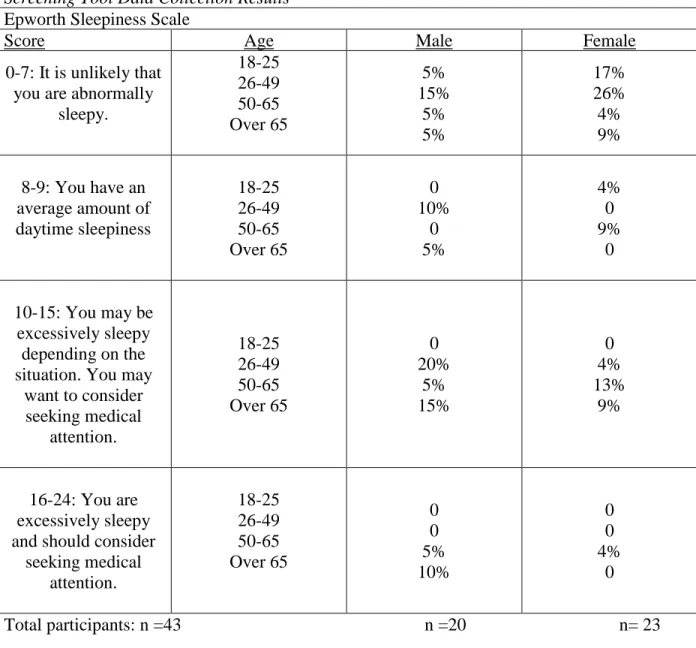
The data was collected from 54 adult patients aged 18 and older. All participants read and spoke English. Of those who completed the screening eleven participants needed to be excluded from the data set for the following reasons: three because they did not indicate age or gender, six because they were already being treated for sleep apnea, and two because they did not complete all the questions of the questionnaire.
The final sample consisted of 43 participants in the questionnaire, of whom 20 were male and 23 were female.
Table 1
Screening Tool Data Collection Results
Epworth Sleepiness Scale
Score Age Male Female
0-7: It is unlikely that you are abnormally
sleepy. 18-25 26-49 50-65 Over 65 5% 15% 5% 5% 17% 26% 4% 9% 8-9: You have an average amount of daytime sleepiness 18-25 26-49 50-65 Over 65 0 10% 0 5% 4% 0 9% 0 10-15: You may be excessively sleepy depending on the situation. You may
want to consider seeking medical attention. 18-25 26-49 50-65 Over 65 0 20% 5% 15% 0 4% 13% 9% 16-24: You are excessively sleepy and should consider
seeking medical attention. 18-25 26-49 50-65 Over 65 0 0 5% 10% 0 0 4% 0 Total participants: n =43 n =20 n= 23 The Epworth Sleepiness Scale (ESS) screening tool (Appendix C), screened 25% at-risk patients seen in practice. Of male participants, 55% had an Epworth Sleepiness Scale of 10 or greater, indicating a possible sleep health issues and need for further evaluation. Of female participants, 30% had an Epworth Sleepiness Scale of 10 or greater. According to the Centers for Disease Control and Prevention (2014) sleep duration can vary across sex and age.
Table 2
Follow-up Questionnaire Data Collection Results
Follow-up Questionnaire
Question Age Male
YES NO
Female YES NO Have you been
screened for Sleep Health issues by any physician, prior to today? 18-25 26-49 50-65 Over 65 0 5% 5% 40% 5% 10% 15% 20% 4% 17% 0 30% 4% 26% 4% 13%
Did you learn anything about sleep apnea/sleep health through this screening? 18-25 26-49 50-65 Over 65 5% 0 30% 15% 15% 0 25% 20% 17% 4% 22% 9% 26% 4% 9% 9%
Now that you have been screened will you discuss sleep health with your physician? 18-25 26-49 50-65 Over 65 0 5% 20% 25% 15% 0 20% 15% 4% 17% 4% 26% 17% 13% 9% 9%
Do you think this screening was time-consuming? 18-25 26-49 50-65 Over 65 0 5% 0 45% 0 15% 5% 30% 0 22% 0 30% 0 30% 0 17%
Do you think this screening was beneficial? 18-25 26-49 50-65 Over 65 5% 0 20% 25% 10% 5% 25% 10% 22% 0 22% 9% 22% 9% 17% 0 Total participants: n = 43 n = 20 n = 23
The majority (60%) of the male participants found the screening tool beneficial and only 5% found it time-consuming with 55% of the male participants reporting they will discuss sleep health with their physician. Most (63%) of the female participants also found the screening tool beneficial and none found it time-consuming with 34% of the female participants reporting they will discuss sleep health with their physician.
This DNP project results indicated that 55% of males and 30% of females that were screened were are at risk for sleep health issues and would need further evaluation. The post survey results also indicated that 55% of males and 34% of females will now discuss the topic of sleep health with their providers based on this screening.
Setting facilitators and barriers. The main facilitator of this project was the structure of the
urgent care center and the participation of the urgent care manager in the project. Those whom visited the urgent care center, after they registered to be seen, were 18 years or older, read and spoke English, were asked to voluntarily participate by the manager. The manager is a facilitator because she knew the process of the urgent care center and how to ask patients to voluntarily participate without affecting the flow of their visit.
It was initially difficult in getting the completed surveys from the manager, as her schedule differed from the DNP student’s schedule, and she had prescheduled vacation time. Therefore, the manager was emailed prior to pick up of the surveys to set a meeting time to assure surveys were available to pick up. Another barrier to the project was that some patients did not fill out the survey completely, and therefore they were excluded from the results. Discussion
The main findings of the literature review were that sleep apnea screening was not being conducted for prevention in the urgent care setting. When a patient was assessed for sleep health problems in the primary care settings, like Cardiology and Neurology, an evidence based self-reported questionnaire was used as the initial step to determine if further evaluation was needed. This project utilized the same sort of measurement, but in an urgent care setting as they had no protocol to assess for sleep health conditions. The results of this project indicate that only 5% of
the participants found the screening time consuming, which indicates that the questionnaire’s use in this setting is feasible and effective.
The theoretical framework that guided this project was Orem’s Self Care Deficit Theory (2001). The main point of the theory is a patient cannot take steps to promote their health or prevent future illness if they are not aware they have a risk. The results indicated that 88% of the participants had not been screened for sleep health issues prior to participation, which indicates a need to bring awareness. Once they completed the survey 72% of the participants reported they found this screening tool beneficial. Furthermore, participants were now made aware of the risks and the results indicated 55% of males and 34% of females, will discuss with their results with their physician. Therefore, paralleling Orem’s Theory, through bringing awareness to
participants through completion of this self-reported questionnaire they can advocate for themselves with their physicians to help prevent future illness.
This project included 54 participants with only five being excluded because of previous diagnosis or treatment of OSA. From this we can infer that most people with sleep health issues are not aware of their risk, have not discussed that risk with their provider, and were not
considering getting treatment until completing this project.
The same evidence based self-reported questionnaire to assess sleep health issues is used by the specialist offices within the practice where this project took place, such as Neurology and Cardiology. Therefore, its use in the urgent care clinic would allow for easy referral to the various practices. Results were shared with Stakeholders through email communication, due to their demanding work schedules, and the urgent care center will not be implementing the process change in practice given the small number of participants, and it being the first study conducted
at this center. There is a possibility for future implementation with more research and a larger sample size.
Cost-Benefit Analysis/Budget
The financial cost to implement this DNP project was insignificant, as the office supplies needed were donated through the site for the project, and there was no cost for the student’s or project mentor’s time. Since the ESS and survey are self-administered, they were completed in the examination room waiting for physician and take up very little of clinicians’ time. The benefit to patients and the healthcare system could be significant since to treat otherwise
undiagnosed OSA may lead to decreased cardiovascular risk and greatly reduced future medical costs (see Appendix E for full budget). The urgent care center does not consider the cost as a major barrier to implementing into practice and they would implement it given more research is conducted.
Conclusion
Sleep health is a modifiable risk factor that when left untreated increases risk of cardiovascular disease and other negative health outcomes. Sleep apnea often goes undetected because it is not regularly assessed in all clinical settings. Sleep health issues are easily identified using the Epworth Sleepiness Scale questionnaire Furthermore, as Orem’s self-care deficit theory emphasizes, bringing awareness to patients may lead to behavior change causing patient to be more proactive with their sleep health.
With routine screening and patient education about sleep issues, increased diagnosis and patient awareness can allow for effective treatment and prevention behaviors, decreasing long-term risk for negative health outcomes. The results of this DNP project are promising regarding
the potential benefit of routine sleep health screening in urgent care settings for educating patients about sleep health and motivating patients to discuss sleep issues with their providers.
References
Andrucha, C.R.S, Ceolim, M. F. (2015). Excessive daytime sleepiness in patients with acute myocardial infarction. Acta Paulista De Enfermagem, 28(3), 230-236. doi:10.1590/1982-0194201500039
Agency for Healthcare Research and Quality. (2015). Plan-do-study-act (pdsa) directions and examples. Health Literacy Universal Precautions Toolkit, 2nd Edition. Retrieved from
https://www.ahrq.gov/professionals/quality-patient-safety/quality-resources/tools/literacy-toolkit/healthlittoolkit2-tool2b.html
Antony, K. M., Agrawal, A., Arndt, M. E., Murphy, A. M., Alapat, P. M., Guntupalli, K. K., & Aagaard, K. M. (2014). Association of adverse perinatal outcomes with screening measures of obstructive sleep apnea. Journal Of Perinatology, 34(6), 441-448. doi:10.1038/jp.2014.25
Bhattacharyya, N. (2015). Sleep and health implications of snoring: A populational analysis. Laryngoscope, 125(10), 2413-2416. doi:10.1002/lary.25346
Baumgartel, K., Terhorst, L., Conley, Y., & Roberts, J. M. (2013). Psychometric evaluation of the Epworth Sleepiness Scale in an obstetric population. Sleep Medicine, 14(1), 116–121. http://doi.org/10.1016/j.sleep.2012.10.007\
Bonuck, K. A., Blank, A., True-Felt, B., & Chervin, R. (2016). Promoting sleep health among families of young children in Head Start: Protocol for a social-ecological approach.
Preventing Chronic Disease, 13, E121.
Bonzelaar, L. B., Salapatas, A. M., Yang, J., & Friedman, M. (2017). Validity of the Epworth Sleepiness Scale as a screening tool for obstructive sleep apnea. Laryngoscope, 127(2), 525-531. doi:10.1002/lary.26206
Burns, N. (2014). An integrative review of screening for obstructive sleep apnea in commercial vehicle drivers. Workplace Health & Safety, 62(3), 114-120. doi:10.3928/21650799-20140219-05
Centers for Disease Control and Prevention. (2014). Sleep and health among adults in Massachusetts. Retrieved from
https://www.cdc.gov/sleep/pdf/states508/FS_ShortSleepByState_MA_508tagged.pdf Dilektasli, E., Dilektasli, A., & Dilektasli, A. G. (2016). Laparoscopic sleeve gastrectomy
improves excessive daytime sleepiness and sleep quality 6 months following surgery: A prospective cohort study. Advances In Therapy, 33(5), 774-785. doi:10.1007/s12325-016-0323-8
Johns, M. W. (1991). A new method for measuring daytime sleepiness: The Epworth Sleepiness Scale. Sleep 14(6), 540-5.
Itani, O., Jike, M., Watanabe, N., & Kaneita, Y. (2017). Short sleep duration and health outcomes: A systematic review, meta-analysis, and meta-regression. Sleep Medicine,
32246-256. doi:10.1016/j.sleep.2016.08.006
MedlinePlus. (2016a). Sleep apnea. Retrieved from https://medlineplus.gov/sleepapnea.html MedlinePlus. (2016b). Sleep and your health. Retrieved from
Migacz, E., Wichniak, A., & Kukwa, W. (2017). Are questionnaires reliable in diagnosing sleep-disordered breathing in university students? Journal Of Laryngology & Otology, 131(11), 965-971. doi:10.1017/S0022215117001839
National Guideline Clearinghouse (NGC). (2017). Guideline summary: Clinical practice
guideline for diagnostic testing for adult obstructive sleep apnea: an American Academy of Sleep Medicine clinical practice guideline. Retrieved from
https://www.guideline.gov/summaries/summary/50887/clinical-practice-guideline-for- diagnostic-testing-for-adult-obstructive-sleep-apnea-an-american-academy-of-sleep-medicine-clinical-practice-guideline?q=sleep+health
Nurseslabs. (2018). Dorothea Orem’s self-care theory. Retrieved from https://nurseslabs.com/dorothea-orems-self-care-theory/
Petiprin, A. (2016) Self care deficit theory. Retrieved from http://www.nursing-theory.org/theories-and-models/orem-self-care-deficit-theory.php\
Shekelle, P. G., Woolf, S. H., Eccles, M., & Grimshaw, J. (1999). Developing clinical guidelines. Western Journal of Medicine, 170(6), 348–351.
Spira, A., Beaudreau, S., Stone, K., Kezirian, E., Lui, L., Redline, S., & ... Stewart, A. (2012). Reliability and validity of the Pittsburgh Sleep Quality Index and the Epworth Sleepiness Scale in older men. Journals Of Gerontology Series A: Biological Sciences & Medical Sciences, 67A(4), 433-439. doi:10.1093/gerona/glr172
Todd, J., & Mullan, B. (2014). The tole of self-monitoring and response inhibition in improving sleep behaviors. International Journal Of Behavioral Medicine, 21(3), 470-477.
TownCharts. (2018). Dartmouth, Massachusetts demographics data. Retrieved from http://www.towncharts.com/Massachusetts/Demographics/Dartmouth-town-MA-Demographics-data.html
Williams, R. (2017). Implementation of an obstructive sleep apnea screening program at an overseas military hospital. AANA Journal, 85(1), 42-48.
Appendix A Gap Analysis Best Practice Best Practice Strategies How Your Practices Differ from Best Practices
Barriers to Best Practice Implementation Will Implement Best Practice (Yes/No; Why/ Why Not?) Questionnaire Bloom, Ahmed, Alessi, An coli-Israel, Buysse, Kryger, & Zee (2009) To assess patients on a regular basis on their sleep health. This can be done during the initial assessment before the patient sees the doctor, as a self-administered questionnaire the patient completes in the waiting area.
Assessing sleep is part of the general head to toe assessment, but providers usually assess it with a single question rather than using a full
questionnaire.
It is time-consuming for patients to complete a full questionnaire when there is limitation on patient visit time
Yes- the
questionnaire may be time consuming but should be able to be adjusted to provide further education to patients. Questionnaire Grandner, Jackson, Gooneratne, & Patel (2014)
DBAS and Sleep Beliefs Scale. These scales do not address patient beliefs provide education.
Similar practice with a different scale. The scale differs in that it does not include educational information for the patient.
The scales are limited because they only evaluate beliefs and attitudes toward sleep
No, the current used scales would need updating and include a take home
questionnaire with educational information so the patient knows to contact their doctor.
Clinical re-assessment, sleep diary, and questionnaire Schutte-Rodin, Broch, Buysse, Dorsey & Sateia (2008)
The patient should be re-assessed every few weeks, monthly, and then every 6 months. The patient should keep a sleep diary and answer questionnaires to evaluate their sleep health.
The patient follows up with a sleep specialist rather than the primary care physician. Most patients with sleep disturbances are referred to a specialist.
Barriers include patients keeping appointments since the followup is frequent and since most insurances do not cover 100% of specialist followups.
Some of the interventions provided can be useful. For example, implement a
questionnaire that can indicate to the patient when they need to contact their doctor. You can do the same with the sleep diary. Have sleep diary guidelines of when to contact the physician.
Appendix B
Appendix C Screening Tool
Do you currently have a diagnosis of sleep apnea? YES NO
Are you being treated for sleep apnea currently, and/or are you in the process to be treated
for sleep apnea? YES NO
Age: Gender:
The Epworth Sleepiness Scale
The Epworth Sleepiness Scale is widely used in the field of sleep medicine as a subjective measure of a patient's sleepiness. The test is a list of eight situations in which you rate your tendency to become sleepy on a scale of 0, no chance of dozing, to 3, high chance of dozing. When you finish the test, add up the values of your responses. Your total score is based on a scale of 0 to 24. The scale estimates whether you are experiencing excessive sleepiness that possibly requires medical attention.
How Sleepy Are You? How likely are you to doze off or fall asleep in the following situations? You should rate your chances of dozing off, not just feeling tired. Even if you have not done some of these things recently try to determine how they would have affected you. For each situation, decide whether or not you would have:
• No chance of dozing =0 • Slight chance of dozing =1 • Moderate chance of dozing =2 • High chance of dozing =3
Write down the number corresponding to your choice in the right hand column. Total your score below.
Situation Sitting and reading
Watching TV
Sitting inactive in a public place (e.g., a theater or a meeting) As a passenger in a car for an hour without a break
Lying down to rest in the afternoon when circumstances permit Sitting and talking to someone
Sitting quietly after a lunch without alcohol In a car, while stopped for a few minutes in traffic Total Score = ________________________ Analyze Your Score
Interpretation:
0- It is unlikely that you are abnormally sleepy.
8-9: You have an average amount of daytime sleepiness.
10-15: You may be excessively sleepy depending on the situation. You may want to consider seeking medical attention.
Appendix D Post Survey
You must provide an answer to each question. Please circle your best choice to answer the question. Have you been screened for Sleep Health issues by any physician, prior to today?
YES NO
Did you learn anything about sleep apnea/sleep health through this screening?
YES NO
Now that you have been screened will you discuss sleep health with your physician? YES NO
Do you think this screening was time consuming?
YES NO
Do you think this screening was beneficial?
YES NO
Appendix E Budget Table
Expense Cost Other
Office Supplies: Paper $ 5.00 Donated
Student Implementing
Survey $ 0.00 Unpaid position
NP Implementing Survey $ 0.00 Volunteered time
Appendix F Timeline Task October 2018 November 2018 December 2018 January 2019 February 2019 March 2019 April 2019 Recruitment of eligible participants X X X Data collection X X X Every 2 weeks analysis of data and process to see if adjustments need to be made X X X Data analysis
X
X
Writing DNP final paper based on dataX
X
Presenting results to local providersX
Appendix G
University of Massachusetts Amherst
Office of ResearchCompliance
Human Research Protection Office voice: (413) 545-3428 Mass Venture Center fax: (413) 577-1728 100 Venture Way, Suite 116
Hadley, MA 01035
I.
Memorandum – Not Human Subjects Research
Determination
Date: August 10, 2018
To: Melissa Vuolo, Nursing
Project Title: Promoting Sleep Health through Identification and Management of Obstructive Sleep Apnea
IRB Determination Number: 18-143
The Human Research Protection Office (HRPO) has evaluated the above named project and has made the following determination based on the information provided to our office:
☐ The proposed project does not involve research that obtains information about living individuals
[45 CFR 46.102(f)].
☐ The proposed project does not involve intervention or interaction with individuals OR does not use identifiable private information [45 CFR 46.102(f)(1),(2)].
☒ The proposed project does not meet the definition of human subject research under federal regulations
[45 CFR 46.102(d)].
Submission of an Application to UMass Amherst IRB is not required.
Note: This determination applies only to the activities described in the submission. If there are changes to the activities described in this submission, please submit a new determination form to the HRPO prior to initiating any changes.
A project determined as “Not Human Subjects Research”, must still be conducted in accordance with the ethical principles outlined in the Belmont Report: respect for persons, beneficence, and justice. Researchers must also comply with all applicable federal, state and local regulations as
well as UMass Amherst Policies and procedures which may include obtaining approval of your activities from other institutions or entities.
Please do not hesitate to call us at 413-545-3428 or email [email protected] if you have any questions.
Iris L. Jenkins, Assistant Director